
He M., Petoukhov S. Mathematics of Bioinformatics: Theory, Methods and Applications
Подождите немного. Документ загружается.


SEQUENCE ALIGNMENT 73
and
Lij Lij sabLijsa
Lij
ij i
, max , , , , , , ,
,
()
=−−
()
+
()
−
()
+−
()
{
−
()
011 1
1
++−
()
≤≤ ≤≤
}
sb im jn
j
,,11
where s ( x , y ) ≥ 0 if x and y match; s ( x , y ) ≤ 0 if x and y do not match or one
of them is a blank.
Then
Ljl Sa a b b i j m k l n
ijkl
, max , , ,
()
=
()
≤≤≤ ≤ ≤≤
{}
011
Each maximal entry L ( j * , l * ) of the array L corresponds to an optimal local
alignment of the sequences a and b .
Example 3.2 Consider the sequences GGTATGG and CCCTTTTCCC and
score the matches with the value of 5, mismatches with the value of − 4, and
indels with the values of − 7. The matrix L is then given as follows:
The optimal local alignment score for these two sequences is L (5, 6) = 6. This
score leads to the optimal local alignment
TAT
TTT
Global – Local Alignment
Global – local alignment ( hybrid alignment ) compares a sequence with the
subsequences of another sequence. This can be especially useful when the
downstream part of one sequence overlaps with the upstream part of the other
sequence. In this case, neither global nor local alignment is entirely appropri-
ate: A global alignment would attempt to force the alignment to extend beyond
L
i
j
0
—
1
C
2
C
3
C
4
T
5
T
6
T
7
C
8
C
9
C
0 — 0 0 0 0 0 0 0 0 0 0
1 G 0 0 0 0 0 0 0 0 0 0
2 G 0 0 0 0 0 0 0 0 0 0
3 T 0 0 0 0 5 5 5 0 0 0
4 A 0 0 0 0 0 1 1 1 0 0
5 T 0 0 0 0 5 5 6 0 0 0
6 G 0 0 0 0 0 2 1 2 0 0
7 G 0 0 0 0 0 0 0 0 0 0

74 BIOLOGICAL SEQUENCES, SEQUENCE ALIGNMENT, AND STATISTICS
the region of overlap, while a local alignment might not fully cover the region
of overlap (Lipman et al., 1984 ). Here we present an optimal global – local
alignment.
Let a = a
1
a
2
…
a
m
and b = b
1
b
2
…
b
n
be two sequences of different length
over the alphabet Σ . Here we let m ≤ n . The problem is to fi nd the maximum
matching of the shorter sequence with the longer one. That is, fi nd
HSbbklm
kl
ab a, max ,
()
=
()
≤≤≤
{}
1
Theorem 3.4 (Optimal Global – Local Alignment) Let a = a
1
a
2
…
a
m
and
b = b
1
b
2
…
b
n
be two sequences over the alphabet Σ . Defi ne
Hj jm00 0,,
()
=≤≤
Hi sa i n
k
k
i
,,,00
1
()
=−
()
≤≤
=
∑
and
Hij Hij sabHijsa
Hij s
ij i
,max , ,, , ,,
,
()
=−−
()
+
()
−
()
+−
()
{
−
()
+
11 1
1 −−
()
≤≤ ≤≤
}
,,bimjn
j
11
where s ( x , y ) ≥ 0 if x and y match; s ( x , y ) ≤ 0 if x and y do not match or one
of them is a blank.
Then
Hij Sa a b b i m k j n
iik j
,max , ,
()
=
()
≤≤ ≤ ≤≤
{}
11
In particular,
HHmjjnab, max ,
()
=
()
≤≤
{}
1
Example 3.3 Consider the sequences AUUA and UAAUAAU and score the
matches with a value of 5 and mismatches and indels with a value of − 4. The
matrix H is given as follows:
H
i
j
0
—
1
U
2
A
3
A
4
U
5
A
6
A
7
U
0 — 0 0 0 0 0 0 0 0
1 A
− 4 − 4
5 5 1 5 5 1
2 U
− 8
1 1 1 10 6 2 10
3 U
− 12 − 3 − 3 − 3
6 6 2 7
4 A
− 16 − 7
2 2 2 11 11 7
SEQUENCE ALIGNMENT 75
The optimal alignment score for these two sequences is given by the maximum
entries H (4, 5) = H (4, 6) = 11. This alignment leads to the respective optimal
global – local alignments:
AUUA
AUAA
and
AUUA
AAUA
Multiple Sequence Alignment
Multiple sequence alignment is an extension of pairwise alignment used to
incorporate more than two sequences at a time. Multiple sequence alignment
invalues aligning a number of sequences simultaneously to determine common
features among a collection of sequences. Multiple alignments are often used
to identify conserved sequence regions across a group of sequences hypo-
thesized to be related evolutionarily. Such conserved sequence motifs can be
used in conjunction with structural and mechanistic information to locate the
catalytic active sites of enzymes. To identify the common features, one needs
to determine an optimal alignment for the entire collection of sequences.
Multiple sequence alignments are computationally diffi cult to produce, and
most formulations of the problem lead to NP - complete combinatorial optimi-
zation problems (Deken, 1983 ). Nevertheless, the utility of these alignments
in bioinformatics has led to the development of a variety of methods suitable
for aligning three or more sequences.
Let Ω = ( a
1
a
2
…
a
k
) be a family of sequences over the alphabet Σ ,
aa a
n111 1
1
=
aa a
kk kn
k
=
1
and
Σ*(
** *
)= aa a
12
k
be a corresponding family of sequences of equal length
l over the extended alphabet Σ * = Σ ∪ { · },
aa a
l111 1
** *
=
aa a
kk kl
** *
=
1
by inserting blanks, where max{ n
1
, n
2
, … , n
k
} ≤ l ≤ n
1
+ n
2
+
…
+ n
k
.
For example, a multiple alignment of the three sequences AAGAA,
ATAATG, and CTGGG is

76 BIOLOGICAL SEQUENCES, SEQUENCE ALIGNMENT, AND STATISTICS
AA GAAA
AT AATG
CTGG G
−
−
−−
The optimal global alignment is to fi nd the maximum similarity between these
sequences Ω in terms of a scoring function s ( Ω * ), that is,
S is a multiple alignment ofΩΩΩ Ω
()
=
()
{}
max * *s
where
ssaa
iki
i
l
Ω*(
*
,,
*
)
()
=
=
∑
1
1
…
is the sum of scores of the columns. Here it is assumed that the columns of the
alignment are statistically independent. We are now in a position to state the
optimal multiple sequence alignment result.
Theorem 3.5 (Optimal Global Multiple Sequence Alignment) Let Ω =
( a
1
a
2
…
a
k
) be a family of sequences over the alphabet Σ ,
aa a
n111 1
1
=
aa a
kk kn
k
=
1
and B = ( b
1
, … , b
k
) be a binary vector over {0, 1} and defi ne b * x = x if b = 1
and b * x = − x if b = 0. For all index vectors ( i
1
, … , i
k
), defi ne
Si i Si b i b sba ba
kkkikki
k
11111
1
, , max{ , , (
*
,,
*
)}………
()
=−−
()
+
where the maximum is taken over all nonzero binary vectors B . Also, we set
S 000,,…
()
=
Then
Si i Sa a a a
kikki
k
11111
1
,, ,, ,,,…………
()
=
()
In particular,
SSnn
k
Ω
()
=
()
1
,,…
Example 3.4 Figure 3.1 is a representation of a protein multiple sequence
alignment produced using ClustalW (Chenna et al., 2003 ). The sequences are
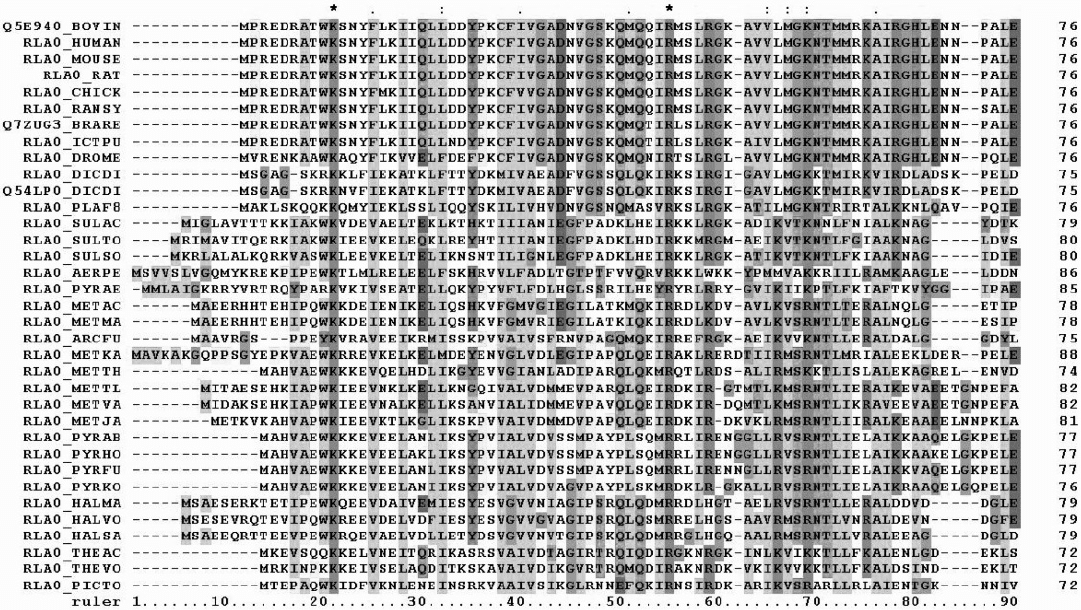
FIGURE 3.1 First 90 positions of the alignment. The shadings represent the amino acid conservation according to the properties and
distribution of amino acid frequencies in each column. Note the two completely conserved residues arginine (R) and lysine (K), marked
with asterisks at the top of the alignment.
77
78 BIOLOGICAL SEQUENCES, SEQUENCE ALIGNMENT, AND STATISTICS
instances of the acidic ribosomal protein P0 homolog (L10E) encoded by the
Rplp0 gene from multiple organisms. The protein sequences were obtained
through SwissProt searching using the gene name. This was generated by
Miguel Andrade, February 2006 (UTC).
Profi le and Sequence Alignment
Profi le analysis has long been a useful tool in fi nding and aligning distantly
related sequences and in identifying known sequence domains in new
sequences. Basically, a profi le is a description of the consensus of a multiple
sequence alignment. It represents the common characteristics of a family
of similar sequences where any single sequence is just one realization of a
family ’ s characteristics. It uses a position - specifi c scoring system to capture
information about the degree of conservation at various positions in the
multiple alignment. The profi le method has several advantages over most
sequence comparison methods. Since the profi le represents the alignment of
a number of known sequences, it contains information that defi nes where
the family of sequences is conserved and where it is variable. Comparison
of a new sequence to a profi le search can emphasize similarity to conserved
regions while tolerating diversity in variable regions. This makes it a much
more sensitive and specifi c method for database searching than pairwise
methods, such as those used by BLAST or FastA, that use position -
independent scoring.
Example 3.5 Consider an optimal profi le - sequence alignment that aligns a
sequence against a profi le. Let Ω = ( a
1
a
2
…
a
k
) be a family of sequences over
the alphabet Σ and
Ω*(
** *
)= aa a
12
k
be a corresponding family of sequences
of equal length l over the extended alphabet Σ * = Σ ∪ { · }:
aa a
l111 1
** *
=
aa a
kk kl
** *
=
1
The profi le of the alignment Ω * is a sequence of l probability distributions
P
j
= ( p
j
,
x
) on the alphabet Σ * such that p
j
,
x
is the relative frequency of the
character x to occur in the j th column of the alignment. We denote the profi le
of the alignment Ω * by
PPP
L
**(
**
)Ω
()
=
1
. An alignment of the profi le
P ( Ω * ) and the sequence
a*
**
= aa
L1
is a pair of sequences
PP
L1
**
aa
L1
**

SEQUENCE ALIGNMENT 79
A blank in the profi le P * ( Ω * ) is the probability distribution denoted by –
p
:
1
0
0
which assigns probability 1 to the blank and probability 0 to all other charac-
ters. The optimal profi le - sequence alignment is to fi nd the maximum similarity
between the profi le P and the sequence a , that is,
SsP a P* a* P* a* P a, max , , ,
()
=
()() ()
{}
is an alignment of
where s ( P * , a * ) is a score function that may be defi ned as
ssaxp
ix
xi
l
P* a*,(
*
,)
*
()
=
∈=
∑∑
Ω1
with an individual similarity score s ( a , x ) on the alphabet Σ * and a score
between the probability distribution p = ( p
x
) on the alphabet Ω * and the char-
acter x in Σ * .
Theorem 3.6 (Optimal Profi le - Sequence Alignment) Let P = p
1
p
2
…
p
n
be
the profi le of a multiple sequence alignment and a = a
1
a
2
…
a
n
be a sequence
over the alphabet Σ * . Defi ne
Sij S aa a i m j n
ij
,,,,
()
=
()
≤≤ ≤≤pp p
12 12
11
and set
SSispSjsa
k
k
i
k
k
j
00 0 0 0
11
,, , ,, , ,
()
=
()
=−
() ()
=−
()
==
∑∑
p
Then
Sij Sijs Sij saSij s
iij
, max , , , , , , ,
()
=−
()
+−
()
−−
()
+
()
−
()
+−111 1pp
pp
, a
j
()
{}
In particular,
SSmnPa,,
()
=
()
Example 3.6 Consider the sequences AGCA, AGAGA, ACCG, and CGGC
over the DNA alphabet. The multiple alignment

80 BIOLOGICAL SEQUENCES, SEQUENCE ALIGNMENT, AND STATISTICS
AG CA
AGAGA
AC CG
CG GC
−
−
−
has the following profi le P :
0 0 3/4 0 0
3/4 0 1/4 0 1/2
1/4 1/4 0 1/2 1/4
0 3/4 0 1/2 1/4
0 0 0 0 0
where the columns are labeled in turn by – , A, C, G, and T. The profi le P can
be viewed as a column stochastic matrix.
An alignment between this profi le and the sequence AACCT is
ppppp
12345
−
p
AA CC T−
A blank in the profi le must be inserted into all sequences of the corresponding
multiple alignment, so the resulting multiple alignment is
AG CA
AGAGA
AC CG
CG GC
AA CC T
−−
−
−−
−−
−
Next we present an optimal profi le - to - profi le alignment in terms of the
distance scoring function.
Theorem 3.7 (Optimal Profi le - to - Profi le Alignment) Let P = p
1
p
2
…
p
m
be
the profi le of a multiple sequence alignment and Q = q
1
q
2
…
q
n
be the second
profi le of a multiple sequence alignment over the alphabet Σ * . Then defi ne
Dddpq
ii
i
l
PQ PQ PQ,min*,* (
*
,
*
)*,*
()
=
() ()
=
∑
= is an alignment
1
oof PQ,
()
⎧
⎨
⎩
⎫
⎬
⎭
as the minimum distance between the profi les P and Q . Let
SEQUENCE ANALYSIS AND FURTHER DISCUSSION 81
Di j D i m j n
ij
,,,,
()
=
()
≤≤ ≤≤pp p qq q
12 12
11
and set
DDidp Djdq
k
k
i
k
k
i
00 0 0 0
11
,,, ,, , ,
()
=
()
=−
()
()
=−
()
==
∑∑
pp
Then
Dij Dijd Dij
sSij
i
ij
,min , ,, ,
,,,
p
()
=−
()
+−
()
−−
()
+
{
()
−
()
111
1
p
pq ++−
()
}
d
jp
, q
In particular,
DDmnPQ,,
()
=
()
3.4 SEQUENCE ANALYSIS AND FURTHER DISCUSSION
Now we know how to fi nd an optimal alignment. A major concern when inter-
preting alignment results is whether similarity between sequences is biologi-
cally signifi cant. Good alignments can occur by chance alone. Many chance
mechanisms are involved in the creation of these data. How do we know if it
is a biologically meaningful alignment, especially when the similarity is only
marginal? Here we present two approaches. One is the classical approach
based on the traditional statistical approach of calculating the chance of a
match score greater than the value observed. The other is the Bayesian
approach, based on a comparison of models.
Under even the simplest random models and scoring systems, very little is
known about the random distribution of optimal global alignment scores
(Deken, 1983 ). Monte Carlo experiments can provide rough distributional
results for some specifi c scoring systems and sequence compositions (Reich
et al., 1984 ), but these cannot be generalized easily.
Therefore, one of the few methods available for assessing the statistical
signifi cance of a particular global alignment is to generate many random
sequence pairs of the appropriate length and composition, and calculate the
optimal alignment score for each (Altschul and Erickson, 1985 ; Fitch, 1983 ).
Although it is then possible to express the score of interest in terms of standard
deviations from the mean, it is a mistake to assume that the relevant distribu-
tion is normal and convert this Z - value into a P - value; the tail behavior of
global alignment scores is unknown. The most that one can say reliably is that
if 100 random alignments have scores inferior to the alignment of interest, the
P - value in question is probably less than 0.01. One further pitfall to avoid is
exaggerating the signifi cance of a result found among multiple tests. When
82 BIOLOGICAL SEQUENCES, SEQUENCE ALIGNMENT, AND STATISTICS
many alignments have been generated (e.g., in a database search), the signifi -
cance of the best must be discounted accordingly. An alignment with a P - value
of 0.0001 in the context of a single trial may be assigned a P - value of 0.1 only
if it was selected as the best among 1000 independent trials.
However, unlike those of global alignments, statistics for the scores of local
alignments are well understood. This is particularly true for local alignments
lacking gaps, which we consider fi rst. Such alignments were precisely those
sought by the original BLAST database search programs (Altschul et al., 1990 )
from each of the two sequences being compared. A modifi cation of the Smith –
Waterman (1981) or Sellers (1984) algorithms will fi nd all segment pairs whose
scores cannot be improved by extension or trimming. These are called high -
scoring segment pairs (HSPs). To analyze how high a score is likely to rise by
chance, a model of random sequences is needed. For proteins, the simplest
model chooses the amino acid residues in a sequence independently, with
specifi c background probabilities for the various residues. Additionally, the
score expected for aligning a random pair of amino acid is required to be
negative. Were this not the case, long alignments would tend to have high
scores independent of whether the segments aligned were related, and the
statistical theory would break down. Just as the sum of a large number of
independent identically distributed (i.i.d.) random variables tends to a normal
distribution, the maximum of a large number of i.i.d. random variables tends
to an extreme value distribution (Gumbel, 1958 ). (We elide the many technical
points required to make this statement rigorous.) In studying optimal local
sequence alignments, we are essentially dealing with the latter case (Dembo
et al., 1994 ; Karlin and Altschul, 1990 ). In the limit of suffi ciently large sequence
lengths m and n , the statistics of HSP scores are characterized by two para-
meters, K and λ (lambda). Most simply, the expected number of HSPs with a
score of at least S is given by the formula E = K
mn
e
- λ
S
. We call this the E - value
for the score S .
This formula makes eminently intuitive sense. Doubling the length of either
sequence should double the number of HSPs attaining a given score. Also, for
an HSP to attain the score 2 x , it must attain the score x twice in a row, so one
expects E to decrease exponentially with the score. The parameters K and λ
can be thought of simply as natural scales for the search space size and the
scoring system, respectively.
The other approach is based on a comparison of models.
1 . Hidden Markov model (HMM). This is a statistical model in which the
system being modeled is assumed to be a Markov process with unknown
parameters, and the challenge is to determine the hidden parameters from the
observable parameters. The extracted model parameters can then be used to
perform further analysis: for example, for pattern recognition applications. In
a regular Markov model, the state is directly visible to the observer, and there-
fore the state transition probabilities are the only parameters. In a hidden
Markov model, the state is not directly visible, but variables infl uenced by the