
Higgins M.D. Quantitative textural measurement in igneous and metamorphic petrology
Подождите немного. Документ загружается.

values are approximately collinear with the data obtained from volcanic rocks
by Cashman (Figure 3.43; 1993).
3.4.3 Silicic volcanic rocks
3.4.3.1 Plagioclase in dacite
Phenocrysts and microlites of plagioclase from the 1980–6 eruptions of
Mt St Helens, USA, were examined by Cashman (1988, 1992). Both phenocrysts
and microlites have straight CSDs and appear to have similar slopes, although
this is difficult to verify as different measurement techniques were used in the
two studies. The CSDs of microlites were combined with geophysical estimates
of the residence time to calculate growth and nucleation rates. Cashman
considered that the growth rate only varied by a small amount for different
values of undercooling, but that the nucleation rate was strongly affected. This
confirms standard nucleation models. She proposed a two-stage crystallisation
model in which most of the phenocrysts nucleated at depth. At the end of the
initial part of the eruption the magma resided in a chamber at a depth of
4–5 km. Further growth in this chamber was caused by coarsening, rather than
nucleation of new crystals.
The Kameni volcano is part of the Thera (Santorini) volcanic complex, an
active volcano in the eastern Mediterranean (Higgins, 1996b, Druitt et al.,
1999). The dacite lavas of the Kameni islands have been erupted over the last
2000 years and form an unusually useful field area: they are fresh, easily
accessible and well-dated. All samples are porphyritic: the most common
megacryst phase is plagioclase (typical mode 12%), with clinopyroxene, ortho-
pyroxene, magnetite, olivine and apatite, all set in a fine-grained to glassy
matrix with plagioclase microlites.
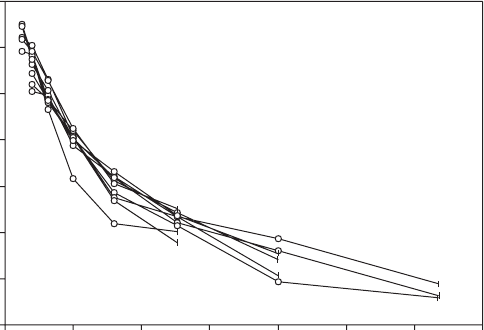
None of the plagioclase CSDs are linear, but curved concave upwards
(Figure 3.52: Higgins, 1996b). Hence, a simple model based on a single
population of crystals, such as that of Marsh (1988b), cannot be applied.
Higgins (1996b) proposed that such CSDs could be produced by mixing of
two populations of crystals, each with overlapping linear CSDs, termed micro-
lites and megacrysts. The two populations can then be examined separately.
Application of the Marsh model (1988b) with growth rates of 10
10
mm s
1
gives residence times of 6–13 years for the microlites and 24–96 years for the
megacrysts. These residence times broadly accord with those determined from
diffusion rates in plagioclase (Zellmer et al., 2000). If the residence times of the
megacryst populations are projected back from the eruption times, then some
of the times of emplacement of the megacryst magmas are found to coincide
3.4 Typical applications 119
with the dates of earlier eruptions. This suggests that the megacrysts are ‘left-
overs’ of earlier injections of new magma into a shallow chamber: that is some
magma remains after each eruption and continues to crystallise. Each eruption
is initiated by the emplacement of new magma with few or no crystals, which
mixes with the older magma. Eruption followed 6–13 years after mixing. Such
a model would suggest that some porphyritic magmas are products of a
shallow magma chamber that is never completely emptied, just topped up
from time to time.
Turner et al.(2003) examined basaltic andesites using CSDs and uranium
disequilibrium and found a profound disagreement in the residence times
determined by these two methods. They suggest that this is caused by incor-
poration of existing cumulates into new magmas, similar to the processes
proposed for the Kameni dacites.
3.4.3.2 Microlites
Microlites occur in many volcanic rocks and their growth may trigger erup-
tions. For stereological reasons prismatic microlites are not easy to measure in
section although they can be measured easily in projection. Castro et al.(2003)
used optical scanning to measure the CSDs of pyroxene microlite prisms in
obsidian from Inyo Domes, California. On a classical CSD diagram the CSDs
are straight from 5 to 30 mm, with a turn-down for smaller sizes. This is not an
–4
–2
0
2
4
6
8
10
0 0.2 0.4 0.6 0.8 1.0 1.2 1.4
size (mm)
ln (population density) (mm
–4
)
Plagioclase in dacite,
Kameni, Greece
Figure 3.52 Plagioclase in dacites from Kameni volcano, Greece (Higgins,
1996b). Data have been reconverted using a massive block crystal shap e with
an aspect ratio of 1:4:4. These concave up CSDs can be modelled by a mixture
of two populations of crystals, each with a straight CSD.
120 Grain and crystal sizes
artefact, as the lower size limit is 0.5 mm. On a simple frequency diagram the
distributions appear to be lognormal. Such distributions were interpreted to
reflect a short nucleation event, followed by growth.
Hammer et al.(1999) examined plagioclase microlites in early, pre-climatic
dacite tephras from the 1991 Mt Pinatubo eruption. This material is particu-
larly difficult to measure as the microlites are small and have shapes that vary
strongly with size: the smaller crystals are tabular, whereas the larger crystals
are prismatic. Nevertheless CSDs from 13 different surge-producing blasts
were all straight. The slope was used to characterise the degree of plagioclase
supersaturation: it was found to vary with the repose time between the eruptions
(40 to >170 minutes). Overall crystallisation passed from a nucleation-
dominated regime, with tabular crystals and steep CSDs to a growth-
dominated regime with shallow CSDs and prismatic crystals.
3.4.3.3 Zircon in rhyolite tuffs and lavas
The CSDs of minerals in explosively erupted rocks are of great interest, as
they can tell us a lot about the state of the magma chamber just before the
eruption. However, crystals are commonly broken by the force of the eruption;
hence there have been few studies to date. One way around this problem is to
look at zircon and quartz crystals, which are generally robust enough to
survive intact.
Bindeman (2003) liberated zircon and quartz crystals from the Bishop Tuff
and other silicic ash-flow tuffs by crushing and acid digestion. The crystals
were then measured under a microscope. This technique avoids problems
introduced during stereological conversions and enables the measurement of
a large number of crystals with a very wide range in size. Both quartz and
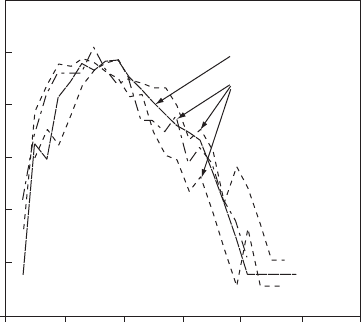
zircon CSDs are concave down on a classical CSD diagram, with a straight
right-hand side (Figure 3.53). However, the distributions are lognormal when
plotted on a CDF diagram, and this is confirmed by other statistical tests.
Bindeman (2003) interpreted these distributions using the single-stage
size-dependent growth model of Eberl et al.(2002). However, as Bindeman
(2003) points out, both zircon and quartz have complex zoning patterns,
indicating periods of growth and solution. It seems more likely that the
lognormal distribution is a result of the interplay of these processes rather
than the simple model of Eberl et al.(2002), which in any case is not supported
by theory. The concave down shape of the CSDs is found in other coarsened
(ripened) rocks; hence coarsening may well dominate here, especially just
before eruption.
CSDs of zircon in rhyolite lavas closely resemble those from tuffs described
above: they are concave down and appear to have a lognormal distribution
3.4 Typical applications 121
(Bindeman & Valley, 2001). Bindeman and Valley (2001) used the slope of
the right-hand side of the CSD to calculate a residence time of 100–200 ka for
these zircons; however, as they point out, the steady-state CSD model may not
be applicable here, the growth rate that they used is not well established and
the zircons may be xenocrysts. Instead they suggest that coarsening may be
important.
3.4.4 Silicic plutonic rocks
3.4.4.1 Orthoclase, plagioclase and quartz in granite porphyry
Mock et al.(2003) have done the first comprehensive quantitative textural
study (size, shape, orientation and position) of a shallow level porphyritic
pluton, using a vertical drill core that intersects the entire pluton. They
examined the CSDs of orthoclase, quartz and plagioclase in slabs and found
that all these minerals have remarkably straight CSDs for crystals larger than
1 mm. The abundance of crystals smaller than this limit is not clear. There is
relatively little variation between samples within the laccolith. Mock et al.
(2003) considered that these CSDs showed that these three minerals nucleated
and grew continuously during magma ascent and emplacement; in situ crystal-
lisation was not detected as the laccolith cooled fast after emplacement at such
high levels. Minor changes in the textural parameters suggested that these were
two episodes of magma injection into the laccolith.
–4
–2
0
0 100 200 300
size, long axis (μm)
Early magma
Late magma
ln (population density) (mm
–4
)
Bishop Tuff – zircon
Figure 3.53 Zircon CSDs in the rhyolitic Bishop Tuff, California (from
Bindeman, 2003). One sample from the early part of the eruption (top of
the magma chambe r) did not differ significantly from three samples from the
later part of the eruption (base of the magma chamber).
122 Grain and crystal sizes
3.4.4.2 K-feldspar in granodiorite
Euhedral potassium-feldspar megacrysts up to 20 cm long are a striking and
relatively common component of many granitoid plutons, but their origin is
still controversial (see the review by Vernon, 1986). Many geologists hold that
the megacrysts are igneous in origin, that is, they grew from a granitic magma
and are phenocrysts. However, a minority view is that megacrysts are post-
magmatic and grew from a circulating water-dominated fluid. Megacrysts are
fundamentally a textural phenomenon; hence lend themselves to CSD studies.
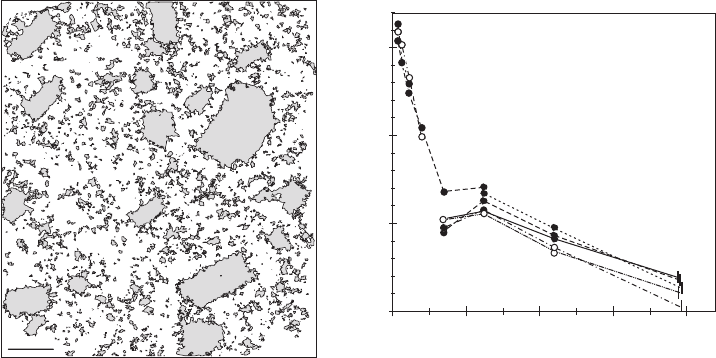
CSDs of megacrysts in the Cathedral Peak granodiorite (CPG) were studied by
Higgins(Figure3.54a;1999).
The CPG is the most voluminous part of the concentrically zoned Tuolumne
Intrusive Suite, in the Sierra Nevada of California (Bateman & Chappell,
1979). This suite started with the emplacement of dioritic magma. Each of
the following three phases was more felsic and was emplaced into the still-
mushy core of the intrusion. An important component of the Cathedral Peak
granodiorite, adjacent parts of the Half-Dome granodiorite and the Johnson
Granite Porphyry is microcline megacrysts. The megacrysts are distributed
–20
–15
–10
–5
ln (population density) (mm
–4
)
0 20 40 60 80
size (mm)
Groundmass
Megacrysts
20 mm
(a) K-feldspar in the Cathedral
Peak granodiorite
(b) K-feldspar CSDs
Figure 3.54 (a) K-feldspar in a slab from the Cathed ral Peak g ranodiorite.
The sample was stained, scanned and filtered for K-feldspar. (b) CSDs of
microcline crystals (Higgins, 1999). Megacrysts from five outcrops were
measured in the field with a ruler. Dimensions of groundmass microcline
crystals in the slabs were determined by automatic image analysis. Open
symbols are for areas with diffuse megacrysts whereas solid symbols are for
sites with ‘nests’ of megacrysts.
3.4 Typical applications 123
heterogeneously with ‘nests’ and elongated areas up to a metre wide. The linear
zones meander for tens of metres across the outcrop and there does not appear
to be any contrast between vertical and horizontal sections. In general, three-
dimensional sheets have linear intersections with surfaces whereas string-like
forms have point intersections. Therefore, the surface distributions of the
megacrysts suggest that the volumes rich in megacrysts have sheet-and
string-like forms in three dimensions.
Somewhat surprisingly the CSDs of both the ‘nests’ of megacrysts and the
diffuse areas have similar shapes, but the nests have higher overall population
densitiesforallcrystalsizesthanthediffuseareas(Figure3.54b).AllCSDs
have a peak at 25 mm. The smallest megacryst that could be reliably measured
was 10 mm; hence the turn-down of the population density to the left of the
peak is not an artefact. If the CSDs were straight down to 10 mm then the
population density at 10 mm would have been 10 to 50 times higher, which is
readily distinguishable from the actual data. The limb to the right of the peak is
generally straight. The CSDs of the groundmass microcline are quite different
from those of the megacrysts. All three CSDs are quite straight, right down to
the smallest crystal that could be measured (1 mm) and much steeper than
those of the megacrysts. One slab was sufficiently large that the abundance of
smaller megacrysts could be determined, although the small numbers of large
crystalsdidnotgiveahighprecision(Figure3.54a).Thecompatibilityofthe
two methods is confirmed by the overlap of the CSDs.
3.4.5 Other undeformed minerals
3.4.5.1 Diamonds
The value of diamonds in a deposit is critically dependent on the distributions
of sizes and quality of the crystals. Although the size distributions of diamonds
are commonly measured this information is usually secret. Of course, it is not
always clear if diamonds are phenocrysts or xenocrysts. However, their CSD
should tell us something about their regions of origin, the mantle. In this
environment one would expect that diamonds are coarsened, unless protected
inside large silicate grains. Hence, the relationship between microdiamonds
and macrodiamonds should be very interesting.
Measurement of diamond CSDs presents a number of unusual problems.
Diamonds are very rare in most rocks; hence a large sample size is needed.
Even then it is difficult to make sure that the sample is from a geologically
homogeneous unit – mixed diamond populations in the sample are almost
inevitable. In some deposits many diamond crystals are broken during empla-
cement, and it must be clearly established how broken crystals will be treated.
124 Grain and crystal sizes
Commercially diamonds are separated by mechanical methods. Such a
process can lead to two problems – yield variations and broken crystals.
Although the yield of larger crystals is high, it may fall to zero for smaller,
commercially unimportant diamonds (<1 mm). If the yield variations are
known then compensation is possible, except where the yield is zero. As has
been shown earlier, it is important to establish the lower size limit of detection.
Upper size is also limited by the crushing process, which may break larger
crystals. However, in some deposits natural forces have already broken many
of the crystals during emplacement and these cannot always be distinguished
from breakage during processing.
Exploration studies commonly use total solution methods, in addition to
mechanical separation. A smaller sample is coarsely crushed and fused with
alkali carbonates. A number of minerals remain and the diamonds are selected
by hand from this concentrate. There is no lower limit to the size of diamonds
that can be recovered. However, the smaller sample size of solution methods
limits the largest crystals that can be recovered, as does the initial crushing of
the sample.
The most extensive study of diamond sizes is that of Rombouts (1995). He
considered that diamond sizes in most deposits follow a lognormal distribu-
tion. However, he pointed out that this commonly breaks down at extreme
sizes. He notes that many diamond deposits have exponentially increasing
crystal numbers versus diameter. This is what is observed in many other rocks
(a ‘straight’ CSD). Unfortunately, there is little published data that can be used
to verify this.
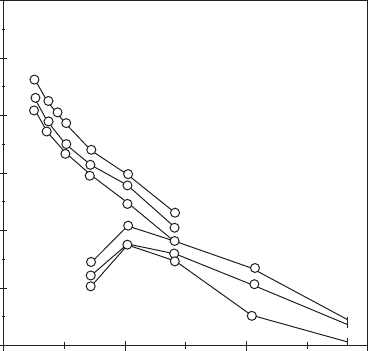
One study has been published on the sizes of diamonds in a lamproite from
Australia (Figure 3.55; Deakin & Boxer, 1989). Diamonds were extracted in
two ways: mechanical and solution. Few crystals were broken; hence a CSD
can be constructed. The two curves can be fitted together, if allowance is made
for the low yield of small stones in the mechanical separation. The resulting
CSD is relatively straight from 0.15–3.00 mm, but with a slight turn-up for
small crystals. This suggests that diamonds grew under conditions of increas-
ing undercooling. Some nucleation and growth must have occurred just before
eruption. There is no evidence for coarsening, but it may have been concealed
by the last stage of growth.
Some eclogite xenoliths in kimberlites are very rich in diamonds (up to
0.5%). Several of these xenoliths have been studied by X-ray tomography
(e.g. Taylor, 2000). However, no information has been published on the
size distribution of diamonds in these rocks. It is true that the crystal
numbers are low; typically less than 30, but even so there would be interest
in such data.
3.4 Typical applications 125
3.4.5.2 Carbonates and chromites
Peterson (1990) studied the CSDs of several unusual minerals from carbona-
tite and other lavas of the 1963 eruption of Oldoinyo Lengai. He examined
the alkali carbonate minerals gregoryite ((Na
2
,K
2
,Ca)CO
3
) and nyererite
(Na
2
Ca(CO
3
)
2
) from carbonatite lavas and combeite (Na
2
Ca
2
Si
3
O
9
) from a
nephelinite lava. In the original paper Peterson did not describe how he
calculated the CSDs from the intersection data. However, in a later paper
part of the earlier data was recalculated (Peterson, 1996). His revised data have
straight CSD, right down to very small crystals. This is consistent with con-
tinuous nucleation and growth.
Waters and Boudreau (1996) examined chromite cumulates in the Stillwater
complex. The chromites occur in centimetric layers. Even in thin section the
crystals in the centre of the layer are clearly larger and more abundant. The
CSDs confirm that the centre has been coarsened, compared to the edges. This
behaviour is consistent with the DeHoff (1984) model of coarsening, as the
growth rate will be higher where the crystal edges are closer together. This type
of positive feedback, reinforcing early, weak structures has been explored by
Boudreau (1987, and subsequent papers) and may account for the well-known
‘inch-scale’ layering in the Stillwater complex.
–18
–16
–14
–12
–10
–8
–6
0 1 2 3
size (mm)
Diamonds in lamproite:
Argyle, Australia
ln (population density (mm
–4
)
Mechanical
separations
Solution
separations
Figure 3.55 Diamonds in lamproite. Smaller diamonds were extracted
by solut ion methods, where mechanical separations were used for larger
diamonds. After Deakin and Boxer (1989).
126 Grain and crystal sizes
3.4.5.3 Chondrules and minerals in meteorites
Study of meteorites differs from most other aspects of geology as data from
a small number of small samples are extrapolated to reveal the essential
character of large bodies. So far textural studies have been concerned with
three aspects of meteorite petrology: size distributions of chondrules in chon-
dritic meteorites, CSDs of minerals in igneous-textured meteorites and CSDs
of magnetic mineral grains possibly of biological origin.
Most silicate-dominated meteorites contain at least some chondrules and
they may dominate the rock. Chondrules are spherical globules of silicate
melts (0.15–1 mm) that are present in almost all silicate meteorites. They
were formed by flash heating of dust in the solar nebula and their size
distribution has been used to infer the dynamics of the nebula (Rubin, 2000).
Given the importance of chondrules, there have been a number of studies of
their size distribution. In several early studies meteorites were disaggregated
and the true size of the chondrules measured. However, not many meteorites
are amenable to this treatment and information on the internal structure of the
chondrule is not available. Many more studies have determined chondrule
sizes from examination of sections. In many cases intersection data were not
converted to 3-D values but examined directly (e.g. Rubin & Grossman, 1987).
This is useful for showing differences in sizes between chondrules in different
meteor classes, but conclusions based on fits of the size distribution to well-
known models are weak. In other cases conversion equations derived empiri-
cally for sedimentary rocks were used (Friedman, 1958) that suggested that
chondrules were actual smaller than their intersections, which is clearly wrong.
Eisenhour (1996) proposed the use of a Saltikov-type method, modified to
account for the thickness of the thin section. He found that chondrule size
distributions that were formerly considered to be lognormal actually fitted
more closely the Weibull distribution. This is important as lognormal distri-
butions have sizes down to zero, whereas Weibull distributions can have a
minimum size.
Shergottites are rare meteorites that are essentially basaltic rocks from
Mars. Many shergottites have olivine, pigeonite and/or augite phenocrysts
set in a fine-grained matrix dominated by plagioclase. CSDs of some of these
minerals have been examined in four different studies (Lentz & McSween,
2000, Taylor et al., 2002, Goodrich, 2003, Greshake et al., 2004). In all these
studies the CSDs were determined from intersection dimensions in thin sec-
tions and, where specified, converted using the inaccurate ‘Wager’ method.
The lower size limit was not specified, but appears to be close to the thickness
of a thin section, 0.03 mm. They found turn-downs for small crystals in some
3.4 Typical applications 127
samples that may just be an artefact of this lower measurement limit. In
addition, they used equal sized intervals, hence many larger size bins were
empty. They then went on to connect up these isolated bins and concluded that
some of the CSDs had two different slopes. While this may be correct, the data
as presented in the papers do not prove this. Clearly this is an interesting
subject for CSDs studies, but perhaps the CSDs of many shergottites should be
studied together using more modern conversion and display methods.
There has been considerable interest in the possibility that some meteorites
may contain fossil bacteria from Mars, hence the first signs of extraterrestrial
life. One possible indicator of the presence of fossil bacteria is magnetite
crystals which are used by bacteria on Earth to orientate themselves (McKay
et al., 1996). The bacterial magnetite crystals have distinctive shapes and size
distributions, which could be used to identify Martian magnetofossils.
Thomas-Keprta et al.(2000) separated magnetite crystals from carbonate
globules in the Martian meteorite ALH84001 and examined them using a
transmission electron microscope. They also extracted magnetite crystals
from a bacterium for comparison. The magnetite crystals were sorted into
different shapes and the size distributions determined for these projected
images. Magnetite crystals in the bacterium were prismatic with a narrow
range in size and shape. Thomas-Keprta et al.(2000) considered that the
prismatic fraction of the meteoritic magnetite crystals also had a similar
range in shape and size which suggested that they may also be of bacterial
origin. There have been many criticisms of this conclusion, summarised by
Treiman (2003). One concerns the size distribution of the meteoritic magnetite
crystals: the size distribution appears to be much wider than that of the
bacterial magnetite crystals. Treiman (2003) suggested that the magnetite
formed by shock and thermal metamorphism of the carbonate. This could
form the observed lognormal distribution.
3.4.5.4 Hematite in pseudotachylytes
Pseudotachylytes are melts that are produced along faults during movements:
they both melt and solidify very rapidly. Petrik et al.(2003) have examined the
CSDs of hematite that crystallised from pseudotachylyte melts. The authors
converted intersection data in two different ways in different parts of the
paper: where stereologically correct methods are used the CSDs are straight
down to very small crystal sizes. However, elsewhere the authors used the
‘Wager’ conversion and interpreted the observed turn-down for small crystals
as indicating coarsening or closed-system crystallisation. It is more likely that
this feature is an artefact caused by both incomplete counting of small crystals
and incorrect conversion of data. The hematite CSDs indicate crystallisation
128 Grain and crystal sizes