
Higgins M.D. Quantitative textural measurement in igneous and metamorphic petrology
Подождите немного. Документ загружается.

Ventura (2002) showed that the strain regime can only be determined precisely
if the orientations of crystals with different shapes can be determined.
Normally this would be for different minerals.
Mineral grains do usually interact, especially at higher grain concentrations,
but this has not been modelled numerically yet. One result of such interactions
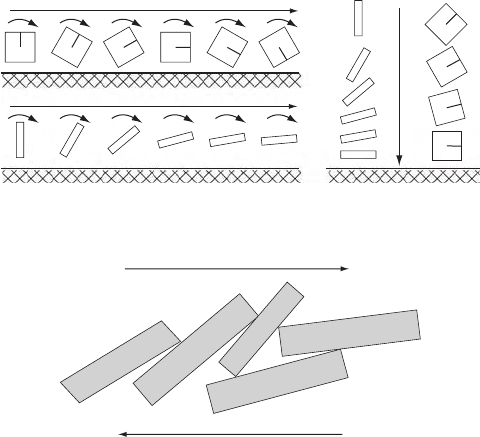
is tiling or imbrication (Figure 5.3; e.g. Blumenfeld & Bouchez, 1988). This is
when the rotation of one grain is stopped by impact against another grain.
Two-dimensional analogue models indicate that tiling can be used to identify
shear directions and planes (Ildefonse et al., 1992). Nicolas and Ildefonse,
(1996) have proposed that crystal mushes in magma chambers flow and
develop fabrics after deposition without plastic deformation. They suggest
that magmatic flow of crystal-rich material (>80% crystals) is enabled by
pressure-solution at imbrication points: flow will be stopped until sufficient
material has been removed and the crystals are no longer imbricated. Flow
then resumes until imbrication is again encountered.
Magmatic deformation is controlled by the shape of the grains; hence the
fabric is the result of SPO. If the crystals are the results of growth without
significant solution, then their shape will reflect the orientation of the crystal
lattice and the LPO will be parallel to the SPO.
Dextral
Figure 5.3 Imbrication or tiling of grains or crystals for dextral simple
shear. Rotation of individual crystals in response to simple shear is stopped
by the presence of an adjoining crystal.
(b) Pure shear
(a) Simple shear
Figure 5.2 Sch ematic behaviour of a cube and tablet in a sheared magma.
5.2 Brief review of theory 169
Many magmatic rocks contain enclaves – generally rounded patches of
texturally or compositionally contrasting rocks. Enclaves are generally
assumed to result from the mixing of two or more magmas. If the enclaves
have a significantly higher liquidus temperature than the magma then the
enclaves will be chilled and act as rigid bodies during magmatic deformation,
similar to the crystals discussed above. However, if the compositional contrast
is small then there will be little viscosity contrast between the enclaves and the
magma. If the enclaves were originally spherical then their shape will record
the total magmatic strain.
5.2.3 Influence of coarsening and pressure solution compaction on fabric
Coarsening (Ostwald ripening, annealing, textural maturation) is the process
by which the energy associated with the surface of the crystals in a rock is
minimised (see Section 3.2.4): Small crystals dissolve at the same time as large
crystals grow. This process may be important in many igneous rocks and
metamorphic rocks that are not being deformed.
As the large crystals grow they need to be accommodated within a fixed
volume of rock. They will tend to rotate to fit into the space created by the
solution of the smaller crystals. If the initial rock has a strong shape-preferred
foliation then this process will reduce the quality of that foliation (Higgins, 1998).
Pure shear, or compaction, is not a very efficient process at producing a
significant fabric (see the above section). An alternative is pressure-solution
compaction (Meurer & Boudreau, 1998). Here, the movement of the crystals
under pure shear is augmented by recrystallisation: plagioclase grains that are
parallel to the applied stress will dissolve more readily than those that are
normal to the stress. This is the same process that is seen in the diagenesis of
sedimentary rocks and occurs because of the excess energy where two grains
are in contact. This process will yield a SPO, but not an LPO. However, an
existing LPO could be preserved. Nicolas and Ildefonse (1996) have proposed
that pressure-solution may also augment simple shear of crystal-rich magmas
(see Section 5.2.2.2)
5.3 Introduction to fabric methodology
A large number of analytical methods have been used to examine the orienta-
tion of grains in rocks (Table 5.1). Some methods measure the orientation of
the grain shape (SPO), others quantify the orientation of the crystal lattices
(LPO) and other methods look at a combination of shape and lattice orienta-
tion. Some methods examine the orientation of each individual crystal,
170 Grain orientations: rock fabric

whereas others only give a measure of the overall or bulk grain orientations.
Grain orientation is a three-dimensional (volume) property but orthogonal
examination of thin sections only gives orientations in the section; hence
several nonparallel sections must be examined.
5.4 Determination of shape preferred orientations
5.4.1 Direct, three-dimensional analytical methods
The orientation of individual grains can be determined by serial sectioning (see
Section 2.2.1) or X-ray tomography (see Section 2.2.3). Voxel or vector images
can be analysed using the methods mentioned in Section 2.3: each grain is
approximated by a triaxial ellipsoid and these ellipsoids summed to give the
overall fabric ellipsoid. So far, there are no orientation studies yet published
using these techniques. In transparent materials, such as volcanic glasses, the
orientation of crystals can be measured directly with a regular or confocal
microscope (see Section 2.2.1; Manga, 1998).
5.4.2 Section and surface analytical methods
Orientation data can be easily acquired from rock surfaces, slabs and sections,
using a variety of techniques described in Section 2.2. Such images can be
Table 5.1 Summary of grain orientation analytical methods.
Analytical method SPO or LPO
Individual
or bulk data
Volume or
section
Serial sectioning SPO Individual Volume
X-ray tomography SPO Individual Volume
Sections: optical, orthogonal
stage
SPO or partial LPO Individual Section
Sections: universal stage LPO Individual Volume
Electron backscatter
diffraction
LPO Individual Volume
Anisotropy of magnetic
susceptibility (AMS)
LPO and SPO Bulk Volume
Anisotropy of (partial)
anhysteretic remane nt
magnetism (AAR M –
ApARM)
LPO and SPO Bulk Volume
Neutron diffraction LPO and SPO Bulk Volume
X-ray diffraction LPO and SPO Bulk Volume
5.4 Determination of shape preferred orientations 171
processed manually or automatically to produce classified mineral images (see
Section 2.3). The classified images can be processed to extract overall orienta-
tion data using a number of methods described below. Data from orthogonal
sections can be combined to give 3-D orientations.
Imbrication has been quantified by simply counting the imbrication direc-
tions of suitable pairs of touching grains (e.g. Ventura et al., 1996). A significant
difference between the numbers of pairs that indicate dextral (clockwise) and
sinistral (anticlockwise) movements is used to define the overall sense of simple
shear. If the flow direction can be established by other means (e.g. geological
structures or palaeosurface orientation) then the grain orientation can be used
to determine the imbrication orientation and hence the direction of flow.
5.4.3 Extraction of orientation parameters
Orientation analytical data need to be summarised before they can be applied
to geological problems. Most work in this subject has been applied to sections,
but can be extended easily to three-dimensional data. A number of different
approaches are possible: for instance individual crystal outlines can be sum-
marised by the inertia tensor method, whereas the intercept method looks at
the orientation distribution of the grain outlines.
5.4.3.1 Inertia tensor method
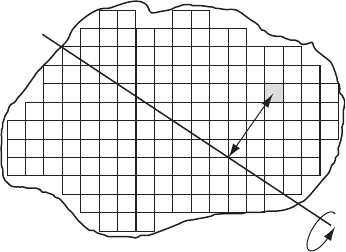
Any complex grain outline can be reduced to an equivalent ellipse that has the
same area and moment of inertia (Figure 5.4). The orientation ellipse of each
separated grain in a section is calculated by the inertia tensor method and the
results summed for all grains. Clearly, the method can only be used where the
individual grains have been separately defined. The method can also be
extended to 3-D structures. The inertia tensor is calculated from the coordi-
nates of the grain outlines, or from the pixels of a bitmap image (Launeau &
Cruden, 1998). The inertia tensor method has the advantage that the contribu-
tion of each grain to the total orientation ellipse is weighted by its area (see
Appendix; Launeau & Cruden, 1998).
5.4.3.2 Intercept (intersection) method
The intercept method is a powerful technique for the numerical analysis of
fabrics (see Appendix;Launeauet al., 1990, Launeau & Robin, 1996). It actually
quantifies the orientation of the boundary of a phase and hence does not
necessarily give the same information as the inertia tensor method. Because it
only examines boundaries, it can be used to analyse any set of objects (crystals,
clasts, voids, lineaments, etc.) that can be identified in the image. It is not
172 Grain orientations: rock fabric
necessary that the objects are all separated, as is the case for the inertia tensor
method described above. For example, if a slab of granite stained for potassium
feldspar with sodium cobaltinitrite is scanned, then quartz, potassium feldspar
and plagioclase can be readily distinguished from each other. However, most of
the larger crystals will touch, giving a framework. The intercept method can be
used to determine the SPO of this texture. It should be noted that the intercept
method is more commonly used in stereology to count objects or determine the
ratio of surface area to volume (see Section 2.5.2;Russ,1986).
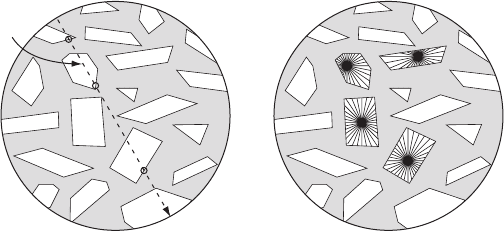
The method is based on counting intercepts (intersections): a test line is
drawn through the section and an intercept is counted where the object in
questionisexited(Figure5.5a).Inpracticemanytestlinesaredrawnthrough
the section at regular intervals and at different angles. The numbers of inter-
cepts are counted for each test line and summed for each angle. The intercept
totals for each angle are divided by the total length of the test lines, giving the
intercept density. The inverse of the intercept density is the mean intercept
length. Both data sets can be plotted as rose diagrams. The orientation or
strain ellipse can be derived from the rose of mean intercept lengths.
The star length and star volume methods are intrinsically similar to the
intercept method (Smit et al., 1998). A point is selected randomly within the
phaseofinterest(Figure5.5b).Thelengthsoflinesatdifferentanglespassing
through this point are compiled. The star length for an angle is the mean length
of the lines at that orientation. The star volume method is similar, but the cube
of the length is summed giving a different weighting for different crystal sizes.
Rotation
axis
Figure 5.4 The inertia tensor parameter of a crystal outline. The method is
equivalent to the following process: the crystal outline is considered as a thin
sheet of material. The moment of inertia of the crystal outline for an axis in
the plane of the paper can be calculated by summing the inertia contributions
of the pixels enclosed by the outline. For each pixel the inertia depends on the
distance from the rotation axis. The moment of inertia is calculated for
different orientations of the axis and the maximum and minimum values
recorded. These are used to calculate the parameters of an equivalent ellipse.
5.4 Determination of shape preferred orientations 173
The method has also been extended to the analysis of 3-D voxel images
(Ketcham & Ryan, 2004).
5.4.3.3 Grey-scale image analysis methods
Rock fabrics in two dimensions can be deciphered at different scales using
powerful wavelet analysis techniques (Darrozes et al., 1997, Gaillot et al.,
1997, Gaillot et al., 1999). This technique uses 2-D wavelets to give estimates
of the orientation and quality of orientation of mineral grains at different
scales. It is the only generalised method that can do this. It is not necessary to
produce a classified mineral image as the method can be applied to grey-scale
images. Although the method has much promise it has not been used much.
Another image analysis technique that can be applied to grey-scale images is
based on the autocorrelation function (Heilbronner, 1992, Heilbronner, 2002).
This function is used to identify periodic structures in images. It is less general-
ised and powerful than wavelet-based methods. However, it is better sup-
ported by software. A similar method is the directional variogram (Cressie,
1991). It is defined by the variance of the grey-scale pixels at a distance h in a
direction a.
5.5 Determination of lattice preferred orientations
5.5.1 Optical analytical methods: regular and universal stages
Partial information on the lattice orientation of some minerals can be obtained
from a regular thin section and petrographic microscope. For uniaxial
(b) Star length method
Test line
length l
1
2
3
(a) Intercept method
Figure 5.5 (a) The intercept method. A test line of length l is drawn and the
number of times that a crystal is exited (intercepts) is counted, three in this
case. (b) The star length method. A point is randomly placed within the phase
of interest. The lengths of lines radiating from this point at particular angles
are compiled.
174 Grain orientations: rock fabric
minerals, such as quartz and calcite, the optical axes are parallel to the crystal-
lographic axes; hence extinction positions in cross-polarised light can indicate
the orientation of a plane that contains the extraordinary ray or rotational axis
of symmetry.
For biaxial minerals the optical axes are not generally parallel to the crystal-
lographic axes, hence structural features such as twins or cleavage are neces-
sary to define the lattice orientation. Some information on the lattice
orientation of minerals can be readily obtained from the orientation of the
trace of the twin lamellae. This is most commonly applied to plagioclase.
The universal stage is an accessory for a petrographic microscope that
enables a standard thin section to be rotated out of the plane of the microscope
stage. A standard thin section is sandwiched between two glass hemispheres
and the whole assemblage can then be rotated along four or five independent
axes (Emmons, 1964, Muir, 1981). Most universal stages have to be read
manually, but some have been modified by the addition of sensors that transfer
data to a computer. Two or three orthogonal sections must be measured, as the
section can only be rotated up to 458 out of the plane of the stage.
It is relatively easy and quick to measure the orientations of uniaxial
minerals such as quartz and calcite, as only one direction need be determined.
Orthorhombic minerals, such as olivine, are more complex as three directions
must be determined. The most difficult are monoclinic and triclinic minerals,
such as plagioclase. The relationship between the lattice orientations and the
axes of the optical indicatrix is controlled by the composition of the plagio-
clase. If the composition is known then the lattice orientation can be deter-
mined from measurements of optical axes, cleavage planes and twin
composition planes. The method is complex but a computer program can
ease the calculations (Benn & Mainprice, 1989). Normally grains are measured
in three orthogonal sections. However, Ji et al.(1994) suggest that measuring
all twinned grains in any two orthogonal sections is more statistically mean-
ingful and time-saving. However, their method does not always provide a
complete LPO.
5.5.2 Computer-integrated polarisation microscopy
Partial information on the orientation of anisotropic grains in a section can be
obtained from their extinction positions in cross-polarised light. A computer-
controlled microscope stage has been developed that can automate this process
(see Section 2.6.4; Heilbronner & Pauli, 1993, Fueten, 1997, Fueten &
Goodchild, 2001). This system can give information on individual grains as
well as the overall fabric ellipsoid of the rock. In general, it can only be applied
5.5 Determination of lattice preferred orientations 175
to rocks containing a single mineral with an orthorhombic or higher symme-
try. Plagioclase, for example, cannot currently be measured using this tech-
nique, because of its low symmetry and almost ubiquitous twinning.
5.5.3 Electron backscatter diffraction (EBSD)
Electron backscatter diffraction (EBSD) is a versatile technique that can give
the complete crystallographic orientation of individual mineral grains as small
as 1 mm in polished thin sections and surfaces (see review in Prior et al., 1999).
It can be used with all minerals, even those with low symmetry, such as
plagioclase. It uses a standard scanning electron microscope (SEM) equipped
with a phosphor screen and a light detector. Many systems are completely
automated and can collect data from crystals in an area of 5 mm
2
.
When an electron beam strikes a surface, electrons will be scattered by the
atoms of the material in the top few mm (see Section 2.5.2.1). This omnidirec-
tional population of electrons is the source for EBSD in an SEM. Electrons are
diffracted by lattice planes in a crystal to produce two cones, with axes normal
to the lattice plane. Under normal conditions for EBSD the opening angle
between the two cones is very small; hence the electrons appear to stream out
along the lattice planes. These electrons are allowed to strike a phosphor
screen where they are converted into light. This light is detected by a CCD
and conveyed to the computer. Many lattice planes in a crystal will diffract
electrons and these bands will interfere constructively. Where a number of
bands intersect, a bright spot will form which corresponds to a zone axis.
Crystallographic directions can be identified from the relative position of the
bands and zones. This process is commonly automated, although there is
always a proportion of patterns that cannot be indexed. Spatial resolution is
about 1 mm in geological specimens, but can be improved by using a field
emission electron gun.
There are always compromises to the optimal configuration for EBSD,
especially as the necessary hardware is commonly added onto an existing
SEM. The sample surface is oriented at an angle of about 708. The phosphor
screen must be as close as possible to the part of the sample illuminated by the
electron beam. It is better to move the sample and not the beam so that the
geometry remains constant.
The importance of correct sample preparation cannot be overstated. EBSD
observes the crystal lattice in the top 1–2 mm of the surface; hence the lattice
must be intact there. Crystal faces and fractures provide a pristine lattice, but
are not very useful for most projects. Mechanical polishing generally damages
the lattice, although some workers have had success with a very fine colloidal
176 Grain orientations: rock fabric
silica (Xie et al., 2003). A number of other treatments can be used: etching
removes the damaged material, but generates unwanted relief. Chemical-
mechanical polishing gives a good surface, but some minerals dissolve rapidly
in the fluid used (Prior et al., 1999). Ion-beam milling is another promising
possibility.
Another problem for geological specimens is that they are generally non-
conducting and hence surface charging may occur. This effect is very variable
both spatially and temporally. Coating the sample in carbon reduces the
problem, but requires higher beam currents. Most studies do not use coated
samples, but just accept that some measurements will be lost owing to char-
ging. Another possibility is to maintain the sample chamber at a higher
pressure in an environmental SEM (Habesch, 2000). This results in more
electron scattering but less sample charging.
5.6 3-D bulk fabric methods: combined SPO and LPO
A number of methods examine the bulk physical properties of the grains of one
or all phases in a rock. In general such methods record a combination of the
SPO and LPO. They give a single value for the orientation ellipsoid for the
material.
5.6.1 Anisotropy of magnetic susceptibility
Anisotropy of magnetic susceptibility (AMS) is a technique for measuring the
bulk, 3-D magnetic fabric of rocks. It is sensitive, quick, and relatively cheap
and can be applied to a wide range of rock types (Jackson, 1991, Rochette
et al., 1992, Tarling & Hrouda, 1993, Rochette et al., 1999, Martin-Hernandez
et al., 2005). It has been applied extensively in all branches of structural
geology and petrology. If the susceptibility is dominated by magnetite then
the AMS measures only the SPO and spatial distribution of that mineral. If
there are significant contributions from paramagnetic minerals then the AMS
records a mixture of the SPO and LPO. AMS is measured using core samples
25 mm in diameter and 22 mm long. The cores are oriented in the field or
drilled in the laboratory from oriented blocks. Many samples are generally
taken at each outcrop or unit of interest and the results averaged. AMS is
measured in a dedicated instrument.
The total magnetic susceptibility of a sample, K, is the ratio of the intensity
of magnetisation of a material divided by the strength of the inducing magnetic
field. It is not necessarily related to the remanent magnetism, which is the
magnetic field of a sample in the absence of an inducing field. The magnetic
5.6 3-D bulk fabric methods 177
susceptibility is commonly anisotropic and this anisotropy has an orientation:
hence, AMS is second order tensor, K
ij
and can be represented as an ellipsoid.
Three groups of minerals contribute to the susceptibility (Rochette et al.,
1992). (1) Ferrimagnetic minerals include those that are generally considered
to be ‘magnetic’, that is they have a significant remanent magnetism. They
have a much higher susceptibility than other minerals and will dominate the
susceptibility of a rock when the measurement is carried out under normal
conditions, in a low field. The most well-known ferrimagnetic minerals are
magnetite, ilmenite, pyrrhotite, garnet and hematite. (2) Paramagnetic min-
erals have lower susceptibilities, but may be present in larger quantities than
ferrimagnetic minerals. Those minerals that are richer in iron will generally
have a higher susceptibility. Important minerals of this group are pyroxenes,
amphiboles, staurolite, cordierite and biotite. (3) Diamagnetic minerals have a
very low negative susceptibility; this means that the induced field has an
opposite polarity to the applied field. These minerals are only important in
the absence of ferrimagnetic or paramagnetic minerals. Prominent diamag-
netic minerals are quartz and calcite. The total anisotropy of magnetic suscept-
ibility of a rock is produced by the anisotropy of magnetic susceptibility of the
mineral grains, if they have a LPO. It is also produced by the SPO of minerals
which have a significant total susceptibility, but which are not necessarily
anisotropic (e.g. garnet).
AMS analysis produces a susceptibility ellipsoid whose principal axes
are labelled k
1
k
2
k
3
(or k
max
, k
int
and k
min
). The parameters of the
ellipsoid are commonly reduced to orientation, mean susceptibility (k
m
¼
(k
1
þ k
2
þ k
3
)/3), lineation parameter (L ¼ k
1
/k
2
), foliation parameter
(F ¼ k
2
/k
3
) and degree of anisotropy (P ¼ k
1
/k
3
). The shape of the magnetic
anisotropy ellipsoid can be displayed on a ‘Flinn-type’ diagram (Flinn, 1962),
where L is plotted against F.
Most interpretations of AMS data are based on the following assumptions
(Borradaile, 1988, Rochette et al., 1992, Borradaile & Henry, 1997). (1) The
AMS ellipsoid is coaxial to the fabric, with the k
3
axis perpendicular to the
foliation and the k
1
parallel to the lineation. (2) The shape of the AMS ellipsoid
is related to the rock fabric, in terms of intensity of foliation and lineation
development. (3) AMS measurements are not affected by remanent magnet-
ism. These assumptions must be verified by comparison with independent
mineral fabric measurements using any of the methods described in this
chapter. Where they are correct the magnetic fabric is called ‘normal’. In
some cases it is found that the k
1
axis is perpendicular to the foliation and
the k
2
axis is parallel to the lineation. This is called a ‘reverse magnetic fabric’.
In other cases k
2
is perpendicular to the foliation, which is referred to as an
178 Grain orientations: rock fabric