
Hogg S. Essential microbiology
Подождите немного. Документ загружается.

JWBK011-17 JWBK011-Hogg August 12, 2005 16:36 Char Count= 0
418 INDUSTRIAL AND FOOD MICROBIOLOGY
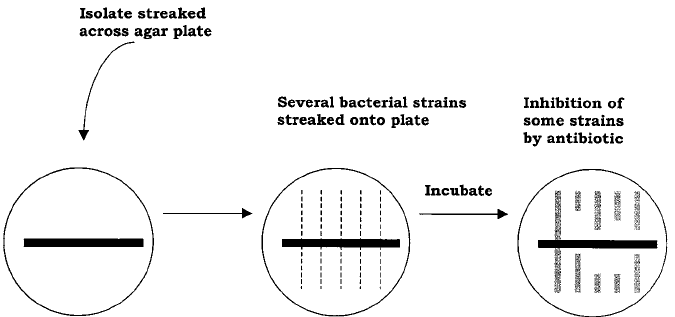
Figure 17.6 Assessing the antimicrobial properties of an antibiotic. Candidate antibiotic
is streaked onto an agar plate along with several bacterial isolates. Following incubation,
areas of clearing indicate inhibition of growth and thus susceptibility to the antibiotic
of bacteria at right angles (Figure 17.6). As the antibiotic diffuses through the agar, it
will inhibit growth of any susceptible species. Isolates that still show potential are then
grown up in a laboratory scale fermenter; it is essential for commercial culture that the
antibiotic-producing organism can be cultured in this way.
Before committing to large-scale production, exhaustive further tests must be carried
out on two fronts: to ascertain the potency of the preparation and the breadth of its
antimicrobial spectrum, and to determine its therapeutic index (see Chapter 14) by
carrying out toxicity testing on animals. The final stages of development involve pilot-
scale production, followed by clinical trials on human volunteers.
When an antibiotic or any other fermentation product finally goes into production,
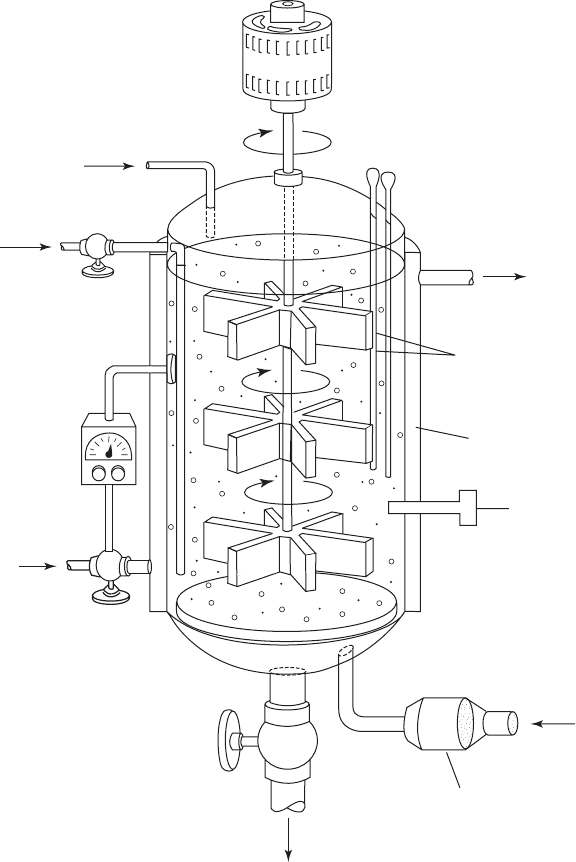
it is cultured in huge stirred fermenters or bioreactors, which may be as large as 200 000
litres. A typical stirred fermenter has impellers for mixing the culture, an air line for
aeration and microprocessor-controlled probes for the continuous monitoring and reg-
ulation of temperature, pH and oxygen content (Figure 17.7). Cultures with a high
protein content may also have an antifoaming agent added. The process of scale-up is a
complex operation, and not simply a matter of growing the microorganism in question in
ever-larger vessels. Factors such as temperature, pH, aeration, must all be considered at
the level of the individual cell if scale-up is to be successful. Fermenters are usually made
from stainless steel, which can withstand heat sterilisation; the economic consequences
of microbial contamination when working on such a large scale can be immense.
Products derived from genetically engineered
microorganisms
In Chapter 12 we saw how recombinant DNA technology can be used to genetically
modify microorganisms so that they produce commercially important proteins such as
human insulin. This is done by incorporating the gene for the desired protein into an
JWBK011-17 JWBK011-Hogg August 12, 2005 16:36 Char Count= 0
PRODUCTS DERIVED FROM GENETICALLY ENGINEERED MICROORGANISMS 419
Motor
pH probe
Dissolved oxygen probe
Cooling
water
out
Impellers
Cooling
jacket
Biosensor
unit
Air in
Air filter
Valve
Valve
Cooling
water in
Temperature
sensor and
control unit
Harvest
line
Valve
Sample
line
Culture or
nutrient addition
Figure 17.7 A continuous flow stirred tank reactor. Parameters such as pH and concen-
trations of specific metabolites are closely monitored to ensure the maintenance of optimum
conditions. Outlets allow for the collection of samples during fermentation as well as the
collection of cells and medium at the conclusion of the reaction. Addition and collections
are carried out under aseptic conditions. From Prescott, LM, Harley, JP & Klein, DA: Mi-
crobiology 5th edn, McGraw Hill, 2002. Reproduced by permission of the publishers
JWBK011-17 JWBK011-Hogg August 12, 2005 16:36 Char Count= 0
420 INDUSTRIAL AND FOOD MICROBIOLOGY
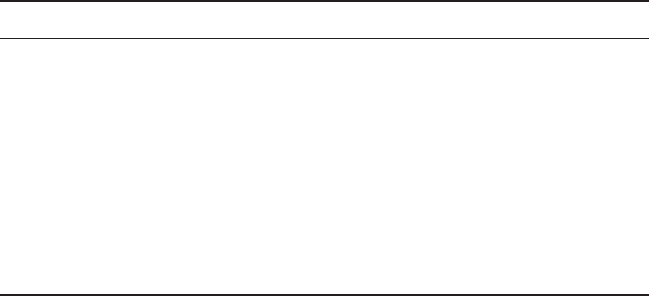
Table 17.6 Medically important proteins made by recombinant microorganisms
Protein Application Produced in
Insulin Treatment of Type 1 diabetes E. coli
Human growth
hormone
Treatment of pituitary dwarfism E. coli
Hepatitis B
vaccine
Vaccination of susceptible personnel
e.g. healthcare workers, drug users
Saccharomyces
cerevisiae
Epidermal
growth factor
Treatment of wounds, burns E. coli
Acyltransferase Used in synthesis of ovarian cancer
drug taxol
E. coli
Endostatin Antitumour agent Pichia pastoris
(yeast)
appropriate cloning vector, and inserting it into a host cell such as E. coli or
Saccharomyces cerevisiae. The initial application of this technology was in the micro-
bial production of medically important proteins such as insulin and epidermal growth
factor (Table 17.6), however other proteins may also be produced by these means. These
include enzymes used in diagnostic and analytical applications, where a higher purity
of preparation is required than, for example, the enzymes used in detergents. These
are often derived originally from other microorganisms; for example the thermostable
DNA polymerase from Thermus aquaticus used in PCR is now commonly made by
recombinant E. coli cells that have been transformed with the T. aquaticus gene. Many
of the more recent recombinant human proteins to be developed for therapeutic use
have been too complex for expression in a microbial system (e.g. Factor VIII), so it has
been necessary to employ cultured mammalian cells.
Microorganisms in wastewater treatment and
bioremediation
These applications of microbial processes in an environmental context are discussed in
Chapter 16.
Microorganisms in the mining industry
An unexpected application for microorganisms is to be found in the mining indus-
try. Acidophilic bacteria including Acidithiobacillus ferrooxidans are increasingly being
used to extract valuable metals, notably copper, from low-grade ores that would not
be worth working by conventional technologies. You may recall from Chapter 16 that
A. ferrooxidans is the organism largely responsible for the phenomenon of acid mine
drainage; by carrying out the same reactions in a different context, however, it can be
put to a beneficial use. Tailings, that is, mineral waste with a low metal content, are
JWBK011-17 JWBK011-Hogg August 12, 2005 16:36 Char Count= 0
MICROORGANISMS IN THE MINING INDUSTRY 421
Fe
2
(SO
4
)
3
+ Bacteria
pumped back to dump
Low Leaching
Grade through
Copper dump
Ore
CuS
Cu
2
S Oxidation
pond
A. ferrooxidans
2FeSO
4
Fe
2
(SO
4
)
3
FeSO
4
Cu
2+
, SO
4
2-
, Fe
2+
Recovery of copper
from solution
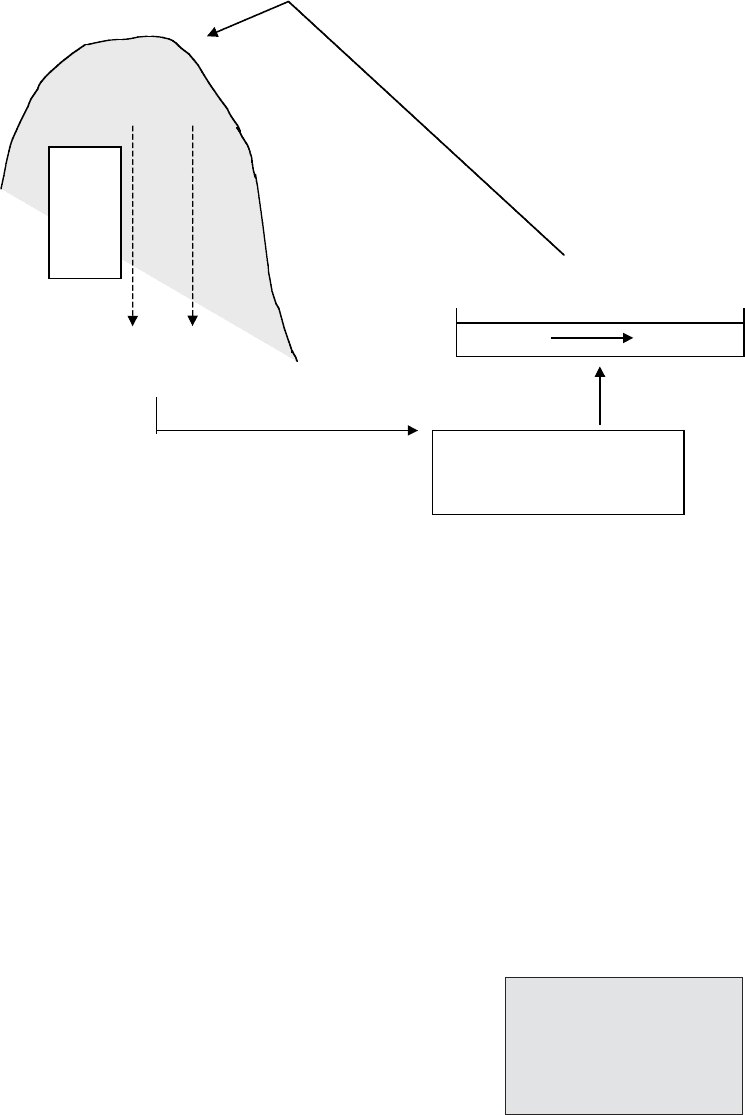
Figure 17.8 The bacterial extraction of copper. Solubilisation of copper sulphides occurs
by a combination of direct (biological) and indirect (chemical) leaching. The ferric iron
necessary for chemical oxidation is produced by bacterial oxidation of ferrous iron in the
oxidation pond
gathered in huge tips and acidified water sprinkled over them (Figure 17.8), stimulating
the growth of indigenous bacteria. Bacterial oxidation results in soluble copper sulphate
leaching from the tip and being collected for copper extraction. This bacterial action is
known as direct bioleaching, but if you follow the process in Figure 17.8, you will see
that A. ferrooxidans has not finished yet! This remarkable organism can also oxidise
iron from its ferrous to ferric form; the resulting ferric sulphate is a potent oxidising
agent, which, when recycled to the tip, carries out indirect (chemical) bioleaching, and
so the cycle continues. A. ferrooxidans has a number of other unusual features, which
enable it to survive in this hostile environment; it thrives in acidic conditions (pH < 2.0),
and has an unusually high tolerance of metal ions such as copper.
Other metals, including
zinc, nickel uranium and
gold have also been ex-
tracted with the aid of
bacteria.
Bacteria are also involved in the extraction of other
metals such as uranium and gold; the methodologies dif-
fer slightly, but still involve the conversion of an insoluble
compound to a soluble one. It is only in the last 20 years
or so that the economic possibilities of biohydrometal-
lurgy have been realised, and now a significant propor-
tion of the world’s copper and other metals is produced
in this way. The method is inexpensive but rather slow;

JWBK011-17 JWBK011-Hogg August 12, 2005 16:36 Char Count= 0
422 INDUSTRIAL AND FOOD MICROBIOLOGY
it may take years to extract the copper from a large tip. However as high-grade copper-
bearing ores become increasingly scarce, bioleaching seems likely to play an increasingly
important role.
Sulphur-oxidising bacteria also have a role to play in the coal mining industry. In-
creased environmental awareness in many countries means that it is no longer acceptable
to burn off the sulphur content of coal as sulphur dioxide, so an alternative must be
found. One possibility is the biodesulphurisation of coal, using sulphur-oxidising bac-
teria to remove the sulphur before combustion. Whilst technically feasible, economic
considerations mean that this has not yet been widely adopted.
Test yourself
1 In winemaking, juice from the crushed grapes (known as the )is
treated with
to remove any naturally occuring microor-
ganisms.
2
wines result from converting most of the sugar from the grapes to
alcohol.
3 Fermentations in the beer and wine industries are carried out by yeasts of
the genus
.
4 Hops were originally added to beers because of their
properties.
5 The alcohol content of an average beer is around
per cent.
6 Coagulation of milk using rennet allows separation into
and
.
7
cheeses, such as Parmesan, require the longest periods of
.
8 The bacteria
and are involved in
yoghurt making, converting lactose to
.
9 Quorn
TM
is a meat substitute derived from the fungus .
10 The end-product of sugar fermentation in bread making differs from that in
alcoholic fermentations beacuse it takes place in
conditions.
11
and are two human pathogens found as spoilage organ-
isms in foodstuffs.
12 Foodstuffs with a low
content are less susceptible to microbial
attack.

JWBK011-17 JWBK011-Hogg August 12, 2005 16:36 Char Count= 0
TEST YOURSELF 423
13 produced microbially from by a species of Clostridium, was im-
portant in explosive manufacture during the First World War.
14 The three amino acids produced in greatest quantities for use in the food
industry are
, and .
15 Citric acid is widely used in the food industry; it is produced by the mould
.
16 Starch is converted to
by the action
of the enzymes α-amylase, glucoamylase and glucose isomerase.
17 The enzymes most widely used in cleaning products are
and
.
18 Microbial cultures for the commercial production of antibiotics are grown
in large-scale
.
19
is able to convert copper from its insoluble
to its soluble . It can also convert iron from its to its
from.
20 The biggest disadvantage of using biological methods of metal extraction is
that the process is
.
JWBK011-17 JWBK011-Hogg August 12, 2005 16:36 Char Count= 0
424
JWBK011-GSY JWBK011-Hogg May 25, 2005 16:33 Char Count= 0
Glossary
Acid–fast stain a procedure for assessing the ability of an organism to retain hot
carbol fuchsin stain when rinsed with acidic alcohol.
Acidophilic (‘acid-loving’): a term applied to organisms that show optimal growth in
acid conditions (pH<5.5).
Activated sludge treatment a method of wastewater treatment involving aeration in
tanks that have been seeded with a mixed microbial sludge.
Activation energy the energy required to initiate a chemical reaction.
Active site the part of an enzyme involved in binding its substrate; the site of
catalytic action.
Active transport an energy-requiring process in which a substance is transported
against an electrochemical gradient.
Adenosine triphosphate (ATP) the principal compound used for the storage and
transfer of energy in cellular systems.
Aerobe an organism that grows in the presence of molecular oxygen, which it uses
as a terminal electron acceptor in aerobic respiration.
Aerotolerant anaerobe an anaerobe that is able to tolerate the presence of
oxygen, even though it does not use it.
Aetiology the cause or origin of a disease.
Aldose a sugar molecule that contains an aldehyde group.
Alga a photosynthetic, eucaryotic plant-like organism. It may be unicellular or
multicellular.
425
JWBK011-GSY JWBK011-Hogg May 25, 2005 16:33 Char Count= 0
426 GLOSSARY
Alternation of generations a pattern of sexual reproduction that includes both
haploid and diploid mature individuals.
Ames test a test to assess the mutagenicity of a substance.
Amino acid an organic acid bearing both amino and carboxyl groups. The building
block of proteins.
Amphipathic having a polar region at one end and a nonpolar region at the other.
Anabolism metabolic reactions involved in the synthesis of macromolecules, usually
requiring an input of energy.
Anaerobe an organism that grows in the absence of molecular oxygen.
Anammox the formation of nitrogen gas by the anaerobic oxidation of ammonia
and nitrite.
Angstrom unit one ten billionth (10
−10
) of a metre.
Anisogamy the fusion of unequally sized gametes.
Anoxygenic photosynthesis a form of photosynthesis in which oxygen is not
generated; found in the purple and green photosynthetic bacteria.
Antibiotic a microbially produced substance (or a synthetic derivative) that has
antimicrobial properties.
Antibody a protein of high binding specificity produced by the immune systems of
higher animals in response to infection by a foreign organism.
Anticodon the three-nucleotide sequence carried by a tRNA, that base-pairs with its
complementary mRNA codon.
Antigenic shift a process by which major variations in viral antigens occur.
Antiseptic a chemical agent of disinfection that is mild enough to be used on
human skin or tissues.
Archaea a group of prokaryotes that diverged from all others (see Bacteria)atan
early stage in evolution, and that show a number of significant differences from them.
One of the three domains of life.
Ascospore a haploid spore produced by members of the Ascomycota.
JWBK011-GSY JWBK011-Hogg May 25, 2005 16:33 Char Count= 0
GLOSSARY 427
Ascus a sac-like structure possessed by members of the Ascomycota that contains
the ascospores.
Aseptic technique a set of practical measures designed to prevent the growth of
unwanted contaminants from the environment.
Assimilatory sulphate reduction the incorporation of inorganic sulphate into
sulphur-containing amino acids.
Autoclave an appliance that uses steam under pressure to achieve sterilisation.
Atomic mass the average of the mass numbers of an element’s different isotopes,
taking into account the proportions in which they occur.
Atomic number the number of protons in the nucleus of an element.
Autotroph an organism that can derive its carbon from carbon dioxide.
Auxotroph a mutant that lacks the ability to synthesise an important nutrient such as
an amino acid or vitamin, and must therefore have it provided (c.f. prototroph).
Axenic culture a pure culture containing one type of organism only, and completely
free from contaminants.
Bacillus (pl. bacilli): a rod-shaped bacterium.
Bacteria procaryotes other than the Archaea (q.v.). Less formally, the term is
frequently used to describe all procaryotes.
Bactericidal causing the death of bacteria.
Bacteriophage a virus whose host is a bacterial cell.
Bacteriostatic inhibiting the growth of bacteria, but not necessarily killing them.
Basidiocarp the fruiting body of members of the Basidiomycota.
Basidiospore a haploid spore produced by members of the Basidiomycota.
Basidium a club-shaped structure carrying the basidiospores in members of the
Basidiomycota.
Batch culture a microbial culture grown in a closed vessel with no addition of
nutrients or removal of waste products.