
Hogg S. Essential microbiology
Подождите немного. Документ загружается.

JWBK011-FM JWBK011-Hogg August 12, 2005 19:44 Char Count= 0
x PREFACE
their first introduction, to facilitate uninterrupted reading. All chapters except the first
are followed by a self-test section in which readers may review their knowledge and
understanding by ‘filling in the gaps’ in incomplete sentences; the answers are all to be
found in the text, and so are not provided separately. The only exceptions to this are
two numerical questions, the solutions to which are to be found at the back of the book.
By completing the self-test questions, the reader effectively provides a summary for the
chapter.
A book such as this stands or falls by the reception it receives from its target reader-
ship. I should be pleased to receive any comments on the content and style of Essential
Microbiology from students and their tutors, all of which will be given serious consid-
eration for inclusion in any further editions.
Stuart Hogg
January 2005
JWBK011-FM JWBK011-Hogg August 12, 2005 19:44 Char Count= 0
Acknowledgements
I would like to thank those colleagues who took the time to read over individual chapters
of this book, and those who reviewed the entire manuscript. Their comments have been
gratefully received, and in some cases spared me from the embarrassment of seeing my
mistakes perpetuated in print.
Thanks are also due to my editorial team at John Wiley, Rachael Ballard and Andy
Slade, and production editor Robert Hambrook for ensuring smooth production of this
book.
I am grateful to those publishers and individuals who have granted permission to
reproduce diagrams. Every effort has been made to trace holders of copyright; any
inadvertent omissions will gladly be rectified in any future editions of this book.
Finally, I would like to express my gratitude to my family for allowing me to devote
so many weekends to ‘the book’.
xi
JWBK011-FM JWBK011-Hogg August 12, 2005 19:44 Char Count= 0
xii
JWBK011-01 JWBK011-Hogg August 12, 2005 15:39 Char Count= 0
Part I
Introduction
1
JWBK011-01 JWBK011-Hogg August 12, 2005 15:39 Char Count= 0
2
JWBK011-01 JWBK011-Hogg August 12, 2005 15:39 Char Count= 0
1
Microbiology: What, Why
and How?
As you begin to explore the world of microorganisms, one of the first things you’ll
notice is their extraordinary diversity – of structure, function, habitat and applications.
Microorganisms (or microbes) inhabit every corner of the globe, are indispensable to
life on Earth, are responsible for some of the most deadly human diseases and form the
basis of many industrial processes. Yet until a few hundred years ago, nobody knew
they existed!
In this opening chapter, we offer some answers to three questions:
r
What is microbiology?
r
Why is it such an important subject?
r
How have we gained our present knowledge of microbiology?
What is microbiology?
Things aren’t always the way they seem. On the face of it, ‘microbiology’ should be an
easy word to define: the science (logos) of small (micro) life (bios), or to put it another
way, the study of living things so small that they cannot be seen with the naked eye.
Bacteria neatly fit this definition, but what about fungi and algae? These two groups each
contain members that are far from microscopic. On the other hand, certain animals,
such as nematode worms, can be microscopic, yet are not considered to be the domain
of the microbiologist. Viruses represent another special case; they are most certainly
microscopic (indeed, most are submicroscopic), but by most accepted definitions they
are not living. Nevertheless, these too fall within the remit of the microbiologist.
In the central section of this book you can read about the thorny issue of microbial
classification and gain some understanding of just what is and what is not regarded as
a microorganism.
Why is microbiology important?
To the lay person, microbiology means the study of sinister, invisible ‘bugs’ that cause
disease. As a subject, it generally only impinges on the popular consciousness in news
3

JWBK011-01 JWBK011-Hogg August 12, 2005 15:39 Char Count= 0
4 MICROBIOLOGY: WHAT, WHY AND HOW?
coverage of the latest ‘health scare’. It may come as something of a surprise therefore
to learn that the vast majority of microorganisms coexist alongside us without causing
any harm. Indeed, many perform vital tasks such as the recycling of essential elements,
without which life on our planet could not continue, as we will examine in Chapter 16.
Other microorganisms have been exploited by humans for our own benefit, for instance
in the manufacture of antibiotics (Chapter 14) and foodstuffs (Chapter 17). To get some
idea of the importance of microbiology in the world today, just consider the following
list of some of the general areas in which the expertise of a microbiologist might be used:
r
medicine
r
environmental science
r
food and drink production
r
fundamental research
r
agriculture
r
pharmaceutical industry
r
genetic engineering.
The popular perception among the general public, however, remains one of infections
and plagues. Think back to the first time you ever heard about microorganisms; almost
certainly, it was when you were a child and your parents impressed on you the dangers
of ‘germs’ from dirty hands or eating things after they’d
been on the floor. In reality, only a couple of hundred
out of the half million or so known bacterial species give
rise to infections in humans; these are termed pathogens,
and have tended to dominate our view of the microbial
world.
A pathogen is an organ-
ism with the potential to
cause disease.
In the next few pages we shall review some of the landmark developments in the
history of microbiology, and see how the main driving force throughout this time, but
particularly in the early days, has been the desire to understand the nature and cause of
infectious diseases in humans.
How do we know? Microbiology in perspective: to the
‘golden age’ and beyond
We have learnt an astonishing amount about the invisible world of microorganisms,
particularly over the last century and a half. How has this happened? The penetrating
insights of brilliant individuals are rightly celebrated, but a great many ‘breakthroughs’
or ‘discoveries’ have only been made possible thanks to some (frequently unsung)
development in microbiological methodology. For example, on the basis that ‘seeing
is believing’, it was only when we had the means to see microorganisms under a micro-
scope that we could prove their existence.
Microorganisms had been on the Earth for some 4000 million years, when Antoni
van Leeuwenhoek started out on his pioneering microscope work in 1673. Leeuwen-
hoek was an amateur scientist who spent much of his spare time grinding glass lenses
JWBK011-01 JWBK011-Hogg August 12, 2005 15:39 Char Count= 0
HOW DO WE KNOW? MICROBIOLOGY IN PERSPECTIVE 5
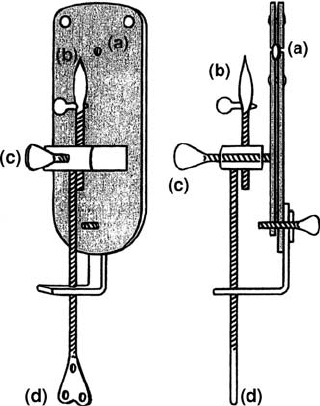
Figure 1.1 Leeuwenhoek’s microscope. The lens (a) was held between two brass plates
and used to view the specimen, which was placed on the mounting pin (b). Focusing was
achieved by means of two screws (c) and (d). Some of Leeuwenhoek’s microscopes could
magnify up to 300 times. Original source: Antony van Leeuwenhoek and his little animals
by CE Dobell (1932)
to produce simple microscopes (Figure 1.1). His detailed drawings make it clear that
the ‘animalcules’ he observed from a variety of sources included representatives of what
later became known as protozoa, bacteria and fungi. Where did these creatures come
from? Arguments about the origin of living things revolved around the long held belief
in spontaneous generation, the idea that living organisms could arise from non-living
matter. In an elegant experiment, the Italian Francesco Redi (1626–1697) showed that
the larvae found on putrefying meat arose from eggs deposited by flies, and not sponta-
neously as a result of the decay process. This can be seen as the beginning of the end for
the spontaneous generation theory, but many still clung to the idea, claiming that while
it may not have been true for larger organisms, it must surely be so for minute creatures
such as those demonstrated by Leeuwenhoek. Despite mounting evidence against the
theory, as late as 1859, fresh ‘proof’ was still being brought forward in its support. Enter
onto the scene Louis Pasteur (1822–1895), still arguably the most famous figure in the
history of microbiology. Pasteur trained as a chemist, and made a lasting contribution
to the science of stereochemistry before turning his attention to spoilage problems in
the wine industry. He noticed that when lactic acid was produced in wine instead of
alcohol, rod-shaped bacteria were always present, as well as the expected yeast cells.
This led him to believe that while the yeast produced the alcohol, the bacteria were
responsible for the spoilage, and that both types of organism had originated in the en-
vironment. Exasperated by continued efforts to substantiate the theory of spontaneous
generation, he set out to disprove it once and for all. In response to a call from the
French Academy of Science, he carried out a series of experiments that led to the ac-
ceptance of biogenesis, the idea that life arises only from already existing life. Using his
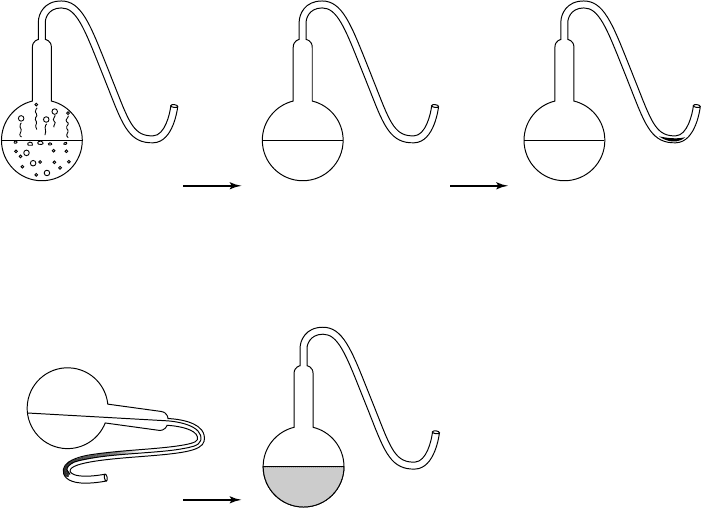
famous swan-necked flasks (Figure 1.2), he demonstrated in 1861 that as long as dust
JWBK011-01 JWBK011-Hogg August 12, 2005 15:39 Char Count= 0
6 MICROBIOLOGY: WHAT, WHY AND HOW?
Liquid sterilised
by boiling.
Liquid allowed
to cool.
Flask tilted, allowing
liquid to come into
contact with deposit in neck.
Liquid turns cloudy
due to microbial growth.
Dust and microrganisms
settle in bend of flask neck.
Liquid remains sterile.
Left for
months/year
Figure 1.2 Pasteur’s swan-necked flasks. Broth solutions rich in nutrients were placed in
flasks and boiled. The necks of the flasks were heated and drawn out into a curve, but
kept open to the atmosphere. Pasteur showed that the broth remained sterile because any
contaminating dust and microorganisms remained trapped in the neck of the flask as long
as it remained upright
particles (and the microorganisms carried on them) were excluded, the contents would
remain sterile. This also disproved the idea held by many that there was some element in
the air itself that was capable of initiating microbial growth. In Pasteur’s words ‘. . . . the
doctrine of spontaneous generation will never recover from this mortal blow. There
is no known circumstance in which it can be affirmed that microscopic beings came
into the world without germs, without parents similar to themselves.’ Pasteur’s findings
on wine contamination led inevitably to the idea that microorganisms may be also be
responsible for diseases in humans, animals and plants.
The notion that some invisible (and therefore, presumably, extremely small) living
creatures were responsible for certain diseases was not a new one. Long before micro-
organisms had been shown to exist, the Roman philosopher Lucretius (∼98–55 bc) and
much later the physician Girolamo Fracastoro (1478–1553) had supported the idea.
Fracastoro wrote ‘Contagion is an infection that passes from one thing to another’ and
recognised three forms of transmission: by direct contact, through inanimate objects
and via the air. We still class transmissibility of infectious disease in much the same way
today. The prevailing belief at the time, however, was that an infectious disease was due

JWBK011-01 JWBK011-Hogg August 12, 2005 15:39 Char Count= 0
HOW DO WE KNOW? MICROBIOLOGY IN PERSPECTIVE 7
to something called a miasma, a poisonous vapour arising from dead or diseased bodies,
or to an imbalance between the four humours of the body (blood, phlegm, yellow bile
and black bile). During the 19th century, many diseases were shown, one by one, to be
caused by microorganisms. In 1835, Agostino Bassi showed that a disease of silkworms
was due to a fungal infection, and 10 years later, Miles Berkeley demonstrated that a fun-
gus was also responsible for the great Irish potato blight. Joseph Lister’s pioneering work
on antiseptic surgery provided strong, albeit indirect, evidence of the involvement of mi-
croorganisms in infections of humans. The use of heat-treated instruments and of phenol
both on dressings and actually sprayed in a mist over the surgical area, was found greatly
to reduce the number of fatalities following surgery. Around the same time, in the 1860s,
the indefatigable Pasteur had shown that a parasitic protozoan was the cause of another
disease of silkworms called p
´
ebrine, which had devastated the French silk industry.
The first proof of the involvement of bacteria in disease and the definitive proof of
the germ theory of disease came from the German Robert Koch. In 1876 Koch showed
A bacillus is a rod-
shaped bacterium.
the relationship between the cattle disease anthrax and a
bacillus which we now know as Bacillus anthracis. Koch
infected healthy mice with blood from diseased cattle
and sheep, and noted that the symptoms of the disease
appeared in the mice, and that rod shaped bacteria could
be isolated from their blood. These could be grown in culture, where they multiplied
and produced spores. Injection of healthy mice with these spores (or more bacilli) led
them too to develop anthrax and once again the bacteria were isolated from their blood.
These results led Koch to formalise the criteria necessary to prove a causal relationship
between a specific disease condition and a particular microorganism. These criteria
became known as Koch’s postulates (Box 1.1), and are still in use today.
Box 1.1 Koch’s postulates
1 The microorganism must be present in every instance of the disease and absent
from healthy individuals.
2 The microorganism must be capable of being isolated and grown in pure culture.
3 When the microorganism is inoculated into a healthy host, the same disease
condition must result.
4 The same microorganism must be re-isolated from the experimentally infected
host.
The term in vitro (= ‘in
glass’) is used to de-
scribe procedures per-
formed outside of the
living organism in test
tubes, etc. (c.f in vivo).
Despite their value, it is now realised that Koch’s pos-
tulates do have certain limitations. It is known for ex-
ample that certain agents responsible for causing disease
(e.g. viruses, prions: see Chapter 10) can’t be grown in
vitro, but only in host cells. Also, the healthy animal
in Postulate 3 is seldom human, so a degree of extrapo-
lation is necessary – if agent X does not cause disease in