
Hogg S. Essential microbiology
Подождите немного. Документ загружается.

JWBK011-15 JWBK011-Hogg August 12, 2005 16:33 Char Count= 0
388

JWBK011-16 JWBK011-Hogg August 12, 2005 16:35 Char Count= 0
16
Microorganisms in
the Environment
Living organisms, togeth-
er with their physical sur-
roundings, make up an
ecosystem.
At various points in this book we have referred to the dif-
ferent environments in which particular microorganisms
are to be found. Like other living organisms, they live as
part of ecosystems, and we shall consider the three main
types of ecosystem – terrestrial, freshwater and marine –
later in this chapter.
First, however, we must turn our attention again to the
subject of energy relations in living things. In Chapter 4, we looked at the different ways
in which microorganisms can derive and utilise energy from various sources. We now
need to put these processes into a global perspective. All organisms may be placed into
one of three categories with respect to their part in the global flow of energy:
r
(Primary) Producers: autotrophs that obtain energy from the sun or chemical sources
(e.g. green plants, photosynthetic bacteria, chemolithotrophic bacteria). They use the
energy to synthesise organic material from carbon dioxide and water.
r
Consumers: heterotrophs that derive energy through the consumption of other organ-
isms (producers or other consumers). They may serve as a link between the primary
producers and the decomposers.
r
Decomposers: organisms that break down the remains and waste products of pro-
ducers and consumers, obtaining energy and releasing nutrients, including CO
2
, that
can be reused by the producers.
Natural systems exist in a balance; carbon and all the other elements that make up living
things are subject to repeated recycling, so that they are available to different organisms
in different forms. Think back to Chapter 6, in which we discussed how algae, green
plants and certain bacteria capture light energy, then use it to synthesise organic carbon
compounds from carbon dioxide and water. What happens to all this organic carbon?
It does not just accumulate, but is recycled by other living things, which convert it back
to carbon dioxide by respiration. This can be seen in its simplest form in Figure 16.1.
Many other elements such as sulphur, nitrogen, and iron are similarly changed from
one form to another in this way, by a cyclic series of reactions. Microorganisms are
responsible for most of these reactions, oxidising and reducing the elements according
389

JWBK011-16 JWBK011-Hogg August 12, 2005 16:35 Char Count= 0
390 MICROORGANISMS IN THE ENVIRONMENT
Autotrophs
CO
2
Organic carbon
Heterotrophs
Figure 16.1 The carbon cycle. Autotrophs fix CO
2
as an organic compound, which het-
erotrophs convert back to CO
2
. The recycling of carbon satisfies the requirements of both
nutritional types
to their metabolic needs. The continuation of life on Earth is dependent on the cycling
of finite resources in this way.
The carbon cycle
The carbon cycle is the
series of processes by
which carbon from the
environment is incorpo-
rated into living organ-
isms and returned to the
atmosphere as carbon
dioxide.
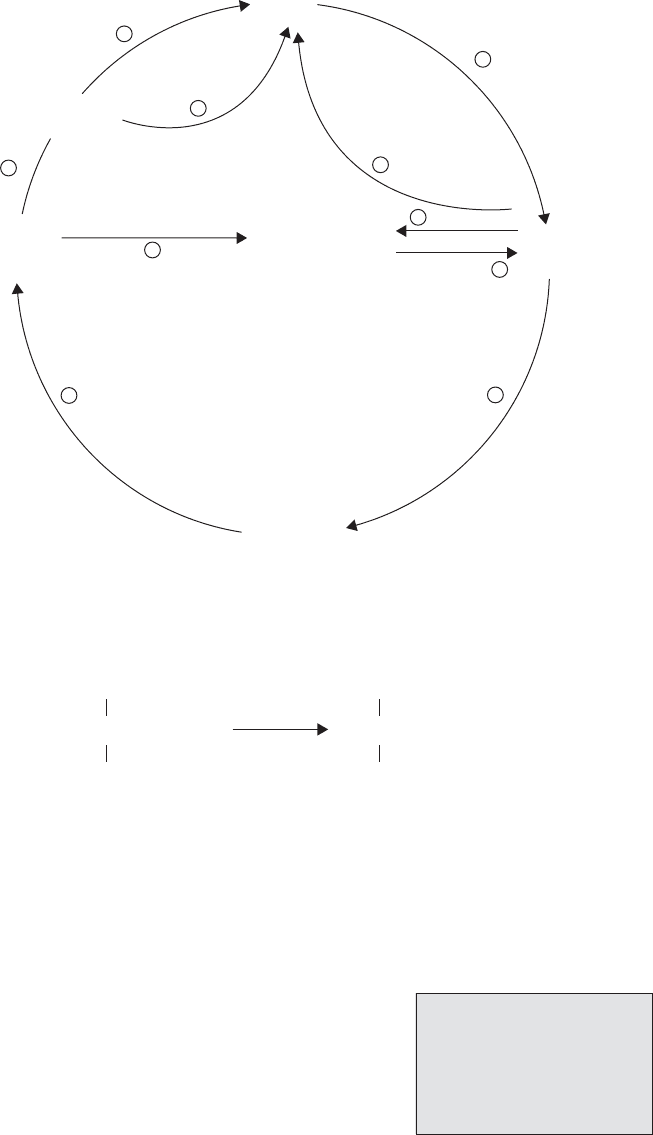
A more detailed scheme of the carbon cycle is shown in
Figure 16.2. Both aerobic and anaerobic reactions con-
tribute to the cycle. The numbers in parentheses in the
following description refer to those in Figure 16.2.
Atmospheric CO
2
is fixed into organic compounds
by plants, together with phototrophic and chemoau-
totrophic microorganisms (1). The organic compounds
thus synthesised undergo cellular respiration and CO
2
is returned to the atmosphere (2). The carbon may have
been passed along a food chain to consumers before this
occurs. Carbon dioxide is also produced by the decomposition of dead plant, animal
and microbial material by heterotrophic bacteria and fungi.
Methanogenic bacteria produce methane from organic carbon or CO
2
(3, 4). This in
turn is oxidised by methanotrophic bacteria; carbon may be incorporated into organic
material or lost as CO
2
(5, 6).
The nitrogen cycle
Nitrogen is essential to all living things as a component of proteins and nucleic acids.
Although elemental nitrogen makes up three quarters of the Earth’s atmosphere, only a
handful of life forms are able to utilise it for metabolic purposes. These are termed
nitrogen-fixing bacteria, and incorporate the nitrogen into ammonia (Figure 16.3,
reaction 1):
N
2
+ 8e
−
+ 8H
+
+ 16ATP−−−−−−−−→2NH
4
+
+ 16ADP + 16Pi

JWBK011-16 JWBK011-Hogg August 12, 2005 16:35 Char Count= 0
THE NITROGEN CYCLE 391
CO
2
CH
4
Organic C
1
2
4 5
63
Figure 16.2 The carbon cycle – a closer look. Carbon is circulated as one of three forms,
carbon dioxide, methane and organic compounds. Different organisms are able to utilise
each form for their own metabolic requirements, converting it in the process to one of the
others. Numbered arrows refer to reactions described in the text
The nitrogenase enzyme complex responsible for the reaction is very sensitive to oxygen,
and is thought to have evolved early in the Earth’s history, when the atmosphere was
still largely oxygen-free. Many nitrogen-fixing bacteria are anaerobes; those that are not
have devised ways of keeping the cell interior anoxic. Azotobacter species, for example,
utilise oxygen at a high rate, so that it never accumulates in the cell, inactivating the
nitrogenase. Many cyanophytes (blue-greens) carry out nitrogen fixation in thick-walled
heterocysts which help maintain anoxic conditions.
Some nitrogen-fixing bacteria such as Rhizobium infect the roots of leguminous
plants such as peas, beans and clover, where they form nodules and form a mutually
beneficial association (see Chapter 15).
The process by which
microorganisms convert
organic matter to an in-
organic form is termed
mineralisation.
Ammonia produced by nitrogen fixation is assimi-
lated as amino acids, which can then form proteins and
feed into pathways of nucleotide synthesis (2). Organic
nitrogen in the form of dead plant and animal mate-
rial plus excrement re-enters the environment, where it
undergoes mineralisation (3) at the hands of a range
of microorganisms, involving the deamination of amino
acids to their corresponding organic acid. This process
of mineralisation may occur aerobically or anaerobically, in a wide range of microor-
ganisms, e.g.:
JWBK011-16 JWBK011-Hogg August 12, 2005 16:35 Char Count= 0
392 MICROORGANISMS IN THE ENVIRONMENT
N
2
Organic
NO
2
−
NO
2
−
NO
3
−
NH
4
+
+
6
8
6
7
5
1
8
2
3
4
Figure 16.3 The nitrogen cycle. See the text for further details of reactions. Numbered
arrows refer to reactions described in the text
CH
3
CH
3
COO
–
Alanine Pyruvate
2 HC-NH
3
+
+ O
2
2 C=O + 2 NH
4
+
COO
–
Deamination
The process of nitrification, by which ammonia is oxidised stepwise firstly to nitrite and
then to nitrate, involves two different groups of bacteria (4, 5).
NH
4
+
−→ NO
2
−
NO
2
−
−→ NO
3
−
Denitrification is the re-
duction, under anaero-
bic conditions, of nitrite
and nitrate to nitrogen
gas.
The nitrate thus formed may suffer a number of fates. It
may act as an electron acceptor in anaerobic respiration,
becoming reduced to nitrogen via a series of intermedi-
ates including nitrite (6). This process of denitrification
occurs in anaerobic conditions such as waterlogged soils.
Alternatively, it can be reduced once again to ammonia
and thence converted to organic nitrogen (7).

JWBK011-16 JWBK011-Hogg August 12, 2005 16:35 Char Count= 0
THE SULPHUR CYCLE 393
Anammox is the forma-
tion of nitrogen gas by
the anaerobic oxidation
of ammonia and nitrite.
A final pathway of nitrogen cycling has only been dis-
covered in recent years. It is known as anammox (anaer-
obic ammonia oxidation), and is carried out by members
of a group of Gram-negative bacteria called the Planc-
tomycetes (see Chapter 7). The reaction, which can be
represented thus:
NH
4
+
+ NO
2
−
= N
2
+ 2H
2
O (8)
has considerable potential in the removal of nitrogen from wastewater.
The sulphur cycle
Sulphur is found in living organisms in the form of compounds such as amino acids,
coenzymes and vitamins. It can be utilised by different types of organisms in several
forms; Figure 16.4 shows the principal components of the sulphur cycle.
In its elemental form, sulphur is unavailable to most organisms; however, certain
bacteria such as Acidithiobacillus are able to oxidise it to sulphate (1), a form that can
be utilised by a much broader range of organisms (see Chapter 7):
2S + 3O
2
+ 2H
2
O−−−−−−−→H
2
SO
4
Powdered sulphur is often added to alkaline soils in order to encourage this reaction
and thereby reduce the pH.
Sulphate-reducing bacteria convert the sulphate to hydrogen sulphide gas (2) using
either an organic compound or hydrogen gas as electron donor:
8H
+
+ SO
4
2−
−−−−−−−→H
2
S + 2H
2
O + 2OH
−
Sº
Organic S
SO
4
2−
H
2
S
Dissimilatory reduction
OxidationOxidation
Mineralisation Assimilatory
reduction
1
2
3
4
5
Figure 16.4 The sulphur cycle. See the text for further details of reactions. Numbered
arrows refer to reactions described in the text

JWBK011-16 JWBK011-Hogg August 12, 2005 16:35 Char Count= 0
394 MICROORGANISMS IN THE ENVIRONMENT
These bacteria are obligate anaerobes, and the process is termed dissimilatory sulphate
reduction.
Plants are also able to utilise sulphate, incorporating it into cellular constituents such
as the amino acids methionine and cysteine (3)(assimilatory sulphate reduction).
When the plants die, these compounds are broken down, again with the release of
hydrogen sulphide (4) (see mineralisation, above).
CH
2
HS CH
3
COO
–
Cysteine
Pyruvate
HC-NH
3
+
+ H
2
O C=O + NH
4
+
+ H
2
S
COO
–
Green and purple photosynthetic bacteria and some chemoautotrophs use hydrogen
sulphide as an electron donor in the reduction of carbon dioxide, producing elemental
sulphur and thus completing the cycle (5):
H
2
S + CO
2
−−−−−−−→(CH
2
O)
n
+ S
0
Phosphorus
Phosphorus exists almost exclusively in nature as phosphate; however, this is cycled
between soluble and insoluble forms. This conversion is pH-dependent, and if phosphate
is only present in an insoluble form, it will act as a limiting nutrient. This explains the
sudden surge in the growth of plants, algae and cyanobacteria when a source of soluble
phosphate (typically fertiliser or detergent) enters a watercourse. Unlike the elements
discussed above, phosphorus hardly exists in a gaseous form, so its main ‘reservoir’ is
in the sea rather than the atmosphere.
The microbiology of soil
The topsoil is the top
few centimetres of a soil,
characterised by its high
content of organic ma-
terial in various stages
of decomposition. It is
distinguished from the
succeeding layers un-
derneath it, termed the
subsoil, parent layer and
bedrock.
In the following section it will be necessary to generalise,
and treat soil as a homogeneous medium. In fact, it is no
such thing; its precise make-up is dependent upon the un-
derlying geology, and the climatic conditions both past
and present. In addition, the microbial population of a
soil will vary according to the amount of available wa-
ter and organic matter, and different organisms colonise
different strata in the soil.
The organic content of a soil derives from the re-
mains of dead plants and animals. These are broken
down in the soil by a combination of invertebrates and
microorganisms (mainly bacteria and fungi) known as
the decomposers. Their action results in the release of

JWBK011-16 JWBK011-Hogg August 12, 2005 16:35 Char Count= 0
THE MICROBIOLOGY OF SOIL 395
Humus is the complex
organic content of a
soil, comprising complex
materials that remain
after micribial degrada-
tion.
substances that can be used by plants and by other mi-
croorganisms. Much organic material is easily degraded,
while the more resistant fraction is referred to as hu-
mus, and comprises lignin together with various other
macromolecules. The humus content of a soil, then, is
a reflection of how favourable (or otherwise) conditions
are for its decomposition; the value usually falls between
2 and 10 per cent by weight. The inorganic fraction of
a soil derives from the weathering of minerals. Microorganisms may be present in soils
in huge numbers, mostly attached to soil particles. Their numbers vary according to
the availability of suitable nutrients. Bacteria (notably actinomycetes) form the largest
fraction of the microbial population, together with much smaller numbers of fungi,
algae and protozoans. Published values of bacterial numbers range from overestimates
(those that do not distinguish between living and dead cells) and underestimates (those
that depend on colony counts and therefore exclude those organisms we are not yet
able to grow in the laboratory – 99 per cent according to some experts!). Suffice to
say that many millions (possibly billions) of bacteria may be present in a single gram
of topsoil. In spite of being present in such enormous numbers, microorganisms only
represent a minute percentage of the volume of most soils. Fungi, although present in
much smaller numbers than bacteria, form a higher proportion of the soil biomass,
due to their greater size. The majority of soil microorganisms are aerobic heterotrophs,
involved in the decomposition of organic substrates; thus, microbial numbers diminish
greatly the further down into the soil we go, away from organic matter and oxygen.
The proportion of anaerobes increases with depth, but unless the soil is waterlogged,
they are unlikely to predominate.
Other factors affecting microbial distribution include pH, temperature, and mois-
ture. Broadly speaking, neutral conditions favour bacteria, while fungi flourish in mildly
acidic conditions (down to about pH 4), although extremophiles survive well outside
these limits. Actinomycetes favour slightly alkaline conditions. Bacterial forms occur-
ring commonly in soils include Pseudomonas, Bacillus, Clostridium, Nitrobacter and
the nitrogen-fixing Rhizobium and Azotobacter, as well as cyanobacteria such as Nostoc
and Anabaena. Commonly found actinomycetes include Streptomyces and Nocardia.
As we have noted elsewhere, actinomycetes are notable for their secretion of antimicro-
bial compounds into their surroundings. This provides an example of how the presence
of one type of microorganism in a soil population can influence the growth of oth-
ers, forming a dynamic, interactive ecosystem. In addition, bacteria may serve as prey
for predatory protozoans, and secondary colonisers may depend on a supply of nutri-
ents from, for example, cellulose degraders. Important fungal genera common in soil
include the familiar Penicillium and Aspergillus; these not only recycle nutrients by
breaking down organic material, but also contribute to the fabric of the soil, by bind-
ing together microscopic soil particles. Soil protozoans are mostly predators that ingest
bacteria or protists such as yeasts or unicellular algae. All the major forms of proto-
zoans may be present (flagellates, ciliates and amoebas), moving around the water-lined
spaces between soil particles. Algae are of course phototrophic, and are therefore to
be found mostly near the soil surface, although it will be recalled from Chapter 9
that some forms are capable of heterotrophic growth, and may thus survive further
down.
JWBK011-16 JWBK011-Hogg August 12, 2005 16:35 Char Count= 0
396 MICROORGANISMS IN THE ENVIRONMENT
The surface of soil particles is a good natural habitat for the development of biofilms,
complex structures comprising microbial cells held together in a polysaccharide matrix.
The microorganisms themselves produce the polysaccharide, which also allows the pas-
sage of nutrients from the environment. Biofilms can form on almost any surface, and are
often to be found in rapidly flowing waters. Biofilms may be beneficial (e.g. wastewater
treatment – see below) or harmful (e.g. infections resulting from growth in catheters)
to humans.
Although we have emphasised the importance of organic matter in soil ecosystems,
microorganisms may also be found growing on or even within rocks. The growth of such
organisms, together with the action of wind and rainfall, contribute to the weathering
of rocks.
The microbiology of freshwater
The microbial population of freshwater is strongly influenced by the presence or ab-
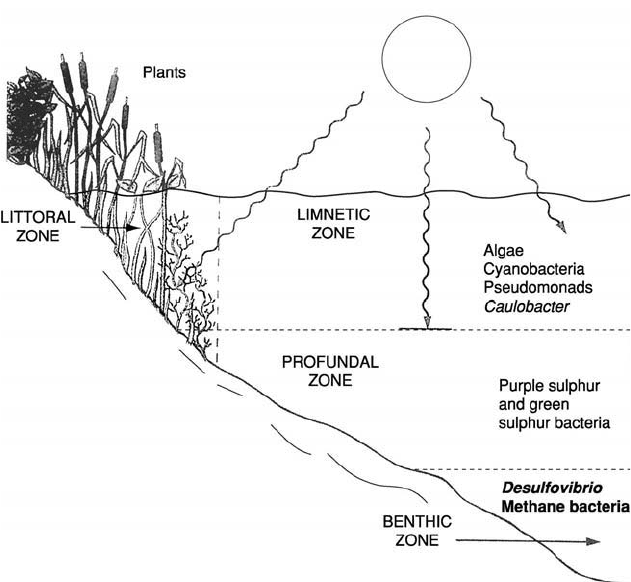
sence of oxygen and light. A body of water such as a pond or lake is stratified into
zones (Figure 16.5), each having its own characteristic microflora, determined by the
Figure 16.5 Vertical zonation in a lake or pond. Representative organisms are indicated
for each zone. From Black, JG: Microbiology: Principles and Explorations, 4th edn, John
Wiley & Sons Inc., 1999. Reproduced by permission of the publishers

JWBK011-16 JWBK011-Hogg August 12, 2005 16:35 Char Count= 0
THE MICROBIOLOGY OF SEAWATER 397
availability of these factors. The littoral zone is the region situated close to land where
the water is sufficiently shallow for sunlight to penetrate to the bottom. The limnetic
zone occupies the same depth, but is in open water, away from the shore. The profun-
dal zone occupies deeper water, where the sun is unable to penetrate, and finally the
benthic zone comprises the sediment of mud and organic matter at the bottom of the
pond or lake.
Oxygen is poorly soluble in water (9 mg/l at 20
◦
C), so its availability is often a limiting
factor in determining the microbial population of a body of water. Oxygen availability
in lakes and ponds is closely linked to oxygenic photosynthesis and therefore, indirectly,
to the penetrability of light. Phototrophs such as algae and blue-greens are limited to
those regions where light is able to penetrate. Oxygen is absent or very limited in the
benthic zone, where anaerobic forms such as the methanogenic bacteria are to be found.
Another factor influencing microbial populations is the organic content of the water; if
this is high, the growth of decomposers will be encouraged, which will in turn deplete
the oxygen. This is much less of an issue in rivers and streams, where physical agitation
of the water generally ensures its continued oxygenation.
The temperature of freshwater ecosystems ranges between extremes (0–90
◦
C), and
microorganisms may be found throughout this range.
Microorganisms play a central role in the purification of wastewaters, a topic we
shall examine in more later in this chapter.
The microbiology of seawater
The world’s oceans cover some 70 per cent of the Earth’s surface and have a fairly
constant salt content of 3.5 per cent (w/v). The depth to which light can penetrate
varies, but is limited to the first 100 metres or so. A world of permanent darkness exists
at greater depths, however in spite of the absence of photosynthesis, oxygen is often still
present. This is because the generally low levels of mineral nutrients in seawater limit
the amount of primary production, and therefore heterotrophic activity. At extreme
depths, however, anoxic conditions prevail.
Compared to freshwater habitats, marine ecosystems show much less variability in
both temperature and pH, although there are exceptions to this general rule. A more
pertinent issue in marine environments is that of pressure; this increases progressively
in deeper waters, and at 1000 metres reaches around 100 times normal atmospheric
pressure. Concomitant with this increase in pressure is a decrease in temperature and
nutrients. Surprisingly, however, certain members of the Archaea have been isolated
even from these extreme conditions.
Phytoplankton is a col-
lective term used to
describe the unicellular
photosynthesisers, which
include cyanobacteria,
dinoflagellates, diatoms
and single-celled algae.
In contrast to terrestrial ecosystems, where plants are
responsible for most of the energy fixation via photo-
synthesis, marine primary production is largely micro-
bial, in the shape of members of the phytoplankton.As
we have seen, such forms are restricted to those zones
where light is able to penetrate. Also found here may be
protozoans and fungi that feed on the phytoplankton.
Because of the high salt concentration of seawater, the
bacteria that are typically found in such environments