
Holik H. (ed.) Handbook of Paper and Board
Подождите немного. Документ загружается.

Coating of drying cylinders in some positions aims to reduce the deposition of
stickies or color on the roll surface. The release characteristics of the coating allow
easier removal of the deposits by doctoring.
6.2.4.2.4 Nip Design in Coating and Sizing
For coating, sizing or pigmenting in film transfer presses the primary purpose of
the cover is both to provide a soft nip and to transfer the applied liquid film
uniformly to the paper web. Abrasion resistance is important for keeping the nip
geometry constant, as the film thickness of the applied coat/size is extremely thin
and any nonconformity in the nip results in nonuniform film application. Good
wettability and film splitting properties are also required.
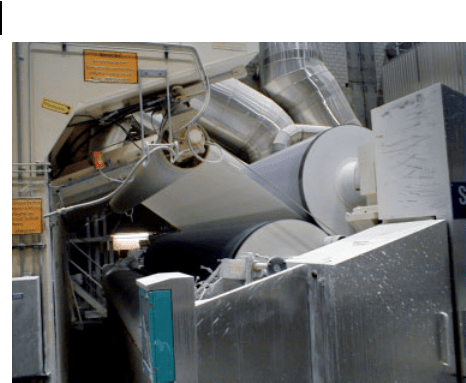
Figure 6.8 shows a film press cover.
In conventional puddle size presses the hard and elastic covers must mainly
ensure a uniform nip, in which the size is pressed into the paper web. Both tem-
perature and chemical resistance of the covers are essential.
Coater backing rolls give elastic support and ensure transport of the paper web
without slipping of the web, which is coated on the opposite side. Elasticity and
optimized deformation behavior are the crucial parameters for roll cover design.
6.2.4.2.5 Nip Design in Calenders
The functions of covers or coatings in soft nip calenders are twofold. The hard
heated roll in the calender is either a chilled iron roll with a hard wear-resistant
surface, or it is coated for even more improved wear resistance. The surface of the
hard roll needs to be extremely smooth, as the roll surface is imprinted onto the
paper surface. Since thermal energy must be transferred to the paper through the
coating, its thermal conductivity and thickness are important.
Fig. 6.8 Film press cover (source: Voith).
6 Paper and Board Manufacturing
232

The soft elastic roll presses the paper web against the heated roll. This cover
must exhibit a certain local deformation ability in order to at least partly follow the
“microscale” topography of the paper web in the calender nip. The compression
modulus of the cover is of similar magnitude to that of the paper. The local de-
formation of the cover ensures that the paper is not just calibrated in the nip, but
that the thinner areas of the web are calendered as well. Thus soft nip calendering
results in better printability compared to hard nips for most printing processes.
6.2.4.2.6 Other Applications
In winding, reeling and cutting operations the covers mainly have to support the
paper without affecting the paper surface negatively. Soft, sometimes compressible
covers are used, providing lower shear stresses in the nip compared to incompress-
ible elastomeric covers.
6.2.4.2.7 Application Overview
The functions of roll covers and coatings are various and significantly influence
paper quality as well as the runnability of a paper machine. This explains the need
for a variety of materials which enables one to have custom-designed covers and
coatings for all applications. Each of the major materials has its unique advan-
tages, nevertheless an overlap of the different cover materials exists for many ap-
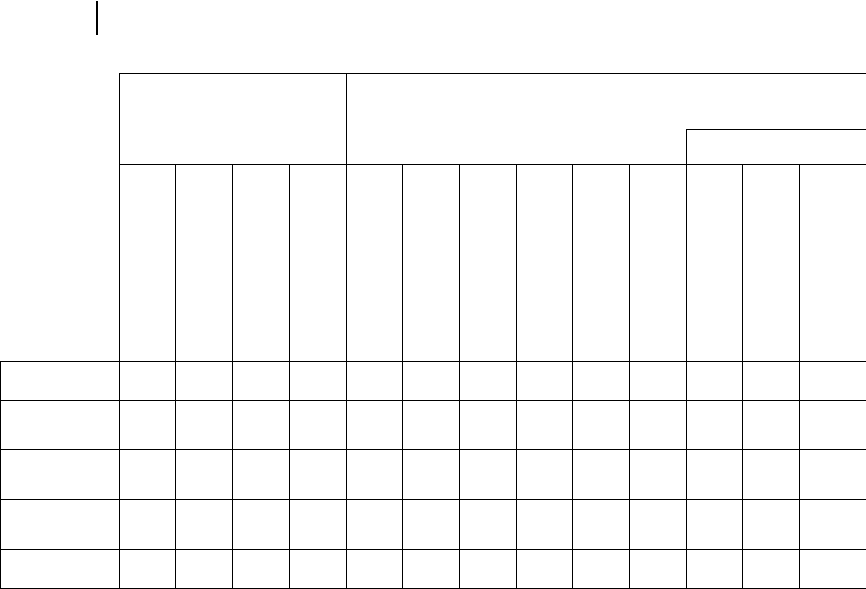
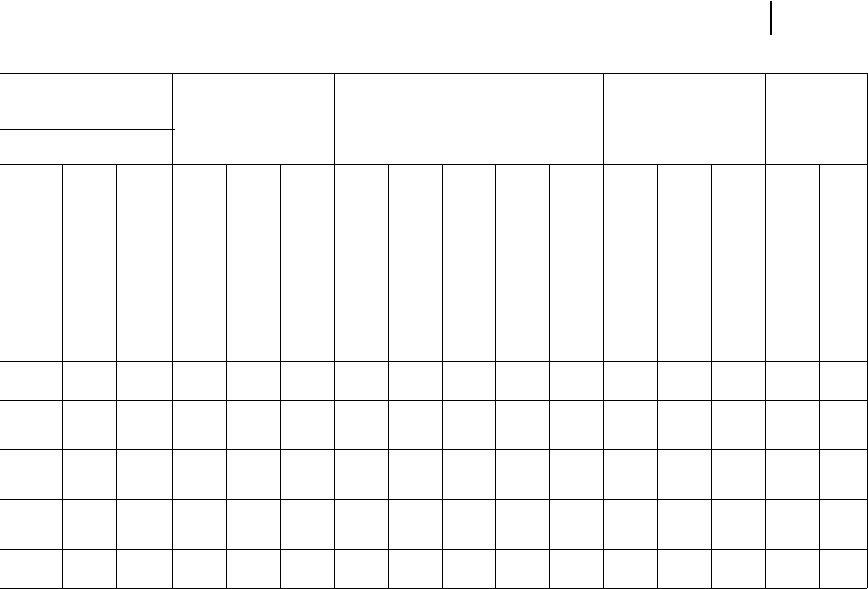
plications. Table 6.1 gives an overview of the materials presently used as roll covers
and coatings, their main properties, as well as their major applications in paper
machines. In the following sections these materials are described in more detail.
Future development of covers and coatings must take into account ever increas-
ing production speeds as well as the demand for improved runnability of paper
machines. Here reliability, predictable operation (grinding) intervals, predictable
lifetime and safety aspects in the case of damage are the main goals. The main
issues in paper technology are innovations in coating and calendering to give im-
proved printability of the paper.
6.2.4.3 Materials
6.2.4.3.1 Rubber Roll Covers
Rubber roll covers are the covers with the longest tradition. The hardness ranges
from very soft elastomeric covers to hard rubber. Both natural rubber and synthetic
rubber polymers are used. Typical rubber formulations consist of approximately 8
to 15 ingredients, such as polymers, fillers, processing materials, tackifiers, anti-
degradant components, colorants, activators and vulcanizing agents. The possibil-
ity of compounding standard formulations as well as high performance formula-
tions makes rubber an excellent material for roll covers.
Hard rubber covers are used for guide rolls and hard press rolls. For guide rolls
the compounds are cost optimized due to the large number of guide rolls in a
6.2 Rolls in Paper and Board Machines 233
paper machine and the relatively low mechanical demands. Therefore a large
amount of conventional inexpensive fillers is used. Depending on the application,
single layer designs are usually used. Bonding of the covers to the metal shell is a
combination of shrink fit of the hard rubber and chemical bonding, resulting in
good corrosion resistance, which is the main reason for applying the cover.
For hard press roll applications the demand on surface quality and abrasion
resistance is higher, therefore more expensive fillers and combinations of fillers
are used. Release properties of the cover can be adjusted by addition of polymer
fillers like PTFE. Two layer designs are frequently used, a cost optimized hard
rubber bonding layer and a performance optimized functional layer.
Soft press roll covers are formulated for good dynamic properties in combina-
tion with high wear resistance. Chemical resistance and swelling characteristics
are adjusted by selection of the polymer. The higher loads of the nipped positions
require two or three layer designs in order to withstand the shear forces in opera-
tion. Bonding is achieved by chemical bonding supported by the shrink fit when
using a hard underlayer.
Sizing/coating/pigmenting is the domain of the high end formulations. Syn-
thetic polymers like Hypalon give outstanding abrasion resistance, nitrile rubbers
Wire guide roll covers
(p)
Wire drive roll covers
(p)
Wire suction roll covers
(sd)
Lumpbreaker roll covers
(p)
Paper guide roll covers
(p)
Wire and felt guide rolls
(p)
Hard press roll covers
(p)
Hard press roll covers
(g)
Soft press roll covers
(g, bd, bdg)
Suction press roll covers
(s, sg, sbd, sbdg)
Smoothing press, soft covers
(p)
Shoe press counter roll covers
(p, bd)
Long nip presses
(Jumbo press) (bd)
Table 6.1 Roll cover applications.
Wet section Press section
Special press
Rubber covers
xxxxxxx xxxxx
Polyurethane
covers
(x) x x x (x) x
Composite covers
(Resin covers)
(x) x x
Composite covers
Fiber reinforced
(x)
Thermal coatings
(x) (x) (x) (x) x x (x) x
x = standard p = plain bd = blind drilled
(x) = special application s = suction drilled g = grooved
6 Paper and Board Manufacturing234
for example result in good chemical resistance. Properties like heat build up,
dampening, wettability, roughness, and low compression set for marking resis-
tance must be considered for development of the compound in these applica-
tions.
Most roll cover manufacturers carry out their own rubber compounding because
of the variety of the formulations, the demand for high quality and the small batch
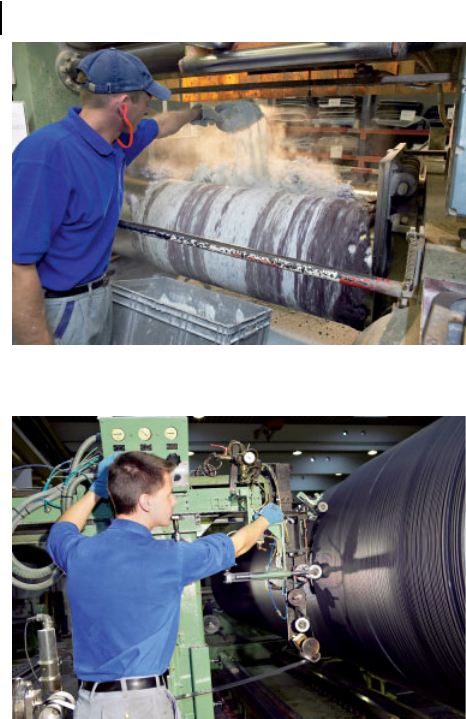
sizes. Mixing of the compounds is frequently done on open mills (Fig. 6.9) due to
the small batch sizes, the high number of different compounds as well as hardness
variations and the good quality of this compounding procedure. The use of inter-
nal mixers is not always justified due to high equipment costs.
After mixing the rubber compound, it is strained to remove impurities and
converted into either a feeding strip for an extruder or a calendered sheet for direct
application.
The surface of the roll is carefully prepared by cleaning and sandblasting before
the application of chemical adhesives or rubber cements.
There are three basic methods for applying the rubber cover to the roll core:
• Extrusion: an extruded strip of rubber is spirally wound around the rotating roll
body (Fig. 6.10)
Dryer
Section
Sizing, coating and pigmenting Calender Reeling
configurations
x xxx xxxxxx xx
(x) (x) x x
(x) (x) (x) (x) x
x
(x) (x) x (x) (x) (x) x x
Roll covers for tissue machines
(bd, sbd)
Press roll covers for
marking press (p)
Press roll covers
for glazing cylinders (p)
Paper guide roll covers
(p)
Wire and felt guide rolls
(p)
Coatings for drying cylinders
Paper guide roll covers
(p)
Hard roll covers for puddle size
press (p)
Soft roll covers for puddle size
press (p)
Film press roll covers
(p)
Coater backing and applicator
roll covers for coating machines
(p)
Paper guide roll covers
(p)
Elastic roll covers
(p)
Hard roll covers
(p)
Reel spool
(p)
Reel drum
(p)
6.2 Rolls in Paper and Board Machines 235
• Knott method: a narrow strip of calendered rubber is spirally wound around the
rotating roll body
• Hand build: large calendered sheets of rubber are manually applied on the roll.
With each of these build up methods, the desired layers of different materials are
applied. The choice of application method depends mainly on the compound and
the requirements for cover homogeneity. The hand build method, as an example,
is the most sophisticated and most expensive build method. For these reasons it is
only used for applications with extremely high demands on surface quality such as
sizing or coating.
Vulcanisation of the covers is done in steam autoclaves, where the rubber poly-
mer is crosslinked to the elastomeric network. The cover is finished by mechanical
tooling, drilling and grinding to the required geometrical dimensions.
Fig. 6.9 Rubber compounding on an open mill
(source: Voith).
Fig. 6.10 Extrusion of rubber cover (source: Voith).
6 Paper and Board Manufacturing
236
6.2.4.3.2 Polyurethane Roll Covers
Polyurethane roll covers were introduced to the paper industry at the end of the
1980s. The outstanding mechanical and dynamical properties make polyurethane
the most suitable material for soft elastomeric covers in press positions. Depend-
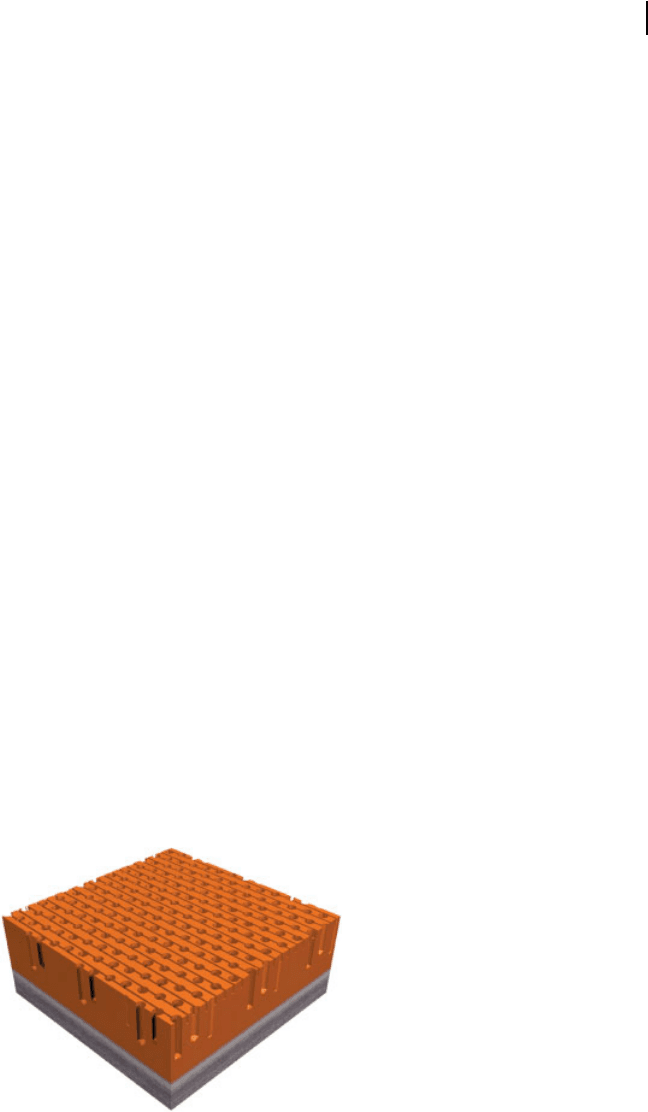
ing on paper quality and press design, high open surfaces up to 45 % with grooves,
blind drilled holes or suction holes, as well as combinations thereof are used. An
example of surface design is shown in Fig. 6.11.
For these types of covers in modern machines only polyurethane elastomers are
able to provide enough wear resistance to reach acceptable grinding intervals.
High performance polyurethane formulations are used, giving the required me-
chanical strength and elasticity as well as outstanding hydrolytic stability.
Usually the cover has a multilayer design in order to ensure excellent bonding of
the polyurethane functional layer to the core as well as safe running properties.
State of the art are composite base-layers with endless fiber reinforcements, which
allow a gradual adjustment of the mechanical and thermal properties of the cover
in a radial direction. This results in a gradual adjustment of the shear forces cre-
ated by the nip load within the cover layers. Two layer designs with a harder polyu-
rethane underlayer are also used to provide bonding to the shell.
In fast running machines the dynamic heat build up in the cover limits the
application of elastomeric materials. Polyurethane polymers, based on special for-
mulations with excellent dynamic properties, ensure good performance in these
applications with minimal heat build up. An example of such an application is the
substitution of grooved steel rolls by elastomeric covers in shoe presses.
The functional layer of polyurethane covers is manufactured by casting proc-
esses, thus ensuring very homogeneous material properties.
Roll preparation is similar to that for rubber, chemical adhesives are used to
bond the base layer. The base layer can be a fiber reinforced composite, which is
applied in a wet impregnation process of the reinforcement material. The glass
fiber reinforcement (tapes or rovings) is impregnated in a resin bath and then
spirally wound onto the roll shell. Curing of the base layer with infrared heating
and/or ovens and tooling to a defined geometry are the next steps.
Fig. 6.11 Example of surface design for
polyurethane press cover (blind drilled
and grooved) (source: Voith).
6.2 Rolls in Paper and Board Machines
237
The polyurethane elastomer itself is a reaction polymer, created by the mixing of
prepolymers and chain extenders or hardeners. This reactive mixture, which is
created in the desired mixing ratio by special casting machines, is cast into a mold
built around the roll shell with the base layer. The casting procedure can be carried
out horizontally or vertically. Bonding to the base layer is done chemically with
adhesives or reactive layers. The polyurethane material itself is not normally filled,
thus providing outstanding elastomeric material properties.
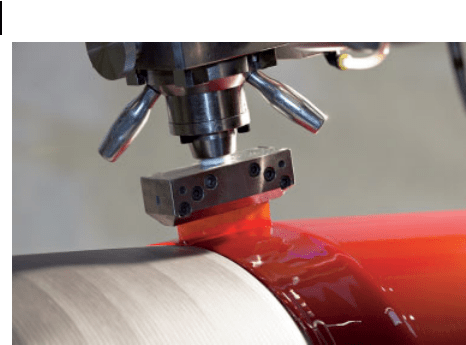
Another method for manufacturing polyurethane covers is the moldless rota-
tional casting process (Fig. 6.12). Here the reacting polyurethane mixture is cast as
a spiral on the rotating roll, the fast reaction of the polyurethane mixture prevents
the material dripping off the roll. Layers of different hardness can be applied easily
with this method.
Most polyurethane formulations need to be post-cured at elevated temperatures
for optimum material properties. The final mechanical manufacturing steps are
similar to those of rubber covers.
6.2.4.3.3 Composite Roll Covers
Two basic composite designs for the functional layer of roll covers are used in the
paper industry: Composite covers with a fiber reinforced functional layer and com-
posite covers with a cast functional layer (resin covers).
6.2.4.3.3.1 Fiber Reinforced Functional Layer
Composite covers with fiber reinforcement in the functional layers are mainly
used in calender applications. The use of fibers significantly improves the mechan-
ical and thermal robustness of the cover. High performance materials like Ara-
mide fibers are used, where a high damage tolerance is required. Compared with
Fig. 6.12 Moldless rotational casting of polyurethane cover
(source: Voith).
6 Paper and Board Manufacturing
238
structural composites, where the fiber characteristics dominate the mechanical
properties, the fiber volume content of the functional layer of roll covers is rela-
tively low. The major physical properties like hardness, compressive modulus or
strength of the covers are mainly dominated by the particle filled resin matrix.
The base-layers of the multilayer designs are mostly glass fiber reinforced, in
these layers the fiber content is higher, and therefore the fiber properties dominate
the properties of the composite.
For soft calendering different hardnesses – or more accurately different Young’s
moduli – of the covers are required in order to ensure the required paper proper-
ties. This can be achieved primarily by varying the amount and combination of
different fillers in the fiber reinforced composite.
The surface of the covers must be as smooth as possible, the wear resistance
excellent. These properties can be influenced for instance by the modulus of the
fibers, particle size distribution and hardness combinations of the fillers and, to a
minor extent, by the properties of the resin. Temperature resistance and low heat
build up of the cover under dynamic load is mainly a function of the resin matrix
system. Operating conditions of calenders such as 25 Hz load frequency, 90 °C
surface temperature and 50 MPa nip pressure as well as expected load cycles of
>10
9
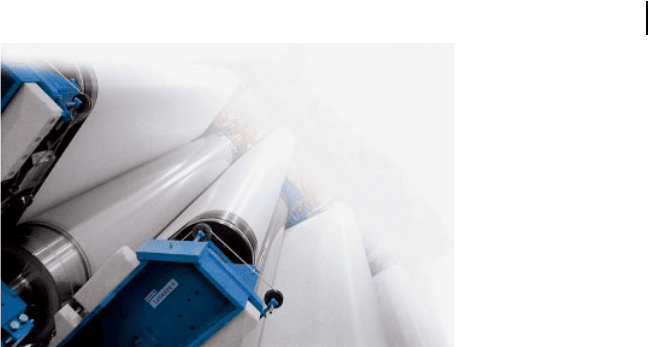
make the elastic calender covers the most demanding applications of roll
covers. Figure 6.13 shows an elastic composite cover in a multi-nip calender.
For lower demand applications composite covers with conventional fiber rein-
forcements (glass or polyester) are used. These covers are for applications such as
guide rolls or special press positions.
6.2.4.3.3.2 Cast Functional Layer (Resin Covers)
Composite covers with cast functional layers are applied in the press section or in
calenders. Typically, mineral filled resin systems are applied onto a fiber reinforced
Fig. 6.13 Elastic composite cover in multi-nip calender
(source: Voith).
6.2 Rolls in Paper and Board Machines
239

base layer. The advantages of the cast resin systems are extreme homogeneity of
the functional layer and good abrasion resistance. These properties are important
for applications such as soft calender covers or center press roll positions. Special
formulations of the resin/filler composite allow the adjustment of sheet release
properties as well as wear resistance. Limitations for this type of cover are the
sensitivity to mechanical damage and thermal shocks due to the relatively brittle
functional layer.
For the manufacture of composite covers wet impregnation processes are pri-
marily used. The reinforcement fibers (tapes, rovings or nonwovens) are impreg-
nated in formulated resin mixtures and wound onto the roll body. Multilayering
with different fiber reinforcements and different fiber orientations is applied. The
winding angle of the reinforcement material mainly governs the reinforcement
direction of the fibers, creating anisotropic (direction dependent) material proper-
ties. These special material properties are used for design purposes, e.g. to influ-
ence the strength, thermal expansion behavior or modulus of the composite
structure.
Particle filled functional layers are applied by casting processes similar to polyu-
rethane covers.
The curing of the resin systems which are primarily epoxy-based, is done by
infrared heating and/or by heated curing ovens. Mechanical processes are similar
to those used for the other cover types. Final surface grinding requires special
techniques to reach the desired smooth surface properties.
6.2.4.3.4 Thermal Coatings
Thermally sprayed coatings are gaining wider use in modern paper machines due
to their outstanding wear resistance. Even thin coatings of 0.2–0.7 mm provide
both excellent resistance and long lifetime. Different thermal spraying processes
(e.g. plasma, HVOF, flame/arc spraying) allow the use of a large variety of mate-
rials.
6.2.4.3.4.1 Ceramic Coatings
Oxide ceramic coatings based on Al, Ti, Cr Oxides or combinations, are used in
hard press roll positions. The outstanding wear resistance of the ceramic surface
as well as excellent sheet release make these coatings suitable for high speed paper
machines. Due to the well defined porosity structure of the ceramic, a hydrophilic
coating surface is created. This results in excellent sheet release and a low ten-
dency for deposition of hydrophobic stickies on the roll surface. The surface topog-
raphy of the coating, an important factor for sheet release, is kept constant over its
lifetime, even under doctored conditions.
The coating itself is usually a two or three layer design. The functional layer
made of ceramics is, by its nature, porous. To ensure a corrosion resistant coating
either chemical sealing of the pores is carried out or corrosion resistant nonporous
underlayers are applied.
6 Paper and Board Manufacturing240
The main applications are for hard press rolls/center press rolls in fast running
paper machines.
6.2.4.3.4.2 Hard Metal Coatings
Hard metal coatings are carbides, nitrides and borides of transition metals. Car-
bides of the Cr-group are mainly used for thermal coatings. These wear resistant
layers are used for grooved or drilled press rolls providing increased grinding
intervals. Optimized formulations of these multiphase coatings are used to coat
heated calender rolls. These coatings can be polished to extremely fine surface
smoothness. The durability of these systems allows continuous doctoring of the
coatings.
6.2.4.3.4.3 Metals and Alloys
Metals and/or alloys are sprayed mainly as base or underlayers in combination
with oxide ceramics and hard metal coatings. The difference in thermal expansion
of the oxide layer and the metallic roll is partly compensated by these layers. The
major features of these materials are ductility and toughness, improving the over-
all coating performance.
Thermal spraying is the build up of a coating on a substrate from particles
sprayed at defined temperature and kinetic energy onto the roll surface. The ther-
mal energy is required to melt the powder particles or the wire while the gas flow is
necessary for the particle acceleration. Energy sources can be either electrical (arc,
plasma) or chemical: H2, propane or kerosene (flame spraying). The melted and
accelerated particles hit the surface, re-solidify and build up the coating layer by
layer (approx. 10–20 mm/pass).
Arc and plasma spraying can be performed either in vacuum (VPS) or under
atmospheric (APS) conditions, but only the latter is applicable for roll coatings.
Differences in flame spraying mainly concern the particle velocity. High velocity
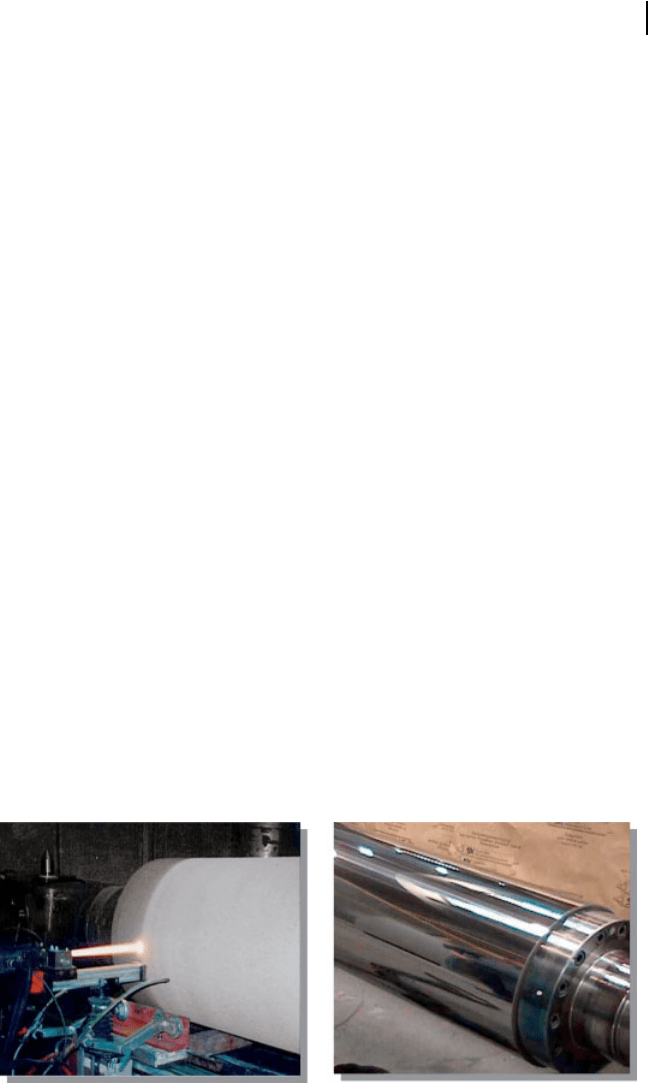
spraying can be continuous (HVOF) or discontinuous (D-Gun). The plasma coat-
ing of a press roll is shown in Fig. 6.14.
Fig. 6.14 Plasma coating of press roll (source: Voith).
6.2 Rolls in Paper and Board Machines
241