
Holik H. (ed.) Handbook of Paper and Board
Подождите немного. Документ загружается.


(> 50 mm). This is achieved by installing at least one washing and a second disper-
sion stage [1–5].
4.3.2.2 Systems for Packaging Paper and Board Grades
For packaging paper and board grades, recovered paper is the main fiber source
with a share of about 60% worldwide. In Europe most of the mills produce packag-
ing papers based on 100% recycled fibers. The main recovered paper qualities for
the packaging grades are mixed recovered paper from households and supermar-
kets, the latter mainly being old corrugated containers (OCC). The recovered paper
qualities for packaging grades contain much more debris than “white” recovered
paper grades.
The recovered paper quality in general, and especially for the “brown” grades,
tends to steadily decrease. At the same time the production costs, the stock quality
demands concerning the paper machine runnability as well as the final product
properties put high demands on the fiber preparation systems. This results in
these more sophisticated than they used to be in earlier times. The major ob-
jectives in systems for packaging grades are cleanliness, strength characteristics
and high yield. The importance of optical characteristics is steadily increasing as
packaging material is often printed.
Many of the packaging paper and board grades are multilayer products, meaning
that they consist of different layers using different fiber types, virgin and/or re-
cycled. Therefore different individual fiber preparation systems are often needed.
In the case of 100% recycled fiber based production with multilayer or multi-ply
paper machine forming sections one completely separate fiber preparation plant is
installed for each layer. Or, as is also state of the art, different recycled fiber quali-
ties are produced, starting with one fiber preparation line and then separating the
stock flow into lines of different qualities by fractionation. These fractions can then
be used either separately for each layer on the paper machine or they can be
remixed in desired proportions [1, 2].
Table 4.4 Quality parameters of European MOW/UWF/MWF
mix and DIP for different woodfree graphical paper grades.
Grade DIP
Brightness
DIP
Dirt Count > 50 mm
DIP
Stickies
a
DIP
Ash content (575 °C)
% ISO mm
2
m
–2
mm
2
kg
–1
%
recovered paper
(Mix MOW/UWF/CWF)
60–70 1000–5000 5000–20000 15–25
tissue 80–90 < 150 < 200 < 2
market DIP as substitute
of chemical pulp
80–90 < 100 < 20–40 < 5
a
According to TAPPI T277 (measurement with Somerville laboratory
screen with 0.15 mm slotted screen plate).
4 Stock Preparation202
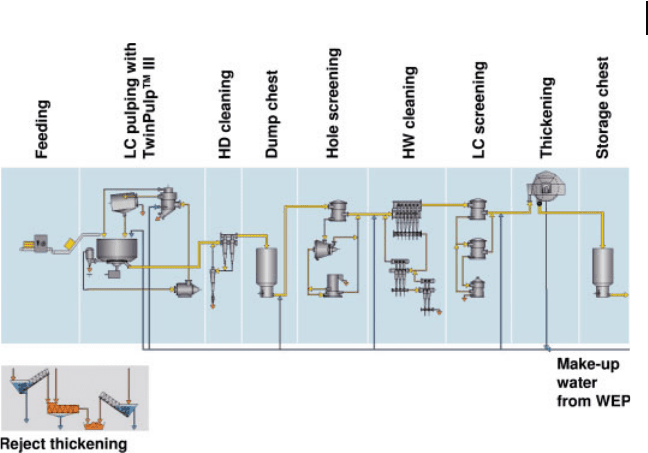
Fig. 4.59 shows a state-of-the-art fiber preparation system for packaging grades
without fractionation. The recovered paper, delivered in bales, is put on a conveyor
belt where the wires are cut, but not removed, and sent to a LC pulper working at a
consistency of 4.5–5.5%. In the pulper wires, strings and other spinning con-
taminants are removed by the ragger. As various other types of contaminants accu-
mulate in the pulper, an efficient detrashing system is one of the key components
of a fiber preparation plant for packaging paper. The slushed stock, after high
consistency cleaning, can still contain up to 20% flakes. It is fed into a dump chest
with a certain retention time, to assist the defibration of the flakes further down in
the process.
After the dump chest the stock is treated in a hole screening stage at a con-
sistency of approximately 3.5%. The design of this stage depends to a high degree
on the flake content of the stock. For high flake contents, disk screens (hole sizes
2.4 mm) are recommended, at least in the second stage, as they are more robust
and they have a distinctly higher deflaking potential than cylindrical screens (hole
sizes 1.6 mm). The first and second stages are fed forward.
After hole screening, the flake content should not exceed 4% to ensure a good
runnability of the following cleaning and fine screening stages. Heavyweight
cleaning is done after dilution of the stock and is followed by the fine screening
with slot widths of 0.20–0.15 mm. Here the major part of the stickies and other
contaminants is removed from the process. After that, the stock is thickened in a
disk filter for separation of the water circuits of the fiber preparation and the paper
machine and to reduce the volume of the following storage tower.
Fig. 4.59 Fiber preparation system for packaging grades
without fractionation (source: Voith).
4.3 Systems for Fiber Stock Preparation
203
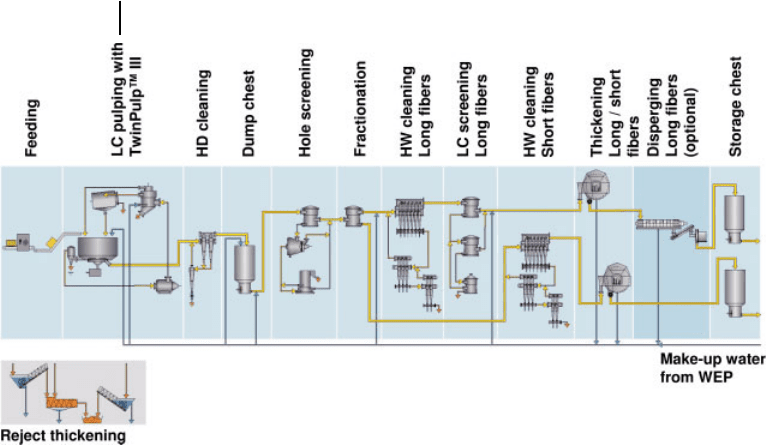
In the case of a fiber preparation line with fractionation (Fig. 4.60), the stock
after hole screening is fractionated by screening at slot widths of 0.20 to 0.15 mm.
The accept fraction represents the so-called short fiber fraction and is treated fur-
ther by removing sand through heavyweight cleaning and thickening before stor-
age. The “rejected” fraction is called the long fiber fraction and is treated much
more intensively than the short fibers. This fraction contains, besides the longer
fibers, an increased amount of contaminants. Therefore it needs to be treated, as a
minimum, by a heavyweight cleaning stage and a fine screening stage. If the
demand on optical cleanliness is very high, a dispersion stage is used for homog-
enization. If the recovered papers potentially contain waxes, as in American OCC
grades, lightweight cleaners in both fractions as well as a dispersion unit in the
long fiber fraction should be installed. For applications, where the recovered fibers
still show a potential for strength development, refining of the long fiber fraction is
also recommended [1, 2].
4.3.3
Systems for Broke Treatment
Broke is an important stock source and occurs on a continuous basis as trims from
the wire as wet broke and from the winders as dry broke. It can also occasionally
occur as reel slab-offs, in the finishing room or during breaks in the paper ma-
chine or coating equipment. Usually all broke is fed back to the process in the
approach flow system. Broke treatment starts with slushing in different pulpers.
These pulpers are installed under the machine and dimensioned according to the
Fig. 4.60 Fiber preparation system for packaging grades with
fractionation (source: Voith).
4 Stock Preparation
204

paper machine width like couch pit pulpers for wet broke and size-press and reel
pulpers for dry broke. Alternatively, they are installed separately like winder, finish-
ing room and broke roll pulpers for dry broke (see Section 4.2.2). The design of a
broke treatment system depends on the requirements of the paper machine and
can contain several stages like thickening, screening, cleaning and deflaking (see
Section 4.2). Sufficient buffer capacity for the broke is also important because it
should be fed back in controlled portions as it has different properties from fresh
stock due to drying, chemical content or, in coated paper production, to high filler
content. In specialty paper production, e.g. wet-strength papers or impregnated
papers, broke has either to be further treated (for example by mechanical disper-
sion, increased temperature through steam injection or the use of special chem-
icals for repulping) or be taken out of the papermaking process. In colored paper
production, dry broke has to be used immediately or, if this is not possible, stored
until the same color is produced again [6].
4.3.4
Peripheral Systems in Secondary Fiber Preparation
In secondary fiber preparation, peripheral systems are very important for the runn-
ability of the whole plant as well as for cost minimization and environmental
issues. Peripheral plant components are the reject system, sludge treatment and
water handling (see Fig. 4.56–4.60). Coarse rejects from the pulping section, heavy
particle separation and hole screening are dewatered to a dry content of approx-
imately 60%. If thermal treatment is involved for these rejects, metal components
have to be removed and the particle size adapted to the burning process by means
of shredding.
Fine rejects and sludges from the flotation stages and the DAFs are also drained
to approximately 60% dry content and either sent to energy recovery or used in the
concrete or brick industry [3]. Water handling is another key element as it affects –
besides costs and environmental issues – various quality parameters of the fin-
ished product such as brightness, cleanliness or odor (see Chapters 5 and 10).
4.3.5
Process Engineering and Automation
Today, advanced process engineering and automation are – due to the complexity
of the plants – basic requirements for fiber preparation systems. Engineering pro-
vides the right connection of all the described process stages by planning the
process layout and selecting adequate pump, pipe and chest designs and sizes for
low energy consumption and economic investment. State of the art is a nearly
chest-free stock preparation system between pulper dump tower and storage tower,
where fan pumps (like in the paper machine) have widely replaced chests.
The main field of automation in a fiber stock preparation system lies in the
control of those operational parameters which are important for every stage in the
process e.g. consistency, flow, pressure, level, power consumption and tempera-
4.3 Systems for Fiber Stock Preparation 205

ture. It also includes programs in the DCS for automated start-ups and shut-downs
of the different subsystems or even the whole fiber preparation system. Advanced
automation concepts ensure, in the case of production (i.e. oven-dry tonnage)
changes, that each subsystem is simultaneously adjusted to the new production
requirements. Here a production set point is entered by the operator or automat-
ically controlled as a function of paper machine production or the level of the
storage tower. The production control value for each subsystem is then calculated,
whereby the losses of the individual subsystems are taken into account [7].
Another advanced approach in automation for fiber preparation systems is the
introduction of quality control systems. As an example, the operator chooses the
desired brightness value of the final stock in the storage tower. So-called model
predictive controls calculate the necessary bleaching chemicals according to the
actual conditions measured ahead of a bleaching stage(s) to control the brightness
on a feed-forward basis instead of the conventional feed-back control strategy. This
reduces dead times significantly and leads to more constant quality as well as to
reduced costs for bleaching. An additional cost-control module for multistage
bleaching processes calculates the most quality- and cost-efficient dosage of
bleaching chemicals for each individual bleaching stage [8].
References
Section 4.2.3
1 K.-A. Hoheisel, J. Lipponen, J. Heimonen,
DIP-Linienkonzepte für unterschiedliche
Anwendungen, Wochenblatt Papierfabrik.
2001, 21, 1398.
2 M. Schwarz, Design of recycled fiber proc-
esses for different paper and board grades,
Paper Making Science and Technology, Book
7, Recycled Fiber and Deinking, Ch. 6,
p. 211ff.
3 A. Stetter, De-inking – the key technology
in the treatment of recovered paper, Up-
times – Pulp and Paper News, vol 9, p. 2ff.
4 J. Toland, Developments in deinking, Pulp
Paper Int. 2003, 45 (4); www.paperloop.
com/db-area/archive/ppi-mag/2003/0304/
ppi4.html
5 J. Toland, Around the world of stock prep-
aration, Pulp Paper Int. 2003, 45 (4);
www.paperloop.com/db-area/archive/
ppi-mag/2003/0304/ppi3.html
6 U. Weise, J.Terho, H. Paulapuro, Stock
and water systems of the paper machine,
Paper Making Science and Technology, Book
8, Paper Making, Part 1, Stock Preparation
and Wet End, Ch. 5, p. 1.
7 T. Köberl, Technology and control strategy
– the basis for profit – and quality-con-
scious secondary fiber systems, Proceed-
ings, Session 2, Control Systems Confer-
ence, Stockholm, 1994.
8 B. Reinholdt, A. Stetter, V. Gehr, F.
Meltzer, A new proven intelligent control
system maximizes bleaching efficiency
and minimizes costs, Proceedings 10,
Control Systems Conference, Stockholm,
2002.
Further Reading
Recycled Fiber and Deinking, Vol. 7 of Paper-
making Science and Technology, Ser. Eds. J.
Gullichsen, H. Paulapuro, Fapet Oy,
Helsinki, 2000.
H. Holik, Towards a better understanding of
the defibering process, TAPPI 1988 Engi-
neering Conference Proceedings, TAPPI
Press, Atlanta, p. 223.
H. Vomhoff, K.-J. Grundström, Fractionation
of bleached softwood pulp and separate
refining of the earlywood- and latewood-
enriched fractions, Das Papier 2003, T17.
L. Svarovsky, Hydrocyclones, Technomic Pub-
lishing, London, 1984, pp. 198.
A.V. Nguyen, et al., Elementary step of three-
phase contact line expansion in bubble-par-
ticle attachment: an experimental approach
References
206

to flotation theory, Proceedings of the XX
IMPC, Max Planck Institute for Colloids
and Interfaces, Freiberg, Germany, 1997, p.
31.
T.P. Eriksson, M. A. McCool, A review of flo-
tation deinking cell technology, Paper Recy-
cling Challenge, Vol. II, Doshi, Appleton,
USA, 1997, p.69.
T. Bliss, M. Ostoja-Starzewski, Suspended sol-
ids washing overview, Paper Recycling Chal-
lenge, Vol. II, Doshi, Appleton, USA, 1997,
p.85.
F. Julien Saint Amant, Ink removal by flota-
tion and washing, hydrodynamic and tech-
nical aspects, CTP, Grenoble/France, 1997,
C. R. no. 3660, p.38.
B. Carré et al., The effect of hydrogen perox-
ide bleaching on ink detachment during
pulping and kneading, Wastepaper 95, Con-
ference Proceedings, CTP Grenoble/France,
1995, p.89.
B. Carré, Y Vernac, G. Galland, Comparison
between low-speed kneader and high-speed
disperser: effect of temperature, energy
consumption and chemistry on optical
properties, Doc CTP 1815, CTP Grenoble/
France, 1997.
J. Rihs, Refining of recycled fibers for brown
and white grades, TAPPI 1992 Papermakers
Conference Proceedings, TAPPI Press,
Atlanta, p. 239.
R. J. Kerekes, Characterization of pulp refin-
ers by a C-Factor, Nordic Pulp Paper Res. J.
1990, 1, 3.
G. G. Duffy, S. N. Kazi, X. D. Chen, Pulp fiber
quality measurement from flowing wood
pulp fibre suspensions, Das Papier 2002,
T112.
H. Gabl, Papillon
TM
- a new refining concept,
Das Papier 2004, T33.
J. K. Borchardt, Recent developments in pa-
per deinking technology, Pulp Paper Can.
2003, 104 (5), 32.
T. Friesen, N. Bourdet, P. Tuomela, B. J. Alli-
son, J. A. Olson, Pressure screen system
simulation for optimal fractionation, Pulp
Paper Can. 2003, 104 (4), 43.
S. Dong, The effect of slot screen shape on
the performance of a pressure screen,
TAPPI J. May 2004.
R. Rienecker, Screening of recovered paper
stock for the production of graphic papers,
Paper Technol. J. Voith Paper Vol. 10, 2000.
R. W. Gooding, The passage of fibers through
slots in pulp screening, M.A.Sc. thesis,
University of British Columbia, Vancouver,
1986.
S. Schabel, V. Schädler, R. Rienecker,
Scherbeanspruchung von Polymeren im
konstanten Teil – eine exemplarische Be-
trachtung, Das Papier 2004, T112.
H.-P. Putz, et al., Rezyklierbarkeit von be-
druckten gestrichenen Papieren, Das Papier
2003, T18.
References
207

5
Water Circuits
Andrea Stetter
5.1
Introduction
Water is, besides fibers of course, the key component in pulp and paper manu-
facturing and fulfills numerous functions in the process. It is used as a transport
medium, for cleaning and cooling, as a lubricant and finally as the “binding agent”
for forming hydrogen bonds between the fibers within the paper sheet. In earlier
times paper was produced with a high specific fresh water consumption in the
range of 500 l (kg paper)
–1
. For economic and, in the last decades, also for eco-
logical reasons, the average water consumption has been reduced to less than
15 l (kg paper)
–1
as state of the art. This dramatic reduction was only feasible
thanks to the increasing closure of the in-house water circuits and because most of
the former fresh water consumers are now fed by clarified circuit water [1].
5.2
Fresh Water
The source of fresh water (FW) in a paper mill is usually surface water and to some
extent groundwater, depending on the availability and local conditions. Surface
water in particular does not meet the required quality parameters and therefore
has to be conditioned by filtering and/or chemical coagulation and flocculation
and subsequent sedimentation before use. For boiler house use and in specialty
paper, e. g. photographic base paper or cigarette paper, production, the fresh water
is softened and/or desalinated. With the limited amount of fresh water available
nowadays, this resource must be used efficiently. In general the fresh water taken
into a mill is first used for cooling then it is distributed to its process consumers
either directly or after further heating. There are only a few fresh water consumers
in modern mills, like for instance chemical preparation and dilution systems, seal-
ing water consumers (mainly vacuum pumps) and some high pressure sprays for
felt conditioning.
Handbook of Paper and Board. H. Holik (Ed.)
Copyright © 2006 WILEY-VCH Verlag GmbH & Co. KGaA, Weinheim
ISBN: 3-527-30997-7
208

5.3
Process Water
The majority of water used in a paper mill is process water, meaning water that is
recycled in the different water loops of the water circuit of the system before dis-
posal. The process water is “produced” in the thickening and dewatering stages of
the papermaking process. Due to its content of solid, colloidal and dissolved sub-
stances, the quality of the process water is lower than that of fresh water.
5.3.1
Detrimental Substances
Major process changes in paper production in the last two decades have been
• a strongly increased use of recovered paper
• the change from acid to neutral systems in the paper machines
• the reduction of fresh water consumption.
These changes led to steadily growing problems due to an increased content of so-
called detrimental substances in the water loops. Detrimental substances stem
from wood components such as resin or lignin derivates, from freshwater as hu-
mic acids, from broke and recovered paper as coating binders, glues and adhe-
sives, from additives as fatty acids or silicates, starch and others. Table 5.1 shows
the composition and origin of detrimental substances in the process water [2].
Detrimental substances can cause a lot of problems throughout the whole paper-
making process such as reduced efficiency of additives, reduced optical and
strength properties, poor sizing, bad odor, negative effects on drainage and drying
and therefore reduced paper machine speed. These substances are the main rea-
sons for deposits and foam generation causing defects in paper as well as resulting
in paper web breaks. Detrimental substances include anionic oligomers and poly-
Table 5.1 Composition and origin of detrimental substances.
Chemical compound(s) Origin
sodium silicate peroxide bleaching, deinking, recovered paper
polyphosphate filler dispersing agent
polyacrylate filler dispersing agent
starch coated broke, recovered paper
humic acids fresh water
lignin derivates, lignosulfonates
hemicelluloses
chemical and mechanical pulp
fatty acids mechanical pulp, deinking
5.3 Process Water 209
electrolytes as well as nonionic hydrocolloids [3]. Their content in the water circuits
is usually measured with the help of sum parameters as so-called anionic trash,
measured as cationic demand by polyelectrolyte titration in a streaming current
device or as chemical oxygen demand (COD).
Inorganic dissolved substances, i.e. salts, are measured as increased conductiv-
ity. Salts are also detrimental to the process performance and potentially for the
paper properties. Electrolytes reduce the swelling potential of fibers and chloride
especially leads to corrosion of machine parts [4]. The content of detrimental sub-
stances in paper mill water circuit systems depends on the input of raw materials,
on the output by bleeding through waste water disposal as well as by the degree of
transfer to the final paper, on the loop design, and on the presence of “kidney”
technologies in the mill.
For different applications, such as sprays in the paper machine, solids (mainly
fibers, fines and fillers) in the process water are also disturbing and have to be
removed before the water is used.
5.4
Water Circuits
All processing cycles in paper production are connected directly or indirectly by
water loops. The objectives of the water circuit system are to offer the required
volume rate and quality of water for each consumer and to treat and/or bleed out
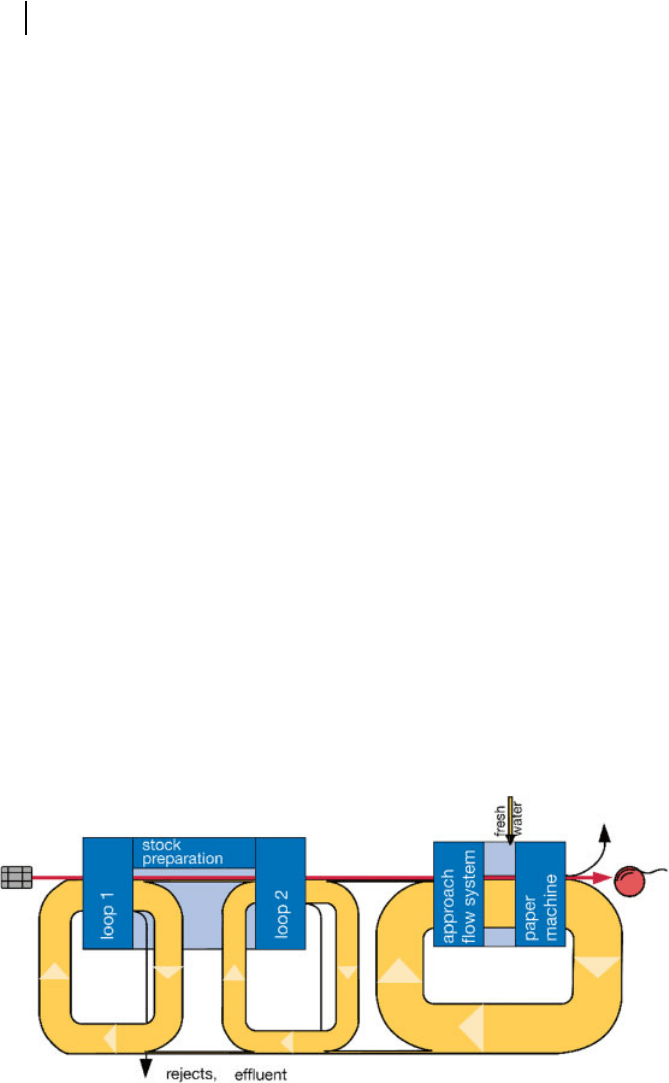
water containing detrimental substances. A water circuit system of a paper mill
usually includes different water loops (Fig. 5.1):
• Paper machine (PM) loop including the approach flow system and the white
water systems I (WW I) and II (WW II)
• One or two (in special cases, such as market DIP (deinked pulp) production,
sometimes even three) water loops in the stock preparation.
Fig. 5.1 Water loops in a paper mill (source: Voith).
5 Water Circuits
210

End-of-pipe treatment for bled-out water is carried out in waste water treatment
plants which are either owned by the mill or the public (see Section 10.1). In a few
cases mills have completely closed their water circuits, meaning there is no waste
water produced at all and fresh water therefore is only fed at the same volume rate
(approximately 1.5 l (kg paper)
–1
) as it is removed by evaporation in the dryer
section of the paper machine and with the rejects leaving the mill.
Due to the challenges mentioned above, water management is an absolute must
for every modern paper mill. Some main principles have to be followed in order to
manage the water circuit system successfully:
• Efficient loop separation, i.e. transferring stock from one process loop to the
following one only at high consistency (preferably 30%), which means at low
water content, in order to avoid, to the greatest possible degree, transferring
detrimental substances from one water loop to the following one.
• Application of counter current flow, meaning fresh water is added only at the
paper machine, excess water from each loop must only be sent backwards and
waste water is disposed of only from the first loop in fiber preparation (lowest
quality water).
• No mixing of water from different production lines in mills where more than
one paper machine is operated
• No mixing of water from different fiber preparation lines and/or pulp prepara-
tion plants
• Use of kidney technologies for removal of solids and/or detrimental sub-
stances
• Adequate sizing of the water buffers for each water loop in accordance with the
stock storage volumes for avoiding uncontrolled overflows in start-up, shut-
down or paper machine sheet break situations.
5.4.1
White Water Circuit System
The white water circuit of a paper machine, also called the paper machine loop,
consists of the white waters I (WW I) and II (WW II) and the save-all unit. White
water I, coming from the wire section, is used to directly dilute the main stock flow
after the machine chest in the approach flow system and for profile control in the
headbox. Whitewater II originates also from the forming section but additionally
from the press section (after removal of felt hairs, usually with a bow screen), from
broke thickening and from the overflow of white water I. White water II is sent to
a buffer tank and from there it is used at the end of stock preparation to dilute
stock from high consistency (12–30%) to storage consistency (4–12 %) and for
slushing and diluting broke. A defined amount of white water II, preferably the
majority of it, plus the trimmings from the forming section are fed to the save-all
unit. Save-alls have a dual function: stock recovery and water clarification. Most of
the modern paper machines are equipped with a disc filter save-all treating a cer-
tain volume of white water II by filtering it through a fiber mat. This mat is formed
by adding a so-called sweetener stock to the white water II filter. For sweetener
5.4 Water Circuits 211