
Holik H. (ed.) Handbook of Paper and Board
Подождите немного. Документ загружается.

technical and social evolution and developments in the individual countries and in
the world as a whole.
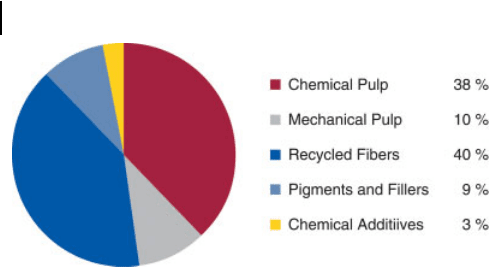
The components used in paper and board production worldwide are given in
Fig. 1.1. Today recovered paper has become the main resource for paper and board
production, followed by chemical pulp, mechanical pulp, pigments and fillers, and
chemical additives. Paper is mainly based on fibers from cultured woods, and is a
renewable and recyclable raw material. The special characteristic of this fiber mate-
rial is that the paper strength results from the hydrogen bonding between the
individual fibers. In certain cases it is enhanced by the addition of starch or wet
strength additives. The hydrogen bonds are loosened by rewetting the paper which
allows easy recycling.
Increased paper recycling and sustained foresting help to preserve the wood
resources of the earth. The paper industry has steadily improved its standards in
complying with environmental demands as related to water consumption and wa-
ter effluents, energy consumption, and primary (and secondary) fiber consump-
tion. These standards have to be maintained and even improved in the future
because of further increasing paper and board consumption and limited resources.
The paper and board market is global, and so is the paper industry where an
evident consolidation has occurred over the last decades: In 1980 the 150 biggest
companies contributed about 45% to the overall production, in 2000 this figure
was about 70% in a market which had nearly doubled from about 170 million
tons/year to about 320 million tons/year. It seems that this concentration process
has not yet come to an end.
Papermaking has changed from an “art”, where all specific processes were kept
secret, to an industry with high-tech production facilities and with a scientific
approach. Great challenges are e. g. the huge production quantities per unit and
the high quality demands placed on the paper and board properties and their
uniformity. Only high quality products – at low price – satisfy the expectations of
the customer and end user.
Since paper is a commodity, low cost production is mandatory. As the fiber raw
material is the main cost factor in paper production recovered paper has become
Fig. 1.1 Components used in paper and board production
worldwide (by mass ratio).
1 Introduction
2

the main fiber stock material worldwide and its proportion will increase further.
Several grades, such as newsprint and many packaging and board grades, can be
entirely based on recycled fibers. Today recovered fibers must be used in paper
grades similar to the recovered paper grade, downgrading of recovered paper (high
quality fibers for lower quality paper products) is no longer economic.
In former times, with mainly virgin fibers consumption, a paper mill was lo-
cated close to the wood (and the water and energy resources). This is still true for
regions of Portugal, Spain and Brazil with Eucalypt plantations used mainly for
copy or similar paper grades. One result of the increased use of recovered paper is
that certain new “green field” paper mills are established today in the vicinity of
highly populated areas to have easier access to recovered paper resources and to be
closer to the market.
The capital demand for a new mill is of the order of magnitude of 500 million €.
In the last thirty years the investment costs (inflation-adjusted) related to the spe-
cific annual production (t/a) have been approximately halved. This drop is mainly
due to increased machine speeds and machine widths as well as to improved
runnability. On the other hand the investment costs related to annual turnover
have remained constant or even increased.
1.2
Overview of the Manufacturing Process for Paper and Board
Papermaking today includes, in principle, the same process steps as applied for
centuries: preparation of the fiber material, sheet or web forming, pressing, dry-
ing, sizing and smoothing. However, in the last two centuries much of the detail
has changed. Each process step has undergone – and still undergoes today – in-
tensive research and development work to meet economic and ecological require-
ments. All links in the chain between fiber and end user contribute to this pro-
gress. The chain does not only include the paper producing industry itself and its
suppliers such as the machine and chemical industry, but also the paper industry’s
customers and related industries, e.g. printing-houses, printing ink and printing
machine suppliers and the manufacturers of corrugated board.
R&D focus has been on economic and environmental aspects such as
• reduction in consumption of raw material, energy and water as well as noise
reduction
• high machine runnability and long lifetime of machinery and its components
• improvement of paper and board quality with respect to improvement of con-
verting quality
which has led to results of high practical value such as
• better understanding and consequent control of the whole process in a narrow
band
• reduction in fiber consumption by reducing basis weight at the same quality
level and practical value
1.2 Overview of the Manufacturing Process for Paper and Board 3

• increased ratio of recycled fibers in graphic paper production, with up to 100%
for newsprint and a growing ratio in high grades such as supercalendered (SC)
and light weight coated (LWC) papers
• fillers and coatings replacing part of the expensive fiber material and improving
quality
• new coating and calendering technologies
• higher safety in Yankee dryer and suction press roll operation
• new methods of material design for fighting wear of machine components
• minimum number of personnel involved in the paper and board production
process.
R&D work is supported by modern tools and sciences e.g.
• process analysis using advanced measuring and analysis techniques
• process simulation and advanced control techniques
• morphological characterization of fibers for papermaking
• chemistry developing functional and process chemicals
• finite element method (FEM) and computational fluid dynamics (CFD)
• visualization techniques in the micro- or nano-ranges, video documentation and
analysis
• material sciences including plasma ions implantation into the base material at
low temperatures.
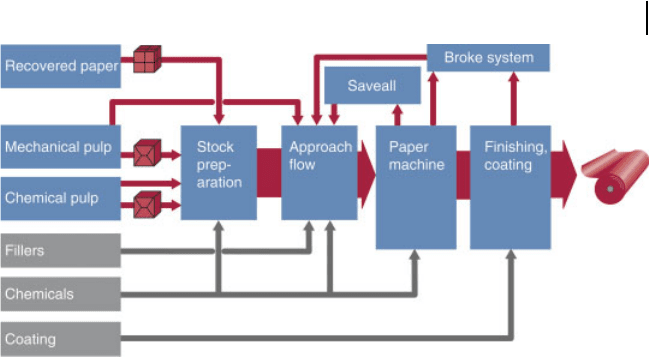
The papermaking process (Fig. 1.2) starts with the delivery of the raw material of
the stock components. These are
• fibers such as
– virgin pulps (chemical or mechanical) which are usually supplied in bales or,
in special cases, as a suspension when both pulp and paper are manufactured
at the same location (integrated processing)
– recovered paper in bales or as loose material
• fillers and pigments
• chemical additives
• coating colors when coated paper is produced.
All these components have to be adequately prepared for optimum use in the
papermaking process steps. The additives may be delivered ready for use or may
have to be finally prepared according to the requirements in the mill. Fiber stock
preparation includes several unit operations depending on the furnish and the
purpose. Stock preparation of virgin fiber pulp needs less machinery and energy
than the preparation of recovered paper which, however, is the cheaper raw mate-
rial. Fiber stock preparation ends at the paper machine chest. Here stock of high
consistency is preferred to minimize carry-over of chemicals and contaminants.
Stock preparation is followed by the approach flow system connecting stock
preparation with the paper machine. Its main tasks are
• to dose exactly and mix uniformly all the different components of the final sus-
pension to be delivered to the paper machine
1 Introduction4
• to supply a continuous suspension flow of constant consistency, quality and flow
rate at constant pressure to the headbox of the paper machine.
The approach flow system ends at the distributor of the headbox.
The task of the paper machine is to produce paper or board of the quality re-
quired by the end user – or by the intermediate process steps such as converting or
printing. The paper and board properties have to be uniform in machine direction
(MD) as well as in cross machine direction (CD). Further, the paper machine has to
make the best use of the quality potential of the entering stock. The paper machine
includes
• the headbox distributing the suspension across the machine width onto the
wire
• the wire section where the suspension is formed into an endless web by dewa-
tering
• the press section pressing water out of the web by mechanical means
• the dryer section where the residual water is evaporated
• often a sizing unit where starch, or pigments are transferred onto the web
• sometimes a coating section where coating color is applied to the web
• the calender to finally smooth the paper or board surface.
The paper manufacturing process ends with the paper web being reeled at the
reeler at full width.
By tradition and technical feasibility, coating and supercalendering for surface
quality improvement have been off-line processes. Today both are increasingly
integrated into the paper machine. The final activities in paper and board produc-
tion are slitting of the full width reels into smaller rolls at the winder followed by
packaging the rolls for shipment.
Fig. 1.2 Overview of the paper making process.
1.2 Overview of the Manufacturing Process for Paper and Board
5

Paper broken during the manufacturing process has to be recycled and fibers are
recovered from the white water of the paper machine in a saveall. White water is
fed back from the paper machine to the approach flow system and stock prepara-
tion. Fresh water is supplied to the paper machine.
Along the paper production line stock consistency varies according to the re-
quirements of the unit operations. Unfortunately the terms low, medium and high
consistency relate to different consistency numbers depending on the actual unit
operation (Table 1.1). It is also important to note whether the number gives the
overall consistency including fibers and fillers or just fibers.
1.3
Historical Background and General Aspects [1]
Peter F. Tschudin
1.3.1
Introduction
Paper is defined internationally as a thin layer of mostly cellulosic plant fibers,
produced on a screen by dewatering a slurry of fibers in water [2]. The slurry is
called pulp. Despite recent developments (proteinic or synthetic fibers, chemical
additives, coating, etc.) the “cellulosic plant fiber” will be the main, not exclusive,
component of paper, and water will be used in preparing the pulp and in forming
the paper web also in the future.
Table 1.1 Different naming of consistency ranges in the
various unit operations in paper making.
Unit operation Actual consistency
LC (%) MC (%) HC (%)
(low consistency) (medium consistency) (high consistency)
Repulping < 6 < 12 12–28
Screening < 1.5 < 4.5 –
Centrifugal cleaning < 1.5 < 2.5 2.5–6
Bleaching – 10–15 25–35
Refining 3–6 10–13 28–35
Web forming (headbox) < 2.0 – > 2.5
1 Introduction6

1.3.2
Precursors of Paper
1.3.2.1 Tapa (Bark-cloth)
Bark-cloth, made since prehistoric times, is found widely along the Equator belt in
nearly all cultures, used mainly for decorating and clothing [3]. It is produced by
beating or pressing the inner bark (liber, bast) of trees and shrubs like paper mul-
berry, lime-tree, fig or daphne, and is known by the generic term “tapa”, derived
from the Polynesian language. Tapa is a felt-like material, similar to thick woven
paper, showing in most cases traces of the beating mallets. Technically speaking, it
is a kind of non-woven paper.
There are three different techniques to be observed in tapa-making. The most
sophisticated method consists of three steps. In the first, small strips of bast are
cut and cooked for several hours in suds of wood ash. This cooking is very similar
to the basic operation of our alkaline pulping. Then the strips are rinsed, placed
together on a wooden board and beaten with a mallet, thus forming a small sheet
on the board. The third step consists of drying and smoothing.
1.3.2.2 Felt
Felting techniques go back into prehistory [4]. Plant fibers or animal hair are sepa-
rated from their original linking as much as possible and spread in thick layers
onto a cloth or mat. Then they are covered by another cloth and beaten by foot
stamping or with heavy wooden sticks to entangle them and stick them together.
In another way, the ground mat bearing the fibers is rolled and the roll is beaten.
The mat is unrolled and rolled again several times. In wet felting, water is used to
soak the fibers and help felting.
1.3.2.3 Papyrus
Papyrus, the most commonly used writing material of Ancient Egypt and Classical
Antiquity, was made in Egypt from the beginning of the 3rd millennium BC. The
triangulated stem of the papyrus plant is peeled and the pith cut into thin, small
strips. A first layer of wet strips placed vertically side by side with a slight overlap is
laid onto a board. Then, a similar layer of horizontally oriented stripes is laid above
it. Beating with wooden sticks and pressing the still wet layers leads to a sheet of
entangled fibers, most remaining in the original linking of the pith. After drying
and smoothing several sheets are glued together to form a roll, ready to be written
on. Gluing of several papyrus sheet fragments, usually recycled material, results in
board or papier-mâché.
New papyrus rolls are very strong and flexible, an ideal writing material. They
were exported in large quantities into the Mediterranean area until the 8th century
AD. Parchment replaced the dwindling supply from Egypt. When paper was im-
ported from the East, it was given the name of the Egyptian writing material
because of its resemblance to papyrus.
1.3 Historical Background and General Aspects 7

1.3.3
Paper
1.3.3.1 Invention of Paper
The oldest papermaking technique, pouring pulp into a primitive mould, is still in
use at a few locations in the Himalayas, in some remote spots of China and in
Southeast Asia. It shows clearly the descent from tapa and felting techniques.
From recent findings of the oldest papers in Chinese tombs or in refuse heaps of
military posts it must be concluded that some kind of paper was produced in
China since the final centuries BC. Nevertheless, the Chinese chronicles state that
in 105 AD in Loyang, the court official Cai Lun invented papermaking from textile
waste, i.e. from rags, and propagated paper as a writing material [5]. This was the
birth of paper as we know it today.
1.3.3.2 Chinese Paper
Chinese papermakers improved the effectiveness of the production, replacing the
pouring technique by dipping the bamboo screen into a vat filled with diluted pulp.
After lifting the mold out of the vat and dewatering, the newly formed sheet of
paper was immediately couched on a wooden board or a plastered wall to let it dry.
The flexible bamboo screen was rolled off and could be reused with the vat. Thus,
the handicap of waiting until a sheet dried on the mold, was surmounted. Because
of rag and paper mulberry shortages, they chose bamboo as a further source of
fiber [6] the pulping of which took several months.
China developed many kinds of specialty papers (sized, coated and dyed paper;
anti-moth paper; waterproof paper); over-size sheets were made by couching the
wet borders of smaller sheets together, and decoration watermarks were added by
putting leather or board figures on the screen before pouring the pulp. Paper
served for almost everything: writing, drawing, wrapping, clothing, protection
from wind and rain, decoration, windows, even for making balloons and kites,
and, last but not least, for making paper money or special currency to be burned in
honor of the ancestors.
1.3.3.3 The Eastern Spread of Papermaking
Chinese papermaking techniques were introduced into Korea at an early date, and
reached Japan in 610 AD. In both countries, fibers of the paper mulberry were
mainly used. In Japan, splash dipping was developed, using a big mold suspended
on a teetering twig [7]. Japanese papermakers were fond of art papers for decora-
tion purposes. The ultimate in Japanese papermaking was the production of Shifu,
paper yarn woven into heavy, beautiful fabric.
1 Introduction8

1.3.3.4 The Spread of Papermaking into Central and Southern Asia
At an early date (4th to 6th centuries AD), it is attested that there were Chinese
papermakers in Central Asia along the Silk Road, using the very old technique and
local fiber plants like black mulberry. There, Tibetans learned the papermaking
craft and transferred the knowledge into the high valleys of the Himalayas where
they used local plants like the roots of Stellera Chamaejasme. From Southern
China, the old-fashioned pouring technique spread into the emerging kingdoms
of South Eastern Asia. India kept its traditional use of bark, textile cloth and palm
leaves as writing materials for a long time. Only at a later period (11th century
AD?), was papermaking introduced from the north through contacts with Central
Asia and Persia [8].
1.3.3.5 Arab Paper
The Arabs, in the course of their eastern expansion, became acquainted with the
production of the new writing material reaching Samarkand. Subsequently, paper-
mills were set up in Baghdad, Damascus, Cairo, and later in the Maghreb. Having
no paper mulberry trees and using screens made of reed, the Arabs made thin
sheets of poorly beaten rag pulp and coated them on both sides with starch paste
(from wheat or rice) which could be colored. This gave Arab paper its good writing
properties and its fine appearance but also made it prone to damage due to humid-
ity, crumbling or insects. In the 11th century AD, Arab papermaking knowledge
spread into the Byzantine world and into medieval Europe, especially Spain (Xa-
tiva, Cordoba) and Italy (Amalfi, Genoa).
1.3.3.6 Medieval European Paper
Papermakers from Genoa and Fabriano tried to improve the Arab technique. They
still exploited linen or hemp rags to get pulp, but improved the beating. Water
power was used to drive heavy stamping mills, huge oak trunks comprising four to
six large troughs with three or four heavy wooden stampers each beating the rags
in fresh circulating water. The rags were transferred from trough to trough every
six hours to ensure a better degree of refining. Further improvements were molds
consisting of a wooden frame with inlaid copper or brass wire, heavy screw
presses, and the replacement of starch sizing by dip sizing in animal glue.
This is the origin of the division of labor leading to a considerable increase in
production: Work at the vat normally involved four people: the vatman, who made
the sheet using the mold; the couchman working alongside the vatman, placing
the sheet on felt; the layman, who removed the moist sheets from the felts, and the
apprentice, who had to feed pulp to the vat and provide vat heating. The press was
operated jointly by this team. Depending on the format, up to nine reams (4500
sheets) of paper were made during a working day averaging 13 to 15 hours. The
paper was dried by women hanging it on ropes in the drying loft. Apart from
different sizes, three main sorts of paper were produced: writing paper (for letter
and chancery use), printing paper (mostly unsized) and cheap wrapping paper
(also broke, screenings), used also for drafts.
1.3 Historical Background and General Aspects 9

As a further consequence of the change in mold construction, watermarking
was invented in medieval Italy. The real watermark, a bright figure in the paper
sheet, is seen by the naked eye. In hand papermaking, it is formed by a curved wire
which is sewn onto the screen of the mold; the wire reduces the thickness of the
sheet, thus making the figure transparent. The watermark serves as a trademark
and provides the historian with an unsurpassed dating and authenticating tool. By
comparing a watermark with others of a certain date or origin, the paper historian
will be able to determine the age and origin of a document or print. Shadow
watermarks are produced on a mold bearing a fine, embossed woven wire, show-
ing an image like a black and white photograph.
1.3.3.7 Mechanization and Industrialization
In Europe, technical progress continued. In the 16th century, glazing the sheets by
hand using a glass or stone burnisher was supplemented by the use of the glazing
hammer, similar to a forging hammer. Towards the end of the 17th century, a most
efficient tool, the so-called “hollander” beater, supplemented or even replaced the
stamping mill. As the rotating knives of the Hollander beater cut and shorten the
fibers more than a stamper, the ageing of paper was accelerated. This phenome-
non is true also for the change in sizing. To improve the solubility and the penetra-
tion of the animal glue solution, alum was added, leading to acidic deterioration of
paper.
Further development of printing during the 18th and 19th century led to a
steeply rising demand for paper, especially for new printing grades. This and the
tremendous upsurge in papermaking soon led to a serious shortage of raw mate-
rial and to regulations governing the trade in rags, to ensure the local production
of paper for administrative purposes. Rags of minor quality, even cotton and wool
were used, together with fillers like starch or kaolin. So systematic search for rag
fiber substitutes was needed [9].
Since the 17th century, there had been some concentration of handicraft activ-
ities in big factories, consisting of several mills, which still depended on skilled
papermakers organized in open guilds. The efforts made to improve paper quality
(woven wire molds since 1738) and to step up production as much as possible
employing local people and developing auxiliary mechanical means (rag cutter, rag
digester, hollander beater, vat paddles, strainers, couching press, hydraulic press,
glazing table, glazing hammer, calender) culminated in the design and construc-
tion of paper machines.
1.3.3.8 Paper Machines
A Frenchman, J. N. L. Robert, built the first paper machine, patented in 1799. It
was driven by one worker using a crank. The diluted pulp contained in a large vat
was hurled into a wooden chest by a rotating paddle wheel and directed onto an
endless wire screen of laid type. The screen bearing the forming paper web was
moved forward, horizontally shaken and passed a pair of couch rolls equipped with
1 Introduction10

felts. The web, still moist, was then taken by a worker and cut into large pieces
which were hung on ropes to dry.
This machine was further developed in England by Bryan Donkin and by the
Fourdrinier brothers. Soon, other types were developed, e.g. the cylinder machine
(Bramah, 1805; Dickinson, 1809) in which a cylinder with mounted wire-screen
rotates in a vat filled with pulp. Other types were the mold-chain machine (Four-
drinier, 1806) and the twin-wire machine. Flat-type and cylinder machines gained
ground in the 19th century and were extended to include a dryer section (Cromp-
ton, 1820) and a reeler, somewhat later (1850) also a calender section. Steady im-
provements led to a considerable increase in production. The paper machine her-
alded industrialization. In this new situation, the small operators who were unable
or unwilling to afford machines tried to survive with piece work or by producing
special grades and cardboard, but they were sooner or later compelled to discon-
tinue their activities. Others had to adapt their existing buildings or set up new
mills elsewhere.
The decisive step in developing the US paper industry was initiated by Joshua
Gilpin (1815). Special paper machines were successfully built (e. g. the so-called
“Yankee” cylinder machine), and soon the US paper production became the largest
in the world.
1.3.3.9 Pulping and Sizing
In European medieval papermaking, the rags were moistened and exposed to air
in order to rot for weeks before beating (fermentation). This helped to dissolve dirt,
yarn knots or knit links and was equivalent to a modern enzymatic fiber treatment.
During beating, slaked lime was added to the slurry, which resulted in fiber swel-
ling, fiber bleaching and improved fiber separation and quality [10]. Even after
washing and beating, particles of calcium carbonate and magnesium carbonate
remained sticking to the fibers and got into the vat and into the paper sheet. There,
they acted as a buffer, neutralizing acids and thus inhibiting the ageing of old
hand-made papers.
In the 18th and 19th centuries, efforts were made to improve the efficiency of
rag pulping. Rag cutting machines and rag digesters replaced old-fashioned break-
ing and boiling. The stampers were replaced by the hollander beater and later by
refiners. To obtain rag substitutes on an industrial scale, in 1774, Claproth in
Leipzig promoted de-inking, using a kind of bentonite. Straw was propagated as a
raw material but failed because of poor paper quality (Koops, 1800). Only the
invention of the stone groundwood process (Keller, 1843) and of chemical pulping
(soda process: first patents, 1851: Watt, 1854: Mellier; sulfate process: Dahl 1884;
sulfite process: Tilghman 1866) solved the problem of getting large fiber quan-
tities.
Dip sizing of paper bundles in a solution of animal glue was replaced by pulp
sizing, using rosin and alum (Illig, 1807). The resulting acid conditions in paper-
making are in a large part responsible for the poor ageing behavior of machine-
made paper until the 1980s, especially of wood-containing grades in which lignin
reactions are triggered.
1.3 Historical Background and General Aspects 11