
Holik H. (ed.) Handbook of Paper and Board
Подождите немного. Документ загружается.

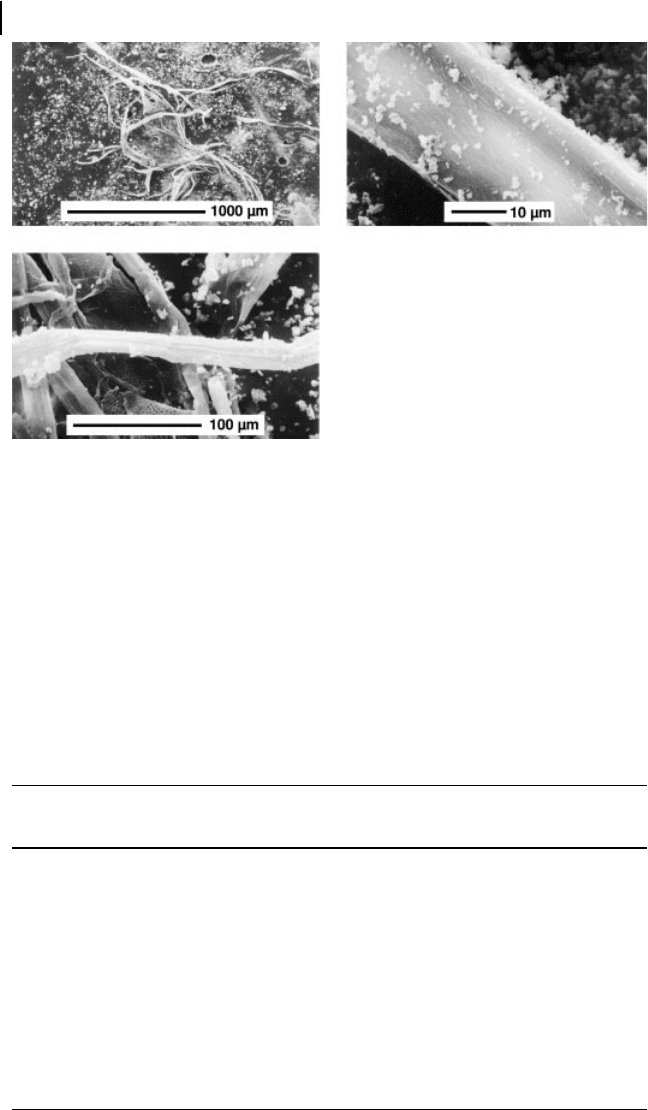
Figure 2.14 indicates the size relation between the GCC filler particles and the
fibers in the sheet. As is clearly demonstrated, the filler particles are much finer
than the fiber and, in particular, much smaller than the voids between the fibers.
In the papermaking process, most of the original filler particles form agglomer-
ates or flocculates, by addition of different flocculating wet end additives. The
degree of flocculation can be optimized by careful handling of the wet end chem-
istry. To obtain a highly uniform sheet, any excessive flocculation, of course, needs
to be avoided.
In general the optical properties provided by a filler are also strongly influenced
by its particle size and particle size distribution. Finer fillers, within limits, as well
Fig. 2.14 Scanning electron micrograph
pictures of natural ground calcium carbon-
ate filler and chemical pulp fibers in a paper
sheet (source: OMYA).
Table 2.6 Light scattering (m
2
kg
–1
) of major fillers, specialty
pigments and virgin pulps.
Material Light scattering
(m
2
kg
–1
)
kaolin hydrous 70–120
GCC 140–190
PCC 210–270
calcined clay 200–300
titanium dioxide 450–650
silicates/silica 280–340
chemical pulp 20–45
mechanical pulp 50–70
2 Raw Materials for Paper and Board Manufacture42

as steeper particle size distribution curves (more particles of similar optimum size)
produce more light scattering, hence more opacity. Table 2.6 gives some typical
light scattering ranges for major fillers, specialty pigments and also, for compar-
ison, for some virgin pulps. However, finer fillers exhibit a more negative impact
on paper strength properties than relatively coarse pigments of the same weight
proportion. Non-platy large particles tend to be released out of the paper surface
more easily than smaller particles resulting in, for example, more blanket piling in
the offset printing process or the contamination of a copy machine.
2.2.1.3.5 Specific Surface Area
Usually the specific surface area is measured by the nitrogen-adsorption method
(BET: Brunauer, Emmet, Teller). The particle fineness, the particle size distribution
and the particle morphology are, depending on the structure, indirectly reflected in
the specific surface area of a filler. Finer nonstructured fillers exhibit a higher
specific surface than coarser ones. There is a general direct correlation of the
specific surface area of a filler and, for example, the internal sizing agent demand.
Internal sizing agent is applied to the wet end in order to make the paper more
hydrophobic. The specific surface area of regular paper fillers ranges between 4
and 12 m
2
g
–1
. Typical papermaking fibers exhibit a specific surface area between 1
and 2 m
2
g
–1
, while fiber fines show specific surface areas of 6–8 m
2
g
–1
. As one
consequence, increasing the filler loading level usually significantly increases the
additive demand, i.e. sizing agent, dyes etc. Specialty pigments applied as filler can
reach specific surface areas as high as 70–80 m
2
g
–1
.
2.2.1.3.6 Particle Charge
The fillers applied need to be understood as part of the rather complex wet end
chemistry in the papermaking process. The electrostatic charge (zeta potential),
which surrounds the pigment, can be anionic or cationic. Depending on the type
of filler, its origin, the specific chemicals applied in the production process and the
dispersing treatment, the charge density can be on a quite different level. To obtain
a good stabilization of a filler slurry, the dispersant applied needs to be highly
charged. Typically the salts of polyacrylic acid are applied for this purpose of elec-
trostatic stabilization as these provide the pigment surface with a distinct anionic
charge. Low molecular weight and high charge density polydadmac, modified poly-
ethylenimine or polyvinlyamine etc. can be used, for example, to develop a distinct
cationic slurry stabilization.
The charge density of a filler slurry is of particular importance in the context of
selecting the most suitable retention aid system. Today there are many retention
systems available and the most suitable one has to be found for each individual
filler application. The ordered addition of multi-polymer retention aid systems
and, in particular, so-called microparticle systems offers efficient tools to retain
anionic stabilized filler pigments at high production speeds effectively. Cationically
charged, partly self-retaining, fillers are no longer much in use, one reason being
2.2 Non-fiber Raw Material 43
the potential for quenching the commonly applied negatively charged optical
brightening agents.
5.2.1.3.7 Abrasiveness
The abrasion potential of fillers is influenced by the particle structure, the particle
fineness and the particle hardness. Relatively coarse platy pigments tend to be less
abrasive than non-platy ones of similar size. Increasing the filler fineness de-
creases the wire abrasion potential significantly. This is particularly pronounced
when testing non-platy pigments. Large size non-platy impurities such as quartz
increase the wire abrasion excessively. Any pigment which is harder than the syn-
thetic wire, commonly installed in the paper machine, potentially initiates wear on
the wire.
There are different laboratory methods of determining the potential abrasive-
ness of a filler. The most modern unit is the Einlehner AT 2000 abrasion tester.
This instrument works by using a cylindrical ceramic body with specific slots and a
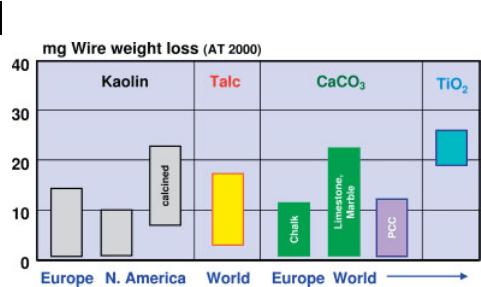
wire made of synthetic filament. Figure 2.15 compares different paper fillers on a
global basis by this specific method. Again, because of differences in the raw
material used, the processes applied and the differences in particle fineness, abra-
sion ranges are presented as being indicative only.
Practical experience collected in recent years has shown, that wire abrasion is
greatly influenced also by the conditions on the paper machine. In general, lower
filler retention potentially increases wire wear. The wire drag load should be mini-
mized, for example, by a low number of stationary drainage elements and opti-
mized low vacuum loads. The dry suction box ceramic surfaces should display a
low surface porosity and should be well maintained [3].
2.2.1.4 Main Mineral Fillers
The main mineral fillers (in terms of quantity applied) are kaolin (hydrous), GCC,
PCC and talc.
Fig. 2.15 Indicative abrasion ranges of various paper fillers
(measured by laboratory (source: OMYA), method Einlehner
AT 2000).
2 Raw Materials for Paper and Board Manufacture
44
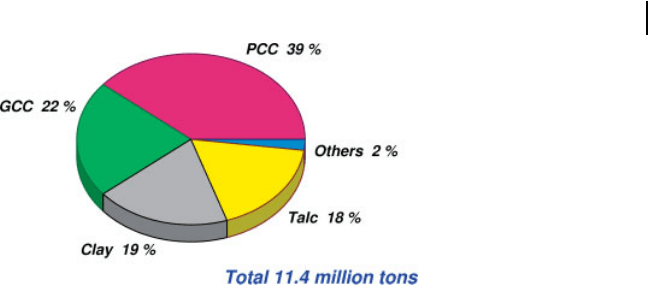
Figure 2.16 depicts the global consumption of the different main types of virgin
fillers applied in papermaking. The data refer to the market situation in the year
2004. The share given for talc includes the use of talc as filler as well as its applica-
tion as a pitch control agent. Globally in 2004, the paper industry consumed 29
million tons of pigment for coating and filling. As indicated in Figure 2.16, for
filling purposes alone, 11.4 million metric tonnes were used.
With the use of recovered paper in papermaking (e.g. for newsprint, SC-B,
board, etc.) a substantial amount of secondary pigment is transferred into the new
paper. This recycled pigment also acts as a filler. However, as the pigment is mostly
agglomerated and the composition varies by nature, the resulting impact on paper
quality is somewhat inconsistent. Recycled pigment cannot meet the quality and
the range of functionality, as provided by the specifically designed virgin fillers.
2.2.1.4.1 Kaolin (hydrous)
This is used today predominantly in wood-containing uncoated papers (super cal-
endered magazine papers, catalogues etc.) [4]. Kaolin deposits can be found at a
number of major sites around the globe as a result of metamorphosis granite
outcrops. The largest ones, from which paper fillers are extracted, are located on
the South East coast of the United States (mainly secondary deposits) and in Corn-
wall in the South West of the United Kingdom (primary deposits). Primary kaolins
are those which are found at the places where they were originally formed and are
accompanied by the original matrix including partially altered and residual materi-
als. Secondary kaolins have been moved from their place of origin and by pro-
gressive sedimentation become deposited at a different location. Other kaolin de-
posits of commercial interest occur in Russia, Central Europe (Czech Republic,
Germany, France, Spain) (all primary), Australia (secondary), China (primary, sec-
ondary) and Brazil (secondary). Due to the presence of a very high ratio of kaolin,
exploiting a secondary deposit source requires less processing than drawing from
a primary deposit.
Fig. 2.16 Global paper filler (kaolin, GCC, PCC, talc and
others) consumption in 2004 (source: OMYA).
2.2 Non-fiber Raw Material
45
Kaolin processing involves purification of the kaolin-containing raw material by
several techniques including mechanical classification, grinding, bleaching, mag-
netic separation and flotation. Kaolin is supplied as a slurry or dried in powder
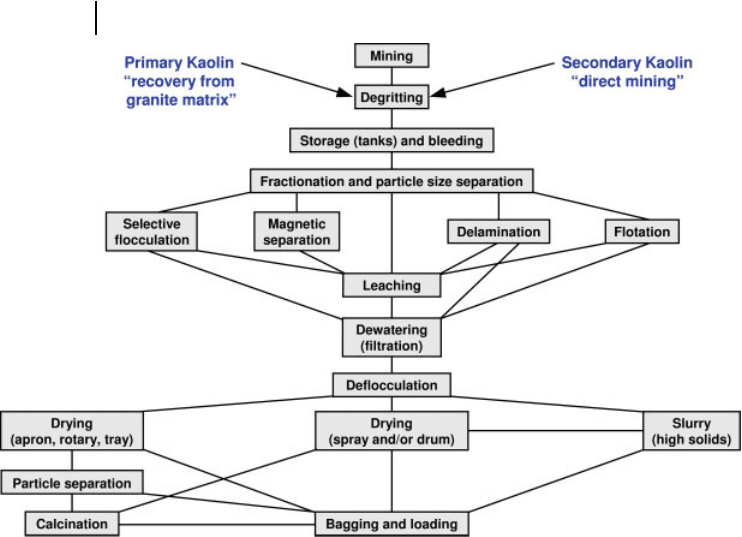
form (spray dried or in crumbles). Figure 2.17 shows a generalized flow sheet for
the wet processing of kaolin, based on primary and secondary deposits.
The aspect ratio or platyness of kaolin is strongly dependent on the geophysical
nature of the deposit. The aspect ratio expresses the relationship of the major
diameter to the platelet caliper. Secondary kaolins tend to be of lower aspect ratio;
some Brazilian examples, however, are exceptions to this rule. Primary Cornish
kaolin, for instance, has an aspect ratio of 25–40:1, compared to Georgian kaolin
with an aspect ratio of 12–25:1). The aspect ratio distribution throughout the vari-
ous size ranges is also an important attribute of kaolin, with the presence of bento-
nite or montmorillonite at the fine end of the particle size distribution being a
particular feature of some clays. The hexagonal crystalline platelets of kaolin pro-
duce a high gloss of the finished paper after calendering. This gloss development
also depends on the degree of delamination, i.e. the extent to which the platelet
agglomerates or stacks are broken into individual platelets. Due to its chemical
composition, kaolin can be used as a filler in both acid and alkaline papermaking
environments.
The brightness of regular filler kaolin is distinctly lower than most CaCO
3
based
fillers. For this reason, in recent decades, kaolin has been largely replaced globally
Fig. 2.17 Flow sheet for the wet processing of kaolin (source:
H. Murray).
2 Raw Materials for Paper and Board Manufacture
46

by CaCO
3
fillers in wood-free uncoated papers. Due to the continued growth of the
higher brightness SC paper market (super calendered uncoated magazine paper,
catalogues etc.), kaolin is being increasingly combined with or replaced by high
brightness calcium carbonate based fillers in this area.
2.2.1.4.2 Natural Ground Calcium Carbonate (GCC)
This is predominantly applied in wood-free uncoated paper, mechanical uncoated
papers (usually in combination with kaolin), coating base papers, newsprint and
white top liner board.
Natural CaCO
3
constitutes the most frequently occurring type of sedimentary
rock on our planet. It covers about 1% of the earth’s crust. Natural CaCO
3
occurs
in three major geological modifications. Chalk was and is formed in the oceans
through biomineralization and the reactions of calcium salts with the CO
2
in the
air. By geological transformation (pressure) and thermal metamorphosis (heat and
pressure), it is modified into limestone and marble.
Natural CaCO
3
for the paper industry is processed at numerous locations
around the globe: for example, in North America (Vermont, Canada, British Co-
lumbia, Alabama), in Europe (Norway, Finland, France, Spain, Germany, Austria,
Italy, Turkey), in the Far East (South Korea, Taiwan, Indonesia), in Australia and
New Zealand. In addition there are active plants located in Latin America (Mexico,
Chile, Brazil), Russia, China and South Africa [5].
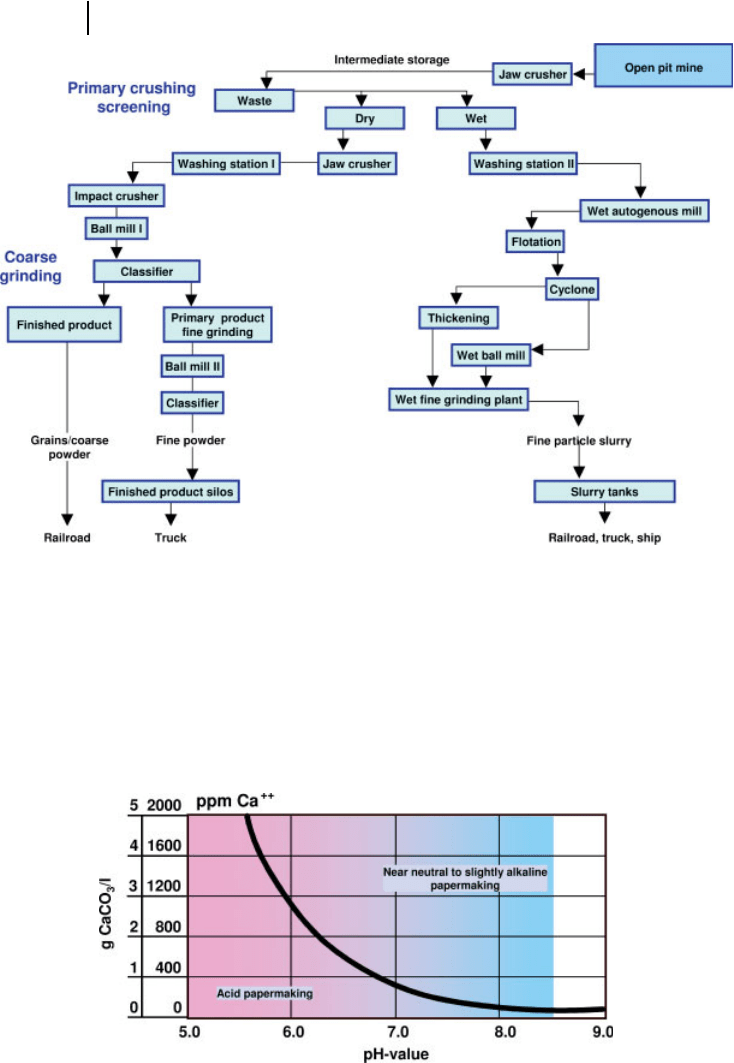
GCC fillers are produced by pre-washing the raw material, followed by grinding,
fine grinding and screening the product. Undesired impurities in the raw material
are removed by magnetic separation and flotation. Figure 2.18 shows a typical
production process flowchart for GCC fillers, based on limestone or marble raw
material.
The production, shipping and application of GCC fillers in wet (slurry) form has
become by far the most preferred practice. GCC filler slurries exhibit a solids
content of 65–72% (by weight) and are usually stabilized by using an anionic
grinding and dispersing agent. Specifically, cationically stabilized GCC filler prod-
ucts are also available.
The structure of GCC filler is rhombohedral. Because of the high brightness
demand, GCC fillers based on limestone and marble are preferred by the paper
industry. Lower brightness chalk is increasingly used as a filler in the production of
regular newsprint, where there is less demand for brightness. The fineness of
GCC fillers for paper is generally much greater than kaolin based fillers, partic-
ularly those sourced from primary kaolin deposits. This is required, for example,
for obtaining high light scattering, low abrasiveness and low dusting out of the
paper surface in the printing process.
CaCO
3
is soluble under acid conditions, and therefore requires a near-neutral or
slightly alkaline pH papermaking environment [6]. To be able to use CaCO
3
as a
filler and/or as a coating pigment, numerous paper and board mills around the
globe have converted their wet end systems from acid to neutral and slightly alka-
line pH. Historically, paper was mostly produced at acid pH (< pH 7). Paper pro-
2.2 Non-fiber Raw Material 47
duced in such a manner decomposes relatively quickly and therefore presents a
serious problem for the conservation of documents in libraries etc. Complicated
and expensive measures are applied to save valuable documentation printed, un-
fortunately, on acid made paper. Wood-free paper, produced in the slightly alkaline
mode and containing some CaCO
3
filler for buffering, exhibits a dramatically im-
Fig. 2.18 Flow sheet for the processing of natural ground cal-
cium carbonate (source: OMYA).
Fig. 2.19 Solubility of calcium carbonate (CaCO
3
) versus pH
of the environment (source: OMYA).
2 Raw Materials for Paper and Board Manufacture
48
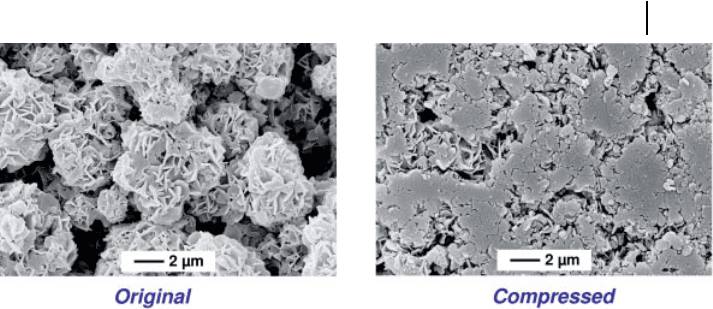
proved permanence and can be stored for hundreds of years under regular condi-
tions. Figure 2.19 depicts the solubility of CaCO
3
relative to the pH of the envi-
ronment.
2.2.1.4.3 Modified Natural Ground Calcium Carbonate (GCC)
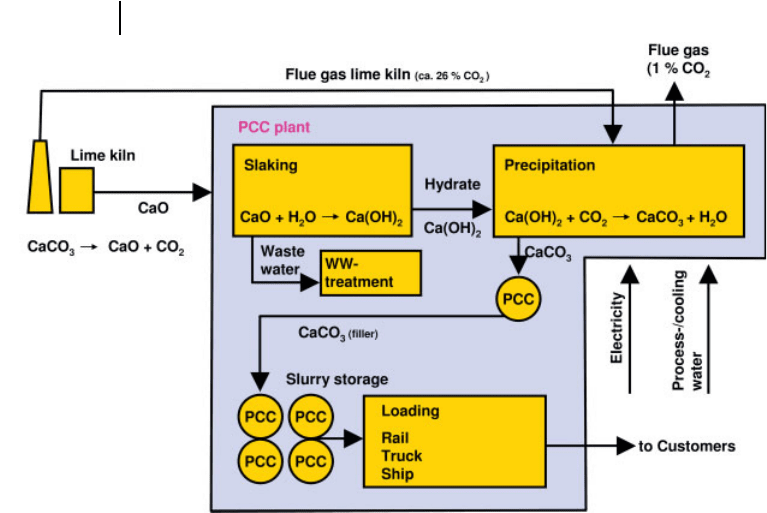
In a more recent development, finely ground GCC has been specifically modified
into a pigment with a completely different morphology and consequently different
properties. Figure 2.20 shows modified GCC particles in their original state and
after compressing (calendering). It should be mentioned that the modified GCC
also exhibits an extraordinarily high specific surface area of up to 80 m
2
g
–1
BET.
Providing high brightness, easy gloss development and good printability in offset
and rotogravure, this modified GCC has already found its way into the commercial
production of SC (super calendered) paper. As specialty pigment, it is applied in
conjunction with regular CaCO
3
fillers [7].
2.2.1.4.4 Precipitated Calcium Carbonate (PCC)
This is also predominantly applied in wood-free uncoated paper, wood-containing
uncoated paper (in combination with kaolin), wood-free coating base paper, direc-
tory grades and white top linerboard [8]. In order to control porosity and burning
rate, PCC is also widely used as a filler in the manufacture of cigarette paper.
One very important raw material for the production of PCC is a suitable deposit
of natural CaCO
3
. Only rather few limestone deposits meet the stringent demands
for the production of high quality PCC. Carefully selected limestone is calcined at
800–900 °C to obtain calcium oxide (CaO or quicklime), requiring energy and re-
leasing CO
2
. The quality and uniformity in quality of the lime used has an im-
mense influence on the quality of the final PCC product. The addition of water
(exothermic reaction) produces calcium hydroxide (Ca(OH)
2
or slaked milk of
Fig. 2.20 Modified ground calcium carbonate in its original
state and after compressing (source: OMYA).
2.2 Non-fiber Raw Material
49
lime). The usually applied carbonation process consists of bubbling CO
2
through
the slaked milk of lime. At the end of the process there exists once again CaCO
3
,
now in the form of PCC. The process can be manipulated, within limits, to influ-
ence particle shape and fineness. PCC is often produced in plants located on-site at
the paper mill, but there are also many so-called off-site production units. A gener-
alized flow sheet for the production of off-site manufactured PCC is presented in
Figure 2.21.
Various investigations and development work have been carried out in order to
produce PCC directly in, for example, a high consistency stock. However, so far
there has been no major breakthrough into the commercialization of such proc-
esses [9, 10].
The morphologies of PCC used as fillers are commonly scalenohedral (rosette-
shaped), rhombohedral (cubic-shaped) or aragonite (needle-shaped). The type of
morphology is defined by process parameters like temperature, pressure, reaction
speed, additives etc. The particles can be arranged as individual discrete, clustered
or agglomerated. These different arrangements represent an additional tool to
influence the overall pigment performance.
Currently the most common PCC morphology applied around the globe is the
clustered scalenohedral one. This rosette-shaped type of PCC provides increased
caliper and bulk to the paper (compared to kaolin or GCC). However, as a con-
Fig. 2.21 Flow sheet for the production of precipitated
calcium carbonate (source: OMYA).
2 Raw Materials for Paper and Board Manufacture
50

sequence of this higher bulk, strength properties are reduced and the sheet be-
comes distinctly more open and permeable. An extra high bulk providing PCC in
general tends also to exhibit a lower light scattering potential. Combining different
carefully selected morphologies assists in the optimization of specific paper prop-
erties. Although particle morphology and fineness can be influenced largely in the
PCC production process, in the end a suitable compromise addressing the differ-
ent properties desired by the papermaker has to be found.
CaCO
3
in the form of PCC, as true for GCC, is naturally soluble under acid
conditions and therefore requires a near neutral to slightly alkaline pH environ-
ment. Residual calcium hydroxide Ca(OH)
2
in the PCC can require extra measures
for pH control of the final product and the paper mill wet end system. Despite
reported developments in providing so-called acid tolerant PCC, intended to re-
main stable against dissolution under acid (< pH 7) conditions, papermakers, it
seems, continue to make the conversion to slightly alkaline or alkaline paper-
making when considering the use of CaCO
3
.
2.2.1.4.5 Talc
This is applied in wood-free uncoated paper in Asia Pacific, often combined with
GCC. In Europe it is used in a few cases as a primary filler in wood-containing
coating base paper and wood-containing uncoated paper, in the latter case in com-
bination with kaolin.
Talc is found naturally throughout the world within an assembly of various min-
erals and as a secondary pigment. It is a hydrous silicate mineral that is very soft
(Moh’s hardness 1, compared with pure CaCO
3
being typically 3 and diamond 10)
and has a low abrasiveness. It is chemically inert, very platy, water insoluble, orga-
nophilic and hydrophobic. As a result of the pronounced platelet structure found
in pure grades, the use of such talc as filler provides a high smoothness and gloss
to the paper at calendering. Due to its hydrophobic nature, talc has some limits in
the use of offset printing papers when used alone, and so should be used judi-
ciously in combination with other hydrophilic minerals such as CaCO
3
or kaolin.
Talc has particular merit when used in rotogravure printing papers.
Micronised talc is applied to control pitch and stickies, originating during wood
fiber processing depending upon the variety of fiber in use. Talc for sticky control
can also be found in paper mills processing recovered paper. Talc particles are
adsorbed on the surface of the resin or the sticky component and render these
interfering substances harmless by covering them or being incorporated into
them.
2.2.1.4.6 Gypsum (Calcium Sulfate)
This is used only on a very small scale as a filler in printing and writing papers. In
recent years, gypsum as filler has been replaced by GCC at various locations. Gyp-
sum on the other hand is largely applied in the manufacturing of gypsum board.
Gypsum board is made up with a high percentage of calcium sulfate material and
2.2 Non-fiber Raw Material 51