
Holik H. (ed.) Handbook of Paper and Board
Подождите немного. Документ загружается.


(elementary chlorine free) pulps compared with the conventionally bleached
pulps.
The quality of pulp depends on the kind of wood used. Softwood pulps have
longer fibers, resulting in higher strength, whereas hardwood pulps with shorter
fibers for instance produce a more uniform sheet. Paper containing only chemical
pulp as the fiber component is called wood-free paper, i.e. it has only a low residual
lignin content.
Sulfate pulps have distinctly higher strength than sulfite pulps, especially if they
are unbleached. That is why unbleached sulfate pulps are mostly used in papers
with high strength demand such as corrugated board, packaging papers, or techni-
cal papers. Highly bleached pulps are used in high-quality printing papers.
The dominant process of semi-chemical pulping is the neutral sulfite semi-
chemical process (NSSC), with sodium or ammonium sulfite as the digestion
chemicals. The pulp yield is in the range 70–80% depending on the wood species,
most commonly hardwood species like birch, beech, maple, oak and eucalyptus.
This pulp is used for fluting production – often as the sole component in fur-
nish.
2.1.3
Mechanical Pulp
Mechanical pulp is produced from wood by mechanical defibration. Different
processes are in use:
• Stone groundwood (SGW) is produced by the mechanical defibration of round
wood logs by a grinding stone.
• Refiner mechanical pulp (RMP) is obtained by mechanical defibration of wood-
chips in a refiner and is carried out without pre-treatment. Defibration takes
place under atmospheric pressure. The wood chips are defibrated at tempera-
tures of about 100 °C, mostly in two stages with consistencies of 20 to 30 % in
the second stage.
• In the refiner process with thermal pre-treatment (TMP), wood chips are treated
with steam at 110 °C to 130 °C for 2 to 5 min before they are defibrated under
high pressure.
• In the refiner process with chemical pre-treatment (CTMP/CMP), wood chips
are impregnated with chemicals before they are mechanically defibrated in the
refiner under high pressure of about 3 bar or at atmospheric pressure, mainly in
two stages.
The CTMP and CMP processes differ in the intensity of the chemical treatment
and the yield. The yield of softwood CTMP is about 91% to 96%. CMP is more
heavily chemically treated and therefore has more the character of a chemical pulp,
i.e. higher strength properties at a cost of lower light-scattering coefficient (see
Table 2.2). For hardwood, the yield of CMP can decrease to 80%.
During mechanical defibration, lignin is plasticized and remains in the pulp.
This is the reason for the lower strength properties but higher light-scattering
2 Raw Materials for Paper and Board Manufacture22

coefficient and opacity compared to chemical pulp. The residual lignin in mechan-
ical pulps results in a poorer and less stable brightness level. Mechanical pulps
cannot be brightened by oxidative and reductive bleaching to the same extent as
chemical pulps as only negligible delignification takes place compared to the
bleaching of chemical pulp.
Paper grades that contain pulp produced by mechanical or chemimechanical
processes are referred to as wood-containing papers. Mechanical pulps are mainly
used in short-life printing papers, hygienic papers and board.
A comparison of some of the main characteristics of chemical and mechanical
pulps: yield, BOD (biological oxygen demand), grinding or refining energy (in the
case of chemical pulp for final pulp preparation), freeness, tensile index and light
scattering coefficient, is given in Table 2.2. The yield decreases from 97 % for SGW
to 40% for chemical pulp (kraft type) and the effluent impact increases i.e. the
biological oxygen demand increases. Specific energy consumption is lower for
conventional chemical pulps than for chemimechanical pulps but chemical con-
sumption is higher.
Freeness is measured as about 100 ml for (fines-containing) stone groundwood
(SGW) and 780 ml for chemical pulp with high long-fiber content.
Chemical pulps have a higher strength potential (tensile index) but lower light
scattering ability.
Light scattering values are given for the pulp before undergoing additional me-
chanical treatment. Post-refining of mechanical pulp increases the light scattering
coefficient whereas refining of chemical pulp decreases this property.
Table 2.2 Characteristics of mechanical, chemimechanical and
chemical pulps.
Pulp type Mechanical pulp Semi-
chemical
Chemical
pulp
SGW TMP CTMP CMP pulp
Yield % 97 95 90 80 70 60 40
biological
oxygen demand
(BOD)
kg t
–1
10 20 50 100 200
grinding or
refining energy
kWh t
–1
1200 2200 2500 1000 500 200 100
freeness CSF ml 100 120 200 400 600 800
tensile index Nm g
–1
30 40 50 60 70 80 100
light-scattering
coefficient
m
2
kg
–1
65 60 50 40 30
2.1 Fibrous Materials 23
2.1.4
Recovered Paper, Recycled Fibers
Hans-Joachim Putz
2.1.4.1 Role of Recovered Paper in the Paper and Board Industry
In the past chemical pulp was the most important raw material for paper produc-
tion, but now this has been replaced by recovered paper. 158 million tons of this
raw material were used globally in 2002. This volume exceeds the total volume of
woodpulp, i.e. chemical pulp (117 million tons) and mechanical pulp (36 million
tons) [1]. These figures show that recycled fibers play a very important role today in
the global paper industry as a substitute for virgin fiber pulps.
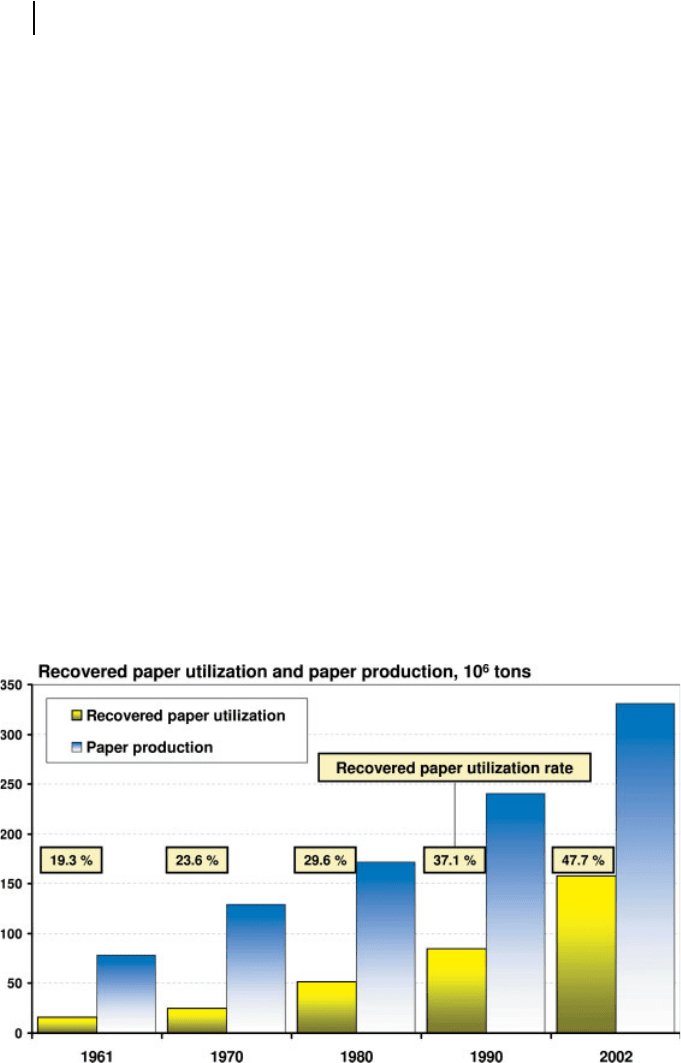
Figure 2.1 shows the global increase in recovered paper usage, compared to
paper production since 1961. Globally the use of recovered paper increased by
approximately 5.8% annually whereas annual paper production growth was only
3.6%.
The paper industry is the exclusive relevant user of recovered paper as a secon-
dary raw material – at least in terms of material recycling. Various recovered paper
processing systems with mechanical and chemical unit processes prepare recycled
fibers for the production of paper and board grades. These processing systems use
different recovered paper grades that contain either chemical or mechanical fibers
or, mainly, an undefined mixture of both. Some paper and board grades can be
made from recycled fibers exclusively. This includes paper grades such as corrugat-
ing medium and testliner or newsprint in Europe. For newsprint and other grades
blends of recycled and virgin fibers are also used. The proportion of recycled fibers
Fig. 2.1 Global development of recovered paper utilization
and paper production (1961–2002) [1–5].
2 Raw Materials for Paper and Board Manufacture
24
in the raw material furnish can vary from about 5% for fine papers to 100%
depending on the paper grade or geographic region.
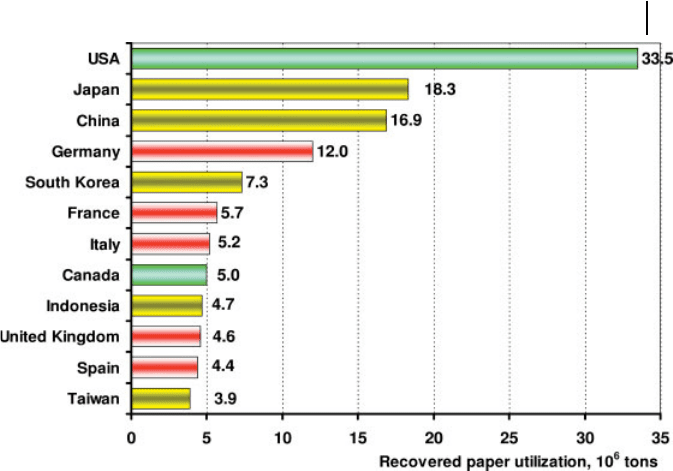
Figure 2.2 shows the largest recovered paper consuming countries. They used in
total 122 million tons in 2002 corresponding to 77% of the global recovered paper
consumption.
2.1.4.2 Main Definitions for Statistics
Consideration of recovered paper use and recovery of used paper products requires
definitions. Statistical definitions can be related to the world, a continent, a country
or a certain region (e.g. Europe) or to a certain category of paper products (e. g.
graphic papers or newsprint). Differentiation is given by three statistical parame-
ters:
• Recovered paper utilization rate, in percent, is the amount of recovered paper
used as raw material in the paper industry, in tons, divided by paper production,
in tons, on an annual basis, multiplied by 100.
• Recovery or collection rate, in percent, is the amount of collected recovered
paper for material recycling, in tons, divided by paper consumption, in tons, on
an annual basis, multiplied by 100.
• Recycling rate, in percent, is the amount of recovered paper used as raw material
in the paper industry, in tons, divided by paper consumption, in tons, on an
annual basis, multiplied by 100.
Fig. 2.2 The 12 largest recovered paper consuming countries
in the world (2002) [1].
2.1 Fibrous Materials
25
From these definitions it becomes obvious that the utilization rate is related to
recovered paper usage in paper production, whereas the recovery rate is related to
the amount of collected paper related to paper consumption. Both rates can be
affected directly either by the paper industry by the use of more or less recovered
paper in paper production or by the waste management industry collecting more
or less recovered paper from the paper consumed. The recycling rate is a more
theoretical value putting recovered paper usage in relation to paper consumption.
A high level of recovered paper usage in paper production combined with strong
net paper export rates will result in a high recycling rate, which has to be satisfied
by recovered paper imports from abroad.
Recovered paper utilization rates globally and nationally may be used for com-
parison. Such statistics can give, however, a false impression of the recycling activ-
ities in different countries as the following discussion explains. The range of na-
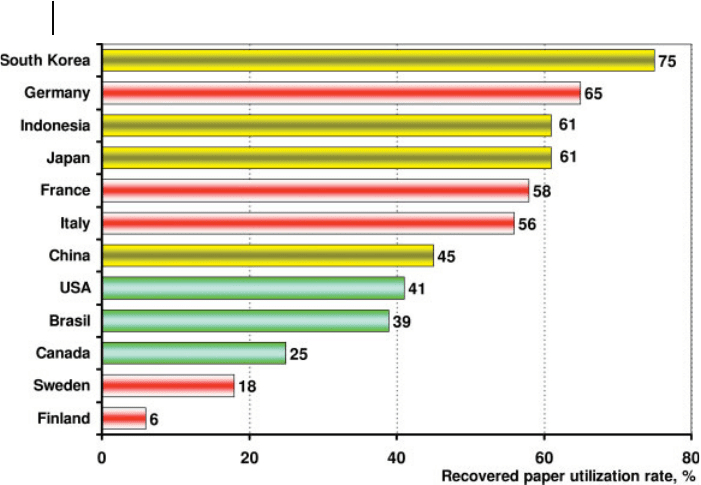
tional utilization rates extends globally from 5% to more than 100 %. Figure 2.3
shows the 12 largest papermaking countries, accounting for almost 80% of the
global paper production in 2002 of 331 million tons. Simultaneously, they con-
sumed about three quarters of the world’s recovered paper volume. Heading the
list are South Korea, Germany, Indonesia and Japan with utilization rates above
61%. The lowest utilization rates are for Finland and Sweden. This is because
more than 80% of their paper production is exported due to their low population
figures and related low level of national paper consumption.
Fig. 2.3 Utilization rates of recovered paper of the 12 largest
papermaking countries in the world (2002) [1].
2 Raw Materials for Paper and Board Manufacture
26
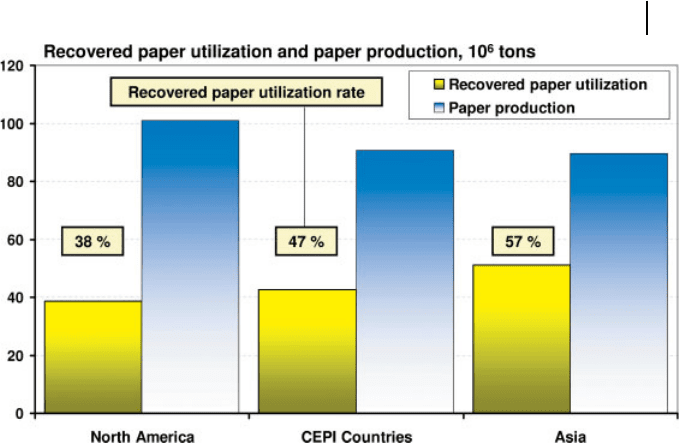
Figure 2.4 shows the utilization rate for the three largest paper production re-
gions in the world where the paper industry uses 85% of the global recovered
paper volume: Asia, Europe and North America. Paper production in these three
regions is between 90 and 100 million tons each, resulting in recovered paper
utilization rates of roughly 57% in Asia, 47 % in Europe and 38 % in North
America.
2.1.4.3 Utilization Rates for Different Paper Grades
Utilization rates for different countries should not be compared without further
comment. It is important to know the structure of the production program of the
different national paper industries in the main product categories of packaging
papers and board, graphic papers, household and hygiene papers as well as spe-
cialty papers because the utilization rates for these product segments differ sig-
nificantly.
In Fig. 2.5 for the CEPI countries the recovered paper utilization by the main
paper categories is presented and additionally the utilization rates are given. The x-
axis is a summarizing ordinate representing the total paper production in the
CEPI countries of 91 million tons, subdivided into the production of the various
paper categories. The broader a single paper category, the larger the paper produc-
tion (for example, the biggest category, with 34 million tons, is other graphic pa-
pers). For each paper product category (e.g. newsprint) the used recovered paper
Fig. 2.4 Recovered paper utilization rate and paper production
in Asia, the CEPI countries
1
and North America (2002) [1].
1
CEPI countries are all EU countries plus the Czech Republic,
Hungary, Norway, the Slovak Republic and Switzerland.
2.1 Fibrous Materials 27
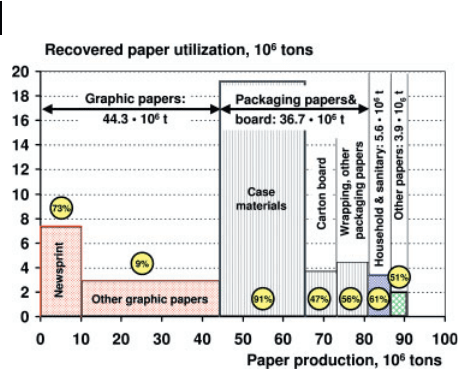
volume is shown on the y-axis. In the circles the corresponding recovered paper
utilization rate is given. It becomes obvious that the highest volume of recovered
paper is used in the production of case materials (19.2 million tons). The second
highest recovered paper utilization rate of 73% is in newsprint with a volume of
7.4 million tons. In the other paper categories between 2.0 and 4.4 million tons of
recovered paper are used, resulting in recovered paper utilization rates between
9% and 61 %.
Traditionally, packaging papers and board have the highest recovered paper utili-
zation rate. In the CEPI countries this ratio has reached almost 75%. Demanding
quality specifications have to be fulfilled by these recycled fiber-based paper and
board grades to ensure trouble-free converting, for example, to corrugated board
boxes or folding boxes and adequate functional characteristics of the finished prod-
ucts. Occupying second place is the utilization rate of household and hygiene
papers (61%). Due to high yield losses in the flotation and washing steps, the
proportion of recycled fibers in hygiene paper is not higher than 40% on average.
The figure of 40% deinked pulp comes from about 60% yield of about 65 % utiliza-
tion rate. The group of other papers, comprising gypsum liners, special papers for
waxing, insulating and roofing, achieve a 51% utilization rate in the CEPI coun-
tries, but there are also many specialty paper grades such as cigarette paper, filter
paper, or banknote paper which never can use recycled fibers.
Finally, the level of the utilization rate for graphic papers is only 23%. Due to the
wide spectrum of the paper grades produced, a distinction is necessary for this
product segment because newsprint has reached a level of 73%. The utilization
rate of the other graphic papers averages only 9%. Included among these other
graphic papers are wood-containing and woodfree papers that are coated or un-
coated. Some use 100% recycled fiber furnish, e.g. recycling copy papers.
Fig. 2.5 Recovered paper utilization by paper grades in the
CEPI countries (2002) [6].
2 Raw Materials for Paper and Board Manufacture
28
2.1.4.4 Resources of Recovered Paper
Before using recovered paper for paper production its recovery is necessary. Re-
sources of recovered paper are in general collection from industrial enterprises
(e.g. printing houses), business operations (e.g supermarkets) or offices and from
private households and small commercial enterprises. Whereas the recovery of
used paper from industry, business operations and offices has a long history and
can be easily managed, recovery of used paper from private households is more
complex. Additional recovered paper resources cannot be expected in the first cate-
gory, because these paper grades mainly belong to the so-called “pre-consumer”
grades, are of high quality and are already almost 100% recovered. Collected paper
from private households is “post-consumer” recovered paper which is usually
mixed and always requires a sorting process.
As far as national recycling activities are concerned, an assessment of the paper
recovery rates of different countries is more relevant than a comparison between
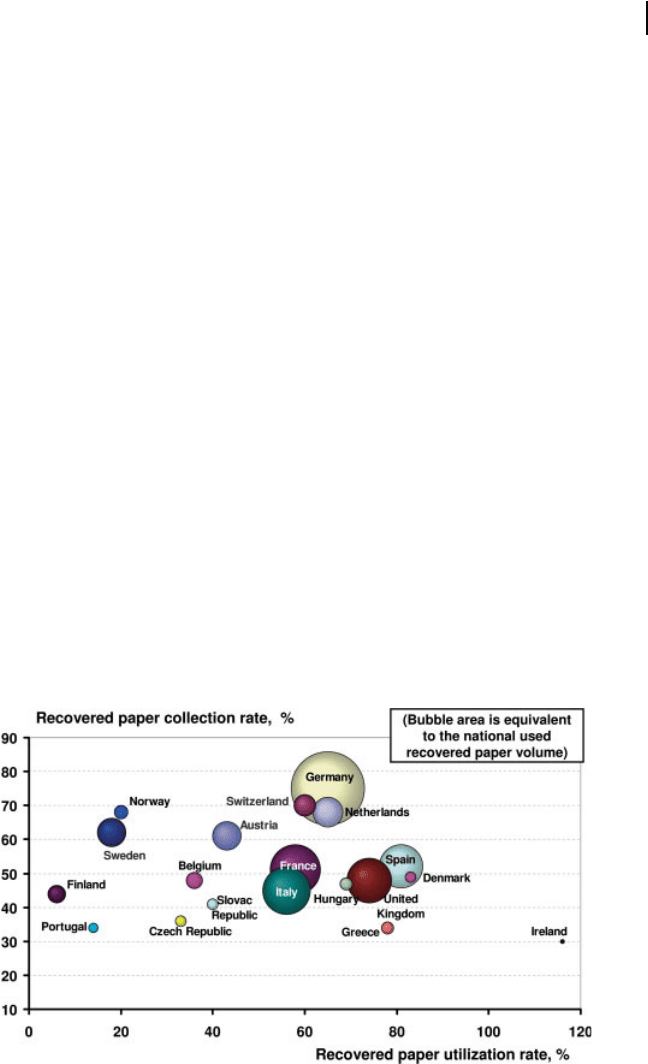
national recovered paper utilization rates. Figure 2.6 shows the collection rates vs.
the utilization rates of recovered paper in the CEPI countries. The bubble size is
equivalent to the tonnage of recovered paper used in each country. Due to in-
tensified collection in each country the average rose from 41% in 1991 to 56%,
corresponding to a total volume of recovered paper of 46 million tons in 2002. It
becomes obvious that the highest collection rates in the CEPI countries are by
Germany, Switzerland, the Netherlands, Norway, Sweden and Austria, whereas the
highest utilization rates are reached in Ireland, Denmark, Spain, Greece, the
United Kingdom and Hungary. The largest tonnages of recovered paper are used
in Germany, France, Italy, the United Kingdom and Spain.
The maximum paper recovery rate in an industrialized country with a well-
developed infrastructure is about 80% [7]. This theoretical limit of the recovery rate
Fig. 2.6 Recovered paper utilization and collection rates vs.
utilization rate in CEPI countries (2002) [1].
2.1 Fibrous Materials
29
occurs since approximately 20% of the used paper products are not collectible,
because they are contaminated, long living products or are destroyed by disposal or
burning. This includes hygiene paper, specialty paper products, long-life paper
products, papers used in industrial applications, and papers used for other pur-
poses in private homes such as fuel or compost material. Considering the theoret-
ical recovery rate of 80%, the recovery rate of 75 % already achieved in 2002 in
Germany is equivalent to a paper collection efficiency of about 94%. Collecting
additional used paper is probably not economically feasible.
At the global level, no data are available for the different sources of collection
systems of recovered paper by tonnage. In Europe, CEPI has conducted recovered
paper surveys which found, for 2002, the following five sources of recovered pa-
per:
• Recovered paper from households: 38%
• Recovered paper from trade and industry: 33%
• Recovered paper from converting and printing: 15%
• Recovered paper from offices: 10%
• Recovered paper from unsold newspapers and magazines: 4%.
The recycling rate was introduced by CEPI for the first time as the relation between
recovered paper utilization and paper and board consumption. Related to the con-
sumption of paper and board the figure indicates the internal material recycling of
recovered paper in a country or a region, so long as no net import of recovered
paper occurs. Nevertheless, recycling rates close to 100% indicate that either a
large amount of recovered paper is imported or a high volume of produced paper
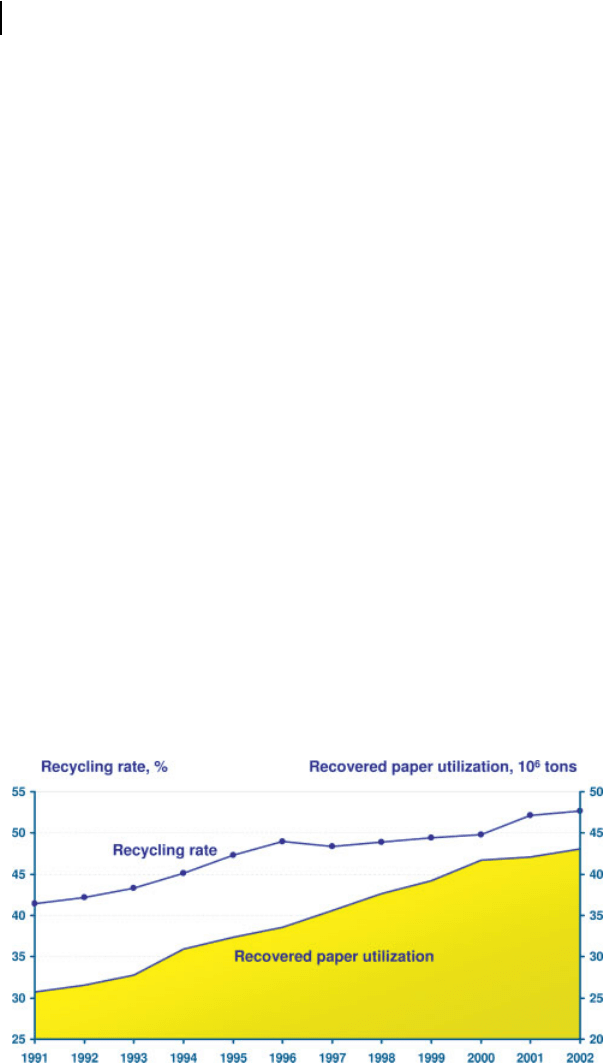
and board is exported. Figure 2.7 shows the development of the recycling rates in
the CEPI countries from 1991 with an increase of 2.2% p. a. until 2002, when it
was approaching 52.7% and it should reach 56 % in 2005, far from the theoretical
or practical limit.
Fig. 2.7 Development of recycling rate and recovered paper
utilization in the CEPI countries (1991–2002) [6].
2 Raw Materials for Paper and Board Manufacture
30

2.1.4.5 Lists for Recovered Paper Grades
Globally no common list of recovered paper grades exists. A European Standard
was established in 2001 by CEN (European Committee for Standardization) as EN
643 for Europe [8]. All recovered paper grades are classified into the following five
groups:
• Ordinary grades
• Medium grades
• High grades
• Kraft grades
• Special grades.
Recovered paper grades are generally not defined by physically verifiable quality
characteristics. Instead, the naming of recovered paper in the list uses one of the
following criteria:
• Places of occurrence, such as supermarket corrugated paper and board (1.04)
• Former paper grades of which the recovered paper consists, such as mixed mag-
azines and newspapers (1.10)
• Mixed categories such as mixed sorted papers and boards (1.02).
Globally and in Europe, the use of deinked pulp (DIP) in newsprint dominates
(55%–65 %), followed by hygiene papers (20 %–15%) and printing and writing
papers (about 12%). Therefore, another very important paper grade in Europe
describes a wood-containing recovered paper mix, commonly used for deinking. It
is called “Sorted graphic paper for deinking” (1.11) and originates primarily from
household collections.
The complete list of recovered paper grades is published in the Annex of Volume
I and is available also on the website of GesPaRec (www.altpapier-rohstoff.de).
Recovered paper grade lists are not comparable between Europe, USA and Asia.
Therefore recovered paper grades are summarized very often in the following four
groups:
• Mixed grades: comprising always a mixture of various paper and board grades
used for the production of packaging paper and board.
• Corrugated and kraft grades: comprising predominantly packaging paper and
board grades used for the production of packaging paper and board. The term
OCC is also very often used for this recovered paper grade and stands for “old
corrugated containers”.
• Deinking grades: comprising exclusively graphic paper grades used – after a
deinking process – predominantly for the production of graphic and tissue pa-
pers.
• High grades: comprising predominantly white lightly printed graphic papers
and board (very often woodfree), recovered by separate collection and therefore
relatively clean.
2.1 Fibrous Materials 31