
Holik H. (ed.) Handbook of Paper and Board
Подождите немного. Документ загружается.

lined with reinforcing sheets of paper. It is used in building construction for walls
and ceilings.
Gypsum can be sourced from either natural deposits or as a byproduct, for
example in the production of fertilizer or citric acid. Another gypsum byproduct
originates from the desulfurization of flue gases emitted by power plants operating
on the basis of fossil energy. Although available in huge amounts, so far all at-
tempts to make this byproduct technically and economically useable as paper filler,
have been unsuccessful. Gypsum may exist as different chemical structures
(CaSO
4
2H
2
O dihydrate, CaSO
4
1/2H
2
O hemihydrate, CaSO
4
anhydrite) and in
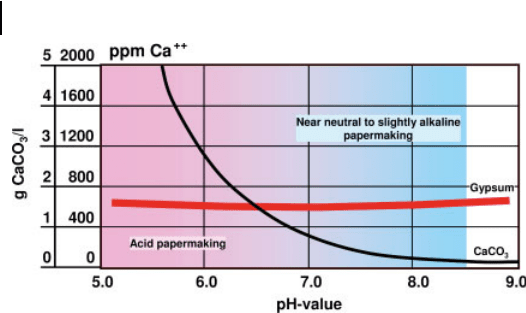
general exhibits a high solubility, more or less independent of the pH environment
[11]. Figure 2.22 compares the solubility of gypsum and calcium carbonate versus
the pH.
2.2.1.5 Specialty Filler Pigments
2.2.1.5.1 Calcined Clay
This is a specialty filler, applied to the sheet mainly in order to increase light
scattering/opacity and to reduce the ink print-through potential. Typical areas for
the application of calcined clay are lower basis weight uncoated wood-containing
papers (i.e. telephone directories, low basis weight newsprint and SC paper etc.).
In the calcination process of kaolin, the water of hydroxylation (14%) is first
driven off at temperatures of 500–700 °C. On continued heating up to 900–1000 °C
the particles begin to fuse together into secondary particle aggregates, accompa-
nied by an increase in brightness. Further agglomeration results in tertiary parti-
cles. The final result is a large number of kaolin-air interfaces and relatively high
internal pore volume leading to increased light scattering and opacifying proper-
ties.
Fig. 2.22 Comparison of the pH related solubility of gypsum
and calcium carbonate (source: OMYA).
2 Raw Materials for Paper and Board Manufacture
52

2.2.1.5.2 Titanium Dioxide
This is a specialty and particularly effective filler. It is applied in specialty papers,
often at low basis weights, with particularly high demand in dry and wet opacity
and sheet brightness. TiO
2
can be found in thin print paper, i. e. bible paper, high
opaque grades, label paper and decoration paper.
Titanium is the fourth most abundant chemical element found on earth. In
nature, titanium occurs only in the form of oxides or mixed oxides with other
elements. Mineable deposits are generally of volcanic origin. The titanium dioxide
pigment industry uses between 90 and 95% of the global titania ore extracted.
Titanium dioxide is a synthetic material, commercially produced by the sulfate
or the chloride process. It exists in three modifications with different crystal lattice
structures and therefore different physical properties. The modifications are rutile,
anatase and brookite. Only rutile (hexagonal close packing of the oxygen atoms)
and anatase (cubic close packing of the oxygen atoms), which differ from each
other in some of their physical properties, are of technical importance. The typical
refractive index for rutile is 2.75 and 2.55 for anatase (cf. CaCO
3
1,58). In compar-
ison to other pigments TiO
2
exhibits also an extraordinarily high density
(3.9 g cm
–3
anatase, 4.2 g cm
–3
rutile). Rutile gives higher brightness (but less blue
whiteness) and opacity, while anatase supports optical brightening agents better as
it absorbs less ultraviolet light. Compared with the rutile form, anatase has a lower
Moh’s hardness of 5.5 to 6.0 instead of 6.5 to 7 [12].
Even at only low addition levels, TiO
2
has a remarkable effect on paper opacity
due to its unmatched high refractive index and high light scattering potential.
Because of its high refractive index, TiO
2
is the only pigment, which also provides
high opacity when the paper is wet (label paper). The extra high refractive index is
also important for providing opacity in the manufacturing of decoration paper. In
the production process of this specialty paper, resin penetrates completely
throughout the sheet structure, thereby filling up the voids and diminishing pore
structure volume with resulting reduced light scattering. Because of the extreme
fineness (average particle size 0.2–0.25 mm) and the complex chemistry in applica-
tion (for example high amounts of cationic wet strength agent etc.) TiO
2
filler
pigments can be difficult to retain in the paper web.
Due to its high cost, TiO
2
is often used in combination with extenders. These
extenders are other less costly minerals (for example Al(OH)
3
, synthetic silicate
and silica, barium sulfate), which are capable of replacing TiO
2
to a limited extent
while producing similar results. The effect of providing wet opacity to the sheet by
TiO
2
, however, cannot be reached by using extenders alone. No extender matches
the extra high refractive index of TiO
2
. The closest to TiO
2
in terms of refractive
index is zinc sulfide with a value of 2.37.
2.2.1.5.3 Amorphous Silicates and Silica
These are also specialty pigments, mostly used in lower basis weight newsprint
and directory paper. These pigments are added in small percentages (sometimes
applied in combination with regular paper fillers), to enhance paper brightness
and opacity as well as absorption properties, e.g. reduction of print-through.
2.2 Non-fiber Raw Material 53

Amorphous silicates are produced by destabilization of soluble silicates to yield
amorphous discrete particles in varying degrees of aggregation. The high specific
surface area in combination with an organophilic surface is responsible for the
excellent ink adsorption characteristics. Amorphous silicate also has the potential
to increase somewhat the bulk of the paper sheet.
In a recent development, Mg-Al-silicate was coprecipitated with a rhombohe-
dral-shaped precipitated calcium carbonate as core, as one single product. This
development has already found its way into commercial application. One target is
to reduce the ink print-through in lower basis weight newsprint or directory paper
at lower cost than regular Mg-Al-silicates [13].
2.2.1.5.4 Aluminum Trihydrate (Hydrated Alumina)
This represents a specialty filler which contributes to paper brightness, ink re-
ceptivity and acts as a flame retardant. The effect on flame retardancy can be
explained by the 35% of bound water based on material weight. The bound water
is released at temperatures above 150 °C. The raw material source for the produc-
tion of aluminum trihydrate (ATH) is bauxite. Bauxite is a blend of Al
2
O
3
, Fe
2
O
3
,
SiO
2
, H
2
O, TiO
2
and other minerals. To produce ATH it is necessary to stabilize
the alumina content and to separate out the other minerals. This is done by the so-
called Bayer process. After final filtration, the clear liquor of sodium aluminate is
seeded with specially prepared fine crystals of ATH. This seeding causes the so-
dium aluminate to decompose to ATH or Al(OH)
3
which forms a precipitate.
Some bauxite ore deposits exhibit a rather high purity and brightness. Such
material can be converted directly into filler grades. The physical difference be-
tween a fine precipitated ATH and a fine ground ATH is small.
2.2.1.5.5 Other Fillers
It must be mentioned, that there are several other industrial minerals being used
directly or indirectly as paper fillers. These materials include barytes, barium sul-
fate, calcium sulfite, zinc oxide, zinc sulfide, diatomaceous earth, mica, bentonite
and pyropholite. Synthetic organic fillers are, for example, based on polystyrene or
urea-formaldehyde. Local availability, cost and the need for obtaining certain spe-
cial properties are the deciding factors in the selection of these materials. However,
the total volume is quite small in comparison to the major fillers and specialty
pigments, as described above.
2.2.1.6 Outlook
There is a continuous demand for technical and economic development in the
various paper grades. In this context, the quality and choice of filler is also often
reconsidered. Brightness, opacity and surface properties like smoothness, uni-
formity, surface strength and printability will continue to be of great importance.
To address these demands, further specific pigment developments and the com-
2 Raw Materials for Paper and Board Manufacture54

bined application of different filler grades can be expected. Costructuring different
pigments and coprecipitation could represent suitable tools to reach some of the
functional targets. Investigations on how to further increase the filler loading in
various paper grades are constantly ongoing. Maintaining stiffness properties at
increased loading and cost effectiveness are some of the challenges. At the already
very high filler loading levels as practiced in Europe, each% point of further in-
crease represents a particularly significant success. Filling through the surface of
the sheet could be an additional tool for completely new developments. Positioning
the fillers at a specific location within the z-direction of the sheet (multilayering) is
in an early stage of investigation. Replacing more expensive specialty pigment
applications by regular fillers is always of interest. Calcium carbonate based fillers
will penetrate the paper market even further, as for example currently observed in
the area of higher brightness SC paper.
Much emphasis is given today on seeking the potential of nanotechnology in the
area of papermaking. It remains to be seen if nano per se will provide innovative
products, but there are materials available now, primarily in structured forms of
PCC or surface modified GCC that provide nanoscale features on the surface of
otherwise microparticles. Properties so far indicate high absorption potential, and
their use in digital inkjet printing and as specialty fillers are being evaluated in-
tensively [14, 15].
2.2.2
Coating Pigments
Werner Kogler
†
, Thoralf Gliese, and Werner J. Auhorn
2.2.2.1 General Overview
Coating improves the surface quality of paper and board resulting in higher bright-
ness, smoothness and gloss as well as better opacity and generally significantly
improved printability. Pigments are the main coating components for improving
the surface properties of coated paper and board grades. Usually they account for
80–95% of the total dry coating weight or, as a volume fraction, 70–80 % of the
solid material of the coating. This is based on a pigment density of about
2.5gcm
–3
and a density of the rest of the solid material in the coating of about
1.0gcm
–3
. In 2004 a total of approximately 18 V 10
6
tons of coating pigments were
used worldwide in the paper and board industry, which means nearly 2/3 of the
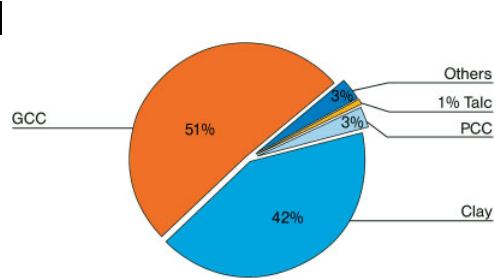
total usage of fillers and coating pigments. Kaolin (Clay) has been the biggest
coating pigment in the past, but its share dropped to 42% in 2004 while natural
ground calcium carbonate (GCC) took over the No. 1 position with 51% share.
Recently precipitated calcium carbonate (PCC) with a present share of 3% switched
from the status as a special coating. Pigments also largely determine the cost of the
coating. A sizeable number of white pigments are available for surface finishing in
the paper and board industry. A large majority of these are of natural origin, being
physically and chemically homogenous minerals formed by inorganic processes.
Organic products like plastic pigments may also be used in coating colors in spe-
cial cases. A more detailed description of the pigments used as fillers, their origin,
2.2 Non-fiber Raw Material 55
preparation and properties is given in Section 2.2.1 and a more detailed descrip-
tion of those used as coating is given in Chapter 7.
The pigments can be classified as:
• Main pigments:
– ground calcium carbonates (GCC)
– kaolin clays
– precipitated calcium carbonates (PCC) (recently switching from a special pig-
ment to a main pigment)
• Special pigments:
– talc
– gypsum (calcium sulfate)
– plastic pigments (e.g. polystyrene)
– satin white (calcium sulfoaluminate)
– barium sulfate
• Additional pigments:
– calcined clays (kaolins)
– titanium dioxides
– alumina trihydrates
Central properties of pigments are particle size and size distribution, particle
shape and shape distribution, refractive index, light scattering and light absorption
and density. The properties of coating color and the final coating can be influenced
and explained to a great degree by these factors. The following simplifies how
different quality parameters of coated paper can be improved by changing specific
pigment properties:
• better gloss by increase in platiness and/or decrease in particle size
• higher opacity by increase in refractive index and/or decrease in particle size
• higher brightness by decrease in light absorption
• higher porosity and ink absorption by decrease in packing (less compact pig-
ment layer), e.g. through mixing of different particle shapes
Fig. 2.23 Pigment to a main pigment.
2 Raw Materials for Paper and Board Manufacture
56

• higher bulk and better coverage by decrease in packing (decrease in density)
through mixing of different particle shapes.
Table 2.7 gives an overview and comparison of the most important physical and
optical properties of coating pigments. Besides the main pigments for paper coat-
ing, only the most important special and additional coating pigments are described
in more detail in this section (for others see Section 2.2.1).
2.2.2.2 Main Coating Pigments [16–19]
2.2.2.2.1 Kaolin Clays
Kaolin clays in paper coating have probably been used since the second half of the
19th century when paper coating was developed. Since that time they played a
dominant worldwide role as a coating pigment almost until today. Kaolin is one of
the most widely occurring minerals. Kaolinite, the principal constituent of kaolin
is a layered aluminosilicate having the chemical formula Al
4
Si
4
O
10
(OH)
8
. Kaolin is
Table 2.7 Physical and optical properties of coating pigments
(main source: [16]).
Pigment Chemical
composition
Most particles
(mm)
Particle shape Density
(kg dm
–3
)
Refractive
index
ISO-
Brightness
Kaolin clay Al
2
O
3
·2SiO
2
·2H
2
O 0.3–5 Hexagonal
platy
2.58 1.56 80–90
GCC
a
CaCO
3
, MgCO
3
(2–3%)
0.7–2 Cubic, pris-
matic, platy
2.7 1.56–1.65 87–97
PCC
b
CaCO
3
0.1–1.0 Variable,
usually rodlike
2.7 1.59 96–99
Talcum MgO · 4SiO
2
·H
2
O 0.3–5 Platy 2.7 1.57 85–90
Gypsum CaSO
4
·2H
2
O 0.2–2 Roundish 2.3 1.52 92–94
Plastic pigment
– solid
– hollow
Polystrene most
common
0.1–0.5
0.4–1.0
Spherical
Spherical
1.05
0.6–0.9
1.59
1.59
93–94
93–94
Calcined kaolin Al
2
O
3
·2SiO
2
0.7 (median) Aggregated
plates
2.69 1.56 93
Titanium dioxide
– anatase
– rutile
TiO
2
TiO
2
0.2–0.5
0.2–0.5
Rodlike
Roundish
3.9
4.2
2.55
2.70
98–99
97–98
ATH
c
Al(OH)
3
0.2–2 Platy 2.42 1.57 98–100
a Ground calcium carbonate (calcite), b Precipitated calcium carbonate,
c Alumina trihydrate.
2.2 Non-fiber Raw Material 57

an intrinsically valuable coating pigment because of its platy particle shape, good
color (white or near white), and the relative ease with which it can be processed to
a fine particle size.
2.2.2.2.2 Ground Calcium Carbonate (GCC)
GCC as a coating pigment was successfully introduced in 1973. It marked an
epochal step towards lower production costs and improved paper and print quality
by the successful development of “high solid” coating in the 1980s. Herewith GCC
allows reduced binder requirements and drying energy savings. The development
of finer-grade carbonates with particle sizes down to 99% < 2 mm and special
particle size distribution curves covers a broad spectrum of whiteness, paper and
print gloss, as well as opacity. High solids coating colors offer excellent runnability
even at the highest coating speeds of > 1800 m min
–1
. This also explains the over
proportional growth of ground calcium carbonate as a coating pigment during the
last three decades, whereas kaolin is stagnating and talc is showing constant
growth, especially for gravure coating colors.
2.2.2.2.3 Precipitated Calcium Carbonate (PCC)
PCC allows the production of coating pigments with specific morphologies by
controlled synthesis. Particle size, particle size distribution, and particle shape can
be controlled. The surface properties of the calcium carbonate particles can also be
changed if needed. Commercial PCC pigments typically have CaCO
3
contents
higher than 97%. The remainder is MgCO
3
(magnesium carbonate) and other
residues. Industrially, it has been found practical to produce PCC near the paper
mill by using what are called satellite plants. This saves inbound transportation
costs because the necessary CO
2
gas (40% of the final product weight) can be
taken from a local source and because calcium oxide can be delivered to the PCC
satellite plant in a dry form. Outbound savings are possible as well because the
produced coating or filler pigments can be delivered in a slurry form to a paper
mill, possibly through a pipe.
2.2.2.3 Special Pigments
2.2.2.3.1 Talc
Talc as a coating pigment was introduced industrially in Finland and France in
1982. Since then, talcs have become widely used in light weight coated (LWC)
gravure and coated fine papers in offset formulations. Recently another use has
been found for talc in the coating of special papers. In some applications, e.g.
coating paper for gravure printing, talc can technically replace clay if it is economi-
cally viable and vice versa due to the similar platy form of the particles. The charac-
teristics generally differentiating talcs from delaminated Georgia kaolin clays (US)
or Cornish kaolin clays (UK) are hydrophobicity, low cohesion between the crystal
2 Raw Materials for Paper and Board Manufacture58

layers inside the talc particles, resulting in extremely low friction coefficient, soft-
ness and low abrasivity in spite of a large particle diameter. The brightness of
European coating talcs varies from ISO brightness 82 to 88, depending on the
origin.
2.2.2.3.2 Gypsum
Gypsum consists of calcium sulfate crystallised with different degrees of hydra-
tion, all of which can be referred to as gypsum. However, in most cases, gypsum
refers to calcium sulfate in the dihydrate form, and the other forms are distin-
guished from each other by additional names (e.g., hemihydrate, calcined gyp-
sum, and stucco gypsum). The rate of solubility of gypsum of pigment fineness is
high, so the solubility easily reaches equilibrium in, for example, the water circula-
tion of a paper machine. A saturated gypsum solution contains approximately
2.1 g l
–1
of CaSO
4
, which equals 2.5 g l
–1
as dihydrate and 580 mg l
–1
as a calcium
concentration. Gypsum in itself is a neutral salt that, unlike carbonate, does not
buffer the pH of circulation water. When it comes to solubility, it makes no dif-
ference whether gypsum pigment is used in an acidic or neutral papermaking
process. The major advantages of gypsum pigment include brightness, bulk and
offset printability. Additional optical brighteners used with gypsum are very ef-
fective.
2.2.2.3.3 Plastic Pigments
Plastic pigments are used in paper coatings to provide a surface with the desired
appearance and printability. If properly chosen and formulated, these pigments
provide a coating with surface smoothness, brightness, opacity, as well as a balance
of ink holdout and ink receptivity upon which to print. Organic pigments, com-
monly referred to as “plastic pigments”, are used as partial replacements for in-
organic pigments to improve the optical and print properties of coated paper and
paperboard. There are two general classes of plastic pigments used in the prepara-
tion of coatings for paper and paperboard: solid bead and hollow sphere. Both are
available in a variety of particle sizes and compositions and, in the case of hollow
spheres, in a range of void volumes. All plastic pigments are supplied as polymeric
particles dispersed in water. In the case of hollow-sphere pigments, those particles
are water-filled spheres. During drying the water diffuses through the shell, leav-
ing an air-filled core – hence the term “hollow sphere”. Plastic pigments are used
in paper coatings wherever improvements in finishing efficiency, sheet gloss, or
print gloss are important. They are used extensively in coated folding boxboard,
woodfree coated printing papers, and they are also used in LWC and ULWC pa-
pers.
2.2 Non-fiber Raw Material 59

2.2.2.3.4 Satin White
Satin white (calcium sulfoaluminate) is still of some importance in paper coating.
This pigment has very fine particles; it is extra white, and has a low density. It
increases ink absorption and gloss. The disadvantages of satin white are its sensi-
tivity to increases in temperature and decreases in pH, and its high adhesive de-
mand.
2.2.2.4 Additional Pigments
2.2.2.4.1 Titanium Dioxide
Titanium dioxide pigments show extremely high refractive indices. This, and their
whiteness, i.e., their high reflectance in the visible region of light, as well as their
optimal particle size, make them the most effective white pigments. Titanium
dioxide exists in three crystal forms: anatase, rutile, and brookite. The first two are
stable and therefore of commercial importance. Titanium dioxide pigments are
used in paper coatings to increase the opacity of coated paper. To ensure good
optical efficiency of titanium dioxide in coatings, TiO
2
pigments must be properly
dispersed in the coating color. Undispersed aggregates or agglomerates diminish
the optical efficiency of TiO
2
pigments. Rutile slurry pigments are usually the most
effective titanium dioxide grades in paper coatings because they have the highest
TiO
2
content and refractive index, as well as optimal particle size and particle size
distribution.
References
Section 2.1.4
1 Anon., Papier 2004 – Ein Leistungsbericht,
VDP, Bonn, 2004, 89 pp.
2 Anon., Papier 1993 – Ein Leistungsbericht,
VDP, Bonn, 1993, 64 pp.
3 Anon., Papier 1983 – ein Leistungsbericht,
VDP, Bonn, 1983, 50 pp.
4 Anon., 1972 Annual Review, Pulp Paper
Int. 1972, 14 (8), 67–185.
5 Anon., 1963 Annual Review, Pulp Paper
Int. 1963, 5 (9), 83–212.
6 Anon., Special Recycling 2003 Statistics,
CEPI, Brussels, 2004, 8 pp.
7 Anon., Towards a Sustainable Paper Cycle,
International Institute for Environment
and Development (IIED), London, 1996,
258 pp.
8 Anon., Paper and board – European list of
standard grades of recovered paper and
board. DIN EN 643, Brussels, 2001.
Section 2.2.1
1 M. Altemeier, R. Meyers, F. Aviles, Size
Press Filling Boosts Ash Content, En-
hances Uncoated Free-sheet Quality, Pulp
and Paper, January 2004, 52–54.
2 A. Puurtinen, T. Saari, J. Grön, Laborun-
tersuchungen zur Optimierung des
Schichtaufbaus holzfreier Streichrohpa-
piere, PTS Munich/Germany 09 2002 Con-
ference Proceedings 37–1 to 37–11.
3 M. Laufmann, H. Rapp, Wire Abrasion
and its Potential Causes, Wochenblatt für
Papierfabrikation 1995, 18, 803–812.
4 M. Lex, O. Tamms, Füllstoff Kaoline im
Wandel der Papierherstellung, Wochenblatt
für Papierfabrikation 2003, 5, 233–237.
5 M. Strutz, C. Sweeney, Natural Ground
Calcium Carbonate, Neutral/Alkaline Pa-
permaking Short Course October 1990,
Tappi Reprint
6 M.Laufmann, W. Hummel, Neutral
Groundwood Containing Papermaking,
References
60

Overview-Anion. Trash-Conversion, Wo-
chenblatt für Papierfabrikation 1991, 119 (6),
269–293.
7 M. Laufmann, W. Hummel, M. Forsblom,
Calcium Carbonate Fillers, in SC Paper
PTS Symposium Munich 2004,
Conference Proceedings, pp. 16/1–
16/18.
8 R. A. Gill, The Effect of PCC Filler Charac-
teristics on the Optical and Permeability
Aspects of Paper, Tappi International
Paper Physics Conference Proceedings,
1991, pp.211–218.
9 K. Doelle, Method of Chemically Loading
Fibers in a Fiber Suspension, US Pat. 6,
355, 138 B1 March12, 2002.
10 S. Middleton, J. Desmeules, A. Scallan,
Lumen Loading with Calcium Carbonate
Fillers, J. Pulp Paper Sci. 2003, 29 (7),
241–248.
11 M. Sanchez, Use of Calcium Sulfate in the
Papermaking Process, PIRA Conference
Barcelona 2003, Scientific and Technical
Advances in Fillers and Pigments for
Papermakers, Conference Proceedings.
12 J. Winkler, Titanium Dioxide, European
Coatings Literature, Hannover Vincentz,
2003, ISBN 3-87870-148-9.
13 M. Pietsch, J. Haverinen, Silicate and
Carbonate Join Forces – A New Filler
Improves Printability, PTS Symposium
Munich 2004, Conference Proceedings pp.
18/1–18/12.
14 P. A. C. Gane, A study of the use of novel
pigments with nanosurface features on
microparticles, Pulp Paper, 2004.
15 T. Harper, Key growth areas and develop-
ments in nanotechnology, Pira Conference
Miami FL USA, 2005, The Future of Nano-
materials Conference Proceedings.
Section 2.2.2
16 E. Lehtinen, Papermaking Science and Tech-
nology, Book 11, Pigment Coating and Sur-
face Sizing of Paper, Fapet Oy, Helsinki
1999, in cooperation with Finnish Paper
Engineers’ Association and TAPPI.
17 L. Huggenberger, Wochenblatt Papierfabrik.,
1999, 16.
18 Calcium Carbonate, From the Cretaceous
Period into the 21
st
Century, Birkhäuser
Verlag, Basel 2001.
19 E. Eiroma, J. Huuskonen, Pigment Coating
of Paper and Board, Paper Manufacture,
Book 1, Antti Arjas, Ed., Teknillisten tietei-
den akatemia, Turku, 1983.
References
61