
Holik H. (ed.) Handbook of Paper and Board
Подождите немного. Документ загружается.

2.1.4.6 Use of Recovered Paper Grades
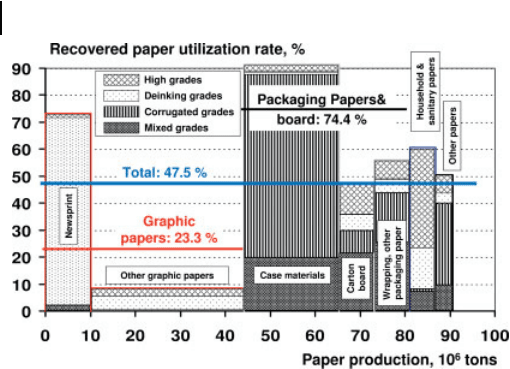
Figure 2.8 shows that the use of recovered paper in paper production in the CEPI
countries varies greatly by grade of recovered paper. In 2002, the consumption of
recovered paper of all CEPI countries was as follows:
• 41% OCC grades
• 26% Deinking grades
• 20% Mixed grades
• 13% High grades.
Whereas mixed grades and OCC grades (91% by weight) primarily find use in the
production of packaging papers and board, the majority of all deinking grades
(80% by weight) go to graphic paper production. These recovered paper grades are
also used for household and sanitary papers with the addition of nearly two-third
high grades. The production of other papers requires various proportions of all
four recovered paper grade groups.
The total amount of 43 million tons of recovered paper was used:
• 45% for the production of case materials
• 17% for newsprint production
• 10% for wrappings and other packaging papers
• 9% for carton boards
• 8% for household and sanitary papers
• 7% for other graphic papers
• 4% for other paper grades.
The individual paper grades need specific recovered paper grades as raw materials.
Thus collection and sorting of these resources has to be done in such a way as to
satisfy the needs of the paper industry.
Fig. 2.8 Recovered paper utilization by grade in the CEPI
countries (2002) [6].
2 Raw Materials for Paper and Board Manufacture
32

2.2
Non-fiber Raw Material
2.2.1
Pigments as Fillers
Maximilian Laufmann
Mineral fillers have long been used in papermaking. While they can be found in
different paper and board grades, printing and writing papers represent by far the
most dominant area for their application. Initially, they were added to increase the
weight of the sheet and to improve the writing properties. Today, there are several
further functional reasons for the use of fillers in printing and writing papers.
2.2.1.1 Why Use Fillers?
Fillers are applied to the paper mainly
• to improve the optical properties, such as brightness and opacity
• to improve the smoothness of the sheet surface (i. e. decreased roughness, espe-
cially after calendering)
• to improve the sheet formation by filling the voids between the fiber matrix
• to enhance printability in the various printing processes due to a more uniform
paper surface, higher opacity and better ink receptivity. The latter resulting in
reduced printing ink penetration, wicking and ink strike-through to the opposite
side of the sheet
• to improve the dimensional stability of the paper as most fillers remain inert
when wetted, unlike the natural fibers usually used in papermaking.
• to improve the permanence of the paper (alkaline papermaking, calciumcarbo-
nate (CaCO
3
) filler)
As regular mineral fillers are, in general, lower in price than typical papermaking
fibers, replacing fiber by mineral fillers usually provides better papermaking eco-
nomics. Therefore, efforts are made to include as much filler in the paper as the
technological demands can support.
The amount of filler (loading) in the paper has of course a strong impact on the
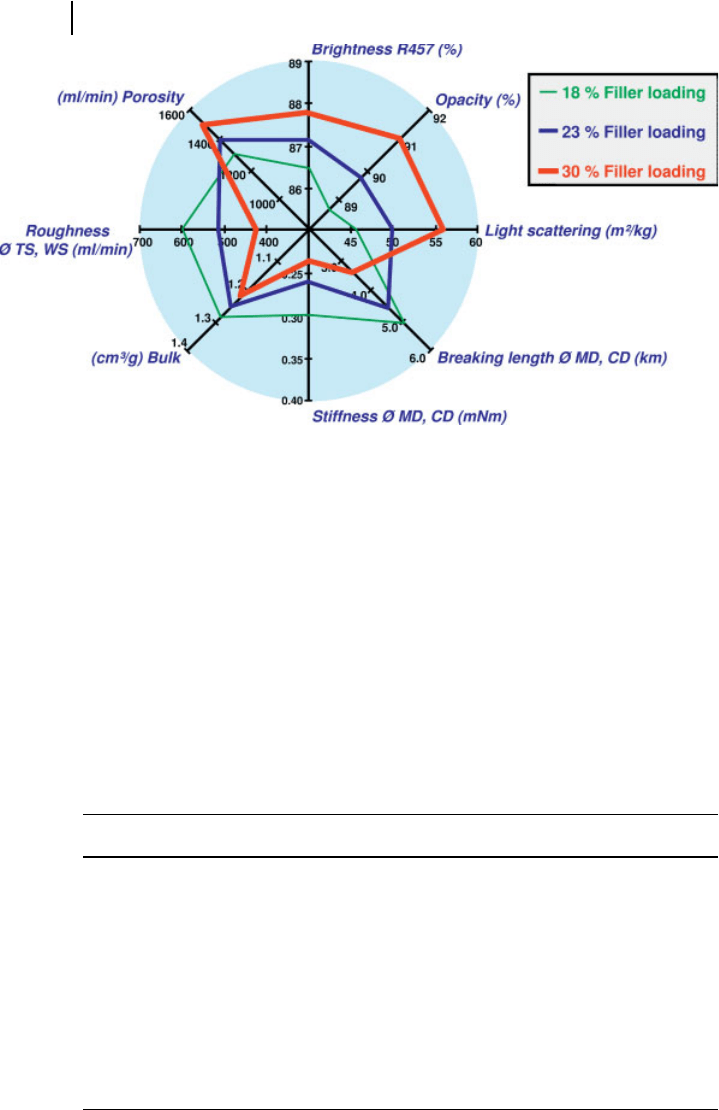
sheet properties obtained. Figure 2.9 shows the influence of increased filler load-
ing on some important paper properties. The results shown are based on a pilot
study, using natural ground calcium carbonate (GCC) as filler in a wood-free fiber
furnish. The basis weight was 80 g m
–2
. In general, the influence of the filler at
increased loading is magnified in both directions, desired and undesired. In partic-
ular the main location and distribution of the filler in the sheet has a major influ-
ence on the end performance. In the final sheet, the effect of a filler is dependent
not only on the intrinsic properties of the filler particles, but also on the extrinsic
influence of the filler on the fiber network. This includes for example the disrup-
tion of the fiber network by the filler.
2.2 Non-fiber Raw Material 33
The limits in terms of filler loading are set primarily by an accompanying reduc-
tion in stiffness and insufficient strength properties (tensile strength, tear resis-
tance, internal bond and surface strength). Sufficient surface strength is partic-
ularly important in offset printing or, for example, in copier machines. Inade-
quately fixed filler on the paper surface can result in dusting (blanket piling) in the
offset printing process or contamination of the copy machine. Typical filler loading
levels in different European paper grades are given in Table 2.3.
Overall, the wood-free uncoated paper grades mentioned are loaded mostly with
primary (fresh) filler only. The coating base papers are filled with coating pigment
Fig. 2.9 Impact of filler loading degree on some important
paper properties (pilot study, GCC as filler, wood-free
furnish, 80 g m
–2
) (source: OMYA).
Table 2.3 Typical filler loading levels in European printing and
writing paper.
Paper Filler loading (%)
wood-free uncoated
(copy, stationery, offset)
12–26
wood-free coating base
(single, double, triple coated)
12–20
wood-containing uncoated
(super calendered, magazine, catalogues)
24–38
wood-containing coating base
(LWC, MWC, HWC)
8–12
newsprint 2–18
2 Raw Materials for Paper and Board Manufacture34

coming from the coated paper broke plus some primary filler. The wood-contain-
ing uncoated papers can contain recycled pigment (originating from the use of
recycled fiber furnish) plus primary filler or just 100% primary filler. Today news-
print is often made from recycled fibers, sometimes combined with virgin fibers.
Newsprint, made from recycled fibers, contains substantial amounts of recycled
pigment and, if sensible and possible, also some fresh filler, reaching up to 18%
total filler loading. Newsprint paper based on virgin fiber only, carries almost no
filler in the paper. However, more recently, virgin fiber newsprint paper can be
found in the paper market, loaded with up to 12% chalk as filler.
Additionally worth mentioning is a development which increases the filler load-
ing level effectively through the paper surface. GCC filler is added to the film press
starch solution and penetrates together with the starch into the sheet. Thereby the
wet end system is not affected at all and, at moderate loading increase, paper
stiffness and strength are also unaffected. Paper caliper and bulk are reduced as in
a conventional internal filler loading increase. Porosity is dramatically reduced by
this method, allowing potentially also for some reduction in fiber refining [1].
Developments, in which the filler is preferentially positioned at specific locations
in the z-direction of the sheet are also at a very early stage. Turning such concepts
into practice will require new technologies and quite significant investment [2].
2.2.1.2 Choice of Fillers
The choice of fillers usually takes into consideration primarily the desired perform-
ance in a specific paper grade, the mill internal situation, logistical possibilities
and consequences, the general availability of the product, and the costs, including
the external and internal logistics.
Optimizing one type of filler for a specific paper grade usually results in a com-
promise between the obtainable properties with this filler. In cases where one
single pigment does not meet all the requirements, filler combinations are applied.
There is a continuous trend towards fully or partially replacing specialty pigments
by regular or modified regular fillers. Table 2.4 provides an overview of the range of
regular fillers and specialty pigments applied in the production of certain paper
grades.
Of great importance are the potential interactions of the fillers with wet end
furnish components like retention aids, starch, sizing agents, dyes etc. Therefore,
the selection of the filler type and grade needs also to be made in the light of these
possible interactions.
2.2.1.3 Characterization of Fillers
Chemical composition, particle morphology, particle size and particle size distribu-
tion, brightness, refractive index, specific surface, particle charge and abrasiveness
are commonly used to characterize papermaking fillers. Table 2.5 summarizes
some chemical and physical data of fillers and fibers. More detailed information is
given in the following paragraphs.
2.2 Non-fiber Raw Material 35
2.2.1.3.1 Brightness
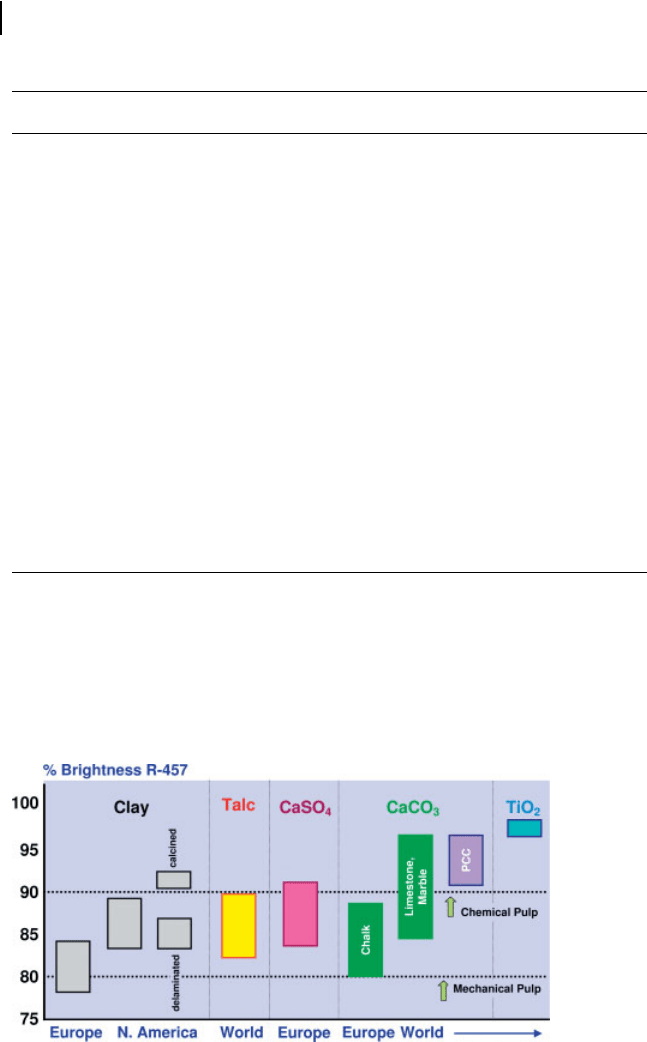
Tappi brightness is measured at a wavelength of 457 nm. Fillers with high pigment
brightness, like GCC or PCC, are in demand for the production of high quality
printing and writing papers. Figure 2.10 compares the Tappi brightness of various
fillers of different geographical origin as well as of highly bleached chemical and
Table 2.4 Paper grades and range of fillers and/or specialty
pigments applied.
Paper grade Filler/specialty pigment
wood-free uncoated
(copy, stationery, offset)
PCC, GCC, PCC/GCC, talc/GCC (Asia only),
amorphous silicate, calcined clay
wood-free coating base
(single, double, triple coated)
GCC, PCC
wood-containing uncoated
(super calendered, magazine, catalogues)
clay, clay/GCC, clay/PCC,
recycled pigment/clay/GCC or PCC
calcined clay, amorphous silicate
wood-containing coating base
(LWC, MWC, HWC)
GCC, Talc, PCC
Newsprint/Directory Recycled pigment, GCC, PCC,
amorphous silicate, calcined clay, (TiO
2
)
high opaques
(thin print)
TiO
2
, Zinc sulfide, PCC, amorphous silicate
calcined clay
decoration paper TiO
2
, TiO
2
/Talc, TiO
2
/calcined clay or silicate
cigarette paper PCC
white top liner GCC, PCC, calcined clay
Fig. 2.10 Brightness (Tappi R-457) of various paper fillers and
highly bleached mechanical and chemical pulp (source:
OMYA).
2 Raw Materials for Paper and Board Manufacture
36

Table 2.5 Characteristic chemical and physical data of regular
fillers and specialty pigments.
Filler Chemical
composition
Crystal
habit
Morphology ISO
Brightness
%
Refractive
index
Density
gcm
–3
Specific
surface
m
2
g
–1
kaolin hydrous Al
4
(OH)
8
(Si
4
O
10
) hexagonal
(1:1 layer silicate)
hexagonal platelets 70–90 1.56 2.8 10–25
calcium carbonate CaCO
3
trigonal
– natural rhombohedral 80–96 1.58 2.7 2–12
scalenohedral
aragonite
rhombohedral
– precipitated prismatic 92–97 1.56 2.7 4–12
all forms can occur
discretely, clustered
or agglomerated
talc Mg
3
(OH
2
) (Si
4
O
10
) hexagonal
(2:1 layer silicate)
hexagonal
patelets
70–88 1.57 2.7 5–20
gypsum CaSO
4
monoclinic needles 88–98 1.54 2.8 2–5
titanium dioxide
rutile, anatase
TiO
2
tetragonal isomorphic
(round particles)
97–99 2.76/2.55 4.2/3.8 8–12
calcined clay Al
2
O
3
/SiO
2
hexagonal
(1:1 layer silicate)
fused
platelets
89–93 1.56 2.7 15–25
synthetic, precipitated
silicate, silica
mostly Al or Mg/
Ca-Silicates
mostly
amorphous
irregular
composite
93–96 1.55 2.1 40–70
aluminum, trihydrate,
hydrated alumina
Al(OH)
3
/
Al
2
O
3
xH
2
O
gel,
pseudohexagonal
(pseudo boehmite)
irregular composite,
hexagonal platelets
96–98 1.58 2.4 5–9
cellulose 90 1.60
air 1.00
fibers ca. 0.7 1–2
fiber fines 6–8
2.2 Non-fiber Raw Material 37

mechanical pulps (dotted lines). The brightness range of the different types of filler
is given by the raw material quality used and the various processes (mechanical
classification, magnetic separation, flotation, grinding, bleaching, precipitation
etc.) applied.
2.2.1.3.2 Refractive Index
The refractive index indicates the extent to which a light beam is deflected when
passing from vacuum into a given substance. The refractive index is given by the
filler’s chemical composition and molecular structure. Powders are usually meas-
ured in a refractive index matching liquid. The material, ground into a fine pow-
der, is immersed in a series of liquids until scattering and reflectance disappear,
i.e. the material becomes invisible. Of course the powder should not be soluble in
the liquid. It can be tested either using a laser beam or by studying the turbidity
with the eye or a turbidimetric method. The more the particles differ from the
medium (i.e. the more their refractive indices differ), the more light will be scat-
tered by the particles. If there is no difference at all, no light will be scattered.
However, as calcium carbonate is birefringent (double refraction), the method de-
scribed is not ideally suitable for this specific mineral. The higher the refractive
index developed in the paper, the higher the amount of reflected and/or scattered
light, which results in an increase in paper opacity. While titanium dioxide TiO
2
shows an extraordinarily high refractive index (rutile 2.75, anatase 2.55), other
common fillers exhibit indices of around 1.55–1.65 (zinc sulfide 2.39). For compar-
ison, the refractive index of cellulose, as used in papermaking, is about 1.60.
2.2.1.3.3 Particle Morphology
The structure of a filler can be observed and characterized best by scanning elec-
tron microscopy (SEM). The particle morphology has an influence on light scatter-
ing via the number and size of air microvoids in the sheet. For different morpholo-
gies, there is a different optimum for light scattering in terms of particle size. The
particle morphology has an impact also on the packing of the filler particles in
flocculates usually formed during the papermaking process. The results are mor-
phology related differences in sheet drainage, drying behavior, and in paper prop-
erties such as bulk, porosity, ink receptivity, strength, dusting, etc. The sheet sur-
face roughness and paper gloss after calendering, as well as the sheet compressi-
bility (important in rotogravure printing) are also influenced by the morphology of
the filler or specialty pigment applied. Figure 2.11 shows SEM pictures of various
typical fillers and specialty pigments currently applied in the paper industry.
2 Raw Materials for Paper and Board Manufacture38
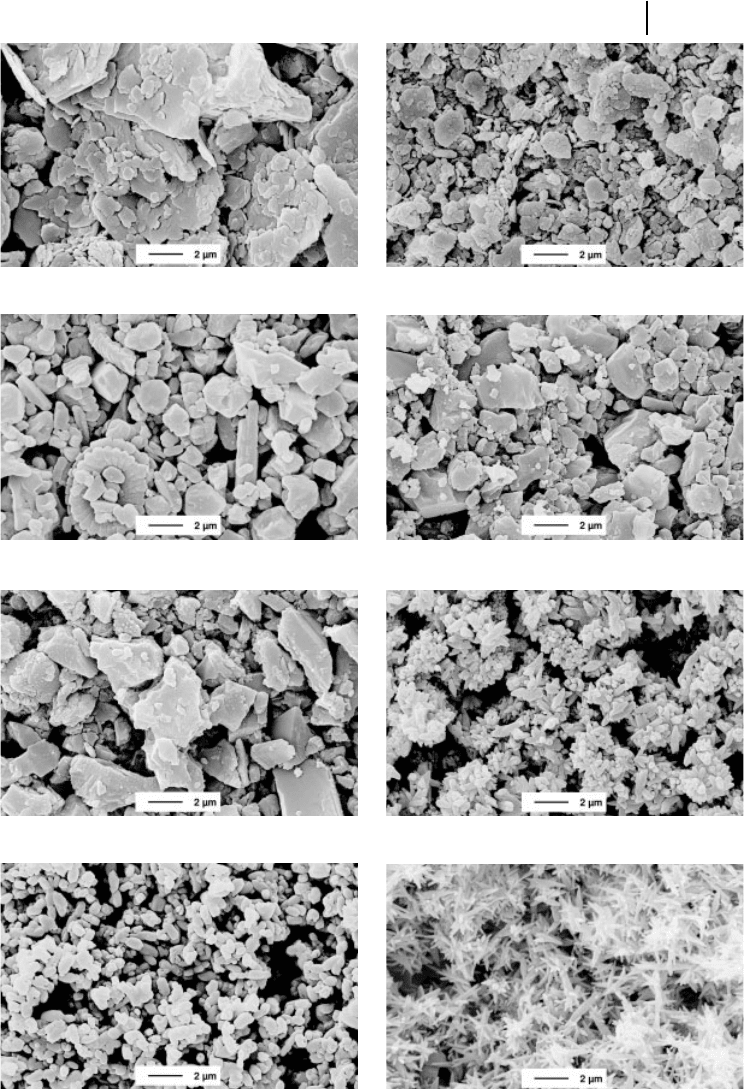
a Kaolin (hydrous, primary deposit) Europe, United
Kingdom
b kaolin (hydrous, secondary deposit) North
America, Georgia
c natural ground calcium carbonate – chalk d natural ground calcium carbonate – limestone
e natural ground calcium carbonate – marble f precipitated calcium carbonate – calenohedral,
clustered
g precipitated calcium carbonate – hombohedral,
clustered
h precipitated calcium carbonate – ragonite,
clustered
Fig. 2.11 Scanning electron microscope pictures of regular
fillers and specialty pigments for paper. Main fillers: a–j,
specialty pigments k–n.
2.2 Non-fiber Raw Material
39
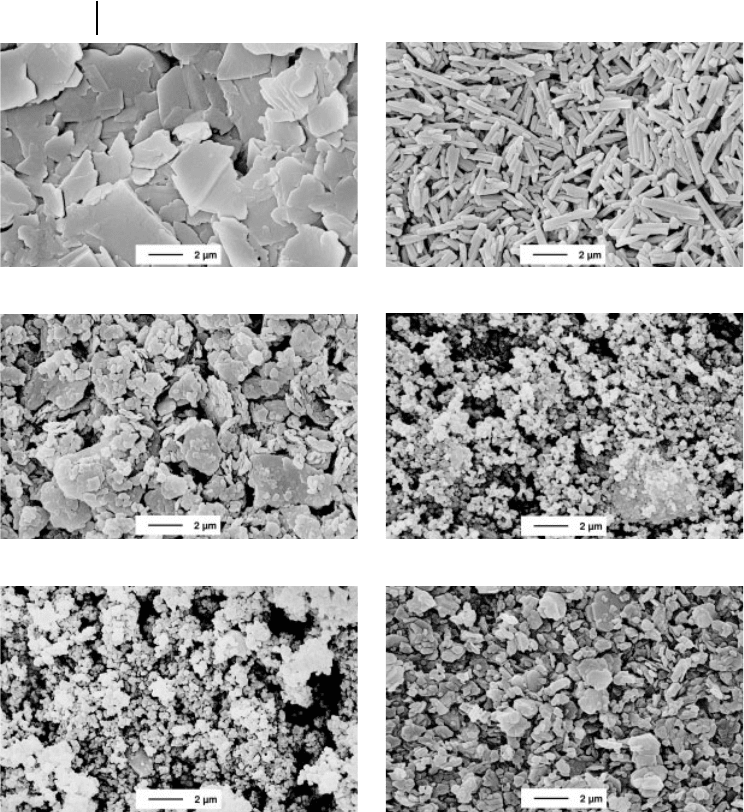
Fig. 2.11 Scanning electron microscope pictures of regular
fillers and specialty pigments for paper. Main fillers: a–j,
specialty pigments k–n.
i talc, Europe, Finland j gypsum (calcium sulfate)
k Calcined clay l titanum dioxide
m Mg-Al-silicate n aluminum trihydrate
2 Raw Materials for Paper and Board Manufacture
40
2.2.1.3.4 Particle Size and Particle Size Distribution
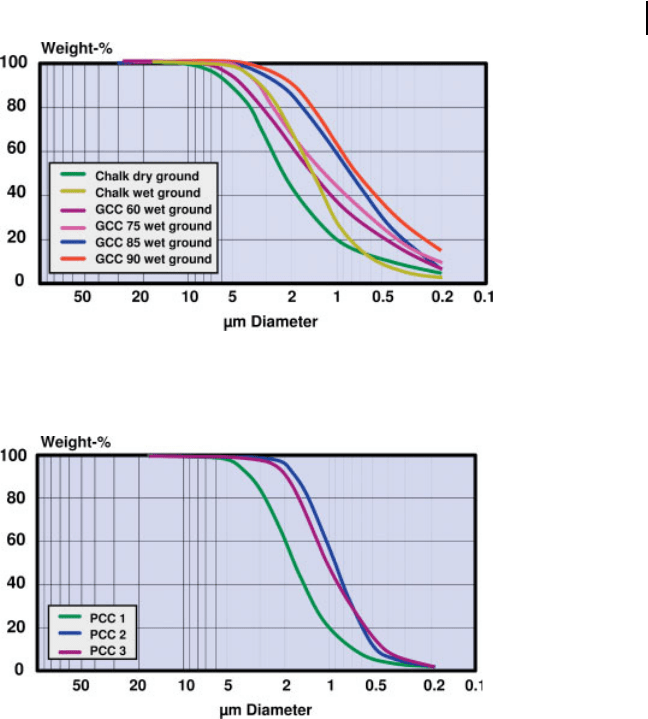
There are different methods (sedimentation, laser scattering/diffraction etc.) to
determine the particle size distribution of a filler. However, the results obtained by
the different methods are usually not directly comparable. Even comparing pig-
ments with very different morphology by just one single method, does not provide
correctly comparable particle size distribution curves. The sample preparation
(state of dispersion) also has a great influence on the outcome of the individual
measurement. Figures 2.12 and 2.13 show some typical particle size distribution
curves (measured by the sedigraph method) of GCC and PCC based fillers.
Fig. 2.12 Typical particle size distribution curves of GCC fillers
(sedigraph method) (source: OMYA).
Fig. 2.13 Typical particle size distribution curves of PCC fillers
(sedigraph method) (source: OMYA).
2.2 Non-fiber Raw Material
41