
Holik H. (ed.) Handbook of Paper and Board
Подождите немного. Документ загружается.

relative to the cylinder with the effect that the condensate ring velocity is lowest
and thus its thickness is highest at the culmination point and not in the bottom
position. For high machine speeds the condensate motion and thus heat transfer
decrease. For heat transfer enhancement and uniform drying spoiler bars induc-
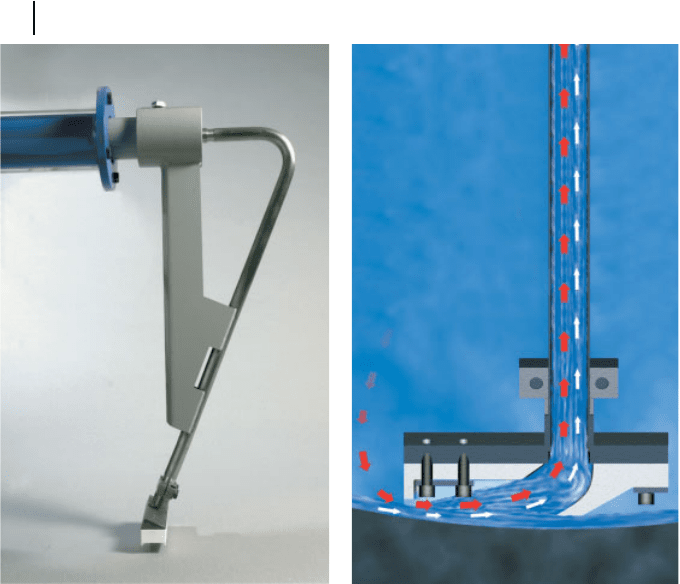
ing turbulence to the condensate layer are installed (Fig. 6.52). The condensate is
removed from the inner surface of the cylinder to its axis by syphons (Fig. 6.53) in
the form of a two-phase flow of steam and condensate. To overcome the high
centrifugal forces and to generate the two-phase flow a pressure difference of
about 0.3 to 0.5 bar is necessary. The syphons either rotate with the cylinder (for
higher machine speeds) or are stationary. Heat transfer through the wall depends
on the thickness and conductivity of the cylinder material which is mainly cast iron
(in some cases steel). Higher steam pressure increases the temperature difference
and thus the drying rates. Accumulation of air in the cylinder has to be avoided as
it would reduce the condensing temperature according to the partial pressure.
Good heat transfer from the cylinder to the paper web is obtained by pressing the
web tightly to the cylinder e.g. by means of dryer fabrics.
Fig. 6.53 Siphon for condensate removal from a drying
cylinder (source: Voith).
6 Paper and Board Manufacturing
282

6.6.2.2 Air Impingement Drying
This drying principle is mainly used in tissue production or in coating machines
but also for enhancing the drying capacity of drying cylinders in multi-cylinder
dryer sections. Hot air is blown through a nozzle plate at high velocity onto the
paper. The impinging air transfers heat to the web and takes up the evaporated
water. The air is then sucked back into the hood. Heat transfer in impingement
drying increases with increased air temperature and velocity and by reducing the
spacing between the nozzle plate and the paper surface.
6.6.2.3 Through Air Drying
This method is used in the drying of tissue and nonwovens. Hot air is sucked or
blown through the air permeable paper web supported by a heat resistant wire.
Heat is transferred directly into the fiber network and the evaporated water is
carried off. Through air drying results in the highest drying rates.
6.6.2.4 Infrared Drying
This heat transfer method is mainly used to enhance the drying capacity in coaters
when the web is wet. Infrared heaters are usually gas fired. The gas heats a mesh to
a temperature of about 900 to 1100 °C. The low thermal inertia of the mesh allows
fast control of the mesh temperature and the heating rate as well as preventing
fires in the case of sheet breaks. In some cases electrical heaters are in use with
temperatures up to about 700 °C, exhibiting a fast cool down of the emitter plates.
Infrared drying units need sufficient air flow in order to carry off the evaporated
water and to prevent coat quality problems.
6.6.2.5 Press Drying
This method is a combination of pressing and drying. First the web is dewatered
mechanically in a press nip and brought into tight contact with the hot surface on
one side. At the opposite side the web is covered by a permeable belt such as a felt
or a wire which continues to press the web to the hot surface over a longer dis-
tance. The vapour escapes through the permeable cover or is stored therein. There
are only a few installations of this dryer type worldwide.
6.6.2.6 Impulse Drying
This method is also a combination of pressing and drying. The process takes place
in a press nip (for instance with a shoe press) where one surface, which is in direct
contact with the web, is heated. The other web side is in contact with a felt. The wet
web is compressed and thus mechanically dewatered. The vapor generated at the
hot surface pushes the water through the compressed capillaries towards the felt
and finally the generated vapor can flow freely through these channels. This kind
of process is still in development.
6.6 Dryer Section 283
6.6.3
Dryer Sections
6.6.3.1 Multi-cylinder Dryer Section
6.6.3.1.1 Types of Multi-cylinder Dryer Section
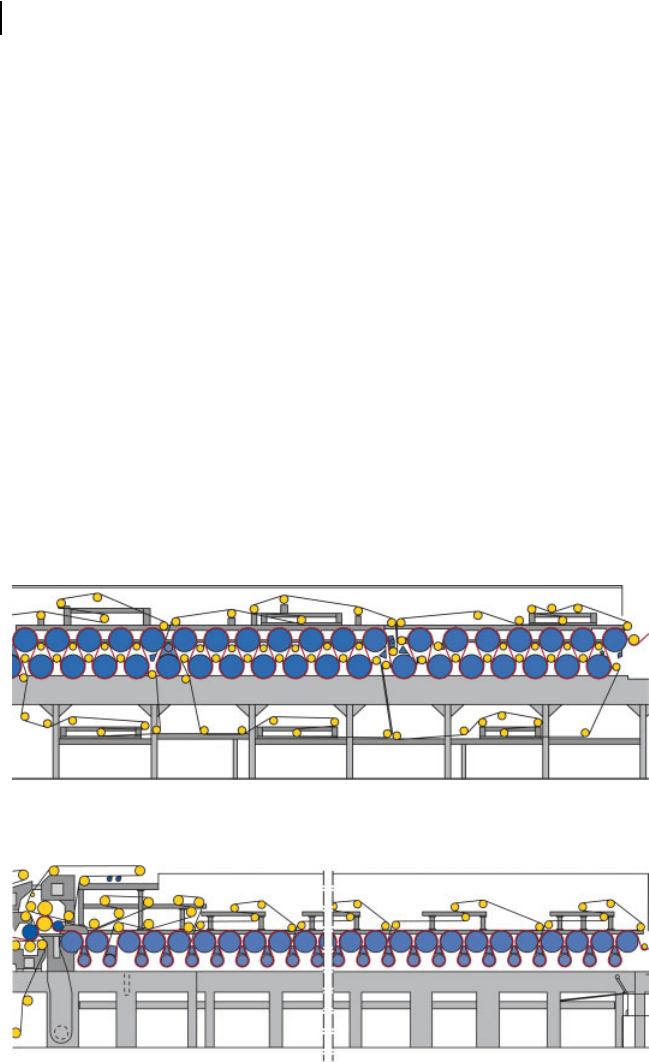
Multi-cylinder dryer sections consist of double-tier or single-tier groups or a com-
bination of both. In double-tier dryer sections (Fig. 6.54) the paper web runs
around a large number of cylinders (up to about 60 in graphic paper machines and
up to 90 for board and packaging paper machines) arranged in an upper and a
lower row. The paper is in contact with each cylinder at an angle of about 220 to
240°. Dryer fabrics, one for each top group and one for each bottom group of
cylinders, press the paper against the cylinder surface for improved heat transfer.
Even together with stabilizers the dryer fabrics can only partly support the paper
web during its transfer to the next cylinder. Tail threading in conventional dryer
sections is usually done by means of ropes.
The state-of-the-art dryer section for a high-speed paper machine has a single-
tier configuration with steam heated cylinders in the top row and suction rolls in
the bottom row. The paper web is always supported by the dryer fabric and runs
jointly around the drying cylinders and suction rolls (Fig. 6.55). In the top row the
paper web is pressed against the drying cylinders by the dryer fabric. In the bottom
Fig. 6.54 Double-tier dryer section (source: Voith).
Fig. 6.55 State-of-the-art single-tier dryer section for high-
speed paper machines (source: Voith).
6 Paper and Board Manufacturing
284
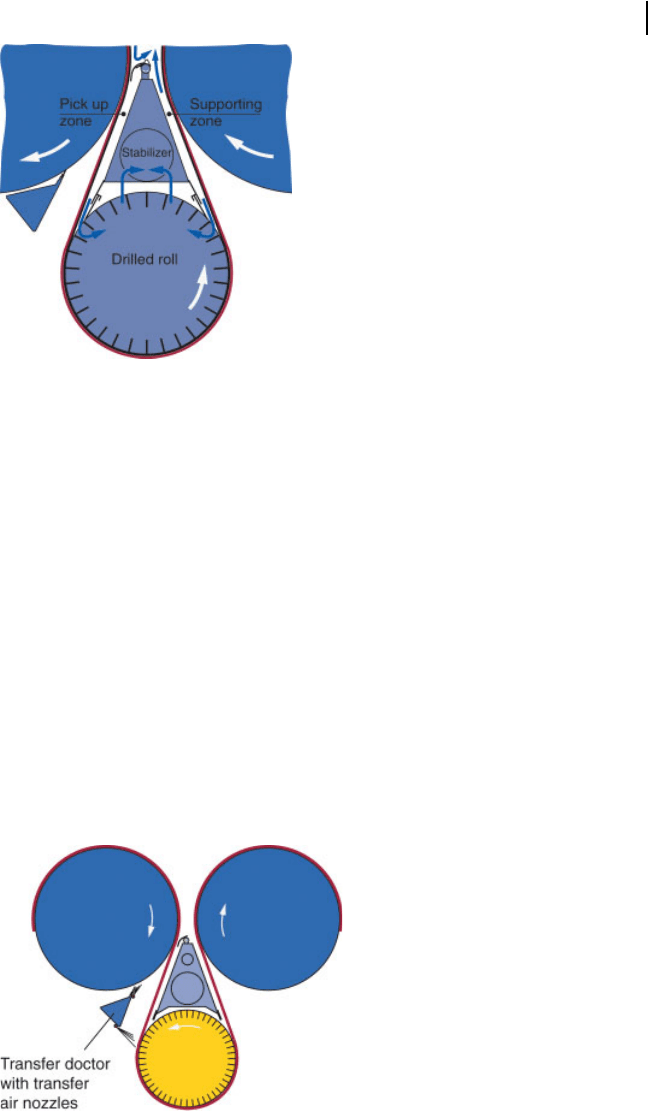
row it is held on the fabric by reduced pressure in the suction rolls. Stabilizing
elements ensure a safe web run along its path between cylinder and suction roll
where the web is not in contact with the drying cylinder (Fig. 6.56). For high speed
paper machines tail threading with only doctors and air jets is standard (Fig. 6.57).
Many paper machines have some single-tier groups for runnability reasons fol-
lowed by double-tier dryer groups. Cylinder diameters today are usually 1.8 m, in
older machines they are also 1.5 or 2.2 m.
The dryer section is split into several drive groups to control web tension and to
account for web stretch and shrinkage. Each group has its own dryer fabric and
separate drive. The steam and condensate system is also split into groups to con-
trol the heating curve. Temperature and steam pressure in the different heating
groups have to follow an ascending curve so, usually, a steam cascade system is
applied, supplying the blow through steam of the last drying group to the last but
one etc. The remaining steam from the first group is condensed and any air ex-
tracted from the steam-condensate system.
In the field of dryer fabrics excessive air entrainment at high machine speeds
had to be reduced without losing drying capacity by decreased air permeability of
Fig. 6.56 Stabilizing elements for web guiding
in single-tier dryer section (source: Voith).
Fig. 6.57 Ropeless tail threading system
for single-tier dryer section (source:
Voith).
6.6 Dryer Section
285

the fabrics. Modern dryer fabrics provide high contact area, low caliper, high stabil-
ity and abrasion resistance. Good cleaning of the dryer fabrics ensures uniform
evaporation, less sheet picking and improved effectiveness of the web run stabi-
lizers. Shutdowns for cleaning can be avoided or cleaning intervals increased by
appropriate cleaning devices as mentioned in Section 6.4.
6.6.3.1.2 Web Handling
In order to reduce the forces acting on the web at high machine speeds a single-tier
dryer section is applied where the paper web is continuously supported by a fabric.
In the critical areas where the web has to be released from the drying cylinder
surface stabilizers support the safe web run. Stabilizers are also used in double-tier
dryer sections. In the most sensitive areas of low strength or low stretch potential
the size and speed of the dryer groups have to be adjusted according to the
strength, stretch potential and web shrinkage. This enables fine-tuning of sheet
quality and improves machine runnability.
6.6.3.1.3 Dryer Hood
The whole dryer section is enclosed in a drying hood with doors which can be
opened e.g. for inspection. It allows controlled flow of the hot and dry make-up air
as well as of the vapor laden exhaust air. The pressure inside the hood should be
balanced in such a way that a minimum of air is blown from the hood into the
machine hall or sucked from the machine hall into the hood. For effective pocket
ventilation the hot air enters via blow boxes or blow rolls and flows to both sides of
the machine where it is sucked off. To prevent condensation the hood walls are
insulated and make up air is supplied along both hood sides from underneath.
These measures allow a low amount of make-up air, a high air dew point of the
exhaust air and effective heat recovery.
6.6.3.1.4 Paper during Drying
The web strength increases with increasing dryness due to build up of hydrogen
bonds between the fibers. The increase in strength from about 50% to 95% dry-
ness is about a factor of 10. Stretch before rupture decreases with drying and also
depends on the web structure and how far the web was allowed to shrink.
The paper web shrinks during drying. The extent of shrinkage depends on the
type of stock, degree of beating, the fiber orientation, and on forces that restrain
the shrinkage. The shrinkage in the machine direction can be controlled by
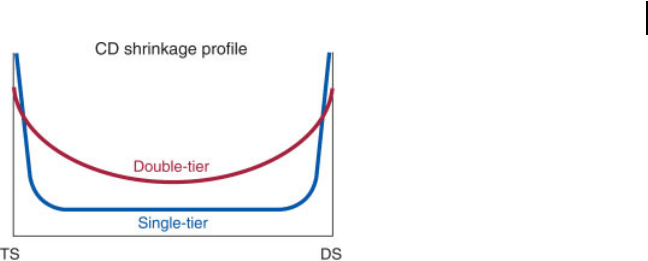
stretching the web. CD shrinkage is nonuniform and is higher at the sides than
towards the center of the web. The single-tier dryer configuration changes the CD
shrinkage profile compared with a conventional double-tier one (Fig. 6.58). The
profile is now flatter over a large part of the sheet between the drive and tender side
with low shrinkage, accompanied by less stretch potential and higher dimensional
stability in this area. On the other hand there are distinctly steeper slopes in the
shrinkage curve with high shrinkage numbers at the edges.
6 Paper and Board Manufacturing286
Paper curl is an undesirable effect when paper undergoes heating or moisten-
ing, e.g. in copy machines or in printing. Curl is due to nonsymmetrical residual
stresses in the z-direction of the web which date back to nonsymmetrical drying of
its top and bottom sides. The amount of curl is influenced by the degree of non-
symmetrical drying. The impact increases towards the end of the drying process.
The direction of curl (MD, CD or diagonal curl may occur) is defined by the paper
and fiber structure. Curl can be overcome by varying the operation of the top and
bottom drying cylinders if there is a conventional double-tier after-dryer section.
With a pure single-tier dryer section curl can be controlled by additional tools such
as by moistening (water, steam) or by additional drying (air impingement dry-
ing).
A uniform CD moisture profile of the web at the end of the dryer section is an
important quality requirement so the heat transfer of the cylinders to the web as
well as the vapor exhaust conditions close to the web have to be uniform. Addi-
tional CD moisture control tools such as sectioned cylinders, blow boxes or mois-
turizers are also used.
6.6.3.2 Tissue Dryer Section
Conventional tissue drying is a combination of contact and impingement drying.
Today a combination with through drying is often used. So a tissue drying system
consists either of a tissue cylinder wrapped by a hood or of a system with an
additional through air dryer section ahead of the tissue cylinder. In some cases
only through air dryers are used.
6.6.3.2.1 Tissue Cylinder
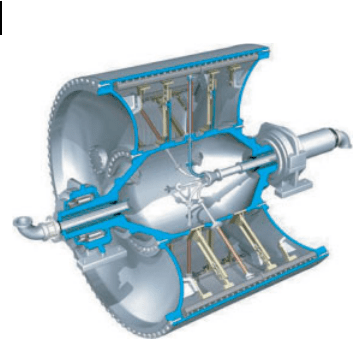
Tissue cylinders (Fig. 6.59), also called Yankee dryers, have a width of up to 8.2 m
and a diameter of 3.6 to 5.5 m, and in special cases even up to 6.3 m. The inside of
a tissue cylinder shell is usually ribbed for maximum drying rates. The drying rate
is further enhanced by turbulence generators. Condensate removal is performed
by two-phase flow through a sodastraw syphon system. The cylinder shell, made of
special cast iron, is the most sensitive part as regards safety against catastrophic
failure. It undergoes a mainly two-dimensional combined static and dynamic
Fig. 6.58 CD shrinkage profile for
single-tier and double-tier dryer
sections.
6.6 Dryer Section
287
stressing. This is due to inside steam pressure, high temperature gradient across
the shell thickness, high centrifugal forces and dynamic stress due to press roll
loading so the admissible steam pressure has to be limited. For good creping effect
a coating consisting of hemicellulose and/or synthetic agents has to be established
on the cylinder shell surface. This also reduces wear; prolonged cylinder lifetime
can also be achieved by covering the surface with a metal spray coating. One (or
two) press roll(s) dewater the web and bring it into good contact with the cylinder
for intense heat transfer. The shell shape in CD depends on the operating condi-
tions. These must be defined in advance in order to grind the adequate crowning
on both cylinder and pressure roll(s) for uniform web pressing and dewatering in
CD. As operating conditions may vary in a certain range, the cylinder shape and in
CD the moisture profile may also show some deviations. To end up with a uniform
moisture profile and creping quality modern tissue drying includes a press roll
which can better adjust to cylinder shape deviations as well as a dryer hood with a
CD moisture profiling system.
6.6.3.2.2 Tissue Dryer Hood
The dryer hood spans the tissue cylinder by about 220 to 260° and consists of two
halves both of which are retractable. The nozzle plate is concentric to the cylinder
and includes exhaust openings. The diameter of the nozzles is about 5 to 7 mm
depending on the spacing between the nozzle plate and the cylinder. The ratio of
nozzle diameter to spacing has to be optimized with regard to minimum fan
energy consumption and maximum drying rate. The minimum spacing is limited
for runnability reasons to about 20 mm. Air temperatures of up to 700 °C and air
blow velocities of up to 160 m s
–1
are used. For CD moisture profile control the
hood is divided in several sections across its width. The hood is insulated. Its
design has to account for the large temperature differences when heated up. The
air system with burners, fans and heat exchangers for heat recovery is located in a
Fig. 6.59 View inside a ribbed tissue
cylinder with soda straw siphons for
condensate removal (source: Andritz).
6 Paper and Board Manufacturing
288
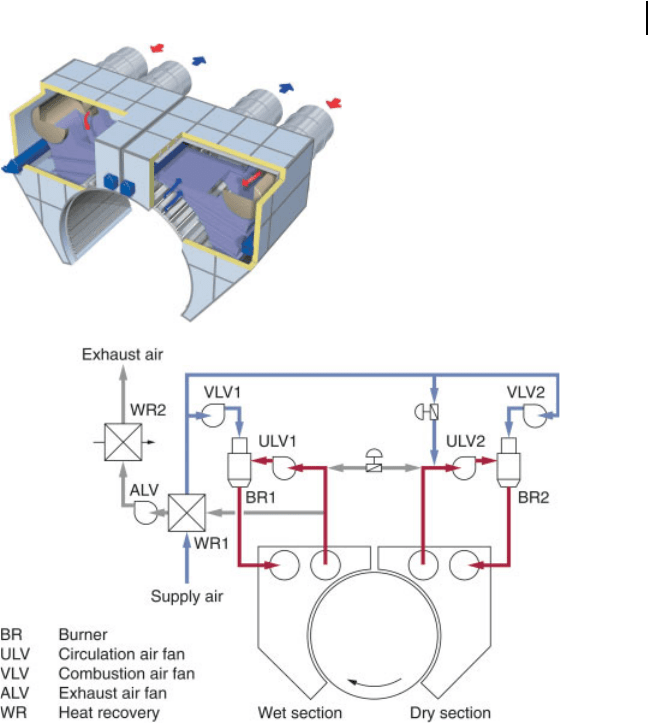
separate place outside the hood. A tissue dryer hood and its air system is shown in
Fig. 6.60.
6.6.3.2.3 Through Air Dryer
This type of cylinder can be built with diameters up to 5.5 m, or in special cases up
to 6.7 m, and widths of up to 9 m. It has a free outside surface area of up to 96% in
order to have a uniform air flow through the paper web. During its contact with the
cylinder the paper web is supported by a revolving wire. The cylinder can run at
speeds of up to 3000 m min
–1
. Air is usually sucked into the cylinder by reduced
pressure and is supplied by a hood wrapping the cylinder by about 250°. The
temperature can be up to 300 °C. The design has to withstand the heat up and cool
down cycles during its operational life and always has to ensure a uniform geome-
Fig. 6.60 Schematics of a tissue dryer hood and an air system
(source: Andritz).
6.6 Dryer Section
289
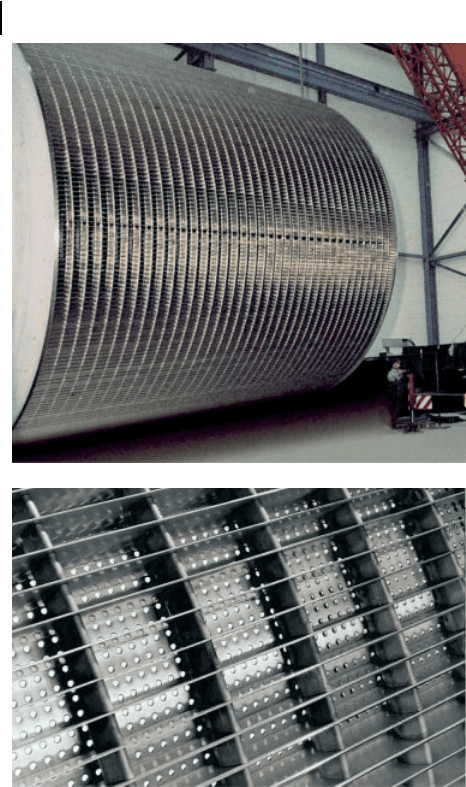
try and drying conditions. Figure 6.61 gives an overall view of a through air drying
cylinder and a closer look at the construction.
6.7
Surface Sizing
Martin Tietz
Some paper machines contain a unit for the application of certain liquid media to
the web surface. When applying a starch solution, a sizing agent, or a mixture
Fig. 6.61 Overall view of a cylinder for through drying with a
highly open surface and some construction details (source:
Fleissner).
6 Paper and Board Manufacturing
290
thereof, this process is called sizing. The main objectives of sizing are to increase
the strength of the paper and to modify the surface properties with respect to
liquid uptake during writing, printing, or coating.
Sized papers show a considerably higher strength. This is, for instance, im-
portant for liner and corrugated media, but also for other packaging papers as well
as for graphic papers. For tensile strength increase, penetration of the size into the
paper is desired. If the main objective is to increase surface strength, for example
for printing, the size should remain on the surface.
Sizing also reduces the penetration of liquids into the paper. This limits, for
example, the ink spread when writing or printing onto the paper. The same effect
is desired for coating base papers, since sizing improves the coating hold-out in
the subsequent coating process.
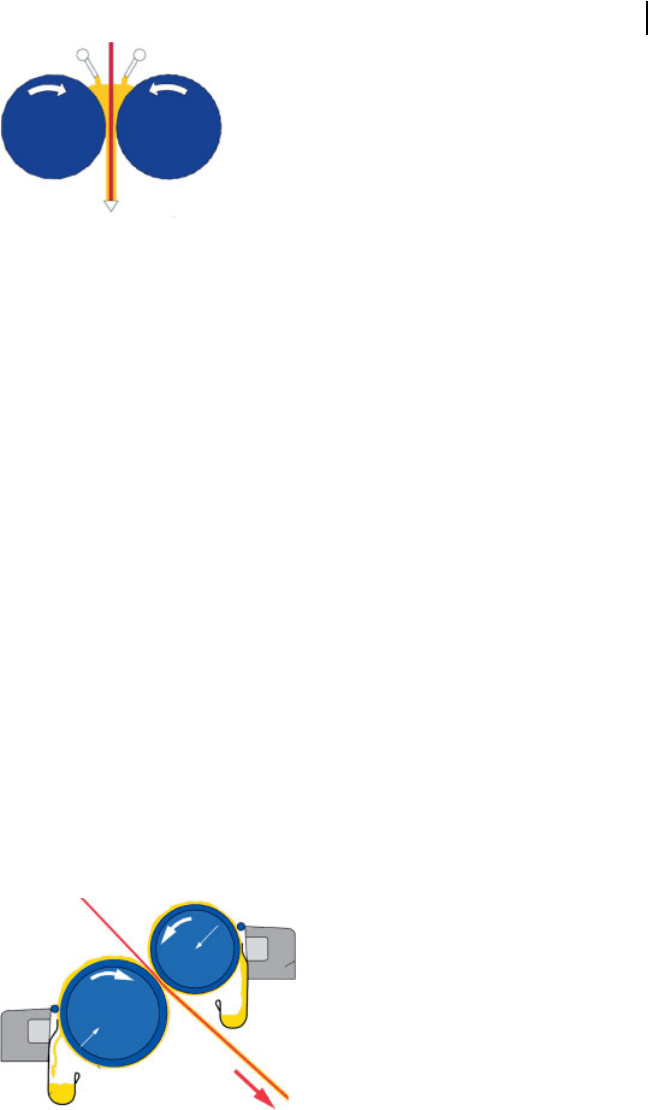
Sizing is usually performed in a size press or a film press. In a size press
(Fig. 6.62), the web is passed through a pond of the sizing agent, which is located
above a roll nip. As a result of both capillary action in the pond and the hydraulic
pressure in the roll nip, the paper web absorbs the sizing liquor.
The amount of size pick-up and the degree of penetration depend upon the pond
height, the concentration and viscosity of the size, the absorption behavior (poros-
ity, moisture content, temperature, etc.) of the paper web, and the nip pressure and
nip length. Control of the size pick-up is mainly by variation of the size concentra-
tion, but also by variation of the pond height or nip pressure.
Typical size concentrations lie between 5 and 12 %. The pick-up is usually
0.8–3 g m
–2
dry substance in total. The size press is limited in speed due to pond
turbulences, which become unacceptable above approximately 1000 m min
–1
. Size
concentration and pick-up are also limited.
Fig. 6.62 Size press (source: Voith).
Fig. 6.63 Film press (source: Voith).
6.7 Surface Sizing
291