
Holik H. (ed.) Handbook of Paper and Board
Подождите немного. Документ загружается.

with a special tail threading device. Similar parameters are found in the OptiLoad
calender of Metso and Küsters’s ProSoft calender.
Based on the Janus Concept calender, Voith developed the Janus MK 2. This
latest multinip-calender version is mainly characterized by the stack being no
longer arranged vertically but inclined at a 45° angle offering operational and tech-
nological advantages (Fig. 6.72).
6.9.3.5 Extended Nip Calenders
Certain board grades have traditionally received their final surface properties by
means of a Yankee cylinder, i. e. a heated cylinder having a large diameter and a
highly polished surface, or by soft calenders. This technology is about to yield to
extended nip calendering which provides two advantages, namely a speed that is
much higher than that possible with the Yankee cylinder and a better relationship
of smoothness versus bulk than can be obtained on a soft calender.
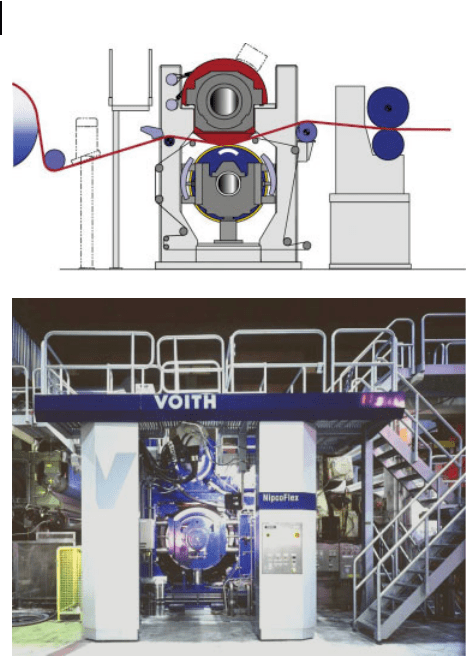
Fig. 6.73 Extended nip calender, schematic and photo of
mounting (source: Voith).
6 Paper and Board Manufacturing
302

The extended nip calender is based upon the well-established shoe-press tech-
nology. The machine consists of a heated metallic roll acting against a soft sleeve
rotating around a shoe roll and a moistening device directed against the side of the
web to be surface-treated. When passing the elongated nip, the web is calendered
on the side contacting the heated metallic roll. Typically, the heated roll is operated
at surface temperatures far above 200 °C. The nip length is determined by the
length of the concave shoe. For board, the length varies between 130 and 250 mm.
Technologically, extended nip calendering can be described as moisture and tem-
perature gradient contour calendering on the basis of reduced line loads and leads
to improved micro-roughness (PPS) and high bulk preservation (Fig. 6.73).
6.9.3.6 Embossing Calenders
The objective of embossing is to give the paper a three-dimensional pattern. This is
achieved by means of a single nip calender.
There are three different embossing methods, namely “matrix” embossing, “flat-
back” embossing and “union” embossing.
Machines for “matrix” embossing consist of an engraved ridged heated and
sometimes chromium plated top roll and a soft covered bottom roll whose diame-
ter is exactly double that of the top roll. By pressing both rolls together and running
them at low speed, the pattern of the top roll is imprinted on the bottom roll. As a
result, a paper web passed through the nip will have an embossed laid pattern on
both sides. Matrix embossing is applied for graphic papers, wallpapers etc.
Flat-back embossers are similar to the a.m. calenders for geared embossing
except that the diameter relation of the top and bottom roll is bigger or smaller
than 1 : 2. With this type of calender, only the top side of the web receives a pattern.
If both sides require a three-dimensional structure, the web has to be passed
through the nip again with the former bottom side now turned against the top roll
and with a reduced nip pressure. Flat-back embossing is applied for writing and
printing papers, photographic papers, car body boards etc.
Union embossing calenders differ from the a.m. machines in so far as they
consist of two rigid rolls of the same diameter. The rolls mesh. The distance be-
tween the two rolls is always adjusted in such a way that it is identical with the
thickness of the web to be embossed. The result of union embossing is a web
having a corrugated shape.
6.9.3.7 Friction Calenders
The purpose of friction calendering is to impart glazing to the paper. Friction
calenders are single or double nip machines in which all rolls are driven separately
at speeds that differ by 10–30%. They are mainly used for glazing playing cards.
6.9 Calendering 303

6.9.4
The Main Calendering Methods for Various Paper and Board Grades
6.9.4.1 Wood-containing Paper Grades
6.9.4.1.1 Newsprint
Newsprint belongs to the group of uncoated, woodcontaining printing papers.
Nowadays it consists of up to 100% DIP (deinked pulp), basis weight around
45gm
–2
. These papers are produced on machines at speeds of up to about
1900 m min
–1
and are equipped with machine calenders or on-line soft calenders.
Modern paper machines equipped with just two double-felted press nips produce a
base paper whose top side is slightly rougher than the bottom side. If a soft calen-
der is used, its heated roll is always installed in the top position, since the contact
of this roll with the rougher top side reduces the two-sidedness. The shrinkage-
preventing, single-tier dryer section of a modern newsprint machine causes a
more or less pronounced upward curl. To eliminate this curling, a steam moistur-
izer is installed in front of the first calender nip. Since optimal CD caliper profiles
are a basic prerequisite for a smooth-running printing process, particularly with
lightweight newsprint, deflection control rolls are used in calenders that allow
zone-controlled, short-wave caliper profiling and insure 2-sigma values of below
0.5 m in the caliper. As far as the printing process is concerned, offset printing is
becoming more and more popular. A differentiation is made between cold offset
and heat offset. Each method places a different demand on the paper.
For cold offset printing, Bendtsen roughnesses of the order of 150–200 ml
min
–1
are required. This roughness level can easily be achieved on a two-roll on-
line soft calender. The linear loads here are between 40 and 100 N mm
–1
. The
calendering temperature corresponds approximately to the web temperature.
For heat offset printing, lower roughness is required, i.e. Bendtsen values of
approximately 100 ml min
–1
. To meet this requirement, on line soft calenders with
a total of two nips are used, so that each side of the web contacts a heated roll once.
With a suitable layout – linear load, roll surface temperature – even rotogravure-
capable SC-B papers (see below) can be produced.
6.9.4.1.2 SC-B/Offset and Rotogravure
SC papers can be subdivided into two main grades, SC-B with a high percentage of
recovered paper (up to 100%) and SC-A with a high percentage of woodpulp (TMP
or groundwood; up to 80%).
In contrast to SC-A top grades (see below), SC-B papers with a partially 100%
DIP portion are already being calendered on-line today on 6, 8 or 10-roll calenders.
The large percentage of DIP means that the papers are very quickly prone to
increased black calendering. This trend continues with increasing web moisture.
For this reason, cooling rolls are indispensable here. These reduce the moisture
losses and therefore allow running into the calender at approximately 9% mois-
ture. On line calendering of course places special demands on the availability of
6 Paper and Board Manufacturing304

the machines, especially on the service life of the resilient rolls and thermorolls
and presupposes a properly functioning tail threading system.
6.9.4.1.3 SC-A/Offset and Rotogravure
SC-A top grades are calendered on 10–12-roll multi-nip calenders in the off-line
process, allowing speeds of up to 1500 m min
–1
. Due to the much higher calender-
ing temperatures compared to the supercalendering process, the web running into
the calender must be significantly moister. To achieve approximately 5% end mois-
ture after the calender, ingoing moistures of 8–10% are necessary. Still higher web
moistures do not produce any additional increase in the effect, on the contrary,
they even worsen the optical properties. The moisture losses between the calender
and the rewind should therefore be kept as low as possible. The use of cooling rolls
has proven useful in these cases. These are installed shortly after the last nip. In
this way, the web temperature is suddenly cooled down by approximately 20 °C and
the moisture loss is reduced accordingly.
Due to the previously mentioned high calendering temperatures in conjunction
with significantly higher steam rates – up to five steam moisturizers are used –
offset papers can be produced that already come very close to the LWC grades and
are characterized by high gloss, a very uniform surface – no more “print mottling”!
– and greatly reduced black calendering.
The calendering of rotogravure-capable SC papers proves to be more difficult,
because rotogravure calls for very smooth paper surfaces in order to minimize the
number of missing dots. A certain compaction is necessary for this, which is
produced by the number of nips, linear load, temperature and addition of steam.
With increasing calendering speed it is of course more and more difficult to
achieve the desired compaction. For high quality rotogravure papers the maximum
possible calendering speed is therefore around 1100 to 1200 m min
–1
.
6.9.4.1.4 Blade-coated LWC/Offset and Rotogravure
LWC papers are either blade-coated or film-coated. In both cases it is recom-
mended to calender the base paper before coating. The objective of this pre-cal-
endering is to optimize the CD caliper profile, to compact the sheet structure and
to easily smooth the web surface. In this way, the end result of calendering can be
improved in Gardner gloss by up to 5 percentage points and in PPS-10S roughness
by up to 0.2 mm. The pre-calendering mostly takes place on a two-roll machine
calender, i. e. in a hard nip. It is, however, also possible to use a two-roll soft
calender. Both types of calender are equipped with a deflection control roll. The
calendered LWC papers go either to offset printing or to rotogravure printing.
LWC papers with a typical basis weight of 50–70 g m
–2
, which are blade-coated
on off-line coating machines, are still calendered off-line today. The extreme de-
mands made on the smoothness of these papers provided with coating of only
6–8gm
–2
per side – the PPS-10S roughness values are around 0.7–0.8 mm – have
until now prevented on line calendering at high speed. For the off-line calendering
6.9 Calendering 305

of these papers generally modern 10 to 12-roll multi-nip calenders are used. The
calendering temperatures are up to 130 °C. The linear loads range between 300
and 400 N mm
–1
.
6.9.4.1.5 Film-coated LWC Offset
On LWC offset grades of typically 45–70 g m
–2
basis weight, the on line-capable
two-sided simultaneous film coating method is becoming more and more popular,
even at the highest speeds. Due to film splitting, the surface of the paper is dis-
tinctly rougher than with the blade coating method and hence harder to smoothen.
As offset papers do not require such high smoothing as rotogravure papers, they
can today already be calendered on-line. Modern 6, 8 or 10-roll multi-nip calenders
are used for this purpose. The calendering temperatures partially lie above 160 °C.
The linear loads can reach 450 N mm
–1
. Gardner gloss values of 55% are not
infrequent. The PPS-10S roughnesses are between 1.4 and 2.0 mm. Today’s base
papers for LWC offset may contain up to 90% recovered paper. It should be noted
that greater efforts are also being made to produce LWC rotogravure grades by the
film-coating method. These film-coated LWC rotogravure papers can then be cal-
endered on line.
6.9.4.2 Woodfree Paper Grades
6.9.4.2.1 Woodfree Uncoated Papers
Woodfree uncoated papers include, above all, office papers, which are in turn
subdivided into writing and printing papers as well as copy papers. In the past,
these papers were not supercalendered. Simple machine calendering was con-
sidered satisfactory. However, the demands made on the surface quality of these
papers have now increased considerably.
Besides the standard copy papers with a Bendtsen roughness of 220–280 ml
min
–1
there is also a smooth paper for color copies with a roughness of less than
80 ml min
–1
. For standard copy papers a low-loaded machine calender with two
hard rolls continues to be sufficient. As these papers require only a low sheet
compaction, calendering in the hard nip does not lead to detrimental mottling. In
the case of copy papers with a Bendtsen roughness of below 150 ml min
–1
, sheet
compaction by a two-roll machine calender is already so high that distinct mottling
occurs here. To avoid this, a 2 V 2-roll on line soft calender is required. As, in this
case, each side of the web contacts a hot nip once, the roughness values are low for
the top and bottom sides. It has been found that linear loads of 150–250 N mm
–1
and roll surface temperatures above 140 °C provide the optimal calendering condi-
tions. Copy papers are cut-size papers, therefore uniform calipers are of special
significance. Thus, irrespective of whether a machine calender or a soft calender is
used, it is recommended to equip the calender with a multi-zone deflection control
roll to optimize the caliper profile.
6 Paper and Board Manufacturing306

6.9.4.2.2 Woodfree Coated Paper Grades
With these papers a differentiation must be made between single-coated, double-
coated and triple-coated papers. In addition, it is also of significance whether the
papers are to be used in rolls or as cut-size sheets.
Single-coated, woodfree papers are generally calendered on-line. The machines
used for this are mostly 2 V 2-roll soft calenders. At speeds up to 1300 m min
–1
,
Gardner gloss values of 55–65% can be achieved. To insure good flatness – this
applies above all to cut-size sheets – the papers must be subjected to only moderate
linear loads.
Up to the mid-1990s, double or triple blade-coated woodfree high-gloss papers
with coating per side of 20–30 g m
–2
were calendered on supercalenders. Even
today, they are still calendered off-line. However, 8–10-roll multi-nip calenders,
whose resilient rolls are covered with synthetic material, have ousted the classic
supercalenders. In contrast to conventional supercalenders, these new types can
be operated at higher temperatures, i.e. temperatures of 100–130 °C. Conse-
quently, the desired calendering parameters – PPS-10S roughness 0.7–0.9 mm and
Gardner gloss 75–85% – can now be achieved at much higher speeds, around
700–1000 m min
–1
. A further increase in speed would theoretically be possible,
but presupposes an increase in the linear load. With rising linear load, however,
the flatness, which is particularly important for cut size paper, would be negatively
affected. Linear loads of 200–300 N mm
–1
have proven to be optimal. Usually,
these calenders are equipped with two cooling rolls.
It goes without saying that in this premium segment there is, in addition to
high-gloss paper, always a certain portion of matte or satin papers. Two different
calendering processes exist for these. Either an on-line soft calender with two
synthetic-covered rolls is built into the coater – by this soft/soft calendering the
matte character of the paper is hardly changed, but the abrasion resistance is
significantly improved – or the a.m. multi-roll off-line calender is used by cal-
endering the web in its uppermost and lowermost nips while the intermediate
nips are “run through” – in this case both the gloss and smoothness of the web are
increased.
6.9.4.3 Specialty Papers
6.9.4.3.1 Silicone Base Paper
Silicone base papers are used as carrier papers for the later application of a one-
sided or two-sided layer of silicone, onto which, in the following operations, fur-
ther layers, e.g. adhesive in combination with label paper, are applied. Silicone
base papers presuppose special quality features. These include, above all, high
compaction, uniform caliper and moisture, high transparency, strength, good flat-
ness and a low surface roughness which ensures that the later application rates of
the cost-intensive silicone are minimized. The basis weight of the silicone base
paper is between 60 and 160 g m
–2
. As in the past, these papers are calendered off-
line on special supercalenders with at least 15 rolls. The resilient rolls consist of a
6.9 Calendering 307

cotton/linen mixture. The surface temperatures are around a maximum of 150 °C
and the linear loads around 450 N mm-1. The operating speed is 600 m min
–1
. It is
only in instances where not such high demands are made that modern off-line
multi-nip calenders with synthetic-coated resilient rolls are taken into considera-
tion.
6.9.4.3.2 Laminated Base Paper
Laminated base papers are highly absorbent papers for the production of layered
materials saturated with synthetic resins. The basis weight of these papers with an
extremely high percentage of fillers – up to 40% – and correspondingly low
strength, lies between 40 and 80 g m
–2
. Laminated base papers are very dry. Their
moisture content is only 1–2%. Characteristic of the production process of lami-
nated base papers is that the trim widths change frequently and to a great extent.
The base papers must be opaque and require one-sided smoothing to Bekk
smoothness values of 400–600 sec. For this purpose, 5-roll on-line multi-nip calen-
ders with a linear load of 300 N mm
–1
are used. The roll surface temperatures of
the heated rolls are around 150 °C. The resilient rolls are covered with synthetic
materials. A steam blow box is also used.
6.9.4.4 Board
6.9.4.4.1 Uncoated Board
Uncoated boards include a large variety of sub-grades like test liner, kraft liner,
white top liner, liquid container board etc. Some of these grades need no calender-
ing at all. Where calendering is required to achieve better surface properties, Yan-
kee cylinders and soft calenders have been used. As with coated grades, this tradi-
tional technology is about to be superseded by extended nip calendering – see
Section 6.9.3.5.
6.9.4.4.2 Coated Board
Coated board grades range from one- to five-ply boards and can consist of virgin
fibers and/or recycled fibers. The most important properties are high bulk, stiff-
ness and smoothness. The board is usually one-side coated. In some cases, how-
ever, it can also be two-sided.
Traditionally, calendering has been performed with Yankee cylinders or soft cal-
enders. In view of the bulk saving, this classical technology is increasingly being
replaced by extended nip calendering – see Section 6.9.3.5.
6 Paper and Board Manufacturing308
6.10
Reeling
Matthias Wohlfahrt
6.10.1
Objectives and Basics
The purpose of reeling is to wind up the continuously produced paper web on reel
spools building up paper rolls of up to 4.5 m diameter. The paper rolls have to fit
the requirements of any following process steps. These mainly concern the paper
roll structure such as hardness and overall shape. As reeling is a discontinuous
process economic aspects as regards broke due to roll change/turn-up are im-
portant as well. This concerns the so-called top broke at the outside of the finished
parent roll and the bottom broke at the inner layers of the spool.
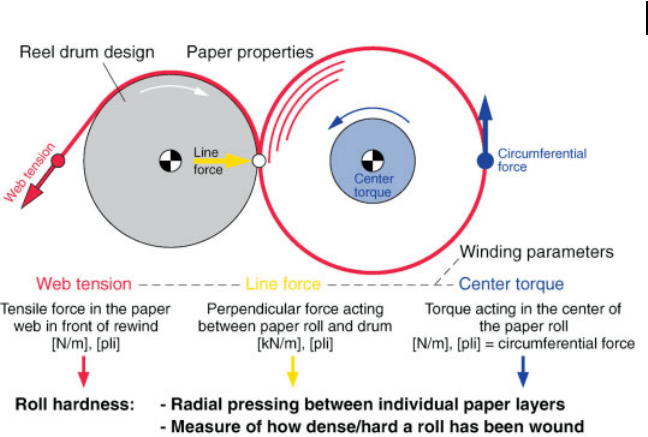
There are only a few key parameters which influence the hardness of a roll
(Fig. 6.74). These are web tension, line force and center torque. As, for example,
some paper grades only allow low web tension to avoid breaks at the winder this
parameter often cannot be used for optimization of roll hardness. So the main
parameter is the line force which usually varies between 1 and 6 kN m
–1
. Line
force can be applied either by the reel drum or the paper roll. The center torque
applied on the reel spool is the third tool to build a good roll structure. There are
different reel types combining these parameters in different ways depending on
the special requirements of the individual paper grades to be reeled.
Fig. 6.74 Variables influencing the structure of a roll
(source: Voith).
6.10 Reeling
309

For certain ranges roll hardness can be described by a linear equation as
s
rad
= f
const
+ (f
WT
V web tension (N m
–1
)) + (f
CF
V circumferential force (N m
–1
)) +
(f
LF
V line force (kN m
–1
))
with the radial pressure s
rad
defined as a positive value.
The f-factors can be determined e.g. by trials on a pilot reeler, where the same
paper roll is wound several times varying the above parameters and measuring the
resulting roll hardness.
As Table 6.3 shows, the f-factors depend on paper grades which can be explained
by their individual quality parameters.
The negative value of f
const
signifies, that for every paper grade and velocity the
combination of the parameters web tension, circumferential force and line force
has to reach at least a minimum value below which the roll could not be wound.
The main influencing paper properties in winding are porosity, smoothness,
Young’s modulus, density, friction coefficient and cross machine (CD) caliper pro-
file. The reel drum is a design parameter which cannot be changed during winder
operation. On the other hand its design has to be reviewed and possibly adapted
when the paper grade produced is changed fundamentally as regards the above
quality properties.
6.10.2
History
During reeling the paper quality cannot be improved any more. This why over
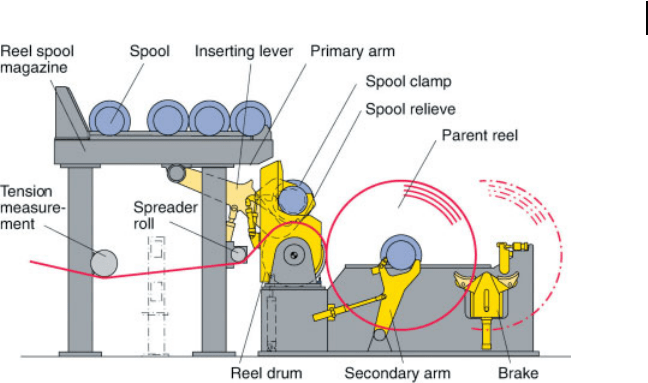
several decades the simple pope reel (Fig. 6.75) was used with nearly no modifica-
tions. This type of reel only applies a line force system in the primary and the
secondary arm and has no center drive. The primary arm handles the spool at the
beginning of the winding process and turns the spool around the center of the reel
drum. The secondary arm guides the spool on the horizontal rail. The line force
system in the arms has to produce the nip load and has to compensate for the
growth of the roll.
Table 6.3 Influence of winding parameters on roll hardness for
constant velocity.
Factor
for
v
= 1200 m min
–1
Unit Heavy weight
coated paper
Light weight
coated paper
f
const
Nmm
–2
–0.6 –0.26
f
WT
Nmm
–2
/N m
–1
8.2 V 10
–4
7.4 V 10
–4
f
CF
Nmm
–2
/N m
–1
5.8 V 10
–4
3.7 V 10
–4
f
LF
Nmm
–2
/kN m
–1
3.0 V 10
–1
9.6 V 10
–2
6 Paper and Board Manufacturing310
Some other reels, e.g. for special papers have no nip for line force application,
but a drive at the spool center. This was necessary for example for sensitive papers
like noncarbon required (NCR) grades. Without a nip the speed is limited to about
700 m min
–1
.
In the 1990s demand increased dramatically. For example in LWC production
coating has been changed from an off-line to an on-line process. This means, that
paper grades with critical properties (very high smoothness and high density) have
to be wound on the reel at high machine speeds. Furthermore the reel diameter
has been increased from e.g. 2.8 m to more than 3.2 m for better efficiency of the
paper machine. This required the development of new reel types.
6.10.3
New Generation reels
6.10.3.1 Center Drive
A common characteristic of the reels of the new generation is the center drive in
the reel spool applied during the whole winding process. Especially for paper
grades with sensitive surfaces the center drive allows one to reduce the nip load
and generate sufficient roll hardness at the same time.
6.10.3.2 Nip Load System
In modern, wide machines the nip load system uses hydraulic cylinders. Here the
nip load system is still a distinguishing factor. Type A in Fig. 6.76 has a nip load
system in the primary and secondary arm. When the nip load is applied by the
parent reel, which may have a weight of up to 120 t the friction forces can no
longer be neglected, so type A reels sometimes use a low friction linear guide for
the parent roll to reduce these forces. As a further possibility the nip load may be
Fig. 6.75 Standard Pope reel (source: Voith).
6.10 Reeling
311