
Johnson, Norman A. Darwinian detectives
Подождите немного. Документ загружается.

This page intentionally left blank

DARWINIAN DETECTIVES
This page intentionally left blank

The Baby with the Baboon Heart
Why Evolution Still Matters
Medicine is magical and magical is art. / Think of the boy in
the bubble and the baby with the baboon heart
—Paul Simon, “The Boy in the Bubble”
Whether it’s preventing a flu pandemic or tackling malaria,
we can use our knowledge of evolutionary processes in
powerful and practical ways, potentially saving the lives of tens
of millions of people. So let’s not strip evolution from the
textbooks, or banish it from the class, or replace it with
ideologies born of wishful thinking. If we do, we might find
ourselves facing the consequences of natural selection.
—Olivia Judson (Judson, )
Baby Fae
On October , , a baby girl, known as Baby Fae, was born prematurely
with the left side of her heart not fully developed. Given this condition,
hypoplastic left-heart syndrome, her chances for survival were very poor;
desperate measures were certainly called for. Twelve days later, Dr. Leonard
Bailey and his team at Loma Linda University Medical Center (a Seventh Day
Adventist institution in California) implanted a heart from a baboon into
Baby Fae.
Baby Fae survived three weeks after the transplant but died on November
, . Dr. Bailey described the cause of her death as “complications that
caused her red blood cells to clump together, obstructing microcirculation
throughout her body.”
1
Other sources noted that Fae’s death was the result
of her immune system attacking the foreign tissue that was the baboon heart.
Indeed, immunorejections often plague cross-species transplants. Bailey and
his staff did use antibiotics and other measures to minimize the risk of
rejection, but their measures did not prevent the immune reaction.
Why use a baboon heart? Other primates, such as gorillas and chim-
panzees, are considerably more closely related to us, with respect to evolution.
Indeed, this difference in closeness of relationship is reflected in taxonomy;
humans, chimpanzees, and gorillas are apes while baboons are monkeys.
When asked why he had used a baboon and not picked a donor from an animal

more closely related to humans, however, Bailey said that he didn’t believe in
evolution. Bailey went on to say:
The scientists that are keen on the evolutionary concept that we
actually developed serially from subhuman primates to humans, with
mitochondrial DNA dating and that sort of thing, the differences have
to do with millions of years. That boggles my mind somehow. I don’t
understand it well, and I’m not sure that it means a great deal in
terms of tissue homology.
2
It is ironic that Dr. Bailey used the term “tissue homology”; the word
homology means “similarity due to shared ancestry.”
3
Although we share
ancestry with the baboon, we share much more recent ancestry with chim-
panzees and gorillas than we do with the baboon. For that reason, we are more
similar evolutionarily to chimpanzees and gorillas. Tissue homology does
depend on overall homology and evolutionary divergence since the common
ancestor.
We cannot, of course, be positive that Baby Fae’s operation would have
been successful even if an animal more closely related to us were used in the
transplant. So many possible things could have gone wrong. Yet the cavalier
dismissal of evolution—the central organizing principle of biology—by a
medical doctor is deeply troubling when lives are at stake. Despite its appear-
ances and Paul Simon’s lyrics, modern medicine isn’t magical; instead, it is
based on scientific principles that include evolution.
Avian Flu Looming
On November , , President George W. Bush unveiled his administra-
tion’s plan to respond to the threat of a bird flu pandemic (a widespread
epidemic). The response included a request for . billion of emergency
funding for the production of vaccines, the stockpiling of anti-viral drugs,
and surveillance measures to respond to outbreaks.
4
At the time of Bush’s
announcement, only people had contacted this particular avian flu, the
HN influenza strain that first appeared in Hong Kong in . And yet for
those who acquired the virus from birds (mainly chickens), the flu has been
deadly, as just over half of those infected died.
In the months following announcement of the Bush plan, avian flu con-
tinued to spread both in bird and human populations. By early , infected
birds were collected from Asia, Africa, and Europe; many biologists and
public health officials suspect it may reach birds in the Americas soon.
Human deaths from infections have occurred in Egypt, Turkey, and Iraq—
countries far removed from Southeast Asia, the source of this flu strain. In six
months after the first report from the Bush White House, additional
human cases of avian flu were recorded, about as many as had been recorded
in the two prior years. Coinciding with the six-month anniversary of their
DARWINIAN DETECTIVES

first report, the White House released a second document with further details
about how the federal government would respond if avian flu were to reach
the United States. Because so many localities could be hit with the flu at one
time, the report suggests that the federal government may not be able to
respond to this crisis as well it does to hurricanes and other natural disasters.
Were human-to-human transmission of this flu to reach the United States,
domestic travel could be restricted, schools and workplaces closed, and
quarantines imposed. Among other recommendations, this report advises
people to maintain a distance of three feet from each other in the event of the
pandemic.
5
Bird flu has not yet reached pandemic stage, and it may never reach it. As
of May , avian flu in humans remains in what the World Health
Organization denotes as “self limiting” or Phase ; the virus cannot spread
from person to person (except possibly in rare cases of very close contact).
Even in the absence of intervention, the virus would not spread among
humans. So why the concern?
The problem is that viruses can adapt to novel environments quickly;
through natural selection and other evolutionary processes, they acquire new
characteristics. Although the current HN bird flu virus does not transmit
easily to humans, just a couple of small genetic changes could lead to the flu
being transmissible from human to human. Why is it that we don’t get bird
flu easily?
Part of the reason that humans don’t acquire and transmit bird flu more
easily is that just getting into our cells is an obstacle for this HN flu strain.
Flu viruses carry a molecule called hemagglutinin that binds to receptors on
the host cell, enabling the virus to enter the cell; the H of HN denotes that
this virus strain has the fifth major variant of hemagglutinin. Various mole-
cules known as sialic acids are on the surfaces of our cells; these molecules
play a number of roles in a variety of systems as diverse as the immune
system and neurobiology. The HN hemagglutinin binds easily to the ,
form of sialic acid, but usually not to the , form. Fortunately for us, the
surfaces of cells in the human trachea contain mainly the , form; cells lower
in the respiratory tract, however, are coated with the , form. The ease at
which the virus can adapt to being able to bind to the , form of sialic acids
is an important aspect of the more general question of the likelihood of
humans contacting HN more readily. Unfortunately, it appears that HN
may already be evolving in this manner; the virus isolated from a human in
Turkey early in is a mixed population, with some viral particles showing
affinity to binding to the , form.
6
Concerns about “bird flu” are not new; indeed, for years many public
health experts have been fretting about the possibility of a deadly flu virus
acquiring human-to-human transmission. Such a change in the virus could
lead to a pandemic that would infect millions. A New Yorker article written
in early called the avian flu “nature’s bioterrorist.”
7
In the worst-case
scenario, a pandemic of this flu could kill over million people worldwide.
The Baby with the Baboon Heart

Nobody knows what are the chances of such a worst-case scenario, but many
experts, including Dr. Anthony Fauci, the director of the National Institute
of Allergy and Infectious Diseases, say “It’s a matter of when, not if ” a flu
pandemic will strike.
8
We have experienced flu pandemics before in the not-so-distant past.
Between and , influenza killed as many as million people world-
wide. This influenza pandemic, known sometimes as the Spanish flu,
caused the deaths of far more people than did World War I. An estimated
, Americans died from the Spanish flu, no one knows exactly how
many; in contrast to the annual flu that kills mainly the elderly, most of the
deaths from the flu were of young to middle-aged adults. The toll from
the flu was so great that the life expectancy in the United States
was briefly depressed by about ten years. Three weeks before Bush’s plan was
unveiled, researchers published in Nature the genome of the virus that caused
the pandemic. These data demonstrate that the virus is a bird flu that
adapted to humans via one or a few genetic changes.
9
The flu was not the only deadly flu that we faced in the twentieth
century. In and , milder influenza epidemics each killed roughly a
million people. Unlike the flu virus, the viruses of these latter influenzas
were recombinants—genetic mixtures—between a bird virus and a human virus.
How do we know the origins of these flu viruses? Through the use of tools
developed by evolutionary biologists to examine the evolutionary relation-
ships of organisms. These same techniques are used to examine the origins of
other pathogens, such as the SARS virus responsible for the outbreak in
and the anthrax bacteria used in the bioterrorist attack in the fall of .
Both the bird flu and the “ordinary” flu viruses evolve rapidly. Their short
generation time enables them to go through many generations within a short
period, and the faster turnover of generations allows for a rapid rate of
evolution.
10
Flu viruses also evolve rapidly because their mutation rate is high.
Their high mutation rate and short generation time, together with their enor-
mous population size and other factors, make flu viruses highly evolvable.
Because of their rapid evolution, new flu vaccines are needed each year; old
vaccines are less than adequately effective against the new flu. The principles
of evolutionary genetics are used to predict what the next year’s flu will look
like, and potentially to ascertain whether a radically different and thus more
deadly virus is on its way.
Understanding how the bird flu virus can and will adapt to humans
requires knowledge not just about the virus but also about the principles of
evolution and population genetics. As Thijs Kuiken and his colleagues in a
review on bird flu adaptation note, “the effective rate of virus adaptation is
not simply determined by the overall rate at which mutations arise, but by the
fitness of these mutations, particularly the proportion that are advantageous
in multiple hosts.”
11
We will discuss in the future (mainly in chapter ) how
biologists can detect the action of positive selection, the form of selection that
yields adaptations.
DARWINIAN DETECTIVES

Evolution as an Enemy, or Resistance Is Not Futile
According to some estimates, about , people die each year from
infections acquired in hospitals, a dramatic increase from , when only
, people died from such infections. This serious health crisis has been
brought on due to the rapid evolution of resistance of bacteria to antibiotics.
Consider the antibiotic vancomycin. Among other purposes, it has been used
to treat urinary tract and other bacterial infections caused by Enterococcus,
spherical bacteria that typically live in digestive and genital tracts and are a
major source of infection. Prior to , there had been no reported cases
of Enterococcus that were resistant to vancomycin. Four years later, of
hospital Enterococcus infections were resistant to the antibiotic. In the years
since, the proportion of resistant Enterococcus has continued to climb.
12
Bacteria rapidly evolve resistance to the agents used to control them. In
this sense, evolution is an enemy that exacts a heavy toll on our society. The
increasing resistance of several disease-causing bacteria to many antibiotics is
a serious and escalating public health crisis. Many species of these pathogenic
bacteria are resistant to multiple antibiotics, including some that had previ-
ously been antibiotics of “last resort.” The evolution of antibiotic resistance is
often so rapid that new antibiotics are virtually ineffective a decade or less
after their introduction. This resistance has resulted in tens of thousands of
deaths every year in the United States alone. In addition to the human toll,
bacterial resistance to antibiotics costs Americans tens of billions of dollars
each year in extra medical care, increased duration of hospital stays, and lost
productivity.
13
Over one million people in the United States and nearly million world-
wide are infected with HIV, the virus that causes AIDS. Over two million
people die from HIV each year in Africa alone. Part of the reason that HIV
is so deadly is that the virus evolves so rapidly that the immune system of the
infected person cannot keep up with it. Like the flu virus, HIV’s rapid evolu-
tion arises from its high mutation rate. This rapid evolution also makes it
unlikely that application of a single drug will effectively halt the progression
of AIDS in infected persons. Instead, a cocktail of several drugs operating on
different parts of the life cycle of the virus is the most effective treatment.
However, even these “wonder drug cocktails” are becoming less effective due
to the evolution of the virus. In his book The Evolution Explosion, Stanford
biologist Steve Palumbi explains how we can delay the evolution of drug
resistance in HIV-infected individuals by applying evolutionary principles.
14
Farmers spray their crops with massive amounts of various insecticides to
reduce damage from insects. Such large amounts are thought to be required
because the insect pests, owing to their short generation time, can quickly
evolve resistance to each chemical used to control them. This evolution of
resistance costs the United States approximately billion each year and puts
our food supply in jeopardy. Furthermore, the large amounts of chemicals
used pose a direct danger to human health. Farmers often court failure by
The Baby with the Baboon Heart

intensifying their attacks on the pest species by using more pesticides or
targeting specific pest species. The principles of evolution tell us that this is
bound to intensify the evolution of specific resistance, and that a better strat-
egy from an evolutionary point of view is to diversify the attack to prevent
specialized adaptations against the pesticide. This is the basis of many “new”
pest-control techniques, which are based on evolutionary principles—even if
their users do not recognize the fact.
The application of evolutionary principles has already helped in the fight
against the evolution of resistance, but the evolution of resistance is a relent-
less enemy. Countering it will require the training of new generations of
scientists, doctors, and public health officials in evolutionary principles. In
addition, combating this “war against resistance” will require a more informed
public.
Plant and Animal Breeding
Darwin himself was an avid breeder of pigeons and other animals and plants,
and in some ways, with its descriptions of numerous varieties of pigeons, the
first chapter of his The Origin of Species reads more like a breeder’s handbook
than it does a polemic. In fact, Darwin used the artificial selection that occurs
in breeding as a metaphor for the natural selection that is the major (but not
exclusive) force in his theory of evolution.
Countless biologists since Darwin have had research interests in practical
applications of evolutionary principles in the breeding of animals and plants.
These biologists developed the field of quantitative genetics to deal with
understanding how selection and other forces will affect traits, such as milk
yield in cows or oil content in corn, that are due to multiple genetic and
environmental factors. The genetic basis of agriculturally important traits
often complex; moreover, different traits may be affected by the same genetic
changes. For this reason, traits are often correlated. To take a hypothetical but
reasonable example, a desirable trait in cattle such as lean muscle mass may
be correlated with a less desirable trait such as fat content. Selection for
increases in the first trait may lead to undesirable increases in the other. So,
how does one get larger but leaner cows? It is problems like these that
evolutionary quantitative geneticists can solve.
Evolutionary genetic principles are also important in addressing concerns
in conservation biology. Populations that are maintained at low numbers for
too long will lose genetic variability; for this reason, they will be less able to
respond to new challenges, such as diseases. For example, cheetahs are almost
completely genetically uniform, and most cheetah males have abnormalities
in their sperm. The principles of evolutionary genetics inform conservation
policies by determining guidelines for minimum population sizes needed
for the maintenance of genetic variation, as well as breeding management
strategies.
DARWINIAN DETECTIVES
Molecular Evolution
Molecular biology provides arguably the most convincing evidence that all
known life is related—that is, shares common descent. The most striking
feature that demonstrates common descent is the commonality of nucleic
acid DNA as the genetic material across all known life. Some viruses (HIV,
for example), known as the retroviruses, use the related nucleic acid RNA as
their genetic material, but even these retroviruses will convert their RNA
information into DNA information at specified times. Moreover, all other
forms of life make use of RNA. Not only is all life based on the nucleic acids
DNA and RNA, but also—aside from a few minor exceptions—all life uses
the same genetic code to convert the information in the nucleic acids into
amino acid information in proteins. In addition, basically the same machinery,
with a few modifications, is used in cellular machinery in humans, fish,
insects, flatworms, plants, and bacteria.
The information stored in a strand of DNA is its sequence of nucleotides.
At any particular site along a strand of DNA, there can be any one of four
nucleotides: adenine (A), cytosine (C), guanine (G), or thymine (T). The
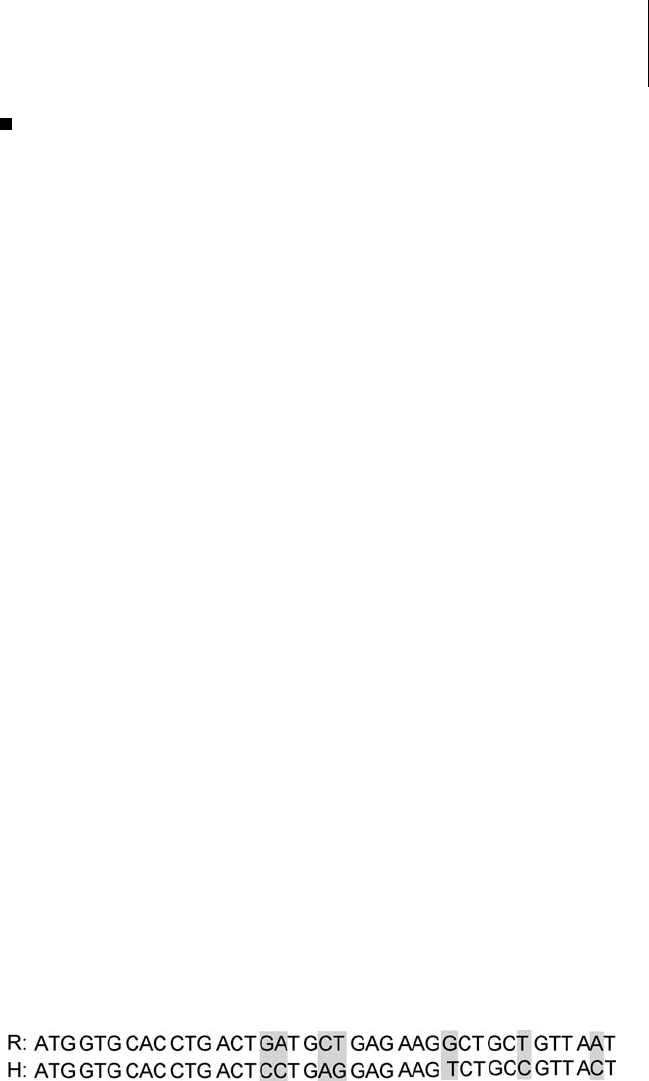
DNA code is simply the order of these Gs, As, Ts, and Cs. If you were to line
up the DNA sequence of the rat gene that encodes for the hemoglobin protein
(which carries oxygen in the bloodstream) and its human counterpart, you
would see stretches where the sequences are the same interspersed with sites
that differ between the two. Because information in proteins is encoded from
DNA information, the proteins made from human and rat genes are also
slightly different. In more distantly related organisms—say, humans and
frogs—the divergence in the gene counterparts is generally greater.
The textbook definition of evolution is simply the change of the frequen-
cies of gene variants in populations over time. Although both this definition
and the vernacular definition of evolution imply change over time, ironically
evolution at the molecular level is often a very conservative process. About
of human genes have a counterpart in mice, despite the to million years
of evolutionary divergence since humans and rodents last shared a common
ancestor.
15
Progressively more distantly related organisms—kangaroos, turtles,
sea urchins, and flies—share fewer and fewer genes with us. Still, researchers
continue to find a surprisingly large number of plant counterparts of human
genes.
The Baby with the Baboon Heart
Figure .
Comparison of DNA sequences. The first nucleotide sequences of the beta-chain
of hemoglobin from human (H) and rat (R) are presented. Nucleotide differences
are highlighted in gray.