
Johnson, Norman A. Darwinian detectives
Подождите немного. Документ загружается.

type of seeds that had grown despite the drought. Hence natural selection,
under drought conditions, favored the deeper beaks.
Evolution by natural selection requires one more condition: those traits
that affect fitness must be passed on to the next generation. Darwin knew
nothing about DNA; he didn’t even know about Mendel’s laws of genetics.
Despite not knowing the mechanisms by which heredity worked, Darwin
knew from observation and his work as a breeder (especially of pigeons)
that individuals tend to resemble their parents. Parents that are tall tend to
produce offspring that are taller than average. This resemblance between
parents and offspring is what allows populations to respond to natural
selection and exhibit evolutionary change. The genetic variants that gave a
deeper beak shape and a larger body size to those Darwin’s finches that
survived the drought were passed on to their offspring. As a consequence,
the offspring were more like their parents than they were like the original
population.
Evolution and natural selection are not the same. Evolution can take
place without natural selection. In fact, as we will see in chapter , much
evolutionary change at the DNA level is due to mutation and the random
process of genetic drift. Conversely, natural selection does not necessarily
DARWINIAN DETECTIVES
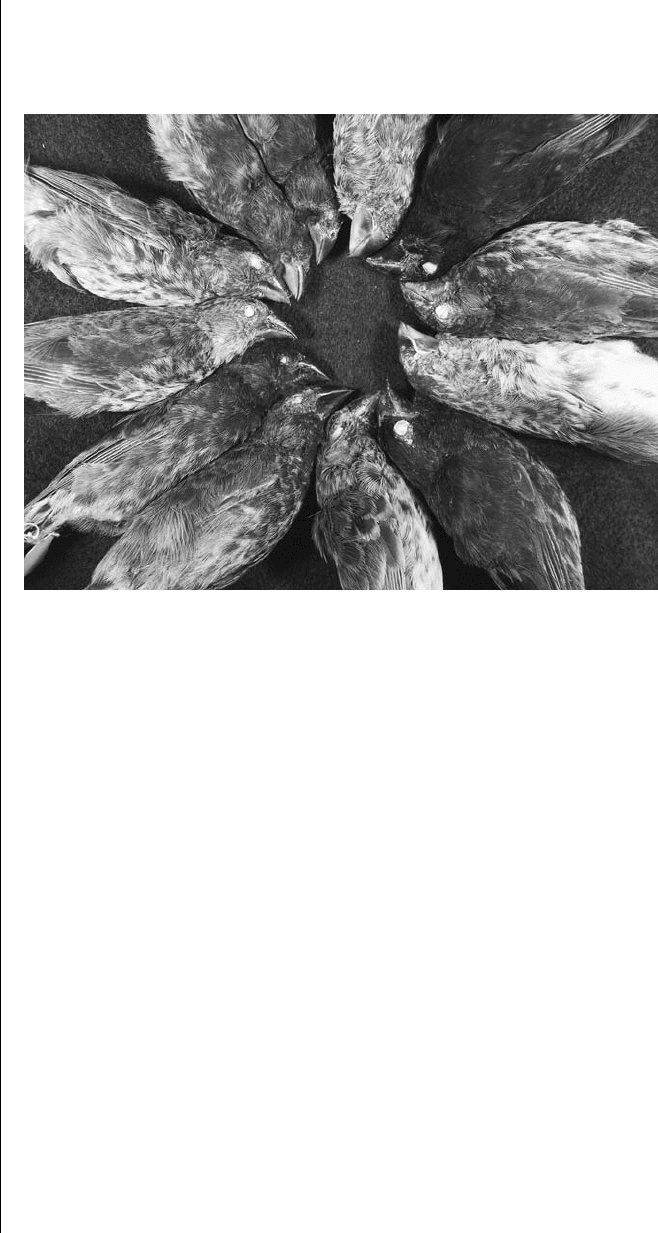
Figure S. Illustration of variation in one species of Darwin’s finches, the medium
ground finch (Geospiza fortis). Taken at the Smithsonian Museum in . Courtesy
of Sarah Huber.

lead to evolutionary change. Natural selection can help maintain the status
quo; many more mutations are deleterious than are beneficial, and selection
acts to weed out the bad mutations. This “weeding out” type of natural
selection is called negative selection to contrast it with the type of selection
(positive selection) that results in rare, beneficial genetic variants becoming
more common. It is this positive selection that is required for the changes
seen in the wings of Drosophila subobscura and the beaks of Darwin’s
finches. In chapter , we will encounter a third type of natural selection
called balancing selection, which actively preserves genetic variants within
populations.
As we’ve seen in the above cases, scientists sometimes can, by careful
and painstaking observation, directly observe evolution by natural selection.
Sometimes they can catch it in the act. But what about evolution by natural
selection that occurs at rates much slower than the episodes of selection
scientists can observe? Given the immense age of the earth, as Darwin
realized, even changes very slow by human standards can be blinks of an
eye from a geological standard. A increase in body size over a thousand
years is far too slow to be detected. That change, maintained and com-
pounded over just a quarter of a million years, would transform a mouse
that weighs an ounce into an animal that weighs almost a pound—the size
of a rat. In another quarter million years, that mouse would be the size of a
house cat, tipping the scale at nine pounds. Obviously, such sustained
changes do not usually persist for such long periods; but when they do, the
results are staggering.
Evolutionary geneticists are now able to detect the action of natural
selection by making inferences from the patterns of changes seen in the
DNA. Natural selection that has operated in the past has left the equivalent
of footprints. To detect these footprints, evolutionary geneticists rely upon
DNA data (taken from many different individuals, usually in more than one
species), statistics, and mathematical theory. We turn to such studies in
chapters and .
INTERLUDE I
This page intentionally left blank
Negative Selection and the Neutral Theory
of Molecular Evolution
Production of man from a primitive jawless fish in half a
billion years is a remarkable example of progressive evolution
but we should not forget that degeneration and extinction are
much more common in evolution.
—Mooto Kimura (Kimura, , p. )
The Irony of Molecular Evolution
One irony of molecular evolution is that the genes that are most important to
the function of the organism usually have changed least through evolutionary
time. Consider histone H, one of a number of proteins known as histones
that binds to DNA and allows for the proper expression of genes.
1
The
sequence in histone H in pea plants differs from that in mammals by only
two changes in a total of amino acid sites. Only two changes occurred
between animals and plants! Assuming that plants and animals last shared a
common ancestor . billion years ago, this is an evolutionary rate of .
changes per site for each billion years.
2
Contrast this strong conservation of the histone H protein with the
comparatively rapid evolution of fibrinopeptides. In the last chapter, we saw
that these are parts of fibrinogen that are cleaved off by thrombin to produce
fibrin in the blood-clotting process. They have little function afterward. These
fibrinopeptides evolve about a thousand-fold faster than the histone H.
Why should these almost-dispensable fibrinopeptides evolve so much faster
than the essential histone H? This seemingly paradoxical finding that func-
tionally less important genes evolve faster than those with more important
functions makes sense when we consider that far more of the mutations that
have an effect on an organism are harmful than are advantageous. Why is this
so? Consider a well-functioning watch. Banging that watch on a table is more
likely to result in worse rather than better performance of the watch. The same

is true for well-functioning organisms. Change is more likely to make things
worse than better. Evolution seems to also hold to the principle, “If it ain’t
broke, don’t fix it.” One the one hand, proper blood clotting is not very depen -
dent upon the exact nature of the amino acid sequences of the fibrinopeptides
as long as they prevent fibrinogen molecules from sticking to each other so
that they can be cleaved off by thrombin under the appropriate conditions.
On the other hand, the exact amino acid sequence of histone H is essential
to gene expression and hence to the viability of the organism. Thus, the DNA
sequence that produces fibrinopeptides can tolerate mutations far better than
the DNA that produces histone H.
Because many more harmful than beneficial mutations occur each genera-
tion, natural selection usually acts as the reaper, weeding out those deleterious
mutations. This weeding type of selection, called negative selection, is much
more common than positive selection, the form of selection that increases the
frequencies of advantageous genetic variants.
Of course, advantageous mutations do occur sometimes, and positive
selection does operate. Adaptations such as the dog’s keen sense of smell,
the antelope’s fast gait, and the cactus plant’s waxy cuticle (which enables it
to survive extreme drought) are the result of new, advantageous mutations
rising in frequency via positive natural selection. Further, new advanta-
geous mutations are required for adapting to new climates, such as what
happens when a species expands its range. Mutations also are required for
the process of coevolution, when different species respond to one another.
An example of such as process of coevolution occurs when a predator
species and its prey are engaged in an “arms race”; the prey adapt to
changes in the predator and vice versa. Similar coevolutionary arms races
occur when a species evolves resistance to a disease and the disease evolves
counter-measures to the resistance. Despite positive selection being essential
for adaptive evolution, this form of selection is considerably rarer than
negative selection.
The conservation of functionally important DNA sequences due to the
operation of negative selection also has practical importance. With the ever-
increasing number of DNA sequences in databases, more and more biologists
are using this principle of conservation to identify new genes and make infer-
ences about their presumptive function. If a DNA sequence from a sea urchin
closely resembles a gene found in mammals that produces a protein involved
in transporting substances across cell membranes, then this new sea urchin
sequence is likely to also play a role in membrane transport.
In the next chapter, we will examine how molecular evolutionary biolo-
gists developed tests to detect the action of positive selection operating on
particular genes. These tests rely, however, on a deep understanding of
how evolution would work in the absence of positive selection. A Japanese
mathematical geneticist named Motoo Kimura developed such understanding
in the late s; in the decades since, his theory has revolutionized the study
of molecular evolution.
DARWINIAN DETECTIVES

Kimura’s Revolutionary Idea
The year was one of worldwide change and political turmoil. It was the
year of the Tet Offensive, the assassinations of Martin Luther King and
Robert F. Kennedy, riots in the streets of Chicago during the Democratic
convention, and the Prague Spring that ended with the Soviet Union’s
invasion of Czechoslovakia. In that same year, Motoo Kimura put forth a
radical theory called the “neutral theory of molecular evolution” that would
revolutionize the field of evolution.
In , Kimura, at age , was arguably the leading mathematical evolu-
tionary geneticist of his generation.
3
Born and raised in Japan, Kimura had
received his Ph.D. at the University of Wisconsin in Madison a decade before
under the tutelage of James Crow. (In January , Crow celebrated his
ninetieth birthday, still much engaged in science as the elder statesman of
evolutionary genetics.) In the s and s, Crow had been studying
effects of mutation in fruit flies; he found many more mutations with subtle
effects on viability and reproduction than mutations that killed the flies.
Kimura acquired from Crow an appreciation of the evolutionary importance
of mutation and negative selection.
Kimura also had been interested in the new data coming from molecular
genetics, namely protein sequence data. Although was years after
Watson and Crick presented the model for the structure of DNA, biologists
were still unable to get large amounts of information from the genetic mate-
rial; techniques for sequencing more than a handful of nucleotides of DNA
at a time would take another decade. Biologists were, however, able to obtain
the amino acid sequences from proteins, the best available alternative to the
gene itself. During the s, more and more sequences of the amino acids
of proteins from a variety of organisms were becoming available. Kimura
had been looking at the rates of changes in amino acid sequences from the
few proteins that had been sequenced at the time. The rates of change at
individual proteins were not very fast, but Kimura realized that genomes
were vast. Kimura extrapolated the rates of evolution observed in a few
proteins to the whole genome, and estimated that in mammals a substitution
of one genetic variant for another occurred every other year. If so many
substitutions were taking place, could positive selection really be driving
most of them?
Kimura was also impressed by the pattern of gene substitution called “the
molecular clock.” The double Nobel laureate Linus Pauling and others
showed that amino acid sequences of proteins seemed to evolve at a constant
rate in different types of organisms. Moreover, for any given protein, the rates
seemed to be constant with time; a protein that changed by between two
species known to be separated by million years of evolutionary divergence
generally changed by about between two species known to be separated
by million years. Recall that not all proteins evolve at the same rate. In
fact, substantial variation exists in their rates of evolution; for example,
Negative Selection and the Neutral Theory of Molecular Evolution

fibrinopeptides evolve hundreds of times faster than histone H. Thus, we see
that molecular clocks based on different genes run at a variety of rates.
Pauling and others saw that the concept of the molecular clock would be
a great boon for evolutionary studies by allowing one to estimate, using solely
molecular data, the point at which two species diverged from a common
ancestor. Given the example of the proteins mentioned above, the molecular
clock predicts that two species differing by in the sequence of that protein
would probably have diverged about million years ago.
Why should the rates of molecular change be more or less the same in
different parts of the evolutionary tree? We know that rates of morphological
change can vary a great deal. For instance, primate morphology seems to
change faster than that of amphibians. Although humans look quite different
from chimpanzees, many species of frogs that diverged much longer ago
than did humans and chimpanzees look very similar to each other. Modern
horseshoe crabs haven’t changed much in morphology from their -
million-year-old fossil relatives.
Kimura’s proposition was that at the molecular level, the vast majority of
new mutations are either deleterious or neutral with respect to selection.
4
Negative selection would quickly weed out the deleterious mutations. Neutral
variants, however, would be subject to chance sampling every generation, a
random process that evolutionary geneticists call genetic drift. Although
nearly all newly arisen, neutral mutations would be lost from the population
after a few generations, a lucky few would rise in frequency. Occasionally, one
very lucky variant would eliminate all others in the population even if it was
no more fit or less fit than the other variants. Evolutionary geneticists refer to
such a variant that rises to frequency as being fixed in the population.
Note that if one genetic variant at a site becomes fixed, all other variants at
that site must have been eliminated. (The terms “fixation” and “substitution”
will be used interchangeably throughout the book.) Advantageous variants
become fixed via natural selection, but the fixation of neutral variants
through the lottery of genetic drift occurs due to chance, not selection.
Most evolutionary biologists, at first, viewed Kimura’s neutral theory with a
great deal of skepticism, if not hostility.
5
To some, Kimura’s ideas seemed to be
counter to Darwin’s and the mainstream evolutionary thought of the s;
indeed, the year after Kimura’s paper appeared, two biochemists, Jack King
and Thomas Jukes, published a proposal similar to Kimura’s with the title
“Non-Darwinian Evolution.”
6
The name “non-Darwinian evolution” for these
ideas dropped out of favor because evolutionary biologists realized that Darwin
himself did not view natural selection as the exclusive means of evolutionary
change and had discussed the role of chance processes in evolution. Kimura’s
term—the neutral theory of molecular evolution—fared much better.
During the s, the leaders in evolutionary biology had focused on
positive selection and adaptation, almost to the complete exclusion of other
evolutionary forces. For example, in Ernst Mayr, one of the domineering
figures in evolutionary biology, wrote that it was “exceedingly unlikely that
any gene will remain selectively neutral for any length of time.”
7
DARWINIAN DETECTIVES

Population geneticists had long been aware of genetic drift as an evolution-
ary force that could alter frequencies of genetic variants in small populations.
An isolated group of a few individuals would have different frequencies of
genetic variants than the main population from which it derived. One conse-
quence of such founder effects is that rare diseases are sometimes more
common in human populations that were derived from a small number of
individuals. Some examples include Tay Sachs disease in Ashkenazi Jews and
congenital colorblindness in peoples of the Pingelap Atoll in Micronesia.
Sewall Wright, one of the founders of the fusion of Mendelian genetics and
Darwinian evolution during the s and s known as the modern
synthesis, had championed the role of genetic drift in evolution. Wright’s
notion was that in situations in which a species was found in many small,
semi-isolated populations, genetic drift would cause different local popula-
tions to have different frequencies of genetic variants from each other. These
local differences would allow populations “to test out” different combinations
of genetic variants. Some of these local populations would hit upon really
good combinations, and selection among those local populations would cause
those superior combinations of variants to become fixed within the big
population. Aspects of Wright’s theory remain controversial to this day.
8
Many population geneticists prior to Kimura dismissed the importance of
genetic drift as an evolutionary force because its strength decreased with
increasing population size. Genetic drift, as a sampling process, is like tossing
coins. A coin—unless it is rigged—should land heads up half the time and
tails up half the time. But that’s just the expected result; it’s not unusual that
seven of ten coins would land heads. It would be unusual if of coins
landed as heads. If of , coins were heads, you would be convinced
that the coin had been tampered with. Genetic drift follows similar patterns
of probability. In a small population, genetic drift can easily alter the
frequencies of genetic variants. This chance process can allow even some
deleterious variants to become fixed in the population. In larger populations,
however, genetic drift is less potent relative to natural selection, and natural
selection can act on variants that have even relatively small differences in
fitness. Small populations, on the other hand, are less likely to persist for long
periods of time.
One revolutionary aspect of Kimura’s proposition was his view of positive
selection as an insignificant force in molecular evolution. Even Wright, the
champion of genetic drift, was not ready for that. Positive selection, both within
and among populations, was an essential component to Wright’s theory. In
contrast, in Kimura’s view of molecular evolution, positive selection is so rare
that that it doesn’t affect the observed patterns of molecular evolution.
Kimura’s ideas were revolutionary also because he argued that the
evolution of molecules is (largely) decoupled from what we ordinarily think
of as evolution—changes in morphological, physiological, developmental,
and behavioral traits. To Kimura, these traits—what biologists call phenotypic
traits—were largely distinct from molecular traits. Kimura didn’t deny that
phenotypic evolution traces to changes in DNA sequences, or that adaptations
Negative Selection and the Neutral Theory of Molecular Evolution
such as the sonar-like navigational abilities of bats and the elaborate dances of
bees to communicate nectar stores are the products of positive selection.
Instead, Kimura noted that these changes in DNA that affect phenotypic
traits are only a very small fraction of the overall changes in DNA sequences.
Thus, the changes caused by positive selection on phenotypic traits could
have a marginal effect on the overall patterns of molecular evolution. In a
sense, Kimura was like Einstein, who in his theory of special relativity limited
the scope of Newton’s laws of motion; Newtonian physics worked well for
sufficiently low velocities but failed when velocities were appreciable fractions
of the speed of light. Although Kimura allowed for pervasive positive
selection acting on phenotypic traits, he concluded that genetic drift, muta-
tion, and negative selection overshadow positive selection in the molecular
world.
DARWINIAN DETECTIVES
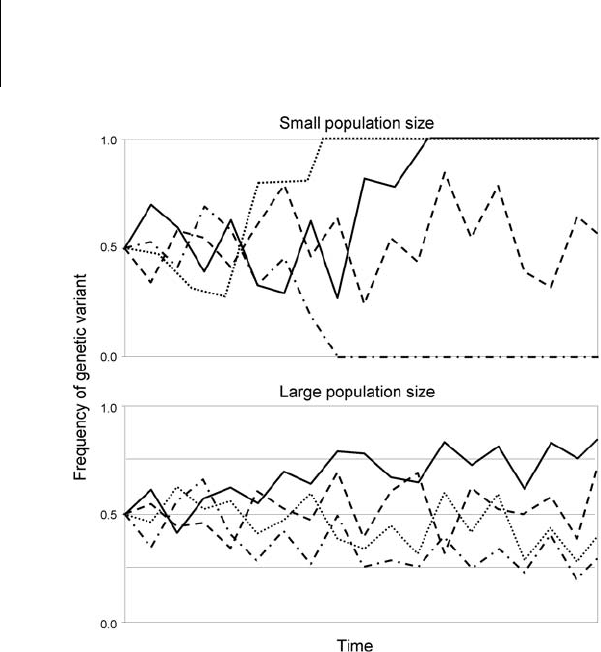
Figure .
Genetic drift is more potent in small rather than large populations. Horizontal
and vertical axes represent time and frequency, respectively. The individual lines
represent the frequency of a specific genetic variant for hypothetical repeated
examples of replicate populations of the same size; all populations began with the
same initial frequencies of the genetic variant. Note that some variants went to
fixation or loss in the small populations but none did in the large populations.

Support for the Neutral Theory
Some of the strongest support for the neutral theory comes from genes that
have lost their function and are unable to produce proteins. Such genes with-
out function, known as pseudogenes, should not experience negative selection.
If negative selection were more important than positive selection, we would
expect these pseudogenes to have very fast rates of evolution. The rates of
evolution for pseudogenes were not known when Kimura first proposed the
neutral theory, so such data would be strong “after the fact” evidence for or
against the neutral theory. In the early s, molecular evolutionists deter-
mined that the rate of pseudogene evolution is very high, among the most
rapid rates of evolution—consistent with Kimura’s prediction.
9
Kimura used his neutral theory to provide theoretical justification for the
molecular clock, the relative constancy of evolutionary rates across different
organisms in a particular protein or DNA sequence. The key point of
Kimura’s justification is that the rate that new variants become fixed in
populations (the substitution rate) is exactly equal to the rate at which neutral
mutations appear. Although we will take this supposition as a given for now,
the rationale behind this simple relationship is explained in the box below.
Provided that the neutral mutation rate does not change much among differ-
ent organisms, the rate of molecular evolution should be constant. Two
factors determine the neutral mutation rate: the overall mutation rate and the
extent of functional constraint (the fraction of mutations that are neutral
versus those that are deleterious). If these factors remain more or less the
same, then the neutral mutation rate will be relatively constant. All other
factors—for instance, the population size or the amount that the environment
fluctuates—are largely irrelevant to the rate of molecular evolution.
Negative Selection and the Neutral Theory of Molecular Evolution
Why the Substitution Rate Equals the Neutral Mutation Rate
Why should the substitution rate be equal to the rate at which neutral
mutations arise? The rate of substitution would equal the number of total
mutations each generation multiplied by the probability that any one of
those mutations will eventually become fixed in the population.
Let’s start with the first part of the equation—the total number of
mutations. Every generation, new mutations appear in the population at a
rate of N times the mutation rate, where N is the population size. Large
populations contain more individuals and thus, more opportunities for
mutation. The “” comes in because, in most species, individuals receive
two distinct sets of genes—one from their mother and one from their
father. Mutation rates are tiny. The typical gene that codes for a protein has
a mutation rate on the order of around one in a million. A nucleotide