
Johnson, Norman A. Darwinian detectives
Подождите немного. Документ загружается.


focus of the scientific aspect of this chapter will be on responding to Behe’s
claims.
So, what does Behe say? First, he accepts an ancient Earth. Indeed, in
Darwin’s Black Box, he states: “For the record, I have no reason to doubt that
the universe is the billions of years old that physicists say it is.”
6
Although this statement is certainly a break from those who believe the
Earth is only a few thousand years old, these young-earth creationists are not
the only type of creationist. It is important to realize that several variations of
creationist thought coexisted throughout the twentieth century; not all of
these hold the view that the Earth was created less than , years ago. For
instance, popular depictions of the Scopes “monkey” trial, as epitomized
in the play (and movie) Inherit the Wind, by Jerome Lawrence and Robert E.
Lee, present Clarence Darrow’s cross-examination of William Jennings Bryan
(the progressive presidential candidate turned anti-evolution crusader) as the
turning point of the trial. According to the play, Darrow got Bryan to admit
that each of the days in Genesis could represent periods that span millions of
years, and thus exposed the intellectual vacuum of the creationists. In reality,
however, this was not an embarrassing admission for Bryan. Like many, and
perhaps the majority, of anti-evolutionists at the time, Bryan subscribed to
what is known as the “Day-Age” creationist view, wherein the days of Genesis
represented ages of perhaps immense time.
7
Not until after World War II was
the leadership of the creationist movement mainly made up of advocates of
“Young Earth” creationism.
Behe goes on to say, “Further, I find the idea of common descent (that all
organisms share a common ancestor) fairly convincing, and have no particu-
lar reason to doubt it.”
8
Behe’s acceptance of common descent, even if it is
lukewarm, is indeed a departure from much of creationist thought.
The quarrel Behe has with Darwinian evolution is with the mechanism. He
says, “Although Darwin’s mechanism—natural selection working on variation—
might explain many things, . . . I do not believe it explains molecular life.”
Behe contends that molecular life—the biochemical machinery of the cell—
is too complex to originate from natural selection and other evolutionary
forces operating on existing variation (that is, replenished by new mutations
and recombination). He is not concerned with complexity in general but with
a specific type of complexity that he calls “irreducible complexity.” Due to the
importance Behe places on “irreducible complexity,” it is instructive to get at
the meaning of his term. To Behe, a system is irreducibly complex if it is
“composed of several well-matched, interacting parts that contribute to the
basic function, wherein the removal of any one of the parts causes the system
to effectively stop functioning.”
9
Behe uses the analogy of a mousetrap to explain irreducible complexity. In
a standard mousetrap, all of the parts are required in order for the trap to work
(catch mice). Removal of any essential part would result in an inoperable
mousetrap. Thus, a mousetrap could not have evolved from the successive
DARWINIAN DETECTIVES

accumulation of components; it must have been designed. Likewise, Behe
argues, various biochemical systems in organisms are irreducibly complex.
Removal of any one of the components results in nonfunctionality; thus, the
biochemical system could not have evolved from the successive accumulation
of its components. Therefore, those irreducibly complex biochemical systems
must have been designed.
Behe presents several examples of what he claims to be such irreducibly
complex biochemical systems; most notable is the blood-clotting system
of vertebrates, about which Behe devotes more than pages of his book.
Behe is correct; the clotting cascade and many other biochemical systems
are remarkably complex. Behe is also a gifted writer; the marvelous detail that
he vividly and cogently illustrates forces the reader to come to grips with the
intricacy of biochemical assemblages.
But Behe’s thesis is incorrect. The remarkable complexity of biochemical
systems can and does evolve via Darwinian processes. Before we delve into the
elaborate biochemical details, let’s explore antecedents of Behe’s argument and
how biologists have dealt with them.
Breaking Through Irreducible Complexity—The Eyes Have It
First, the form of Behe’s argument is not new.
10
Two hundred years before
Behe, the theologian William Paley argued that just as watches show signs of
being designed, so do organisms. Darwin was very much aware of Paley and
this “argument from design,” and indeed had been impressed by Paley as a
young theology student. As an older man, however, Darwin amassed evidence
and used reason to show that this argument was not necessary: natural
selection along with other natural processes could lead to organisms that
appear to be designed.
After Darwin published The Origin of Species, his critics charged that com-
plex systems could not evolve via his mechanism of natural selection. Over
the past century and a half, skeptics of Darwin have often pointed to the ver-
tebrate eye as an example of a system too complex to have evolved
by Darwinian processes. A mid-nineteenth-century author put it best: “To
suppose that the eye, with all its inimitable contrivances for adjusting the
focus to different distances, for admitting different amounts of light, and for
the correction of spherical and chromatic aberration, could have been formed
by natural selection, seems...absurd in the highest possible degree.”
11
Or,
stripping away the flowery Victorian prose, what possible use is half an eye?
The answer is plenty. As we shall see, in the kingdom of the blind, the animal
with even a slightly functioning eye is king.
I must confess that I’ve just pulled a small rhetorical trick. The passage I’ve
quoted above is not from one of Darwin’s critics, but from Darwin himself.
Darwin struggled with the problem of complex organisms such as the eye, but
Why Intelligent Design Is Not Science

he had formulated a solution (that creationist authors seldom provide). Let’s
examine more of what Darwin said about eyes:
Reason tells me, that if numerous gradations from an imperfect and
simple eye to one perfect and complete, each grade being useful to its
possessor, can be shown to exist; as is certainly the case; if further, the
eye slightly varies, and the variations be inherited, as is likewise cer-
tainly the case; and if such variations should ever be useful to any ani-
mal under changing conditions of life, then the difficulty of believing
that a perfect and complex eye could be formed by natural selection,
though insuperable by our imagination, cannot be considered real.
In other words, the objection fails if one can show that the eye could have
arisen via small, successive steps that are each potentially beneficial. Although
it would be wonderful to know exactly how the eye formed, all we need to
show is a plausible route by which evolution could have taken. This will serve
as a starting place for further inquiry.
Image-forming eyes evolved independently literally dozens of times
throughout the animal kingdom. As we shall see, the types of eyes that dif-
ferent animals use vary extensively. Our eyes and those of many vertebrates
contain a flexible lens that focuses light onto the retina, a thin film that con-
tains light-sensitive cells. In contrast, insects use compound eyes; such eyes
contain numerous simple facets, each with photosensitive cells and a miniature
lens. Although the compound eyes result in a pixilated image, these eyes are
highly motion sensitive.
12
As we consider how these eyes could have evolved, let us, as Maria from
The Sound of Music suggested, start at the very beginning. In the beginning
(as far as eyes are concerned) was the photocell, a specialized cell containing
at least one pigment that is able to collect tiny packages of light known as
photons. Even some single-celled organisms, like the freshwater protozoon
Euglena, have regions of their cell that are sensitive to light.
Photocells themselves vary greatly in complexity and in their ability to
capture photons. All things being equal, a more sensitive photocell will be
favored over a less sensitive one. Thus, it is easy to see how increased
complexity and thus increased functionality of photocells can be built up
through small, successive steps that Darwin proposed.
Although photocells are used in all of these vastly different types of eyes,
these photocells differ in details. For instance, the layers used to collect
photons in squid photocells are arranged like old -rpm records around
a hollow tube. In contrast, in the photocells of mammals, these layers
are arranged like a stack of compact disks. Such differences in detail reflect
the fact that evolution often “solves” the same problem in disparate
organisms by slightly different routes. Note that “solves” is in scare quota-
tion marks; evolution does not consciously solve problems, but often the
results of the unconscious process of evolution appear to be solutions to
problems.
DARWINIAN DETECTIVES

How do we get from a photocell to an eye? Through small, successive
steps. Having more than a single photocell is an improvement to having just
one. Multiple photocells could be produced from small changes in develop-
ment. Increasing the number of photocells—through small, successive
steps—could lead to the formation of a thin layer of photocells. We can think
of further improvements, all of which could arise from small steps. Being able
to detect the direction from which light is coming is an improvement over
just the ability to see whether there is light. Such an improvement could arise
from folding of the photocell layer. Diverse animals—the clam, the flatworm,
and the limpet—have cup eyes that are further modifications of such folded
layers of photocells. Richard Dawkins discusses further evolution of the eye
in more detail in his excellent book about how complex structures can and
do evolve, Climbing Mount Improbable.
In a mathematical model, Dan Nilsson and Suzanne Pelger
13
demonstrate
that via natural selection, a flat layer of photocells can evolve into something
that looks like a fish eye. This process occurs through a few hundred to a
few thousand steps, but it can be completed within less than half a million
generations. Their model makes various assumptions about mutation rates,
strengths of selection, and the genetic basis of the traits, but all of these
appear reasonable. Half a million generations is not all that long in evolu-
tionary time. Given a few generations per year, this process can be completed
in about , years, which is but a flicker of an eye in geological time.
Features of the diverse eyes that actually evolved provide evidence that
these eyes have evolved in a historical context, rather than having been
designed. Located in our retinas is a space that lacks photocells. This is where
the optic nerve, the cable that conducts signals from the retina to the brain,
connects. The result is a “blind spot.” The reason that we don’t usually
perceive this blind spot is that we have two eyes and our brains are equipped
to fill in the missing gaps. This way of hooking up the optic nerve is a his-
torical contingency; a better eye could have been designed that had no blind
spot. Indeed, such eyes have evolved; in the octopus eye, for example, the
optic nerve attaches to the underside of the retina, and there is no blind spot.
Biochemistry—Step by Step
We’ve shown that the eye can be build up from humble beginnings through
small successive steps. The same can be said for just about any other complex
organ that has been intensively studied. We may not know all the intricate
details of their evolution, but evolutionary biologists can show that they could
reasonably have evolved through small, successive steps. So, what about
Behe’s realm; is biochemistry any different?
The short answer is no. Whereas modern biochemistry did not begin until
the twentieth century, the study of morphology extends back to the early
nineteenth century, if not earlier. Because detailed morphological studies
Why Intelligent Design Is Not Science

were feasible long before similar biochemistry studies, in general we know
more about morphology than we do biochemistry. In cases in which extensive
studies have been performed, however, evolutionary biochemists can show
that these biochemical systems can also be built by small, successive steps.
Let’s start with Behe’s favorite system: the cascade of reactions involved in
blood clotting.
14
Circulating in relatively high concentrations in my blood,
your blood, and the blood of all vertebrates is a protein, called fibrinogen. It
has the potential to form clots because it is predisposed to stick to copies of
itself. The formation of clots in blood vessels is generally bad, but fortunately,
a small chain of amino acids called fibrinopeptides on the exterior of
fibrinogen prevents fibrinogen from sticking to itself.
So how do clots form? At the site of a wound, clotting starts when an
enzyme called thrombin cleaves off the fibrinopeptides from fibrinogen. Once
the fibrinopeptides are removed, these proteins, now called fibrin, stick to
one another. Thrombin freely circulating through the blood would lead to the
conversion of fibrinogen into fibrin, and thus clots in blood; so thrombin
itself has to be activated. Indeed, thrombin naturally exists as prothrombin,
which can be activated by another enzyme known as factor X at the appro-
priate time. The X in factor X doesn’t signify unknown, but rather the Roman
numeral for ten.
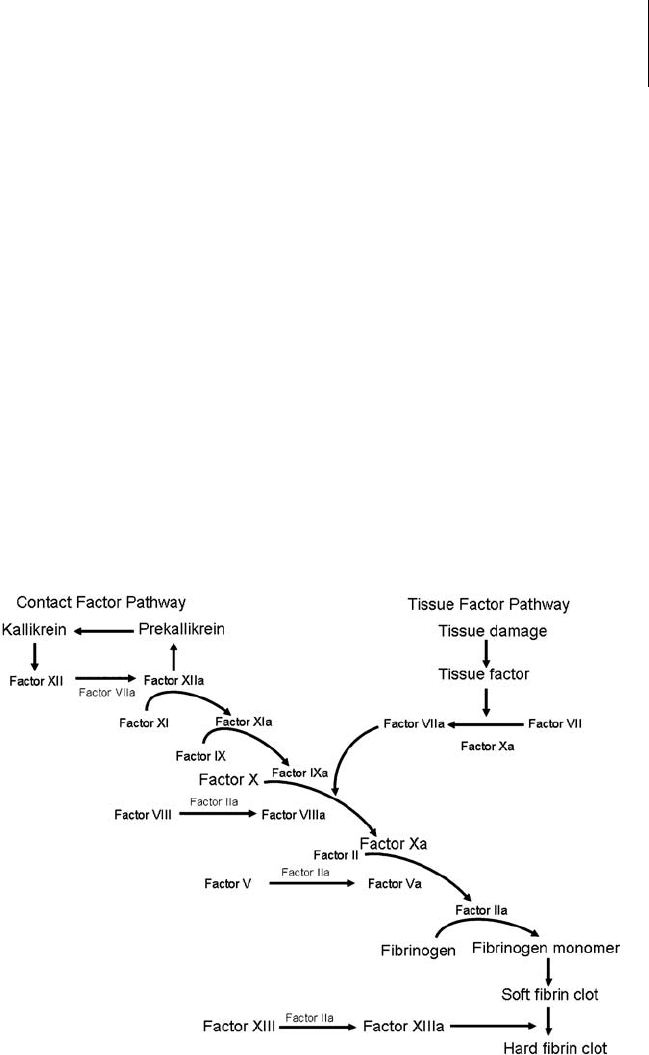
Factor X is of particular interest because it can be activated in two ways.
The presence of tissue factor—found in most tissues but not normally blood—
is released when a blood vessel breaks within a tissue. Exposure of blood to air
leads to cell surface damage. Both the cell surface damage and the tissue factor,
working through intermediaries, lead to the activation of factor X.
Why is this process so baroque? The complexity of the system arises
because the various steps are used to amplify the response in the cascade. By
adding steps to the cascade, a stronger response to a wound can be made. It’s
similar to the old slogan in a shampoo commercial some years ago where one
person who liked the shampoo told two friends, and those friends told two
friends, and so on, and so on. So, the seemingly baroque cascade appears to
be advantageous.
Now, how could this elaborate pathway evolve? A major clue is that many
of the clotting enzymes—including prothrombin and factor X—are quite sim-
ilar to one another. This similarity is a strong indicator that these genes arose
via a series of gene duplications. Other patterns present in the sequences of
the genes that produce these enzymes lend further support to the possibility
that these genes arose from duplications. In addition, thrombin shares
similarity in sequence with an enzyme called trypsin, which is involved in the
cleavage of proteins in the pancreas. The pancreas and the liver (which
produces the enzymes involved in blood clotting) are “sister organs,” that is,
the cells that make up the liver and those that make up the pancreas are
derived from the same cells in the early development of the organism.
These data all support a step-wise mode of evolution of the blood clotting
system. In outline, the system began as a simple one (fibrinogen and thrombin
DARWINIAN DETECTIVES
are among the earliest components of the system) and gradually became more
complex as gene duplications allowed for new components of the system. The
addition of a new component gave an advantage to the organism by providing
amplification of the signal, whereby a small change in the component early
in the clotting system could allow for much larger changes later in the system.
Such an addition probably came at a cost because the functions of the new
gene were not fully in tune with the rest of the system. This cost, however,
was smaller than the added benefit that the new gene provided. Subsequent
changes that integrated the new gene’s functions with the system as a whole
could then minimize the cost, thereby providing a selective advantage.
One may predict from such a model that some components of the system
would have appeared later than did others. By comparing the components
present in different organisms, biologists can test these predictions. To give a
specific example, three components (prekallikren, factor XI, and factor XII)
are thought to be latecomers to the cascade and thus would not be found in
distant relatives of mammals and other terrestrial vertebrates. When the
pufferfish genome was sequenced, Russ Doolittle and his colleagues looked at
which clotting components it contained.
15
Although the pufferfish had most
Why Intelligent Design Is Not Science
Figure .
The blood clotting cascade. The clotting reaction can begin at either the contact
pathway or the tissue factor pathway, and factor X is involved in each step.
The “a” denotes the activated form of a factor (e.g., Factor Xa is the activated
form of Factor X).

of the components of the cascade, it lacked prekallikren, factor XI, and factor
XII—as expected from the distributions of components in related organisms.
Intelligent design can’t even make such predictions.
Tellingly, Behe, in a dialogue with Kenneth Miller, admitted that the
blood clotting system is not irreducibly complex like a mousetrap.
16
One
reason it isn’t irreducibly complex is that some animals (dolphins are a key
example) exist that are missing parts of the system. Redundancies are built in.
The blood clotting system is not the only complex biochemical system for
which a plausible step-by-step scenario for its evolution has been worked out.
In the fruitfly, Drosophila melanogaster, females have two X chromosomes
and males have one X chromosome. Sounds simple, doesn’t it? The actual
pathway that determines sex in this fly, however, contains several steps and
is another example of a remarkably baroque biochemical system. Among
other features, the pathway has several alternative splicing patterns, wherein
one RNA can be spliced in different ways; the end result is that many differ-
ent proteins can be manufactured from the same gene. Genes in this pathway
also have multiple sites at which they can be regulated by other genes. In
addition, the proteins produced by some genes regulate their own produc-
tion. This scenario definitely seems complex, and it is. It’s also likely that the
removal of any one of several parts of the present pathway would lead to the
production of flies that are neither male nor female, and are thus evolution-
ary dead-ends. Nonetheless, a plausible mechanism exists that can account
for this pathway’s evolution.
Comparative evidence from looking at the patterns seen in a variety of
other insects strongly suggests that the complex pathway in Drosophila arose
in a series of steps from a much simpler “one-switch” system. In ,
Andrew Pomiankowski and his colleagues proposed a model that attempts to
explain the evolution of the major features of this pathway in terms of
population genetics. The details of this model are the beyond the scope of this
book, but the formation of such a model generates predictions that can be
tested.
17
Such models also can point to new directions of biological study.
God of the Gaps
Whether for the clotting cascade, sex determination pathways, or any one of
a number of other complex biochemical systems, evolutionary biologists are
able to devise plausible models for how such systems evolved. These models
are subject to testing by a variety of means—whether through laboratory
experiments or through the observation of related individuals. It is true that
gaps remain in our understanding about numerous aspects of biology, includ-
ing biochemistry. But that doesn’t mean that those gaps will not be explained
through the course of further inquiry. The key point is that these models lead
to further scientific inquiry, in contrast to the consequences of throwing one’s
arms up and pointing to an intelligent designer to explain the gaps. Just because
DARWINIAN DETECTIVES

we don’t know everything doesn’t mean that we don’t understand the principles
involved.
In one of my favorite scientific cartoons by Sidney Harris, two scientists are
looking at a blackboard filled with mathematical symbols and other “scientific
looking” writing. In the middle of the blackboard the phrase “then a miracle
occurs” appears. One of the scientists says to the other, “I think you should
be more explicit here in step two.”
18
Invoking the phrase, “Then a miracle occurs,” to processes that we do not
understand is not a scientific statement. This is an example of a “God of the
Gaps” argument, wherein one argues for a supernatural explanation based on
gaps in our scientific understanding. And this is precisely what the proponents
of intelligent design are doing—despite their denials—when they invoke
“Design.” One obvious predicament with the “God of the Gaps” argument is
that gaps, as we have seen, can be filled in and explained by scientists. The
larger problem, however, is that such an argument is counter to scientific
reasoning; reliance on a faith-based explanation does not advance fact-based
understanding.
Facts and Theory
During the presidential campaign, former President Ronald Reagan was
asked about evolution. He replied, “Well, it’s a theory, it is a scientific theory
only, and it has in recent years been challenged in the world of science and is
not yet believed in the scientific community to be as infallible as it once was
believed.”
19
Over the next two decades, subsequent critics of evolution have
used similar language in attempts to dismiss evolution. After all, the popular
perception of the word “theory” is “educated guess.” Or as the biochemist and
science-fiction writer Isaac Asimov said in the same year as Reagan’s quote,
“[Creationists] make it sound as though a ‘theory’ is something you dreamt
up after being drunk all night.”
20
In formal, scientific use, a theory is much more than an educated guess. It
is also more than a hypothesis; it is a coherent body of well-tested hypothe-
ses. A theory is a set of statements that () are interconnected, and internally
consistent; () are based on observable and circumstantial evidence (“the
facts”), () explain a wide variety of observations, and () have been tested by
reference to the observable facts.
The theory of evolution is upheld by, and explains, numerous well-
supported pieces of evidence that we accept as fact. It is a fact that humans
and chimpanzees are closely related species that diverged from a common
ancestor between five and seven million years ago. It is a fact that humans,
chimpanzees, mice, and kangaroos belong to the class of vertebrates known
as mammals, and that these organisms are placed in that class based on
sharing particular characteristics (for instance, are warm-blooded, possess
mammary glands, and have hair). It is a fact that mammals that fly are found
Why Intelligent Design Is Not Science

on oceanic islands, whereas nonflying mammals generally are not. These facts
both support and are explained by common descent with modification via nat-
ural selection and other natural forces—in other words, Darwinian evolution.
Evolutionary theory is not just a theory; as the central organizing principle
of the life sciences, it is one of the most encompassing theories in all of
science. Many smaller theories are contained within the theory of evolution.
Existing evidence supports these smaller theories by varying degrees.
Researchers are continually testing theories by using a variety of methods—
observations, manipulative experiments, mathematical theory, computer sim-
ulations. In this testing, some of the smaller theories gain support and others
lose support. By this process, the theory of evolution as a whole is refined and
adjusted based on new evidence. We will see some examples of refinements
and even re-refinements of evolutionary theory in the chapters to come.
Although evolution is both facts and theory, intelligent design is neither. It
is incorrect to use the phrase (except with scare quotation marks) “intelligent
design theory.” Reference to an “Intelligent Designer” is not an explanation.
An Intelligent Designer cannot be tested. One can speculate about the nature
of such a Designer—whether it acted once and has been silent since or
whether it continually acts (or somewhere in between)—but such speculation
is not testing; it is not science.
ID, DI, and the “Wedge” Agenda
Despite the claims by the ID advocates that they are doing science, it is evi-
dent that they do not practice accepted modes of scientific reasoning and
empirical validation. It is also clear that these ID proponents are guided by
and are propagating faith-based religious and political agendas. The best evi-
dence that they have these agendas comes from the so-called “Wedge
Document” put out by Seattle’s Discovery Institute.
Formed by Bruce Chapman in , the Discovery Institute (DI) was origi-
nally a group of mainly business-oriented, socially liberal Republicans. Focusing
on telecommunications and issues local to the Seattle area, the early DI was
described as having “a forward-looking, futuristic, and intellectually contrarian”
vibe.
21
The DI’s initial purpose is reflected in its current mission statement:
“The Institute discovers and promotes ideas in the common sense tradition of
representative government, the free market and individual liberty.”
22
During the s, however, DI and Chapman (who still serves as its
president) moved steadily rightward politically and religiously. DI, through
its Center for Science and Culture (CSC), now serves a major source of fund-
ing and other support for ID proponents and other critics of evolution. The
Discovery Institute’s CSC has become the headquarters of a movement that,
as described by Barbara Forrest and Paul Gross, “seeks nothing less than to
overthrow the system of rules and procedures of modern science and intel-
lectual footings of our culture laid down in the Enlightenment.”
23
DARWINIAN DETECTIVES

On what basis did Forrest and Gross draw these conclusions? From the
DI’s own “Wedge Document,” which surfaced on the Internet in early .
(DI admitted to owning the document, but only in ). This document
states, “Discovery Institute’s Center for the Renewal of Science and Culture
seeks nothing less than the overthrow of materialism and its cultural legacies.”
24
It views materialism—the tenet that all that exists is material or physical—as the
root of all evil, a position taken by many creationists of the nineteenth
and twentieth centuries. Materialism is closely aligned to, but not the same
thing as, naturalism, the search for only natural explanations in explaining
phenomena. As we shall see, naturalism exists in more than one form.
The “thin edge” of this wedge was the publication of scholarly works on
intelligent design by Michael Behe, William Dembski, Philip Johnson, and
a few other members of DI’s board. The next part of their strategy would
then be attempts to sow doubt about Darwinian evolution among an unsus-
pecting public (especially school boards), presenting ID an alternative. As
Forrest and Gross chronicle, the Discovery Institute, through its CSC, has
been actively working with school boards in several states (notably Kansas,
Ohio, and Washington State). In the case of Kansas, they succeeded in rewrit-
ing the standards to place undue doubt regarding what we actually do know
about evolution.
The Wedge authors also collaborated with conservative religious leaders
such as James Dobson of Focus on the Family. In addition, they conspired
with politicians, particularly in the “right wing” of the national Republican
Party, to advance their agenda. In particular, Senator Rick Santorum of
Pennsylvania almost succeeded in writing Wedge-document language regard-
ing evolution into the “No Child Left Behind” act of . Specifically,
Santorum’s amendment was lifted from the legal playbook of the ID move-
ment, “Teaching the Controversy: Darwinism, Design, and the Public School
Curriculum,” written by several DI members. Although the Santorum
amendment was ultimately defeated, the nonbinding conference report
associated with the bill used similar but diluted language.
25
The agenda of those who champion ID is not just a religious one but one
that puts forth a particular religion. Although in the attempt to gain credibility,
they will sometimes claim that the Intelligent Designer could be an alien, they
really aren’t fooling anyone. Their Designer is clearly the Christian God.
Their very words betray those motives. For instance, here are a few quotes
from William Dembski, a mathematician and philosopher at Baylor University
in Texas and one of the leading ID proponents:
My thesis is that all disciplines find their completion in Christ and
cannot be properly understood apart from Christ....
26
The point to understand here is that Christ is never an addendum to
a scientific theory but always a completion....
27
Christ is indispensable to any scientific theory, even if its practitioners
don’t have a clue about him.
28
Why Intelligent Design Is Not Science