
Johnson, Norman A. Darwinian detectives
Подождите немного. Документ загружается.


DARWINIAN DETECTIVES
within a gene has a mutation rate on the order of one in a billion (one-one
thousandth of one in a million). Population sizes, however, can be rather
large but variable. Species smaller than about , are in critical danger of
going extinct. Population sizes can number in the billions, however,
particularly for species with small body sizes (for example, insects, most
fungi, and bacteria). Therefore, the mutation rate times the population size
generally yields a modest number.
Recall that the neutral theory postulates that virtually all mutations are
either deleterious or essentially neutral. The deleterious mutations don’t
persist, so when considering the substitution rate, we only consider the
neutral mutations. Note that the neutral mutation rate is the overall muta-
tion rate multiplied by the fraction of mutations that are neutral. According
to the neutral theory, all genetic variants persisting in a population have
an equal probability of being the one that becomes fixed in the population.
Thus the probability of a variant becoming the one fixed in the population
at any given time is the same as its current frequency. If a hypothetical
variant of a gene is present at in the population, it has a chance
of becoming the variant that is fixed. This makes intuitive sense—the
variants all are equally fit, and none is more or less likely to be the lucky
one than any of the others. It’s like a lottery; your chances of winning
depend upon how many tickets you possess. The new variant is unique; it
is the only one of its kind. Call the number of individuals in the population
N. Because every individual has two copies of genes, two times N copies of
genes are in the population. The new mutation thus has a one in N chance
of being the lucky variant that wins the genetic lottery and becomes fixed
in the population.
To figure out the rate of substitutions, we need to multiply how many
new mutations occur and the probability that any one new variant will be
the lucky one.
N times the neutral mutation rate of new mutations every generation
multiplied by /N probability of being lucky equals the neutral mutation rate.
An interesting thing happens; the two Ns cancel each other out, making
the math really simple. The rate of substitution is thus equal to the neutral
mutation rate. Of course, this is the neutral mutation rate. If negative selection
is very strong, then the neutral mutation rate may be very much lower than
the actual mutation rate. In the case of amino acids in histone H, the neutral
mutation rate may be around one-thousandth of the actual mutation rate.
Why the Substitution Rate Equals the Neutral
Mutation Rate
(continued)

At the time Kimura had published his first paper on neutral theory,
evolutionary biologists were just starting to use a technique called protein
electrophoresis to measure the extent of variation in proteins within natural
populations in a variety of organisms. Electrophoresis distinguishes protein
variants based on their ability to move across an electrically charged, starchy
gel. Variants of proteins that differ in charge or size owing to slight differences
in their amino acid sequence will move down the gel at slightly different rates.
These variants can thus be easily visualized. The virtue of this technique is
that many individuals can be quickly assessed for differences at a couple of
dozen different proteins. Not only was the technique easy to use and rela-
tively inexpensive, but it also could be used in natural populations in just
about any organism. If you could find ’em and grind ’em (to get out their
proteins), you could study the variation in their proteins. Moreover, protein
electrophoresis requires only a tissue sample, not the whole organism; in
most cases, one can take this sample without harming the organism. Due to
its ease, the technique of electrophoresis became a bandwagon within evolu-
tionary biology circles during the s and especially s. In most species,
populations were found to be surprisingly variable. In organisms ranging
from flies to humans, over of the proteins sampled were variable.
10
Moreover, often up to about of individuals had two different variants for
a particular protein. Such individuals, called heterozygotes, received one
variant from their mother and one variant from their father. How could
so much genetic variation exist in populations? Could all this variation be
maintained by natural selection?
The neutral theory also makes predictions about the extent of polymor-
phism within species. One of Kimura’s major insights was seeing that
polymorphism was the transient stage in the turnover of neutral variants.
Polymorphism and evolutionary change were just two sides of the same
coin. The extent of polymorphism should thus be proportional to the length
of time individual variants took on their journey to becoming fixed or elim-
inated. Consider genetic variants whose frequency is primarily influenced
by drift; such variants will spend more time before either becoming fixed or
going extinct in larger populations than they do in smaller populations. As
an analogy, suppose that Joan and James are both flipping coins, and Joan
flips coins at a time while James tosses coins at a time. Simply
because she flips fewer coins at a time, Joan will almost certainly throw one
set with all heads or all tails long before James ever does. The same princi-
ple works with genetic variants controlled by genetic drift; these variants
will be lost or fixed in smaller populations much faster than they will in
large ones.
The census population size is not the only factor that determines the effect
of genetic drift. If many more females than males occur in a population,
genetic drift will be stronger than one would expect based just on the total
numbers of offspring. Genetic drift is a sampling process that occurs in the
making of gametes and the fertilization of those gametes into zygotes; males,
Negative Selection and the Neutral Theory of Molecular Evolution
as the rarer sex, represent a genetic bottleneck. The same principle would
hold if females were rarer than males. A population of males and
females is affected less by genetic drift than either a population of
males and females or one with males and females. Temporal
fluctuations in population size also influence the effect of genetic drift.
Suppose a population regularly cycles from in one generation to , in
the next to , in the third. This population with fluctuating population
sizes experiences a greater effect of genetic drift than a population whose size
remains constant at . Furthermore, if not all individuals breed, then the
effect of genetic drift would be higher than expected based on the census
population.
Sewall Wright introduced the term “effective population size” to serve as
a measure of how much genetic drift any given population experienced.
11
A population that has an effective population size of , would experience
genetic drift in the same way that an idealized, randomly mating population
of equal numbers of males and females would that was stable at , breeding
individuals in each generation. This measure of “effective population size”
DARWINIAN DETECTIVES
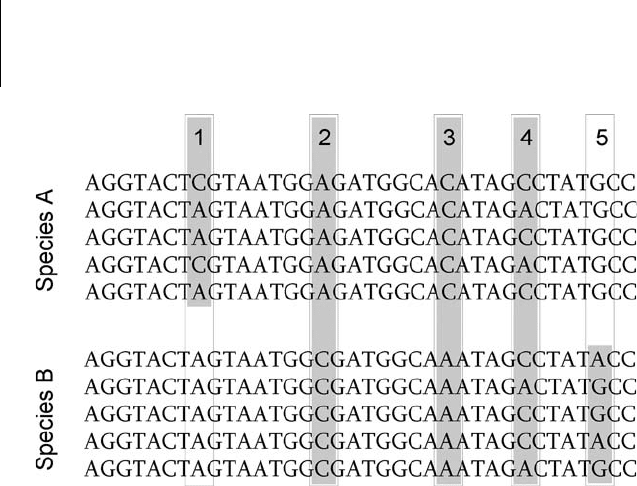
Figure .
Polymorphism and divergence in species. Each row represents the DNA sequence of
a particular gene from one chromosome of individuals from two species A (top) and
B (below). At site , a polymorphism (for nucleotides A and C) exists within species
A but not species B (all sequences are A). Sites and are examples of divergence;
all sequences from species A differ from all sequences of species B at this site. Site
is an example of a shared polymorphism; some sequences are C at this site and some
are A. At site , species B is polymorphic (A and G) and species A is monomorphic.
All other sites are monomorphic.

allows for comparisons among populations and species with very different
demographic properties. We will encounter this measure several times
throughout the following chapters.
The neutral theory also predicts that the neutral mutation rate will affect
genetic variability. Mutations yield new genetic variants, thus an increased
mutation rate would also increase the amount of polymorphism. Because
mutation rates generally vary much less than do effective population sizes,
population geneticists usually focus more on the latter.
Species with larger population sizes do tend to exhibit more genetic
variability. Bacterial populations have more variation than do most insect
species, and most insect species contain more variation than do most verte-
brate species. The effective population size of humans is rather low, despite
their current large census population. This apparent anomaly is almost
certainly due to low historical population sizes of humans, and effective
population size measures being sensitive to dips in population sizes. We will
consider the effective population size of humans in more detail in chapter .
At the extremes, elephant seals and cheetahs both have recently undergone
narrow population bottlenecks in the recent past, and both species exhibit
exceedingly little genetic variation.
Kimura’s Legacy (Part )
The protein data for divergence among species and polymorphism within
species are thus at least roughly consistent with the neutral theory. But this
doesn’t prove that the neutral theory is correct. As some evolutionary biolo-
gists argued, these results also could be consistent with models of evolution
that assume some forms of positive selection. During the s, many
evolutionary biologists took stands in what has been called the selectionist-
neutralist debate. The neutralists defended the neutral theory whereas the
selectionists argued for a greater role for positive selection. Although this
debate still simmers, most participants have taken more nuanced stances.
In , Ernst Mayr admitted that his initial position on the neutral theory
was incorrect:
Although this theory was at first vigorously opposed by most evolu-
tionists, including myself, the high frequency of “neutral” base-pair
replacements is now well established. On the other hand, the selective
significance of numerous alleles that had been considered neutral by
neutrality enthusiasts has also been established.
12
In the next chapter, we will further discuss the legacy of Kimura and the
neutral theory. Today, virtually all evolutionary biologists see that Kimura’s
neutral theory plays a very important role in tests for detecting positive
selection. To understand this role of the neutral theory, we must discuss how
scientists test hypotheses.
Negative Selection and the Neutral Theory of Molecular Evolution

The Neutral Theory, Hypothesis Testing, and the
Burden of Proof
Practitioners of both legal and scientific reasoning encounter issues pertaining
to the burden of proof. In the American legal system, a defendant in a
criminal case must be found guilty beyond a reasonable doubt in order to be
convicted. That is, the burden of proof is on the prosecution rather than the
defense to make its case. Based on English common law, the Anglo-American
legal system puts the onus on the prosecution to prove guilt because we
believe that it is better to let a guilty person go free than it is to imprison an
innocent person. The burden of proof is much lower in civil cases, however.
In civil cases, the plaintiff’s side need not prove their case beyond a reasonable
doubt. The O. J. Simpson cases illustrate this distinction; although Simpson
was found not guilty of murder in a criminal court, he lost the wrongful death
suit in civil court.
Discussions about the burden of proof also appear in science. Given two dif-
ferent explanations that are both consistent with the observations at hand,
which should we choose? Scientists and philosophers have been guided by a
principle known as Occam’s razor, named after the fourteenth-century philoso-
pher William of Occam. According to Occam’s razor, when competing
explanations or hypotheses can each explain the phenomena equally well, then
the one we should pick is the one the one that is least complicated, or the most
parsimonious. As an absurd example, suppose that you see a felled tree that was
previously standing, and you know that a lightening storm occurred the
previous night. One hypothesis is that lightening caused the tree to fall. Another
possibility is that a film crew felled the tree, making it appear as if it were struck
by lightening. In the absence of prior knowledge of a film crew or ancillary
information, the former hypothesis is obviously the most parsimonious.
Sometimes distinguishing the most parsimonious hypothesis is not as cut and
dry. One phrasing of Occam’s razor is “when you hear hoofbeats, think of
horses not zebras.” Because horses are more common than zebras in America
and Europe, horses would be the more parsimonious cause for the hoofbeats in
those continents. But in parts of Africa, zebras are more common than horses,
and thus zebras would be the more parsimonious explanation there.
So the burden of proof is placed on the more complicated, less parsimo-
nious hypothesis. For it to be accepted, it must have some greater explanatory
power than the more parsimonious one. Scientists often frame hypothesis
testing by setting up two hypotheses; one is a “null hypothesis,” and the other
is the “alternative hypothesis.” The null hypothesis is typically the hypothesis
of “no difference.” Take the case of testing the efficacy of a cholesterol-
lowering drug. A null hypothesis would be that no real difference would be
apparent in the cholesterol levels between those patients given the drug and
those given a placebo, that the differences observed are just due to chance. An
alternative hypothesis would be that the patients who received the drug had
lowered their cholesterol levels more than had those patients who received
DARWINIAN DETECTIVES

the placebo. The burden of proof is on the alternative hypothesis; a real
difference must exist between the two groups of patients—one that is unlikely
to have occurred by chance alone. To take an absurd case, suppose that only
one patient was in each of the control and the experimental groups; the
patient given the drug reduced his cholesterol by points, while the patient
given the placebo reduced his cholesterol by only points. Clearly, the
difference could easily arise for chance reasons totally unrelated to the drug.
If people had been in each group, however, and all in the drug treatment
had reduced their cholesterol levels by more points than all in the placebo
treatment, then we could be very sure that the differences were real (due to
the drug). The alternative hypothesis met the burden of proof; thus, we could
reject the null hypothesis of no difference between the drug and the placebo
treatment. Note that failure to reject the null hypothesis doesn’t mean that we
accept the null hypothesis. In the first case, in which only one person had
been in each treatment group, that difference could have been real. We just
lacked proof that it was. The alternative hypothesis did not meet the burden
of proof.
Biologists, like many other researchers, rely on statistical tests to determine
whether differences between groups represent differences that are unlikely to
have arisen by chance alone. Two types of errors can be made in these tests.
The first is rejecting the null hypothesis—saying that there is a difference
between the groups when in fact, no real difference exists. Sometimes, these
errors are called “false positives” (note that positive here doesn’t mean posi-
tive selection). The other type of error is not rejecting the null hypothesis
when there really is a difference. These errors are sometimes called “false
negatives.” By convention, scientists are willing to accept a rate of making
false positives. That is to say, the convention allows that the null hypothesis
is to be rejected when the probability that the differences among the groups
are due to chance is less than . (This level of is somewhat arbitrary and
can be adjusted.) Differences that are unlikely to come about by chance alone
are sometimes called statistically significant. Differences that are extremely
unlikely to come about by chance are sometimes called highly significant.
Note that for any particular result deemed statistically significant, a small
probability exists that it is a false positive. If many tests are performed,
chances are good that at least one of the statistically significant results is a
false positive. Further testing can mitigate that problem.
An important property of a statistical test is its ability to reject the null
hypothesis—that is, not to make a “false negative” error—at a given level of
making “false positive” errors. This property, known as power, is a measure
of the discriminatory ability of the test, and it generally increases with
increasing the number of data. For instance, the likelihood of making a false
negative is lower if one tested individuals with a placebo and with the
drug than it would be if one only tested from each group. Testing with
the larger samples allows for greater power. For a given number of data,
certain tests and experimental designs have more power than do others.
Negative Selection and the Neutral Theory of Molecular Evolution

A major strength of the neutral theory is its ability to generate null
hypotheses. These null hypotheses consider mutation, genetic drift, and
negative selection. Mutation is a fact of life. DNA replication isn’t perfect
and thus genes can be expected to mutate. Genetic drift is also a necessary
consequence of sampling every generation in finite populations. Because most
mutations that have an effect are deleterious, negative selection will be per-
vasive. Therefore, these forces are accounted for in the generation of the null
hypotheses. The burden of proof is then placed on demonstrating positive
selection. As we will see in the next chapters, that burden has been met for
many genes, thus we can infer that positive selection has operated on them.
DARWINIAN DETECTIVES
Detecting Positive Selection
One of the primary goals of population genetics has been to
measure and to understand the role of natural selection in
shaping variation within and between species. Now that
molecular technologies allow genetic variation to be assayed
with relative ease, this goal seems within reach.
—John Wakeley (Wakeley, , p. )
The Fish That Came into the Cold
The coldest waters in the world are those of the Antarctic Ocean. Here, water
temperatures are often just below the freezing point of pure water. High salt
concentration allows the water to remain liquid at temperatures where it is
ordinarily frozen solid. How do the denizens of these waters cope with such
severe conditions? Surely, they must have evolved various specialized adapta-
tions to the frigid water. These waters weren’t always frigid; million years
ago these waters were rather balmy with average temperatures in the upper
s, a little chilly for swimming but certainly not bone-chilling cold. The slow
cooling of the Antarctic Ocean left its inhabitants three choices: evolve adap-
tations to the cold, move, or die. Around million years ago, a barrier to
currents, called the Polar Front, formed, effectively shutting off the migration
option for many species of fish. Although many species went extinct, some
did evolve adaptations to the changing climate.
Among the adaptations that some cold-dwelling fish evolved are natural
antifreezes. Being less salty than seawater, the blood of these fish ordinarily
would freeze. Natural antifreezes, consisting of long repeating chains of
amino acids with a sugar periodically attached to one of the amino acids,
protect the fish by inhibiting the formation of ice crystals. Molecule per
molecule, these natural antifreeze molecules can be hundreds of times more
effective than the antifreeze used in cars.

Other adaptations to the cold include changes in the proteins that carry
oxygen through the circulatory system, known as hemoglobins (see also
chapters and ). At low temperatures, hemoglobin usually doesn’t work
well. At the extreme, the icefish dispensed with hemoglobin altogether, and are
the only known vertebrates who lack hemoglobin. How do these fish transport
oxygen throughout the body? First, the extremely cold temperatures reduce
metabolic needs and thus the amount of oxygen that must be transported to
the tissues. Yet some oxygen is still needed. Ordinarily, blood plasma is
extremely bad at transporting oxygen, but at low temperatures, oxygen can be
carried to a limited extent by the blood plasma alone. These fish make up for
the low efficiency of plasma transport of oxygen by increasing the volume of
plasma and the amount that is moved through the circulatory system in a
given time. As a consequence of the extra blood volume, their hearts have
become greatly enlarged.
A close relative of the icefish, the Antarctic dragonfish (Gymnodraco
acuticeps) also made drastic changes in response to cold adaptation but did
not go quite as far as its cousins. The dragonfish have hemoglobin, but unlike
most vertebrates, in which several forms of hemoglobin are found, these fish
possess but a single hemoglobin—one that is specialized for the cold environs.
1
Although the dragonfish hemoglobin differs in many respects from that of
most other species, the exact nature of the adaptive role of many of these
differences remains a mystery.
In most species, hemoglobin will release oxygen and pick up carbon diox-
ide more readily when in acidic conditions.
2
What purpose does this response
have? Acidity is an indicator that carbon dioxide concentrations are high.
Think about soda water, which is acidic because of the carbon dioxide that
has been dissolved in it. Thus, the response of releasing oxygen under acidic
conditions is usually adaptive because those acidic conditions signal high
carbon dioxide concentrations. It would thus be advantageous for hemoglobin
to release its oxygen and pick up carbon dioxide in acidic conditions. The
hemoglobin of the dragonfish lacks this response; it releases oxygen at
the same rate whether in acidic conditions or not.
Biologists are not totally certain about what advantage the lack of response
to acidity would give these fish. Perhaps at extremely low temperatures,
holding on to oxygen is more important for this hemoglobin than grabbing
carbon dioxide, even when carbon dioxide levels are high. Another possibility
is that the loss of this response is just the result of a release from negative
selection. After all, the icefish totally lost their hemoglobin.
Can we determine whether the changes that led to the dragonfish’s type
of hemoglobin were driven by positive selection and not simply by a
release from negative selection? Will we be able to see whether positive
natural selection for cold-tolerant hemoglobin has left traces that can
be detected from observing the DNA for the hemoglobin? As we discussed
in the previous chapter, to be able to claim that positive selection has
been responsible for patterns of DNA changes, first we must rule out
DARWINIAN DETECTIVES
explanations based solely on mutation rate, genetic drift, and the extent of
negative selection.
Some of the simplest tests for detecting positive selection arise from one
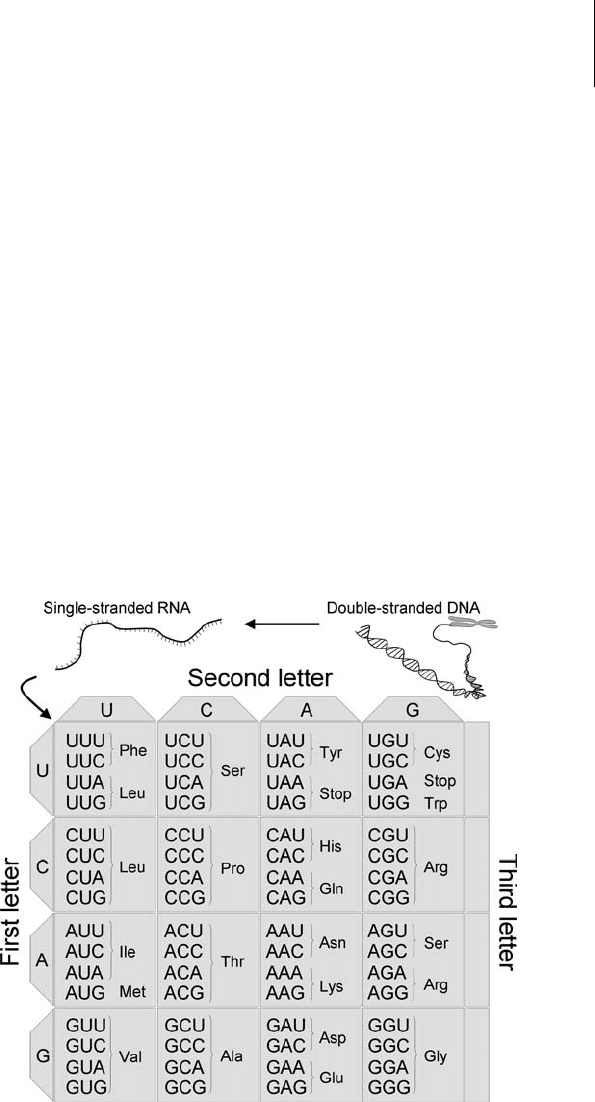
feature of the genetic code: some changes in DNA lead to changes in protein,
but others do not. The transcription of DNA information into RNA infor-
mation is a one-to-one mapping; that is, for every nucleotide of DNA, there
is a nucleotide of RNA. In fact, the only difference is that U (uracil) is used
in RNA instead of T (thymine) in DNA. In contrast, the translation of RNA
information into amino acid (protein) information is not a one-to-one
mapping. The information from a group of three nucleotides (called a codon)
specifies which amino acid will be in the protein translated from the RNA.
There are ( times times ) possible codons, three of which are used
to indicate when translation should end. So aside from these “stop codons,”
codons specify the amino acids commonly used in proteins. Thus an
average of three different codons code for the same amino acid. Typically, the
codons that code for the same amino acid differ in their third codon. For
example, the codon UUU codes for the amino acid phenylalanine, but so does
UUC. Mutations that do not change the amino acid sequence of the protein
Detecting Positive Selection
Figure .
The genetic code. Amino acid information is specified from groups of three RNA
nucleotides (triplet), which had been specified by DNA nucleotide information.