
Johnson, Norman A. Darwinian detectives
Подождите немного. Документ загружается.


are called “silent” mutations, and mutations that result in a different amino
acid being placed in the chain are called “replacement” mutations. Because
they do not alter the nature of the protein, silent changes should affect
characteristics of the individual far less than would replacement changes.
Thus, on average, replacement changes would be more subject to natural
selection (both positive and negative) than would silent changes.
The most straightforward signal of positive selection for new advantageous
mutations operating on a gene is a greater rate of replacement substitutions
than silent substitutions. Although silent sites often are under some degree of
negative selection, it is extremely unlikely that negative selection will affect
silent changes more than it will affect changes that alter the amino acid
sequence of the protein. The silent sites and the replacement sites are also
within the same gene, so they should experience the same levels of genetic
drift. Thus, if the replacement sites are evolving faster than the silent changes,
the most likely cause is positive selection. Such a test would need to take into
account the ability for each site to make silent versus replacement changes. If
it is easier to mutate to a replacement site than a silent site, then a faster rate
of replacement site evolution may just be an artifact. Such tests also need to
rule out chance as the reason for an elevated rate.
Let’s return to the Antarctic dragonfish and its hemoglobin. After taking
into account how often silent site and replacement site mutations occur, the
rate of change for replacement sites has been five times that for silent sites.
This result is extremely unlikely to have come about just from chance.
Positive selection thus acted sometime in the history of this branch of
the evolutionary tree. (The technical term for branches of the evolutionary
tree is “lineages.”) Other lineages of Antarctic fish also display the same
pattern of a greater rate of replacement site than silent site substitutions in
their hemoglobin, thus indicting the action of positive selection; the pattern,
however, is most clear in the dragonfish lineage. One important caveat is that
although this test can detect the action of positive selection, it cannot
pinpoint the exact nature of positive selection by itself. What is clear is that
there has been positive selection operating on features of the hemoglobin.
The Best Defense Is a Good Offense
Biologists have found this signature of the operation of positive selection in
a variety of molecules among very diverse forms of life. Let’s examine a few
other molecules that show this same hallmark. A good place to start is with
biological arms races. For example, most plants are engaged in a never-
ending struggle against predators, parasites, and pathogens. The plants evolve
adaptations to defend against or allow improved toleration of their natural
enemies. In turn, the natural enemies evolve counter-measures to evade the
plant defenses. Such arms races can last for millions of years, going through
numerous escalating cycles of attack and resistance. Genes that are involved
DARWINIAN DETECTIVES

in plant resistance would thus be good candidates to look for the footprints
of positive selection.
Fungi are one particular group of plant natural enemies that can be quite
damaging; one famous example, Phytophthora infestans, was responsible for the
Great Potato Famine in Ireland during the middle decades of the nineteenth
century. To defend against fungi, some plants directly attack the hard substance
used in the cell walls of fungi, known as chitin. Plants can degrade chitin by use
of specialized enzymes known as chitinases; these enzymes destroy chitin with-
out affecting plant cell walls, which generally contain cellulose rather than chitin.
Tom Mitchell-Olds and other researchers at the Max Planck Institute for
Chemical Ecology recently examined chitinases from several species of plants
in the mustard family, including Arabidopsis thaliana.
3
This plant species is
sometimes called “the green Drosophila” because geneticists have studied it
more extensively than they have any other flowering plant. The researchers
found many instances of more replacement changes than silent ones occur-
ring between two species. In eleven pair-wise comparisons, this excess of
replacement changes was tested and found to be statistically significant—that
is, unlikely to be due to chance. In all of these statistically significant cases,
replacement sites changed three or more times faster than did silent sites.
This is strong evidence for positive selection driving many adaptive changes.
The Max Planck researchers were able to go further with the study by the
use of more sophisticated models that enabled them to pinpoint the specific
amino acids that were most likely to be the targets of positive selection. They
also had access to X-ray crystallography pictures of the protein. Although pro-
teins are strings of amino acids, their actual structure is far more complicated
than a linear chain. Proteins fold into convoluted three-dimensional structures
determined in part by their amino acid sequence, but also by the environ-
mental conditions these proteins find themselves in; physical chemists are just
now learning the “rules” that govern protein folding. X-ray crystallography has
been and remains a powerful tool to examine the structures of complex
molecules, including proteins. The Max Planck researchers found that most of
the adaptive replacements in the chitinases were occurring in the active site
cleft, an unusual pattern; in most other instances where positive selection
acted on a protein, the adaptive changes occurred far away from the active site.
The authors suggest that positive selection may be driving changes in the
active site because the fungi attacked by the chitinases defend themselves via
forms of chemical resistance, such as trying to inhibit the chitinase.
The McDonald-Kreitman Test and Flies That Can Hold
Their Liquor
A significant excess of replacement site changes over silent site changes is
a very clear signature of the action of positive selection. Yet the absence of
this excess of replacement changes does not necessarily mean that positive
Detecting Positive Selection

selection has not been acting. Suppose that both positive and negative selection
had been acting on replacement mutations in a molecule. This negative selec-
tion would act more strongly on the replacement than it would on silent
mutations. By acting on the replacement mutations, negative selection would
reduce the replacement substitution rate. Like rain washing away footprints,
negative selection would obscure the signature of positive selection (the
excess of replacement substitutions).
Good detectives are sometimes able to follow the trail of a suspect even
after rain would have washed away any footprints; they do this by looking at
other signs of human movement, such as the disturbance of leaf clutter.
Similarly, molecular evolutionists have been able to use alternative means to
detect positive selection even when negative selection and other evolutionary
forces have obscured the clearest sign of positive selection (excess replace-
ment over silent site changes). During the s, several tests were proposed
to detect the action of positive selection even in the absence of an excess of
replacement substitutions. One of the earliest and easiest of such tests is the
McDonald-Kreitman test, named after the scientists who developed and
applied it.
While still a graduate student at Harvard during the early s, Marty
Kreitman became renowned in evolutionary genetic circles by producing the
first detailed study of variation at the DNA level within a species. Kreitman’s
choice of the fruit fly Drosophila melanogaster as his study organism should
come as no surprise; geneticists have devoted decades of study to that fly. The
gene that Kreitman studied was also very well known—the Adh gene that
codes for the enzyme alcohol dehydrogenase, which breaks down ethanol
(the alcohol in alcoholic beverages) into acetaldehyde. Drosophila melanogaster,
like many fruit flies, develops as larvae inside rotting fruit, where they feed on
the yeast growing on the surfaces of fruits. Even as adults, these flies roam
around the fruit eating yeast, mating, and in the case of females, depositing
eggs. The yeast convert the sugars in fruit into ethanol and other chemicals.
Thus, if the flies (and especially the fly larvae) lack adequate detoxifying
enzymes such as alcohol dehydrogenase, they will become too drunk to eat or
move properly.
Kreitman, in his study, found substantial variation in nucleotides at
the Adh gene.
4
This study by itself did not deal with the adaptive value of the
variation. The value of Kreitman’s study was that it paved the way for thou-
sands of other subsequent studies that have examined variation within species
at the level of DNA.
Fast forward to the early s. Marty Kreitman was at his first faculty
position at Princeton University and was still engaged in investigating the
patterns of DNA variants in D. melanogaster and its closest relatives at Adh
and other genes. He took on as a postdoctoral fellow John H. McDonald, who
had studied marine organisms for his doctoral work at the State University of
New York at Stony Brook. McDonald and Kreitman strongly suspected that
DARWINIAN DETECTIVES

positive selection had been working on Adh in part because of Drosophila
melanogaster had a higher tolerance for ethanol than did Drosophila simulans.
In , McDonald and Kreitman proposed a test for positive selection
based on examining both divergence and polymorphism—variation among
and within species.
5
Recall that changes in the mutation rate change diver-
gence among species and polymorphism within species in the exactly same
way. Double the mutation rate and both polymorphism and divergence
double. The extent of negative selection (functional constraint) also has
identical effects on divergence and polymorphism. A gene that is under high
functional constraint will have reduced polymorphism as well as divergence,
and to the same extent in each case. Positive selection, however, would
increase divergence but would not increase polymorphism. In the McDonald-
Kreitman test, silent sites are used as a control. The ratio of polymorphism
(within species) to divergence (between species) for replacement sites is
compared with that same ratio for silent sites.
McDonald and Kreitman compared polymorphism within Drosophila
melanogaster to divergence between Drosophila melanogaster and two of its
close relatives, Drosophila simulans and Drosophila yakuba, for both silent
and replacement sites. They found a striking pattern; at silent sites, polymor-
phisms within melanogaster outnumber fixed differences between species by
to , respectively. But when they looked at replacement sites, they saw a
different pattern: of the nine variable replacement sites, only two were poly-
morphisms within species and the other seven were fixed between species.
More than eight times as many differences at fixed replacement sites between
the species occurred than what had been predicted by the ratios seen at the
silent sites. This discrepancy is highly unlikely to have occurred by chance.
One the one hand, a faster rate of evolution of replacement sites to silent
sites is a very clear signal of positive selection. Such a pattern would be very
difficult to explain by any process other than positive selection. On the other
hand, the signal from the McDonald-Kreitman test of a significantly greater
ratio of divergence (fixed differences) to polymorphism in replacement sites
than in silent sites could conceivably be due to processes other than positive
selection. In fact, McDonald and Kreitman proposed an alternative hypothe-
sis for this pattern. What if, they supposed, the ancestral population sizes of
both species were much smaller than they are currently? They also supposed
that many slightly deleterious replacement mutations had occurred. Recall
that the random force of genetic drift is stronger when population sizes are
low. Because the ancestral populations were very small, slightly deleterious
mutations could become fixed in the populations via random genetic drift.
Fixation of these slightly deleterious mutations would result in many replace-
ment differences between the species. When the populations expanded, the
slightly deleterious replacement mutations would be weeded out by negative
selection. These would not appear as polymorphisms. If you think this scenario
sounds complicated, you are correct. In fact, McDonald and Kreitman said
Detecting Positive Selection

so in justifying why they favored the adaptive explanation over the slightly
deleterious model to explain their results.
This slightly deleterious model requires so many assumptions about
selection coefficients, population sizes, and times of population expan-
sions, that we prefer the simpler explanation, the occasional fixation
of an adaptive mutation.
6
In other words, McDonald and Kreitman invoked Occam’s razor to support
their choice of explanations.
A virtue of the McDonald-Kreitman test is that it is simple to perform—
requiring nothing more than simple arithmetic, and can be calculated in a
few minutes with a hand-held calculator.
7
The data required are just several
sequences within one species and a comparison sequence from a closely related
species.
DARWINIAN DETECTIVES
How to Perform the McDonald-Kreitman Test
So, let’s look at the actual data collected by John McDonald and Marty
Kreitman as shown in the table below. The top row shows the numbers of
amino-acid replacement changes in the Adh gene; the bottom shows the
numbers of silent changes. The left-hand column displays the number of
fixed changes between species, the right shows the number of polymor-
phisms within Drosophila melanogaster.
There are silent polymorphisms within Drosophila melanogaster and
fixed replacement differences between species. In addition, the researchers
observed replacement polymorphisms and silent fixed differences.
Based on the neutral theory, the ratios of the fixed differences to poly-
morphisms should be the same for the replacement differences (/ ⫽ .)
and the silent differences (/ ⫽ just over .). The ratios aren’t the same,
but are they statistically different?
To figure that out, we first need to determine the expected values for
each of the four entries. The expected value for the number of replacement
(amino-acid changing) substitutions is equal to the total number of
replacement changes ( ⫹ ⫽ ) times the total number of fixed differences
( ⫹ ⫽ ), divided by the grand total ( ⫹ ⫹ ⫹ ⫽ ). The
answer is ., which we can round to ..
We can do the same for all four cells of the table, and we get
. .
. .

During the decade following publication of McDonald and Kreitman’s
article in Nature, numerous other tests for positive selection were proposed:
the Fay and Wu’s test, the Fu and Li’s test, and the Tajima’s D, named after
their inventors. Most of these tests are more complicated than the McDonald-
Kreitman, but the central principle is the same: testing for positive selection
by looking for specific deviations from the expectations of Kimura’s neutral
theory. The results of such tests will appear several times in latter chapters
and demonstrate that detecting the action of positive selection can shed light
on the natural history of humans and other biological organisms.
Selective Sweeps and the Hitchhiker’s Guide to the Genome
Before we discuss global patterns of selection that act on the genome, let’s
consider what happens when a new and advantageous mutation arises in the
population. Most of the time that new mutation—despite being advanta-
geous—will be lost from the population because new mutations start off as
just a single copy and are easily lost. For instance, there may be a mutation
Detecting Positive Selection
Based on McDonald and Kreitman’s data, we would expect to observe
. replacement substitutions, . replacement polymorphisms, . fixed
silent changes, and . silent polymorphisms.
The final step is to compare the actual observed numbers (the top table)
with the expected numbers (the bottom table) for all four cells.
⫹. ⫺.
⫺. ⫹.
Compared with the expected values, . more fixed replacement changes
occurred. We see deviations of the same magnitude—but sometimes of
different sign—for the other cells in the table; for instance, there are .
fewer than expected replacement polymorphisms. Can these deviations be
explained by chance, or are they manifestation of some other force operat-
ing? To answer that question, McDonald and Kreitman used a goodness-
of-fit statistical test; these tests, as their name suggests, tell how well the
expected fit the observed. The details of these tests are beyond the scope of
this book, but according to the G-test (a well-known goodness-of-fit test),
the probability is less than of having the observed values differ as much
from the expected values as the data in the McDonald-Kreitman dataset
did. Therefore, can be quite confident that the excess of amino-acid
changing substitutions is not due solely to chance.
How to Perform the McDonald-Kreitman Test (continued)

that enables a fish living in cold water to be better able to tolerate cold, but if
the individual that harbors that new mutation is eaten before it gets a chance
to breed, that’s the end of that mutation. Advantageous mutations are much
more likely to become fixed in the population than are neutral ones, which in
turn, have a far better probability of fixation than do even slightly deleterious
ones. Evolution is often a game of probability, but as every poker player
knows, some events (getting two pair) are more probable than others (getting
a royal flush).
So let’s consider that the new, beneficial mutation has survived the initial
stages when it was present in only a few individuals. From this point on, its
fate is sealed; it will rapidly increase in frequency in the population until it is
fixed, assuming that the environment stays consistent. How rapidly this
increase in frequency of the favored variant occurs, what geneticists some-
times call a “selective sweep,” depends mainly on the strength (and direction)
of selection. Suppose two alternative genetic variants (A and a) are possible.
Further suppose that of the individuals that had two copies of A (geno-
type AA) survived to adulthood. Also suppose that of those individuals
with one copy of A and one copy of a (genotype Aa) survived, and only
of those with two copies of a (genotype aa) survived. If no differences exist
among these genotypes with respect to reproduction or mating ability, the
relative fitness of genotype AA would be , that of Aa would be ., and that
of aa would be .. Under these conditions, the frequency of the A variant
can go from . to . in under generations. If the selective differences
among the genotypes are smaller, the change in frequency will be slower; but
even when the differences are a couple tenths of a percent the advantageous
variant will be able to sweep through the population in only a few thousand
generations.
An important consequence of the relative rapidity of these selective sweeps
is that other genetic variants close on the chromosome to the advantageous
genetic variant will also rise in frequency, and could also become fixed in the
population. These other variants would not necessarily be of any fitness ben-
efit to the organism; indeed, these variants hitchhiking along with the linked
advantageous variant could well be deleterious. The rise in frequency of
hitchhiking variants is just a happenstance of the other variant that they are
near. Genetic recombination is the only thing that would prevent them from
becoming fixed. Recombination occurs every generation, but the quicker
the selective sweep, the less time recombination would have to prevent the
fixation of hitchhiking variants.
This “hitchhiking” phenomenon and the importance of recombination
were known decades before we had any data and before we could do DNA
sequencing on a massive scale. Moreover, in a paper, the brilliant British
evolutionary geneticist John Maynard Smith noted that through hitchhiking,
the selective sweep would have consequences similar to that of a population
bottleneck: it would reduce genetic variation.
8
Unlike the reduction in
variation that arises from a population bottleneck, this reduction in variation
DARWINIAN DETECTIVES

associated with a selective sweep would be localized to the chromosomal
region near the variant that swept through. How far this region extends
depends upon the strengths of selection and the frequency of recombination.
Darwinian detectives thus can infer a recent selective sweep when they
observe a region of much reduced genetic variability on the chromosome
near regions with higher extents of variation. To be detected as such, the
sweep must have taken place fairly recently because in every generation after
the sweep, new variants will again accumulate due to mutation.
One chromosome of Drosophila melanogaster is much smaller than the
others; genes on this chromosome, sometimes called the “dot” chromosome
due to its small size, experience essentially no recombination. This lack of
recombination means that the entire chromosome acts as an evolutionary
unit; with respect to evolutionary transmission, it is a single “gene.” Any
variant that sweeps to fixation due to selection will carry with it all other
associated variants. If selective sweeps happen relatively often, one would
expect very low levels of genetic variation along the whole chromosome.
Consistent with the predictions, genes across the dot chromosome show
remarkably low levels of variation. For instance, consider the dot-chromosome
gene cubitus interruptus (ci), a gene involved in pattern formation in early
development of flies. Very little or no genetic variation is found within any of
one of the four species Drosophila melanogaster, Drosophila simulans,
Drosophila sechellia, and Drosophila mauritiana.
9
This absence of variation
cannot be explained by functional constraint, because normal levels of genetic
divergence among the species are observed for this gene. Moreover, the lack
of variation is seen in both amino-acid changing sites and those silent sites
that don’t affect amino acid sequences. Other dot-chromosome genes display
the same pattern: zero to very low levels of polymorphism within species with
normal to high levels of divergence among species. The best explanation for
this phenomenon is the consequence of selective sweeps and genetic hitch-
hiking. In cases such as the dot chromosome, in which a large chunk of DNA
has little or no recombination, one cannot infer which of the genes was the
target of selection.
Linkage Disequilibrium and Selection
While selection is in the process of driving a genetic variant to high fre-
quency, the selected variant carries along other variants that are genetically
linked with it. In this situation, one would expect that the variants at one site
would be highly correlated with variants at other nearby sites. An hypotheti-
cal example of such correlations would be that if a chromosome sampled
has nucleotide “A” at site , it would be more likely to have nucleotide “G”
at site (, nucleotides away) than if it had a different variant at site
. Correlations, in general, provide predictive power. For example, weather
patterns between consecutive days are correlated, and these correlations give
Detecting Positive Selection
us some ability to predict the weather the next day. If it’s colder than normal
on Monday, chances are good that Tuesday will be cold as well. The same is
true with these correlations among genetic variants: knowledge of what
variant is present at one site in an individual provides predictive information
about what variants are present at other nearby sites.
With respect to weather forecasts, predictive power falls off with distance.
It’s quite likely that the weather an hour from now will be more or less the
same as the weather now. It’s much harder to predict the weather a week
from now on the basis of the weather today. The same is true in genetics; as
we shall see, linkage disequilibrium (the genetic predictive power) tends to
fall off with increasing genetic distance.
Population geneticists were aware of such correlations decades before
DNA sequencing was possible. In fact, they had developed a theory that
predicts how these correlations would arise and disappear. Specifically, they
found that in the absence of evolutionary forces (selection, genetic drift, and
mutation), genetic recombination should result in the erosion of correlation
among variants at different sites. These population geneticists called such
correlations “linkage disequilibrium” because the patterns were usually only
observed when the variants were genetically linked (close on the same chro-
mosome). At that time, little was done—little could be done—to investigate
patterns of variation within genes.
The Human Genome Project and its spin-offs changed this. Linkage
disequilibrium (known also as LD), once an arcane subject in population
DARWINIAN DETECTIVES
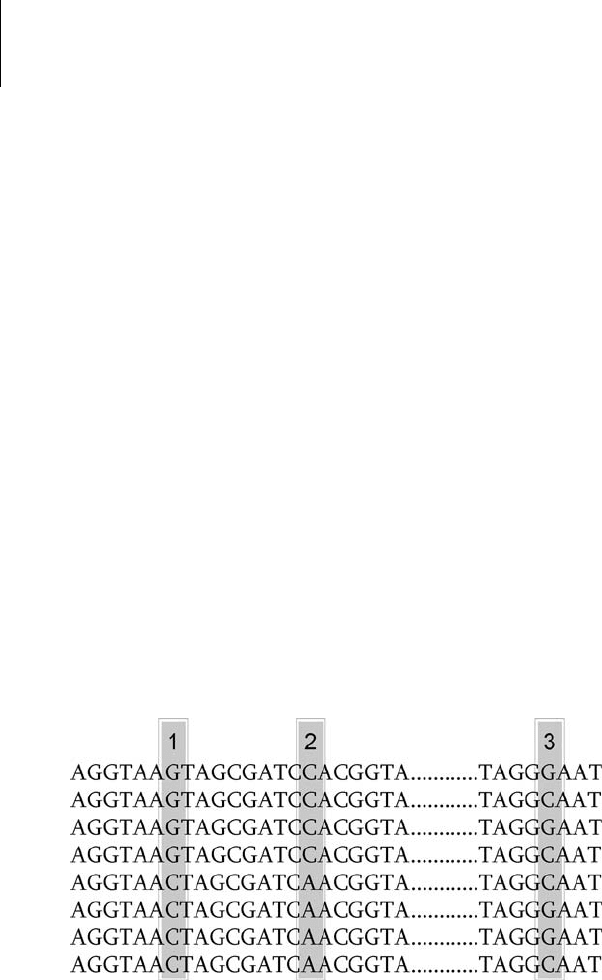
Figure .
Example of linkage disequilibrium. Eight different DNA sequences are collected
from a population. Three sites are polymorphic and are shaded in gray. The other
sites are monomorphic; no variation exists at those sites. The ellipses denote a
chunk of missing DNA. The variants in site and the variants in site are in link-
age disequilibrium with either site or site ; the variants present at site and site
are not associated with G or C at site (the frequencies of G and C at site are the
same regardless of whether site has a G or a C).

genetics, is now of great interest to the human genetics community because
these tight correlations among linked variants can be used to map genetic
variants associated with traits, including medically important ones. In such
mapping, researchers search for regions of the genome where affected
individuals are unusually similar in the genetic variants they possess. The
existence of LD is an aid in these mapping attempts because the presence of
highly correlated variants provides more statistical power.
In principle, observed patterns of LD can be used to infer the action of
positive selection. The presence of LD itself does not signify that positive
selection has acted; even without positive selection, other evolutionary forces
(particularly random genetic drift) can lead to LD.
10
Genetic drift, however,
should have similar effects across the whole genome, whereas the effects of a
selective sweep should be localized. In humans, LD due to genetic drift tends
to disappear after a distance of several thousand nucleotides. Several excep-
tions of this pattern, however, have been found wherein LD can extend much
further along chromosomes. The question is whether these exceptional cases
reflect the variability inherent in a random process such as genetic drift or
indicate the action of something other than drift (namely, positive selection).
Three different genes involved in the immune system of Drosophila all
exhibit strong patterns of LD in a natural Californian population of
Drosophila simulans.
11
In contrast, much less LD was found in an African
population of this species. This pattern is consistent with positive selection
that is currently selecting for a variant or variants within the California
population, but not the African population. Other explanations for the high
levels of LD in the population are possible, so we cannot definitively state that
positive selection has acted on these genes based on the LD pattern alone. In
conjunction with other evidence, this pattern can point to the operation of
selection.
LD created by directional selection will only persist for as long as
polymorphism exists in the population. Given that the eventual result of
directional selection is the loss of genetic polymorphism, LD as a signal for
directional selection has limited utility. Balancing selection—where selection
maintains two or more genetic variants at a given site—can also create LD;
and as we will see in the next chapter, LD created by balancing selection can
persist indefinitely.
Regardless of its cause, the presence of LD creates a structure in the pat-
terns of genetic diversity within a gene or gene region by limiting the number
of combinations of variants found in populations. Consider a gene region
with polymorphic sites. If each of these variable sites has two different
variants, over a million possible combinations are possible. In actual samples,
almost regardless of the species studied, far fewer actual combinations of
variants appear. Strong linkage results in a few groups of closely linked
genetic variants that are inherited as a unit. These groups are called “haplo-
types,” short for the phrase “haploid genotype.”
12
Each individual has two
haplotypes (one from the chromosome they inherited from each parent).
Detecting Positive Selection