
Johnson Sherry. Climate and Catastrophe in Cuba and the Atlantic World in the Age of Revolution
Подождите немного. Документ загружается.

94
•
the violence done to our interests
precedented scale. The cumulative impact of weather-induced crisis dur-
ing the early 1770s eected a complete revision of Spanish royal economic
policy toward the Americas. The economic structures that had been in
place for decades came under re, and the changes were nothing short of
a total realignment of trading paerns in the North Atlantic basin.
The modications of the 1770s grew out of the problems of the 1760s—
such as in Louisiana, where Alejandro O’Reilly arrived in 1769 to quell the
rebellion of the previous year. The rebellion in 1768 and former governor
Ulloa’s ignominious ight meant that for order to be restored, Spain’s re-
sponse needed to be unequivocal. As was the case aer the fall of Havana
in 1762, Charles III never repeated past mistakes. In 1766, Ulloa was sent
to Louisiana with less than 100 troops and with a conciliatory aitude
toward the resident population. In contrast, O’Reilly returned in 1769
with no fewer than 2,000 men and with an uncompromising stance that
brought swi and severe punishment to the ringleaders of the rebellion.
Yet his intractable position toward commerce with foreigners had to be
tempered by the reality of the situation on the ground. O’Reilly and his
successor, Luis de Unzaga y Amézaga, coped with food shortages caused
by ecological crisis and exacerbated by imperial restrictions. By winter
1770, the colony once again faced starvation, and O’Reilly was obliged to
grant permission to traders in New Orleans to receive our from farmers
upriver in the Illinois territory.4
Always sensitive to challenges to its privileges, the monopoly was out-
raged when it learned that O’Reilly had allowed Louisiana’s residents to
trade outside the imperial system, and once again the directors petitioned
the Ministry of the Indies for permission to relax the regulations under
which they were compelled to operate.5 Their arguments were twofold.
First, they complained that the quantity of our that they were allowed to
import was tied to the number of slaves, and they requested an increase
in that ratio from one-to-one to two-to-one. Second, they requested that
they be allowed to trade directly with foreign ports. They argued that their
responsibility was to provide enough our to feed the slaves, but because
of the shortages in shipments from Mexico, their only recourse was to turn
to Philadelphia or New York. They rationalized that if they traded with
foreigners, they would be doing the same thing as when Caribbean gov-
ernors authorized voyages to nearby colonies, only they would not bring
in other contraband goods such as china and cloth concealed in barrels of
our. If they had violated the law in the past, their intent had not been de-
the violence done to our interests
•
95
liberate or as egregious as what the locals commied on a daily basis. The
Asiento’s directors reminded the Council of the Indies that the company
was made up of Spanish citizens of the highest caliber who had never en-
gaged in any other contraband activities. Yet they did succeed in convinc-
ing the Ministry of the Indies to prohibit the export of North American
our (and other luxury items such as beer) from New Orleans to Havana.6
Even more signicant, they convinced the monarchy that the best course
of action was to allow them to purchase our from British North America.
In 1769, the Council of the Indies legitimized the Asiento’s contract with
Arturo Moylan and Company to provide 24,000 barrels of our annually
from Philadelphia, to be distributed among the cities that the Asiento
served.7 The our was supposed to be sent to Cádiz and then be shipped
to the Caribbean— an arrangement that failed even before the rst ship-
ment le port— and payment was secured through bills of exchange re-
deemable in Europe.8
In short order, representatives of each of the signatories traveled to
ports throughout the Atlantic basin to guard the interests of their respec-
tive employers. In Cádiz, Moylan secured the services of James Du, a
long-time resident with extensive local ties who, along with his partner
John Welsh, acted as broker for several mercantile interests.9 Moylan’s
Caribbean factor, James Monson, arrived in Puerto Rico via Dominica
in February 1769, and his reception was considerably more cordial than
that of his predecessor, the unfortunate John Kennedy.10 In another stra-
tegic move, Stephen Moylan, one of James Moylan’s sons, traveled to
Philadelphia, and he quickly entered the city’s economic and social life.11
Backed by the wealth of his family business and bolstered by their con-
tacts throughout the North Atlantic world, young Moylan became one
of the city’s most inuential merchants.12 The Spanish monopoly also
sent representatives to the Caribbean. In 1769, Gerónimo Enrile, son of
one of the principal investors in the Asiento, traveled to Puerto Rico and
then on to Cuba to inform the governors of the new contract.13 Joaquín
Pover replaced Vicente de Zavaleta as the Asiento’s factor in Puerto Rico,
and in July, Manuel Félix Riesch, who had previously served as Antonio
de Ulloa’s secretary when Ulloa was assigned to Peru, took over the mo-
nopoly’s operations in Havana.14
Beginning in March 1770, Philadelphia merchants sent four shiploads
of our to Puerto Rico.15 The two largest cargoes went on vessels partially
or wholly belonging to Philadelphia’s most prominent merchant house,
96
•
the violence done to our interests
Willing and Morris. The last shipment, which cleared port on 6 Septem-
ber, was owned by a consortium of ve investors: Stephen Moylan, Robert
Morris, Thomas Willing, W.Marshall, who had captained boats carrying
two of the three previous shipments, and the former San Juan factor, John
Kennedy, who had recovered from his bout with yellow fever and now
lived in London.16 For its part, the Asiento reported that the new system
was working well. In September 1769, in a moment of candor, the direc-
tors reported to the Ministry of the Indies that “no harm will be done by
obtaining our [from the Americans] because, as everyone knows, all
of the our that [goes] from Cádiz to the Spanish colonies is of foreign
origin.”17 The Asiento was so pleased that it requested an increase in the
amount of our that could be brought in, from one barrel per slave to two,
a request that was quickly approved.18 The Asiento factors in Puerto Rico
and Havana were also more aentive to their responsibility to send regular
shipments of our to the satellite cities, and when a fresh shipment arrived
in 1769, Bucareli immediately sent 423 barrels of our to Santiago.19
Indeed, all of the signatories to the new provisioning arrangement
seemed satised. Only one powerful, dissenting voice rose in protest: that
of the British government. In 1770, Britain and Spain were on the verge of
going to war over the Falkland Islands (Malvinas),20 and even though the
threat passed, the British crown saw the actions of the Philadelphians as
trading with the enemy. In November 1770, ocial notication went out
to Moylan and Company to stop sending our to Cádiz. Moylan’s factor,
James Du, was ordered to cease and desist receiving our from Philadel-
phia for sale to the Asiento. By December 1770, the bad news had made its
way to the Caribbean, and even Du’s promise that he would tell his sup-
pliers to continue to ship their cargoes until the break occurred did lile
to reassure the governors of Cuba and Puerto Rico that they could count
on a regular supply.21 Restrictions were reiterated, and provisioning from
Jamaica and the Bahamas returned to its illegal status.22
The impending crisis in the supply of provisions meant that the lo-
cals simply returned to their old bad habits of smuggling with the Brit-
ish islands, and in one of many instances, a sloop carrying replacement
troops to Santiago de Cuba captured a small boat of English smugglers
on the south coast near Bayamo, in April 1769.23 Two years later, in 1771, a
commissioned coast guard cuer under the command of Clemente Pérez
intercepted another sloop belonging to a local captain, Manuel Manresa,
with a cargo of our and salt on its way to a rendezvous somewhere on
the violence done to our interests
•
97
the north coast of Cuba. In the ensuing bale, Manresa was mortally
wounded and his crew was arrested and taken to jail. Yet they did not
remain in detention for long.24 A well-placed bribe of 400 pesos to a co-
operative jailer allowed Manresa’s second in command and his supercargo
to escape and melt into the countryside.25 At the same time, six Jamai-
can smugglers were not as fortunate when they were apprehended near
Bayamo on the southern coast. They were taken to Santiago de Cuba and
interrogated by the authorities about military activity in Kingston before
being transported to Havana in December 1771.26 Still, enforcement suc-
cesses were sporadic, and on the rare occasions when perpetrators such as
the six Jamaicans were caught and convicted, they were usually sentenced
to hard labor in the Spanish penal colony, Ceuta, in north Africa.27
The open deance of imperial laws prompted Bucareli to admon-
ish Santiago de Cuba’s new governor, Juan de Ayans y Ureta, about the
number of fugitives and criminals that roamed free in the area under his
authority.28 The provincial governors of Cuatro Villas and Trinidad also
worried how they could prevent the vegueros (tobacco farmers) in their
areas from continuing their contraband trade with Jamaican smugglers.
In March 1772, English sloops unloaded our at Sabana on the south
coast and Viana on the north in return for hides.29 In May, the smugglers
returned with our and now also with salt.30 For the most part, these
transactions were friendly and conducted with the cooperation of local
residents, except for one disturbing incident in late August 1772. The lieu-
tenant governor of Puerto Príncipe, Juan de Lleonart, reported that the
hacienda Vertientes, belonging to Lieutenant Francisco de Agramonte,
was aacked by an armed party of English raiders, who stole several head
of cale and took two of the hacienda’s tenant farmers hostage. Even more
disturbing was the reason for the raid. The aackers claimed that they had
come in retaliation for being cheated in a previous transaction. The raid-
ers mistook the hacienda of Agramonte for that of their collaborator on
the island, but when they realized their mistake, they set the captives free
and ed with the cale.31
As in the past, the local population was simply responding to scarcity,
but at the same time, the incident emphasized how desperate the condi-
tions on the island were. Local farmers struggled in vain to provide food
for their communities, because by 1770 the hallmarks of the ElNiño/
LaNiña sequence were once again evident throughout the region. By late
summer 1769, drought in Oriente province brought hunger and misery to
98
•
the violence done to our interests
the town of Santiago del Cobre when no meat provisioner could be found.
Manuel Varela, the commander of the troop detachment, was allowed to
oer the incentive that any supplier who came forward could reduce the
established weight from four pounds of meat per real to three pounds
as long as the product was of good quality.32 Similar to the events in the
1750s, the drought spread westward toward the interior of the island, and
in October 1770, the ranchers of Santa Clara requested relief from their
obligations to provide meat for the town’s slaughterhouse because the se-
vere drought had signicantly reduced the herds of livestock in the area.33
Food shortages also contributed to the onset of epidemic diseases, and
in April 1771, the residents of Santiago del Cobre and of another small
town in Oriente, Holguín, were plagued by a wave of fevers. Now royal
ocials were faced with yet another dilemma; both Holguín and Santiago
del Cobre were isolated villages with few royal ocials assigned to care
for the local populations. Each town had but one doctor, one priest to
administer the last rites to the dying, and one notary to record last wills
and testaments. When these men succumbed to the fevers, the process of
working through death came to a halt. At the onset of the epidemic, the
lieutenant governor of Holguín requested help from Bayamo, asking not
only for medicine and food, but also for replacements for the ocials who
had died. When Bayamo’s city fathers did not reply, he appealed directly
to Bucareli in Havana, and he, in turn, forwarded the urgent request to the
governor of Oriente.34 On one hand, neighboring towns and villages were
obligated to respond to the emergency needs of another. On the other,
contact with the aicted populations ran the risk of spreading the disease.
Ayans ordered Bayamo and other towns to send help as quickly as pos-
sible, but if the epidemic showed signs of spreading, they were to take all
necessary precautions, including quarantining the sick populations to halt
the spread of the fevers.35
Meanwhile, drought extended to the mainland, resulting in crop fail-
ure in Mexico, Cuba’s ostensible provisioning ground. The situation was
so desperate in Yucatán that the authorities from Campeche sent a boat
to Louisiana pleading for corn or any provisions. An English boat laden
with our had just arrived in New Orleans, and in an extraordinary move,
Unzaga authorized it to proceed to Campeche as an emergency measure
to prevent complete starvation.36 The catastrophe in Mexico was ac-
companied by a similar failure of the corn and yuca crops throughout the
north coast of South America in the viceroyalty of New Granada. Towns
the violence done to our interests
•
99
along the northern lioral tried to follow imperial dictates and trade with
each other, but disappointed captains returned with the news that no legal
port had any crops even for their own residents. In desperation, the town
council of Cumaná asked for and received permission from the captain
general, Felipe de Fonsdeviela, the Marqués dela Torre, to send a boat
with a cargo of mules to Martinique to obtain provisions to satisfy their
“most urgent need.”37 De la Torre’s experience in coping with the crisis
brought by drought in the viceroyalty of New Granada would stand him
in good stead when he received orders to transfer to Cuba to replace Anto-
nio María Bucareli, who had been promoted to the viceroyalty of Mexico.
Dela Torre set out for Havana in January 1771, normally a safe time to
sail since the threat of hurricanes was at a minimum. But an uncharac-
teristic winter hurricane struck the western Caribbean, and the packet-
boat belonging to the monopoly that carried the marqués to Cuba was
forcedtoreturn to LaGuaira (in present-day Venezuela) to wait out the
storm.38
At the same time, in Puerto Rico, shortages and uncertainty had re-
turned while the bale between political and commercial interests es-
calated. Marcos de Vergara, the rst governor to challenge the Asiento’s
business dealings, had died in early 1769, and a new governor with decades
of experience had been appointed to take control, Miguel de Muesas, the
former commander of ElMorro in Santiago de Cuba during the war with
Great Britain in 1762. Few royal ocials came to their positions with the
degree of experience of Muesas. By summer 1771, the twin problems of
ecological stress and political intransigence threatened to bring starvation
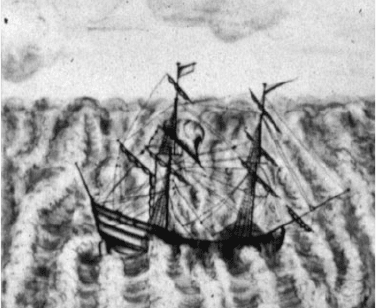
Figure 4.1 The Postillión
de México, dismasted in the
hurricane of January 1771, the
same storm that forced the
Marqués dela Torre en route
to Cuba to return to port.
Source: Ingenios y Muestras,
number 259, Audiencia de Santo
Domingo, Archivo General de
Indias, Seville, Spain.
100
•
the violence done to our interests
to his jurisdiction. Never prone to indecisiveness, Muesas invoked his
emergency authority and permied a registered ship to sail to St.Thomas
and St.Eustatius to nd food. Predictably, the Asiento’s factor, Joaquín
Pover, lodged several protests against the governor’s actions, to no avail.39
The arrival of the Spanish ship did not escape the notice of watchful eyes
in St.Eustatius, and local factors reported to their suppliers in Philadel-
phia that the Spanish had come and purchased all of the available our on
the island.40
The drought lingered into 1772. Beginning in January and continuing
for the rst six months of the year, royal ocials in Santiago de Cuba took
drastic measures to provide water to the main fortress that guarded the
port.41 In Havana, dela Torre and the chief naval ocer in charge of the
port, Juan Bautista Bonet, debated what to do about the diminishing sup-
plies for the troops and naval forces.42 In desperation, they requested that
Louisiana send some of the our that it had obtained from the Americans,
and Unzaga complied by sending one boatload of the valuable commod-
ity to Havana. Unfortunately, the military men failed to consult with Félix
Reisch, the Asiento’s factor, so when Reisch complained, the intendant
in Cuba had no choice but to conscate the vessel and its cargo.43 Their
actions, of course, gave the monopoly justication to renew its barrage of
complaints about the Caribbean governors. In one particularly acerbic let-
ter, the Asiento’s directors railed against Muesas’s actions in Puerto Rico
the previous year. They complained that the governor had no authority
to import 6,000 barrels of foreign our onto the island and complained of
the “violence” that had been done to their interests.44
Yet the perceived violence done by Puerto Rico’s governor would pale
in comparison to the real violence in store for the Caribbean populations
during the extraordinary and destructive hurricane season of 1772.45 That
summer marked a turning point at which metropolitan and local ocials
were forced to invoke emergency measures that would prove to be a per-
manent arrangement. Problems started in June, when a registered packet-
boat on its way to Puerto Rico, the Amable, was blown o course by a storm
at sea and ultimately found safe harbor in Santiago de Cuba.46 A second
hurricane developed in the Lesser Antilles in mid-July and ran westward
along the north coast of Puerto Rico before turning northward into the
Atlantic.47 At the beginning of August, a third hurricane developed in the
Caribbean and moved westward along the south coast of Hispaniola.48
On 4–5 August, it struck Santiago de Cuba and Bayamo and continued
the violence done to our interests
•
101
directly across the island, hiing Havana and the western provinces on
6–7 August.49 Later that month, a fourth major system began in the outer
islands, passed over the south coasts of Puerto Rico and Hispaniola, and
wobbled on a west-southwest track.50 Over water it gained strength, but
it passed between the north coast of Jamaica and the south coast of Cuba.
Protected by mountains, Santiago de Cuba and Bayamo were spared a di-
rect hit, but more rain fell on the eastern region on 31 August. Continuing
westward, the hurricane made landfall on the Yucatán peninsula of Mex-
ico on 1 September.51 Aer causing considerable damage, it exited into the
Gulf of Mexico, regained strength, turned northward, and came ashore
once again between Mobile and New Orleans on 2–3 September.52 Simul-
taneously, the outer islands of the Caribbean became the victims of a large
and powerful hurricane, the h of the season, that caused catastrophic
damage in the Virgin Islands, St.Eustatius, Dominica, and Antigua.53 This
storm devastated an already-weakened Puerto Rico and became the nal
straw that compelled ocials to abandon any semblance of compliance
and to request emergency rations directly from Philadelphia.54 A few days
later, the hurricane compounded its destruction by dumping copious
amounts of rainfall on the north coast of Cuba before turning northward
and causing additional damage on the outer banks of North Carolina.55
By early September, the magnitude of the catastrophe that engulfed the
Caribbean basin was such that no mitigation policy— however enlight-
ened— could provide a remedy.56 Aer the rst storm, the governor of
Santiago de Cuba reported that the hurricane had destroyed the plantains,
rice, corn, and yuca. By the end of the month, aer the eects of the sec-
ond storm, he was pleading with the captain general to send help quickly,
as all of the crops in his jurisdiction were totally ruined.57 Similar reports
came from other towns and villages in eastern Cuba such as Puerto Prín-
cipe and Baracoa.58 The town of Santa Clara suspended the sale of provi-
sions to other areas because the hurricane in late August had ravaged the
countryside in its area and destroyed all of the crops.59 Reports from the
heavily populated towns around Havana echoed those from other areas
of the total destruction of the subsistence crops in that area.60 Barely six
months earlier, the captain general and the monopoly’s factor were at log-
gerheads over bringing Louisiana’s our into Havana. The dispute evapo-
rated in the wake of months of continuous rain, and aer the rst series
of hurricanes, Louisiana governor Unzaga managed to put together three
shipments of provisions for Cuba. En route, two of the three ships were
102
•
the violence done to our interests
caught in the late August storm and sank at the mouth of the Mississippi
River, with considerable loss of life and the total loss of the cargo of emer-
gency supplies.61
The destruction in Puerto Rico was also catastrophic. Aer the rst
storm, the governor of Santiago de Cuba sent the ill-fated Amable to
Puerto Rico with supplies, but the packetboat was caught in the second
hurricane and never made it to its destination.62 Continuous bad weather
in San Juan ruined all of the our that awaited distribution to other Carib-
bean cities. In the aermath of the third hurricane, Muesas and the Asien-
to’s factor were in complete agreement that the situation was critical, and
no protest was lodged when several captains were granted permission to
travel throughout the Caribbean to try to purchase provisions. In this mo-
ment of crisis, the Puerto Rican factor told his captains to “make all haste
to any port” to nd food to bring back to alleviate the suering. Pover
advised the men that he had commercial contacts in neighboring islands
such as Santo Domingo, St.Thomas, St.Croix, and St.Eustatius, and even
though he and they were aware of the prohibition on trading with foreign
islands, the situation was so grave that the circumstances warranted his
actions.63 It was not long before one such captain returned with the bad
news that nowhere in the Caribbean was there any food to be found. As
other disappointed captains returned to San Juan harbor, several men re-
ported that the other islands in the Lesser Antilles were all suering as
much, if not more, than Puerto Rico.64 In the free ports, such as St.Croix,
St.Thomas, St.Martins, St.Eustatius, and Dominica, where normally
there were abundant supplies of provisions, the residents were in a state
of shock as they coped with the realization that entire villages had been
swept away.65 A captain of the Spanish eet on his way from LaCoruña
to Puerto Rico reported that as he sailed through the passage between
Virgin Gorda and Anguilla he came across fragments of houses, beams,
fences, broken masts from ships, bodies, and other vestiges of what once
had been a selement on St.Eustatius.66 A young Alexander Hamilton
lived through the “horror and destruction” on St.Croix, and he described
cowering in his house as the storm raged outside.67
By September, the magnitude of the catastrophe, along with the folly of
adhering to existing policy, was apparent. The rst line of defense was to
call upon other towns on each island to aid the stricken communities, but
the futility of that strategy soon became obvious, especially aer the series
of storms in late August. The second line of defense was to call upon other
the violence done to our interests
•
103
areas of the Spanish empire, but no help was forthcoming from the main-
land, as Mexico was struggling with drought in grain-producing areas that
had destroyed the wheat that was destined for the Caribbean.68 Eventu-
ally, the chilling realization set in that even the last line of defense against
starvation, the British islands from which smugglers could normally be
counted upon, could provide no relief, as they, too, struggled to make up
their own losses. The despair was almost palpable in the proclamation
issued by Sir Ralph Payne, governor in chief of the British islands, who
spoke of the “melancholy prospect of an approaching famine” and called
upon fellow citizens to dispatch vessels to the islands with provisions as
rapidly as possible.69 By all accounts, by mid-September, all Caribbean
colonies were sharing in the misery of their neighbors, and no island could
spare its food supplies in order to help another.70
Once the extent of the damage became indisputable, Spanish ocials
rapidly took steps to alleviate the suering in their colonies. Le with no
choice, the authorities in Puerto Rico went outside the Spanish imperial
system and established direct contact with Philadelphia.71 Later, the two
antagonists, Muesas and Pover, would each write a lengthy report justify-
ing their decisions and explaining to their superiors that the successive
hurricanes had destroyed all of the our destined for Puerto Rico and for
distribution to other colonies.72 The news that reached the minister of
the Indies, Julián de Arriaga, from Cuba mirrored the reports from Puerto
Rico.73 By the end of August, dela Torre informed the court in Spain that
“not only were we hit badly, but in all of the Leeward Islands especially in
the foreign colonies, the destruction has been terrible.”74
The unprecedented crisis once again highlighted the problems inher-
ent in the Spanish commercial system. As the drought that was emblem-
atic of the ElNiño sequence spread to Mexico and destroyed that region’s
wheat crop, it became even more obvious that the existing system could
not provision the islands of the Caribbean. Over the winter of 1772–73, the
Ministry of the Indies, inuenced by a steady stream of correspondence
bemoaning the crisis in the Spanish Caribbean, acted to remedy the ter-
rible situation. In an eort to nd out what had gone wrong, the unpopu-
lar Asiento came under sharp scrutiny.75 Forced to defend themselves
in front of the most powerful group of men in the empire, the primary
directors of the company, Francisco de Aguirre and José de Arístegui, pro-
duced a long lament on how the inhabitants of Cuba had goen rich while
the poor company had suered.76 Clearly referring to Willing and Morris