
Johnson Sherry. Climate and Catastrophe in Cuba and the Atlantic World in the Age of Revolution
Подождите немного. Документ загружается.

64
•
it appeared as if the world were ending
ñía was replaced by a new monopoly chartered in Cádiz, the Compañía
Gaditana de Negros. The Compañía Gaditana retained the prerogative to
provide slaves to Spanish America, and so it usually was referred to by its
original name, the Asiento de Negros, or simply the Asiento.18 Allowing
the Asiento to continue its existence was a strategic compromise because
of its ability to fulll the demand for slaves.19 The monopoly’s directors re-
mained directly allied with transatlantic slave traders via factors in Cádiz,
and the Spanish crown chose to rely on it as it had in the past.20 Initially,
the Asiento planned to sail directly to Africa, purchase slaves, and take
them to an entrepôt created in Puerto Rico. The operation in Puerto Rico
served as a quarantine and seasoning facility, and from there the slaves
were distributed throughout the Caribbean basin. Almost immediately,
this plan proved to be unworkable, and just one year aer its creation, the
Asiento turned to British slavers in Jamaica, Barbados, and other British
colonies.21
Given the recent trends in scholarship and the unfortunate name re-
tained by the new company, studies have focused on the Asiento’s slaving
activities, while its importance in providing provisions to the Caribbean
has been downplayed.22 The Asiento is invariably seen as a negative—
almost medieval— inuence, but fundamentally it was a broker between
foreign providers and Hispanic consumers for the two items that the Span-
ish empire could not supply. By granting the monopoly permission to deal
with foreigners, the crown intended to remove foreign ships from Cuba’s
ports, which would reduce smuggling and minimize the opportunity to
engage in espionage. The Asiento retained the privilege to import our
along with the slaves, theoretically to feed the slaves so as to avoid impact-
ing local food supplies, but the Caribbean governors dispelled that notion
when they complained to the Spanish governing body for the American
colonies, the Ministry of the Indies, that the Asiento was selling the our
to their residents.23 The quantity of our was directly proportional to the
number of slaves, that is, for every slave the Asiento brought in, it was
permied to bring in one barrel of our. Before and aer the decree, the
proportion was routinely violated.24 Yet, then as now, the law of supply
and demand determined whether the commercial enterprise would be a
success, and the reorganized Compañía Gaditana was a resounding fail-
ure. Key to its failure was— in its own estimation— its obligation to im-
port what Cuba did not need— slaves— while it was limited in its ability
to bring in the much-desired our produced in North America.
it appeared as if the world were ending
•
65
Confronting Problems in Cuba
Under these circumstances, the Conde de Ricla came to Cuba with or-
ders to implement reforms. The new governor and the men in his retinue
harbored a great deal of resentment against the British empire in general,
against British merchants who were exploiting Cuba’s riches, and against
Cuban creoles who were accused of collaborating with the enemy.25 From
the moment he arrived in Havana, Ricla was determined to make life as
dicult as possible for the remaining British subjects in the city. Although
the terms of the peace treaty signed in February 1763 promised that Brit-
ish merchants would be allowed to remove their goods, Ricla refused to
let them leave with their merchandise. To no avail, the heads of merchant
houses in London petitioned the British secretary of state, the Earl of
Halifax, who proposed to send several ships in ballast to retrieve their
property.26 By November 1763, all of the British ocials had le the city,
and Albemarle had le for Jamaica, leaving the remaining merchants to
fend for themselves.27
At the same time, the island became more and more desperate for pro-
visions. Just days aer Ricla’s arrival, Lorenzo de Montalvo, now the inten-
dant of the Spanish navy, who had been one of the intermediaries between
the British authorities and the Cuban population, wrote to the Marqués
de Cruillas, the viceroy of Mexico, asking for our, ham, and vegetables,
along with 300,000 pesos.28 A month later, in August 1763, when his rst
request went unanswered, Montalvo repeated the need for our and other
comestibles to provision the increasing number of troops.29 The situation
was equally dicult in Santiago de Cuba, which had not had the benet
of North American our during the occupation. In February 1764, the
new governor of Oriente, Juan Manuel Cagigal, the Marqués de Casa Ca-
gigal and the son of the man who had been captain general in the 1750s,
appealed to the captain general for permission to send a ship to Jamaica
because of a shortage of foodstus in the city of Santiago. In a lengthy
leer to the captain general, Cagigal wrote about the misery and depri-
vation that plagued the eastern end of the island.30 Three months later,
Montalvo’s and Cagigal’s petitions were reinforced by the intendant of Ha-
vana, Altarriba, who also urged that Spanish ships or ships sailing under
Spanish colors be allowed to travel to Jamaica and New York to purchase
provisions on an emergency basis.31 Aer another dire summer, propo-
nents of direct contact with British provisioners received an unexpected
66
•
it appeared as if the world were ending
show of support from a surprising quarter, the administrator of the Real
Compañía, Martin José de Alegría, who had been sent to Havana to report
on the viability of retaining the monopoly in its existing form.32 Alegría
had rendered his conclusion to Ricla and the Council of the Indies: the
company would remain an unprotable venture because of the need to
transport provisions from Spain and the ever-present threat of war that
made such imports prohibitively expensive. His leer reinforced Cagigal’s
argument that Santiago’s captains desperately needed permission to travel
outside of the Spanish system to nd enough provisions for the city’s
population to survive.33
The conict over food for Cuba is characteristic of the multiplicity of
interests that competed for inuence and power on many levels. On an
imperial level, the conict was between Britain and Spain, although at
times France, Denmark, and Holland also could inuence policy. Within
the British empire, a strong antagonism grew between metropolitan o-
cials in London and provisioners in the thirteen colonies, primarily Phila-
delphia. Sorting out the combatants in the Spanish empire is a bit more
complicated. On one hand, rivalries existed between Cuba and Mexico,
in which Cuba was the perennial recipient of the largesse of the mainland.
In return for their obligation to supply the Caribbean, Mexican merchants
demanded exclusivity on many products that they argued should be pro-
vided from within the empire. On the other hand, the monopoly company
in Cádiz set up to bring desirable goods to Cuba countered that since they
were taking the nancial risks, they should be rewarded with preferential
treatment. Within Spain itself, yet another rivalry existed between old fac-
tions in the traditional gateway to the Americas, Cádiz, and newcomers in
the northern cities of Bilbao, ElFerrol, and LaCoruña.34 Finally, all had to
contend with the scal watchdog for each region, the intendant, who was
charged with increasing tax revenues, restricting frivolous spending, and
guarding His Majesty’s nancial interests in every way possible.
Political rivalries within Cuba complicated maers further. The new
administrator of the mail service, Armona, who reported directly to the
minister of the Indies, possessed sweeping powers of his own, including
the power to limit what was carried on vessels contracted to carry cor-
respondence back and forth from Spain. His authority over boats carrying
mail increased the potential for conict with the commander of the naval
forces in port. Yet the most signicant conict on the island was between
old Cuban families who could trace their lineage to the earliest selers of
it appeared as if the world were ending
•
67
the island and newcomers such as Ricla and O’Reilly who came with the
obligation to reform Cuba’s defensive posture within the empire. Almost
immediately a bier personal and professional rivalry grew up between
these two groups, which only deepened in the subsequent decades. Each
faction had its supporters at court, and the fortunes of each rose and fell,
depending upon which faction held power in Spain.35 Under such condi-
tions, reaching a consensus was virtually impossible, and the residents of
all of the islands in the Caribbean were caught in the middle.
While bureaucrats and functionaries argued over how to feed the is-
land, local residents resorted to their time-honored reliance on contra-
band. Not waiting for permission to trade with nearby foreign colonies,
the residents of eastern Cuba took maers into their own hands and set
out in search of food for their communities. During the month of August
1763 alone, two cases of contraband involving creole vessels were sent to
the Council of the Indies for adjudication; in each case, local ships were
caught leaving the island with mules and horses to trade with foreign
colonies for food.36 Another seizure involved the capture of an English
sloop while it was cruising o the island waiting for the coast to be clear.37
Oriente’s residents also sought to secure provisions by smuggling excess
provisions in legally documented cargoes. In July 1764, customs ocers
seized a large quantity of illegal goods on the frigate Nuestra Señora del
Rosario when it sailed into Trinidad from Cartagena de Indias.38 Three
months later, in October 1764, 67 tercios (13,400 pounds) of illegal our
were discovered aboard the packetboat Santisima Trinidad, and royal of-
cials were also successful in preventing a British ship, LaBretagna, from
unloading its illegal cargo in Oriente province.39 The rise in contraband
activity prompted another pessimistic leer from the administrator of
the Asiento in Havana, Alegría, who wrote to the beleaguered governor
in Santiago de Cuba, oering words of condolence but lile hope for im-
provement. According to the Asiento’s own representative, the company’s
prices were exorbitant, and so it would be impossible to contain or elimi-
nate the contraband trade.40
Royal administrators’ aempts to deal with Havana’s food crisis were
undermined by the presence of a handful of British merchants, who re-
mained in the city in spite of the ocials’ eorts to remove them.41 With
hunger widespread, the ingleses were an unwelcome reminder to the au-
thorities and population alike that our and other comestibles could be
obtained in nearby foreign ports if only they could go outside the Spanish
68
•
it appeared as if the world were ending
commercial system. The British merchants, therefore, posed a challenge
to metropolitan bureaucrats, who sought to implement freer trade on
their own terms. Spain faced the dilemma of determining how to prevent
foreign traders from capitalizing on the empire’s enormous purchasing
power while still obtaining what only they could supply, but the govern-
ment did not have a viable solution to the crisis at hand. Aer allowing
the British merchants eighteen months to sele their aairs on the island,
a royal decree ordered them out of Havana in 1765.42 Representatives of
the ten remaining English merchant houses were told to inventory their
remaining stock in preparation for their departure.43 Meanwhile, the men
and their families were held under house arrest.44
Environmental Crisis Returns
While royal administrators grappled with these problems, in 1765 another
ElNiño sequence descended on the Caribbean. The rst area to feel the
eects was Oriente, where drought returned in early 1765. In April, Cagi-
gal wrote a top secret missive to the minister of the Indies, the Marqués
de Grimaldi, reporting that there was a severe food shortage in Santiago
de Cuba, and that even if had been enough food, there was a shortage
of workers for the harvest.45 The island-wide drought also ruined crops
around Havana, forcing Ricla to face the grim reality of the situation.46
Citing dire necessity, he gave his approval for a voyage to New York to
purchase food and other provisions. The contractor, Francisco Salvatore,
proposed to sail his packetboat, LaMaría, to the northern city to purchase
buer, lard, cheese, wine, cider, linseed oil, candle wax, and various medi-
cines. The packetboat never le Havana because Altarriba inexplicably
revoked the concession and the voyage was canceled.47 Shortly thereaer,
Ricla was recalled to Spain, and the inspector of the army, Pascual de Cis-
neros, succeeded him as interim captain general pending the arrival of the
new appointee, Antonio María Bucareli. Cisneros fared lile beer with
the intendant when the two clashed over who should have authority to
oversee the unloading of 691 badly needed barrels of our that arrived on
an English frigate under contract to the Royal Company.48 Four months
later, the administrator of the royal mail system, José Antonio Armona,
joined the ght when he protested the exemption from a tari concession
that was granted to Salvatore for another shipload of provisions that he
had managed to nd for the city.49
it appeared as if the world were ending
•
69
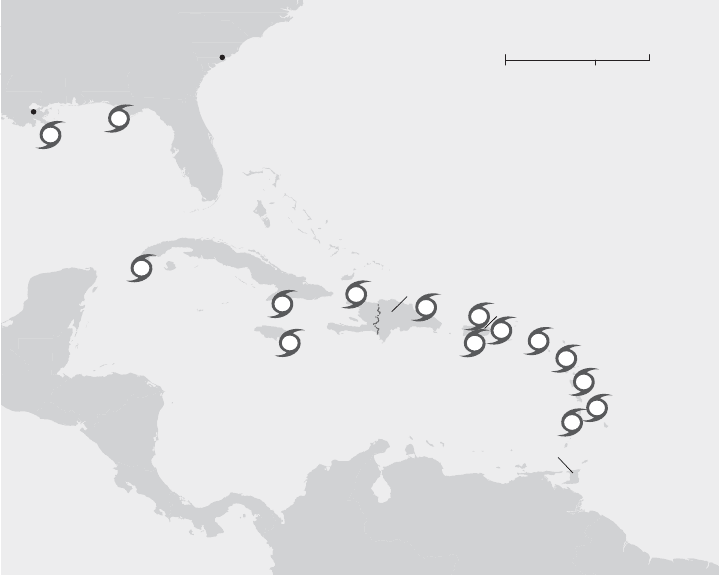
Amid such political and economic chaos, in summer 1766, LaNiña re-
turned to plague the Caribbean basin. Every major area from the Lesser
Antilles to the western Gulf of Mexico suered repeated and severe dam-
age from mid-August onward.50 The heavily populated French island
colonies were particularly hard-hit, but the British, Danish, and Dutch is-
lands also sustained serious damage. Martinique was the rst island to feel
nature’s wrath when it endured an intense early storm on 13–14 August—
440 people died in the storm, 580 people were wounded, and 80 ships
were damaged or destroyed.51 This powerful hurricane went on to strike
Jamaica, where equally devastating consequences were reported.52 A
month later, in September, the northern islands of the Lesser Antilles were
in the line of re when a slow-moving hurricane caused extensive ooding
on Montserrat as it lingered three days over the island. Subsequent storms
later in the month devastated Saint Domingue, Tortuga, St.Christopher,
Map 3.1 Hurricane strikes in the Caribbean basin, from August to October 1766.
Sources: see appendix 2.
Trinidad
Barbados
Cuba
Atlantic Ocean
Caribbean Sea
Charleston
New Orleans
Jamaica
Saint
Domingue
Puerto
Rico
Santo
Domingo
Lesser
Antilles
5
15
4
14
3
11
10
13
9
2
8
7
6
12
1
500 KM0
500 Miles0
70
•
it appeared as if the world were ending
St.Eustatius, and Jamaica.53 Skirting the north coast of Hispaniola, the
September storm made its last landfall near Tortuga, where it destroyed
the salt pans of that island. Finally, on 6–7 October, the southern islands,
which had escaped destruction early in the season, became the victims of
the late-season system.54
The storms that devastated the rest of the Caribbean also caused exten-
sive damage in the Spanish colonies. Puerto Rico was particularly hard-hit
by the August system that ravaged Martinique.55 The slow-moving Sep-
tember hurricane that destroyed Montserrat also ruined the majority of
the subsistence crops in the eastern end of Puerto Rico.56 Barely a month
later, the October storm brought additional destruction; Puerto Rico was
in the path of the deadly system that hit Guadeloupe with a twenty-ve-
foot storm surge.57 This hurricane continued westward, where it came
ashore in eastern Cuba on 10 October, striking the mountains of Oriente
province and inicting signicant damage on the village of Santiago del
Prado.58 Reports from the lieutenant governor, Bartolomé de Morales,
described how the hurricane blew in from the southeast and lingered
over the mountains for twenty-four hours, dumping copious amounts of
rainfall. The mountainous terrain could not absorb the runo, causing the
river to rise out of its banks, sending waves of oodwaters cascading down
the mountainside into populated areas. By some miracle, the raging waters
were diverted into two currents before they reached Santiago del Prado,
thus saving the village from total destruction.59 Yet the problems caused
by the hurricane did not end with the storm’s passage. Two weeks later, a
sergeant of the grenadiers took to his bed with fever. He fought o the dis-
ease and survived, but the population of royal slaves did not fare as well. In
a possible aempt to avoid spreading the fevers, slaves were separated into
groups according to their ages, and out of humanitarian concerns, the old-
est male slaves were exempted from paying religious fees for their burial
in the event that they fell victim to the fevers. As the fever raged through
the town, Morales reported that “removing the cadavers will be dicult,
but [he would be able] to accomplish the task without help.” He closed his
missive to Cagigal with the familiar prayers for the governor’s health and
safety.60
An earthquake had devastated the area just a few months previous,
and as the disasters continued to hit the region, they overwhelmed local
resources. Neighboring towns were ordered to contribute food, but con-
ditions were no beer elsewhere. As late as April of the following year,
it appeared as if the world were ending
•
71
Puerto Príncipe “suered from no small measure of scarcity,” wrote lieu-
tenant governor Juan de Lleonart, but he assured Cagigal that he would
mobilize the residents to begin providing tasajo (dried beef) to send to
Santiago de Cuba.61 Commercial interests were not exempt from the obli-
gation to contribute to the welfare of society, and the Asiento was ordered
to use funds in its coers to aid the victims.62
Although escaping a direct hit, Havana and the western end of the is-
land also endured the eects of poor weather and scarcity, giving the new
captain general, Antonio María Bucareli, his rst experience in coping
with disaster and exercising his authority to deal with an emergency in his
jurisdiction. Just days before receiving news of the tragedy in Oriente, he
had received a copy of a new royal order reiterating the regulations under
which governors could operate in emergency conditions. One of the re-
strictions was that no governor could grant permission to sail to foreign
colonies.63 At the rst reports of misery, Bucareli responded to Cagigal’s
urgent plea for help, promising that as soon as the rains of “this cruel sea-
son” let up, he would send some relief.64 Weeks later, Bucareli informed
Cagigal that he had 201 barrels of our on hand, and that although he
needed at least ve barrels for daily consumption for Havana, he would
send 300 pounds of our on the rst ship.65
Conditions throughout the Spanish Caribbean continued to deterio-
rate when two severe storms struck the western Gulf of Mexico, under-
mining Spanish eorts to bring order to its newly acquired colony, Loui-
siana. The rst storm, in early September, grazed the northern Gulf Coast
and nally made landfall on the Texas coast. It missed the populated areas
along the Mississippi River, but it delayed construction on fortications
planned for the entrance to the river at Balisa.66 The second hurricane, on
22 October, however, did serious damage when ve Spanish convoy ships
laden with the situado (subsidy) were blown o course and sank at the
mouth of Mobile Bay.67
The collateral eects of two hurricanes drained the limited funds in
Louisiana’s treasury and contributed to the political instability that threat-
ened Spanish rule.68 The man chosen as governor of Louisiana, Antonio
de Ulloa, was among the most capable and talented men in Charles III’s
group of military ocers.69 Intelligent, educated, and loyal, and with de-
cades of experience in the Americas, these men were, nonetheless, unpre-
pared to deal with metropolitan intransigence, new geopolitical realities,
and the environmental crisis that they faced. Nowhere did this unfortunate
72
•
it appeared as if the world were ending
combination of circumstances come together in more vivid fashion than
in Louisiana from 1766 through 1768. In December 1766, immediately aer
the hurricanes sank the ships carrying the money to sustain his colony,
Ulloa wrote to Havana pleading for replacement funds. In an eort to re-
lieve the suering of Louisiana’s residents, Ulloa reported that emergency
provisions could be obtained from the British colonies to the north, but
that these purveyors of our and other comestibles demanded payment
in a timely fashion.70 For months thereaer, in January, in February, and
in March 1767, Ulloa’s pleas went unanswered. In February, the governor
authorized Baltazar Toutant Beauregard, the captain of LaCampeleon, to
sail to the French colony, Saint Domingue, with survivors from one of the
shipwrecks. En route, he was charged with stopping in Havana to present
leers to Bucareli requesting immediate relief.71 Hope soared when the
mailboat, the Postillión de Mexico, arrived in Louisiana on 15 March, only
to be dashed once again. The Postillión carried no funds for the struggling
colony, and Ulloa waited another three months, until 60,000 pesos nally
arrived.72
Louisiana was not alone in its distress. By November 1766, most Carib-
bean islands faced immediate starvation because of the destruction of the
food supply on hand. Crops already harvested and in storage were ruined
when roofs gave way under the weight of water and the wind. Crops in
the ground roed in standing water or were washed away. Coastal ood-
ing destroyed salt works that could have been used to preserve what lile
food could be found. The disaster for Martinique and the French colonies
was compounded because France had lost its agricultural colonies, and its
normal supply routes had been disrupted when it ceded Canada to Great
Britain and Louisiana to Spain.73 The French colonies faced not just an
immediate and local crisis of subsistence but also an imperial crisis of sup-
ply and delivery. The situation on Martinique and Montserrat was exacer-
bated because most of the vessels in the ports were destroyed. Martinique
lost eighty vessels in the August storm, the September storm destroyed
every ship in port in Montserrat, and thirteen additional ships were lost at
St.Christopher (St.Kis).74
The situation went from bad to worse. The unusually active hurricane
season of 1766 was accompanied by an epidemic of insurrection that swept
the Caribbean basin.75 One of the earliest uprisings occurred in Savannah
la Mar, Jamaica, in early October when slaves on several plantations went
on a rampage and killed several white selers. Almost simultaneously,
it appeared as if the world were ending
•
73
a series of squalls hit Kingston and damaged many vessels in port. The
unlucky coincidence complicated the post-disaster situation by hamper-
ing the government’s ability to put down the rebellion.76 The relatively
minor uprising in Jamaica paled in comparison to a full-scale rebellion on
Grenada, one of the hardest-hit islands in the October storm. There, in
late December, 600 to 700 escaped slaves established maroon communi-
ties in the mountains from which they raided farms and plantations in the
lowlands.77 In Louisiana, Ulloa faced serious resistance in New Orleans,
where French residents resented the cession of their territory to Spain
and forced him to delay his entry into the city. He and his retinue took
up residence on the barrier island of Balisa, some thirty miles downriver
from New Orleans, while negotiations were conducted with the recalci-
trant French citizens on seling their grievances and surrendering the city
to Spanish rule. In the middle of such uncertainty and discomfort, a small
contingent of soldiers mutinied against the intolerable living conditions
on what amounted to lile more than a sandbar in the middle of the Mis-
sissippi River.78
The timing of all of the revolts throughout the Caribbean basin sug-
gests that they were launched when the conspirators felt that they had
the greatest chance for success. Indeed, such a conclusion conforms to
rebellion theories that gained popularity in the 1980s and early 1990s.79
More important, however, the timing of the rebellions is consistent with a
recent trend in post-disaster theory that demonstrates a strong correlation
between the destabilizing eect of disaster and the propensity for political
unrest.80 In the aermath of a disaster such as a hurricane, all state systems
are strained, and people who see themselves as oppressed tend to take ad-
vantage of a vacuum in authority to change their oppressed status.
It is at this point that the authorities’ behavior at every level from the
metropolis to the individual Caribbean islands becomes signicant. As
could be expected, metropolitan nations sent substantial numbers of
troops to quell the rebellions in their respective colonies. British authori-
ties transferred several army regiments to Jamaica, and in short order local
residents optimistically wrote that the leaders of the insurrection had been
captured and hanged.81 In Grenada, the rebel leaders were hunted down
and executed in particularly gruesome fashion.82 In Louisiana, Ulloa’s
loyal soldiers held rm and thwarted the mutiny of twelve conspira-
tors, who were sent to Havana for two years of hard labor on that city’s
fortications.83