
Johnson Sherry. Climate and Catastrophe in Cuba and the Atlantic World in the Age of Revolution
Подождите немного. Документ загружается.

84
•
it appeared as if the world were ending
ries.148 To begin with, the population outside of Havana was sparse, with
the majority of rural residents clustered in scaered hamlets in the inte-
rior.149 Another factor was population distribution. Although Havana’s
population was substantial and concentrated near the city, regulations
prohibited building within a specied distance, about 4,500 feet or three-
quarters of a mile, from the coast.150 Havana and its barrios outside the
city walls contained more than 40,000 people, yet when the een-foot
storm surge struck the north coast, it did not cause the immense loss of
life of the ash oods of subsequent hurricanes because the population
lived well inland.151 In addition, the fertile boomland of the rivers, which
was vulnerable to ooding, was also o-limits since it was reserved for
tobacco cultivation.152 Finally, the destructive and irreversible process
of deforestation caused by population increase and economic expansion
had not yet begun in earnest.153 The authority to cut lumber rested with
the royal navy, and this exclusive privilege was maintained until 1789.154
With the exception of the hurricane in Oriente in 1766, which struck a
mountainous region that already had runo ooding because of its ter-
rain, the massive mudslides caused by deforestation and subsequent soil
erosion were still twenty-ve years in Cuba’s future. Most casualties from
drowning were reported on the shallow and swampy south coast. When
the storm surge hit Batabanó, Captain Antonio dela Guardia was aboard
his boat in harbor, and he and a sailor from his crew were never seen again
and their bodies were never recovered.155 Later, search parties discovered
six badly decomposed bodies caught in the mangrove roots along the
swampy southern coast, victims who were never identied.156
The majority of the victims died from injuries sustained by ying de-
bris or were caught when the structures in which they had taken shelter
collapsed upon them. Even so, the casualty gures are modest consider-
ing that the storm destroyed over 5,500 houses in Havana province.157 In
the village of Jesús del Monte, where most of the structures were wale
and daub, several residents lost their lives when houses and outbuildings
were torn apart by the wind. Aer visiting all of the farms in his district,
the capitán del partido returned to his own devastated plantation, where
a slave remained in critical condition and a ten-month-old baby had per-
ished.158 On the sitio of widow Antonia de Solis Puñales, a slave died when
he was pinned under a fallen palm tree, and a vagrant was killed by ying
debris.159 Guanabacoa suered ve people killed and forty-ve wounded
as a result of the storm,160 and in the barrios to the west, six were killed,
it appeared as if the world were ending
•
85
including three men and three women.161 One graphic report came from
the administrator of the Jesuits’ property, who told of a pregnant slave,
Catarina Mollombe, who died during the storm. The plantation’s surgeon
managed to save her unborn child, delivered by cesarean section aer her
death.162
Unlike in rural areas, in Havana most houses and other buildings were
constructed of wood or stone, and the city walls oered a degree of protec-
tion from the wind. Nonetheless, many structures, especially the church
towers, sustained considerable damage. The hurricane destroyed the par-
ish church when the bells, clock, and clock tower came crashing through
the roof of the building to the ground.163 Eight more of Havana’s churches
suered damage to a lesser degree, as did the jail, the city council’s build-
ing, and a portion of the city wall.164 Substantial buildings also fared beer
in the barrios outside of the city, where only 43 mortar-and-tile structures
were completely ruined, as compared to 218 wale-and-daub structures.165
Detailed reports from the commanders of the fortications around the
city told a similar tale. Doors were blown in and roofs blew o powder
magazines, exposing the precious gunpowder to the rain. Near the Puerta
dela Tenaza, a portion of the city wall fell to the ground. The oldest for-
tress in the city, LaFuerza, lost all four doors and the bridges that spanned
the moat encircling the building. All of the windows in the lodgings ofthe
regiment of Lisbon were blown in, and walls fell in the apartments of o-
cers Benito Saavedra and Francisco Bello. Even the prición de distinguidos
(the prison for distinguished criminals) was deemed unsafe because of the
loss of several windows; no mention was made as to whether the damage
allowed the oenders to escape.166
The outlying rural areas reported nearly total devastation. Immediately
aer the storm, militia captain José de San Martín rode out to inspect the
damage in the countryside surrounding Guanabacoa and reported that in
his district the parish church, the hospital, two convents, and 1,405 houses
were partially or totally destroyed.167 Simultaneously, his brothers-in-
arms, captains Miguel Peréz Barroso and Francisco Rodríguez and lieu-
tenants Tomás Alvarez, Antonio Montiel, and Manuel de Beralles, took
to their horses to search the countryside for victims. Juan Carrasco le
his position as supervisor of a sugar mill to help in the search and rescue
eorts, and even aging Andrés Pulgarón of the disbanded militia company
joined in the eorts.168 Three of the villa’s clergymen submied a poi-
gnant report to the Council of the Indies. They wrote: “Not only were
86
•
it appeared as if the world were ending
houses and crops ruined but the secondary consequences were that many
families were now homeless. Many more were sick and wounded from the
wounds and blows that they had received during the hurricane, and [this
misery] was followed by a shortage of food because the rain has continued
to fall and nobody could go out to the elds to see if anything could be
salvaged.”169
Reports were equally dismal from other towns and villages, especially
to the east and south of Havana. The parish priest of San Miguel del Pad-
ron spoke of the “horrendo temporal” (horric storm) that destroyed the
parish church, damaged the militia barracks and over 160 estancias in the
district, and forced the villagers to construct makeshi shacks (chozas) to
protect from the elements.170 The captain of Regla, Francisco Blandino,
brought the victims into his own house, which had come through the
storm unscathed.171 A long account wrien by the overseer of the former
Jesuit plantation, Río Blanco, located to the east of Havana, exemplied
some of the information that ocials desired about the storm’s trajectory.
The hurricane began at one o’clock in the aernoon and raged until seven
o’clock at night. Aer enduring six hours of continuous wind, rain, and
ying debris, “it appeared as if the world were ending.”172
Once survivors were rescued, government, ecclesiastical, and private
mitigation eorts swung into full gear. The responsibility for dealing with
the impending famine fell upon the local constables, and their rst task was
to evaluate how much of the crop was destroyed. The most important food
of the common people was the plantain, el pan de los pobres, the poor man’s
bread, and all accounts indicated that the crop was totally destroyed.173 In
addition, major subsistence crops such as yuca, corn, and rice were ruined
by ooding, even in areas that did not sustain a direct hit, and crops that
had been harvested were ruined when torrential rains breached even the
most secure roofs.174 Another important commodity was salt— vital for
food preservation. Most salt pans were located in coastal areas or on adja-
cent shallow islands, and torrential rains and coastal ooding ruined both
the source of supply and the harvested salt that awaited transportation to
the cities.175 Livestock were particularly vulnerable to ooding and ying
debris, and the carcasses of dead animals posed a signicant health hazard
in the hurricane’s aermath. In almost every storm, regardless of intensity,
collateral damage was done to the tobacco crop, which provided income
for most of Cuba’s farmers.176
Since reports from every village reiterated the news of total devasta-
it appeared as if the world were ending
•
87
tion, as soon as the storm had passed, Bucareli immediately sent any ships
that were still seaworthy to Veracruz, Campeche, and Cumaná to secure
provisions and meat.177 Notices also went out to governors of the areas of
Cuba that were not aected to contribute a portion of their normal crop
to help the recovery.178 Compliance was not voluntary, and persons who
refused were punished through nes and sentences of forced labor.179
One of the traditional enclaves of resistance was the Isle of Pines o the
southern coast, a virtual efdom controlled by the Duarte family since
the earliest years of selement. Bucareli was not pleased when provisions
were slow in coming from the ranches on the small island. A scathing
leer from the captain general to the island’s constable, Nicolás Duarte,
prompted the man to action, and in short order boatloads of salted meat
arrived in Batabanó for shipment to Havana.180 Another cause for censure
was speculation and/or price gouging. Immediately aer the storm had
passed, Bucareli declared that prices would be held at the same levels as
before the hurricane.181
Soon supplies began to arrive from unaected parts of the island.182 By
mid-November, the rst of such shipments arrived from the village of Al-
varez, accompanied by a note from the district’s captain, Rosendo López
Silvero, who reported that the hurricane was not as damaging in his district
and so his residents had banded together to send what foodstu they had
to Havana.183 Food was also sent from the eastern end of the island, and
salt came from the salt pans of New Granada (present-day Venezuela).184
Treasury ocials diverted provisions intended for the garrison to provide
for the slaves on the Jesuit plantations.185 In the neighborhoods surround-
ing the city, militia members, who usually were prohibited from engaging
in commercial activity, were allowed to sell plantains (at pre-storm prices)
to the hungry people.186 Palm thatch for roofs was oen in short supply
aer the storm because the high winds had stripped the palm trees bare.
To remedy the problem of providing shelter for thousands of homeless
victims, hamlets to the west of Havana that had escaped the brunt of the
storm provided the thatch for rebuilding.187 As the recovery continued,
the question of how to pay for the repairs was raised. The captain gen-
eral decreed a tax of four pesos per caballería (33 acres) of land and three
per house, which was divided equally among the residents. Ecclesiastical
properties and members of the militia and regular forces were exempt be-
cause they were already serving in the recovery eorts.188
The obvious gravity of the situation would have permied the captain
88
•
it appeared as if the world were ending
general to implement emergency measures, but the cautious bureaucrat
stopped short of opening the island to foreign trade, at least ocially.
But for some areas, such as the remote selements on the south coast of
the island where Havana’s ability to enforce existing laws was tenuous at
best, emergency supplies arrived through networks created by illicit com-
merce. As in the past, when disaster struck, opportunists from neighbor-
ing areas rushed into the aected areas with provisions for the starving
victims. Just days aer the storm, a military patrol along Cuba’s south
coast came across a boatload of Jamaican smugglers providing “emergency
foodstus” to the Spanish residents in the selements along the San Juan
River. When questioned, the smugglers admied that they had come be-
cause they had heard of the suering and starvation due to Cuba’s crops
being ruined, and it appears that they were allowed to leave unmolested,
although empty-handed.189 Smuggler Carlos Yons was not as fortunate.
He was caught red-handed when his small boat was shipwrecked near
the San Juan River, with ve “stolen” male slaves and one female slave on
board.190 Another boat discovered in the bay of Jagua was undoubtedly
engaged in illicit commerce with local residents, but it managed to escape
from the military patrol.191 Yet government permissiveness only went so
far. One Mr. Cabot, the captain of a French merchant ship, sailed into the
port of St.Marys on the north coast, having lost his mainmast and all of
his provisions. He requested safe harbor in order to repair his damaged
boat, but he came to the aention of the authorities because he requested
permission to pay for the repairs through the sale of 800 pieces of china
he carried as part of his cargo. His request was denied because he had a
previous charge of smuggling under similar circumstances pending before
the judicial system.192
The ensuing crisis paralyzed the western end of the island for weeks,
and the widespread reports of misery and destruction were also accom-
panied by disturbing notices of “disorders.” As had happened on other
Caribbean islands aer the hurricanes of 1766, slaves, forced laborers, and
military deserters took advantage of the post-storm confusion and ed.
One of the most vulnerable plantations was Río Blanco, which had been
conscated from the Jesuits.193 Bucareli’s decisive leadership was respon-
sible for averting a potential revolt on the Jesuit plantation. Immediately
following the storm, several slaves ed into the woods, and the captain
general sent out parties of soldiers to capture the fugitives.194 Smugglers
provided an escape route o the island. As for Carlos Yons, there is no way
it appeared as if the world were ending
•
89
to determine whether the slaves he had on board when apprehended were
payment for foodstu or escapees seeking their freedom. The village of
Jagua on the south coast, hard-hit by the storm, provided an ideal escape
route for four military deserters who ed to Jamaica aboard an English
ship. The number of negros y guachinangos fugitivos was also a concern for
Jagua’s captain, Andrés Brito Betancourt.195 Some fugitives made their
way to the barrios outside of Havana where capitanes del partido noted
with anger the number of “vagabonds who have infested our village.”196
Like his counterparts, the captain of San Miguel del Padrón took preven-
tative measures and sent militia members out on patrol to “prevent any
disorders” that might erupt in the post-storm confusion.197
Within a few weeks, western Cuba was well on the way to recovering
from the hurricane of Santa Teresa, but the event would linger in the
memories of countless survivors. Through decisive leadership, Bucareli
engendered a spirit of cooperation and voluntarism throughout the island.
The southern coast near Batabanó was greatly aected, but by 9 Novem-
ber, Juan José Galán proudly reported that the workers had managed to
construct a provisional warehouse and that they had saved 2,000 tercios of
tobacco.198 The eastern province of the island had been especially gener-
ous in providing meat and other provisions, and by December Bucareli
wrote to the captain of Cuatro Villas (present-day Las Villas), Jose Anto-
nio de Azorena: “Everything has been done to my satisfaction.”199
Largely because of the decisions made by Bucareli, the mitigation ef-
forts aer the hurricane of 1768 are almost a textbook model of the way
to respond to a potential catastrophe. In the storm’s aermath, several re-
ports were sent back to Spain to be examined and debated by the Council
of the Indies and Charles III. In every instance, Bucareli’s peers— even his
rivals— were eusive in their praise of his conduct during the crisis. The
head of the royal navy, José Antonio dela Colina, referred to Bucareli as
“our beloved governor,” who while all of the troops and civilians were in a
state of consternation, exhorted those in positions of authority to go out
on patrol to preserve the public order. It was Colina who reported to Ma-
drid that Bucareli and the ecclesiastics had provided for the victims from
their own funds.200 The administrator of the mail system, José Antonio
Armona, oered an even-more-precise description of the captain general’s
leadership. As the fury of the hurricane waned, Bucareli paced impatiently
at the portal of his house in order to be able to act immediately once the
danger had passed.201 Yet the most extraordinary expression of apprecia-
90
•
it appeared as if the world were ending
tion was a sixty-four-stanza poem dedicated to the captain general and
his eorts to bring recovery to Havana as “a magnicent and excellent
leader.”202 In December 1768, the captain general received the approval of
the minister of the Indies, Julián de Arriaga, who praised the governor’s
eorts in coping with the disaster. In short order, Bucareli would receive
an even-greater recognition from Charles III. In 1770, he was awarded the
most coveted position in all of Spanish America, that of viceroy of Mexico.
Just as it seemed that nothing could destroy the feeling of accomplish-
ment, in December 1768, a French merchant frigate sailed into Havana bay
carrying unexpected visitors and unwelcome news: aboard was the gover-
nor of Louisiana, Ulloa, his retinue, and several Spanish soldiers who had
been forced out of Louisiana by a mob of rebellious French inhabitants on
29 October. A stunned Armona conveyed the news to the Council of the
Indies203— the disaster that Ulloa had predicted just months previous had
come to pass. Now royal ocials in Cuba had to deal with the recovery ef-
forts on the island and the rebellion in Louisiana. Ulloa’s untimely arrival
compounded the problems because the majority of ocers and soldiers
were occupied with the recovery eorts. Neither Ulloa nor Bucareli could
respond to the rebellion, and the insurrectionists controlled Louisiana
over the winter of 1768–69.204 The following spring, Spain’s most cel-
ebrated general, Alejandro O’Reilly, whose authoritarian demeanor was
well known, returned to Cuba.205 He stopped in Havana long enough to
put together a military expedition of more than 2,000 soldiers to crush the
rebellion in New Orleans.206
The New Orleans rebellion is universally and invariably analyzed in a
political context and as a purely local event. Revisited in the context of
other rebellions and acts of resistance, the rebellion follows the paern
of countless cases of post-disaster insurrection.207 The aermath of the
Louisiana revolt also conforms to the classic metropolitan response. In
the case of outright rebellion, particularly slave rebellion, the response is
swi, unequivocal, and brutal. Spanish reaction to the rebellion is notable
for its brutality, yet in spite of his heavy-handed methods in dealing with
the local population, O’Reilly faced the same problems as Ulloa, with one
noteworthy exception: his authority was reinforced by more than 2,300
Spanish soldiers. On the surface, at least, public order was maintained,
especially aer O’Reilly executed the ringleaders of the rebellion.
Yet the fundamental problems of Louisiana did not disappear with the
arrival of a large army of occupation, and indeed, the situation worsened.
it appeared as if the world were ending
•
91
Over the winter of 1769–70, severe food shortages in New Orleans com-
pelled O’Reilly to grant permission to merchants, mostly foreign ones, to
import our and other provisions.208 During that winter, Louisiana spent
70,000 pesos, nearly half of its 160,000 peso budget, for our purchased
from the “English.”209 The ood of our into New Orleans continued
unabated, and by the early 1770s, royal ocials were not even making an
aempt to control the ow.210 Henceforth, Louisiana’s our trade would
be dominated by North Americans and, to the Asiento’s dismay, would set
an example for the remainder of the Spanish islands in the Caribbean.

chapter four
The Violence Done to Our Interests
A
t 9:00 a.m. on 10 October 1773, during the height of
hurricane season, a meeting was convened onboard the
agata de correos (mail frigate) ElQuirós. The participants
contrasted sharply, from the grizzled, veteran captains of the coastal and
international trade, to the taered group of harbor pilots that guided ships
into port, to the elegant, well-heeled appearance of the captain general,
the Marqués dela Torre, and the chief administrator of the mail system,
José Antonio de Armona. Despite their dierences in status, the men had
come together on the orders of the monarch with one specic purpose:
to determine whether two of His Majesty’s ships, the Grimaldi and the
Quirós, should be allowed to leave port and sail through the dangerous
Old Bahama Channel to Spain. From the captain’s quarters, the group
could look north past the formidable fortress of Havana, ElMorro, to the
straits of Florida. What the men observed was cause for alarm. Swirling
winds caused the ag above the fortress to whip wildly. Darkening storm
clouds were gathering on the horizon, which lowered ominously as they
watched. As the experienced captains debated the visible weather signs,
other members of the meeting warned of the danger inherent in the con-
junction of the moon and the autumnal equinox. Throughout the Ameri-
cas, a full harvest moon in the month of October was universally known
to mariners as the most dangerous time of the year.1 The men were re-
minded of tragedies of the recent past: the loss of the packetboat Colón in
November 1771 and the horric storm of Santa Teresa on 15 October 1768,
which “still made people tremble.”2 Finally, the junta agreed that the mail
ships should remain in port a few days more. Satised that their work was
done, the group adjourned with the knowledge that their decision prob-
ably saved the ships and their crews from the fate of other mariners who
had braved the Atlantic during the autumnal equinox.3
the violence done to our interests
•
93
The caution evident in their deliberations came about because of the
events of the recent past. For ve years, the residents of Spain’s Caribbean
islands had suered through a period of environmental crisis. Following
the disaster of 1768 and clearly evident by 1770, the signature hazards of the
ElNiño/LaNiña cycle were widespread throughout the Caribbean basin.
Severe drought initially disrupted the smooth functioning of the imperial
commercial system, especially in Mexico and other areas of the mainland.
Four years previous, the hurricane of Santa Teresa had initiated changes
in the way the crown responded to disaster. That experience would prove
invaluable, and by the 1770s, royal ocials had experience, legislation, and
precedent at their disposal to face future catastrophes. Yet no one could
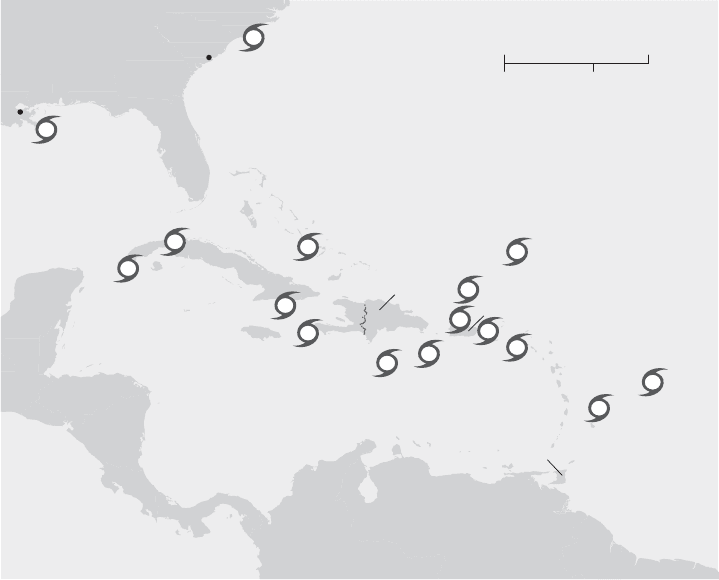
have foreseen the extraordinary hurricane season of 1772, when sixteen
landfalls in the Caribbean and Gulf Coast brought destruction on an un-
Map 4 1 Hurricane strikes in the Caribbean basin, from June to September 1772.
Sources: see appendix 2.
Trinidad
Barbados
Cuba
Charleston
New Orleans
Atlantic Ocean
Caribbean Sea
Jamaica
Saint
Domingue
Puerto
Rico
Santo
Domingo
Lesser
Antilles
5
15
4
14
3
11
10
13
9
2
8
7
6
12
1
16
500 KM0
500 Miles0