
Kallen A. Understanding Biostatistics
Подождите немного. Документ загружается.


38 OBSERVATIONAL STUDIES AND THE NEED FOR CLINICAL TRIALS
Box 2.5 Odds ratios and sampling methods
Let O(A) = P(A)/P(A
c
) be the odds for a property A and let S denote a subpopula-
tion from which we sample patients. Then we have (appealing to Bayes’ theorem; see
Box 4.2) that
O(A|S) =
P(A|S)
P(A
c
|S)
=
P(S|A)P (A)
P(S|A
c
)P(A
c
)
= RO(A),
where R is the relative risk of being sampled for subjects with the event com-
pared to those without it. If we apply this to the exposed subgroup we find that
O(A|E, S) = R(E)O(A|E), where R(E) is the relative risk of being sampled in the
exposed subpopulation. The odds ratio for sampled subjects is therefore proportional
to the overall odds ratio, with the proportionality constant being R(E)/R(E
c
). If the
relative probability of being sampled is independent of whether the subject is exposed
or not, we therefore get the same odds ratio in the subpopulation as in the whole pop-
ulation. This explains why it does not matter if we have a cohort or case–control study
when we compute the odds ratio.
If we have different degrees of exposure, which we denote by x, we can assume a
relationship of the form
O(A|x) = e
α+xβ
,
where the parameter β is of primary interest. This defines the so-called logistic model,
and we see that we can apply this not only to a cohort study, but also to a case–control
study, as long as we are only interested in β. This is because α will be replaced by
α + ln(R) in the case–control study. In the case of the case–control study this means
that the intercept is a pure nuisance parameter, and it can be eliminated by performing
a conditional logistic regression instead (for more on this, see Section 9.4).
We now return to our original question: is the relative risk
RR = P(C |E)/P(C |E
c
)
greater than one? This can be estimated both in the cross-sectional study and in the cohort
study, but it cannot be estimated in the case–control study. So how can we use that study
design to answer the question?
The answer is based on the observation that the odds p/(1 − p) is an increasing function
of the probability p, which implies that RR is greater than one precisely when the odds ratio
OR =
P(C |E)/P(C
c
|E)
P(C |E
c
)/P(C
c
|E
c
)
is greater than one. By a stroke of luck (or, rather, by Bayes’ theorem) this number can also
be written
OR =
P(E |C)/P(E
c
|C)
P(E |C
c
)/P(E
c
|C
c
)
,
which is a set of probabilities that can be measured in a case–control study.
THE EXPERIMENTAL STUDY 39
This observation highlights a symmetry between the cohort and the case–control study:
in the case–control study we fix the outcome (C) and can consider many types of exposures,
whereas in the cohort study we fix exposure (E) but can consider many types of outcomes.
Loosely expressed, by switching C and E we go from one type of study to the other. This
means that case–control studies are optimal for detecting potential risk factors for a particular
outcome, such as a specific disease, because we can study many potential risk factors. In
order to further understand other consequences of such an identified exposure, a cohort study
is useful, in which we study multiple outcomes of the exposure. If we can even perform a
randomized cohort study, this can be used to actually prove the cause–effect relationship in
the sense we have discussed above.
Sometimes an odds ratio may be directly interpreted as a relative risk in an epidemiological
context. In an observational study the proportions we discuss are often, but not always, the
result of observing a population for a period of time in order to see if a particular event occurs.
If individuals in the population turn into cases with a constant intensity, the prevalence odds
in steady state equals the disease incidence multiplied by the disease duration. This will be
further addressed in the final section of this chapter. If we have two groups, exposed and non-
exposed, and we assume that the disease duration is unaffected by the exposure, this means
that the prevalence odds ratio really is the ratio of the intensities of case generation in the two
groups. Note the basic assumptions here: we are in steady state and the disease duration is
unaffected by the exposure.
2.4 The experimental study
An experimental study in humans is usually referred to as a clinical trial and is a special
case of the prospective cohort study, in which we can decide on who is exposed and
who is not. It often refers to some kind of intervention, which may be a drug treatment,
but may also be something else, including a prevention strategy, a diagnostic test or a
screening program. According to most medical historians, one of the first studies of this
type was performed when James Lind decided that the treatment for scurvy on long sea
voyages should be oranges and lemons (see Box 2.6). The ability to decide who goes into
which group makes a huge difference, since we can then devise methods that guarantee
that potential confounders, both known and unknown, get, on average, evenly distributed
between the groups. However, not all exposures can be analyzed in this way. It is, for
example, usually not considered ethical to study the effects of harmful exposures in
experimental studies.
The method that is used to guarantee group comparability is randomization. This means
that we apply some kind of random mechanism when we allocate individual subjects to the
groups. The main advantage with this is that even though imbalance in confounders may still
prevail in the individual study, the statistical machinery allows us to describe what we actually
learn. We will have more to say about randomization in the next chapter.
Parallel group trials are experimental counterparts of observational cohort studies. There
is also a counterpart to the case–control study, with what may be called the case-crossover
study in between. In such a study we select cases, but instead of selecting a matching set
of controls we use as control material historical data on the selected cases, obtained prior to
the time of exposure. The advantage with this design is that it eliminates some potential
confounders, such as sex, but age and anything that goes with it will by necessity be a

40 OBSERVATIONAL STUDIES AND THE NEED FOR CLINICAL TRIALS
Box 2.6 James Lind and the remedy for scurvy
The invention of the modern clinical trial is often attributed to the Scottish doctor James
Lind and his investigation into different treatments for scurvy. Scurvy is a condition
that we now know is due to vitamin C deficiency and was in those times one of the
major killers in the high seas navies. Symptoms start with swollen gums and tooth loss,
followed by an inability to work and finally, and slowly, death. When Lind joined the
Navy as a surgeon’s mate in the mid eighteenth century there was no accepted (and
working) treatment available. Here is a summary of what happened next, according to
most contemporary medical historians.
Lind first scanned the existing literature, noting that descriptions of the disease were
either by lay seamen or by doctors who had never been to sea. Based on the observation
that scurvy was rare on land and common among seamen (but not officers) he suspected
something in the diet and decided to do a controlled experiment himself while serving
as ship’s surgeon on HMS Salisbury in May 1747. James Lind assembled 12 of his
patients at similar stages of the illness, accommodated them in the same part of the
ship, and ensured that they had the same basic diet (he controlled for some potential
confounders). He then allocated two sailors to receive each of six treatments that were
in use for scurvy – cider, sulfuric acid, vinegar, seawater, nutmeg, or two oranges and
a lemon. Lind then observed that: ‘The most sudden and visible good effects were
perceived from the use of the oranges and lemons.’ In fact, after six days one of the two
given oranges and lemons was fit for duty, and the other fit enough to nurse the others.
The test was continued for two weeks, but with no improvement in any of the others.
Of the treatments Lind compared, the Royal College of Physicians favored sul-
furic acid while the Admiralty favored vinegar – Lind’s fair test showed that both
these authorities were wrong. In 1753 Lind published a monograph, A Treatise of
the Scurvy, on his results, but it was not until 1795 that the British Navy sup-
plied lemon juice to its ships. By the turn of the century this deadly disease had all
but disappeared.
confounder; whether it matters is another question. The design may not be much used in
epidemiological research, but in an experimental situation it may be possible to go one step
further and repeat the experiment on the subject both with and without the exposure. This may
be possible when the exposure is a drug treatment. By doing the experiment twice, with and
without drug, we can use the subject as his or her own control. However, if we do the experiment
without the drug first, followed by an experiment with the drug, we have a confounding
factor – does the outcome depend on whether it is the first or the second assessment? To
control for this, we also randomize this type of study, but now with respect to the sequence in
which the treatments are taken (exposure followed by no exposure, or no exposure followed
by exposure).
When investigating the efficacy of a drug, the clinical trial with all the characteristics of
randomization, blinding, etc., is superior to the alternative of an observational study from a
scientific point of view. However, that does not mean they are uncontroversial, at least not
when one tries to give them a design that is optimal with respect to their objective. The problem
here is of an ethical nature. Patients expect to get the best treatment from their physicians, but

THE EXPERIMENTAL STUDY 41
Box 2.7 Ethics and The Declaration of Helsinki
The ethics of clinical research is outlined in the Helsinki Declaration, which is morally
– though not legally – binding on physicians. They still have to follow local law, but
will be held to the higher standard.
The events that triggered the Declaration of Helsinki were the inhumane Nazi
experiments on humans carried out before and during the Second World War by
physicians such as Josef Mengele. These experiments were the subject of some of
the postwar Nuremberg trials in 1947, during which it was realized that there was
no generally accepted code of conduct for the ethical aspects of research on humans.
When the verdict on the so-called ‘Doctors Trial’ was given in August 1947, an opinion
on acceptable medical experimentation on human beings was also formulated as the
ten points of the Nuremberg Code.
Based on the Nuremberg Code, the World Medical Association adopted in Helsinki,
Finland, in June 1964 a set of ethical principles for human research which came to be
known as the Declaration of Helsinki. It has since undergone a number of revisions
(six by 2009), as well as a few clarifications, and has grown from 11 to 35 paragraphs.
It defines the ethical principles of human research and has led to the appearance of
ethical review boards that need to approve clinical studies, in addition to the approval
by regulatory health authorities.
Many of the principles in the declaration are uncontroversial, but there is one im-
portant discussion which is of fundamental importance to the design and conduct of
clinical trials. It is a statement that effectively excludes the use of a pure placebo control
in cases where proven therapeutic methods exist. This is highly controversial and has
never been fully accepted by the FDA because it essentially eliminates the possibility of
proving absolute efficacy, as opposed to relative efficacy. This will be further discussed
in Box 3.6.
in a clinical trial you may need to study an inferior treatment (which may be no treatment at
all) in order to show that a new treatment is superior. Instead we may be forced to study the
new drug on top of existing effective treatments. The better the background treatment is in
its efficacy, the harder it is for the new treatment to demonstrate that it is effective, because
there is less room for improvement. We therefore need to study more patients to document
an effect in such a study, compared to one where the patients in the control arm receives no
treatment. To expose any patient at a stage when you do not know if the new drug is at all
useful is an ethical concern in itself, so there is a compromise that needs to be reached here.
Taken to its logical extreme, any new drug could only be studied on top of the best of the
present treatments, which may make it hard to prove beyond reasonable doubt the efficacy of
a new drug in (short-term) trials of reasonable size.
A clinical study is not necessarily of benefit to the patients participating in the study, but
performed with the intention to obtain information that will benefit future patients. For some
diseases, especially chronic disease, this may be the same patient. To what extent the patients
who choose to participate in clinical trials are representative of patients in general is seldom
well understood, which means that inference to the general population is not clear-cut. This
is a discussion we will pick up in the next chapter.
42 OBSERVATIONAL STUDIES AND THE NEED FOR CLINICAL TRIALS
2.5 Population risks and individual risks
Earlier in this chapter we mentioned that there is a difference between an individual response
and the overall response in a group. In this section we will illustrate this with an example in
which the risk depends on a measurable covariate. In so doing we will introduce the distribution
function as a way to describe random data.
Suppose we want to see to what extent a particular event A occurs in a population. The
event can be that a patient responds to a treatment in a clinical trial; in an epidemiological
context it may be that he contracts a particular disease. The parameter p = P(A) is then the
proportion of subjects for which this particular event occurs. If the event is of a negative
nature, p will be referred to as a population risk or group risk. However, this risk must be
carefully distinguished from the individual risk, which is the risk of the event for a particular
individual, given that person’s genes, environment, age, etc. The group risk will be made up of
the individual risks, weighted according to the distribution of the risk factors in the population.
Obviously, this difference between group and individual probability also applies to the case
where the event is positive, like a treatment effect.
We will assume that the strength of the risk factor can be expressed as a real number and
the distribution of these values by a function, the cumulative distribution function (CDF),
which is defined as
F (x) = the fraction of values that are at most x.
An entity X that is described by a CDF in this way is called a stochastic variable, a term that
is sometimes helpful, less often necessary. The CDF is the function F (x) = P(X ≤ x) and by
definition F (x) is an increasing function which starts at the value zero and ends at the value
one (i.e., F (−∞) = 0 and F (∞) = 1). The CDF plays a prominent role in statistics.
We will discuss in some detail an example in which the event A is that a newborn child has
Down’s syndrome and the risk factor X is the age of the mother. The individual risk (having a
child with Down’s syndrome) will then be a function of the mother’s age, and the group risk,
the proportion of babies with Down’s syndrome, will be determined from the age distribution
of pregnant mothers. Returning to generalities, we let
1. p(x) = P(A|X = x) denote the probability of the outcome A for an individual for
whom the risk factor takes the value x,
2. F (x) denote the CDF for the risk factor in the population.
Note that p(
x) is also a group average – it is the average of all individuals in the population
for whom the value of X is x. In that sense we never come down to pure individual risks, only
an assessment of individual risks based on group data. In the total population, the probability
of the outcome A is the weighted sum of individual risks:
P(A) =
∞
−∞
p(x)dF (x).
This is the probability that a randomly sampled individual from the population will have the
outcome A. (For a discussion on the integral notation, see Box 4.8.)
If we look at another population, for which the risk factor is distributed according to a
different CDF, we will have the same individual risks, but a different group risk. The group
risk may well differ between two studies, if the study populations differ in their distribution of
POPULATION RISKS AND INDIVIDUAL RISKS 43
risk factors. Similarly, the degree to which patients respond to a particular treatment may differ
considerably between two studies if the patients in the studies have different propensity to
respond, depending on disease severity, concomitant medication, etc. This also means that in
order to generalize a treatment, or risk, estimate, from a particular study to a wider population,
the population that was studied must be representative of that wider population.
Example 2.2 The risk of a mother aged 35 years or older having a child with Down’s
syndrome is many times greater than for a mother in her twenties. The reason may be that the
risk that an egg contains the chromosomal abberation that causes Down’s syndrome depends
on how old the egg is (they are made before the mother’s birth). Despite this, it is often said
that most children with Down’s syndrome are born to younger mothers. Let us see why (and
whether this is true).
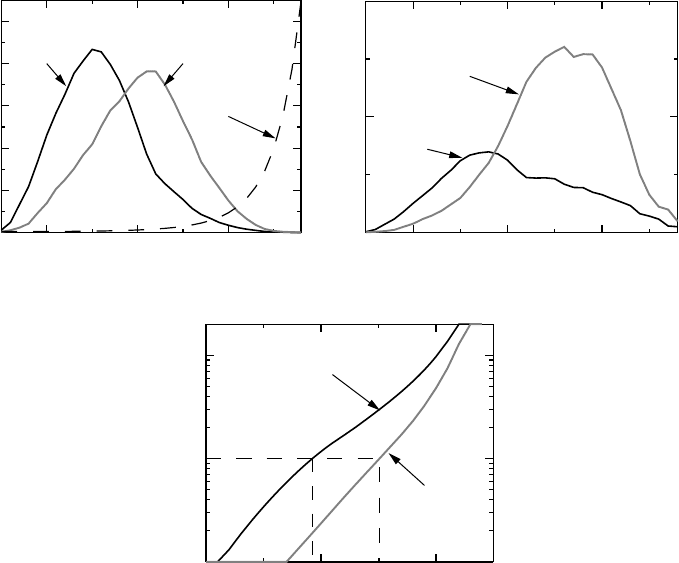
The risk is described by a function p(x) which is shown as the dashed curve in Figure 2.2a.
Also shown in this graph are the probability densities p
Y
(x) by mother’s age in Sweden in
0
2
4
6
8
10
%
403020
Age of Mother
20071973
Risk for Mb Down
(a)
0
1
2
P (MbDown and age = x)(%)
403020
Age of Mother
1973
2007
(b)
10
1
10
0
10
–1
P (age ≤ x | D) / P (age ≥ x | D)
403020
Age of Mother
1973
2007
(c)
Figure 2.2 Do younger mothers give birth to most children with Down’s syndrome? (a)
shows the distribution of the age of mothers together with the age-dependency of the risk that
the child is born with Down’s syndrome, (b) shows the age distribution × risk and (c) shows
the odds for a younger mother (with varying cut-offs defining what ‘young’ means), given
that the child was born with Down’s syndrome. Further details are given in Example 2.2.
44 OBSERVATIONAL STUDIES AND THE NEED FOR CLINICAL TRIALS
two different years, Y = 1973 and 2007. Note that these densities are quite different; the one
for 2007 lies further to the right than that of 1973; women tend to get pregnant later today
than they did back then.
The graph in Figure 2.2b shows, for a range of ages, the probability that a randomly
sampled individual is both age x and gives birth to a child with Down’s syndrome, which is
the function q
Y
(x) = p
Y
(x)p(x). This is not a conditional probability, it is the probability that
both criteria are fulfilled. These curves have a maximum, because older mothers are so few
that, despite their increased risk, they do not provide many cases. By summing q
Y
(x) over
ages x ≥ a, we can compute the probabilities that a pregnancy provides a child with Down’s
syndrome with a mother of an age greater than a. Dividing each of these numbers with
the corresponding proportion of pregnancies with Down’s syndrome, we get the conditional
probability that the mother is older than a, given that the child was born with Down’s syndrome.
The odds of these probabilities are given in Figure 2.2c. We see that in 1973 the ratio is one
when the mothers age is 29.2 years, so if we make the cut-off at an age above this, we will
find that more children with Down’s syndrome are born by mothers younger than this age
than by those that are older. For the year 2003 we find that the cut-off is substantially greater,
at 35.1 years.
In summary, in 1973, when mothers were younger, there were more children born with
Down’s syndrome to mothers aged below 30 than above. This is typically what is meant
by younger mothers. Their numbers compensated for the highly increased risk for the older
mothers. In 2007 the age distribution of mothers has its mode (maximum) above 30 and
the statement that younger mothers give birth to most children with Down’s syndrome is no
longer true.
As a final observation on this subject, we observe that the predicted number of children
with Down’s syndrome is larger than the number actually born. This is because older pregnant
women often undergo amniocentesis to determine whether the child has the chromosome
abnormality, based on which they may decide to have an abortion.
2.6 Confounders, Simpson’s paradox and stratification
We noted earlier that when we investigate an exposure–effect relationship in an observational
study, the identification of confounders is very important. However, when we adjust the
analysis for such confounders, seemingly odd phenomena may occur. One extreme case,
Simpson’s paradox, relates to situations where the conditional results are the opposite of the
overall result.
As an example we consider a medical study which compares the success rates of
two treatments for kidney stones. It was a comparison of two surgical methods used
during two different time periods: one was open surgery (denoted A below) for the
period 1972–80, for which there was an overall success rate of 78% (273/350); the
other was a less invasive method called percutaneous nephrolithotomy (B) used during
the period 1980–85, which had a success rate of 83% (289/350). This corresponds to
an odds ratio of 0.75 for A versus B, which seems to indicate that B should be the
favored treatment.
However, when the data are split up according to stone size, dichotomized to small stones
having a diameter less than 2 cm and large stones with a diameter larger than 2 cm, a different
picture appears:
CONFOUNDERS, SIMPSON’S PARADOX AND STRATIFICATION 45
Box 2.8 Simpson’s paradox described geometrically
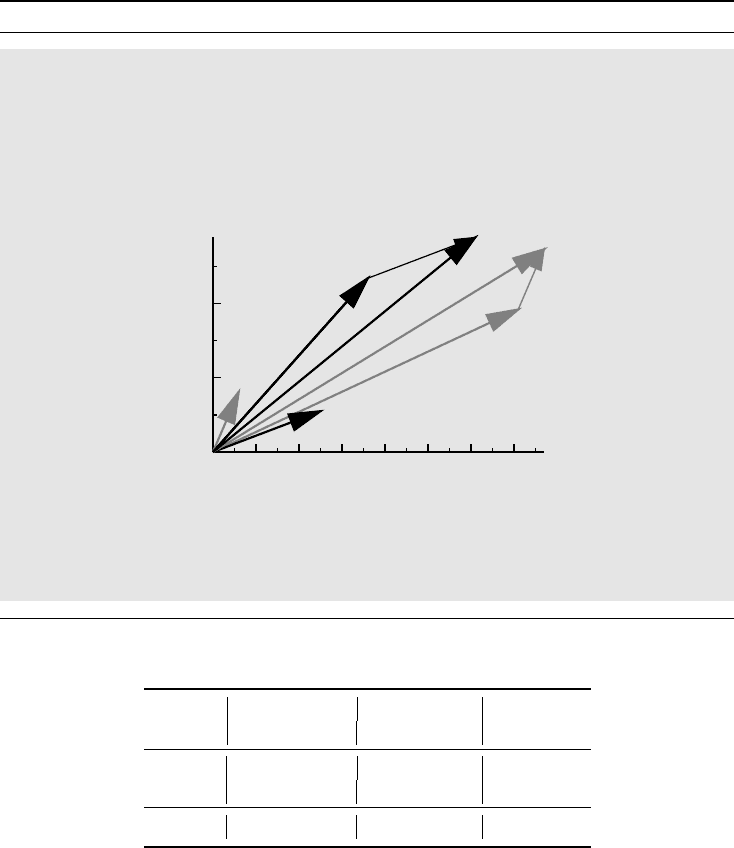
To understand Simpson’s paradox geometrically, consider the graph below, which de-
scribes the pairs (Success, Failure) as arrows from the origin: A and B represent the
treatments and indices 1 and 2 the small and large stone groups, respectively. The slopes
of the arrows are the corresponding odds. The slope for A
i
is greater than that of B
i
for each i. The combined table data are obtained by vector addition, and we see that
A
1
+ A
2
lies below B
1
+ B
2
.
0
100
200
Number of successes
706050403020100
Number of failures
A
1
B
1
A
2
B
2
A
1
+ A
2
B
1
+ B
2
The key to understanding why this can occur is to note that the group slopes are
unchanged if we make the arrows longer, so this is true of the odds ratio as well. The
slope of the total, however, is highly dependent on how long the original arrows are.
Small stones
Large stones Total
A
B ABAB
Success 81 234
192 55 273 289
Failure
636
71 25 77 61
Odds 13.5 6.5
2.7 2.2 3.5 4.7
Dividing the data into sub-tables based on the values of other measured variables, in this case
stone size, is called stratification. Individual sub-tables constitute the strata.
We see that the odds ratio is 2.1 for small stones and 1.2 for large stones, so the data favor
A over B for each of the groups, which is the opposite of the result above. This phenomenon,
that the odds ratios are on opposite sides of one in sub-tables compared to the combined
table, constitutes Simpson’s paradox. The paradox is that you come to different conclusions
depending on how you look at data, and it becomes important to understand why this is, as
well as the precise meaning of the different analyses.
One way to understand Simpson’s paradox is to look at it from a mathematical perspective.
A geometrical explanation is given in Box 2.8, which shows that it holds true for ratios in
46 OBSERVATIONAL STUDIES AND THE NEED FOR CLINICAL TRIALS
general. It will therefore apply equally well to odds and probabilities. It also explains that
there is no paradox, as long as the math is explained correctly. Loosely speaking, we need
two effects to act together:
1. The confounding factor has a large effect on the odds (there is a large angle between
the pair A
1
,B
1
and the pair A
2
,B
2
in the graph in Box 2.8).
2. The relative sizes of the groups which are combined when the confounder is ignored
differ substantially between strata (the length of A
1
in comparison to B
1
differs sub-
stantially from that of A
2
compared to B
2
).
In the table above the majority of small stones were treated with B, whereas the larger
stones were treated with A. Therefore B appears beneficial overall because small stones,
which have a higher probability of success (the odds ratio is 2.9), are more likely to be
treated with B. Indeed, if we have a patient treated with B, he is more likely to have a small
stone, and therefore is more likely to end up with a successful treatment. As the overall
test says.
But which result should we trust? Which treatment should we use? Of course we should
use A, because the question we are interested in relates to a new patient and our problem is
to choose a treatment for that patient. The overall analysis addresses the following question:
if we are to pick a patient from the study with a successful treatment, should we pick one
treated with A or one treated with B? In many situations this question has the same answer
as the one we are interested in, but not in this case, because what is true for the patients
in our study may not be true for a new patient. This insight also tells us how to compute
the odds ratio for the new patient. In fact, A has a 93% success rate for small stones and
a 73% success rate for large stones. Moreover, 51% of stones are small. So the probability
of success when treated with A should be 0.51 · 0 .93 + 0.49 · 0.73 = 0.83. Similarly, the
probability of success when treated with B should be 0.78, so the odds ratio is 1.4 for A
relative to B.
So the right answer in this case is: go for the stratified analysis!
This last computation highlights the problem of which proportions to report from a
stratified analysis. The crude rates may be somewhat misleading and we may need to
standardize the proportions to some common standard to get a meaningful estimate. In
the calculation above we used an internal standard, to get a fair comparison between
the treatments. In other cases we may want to refer to some global, external, standard.
As an example, assume we have a risk factor that has different effects in different age
classes, and we want to see the overall effect in a particular population for which the
age distribution is different from that of a particular study population. We then need
to weight the age-specific risks of the study according to the age distribution in the
target population.
However, the stratified analysis is not always the right thing to do. Suppose we take
the same numbers as above, but now we assume that B works by reducing stone size,
and that our data were obtained from an ultrasound examination some time after initi-
ation of treatment. Under this (somewhat unrealistic) assumption the stratified analysis
has no meaning, since it is only a result of the modus operandi of B. In this case we
definitely should go for the overall analysis – and we should never have done the stratified
analysis, because now the stone size is not a confounder in any meaningful sense of
the word.

CONFOUNDERS, SIMPSON’S PARADOX AND STRATIFICATION 47
Box 2.9 Cornfield’s inequalities
When the association between smoking and lung cancer was found in the 1950s, an
immediate question was whether an unknown factor might significantly change the
association in a Simpson’s paradox type of reversal. For a suggested confounder, and
data that allow us to compute risks, there are necessary conditions on the prevalence
difference or ratio of the confounder in the exposed and unexposed groups. These con-
ditions, called Cornfield’s inequalities, are based on the simple observation that if the
outcome C is actually independent of the exposure E conditionally on a confounder
X, we have for exposed individuals that P(C|E) = P(C|X)P(X|E) + P(C|X
c
)
(1 − P(X|E)), where P(X|E) is the prevalence of the confounder in the exposed
group, and similarly for the unexposed. There are two useful expressions that can
be derived from this. The simplest is the observation that the observed relative dif-
ference
E
= P(C|E) − P(C|E
c
) is related to the confounder relative difference
X
= P(C|X) − P(C|X
c
)by
E
= (P(X|E) − P(X|E
c
))
X
.
If all factors are positive, this shows that a necessary condition for the confounder to
explain all the association is that the prevalence difference P(X|E) − P(X|E
c
) ≥
E
.
Alternatively, considering observed and confounder relative risks RR
E
and RR
X
,
we get
RR
E
=
P(X|E)RR
X
+ 1 − P(X|E)
P(X|E
c
)RR
X
+ 1 − P(X|E
c
)
.
Under the assumption that the relative risks are at least one, this shows that the con-
founder relative risk must be larger than the observed relative risk and, more importantly,
that the prevalence ratio P(X|E)/P (X|E
c
) must be larger than the observed relative risk.
If this is not the case the proposed confounder cannot fully explain the association seen.
Simpson’s paradox is more or less exclusively a problem for observational studies, be-
cause clinical trials often have balanced groups and imbalances are necessary to generate the
paradox. In an epidemiological context there is always a fear that the results we see are not true,
because there may exist some unknown confounder that will reverse the present conclusion.
This is only a reflection of the general fact that new evidence could lead to a change in our
opinion about what the truth is. That is what evidence is for, and only illustrates that science
is not a stationary state, but a dynamic process. One should note, however, that there is an
observation, called Cornfield’s inequality (see Box 2.9), which helps to decide if a particular
confounder can reverse the effect seen. Essentially it says that for a particular confounder to
have the power to fully explain the association observed, not only does it need to have a larger
effect than the association observed, but also the prevalence difference or ratio (depending on
which way you want to express the result) must be larger than the observed effect.
At this point we should also note that the stratum-specific odds ratios and the overall
odds ratio do not have a simple relationship; the latter is not a simple, weighted, average
of the former. In fact, also when the odds are all the same in the different strata, the overall
odds ratio may be different. In order to give a useful pooled estimate from a stratified analysis,