
Kelly J.J. Graduate Mathematical Physics, With MATHEMATICA Supplements
Подождите немного. Документ загружается.


206 6 Analytic Continuation and Dispersion Relations
refraction must be accompanied by absorption – one cannot have one without the other
without violating fundamental physics. In particle physics it is often easier to measure the
energy dependence of the total cross-section, which is directly related to the imaginary
part of the forward scattering amplitude, than it is to measure the real part of the scattering
amplitude. Hence, dispersion integrals of similar form, based upon quite general princi-
ples, provide important tools in nuclear and particle physics.
6.2.4 Sum Rules
It is useful to consider the asymptotic properties of ΕΩ in the limit Ω!, where the
dispersion relations take the form
Re ΕΩ 1
2
ΠΩ
2
0
Ω
'
Im ΕΩ
'
1
Ω
'
Ω
2
Ω
'
(6.68)
Im ΕΩ
2
ΠΩ
0
Re ΕΩ
'
1
1
Ω
'
Ω
2
Ω
'
Ω
4
Ω
'
(6.69)
Assuming that the integral converges, the asymptotic behavior of the real part becomes
Re Ε 1
Ω
p
Ω
2
(6.70)
where the definition of the plasma frequency
Ω
2
p
lim
Ω!
Ω
2
1 Re ΕΩ
(6.71)
is consistent with the earlier definition motivated by the oscillator model. Therefore, we
obtain a sum rule of the form
Ω
2
p
2
Π
0
Ω Im ΕΩ Ω (6.72)
The interpretation of the asymptotic behavior of the imaginary part is trickier. The present
result suggests that its limiting form is proportional to Ω
1
, but convergence of the sum
rule for Ω
p
requires Im ΕΩ to decrease asymptotically more rapidly than Ω
1
which is
consistent with the Ω
3
asymptotic behavior found above for the oscillator model. In fact,
using causality one can show more generally (see exercises) that for large frequencies
Im Ε
G
''
0
Ω
3
(6.73)
and thus we expect to find
0
Re ΕΩ 1Ω0 (6.74)
and must carry one more term in the expansion of Im Ε. Therefore, the asymptotic behavior
takes the form
Im Ε 2¯Γ
Ω
2
p
Ω
3
(6.75)

6.3 Hilbert Transform 207
where
¯Γ
1
ΠΩ
2
p
0
Re ΕΩ 1Ω
2
Ω (6.76)
provides a second sum rule.
If we assume that the asymptotic behavior of Re Ε applies when Ω > Ω
c
, such that
Ω > Ω
c
Re Ε1
Ω
p
Ω
2
3
4
4
4
4
5
Ω
p
Ω
c
4
6
7
7
7
7
8
(6.77)
we find
0
Re ΕΩ 1Ω
Ω
c
0
Re ΕΩΩΩ
c
Ω
2
p
Ω
c
3
4
4
4
4
5
Ω
4
p
Ω
3
c
6
7
7
7
7
8
(6.78)
Therefore,
0
Re ΕΩ 1Ω0
1
Ω
c
Ω
c
0
Re ΕΩ Ω 1
Ω
p
Ω
c
2
3
4
4
4
4
5
Ω
p
Ω
c
4
6
7
7
7
7
8
(6.79)
is known as a superconvergence relation.
Sum rules play an important role in nuclear and particle physics. For some theories,
such as QCD, calculations are often so intractable that it becomes difficult to test the theory
by comparing energy-dependent predictions with experimental data. Sum rules, on the
other hand, depend only upon very general assumptions, such as causality and symmetry
properties. Therefore, provided that one can perform measurements over a large enough
range of energy to ensure convergence of the experimental integral, sum rules test the
underlying assumptions of a theory without need for detailed calculations of scattering
processes.
6.3 Hilbert Transform
The Kramers–Kronig formula is an example of a Hilbert transform. Suppose that f z is
analytic on the real axis and in the upper half-plane and that
f z
converges uniformly to
zero on the surrounding great semicircle. The Cauchy integral formula can then be used to
write
f z
1
2Π
C
f s
s z
s
1
2Π
f s
s x
s lim
R!
R
2Π
Π
0
f R
Θ
R
Θ
x
Θ (6.80)
where C consists of the real axis plus the great semicircle and z is in the interior of C.
The contribution of the great semicircle vanishes because
f z
! 0. Thus, separating
f zRe f zIm f z into real and imaginary components, we obtain the pair of

208 6 Analytic Continuation and Dispersion Relations
equations
Re f z
1
2Π
Im f s
s x
s (6.81)
Im f z
1
2Π
Re f s
s x
s (6.82)
that relate the real component in the upper half-plane to an integral of the imaginary com-
ponent on the real axis, or vice versa.
Similarly, for a point on the real axis we deform C using an infinitesimal semicircular
detour to write
f x
1
2Π
C
f s
s x
s
2Π
f s
s x
s lim
Ε!0
1
2Π
0
Π
f x Ε
Θ
Θ
lim
R!
R
2Π
Π
0
f R
Θ
R
Θ
x
Θ
Θ
2Π
f s
s x
s
1
2
f x
(6.83)
and again discard the great semicircle to obtain
f x
Π
f s
s x
s (6.84)
Note that the analysis is practically unchanged for functions that are analytic and decay
as z !in the lower half-plane instead. Separating fx into real and imaginary compo-
nents, we find
Re f x
Π
Im f s
s x
s (6.85)
Im f x
Π
Re f s
s x
s (6.86)
Notice that these formulas differ by a factor of 2 from those above because the contribution
for a singularity on the contour is the average of contributions for nearby singularities on
either side (half in and half out). If we now consider the real and imaginary components
on the real axis to be two real functions of a real variable, we obtain the Hilbert transform
pair
Ψx
Π
˜
Ψs
s x
s
˜
Ψs
Π
Ψx
x s
x (6.87)
One can assemble a table of Hilbert transforms by decomposing analytic functions that
decay sufficiently rapidly as z !into real and imaginary components on the real axis.
For example, Cosx and Sinx constitute a Hilbert transform pair because Expz is ana-
lytic and satisfies the convergence requirements in the upper half-plane. However, the real

6.4 Spreading of a Wave Packet 209
strength of this technique is to the analysis of experimental data where physical arguments,
such as causality, guarantee the analyticity and convergence properties such that parame-
trization of measurements for one component can be used to reconstruct the other.
6.4 Spreading of a Wave Packet
In quantum mechanics or optics one often constructs wave packets as a superposition of
plane waves such that
Ψx, t
k
2Π
˜
Ψk Expkx Ωt (6.88)
where
˜
Ψk is the amplitude of a plane wave with wave number k and where the frequency
ΩΩk is a function of k. The limitation to one spatial dimension is made here for
simplicity only. If
˜
Ψk
˜
f k k
0
(6.89)
exhibits a relatively narrow peak at k
0
, it becomes useful to express the Fourier integral in
the form
Ψx, tExpk
0
x Ω
0
t
k
2Π
˜
f k k
0
Exp
k k
0
x ΩΩ
0
t
(6.90)
where Ω
0
Ωk
0
. The contributions from k appreciably different from k
0
will tend
to interfere destructively because the phase of the complex exponential varies rapidly.
Expanding the temporal frequency as
Ωk*Ω
0
Ω
1
k k
0
Ω
2
k k
0
2
2
,,, (6.91)
we can write
Ψx, t*Expk
0
x Ω
0
t
Κ
2Π
˜
f Κ Exp
Κx Ω
1
t
Ω
2
Κ
2
2
t
(6.92)
where Κk k
0
. Notice that if Ω
2
0, one obtains
Ω
2
0 Ψx,t f x v
g
t Expk
0
x Ω
0
t (6.93)
where
f x
Κ
2Π
˜
f Κ ExpΚx ,
˜
f Κ
x
Κx
f x (6.94)
is the initial shape of the wave packet at time t 0 and where v
g
Ω
1
Ω
'
k
0
is
the group velocity at the peak of the momentum distribution. Under these conditions, the
intensity
Ψx, t
2
f x v
g
t
2
(6.95)
propagates as a wave with velocity v
g
without changing shape. Therefore, if Ωk is linear,
the propagation is described as nondispersive because the shape of the wave packet is
preserved. However, if Ω
2
0, the wave packet will usually spread with time.

210 6 Analytic Continuation and Dispersion Relations
The phase and group velocities are related by
v
p
Ω
k
,v
g
Ω
k
v
g
v
p
k
v
p
k
v
g
v
p
1
k
v
p
v
p
k
(6.96)
which for a narrow spectral distribution should be evaluated near the peak, k
0
. From optics
we describe situations where v
p
/ k<0 v
g
<v
p
as normal dispersion and v
p
/ k>
0 v
g
>v
p
as anomalous dispersion.
Consider a Gaussian wave packet of the form
˜
f Κ
4ΠΣ
2
1/ 4
Exp
Σ
2
Κ
2
2
(6.97)
f x
ΠΣ
2
1/ 4
Exp
x
2
2Σ
2
(6.98)
normalized according to
x
f x
2
Κ
2Π
˜
f Κ
2
1 (6.99)
such that
Ψx, t
4ΠΣ
2
1/ 4
Exp
k
0
x Ω
0
t
,
Κ
2Π
Exp
Σ
2
Ω
2
t
Κ
2
2
Κx Ω
1
t
(6.100)
Completing the square, we obtain a wave packet of similar form
Ψx, t
Σ
2
Π
1/ 4
Expk
0
x Ω
0
t
Σ
2
Ω
2
t
1/ 2
Exp
x Ω
1
t
2
2Σ
2
Ω
2
t
(6.101)
except that the width
Σ
2
BΣ
2
Ω
2
t (6.102)
becomes time dependent and complex. Using
1
Σ
2
Ω
2
t
1 Τ
Σ
2
1 Τ
2
with Τ
Ω
2
t
Σ
2
(6.103)
the intensity profile takes the form
Ψx, t
2
ΠΣ
2
1 Τ
2
1/ 2
Exp
x Ω
1
t
2
Σ
2
1 Τ
2
(6.104)
or
Ψx, t
2
ΠΣ
2
1
Ω
2
t
Σ
2
2
1/ 2
Exp
S
T
T
T
T
T
T
T
T
T
T
T
T
U
x Ω
1
t
2
Σ
2
1
Ω
2
t
Σ
2
2
V
W
W
W
W
W
W
W
W
W
W
W
W
X
(6.105)
6.4 Spreading of a Wave Packet 211
5
0
5
x
0
2
4
6
8
10
t
0
0.25
0.5
0.75
1
AbsΨ
5
0
2
4
6
8
t
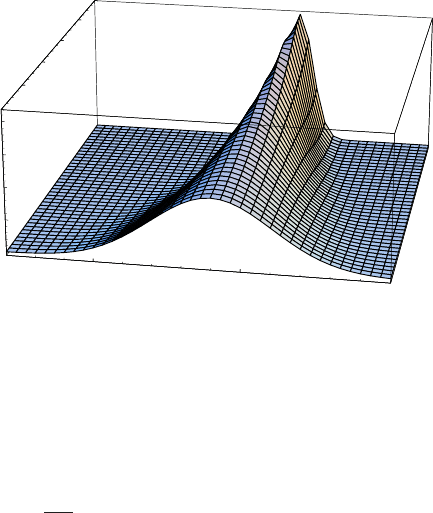
Figure 6.7. Spreading of a Gaussian wave packet.
Therefore, we find that a Gaussian wave packet remains Gaussian in shape but that its
width increases with time according to
ΣBΣ
1
Ω
2
t
Σ
2
2
1/ 2
(6.106)
The spreading of the intensity profile for a typical wave packet is shown in Fig. 6.7.
It is important to recognize that the width increases much more rapidly for a narrow
than for a broad wave packet. A brief pulse contains a broad spectrum of frequencies, but
high frequencies propagate more rapidly than low frequencies in a medium with normal
dispersion (Ω
2
> 0). Thus, the high-frequency components race ahead of the lower fre-
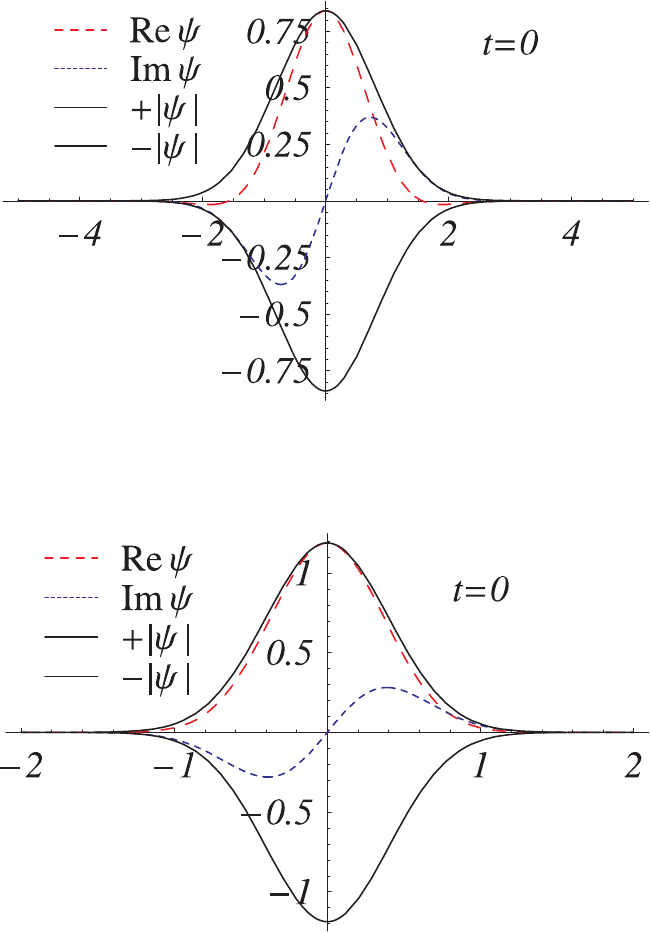
quencies and broaden the pulse. This effect can be seen by examining the real and imag-
inary components separately, as shown in Figs. 6.8 and 6.9. Notice that the two figures
have different spatial scales – the pulse in Fig. 6.8 is initially twice as wide as the pulse
in Fig. 6.9, but after some time the latter is much wider than the former. It should also be
obvious that the higher frequencies dominate the leading side while the lower frequencies
dominate the trailing side of the pulse. We chose a ratio v
g
/v
p
0.5 between group and
phase velocities that is typical of light in a plastic scintillator or voltage in a coaxial cable.
Our choice of dispersive coefficient, Ω
2
, was somewhat arbitrary, but it is clear that narrow
signals can be distorted quite rapidly by dispersive media.
The relationship ΩΩk between frequency and wave number is often called a dis-
persion relation because it governs the spreading of wave packets. A linear relation is
nondispersive, but nonlinear components of the dispersion relation generally produce dis-
persion of the wave packet because Fourier components with different frequencies prop-
agate with different phase velocities. However, the shapes of nongaussian wave packets
may change with time in more complicated ways. Furthermore, in nonlinear media there
are sometimes special profiles, called solitons, for which the distribution of Fourier ampli-
212 6 Analytic Continuation and Dispersion Relations
Figure 6.8. Spreading of the real and imaginary contributions to the intensity of a relatively broad
wave packet.
Figure 6.9. Spreading of the real and imaginary contributions to the intensity of a relatively narrow
wave packet.
tudes
˜
f Κ is matched to ΩΚ such that the wave packet actually retains its initial shape as
it propagates.
6.5 Solitons 213
2 1 0 1 2
ΦΦ
m
1
0.5
0
0.5
1
1.5
VV
m
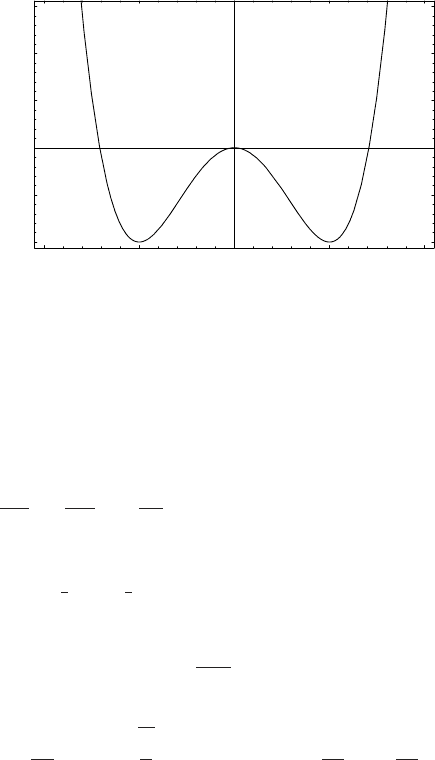
Figure 6.10. A potential that exhibits spontaneous symmetry breaking.
6.5 Solitons
Consider a classical field ΦΦx, t that satisfies a one-dimensional wave equation of the
form
Σ
(
2
Φ
(t
2
Τ
(
2
Φ
(x
2
(V
(Φ
(6.107)
where Σ and Τ are inertial and stiffness constants and where
VΦ
1
2
AΦ
2
1
4
BΦ
4
(6.108)
with positive constants A and B is a potential that exhibits a spontaneously broken sym-
metry. Almost by inspection we recognize that VΦ has a local maximum at Φ0 and
symmetric minima at Φ
A/B with depth A
2
/ 4B. Thus, it is useful to express VΦ
in the form
V
m
A
2
4B
, Φ
m
A
B
V Φ V
m
3
4
4
4
4
5
2
Φ
Φ
m
2
Φ
Φ
m
4
6
7
7
7
7
8
(6.109)
which is plotted in Fig. 6.10. Although the potential is symmetric with respect to Φ,the
equilibrium state with Φ0 is unstable and is not the ground state. There are two stable
ground states at ΦΦ
m
that do not share the symmetry of the potential – at low temper-
ature the system will be found near either the positive or the negative state and this choice
violates the symmetry of the equation of motion. The situation in which the ground state
does not share the symmetry of the dynamical equations is described as a spontaneously
broken symmetry. For example, the dynamics of a ferromagnet are rotationally symmetric,
but in the ground state the constituent magnetic moments are aligned in some arbitrary
direction that violates rotational invariance.
In this section we demonstrate that, in addition to familiar wave solutions for small-
amplitude oscillations about either of the minima, this highly dispersive nonlinear differen-
tial equation also possesses propagating soliton solutions that induce transitions between

214 6 Analytic Continuation and Dispersion Relations
the stable states. We do not attempt to develop general methods for finding such solutions,
which are beyond the scope of this course, but will be content to discuss the general prop-
erties of stipulated solutions in order to gain some appreciation for the phenomena. Models
of this type find widespread application in condensed matter and particle physics.
It is useful to define the intrinsic wave speed in the absence of V as c
Τ/ Σ and to
divide out Φ
m
to obtain a wave equation for ΨΦ/ Φ
m
that takes the form
1
c
2
(
2
Ψ
(t
2
(
2
Ψ
(x
2
ΒΨ Ψ
3
(6.110)
where Β4V
m
/ ΤΦ
2
m
A/Τ. First we demonstrate that there exist approximate solutions
of the form
Ψx, t*1 ΑSinkx Ωt ∆ (6.111)
with ΑI1 that represent small-amplitude oscillations of Ψ around one of the potential
minima. Substituting the trial solution and expanding to lowest order in Α, we find
Ω
2
c
2
k
2
Α Sinkx Ωt ∆ Β2Α Sinkx Ωt ∆,,, (6.112)
Therefore, we obtain a highly nonlinear dispersion relation of the form
Ω
2
c
2
k
2
2Β (6.113)
with phase velocity
v
p
Ω
k
c
1
2Β
k
2
c
1
2A
k
2
Τ
(6.114)
that is independent of the oscillation amplitude. Note, however, that because the equation
is nonlinear the accuracy of the solution does depend upon amplitude – the smaller the
amplitude the more accurate the solution. Also notice that the phase velocity for long
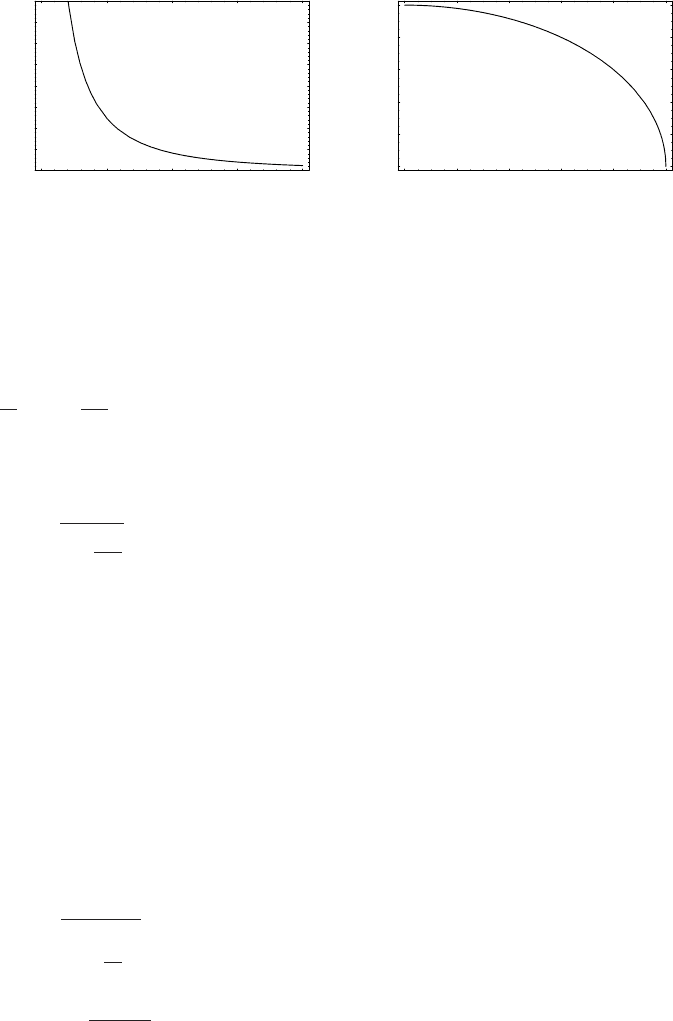
wavelengths is increased dramatically by the harmonic part of the potential. The left side
of Fig. 6.11 shows the phase velocity where k
0
2A/Τ.
Next, we demonstrate that there exist exact solutions of the form
Ψx, tΨ
0
TanhΞx vt (6.115)
for suitable choices of Ψ
0
, Ξ, and v.Using
2
2
z
Tanhz2
Tanhz
Coshz
2
(6.116)
direct substitution gives
2Ψ
0
Ξ
2
1
v
2
c
2
TanhΞx vt
CoshΞx vt
2
ΒΨ
0
TanhΞx vt Ψ
3
0
TanhΞx vt
3
(6.117)
6.5 Solitons 215
0 0.5 1 1.5 2
kk
0
1.5
2
2.5
3
3.5
4
4.5
5
v
p
c
0 0.2 0.4 0.6 0.8 1
Λ Λ
0
0
0.2
0.4
0.6
0.8
1
v
p
c
Figure 6.11. Dispersion relations for Eq. (6.110). Left: small-amplitude waves. Right: soliton solu-
tions.
or
v
2
c
2
1
Β
2Ξ
2
CoshΞx vt
2
Ψ
2
0
SinhΞx vt
2
(6.118)
The space and time dependencies of the right-hand side can be eliminated by choos-
ing Ψ
0
1, such that
v c
1
Β
2Ξ
2
(6.119)
where we choose the positive root because the trial solution already includes the propaga-
tion direction. A soliton of this form propagates without changing shape, but the amplitude
is not arbitrary and the speed depends upon the slope parameter Ξ. Unlike small-amplitude
waves which propagate with v>c, large-amplitude solitons propagate with velocity v<c.
The dependence of the propagation velocity upon the slope parameter is a form of disper-
sion, but unlike a familiar wave the amplitude of the soliton is not arbitrary because the
equation is nonlinear.
A snapshot of the soliton that propagates in the positive x-direction is sketched in
Fig. 6.12. The soliton is a propagating disturbance that switches the local field from one
stable state to the other as it passes and is often described as a kink. The distance over
which the transition occurs is characterized by ΛΞ
1
, the inverse of the slope of the kink
at the origin. Thus, we can express the phase velocity in the form
v c
1
Λ
Λ
0
2
(6.120)
where Λ
0
2BΤ/A
2
is a characteristic distance. The smaller the distance over which
the transition occurs the stronger the kink and the greater its speed. Very strong kinks