
Kerry J., Butler P. Smart Packaging Technologies for Fast Moving Consumer Goods
Подождите немного. Документ загружается.


OTE/SPH OTE/SPH
JWBK126-05 JWBK126-Kerry March 15, 2008 18:57 Char Count= 0
5
Smart Packaging Technologies for
Fish and Seafood Products
Alexis Pacquit, Karl Crowley and Dermot Diamond
5.1 Introduction
Latest figures show that busy consumers are increasingly seeking quick and easy to pre-
pare, fresh chilled or frozen prepacked fish products [1]. Demand for home consumption
products is heavily influenced by the limited time available for meal preparation in today’s
busy lifestyles. Furthermore, coupled with economic, social affluence and lifestyle choices
in terms of disposable income, an increasing number of consumers are moving toward
healthier semi-processed refrigerated prepacked options. Increased awareness of the health
benefits of seafood (high protein, low fat and high omega-3 fatty acids) is certainly a key
driver behind this trend.
The seafood processing industry in Europe was worth approximately €18 billion per
year in 2003; roughly twice the value of landings and aquaculture combined [2]. Although
this industry has benefited from a trend toward healthier eating, it faces mounting problems
largely stemming from dwindling stocks and diminishing returns. This has resulted in a
need to diversify from familiar though threatened species such as cod into what are termed
‘under utilised species’ – fish species that up until now have been seen as having little
commercial value. While this opens new opportunities for fishermen and suppliers alike,
the need to educate and supply information to consumers poses some interesting challenges
that may be met with emergent technologies – including smart packaging.
One area being driven by legislators in Europe and elsewhere is in the area of food
traceability – requiring much more information to be available to the consumer and forcing
the establishment of a chain of responsibility throughout the whole food chain [3, 4]. The
Smart Packaging Technologies for Fast Moving Consumer Goods Edited by Joseph Kerry and Paul Butler
© 2008 John Wiley & Sons, Ltd. ISBN: 978-0-470-02802-5
OTE/SPH OTE/SPH
JWBK126-05 JWBK126-Kerry March 15, 2008 18:57 Char Count= 0
76 Smart Packaging Technologies for Fast Moving Consumer Goods
seafood industry is unique in food production in that a large quantity of fish are both farmed
and caught wild. One common differentiation, often expressed by consumers is the desire
for wild fish over aquaculture produce – particularly in the case of salmon – a preference that
a recent British advertising campaign for wild salmon controversially exploited [5], thus
demonstrating the power of consumer demand for information. Some of these traceability
requirements can be covered by merely stating the additional detail (e.g. harvest date and
location, species, etc.) on the label although others potentially require more advanced
methods, such as RFID tags. Such tags are already being employed on pallets of fish
exported from Alaska as a means of verifying the origin in addition to guaranteeing proper
storage conditions [6]. This quality assurance facet is another area becoming increasingly
important to both suppliers and consumers. There is consequently great interest, within
the fisheries industries, retailers, consumer’s rights watchdogs and food safety controlling
bodies in developing accurate, rapid, cost effective and non-destructive methods to evaluate
real-time freshness of fish and seafood products. Emphasis is on methods that account for
the products history and their storage conditions from ‘harvest-to-home’.
Seafood, particularly fish, has the advantage of being seen largely free from health
issues such as the bird flu, BSE and foot and mouth crises that have affected the poultry and
meat industry over the past few years. Some sectors may have even seen an increase in fish
consumption as a direct result of these crises. Nevertheless, seafood, both fish and shellfish,
are particularly prone to spoilage and the need to minimise the risk to the consumer’s health –
not to mention the supplier’s reputation – is another powerful driving force behind new
smart packaging technologies.
In this chapter, the applications of smart packaging to seafood will be discussed with
reference to current and developing technology, covering both the application and scientific
background of this diverse area.
5.2 What are the Parameters of Fish Quality?
Fish quality is a complex concept involving many factors. The importance of some of
these may vary with markets, geographical location and cultures. The common physical
attributes such as appearance, size, species, colour, odour and taste are of direct concern to
the consumers. However, safety, feeding habits, sexual maturity, fishing ground and depth
of living also affect the quality of the catch. Nonetheless, freshness is by far the most
important factor in fish quality assessment no matter which market or part of the world one
is focusing on.
It is a well known fact that the quality of fish is irregular. Seafood in general may
be available virtually all year round but no two harvests are the same. At present, the
judgement of fish and seafood freshness largely relies on sensory assessment of freshness
attributes, such as appearance (eyes, skin, and gills), texture, odour and colour, by a trained
panel of assessors at fish auctions who assign scores indicating quality and remaining
shelf life. These scores are the basis of a grading scheme, the Quality Index Method
(QIM), produced from the compiled characteristics of various common European fish
species [7, 8]. Additional methods include microbiological (total viable count or TVC),
physical (texture, electrical properties) and chemical (K and K1 values, Total Volatile Basic
Nitrogen or TVB-N, lipid oxidation). The K and K1 values reflect the extent of adenosine
OTE/SPH OTE/SPH
JWBK126-05 JWBK126-Kerry March 15, 2008 18:57 Char Count= 0
Smart Packaging Technologies for Fish and Seafood Products 77
triphosphate (ATP) degradation after death and they have been extensively used as freshness
indicators [9, 10]. An excellent review of these methods has been provided by Olafsdottir
et al. [11]. The possibility of developing a multisensor device to measure fish freshness
was investigated in an European project called ‘MUSTEC/FAIR 98-4076’ (Multisensor
Techniques for Monitoring the Quality of Fish) [12].
5.3 Mechanisms of Fish Spoilage
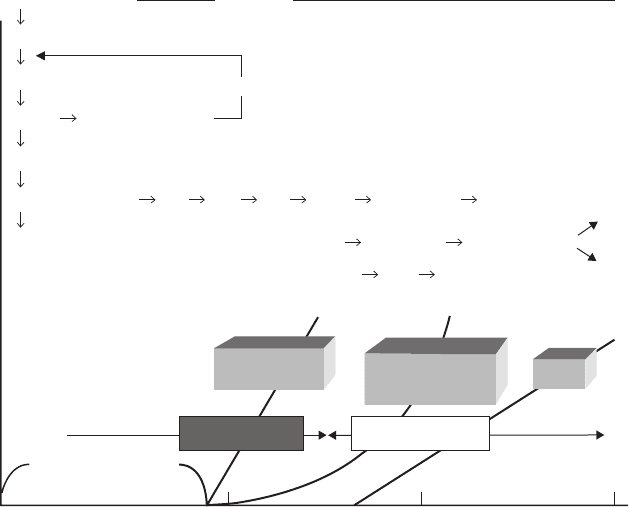
Figure 5.1 shows the post-mortem changes occurring in fish muscle [13]. The initial quality
loss in fish is primarily caused by autolytic changes (enzymatic digestion and degradation of
flesh) and is unrelated to microbial activity [14, 15]. The loss of the intermediate nucleotide
inosine monophosphate (IMP) is responsible for the loss of fresh fish flavour, but apart from
this, the autolytic changes contribute to spoilage by making catabolites, such as nucleotides
and other ATP-related compounds, available for bacterial growth.
Food microbiology may be separated in two key aspects, safety and freshness, as they
concern two different types of foodborne microorganism. Safety in food products often
refers to the risk of hazardous pathogen outbreak (i.e. Listeria monocytogenes, Clostridium
Death of fish
Level of toughness, K value, VBN and total viable cell counts
Autolysis
Feedback inhibition
Spoilage
Anaerobic glycolysis
Formation of lactic acid
pH 7.0 pH 5.0 (muscle)
Activation of ATPase
Degradation of ATP (
Rigor mortis degradation of protein
TMAO TMA
DMA
rapid increase of bacteria
K value
for sashimi
rigon mortis
Storage days at 5°C
death 1 2 3
for cooking
Total viable
cell counts
VBN
formaldehyde
+
polypeptide
ADP AMP IMP Inosine
Hypoxanthine Uric acid
histamine
amino acid
NH
3
Figure 5.1 Post-mortem changes in fish meat. Reproduced from [13] with permission from
Elsevier.
OTE/SPH OTE/SPH
JWBK126-05 JWBK126-Kerry March 15, 2008 18:57 Char Count= 0
78 Smart Packaging Technologies for Fast Moving Consumer Goods
botulinum, Vibrio spp.) which can cause infection with very low numbers of live cells,
and/or the production of biotoxins (e.g. intoxication), both of which can result in food-
borne diseases with serious human pathology. These pathogens may represent part of the
natural flora of fish or maybe are introduced through subsequent processing, storage or
transport [14,16]. On the other hand the study of freshness often refers to the growth of
spoilage microorganisms (Pseudomonas spp., Shewarella putrefaciens, Photobacterium
phosphoreum) that lead to the generation of off-odours, off-flavours and other metabolic
breakdown products. It is however important to note that oxidation of tissues and oils also
results in off-odours and flavours (rancidity in oily fish) [14]. Odour is undoubtedly the most
common index of fish freshness. Indeed, the customer, with no knowledge or training of fish
quality evaluation, is generally assessing the freshness and safety of his/her fish product
upon opening the food pack based on its odour or scent. Since most household kitchen
refrigerators are not at the correct temperature and the yearly average kitchen temperature
is 18 to 19
◦
C, fish product packs only presenting ‘use by date’ information potentially
represent a health and safety issue. However, if such a device as a time temperature inte-
grator (TTI) or an amine sensor were added on the same pack, it may provide a real-time
assessment of the product quality and assist the customer in his/her decision.
Seafood, both fish and shellfish, are highly perishable goods and, in general, food com-
modities have their own structural specificities [pH, water activity (a
w
), be part of a bigger
biological system (meat), whole system (fruit) or processed system (cheese, bread)] and thus
have their own distinctive microbiology. In fish, original microbial flora is influenced by the
species, habitat geography (fresh or saltwater, tropical or arctic water, pelagic swimmers or
bottom dwellers) and even harvest season. Thus, fish harbour quite a heterogeneous flora
when fresh and, aside from temperature, the spoilage characteristics of packaged seafood
will depend upon a number of additional variables such as the subsequent processing steps
(fresh or frozen, whole or filleted, loose or prepacked) as well as the type of packaging
(modified atmosphere, vacuum or air) [16]. After death and during storage, the number of
microorganisms on the skin and gill surfaces increases gradually and spreads within the
various tissues. Generally, one or more species, referred to as specific spoilage organisms
(SSO), will outgrow the others depending on the surrounding conditions and the product
composition, giving off a range of breakdown and metabolic compounds [9]. Examples of
SSOs and typical spoilage compounds of some fish products are presented in Table 5.1.
European guidelines for microbiological criteria in respect of many foodstuffs have not
yet been established. Microbiological guidelines exist for shelled and shucked products of
cooked crustaceans and molluscan shellfish, live bivalve molluscs and live echinoderms,
tunicates and gastropods but no guidelines have been established for fresh uncooked fish
products [18]. The reason for this is related to the variety of natural microbial flora per
fishing ground, habitat geography and species, as outlined above, across the extensive
diversity of countries and climate.
In the past 50–60 years, basic microbial analysis methods have remained essentially
unchanged. Technological advancements have made them relatively faster and easier to
complete, but they still require sample treatment, agar plate preparation and rely on trained
operators for bacteria colony screening. Conventional measurements of bacterial popu-
lations based on plate count procedures typically require several incubation days before
results are available, which then entail backward corrective actions. The products may be
retained in suitable storage conditions before delivery clearance. This causes delays in the

OTE/SPH OTE/SPH
JWBK126-05 JWBK126-Kerry March 15, 2008 18:57 Char Count= 0
Smart Packaging Technologies for Fish and Seafood Products 79
Table 5.1 SSO and typical spoilage compounds in groups of fresh and lightly preserved
seafoods [16, 17]
Number at Typical volatile
Product Typical SSO rejection
a
compounds
Fresh chilled products
stored in air
Shewanella putrefaciens
b
Pseudomonas spp.
c
10
8
–10
9
10
8
–10
9
TMA, H
2
S and other
sulphur compounds,
Hx (hypoxantine).
NH
3
, esters,
non-H
2
S sulfides
Fresh fish, chilled, MA
packed
P. phosphoreum
b
Lactic acid bacteria
c
>10
7
>10
8
TMA, Hx, alcohols and
ketones. Acetic acid,
NH
3
,H
2
S, diacetyl,
tyramine.
Fresh fish, >10
◦
C Vibrionaceae, Aeromonas
spp.
10
7
–10
8
TMA, volatile sulfides
Sous vide cooked fish Clostridium spp. >10
6
Strong faecal, sulfydryl
odours
Sugar-salted herring Halophilic, anaerobes
d
osmotolerant yeast
10
7
–10
8
Indole, H
2
S, acids fruity
10
4
–10
5
a
numbers in cfu g
−1
,
b
typical of marine, temperature water fish,
c
typical of freshwater fish and fish from warmer waters,
d
not identified
production chain, loss of optimal product freshness, reduction in product ‘display–time’,
thus product shelf-life and ultimately financial loss.
Some spoilage metabolites can be used as quality indices [19] such as the volatile com-
pounds trimethylamine (TMA), dimethylamine (DMA) and ammonia, collectively known
as TVB-N, or the biogenic amines hypoxanthine and histamine. Their content in freshly
caught marine fish investigated immediately after hauling is normally found to be rela-
tively constant [20]. Over time and depending on the fish species, temperature and general
storage conditions (atmosphere, a
w
, microbial cross-contamination, etc.), the TVB-N level
increases as a result of bacterial metabolism. Hence, it is a potential indicator of fish spoilage
and figures within current EU legislation as an additional tool for fish quality assessment
[21]. The current method for TVBN analysis involves extracting the volatiles bases using
a perchloric acid solution followed by steam distillation of the extract which is then col-
lected in boric acid and titrated against standard HCl. Although accurate when performed
by experienced analysts, the method is nonetheless destructive and time consuming.
It is time, therefore, to move beyond conventional existing techniques to emerging tech-
nologies for low-cost, real-time, assessment of food quality and safety. Scientists are now
looking at finished products, studying the biodegradation processes under the industry spe-
cific conditions (frozen, chilled, loose, prepacked, in air, in modified air packaging (MAP),
vacuumed, etc.) and making inventories of the changes in appearance, colour, texture, scent,
pH and moisture as well as of the consumption/release of certain compounds. Low cost
devices and non-invasive methods can now be employed to monitor these changes in the
product rapidly and relate them to quality. They can ultimately be integrated within smart
packaging.
OTE/SPH OTE/SPH
JWBK126-05 JWBK126-Kerry March 15, 2008 18:57 Char Count= 0
80 Smart Packaging Technologies for Fast Moving Consumer Goods
5.4 On-pack Quality Indicators
For packed produce, often the only assurance of quality is the use-by date assigned on
packing. For highly perishable foodstuffs such as fish and shellfish this is highly problem-
atic as it assumes proper maintenance of temperature and other conditions during storage
and transport before and after packaging. In this case, the only direct means of testing
whether the seafood has spoiled is to breach the package, rendering the produce unfit for
resale.
Another possibility is to incorporate a device on, or even within, the pack that will allow
a non-destructive assessment of quality. Two main possibilities for non-invasive quality
indicators are:
(i) time-temperature Integrators (TTIs),
(ii) food quality indicators.
In both cases, the indication given by the sensors is generally (though not exclusively) col-
orimetric: a highly visual change in colour of the indicator allowing for a rapid assessment
of the quality of the packed seafood. The two types of indicator are chemical based but
they utilise two different approaches: TTIs displaying a colour change dependent on the
ambient temperature effects on a chemical reaction within the indicator. Food quality indi-
cators react to changes – usually chemical or biological – occurring within the packaging
headspace as the seafood spoils. In this section, the operation, relative merits and issues
associated with these quality indicators will be discussed.
5.5 Time–Temperature Integrators
The spoilage of perishable foodstuffs is almost always heavily dependent on storage tem-
perature. Traditionally, temperature was manually checked at various intervals to ensure
suitable conditions were maintained though this method was time-consuming and did not
provide a complete and verifiable temperature record. In recent times, the use of automated
temperature loggers has allowed a complete archive of data to be collected, verifying stor-
age temperatures and providing information on possible weaknesses in the supply chain
[22, 23]. As noted earlier, battery-powered RFID tags have also been used to monitor tem-
perature for bulk containers of fish transported from Alaska [6]. Although this technology
is useful for storage and transport of bulk produce it is presently too expensive and overly
complicated for single packs of goods – a low-cost and easily read alternative fits the re-
quirement for smart packaging applications. Temperature–time integrators are an example
of this technology and have already found a variety of applications in many areas, including
pharmaceuticals and perishable foods including meat, dairy and seafood [24, 25].
Although TTI technology had been present for several decades [26, 27], it is only in the
last 15 years that it has been considered reliable enough to be employed in these applications
[4]. Since then there has been a steady uptake from suppliers and supermarkets throughout
the world. This uptake is being driven by the consumers desire for quality assurance coupled
with increasing demands from legislators, particularly in the United States – a good example
of this is the Import Alert No. 16-125 issued in 2002 by the United States Food and Drug
OTE/SPH OTE/SPH
JWBK126-05 JWBK126-Kerry March 15, 2008 18:57 Char Count= 0
Smart Packaging Technologies for Fish and Seafood Products 81
Fresh
Still Fresh
Use now
Freshness
NOT
Guaranteed
a)
(c) (b)
(a)
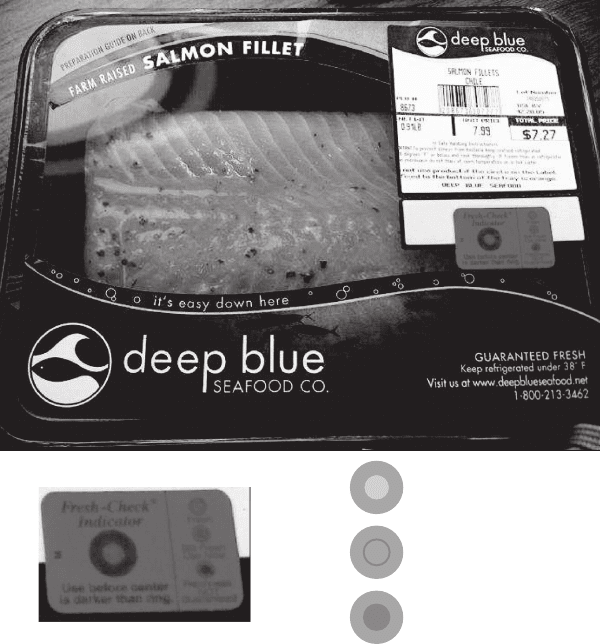
Figure 5.2 An example of smart packaging application of TTIs. Fresh-Check
R
indicator em-
ployed on packaged salmon fillet (a); Detail of the sensor; (b), and change in sensor over time
(c). Used with kind permission of Fresher Than Fresh/TEMPTIME.
Administration [28]. This alert stipulates that refrigerated, modified air packaged (MAP)
fish must be verifiably fit for consumption and refers to TTIs (on each pack of fish) as
one means of fulfilling this requirement. Commercial examples of TTIs employed in smart
packaging seafood are shown in Figures 5.2 and 5.3 (salmon in both cases). In Figure 5.2(a),
the Fresh-Check
r
TTI (detail, Figure 5.2b) is seen to be affixed to the pack in much the
same way as a normal label and it remains on the pack all the way through to the consumer.
The active part of the sensor can be read by a handheld colorimeter for a quantitative result
or can be compared with the reference ring allowing a quick visual inspection to ascertain
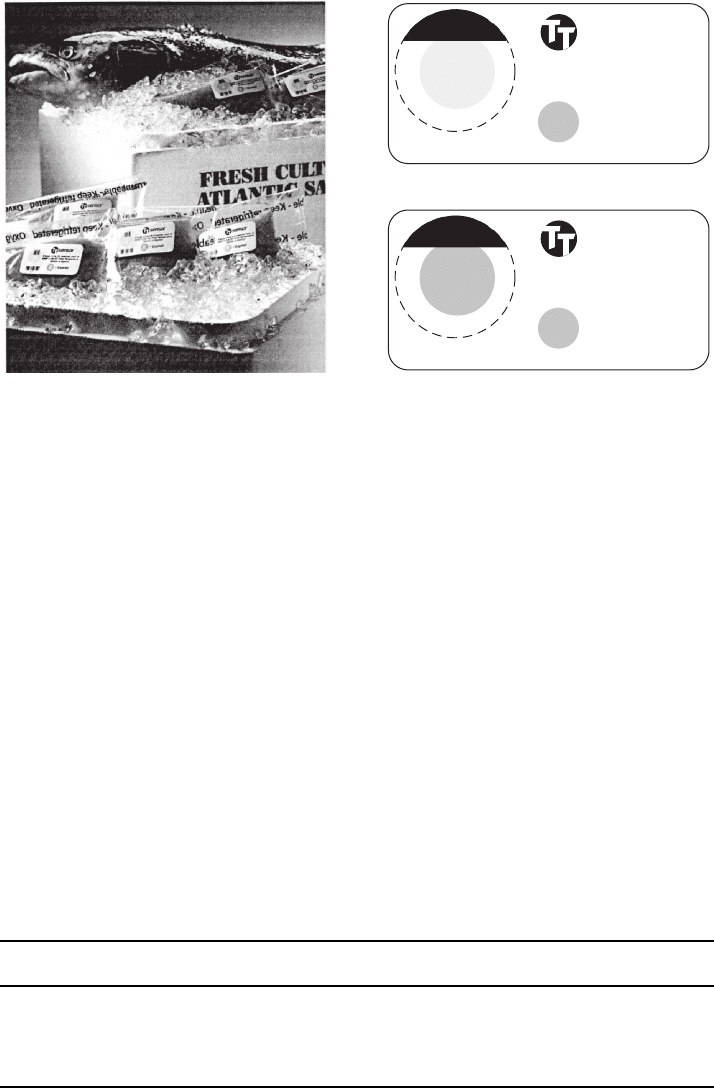
quality (Figure 5.2c). The design of the TT-Sensor
TM
is slightly different, as can be seen in
Figure 5.3. The active circle undergoes a distinctive yellow to pink colour change on expiry.
An example of some of the commercially available TTIs employed for seafood packaging
and their mechanisms are given in Table 5.2.
OTE/SPH OTE/SPH
JWBK126-05 JWBK126-Kerry March 15, 2008 18:57 Char Count= 0
82 Smart Packaging Technologies for Fast Moving Consumer Goods
ACTIVE
= Expired
sensor
TM
35-F
If color of “ACTIVE” large circle
matches color of smalll circle,
TT Sensor
TM
is expired.
TT Sensor
TM
is a Time Temperature Indicator
ACTIVE
= Expired
sensor
TM
35-F
If color of “ACTIVE” large circle
matches color of smalll circle,
TT Sensor
TM
is expired.
TT Sensor
TM
is a Time Temperature Indicator
(b)
(c)
(a)
Figure 5.3 TT-Sensor
TM
on packs of fresh salmon (a), detail of the sensor before (b) and after
expiry (c). Used with kind permission of Avery Dennison.
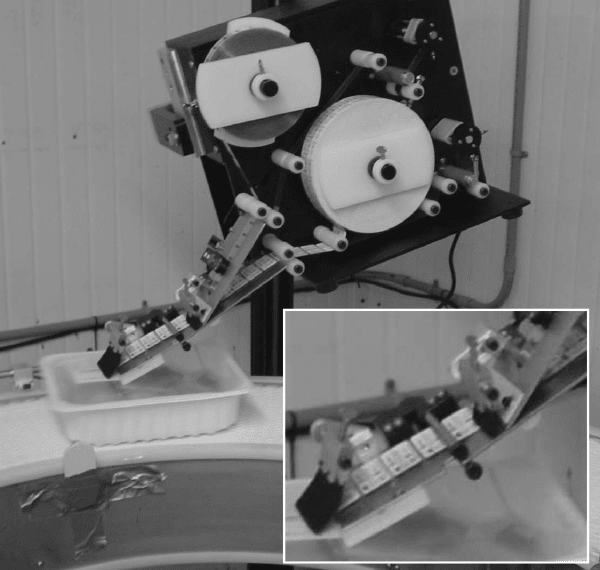
The TT Sensor
TM
is initiated by applying an activator label over the sensor window, an
example of a TT-Sensor
TM
label applier is give in Figure 5.4. The main label is applied by
the wheel on the bottom right while the transparent activator labels are applied from the
spindle visible at top left – both are applied simultaneously to the freshly packed produce.
This approach allows storage of the tabs under normal conditions and a specified start
time for the reaction. The Fresh-Check
r
sensors are ready activated which makes for easy
application – though the sensors must be kept in cold storage prior to use. The various brands
of TTI come in variety of different models, depending on the nature of the food product to
be monitored. The success of a particular TTI will depend on whether its reaction kinetics
matches those of the dominant spoilage mechanisms. Selection of the correct type of TTI
is essential as an indicator that changes too fast will result in wastage of safe seafood while
a slow responding indicator may result in the sale and consumption of spoiled seafood. For
optimal use, both the kinetics of the TTI and the spoilage mechanisms of the produce need
to be understood [27, 29].
Shellfish are especially sensitive with many species, e.g. whelk and oysters, undergoing
rapid spoilage after death, and hence they require immediate cooking or live transport. This
Table 5.2 An example of some commercially available TTIs, which have been employed
for smart packaging of seafood
Company TTI name Mechanism
Avery Dennison TT Sensor
TM
pH change due to diffusion of acidic species.
TempTime Fresh-Check
R
Darkening due to polymerisation reaction.
Vitsab Checkpoint
R
Enzymatic or diffusive mechanism leading
to pH change.
OTE/SPH OTE/SPH
JWBK126-05 JWBK126-Kerry March 15, 2008 18:57 Char Count= 0
Smart Packaging Technologies for Fish and Seafood Products 83
Figure 5.4 TT-Sensor
TM
label applier in operation. Upper spindle holds transparent activator
tabs and lower spindle holds the main label. Inset shows detail of applicator arm. Used with
kind permission of Avery Dennison.
makes TTIs unsuitable as a means of monitoring live/fresh shellfish species. According
to TempTime, their TTIs are not used for live shellfish – however they can be applied to
cooked and processed shellfish produce. Fish species, on the other hand, generally display
a much longer lag time between death and complete spoilage.
The kinetic behaviour of TTIs may be explained through the Arrhenius equation [30], in
which the activation energy is a critical parameter. Some examples of activation energies
for a variety of seafood spoilage mechanisms are given in Table 5.3.
Another important parameter is the order of the reaction kinetics of the TTI: for example,
zero order and first order reactions under isothermal conditions display linear and exponen-
tial changes with time, respectively. Though first order kinetics are generally observed in
nature, it is zero order (or pseudo-zero order) kinetics that have largely been applied in TTIs
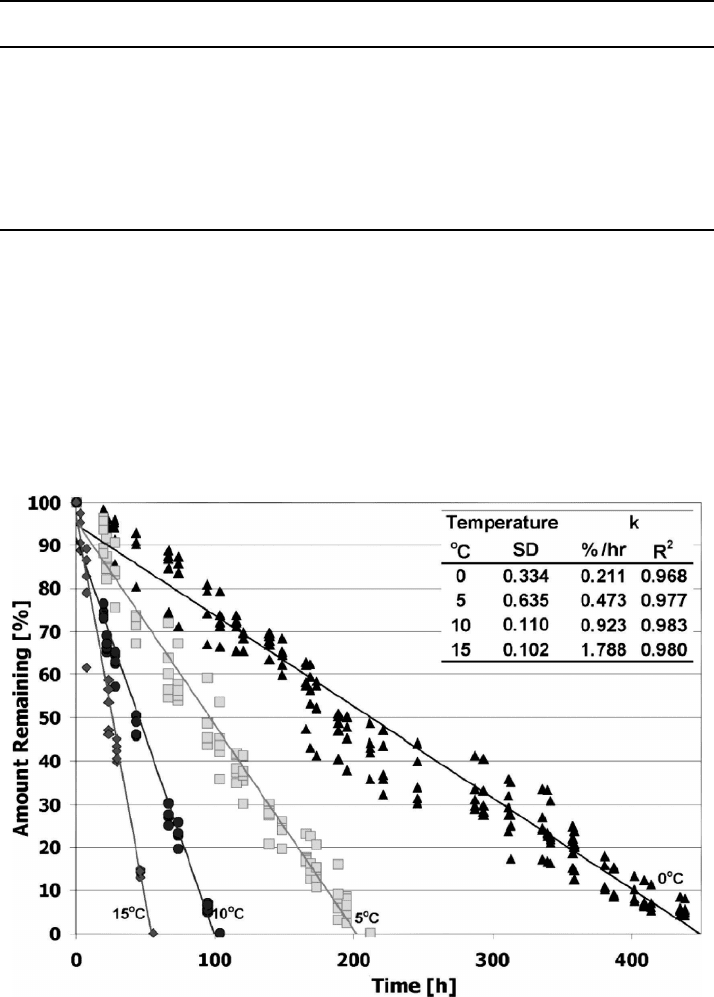
for seafood applications. An example of pseudo-zero order TTI response is given in Figure
5.5 for a Fresh-Check
r
TJ2 indicator [31]. In this case, the measured colourchange of the in-
dicator has been converted to a percentage (starting at 100 %) and plotted against time. Over
long timescales – well past expiry of the TTI – first order kinetics were detected. However,
over the indicator lifetime, linear responses were obtained for each of the temperatures
OTE/SPH OTE/SPH
JWBK126-05 JWBK126-Kerry March 15, 2008 18:57 Char Count= 0
84 Smart Packaging Technologies for Fast Moving Consumer Goods
Table 5.3 Activation energies for different spoilage mechanisms for seafood
Species Mechanism E
a
(kJ mol
−1
)
Fresh fish fillets
a
Spoilage ∼84 – 125
b
[24]
Fresh fish fillets
a
Toxins ∼50–84
b
[24]
Boque Microbial (Pseudomonas spp.) 81.6 ± 11.6 [29]
Boque Microbial (Shewanella putrefaciens) 82.7 ± 11.1 [29]
Cod fillet Spoilage 42.3
b
[25, 32]
Cod fillet Toxin 60.7
b
[25, 32]
Whiting fillet Spoilage 29.3
b
[25, 32]
Whiting Toxin 48.6
b
[25, 32]
a
Species not specified
b
Converted from kcal mol
−1
to kJ mol
−1
studied – as can be seen for the R
2
values for each of the trends. The expected faster re-
sponse for increasing temperatures can be readily observed – changes of 0.211 %/h observed
at 0
◦
C compared with 0.923 %/h at 10
◦
C; almost four times faster.
It would be a mistake, however, to assume that all spoilage mechanisms proceed in such
a simplistic manner; the effect of temperature on fish spoilage can often be non-linear, as
detailed in the followingexample.As notedearlier,assurances of proper temperature storage
for fish packaged in modified atmospheres are required in the US. Although MAP can
Figure 5.5 The response obtained for Fresh-Check
R
TJ2 indicators at different temperatures
over time. Reproduced from T.F. Mendoza, et al., Journal of Food Science, Vol. 69, (3), pp.
FMS90–FMS96. Copyright (2004), with permission of Blackwell Publishing.