
Kerry J., Butler P. Smart Packaging Technologies for Fast Moving Consumer Goods
Подождите немного. Документ загружается.

OTE/SPH OTE/SPH
JWBK126-03 JWBK126-Kerry March 19, 2008 10:2 Char Count= 0
44 Smart Packaging Technologies for Fast Moving Consumer Goods
materials such as enzymes, antigens, microbes, hormones and nucleic acids. Transducers
may be electrochemical, optical, calorimetric, etc., and are system dependent. Intelligent
packaging systems incorporating biosensors have the potential for extreme specificity and
reliability. Market analysis of pathogen detection and safety systems for the food packaging
industry suggests that biosensors offer considerable promise for future growth (Alocilja and
Radke, 2003).
The majority of available biosensor technology is not yet capable of commercial real-
isation in the food sector. ToxinGuard
TM
developed by Toxin Alert (Ontario, Canada) is
a visual diagnostic system incorporating antibodies printed on polyethylene-based plastic
packaging capable of detecting target pathogens such as Salmonella sp., Campylobacter sp.,
Escherichia coli 0517 and Listeria sp. (Bodenhammer, 2002; Bodenhammer et al., 2004).
When the food packaging comes into contact with targeted bacteria, a visual signal alerts
the consumer or retailer. Toxinguard
TM
can be targeted to detect freshness degradation, as
well as the presence of specific food hazards such as pesticides, or indicators of genetic
modification.
Bioett has developed a system based on a biosensor for temperature monitoring. The
Bioett System monitors the accumulated effect of temperature on products over time. The
system consists of a chipless RF circuit with a built-in biosensor that can be read with
a handheld scanner at various points in the supply chain. The information is stored in a
database and can be used to analyse the cold chain and validate that the agreed temperature
has been maintained. A Time Temperature Biosensor (TTB), attachedto 5-kg casesof frozen
meat balls, is activated at source. The biosensor registers the accumulated temperatures that
the product has been exposed to and this information can be used to optimise and monitor
the cold-chain distribution system. A scanner can read the biosensor via radio waves (radio
frequency) and also uniquely identifies the goods using a barcode system. The scanner also
incorporates a software defined radio subsystem that can also be used for reading of RFID
tags. Such systems give some insight into products likely to become more mainstream in
the years to come.
3.7 Indicators
Indicators may be defined as a substances that indicate the presence, absence or concen-
tration of another substance, or the degree of reaction between two or more substances by
means of a characteristic change, especially in colour. In contrast with sensors, indicators do
not comprise receptor and transducer components and communicate information through
direct visual change. Numerous forms of indicator exist.
3.7.1 Integrity Indicators
Another alternative approach to established package-destructive techniques for measuring
meat quality is the use of non-invasive indicator systems. Such systems usually provide
qualitative or semi-quantitative information through visual colorimetric changes or through
comparison with standard references. The majority of indicators have been developed to
test package integrity. The most common cause of integrity damage in flexible plastic
packages is associated with leaking seals (Hurme, 2003). Permanent attachment of a leak
OTE/SPH OTE/SPH
JWBK126-03 JWBK126-Kerry March 19, 2008 10:2 Char Count= 0
Smart Packaging of Meat and Poultry Products 45
indicator or sensor (i.e. visual or optochemical) to a package holds promise as a means of
ensuring package integrity through the distribution chain. A number of studies on package
integrity in MAP meat products (Eilamo et al., 1995; Randell et al., 1995; Ahvenainen et al.,
1997; Smolander et al., 1997) have established critical leak sizes and associated quality
deterioration. Standard (destructive) manual methods for package integrity and leak testing
are both laborious and can test only limited numbers of packs (Hurme, 2003). Currently
available non-destructive detection systems have other disadvantages such as requirements
for specialised equipment, slow sampling time and an inability to detect leakages that are
penetrable by pathogens (Stauffer, 1988; Hurme and Ahvenainen, 1998).
Much of the research into integrity detection has focused on visual oxygen indicators
for MA packaged products (the oxygen sensors discussed previously are also applicable to
integrity testing). With the exception of high oxygen content MA packaging of fresh meat
(primarily to enhance colour) many foods are packaged in low (0–2 %) atmospheres. In
such cases, leaks normally result in a significant increase in oxygen concentration. Many
visual oxygen indicators have been patented and are based mainly on the use of redox
dyes (Yoshikawa et al., 1987; Krumhar and Karel, 1992; Mattilla-Sandholm et al., 1995;
Davies and Gardner, 1996). Such devices have been tested as leak indicators in MA pack-
aged minced steaks and minced meat pizzas and reported as reliable (Eilamo et al., 1995;
Ahvenainen et al., 1997). Disadvantages of such devices include high sensitivity (colour
change resulting from oxygen concentrations as low as 0.1 % means that many indica-
tors are susceptible to residual oxygen in MA packs) and reversibility (undesirable where
leak-induced increases in oxygen are consumed through subsequent microbial growth).
Few of these devices have been taken up commercially. One indicator system, specifically
designed for MAP foods contains, in addition to an oxygen sensitive dye, an oxygen ab-
sorbing component and exemplifies active and intelligent packaging in a single system
(Mattila-Sandholm et al., 1998). In-line, non-destructive package leak detection systems
are not yet commercially viable due to high costs and a lack of reliability.
A number of companies have produced oxygen indicators, the main application of which
has been for the confirmation of proper functioning of oxygen absorbers. Trade names of
such devices include Ageless Eye
r
(Figure 3.5), Vitalon
r
, and Samso-Checker
r
.
A visual carbon dioxide indicator system consisting of calcium hydroxide (carbon diox-
ide absorber) and a redox indicator dye incorporated in polypropylene resin was described
by Hong and Park (2000) and may be applicable to certain meat packaging applications.
3.7.2 Freshness Indicators
The information provided by intelligent packaging systems on the quality of meat products
may be either indirect (e.g. changes in oxygen concentration within packs may imply quality
deterioration through established correlation) or direct. Freshness indicators provide direct
product quality information resulting from microbial growth or chemical changes within a
food product. Microbiological quality may be determined through reactions between indi-
cators included within the package and microbial growth metabolites (Smolander, 2003).
As yet the number of practical concepts of intelligent package indicators for freshness detec-
tion is very limited. Despite this, potential exists for the development of freshness indicators
based on established knowledge of quality indicating metabolites. The improved detection
of biochemical changes during storage and spoilage of foods (Dainty, 1996; Nychas et al.,
OTE/SPH OTE/SPH
JWBK126-03 JWBK126-Kerry March 19, 2008 10:2 Char Count= 0
46 Smart Packaging Technologies for Fast Moving Consumer Goods
AGELESS-EYE
®
Oxygen Indicator
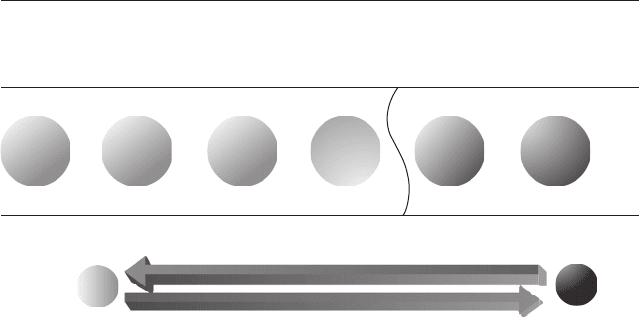
The AGELESS-EYE is an in-package monitor which indicates the presence
of oxygen at a glance.
Magnified
Pink Blue
No oxygen (0.1 % or less)
2.3 hours after oxygen reached zero (25
°
C)
about 5 minutes after contact with oxygen (25
°
C)
oxygen exists
Oxygen exists (0.5 % or more)
No oxygen
Figure 3.5 Ageless-Eye
R
by Mitsubishi Gas Chemical Co. used for oxygen detection. Repro-
duced with permission from Ageless sales, Mitsubishi Gas Chemical Co. Japan.
1998) provide the basis on which freshness indicators may be developed based on target
metabolites associated with microbiologically induced deterioration.
The formation of different potential indicator metabolites in meat products is dependent
on the interaction between product type, associated spoilage flora, storage conditions and
packaging system. A number of marker metabolites associated with muscle food products
exist upon which indicator development may be based.
Changes in the concentration of organic acids such as n-butyrate, l-lactic acid, d-lactate
and acetic acid during storage offer potential as indicator metabolites for a number of meat
products (Shu et al., 1993). Colour based pH indicators offer potential for use as indicators
of these microbial metabolites.
Ethanol, like lactic acid and acetic acid, is an important indicator of fermentative
metabolism of lactic acid bacteria. Randell et al. (1995) reported an increase in the ethanol
concentration of anaerobically MA packaged marinated chicken as a function of storage
time.
Biogenic amines such as histamine, putrescine, tyramine and cadaverine have been im-
plicated as indicators of meat product decomposition (Okuma et al., 2000; Kaniou et al.,
2001; Rokka et al., 2004). Given toxicological concerns associated with these compounds
and their lack of impact on sensory quality, the development of effective amine indicators
would be of benefit. Detection systems described by Miller et al. (1999) and Loughran and
Diamond (2000) provide potential for commercial development. In 1999, COX Technolo-
gies, USA, launched FreshTag
r
colourimetric indicator labels that react to volatile amines
produced during storage of fish and seafood products.
Carbon dioxide produced during microbial growth can in many instances be indicative of
quality deterioration. In MA packaged meat products containing high carbon dioxide con-
centration (typically 20–80 %), indication of microbial growthby changes in carbon dioxide
content is problematical, although application of pH dye indicators may hold promise in
other meat packaging systems.
OTE/SPH OTE/SPH
JWBK126-03 JWBK126-Kerry March 19, 2008 10:2 Char Count= 0
Smart Packaging of Meat and Poultry Products 47
Hydrogen sulfide, a breakdown product of cysteine with intense off-flavours and low
threshold levels, is produced during the spoilage of meat and poultry by a number of
bacterial species. It forms a green pigment(sulphmyocin) when bound to myoglobin and this
pigment formed the basis for the developmentof an agarose-immobilised, myoglobin-based
freshness indicator in unmarinated broiler pieces (Smolander et al., 2002). The indicator
was not affected by the presence of nitrogen or carbon dioxide and offers potential.
Freshness indicators based on broad spectrum colour changes have a number of disad-
vantages that need to be resolved before widespread commercial uptake is likely. A lack
of specificity means that colour changes indicating contamination can occur in products
free from any significant sensory or quality deterioration. The presence of certain target
metabolites is not necessarily an indication of poor quality. More exact correlations need to
be established between target metabolite, product type and organoleptic quality and safety.
The possibilities of false negatives are likely to dissuade producers from adopting indicators
unless specific indication of actual spoilage can be guaranteed.
3.7.3 Time–Temperature Indicators
Among the intelligent packaging solutions available, time–temperature indicators or inte-
grators (TTIs) are expected to witness the sharpest growth in sales in the next 5 years. A
time–temperature indicator or integrator (TTI) is defined as a device used to show a mea-
surable, time–temperature dependent change that reflects the full or partial temperature
history of the food product to which it is attached (Taoukis and Labuza, 1989). Operation
of TTIs is based on mechanical, chemical, electrochemical, enzymatic or microbiological
change, usually expressed as a visible response in the form of a mechanical deformation,
colour development or colour movement (Taoukis and Labuza, 2003). The visible response
thus gives a cumulative indication of the storage temperature to which the TTI has been
exposed. TTIs are classified as either partial history or full history indicators, depending
on their response mechanism. Partial history indicators do not respond unless a temperature
threshold has been exceeded and indicate that a product has been exposed to a tempera-
ture sufficient to cause a change in product quality or safety. Full history TTIs give a
continuous temperature-dependent response throughout a product’s history and constitute
the main focus of interest for research and commercial exploitation.
Essentially TTIs are small tags or labels that keep track of time–temperature histories to
which a perishable product is exposed from the point of manufacture to the retail outlet or
end-consumer. Their use in meat and poultry products, where monitoring of the cold distri-
bution chain, microbial safety and quality are of paramount importance, offers enormous
potential.
The basic requirement of an effective TTI is to indicate clear, continuous, irreversible
reaction to changes in temperature. Ideally, TTIs should also be low cost, small, reliable,
easily integrated into food packaging, have a long pre- and post-activation shelf-life and
be unaffected by ambient conditions other than temperature. TTIs should also be flexible
to a range of temperatures, robust, pose no toxicological or safety hazard and convey
information in a clear manner.
A large number of TTI types have been developed and patented, the principles and
applications of which have been reviewed previously (Taoukis and Labuza, 2003). TTIs
currently commercially available include a number of diffusion, enzymatic and polymer-
based systems, all of which offer potential in meat and poultry products.
OTE/SPH OTE/SPH
JWBK126-03 JWBK126-Kerry March 19, 2008 10:2 Char Count= 0
48 Smart Packaging Technologies for Fast Moving Consumer Goods
Diffusion-based TTIs. The 3M Monitor Mark
r
(3M Company, St Paul, Minnesota, USA)
is a non-reversible indicator dependent on the diffusion of a coloured fatty acid ester along
a porous wick made of high quality blotting paper. The measurable response is the distance
of the advancing diffusion front from the origin. The useful range of temperatures and the
response life of the TTI are determined by the type and concentration of ester.
Another diffusion-based TTI, Freshness Check
r
, produced by the same company incor-
porates a viscoelastic material that migrates into a diffusively light-reflective porous matrix
at a temperature dependent rate. This causes a progressive change in the light transmissivity
of the porous matrix and provides a visual response.
Enzymatic TTIs. The VITSAB
r
TTI (VITSAB A.B., Malm¨o, Sweden) is based on a colour
change induced by a drop in pH resulting from the controlled enzymatic hydrolysis of a
lipid substrate. The indicator consists of two separate compartments containing an aqueous
solution of lipolytic enzymes and another containing the lipid substrate suspended in an
aqueous medium and a pH indicator mix. Different enzyme–substrate combinations are
available to give a variety of response lives and temperature dependencies. Activation of
the TTI is brought about by mechanical breakage of a seal separating the two compartments
and may be done manually or by online automation. Hydrolysis of the substrate causes a
drop in pH and a subsequent colour change in the pH indicator from dark green to bright
yellow. Visual evaluation of the colour change is made by reference to a five-point colour
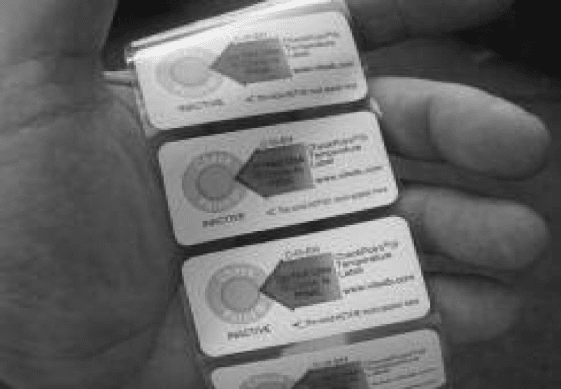
scale. CheckPoint
r
labels are the latest TTIs developed by VITSAB, which comprise a
label type designed to create a better subjective reading response for users and offer direct
application to poultry and ground beef products (Figure 3.6).
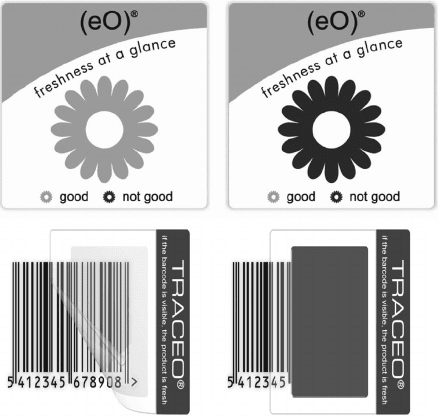
Cryolog (Gentilly, France) has developed two TTI systems relevant to the food industry.
(eO)
r
is an adhesive label TTI in the form of a small gel pad shaped like the petals of
a flower that changes from green (good) to red (not good) as shown in Figure 3.7. The
colour change represents a pH change due to microbial growth of food microorganisms
within the gel itself and its abrupt nature removes any possibility for confusion over whether
Figure 3.6 The TTI CheckPoint
R
system by Vitsab International, Sweden.
OTE/SPH OTE/SPH
JWBK126-03 JWBK126-Kerry March 19, 2008 10:2 Char Count= 0
Smart Packaging of Meat and Poultry Products 49
Figure 3.7 The TTI Cryolog system from Gentilly, France. Reproduced with permission from
Cryolog S.A., Gentilly, France.
the end point has been reached. TRACEO
r
is a transparent adhesive label, designed for
use on refrigerated products, placed over the barcode. It uses colouring and opacifying
reactions (colourless to red) to indicate when a product is no longer fit for consumption,
either because the product has reached its ‘use-by date’, or because it has been subject to
a critical accumulation of ruptures in the cold chain. Once the label is red the barcode is
rejected by the scanner at check-out.
Polymer-based TTIs. Lifelines Freshness Monitor
r
and Fresh-Check TTIs (Lifelines
Technology, Inc., Morris Plains, New Jersey, USA) are based on temperature dependent
polymerisation reactions in which diacetylene crystals polymerise via 1,4-addition poly-
merisation to a highly coloured polymer. Resulting changes in reflectance can be measured
by scanning with a laser optic wand. The Fresh-Check
r
consumer version uses a circular
label in which the colour of the inner circle is compared to that of an outer circle in order
to establish use-by status.
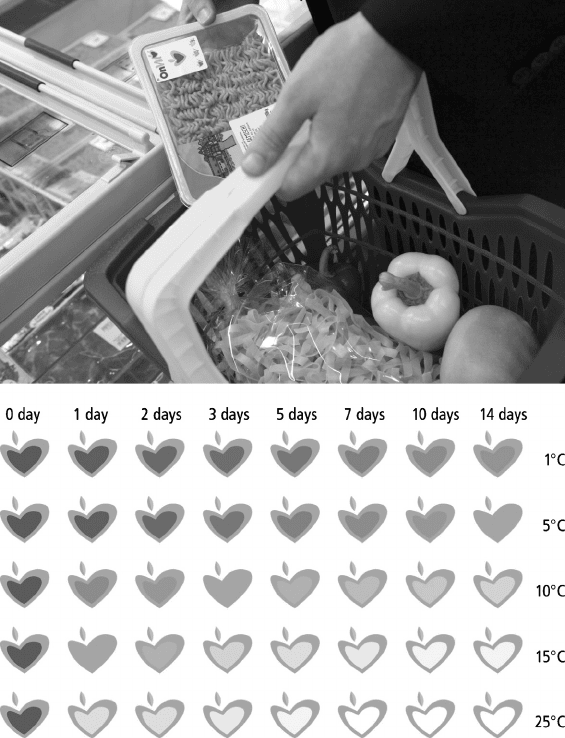
OnVu
TM
(Ciba Specialty Chemicals, Inc., Switzerland) produce TTI labels based on
organic pigments that change colour with time at rates determined by temperature. The TTI
labels consist of a heart shaped ‘apple’ motif containing an inner heart shape. The image is
stable until activated by UV light from an LED lamp, when the inner heart changes to a deep
blue colour. A filter is then added over the label to prevent it being recharged. The blue inner
heart changes to white as a function of time and temperature (Figure 3.8). The system can
be applied as a label or printed directly onto the package. Universal Product Codes (UPC)
or barcodes, are quintessential to food packaging. Data acquired from barcode readers
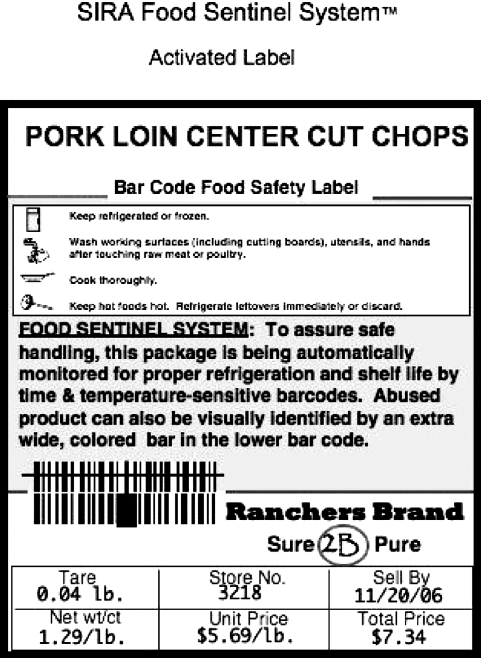
provides an enormous wealth of information. The Food Sentinel System
TM
from SIRA
Technologies in the USA uses a modified barcode containing a proprietary thermochromic
printing ink which is printed in non-scannable colour. On encountering product abuse, the
thermochromic ink changes to an irreversible deep magenta colour which is visible and will
OTE/SPH OTE/SPH
JWBK126-03 JWBK126-Kerry March 19, 2008 10:2 Char Count= 0
50 Smart Packaging Technologies for Fast Moving Consumer Goods
Figure 3.8 The TTI system OnVu
TM
from Ciba Specialty Chemicals, Inc., Switzerland. Re-
produced with permission from Ciba Speciality Chemicals Inc., Switzerland.
be detected during scanning (Figure 3.9). It is therefore capable of adding a temperature
and shelf-life monitor to any product barcode, thus preventing the sale of contaminated
food and archiving the incident.
A number of TTI systems have their histories read by RFID readers (see next section)
ratherthan by direct visual means. These include Bioett
r
,Timestrip
r
,KSW Microtec
r
and
TempTime
r
. The use of electronic readers allows storage of information and subsequent
downloading to local networks and databases.
A number of validation studies has been undertaken in order establish the usefulness of
TTIs to food products (Riva et al., 2001; Shimoni et al., 2001; Welt et al., 2003). Yoon et al.
(1994) showed a positive correlation between oxidative stability and TTI colour change
using a phospholipid/phospholipase-based TTI in frozen pork. Smolander et al. (2004)
OTE/SPH OTE/SPH
JWBK126-03 JWBK126-Kerry March 19, 2008 10:2 Char Count= 0
Smart Packaging of Meat and Poultry Products 51
Figure 3.9 The Food Sentinel System
TM
from SIRA Technologies in the USA. Reproduced
with permission from SIRA Technologies Inc., USA.
and Vainionp¨a¨a et al. (2004) determined the applicability of VITSAB
r
, Fresh-Check
r
and 3M Monitor
r
TTIs for monitoring the quality of MA packed broiler cuts at different
temperatures and in comparison with several standard analytical methods respectively.
In both studies, TTIs were closely correlated with microbiological analyses of spoilage
bacteria and were shown to be more effective than certain metabolic quality indices such
as spoilage-associated volatiles, biogenic amines and organic acids.
Initial expectations for the potential of TTIs to contribute to improved standards in food
distribution,quality and safety have not been realised to date. Factors such as cost, reliability
and applicability have all been influential in this regard. The cost of TTIs has been estimated
to range from $0.02 to $0.20 per unit (Taoukis and Labuza, 2003). Given normal economies
of scale, cost-benefit analysis should favour more widespread use of TTIs in due course.
The use of thermochromic inks (inks that change colour with temperature) is likely to
become more widespread particularly in the light of views that only printing can deliver
sophisticated electronic capabilities to packaging at a price that makes next generation TTIs
OTE/SPH OTE/SPH
JWBK126-03 JWBK126-Kerry March 19, 2008 10:2 Char Count= 0
52 Smart Packaging Technologies for Fast Moving Consumer Goods
economically viable. Recent developments in the area of printed electronics make such a
scenario a real possibility.
In recent years, TTI systems have achieved high standards of production and quality
assurance and can provide reproducible responses according to BSI specifications (BS
7908: 1999). A substantial hurdle to more extensive commercialisation of TTIs has been
the question of applicability. Generalisations on the relationship between temperature and
quality of food classes have provedinsufficient, as even foods of similar type differ markedly
in terms of response. For successful application of TTIs to meat and poultry products, and
food products in general, there is a requirement that the TTI response matches the behaviour
of the food. Whilst the expectation for a TTI to strictly match the behaviour of a foodstuff
over a wide temperature range is unfeasible, a thorough knowledge of the shelf-life loss
behaviour of a food system based on accurate kinetic models is essential (Taoukis and
Labuza, 2003). Advances in food modelling are now making this possible (Taoukis, 2001).
In 1991 a UK survey (Anonymous, 1991) indicated that 95 % of respondents (n = 511)
considered TTIs to be a good idea but indicated that substantial publicity or an educational
campaign would be required for general use. It is likely that such attitudes still apply today.
Despite predictions for the full commercial realisation of TTIs, adoption has been limited.
However, given technological development and greater consumer appreciation for the need
for food safety monitoring (particularly in meat products), analysts believe that TTIs will
find widespread commercial application in the food industry. The critical importance of
maintaining proper storage temperatures for meat and poultry products throughout the
distribution chain means that this sector of the food industry could be a major beneficiary
from such a development.
3.8 Radio Frequency Identification
Radio Frequency Identification (RFID) is an electronic, information-based form of intelli-
gent packaging. RFID uses tags affixed to assets (cattle, containers, pallets, etc.) to transmit
accurate, real time, information to a user’s information system. RFID is one of the many
automatic-identification technologies (a group which includes barcodes) and offers a num-
ber of potential benefits to the meat production, distribution and retail chain. These include
traceability, inventory management, labour saving costs, security and promotion of quality
and safety (Mousavi and Sarhadi, 2002). Prevention of product recalls is also considered
to be an important role of RFID technology (Kumar and Budin, 2005). RFID technology
has been available for approximately 40 years although its broad application in packaging
is a relatively recent development.
At its most basic level, an RFID tag contains a tiny transponder and antenna that have
a unique number or alphanumerical sequence; the tag responds to signals received from a
reader’s antenna and transmits its number back to the reader. While the tags are relatively
simple, much better inventory information than barcode or human entry systems can be
gained through tracking software. RFID tags have the advantage over barcoding in that tags
can be embedded within a container or package without adversely affecting the data. RFID
tags also provide a non-contact, non-line-of-sight ability to gather real-time data and can
penetrate non-metallic materials including bio-matter (Mennecke and Townsend, 2005).
Tags can hold simple information (such as identification numbers) for tracking or can carry
OTE/SPH OTE/SPH
JWBK126-03 JWBK126-Kerry March 19, 2008 10:2 Char Count= 0
Smart Packaging of Meat and Poultry Products 53
more complex information (with storage capacity at present up to about 1 MB) such as
temperature and relative humidity data, nutritional information, cooking instructions, etc.
Read-only and read/write tags are also available depending on the requirements of the
application in question.
Tags are classified according to two types: active tags function with battery power,
broadcast a signal to the RFID reader and operate at a distance of up to 50 metres. Passive
tags have a shorter reading range (up to about 5 metres) and are powered by the energy
supplied by the reader (giving them essentially unlimited life).
Common RFID frequencies range from low (∼125 KHz) to UHF (850–900 MHz) and
microwave frequencies (∼2.45 GHz). Low frequency tags are cheaper, use less power and
are better able to penetrate non-metallic objects. These tags are most appropriate for use
with meat products, particularly where the tags might be obscured by the product itself and
are suitable for close-range scanning of objects with high water content.
The costs of RFID are decreasing as major companies such as Wal-Mart, 7-Eleven
and Marks & Spencer adopt the technology. At present, the cost of passive RFID tags
ranges from approximately $0.50 to $1.00. For the technology to be truly competitive it
is estimated that tags must cost less than $0.05 (others believe tags must be available at
less than $0.01) (Want, 2004). Opinion on possible cost developments differs. Mennecke
and Townsend (2005) reported that tags are expected to fall to the $0.01 per tag level after
2007, although concern remains that tags will be prove too expensive for individual food
product monitoring. Initiatives to establish formal standards should serve to reduce further
the cost of RFID. The use of organic semiconductor materials, capable of being coated
on flexible substrates such as plastics, to create electronic circuits is apparently close to
commercial realisation. It is forecast that such printable electronics will be widely available
within two or three years. Such a development would see the price of RFID tags drop to
that of bar-codes and catalyse the spread of RFID technology.
At present, a number of countries are using RFID to trace individual animals (mainly
cattle) from birth to the processing plant. The key to individual animal traceability lies in
the ability to transfer animal information sequentially and accurately to sub-parts of the
animal during production. RFID-based tracking systems provide an automated method of
contributingsignificantly to that information exchange(Mennecke and Townsend,2005). At
present, individually RFID tagged meat products are not available to the consumer, although
the use of RFID tagging of meat cuts has extended to the pig processing industry (Dalehead
Foods, Cambridge, UK), where tracking occurs from the individual pig to its subsequent
primal pieces, i.e. hams. Although the purpose of this tracking scheme is for quality control,
employee accountability and precision cutting, and does not extend beyond the cutting room
floor or provide information about the individual animal with the final product, it does
exemplify the developing use of RFID technology within the meat industry. In another
instance, RFID has been used to track boxed imported beef into the UK from Africa.
The effective use of RFID is extremely specific to the immediate environment in which
the technology is applied. Customised system design and trials to minimise localised in-
terferences are necessary to establish properly functioning systems. Such requirements,
along with a poorly understood cost efficiencies, are contributing to a slow uptake of this
technology in the meat industry. The implementation of RFID technology as an intelli-
gent packaging strategy for meat products is still largely hypothetical. Should the fore-
casts for an exponential, multi-sector increase in RFID use come to be realised, it is