
Kerry J., Butler P. Smart Packaging Technologies for Fast Moving Consumer Goods
Подождите немного. Документ загружается.


OTE/SPH OTE/SPH
JWBK126-04 JWBK126-Kerry March 3, 2008 12:54 Char Count= 0
Application of Time–Temperature Integrators 65
This approach would require an unlimited number of TTI models. Instead, a methodology
of translating TTI response to product quality status based on systematic modelling of both
the TTI and the food could be used as a tool for product quality monitoring and shelf life
management.
Determination and modelling of the shelf life or keeping quality of perishable consumer
products is the most important prerequisite for the application of a TTI-based monitoring
and management system, usually evaluated by the measurement of the change of one or
more characteristic quality indices, A, with time t. The selected indices can be chemical (like
development of off flavours or off colours from oxidations or other chemical reactions, loss
of an active component like a nutrient, a cosmetic or a therapeutic ingredient), biological
(microbial growth, enzymatic deterioration) or physical (texture loss, phase separation).
The change of indice A can be expressed as
f (A) = k(T )t (1)
where f(A)isthequality function of the product and k the reaction rate constant.
The rate constant is an exponential function of inverse absolute temperature, T, given by
the Arrhenius expression,
k = k
ref
exp
−E
A
R
1
T
−
1
T
ref
(2)
where k
ref
is the reaction rate constant at a reference temperature T
ref
, E
A
is the activation
energy of the reaction that controls quality loss and R the universal gas constant. The form
of the quality function of the product depends on the reaction order of the phenomenon
controlling the deterioration of the product, e.g. f(A) =ln (A
o
/A
t
) for n =1 order and f(A) =
[A
t
1−n
− A
o
1−n
]/n−1 for n = 1. The activation energy of food related chemical reactions
and spoilage or pathogenic microbial growth usually falls within 30–140 kJ/mol (Taoukis
et al., 1997).
The value of the quality function, f(A)
t
, at time t, after exposure of the product at a known
variable temperature exposure, T(t), can be found based on Equation (1) by calculating the
integral of k[T(t)] dt, from 0 to time t. We can define the effective temperature, T
eff
, as the
constant temperature exposure to which for the same time results in the same quality value,
f(A)
t
, as the variable temperature distribution, T(t). The same kinetic approach can be used
to model the measurable change X of the TTI. If a response function F(X) can be defined
such that F(X) = kt, with k an Arrhenius function of T, then the effective temperature
concept as described above can also be used for the TTI. For an indicator exposed to the
same temperature distribution, T(t), as the food product, and corresponding to an effective
temperature T
eff,
the response function can be expressed as
F(X)
t
= k
I
ref
exp
−E
A
I
R
1
T
eff(TTI)
−
1
T
ref
t (3)
where k
I
ref
and E
A
I
are the Arrhenius parameters of the indicator.
Thus for applying a TTI based product quality monitoring scheme we need to define
experimentally the quality function of the product, the response function of the TTI and
the respective kinetic parameters. From the measured response X of the TTI at time t the
value of the response function is calculated, from which by solving Equation (3), the T
eff
of the exposure is derived. With the T
eff
and the kinetic parameters of the product known,
OTE/SPH OTE/SPH
JWBK126-04 JWBK126-Kerry March 3, 2008 12:54 Char Count= 0
66 Smart Packaging Technologies for Fast Moving Consumer Goods
the quality function value is calculated from Equations (2) and (1), and the value of index
A is found. This gives the extent of the quality deterioration of the product and allows the
calculation of the remaining shelf-life at any reference conditions.
The developed principles give a potential user the ability to select and apply the most
appropriate TTI without the need for extensive side-by-side testing of the product and the
TTI. A TTI with an activation energy E
A
I
that differs from the product’s E
A
by less than
20 kJ/mol would result in a T
eff
estimation of the product within ±1
◦
C.
Based on TTI testing and the described principles, the response function and the response
rate of different TTIs has been reported (Taoukis et al., 1999; Taoukis, 2001; Mendoza et al.,
2004; Giannakourou and Taoukis, 2002; Giannakourou et al., 2005). More recent testing
has been conducted by the author’s research group (Taoukis, 2007, unpublished data).
The Arrhenius parameters that describe the temperature dependence of the response were
obtained by plotting the logarithm of the response rate constant versus temperature (1/T)
and calculating the best statistical fit.
All tested TTIs can be tuned with regards their total response time from few hours to
several weeks and thus cover the required monitoring time for the different perishable
products. Most TTIs have to be manufactured with different specifications to achieve this
(e.g use different enzyme or chemical concentration). The OnVu TTI has the flexibility to
set the response length by selection of activation time.
The second requirement is that the temperature dependence of the quality of the products
expressed by the E
A
value should be similar to the E
A
of the TTI response. The TTIs fall in
the useful range with the Checkpoint and the OnVu showing the widest range and flexibility
of setting the E
A
value. The Fresh Check and TT Sensor basically have fixed E
A
value in
the middle of the range, where most but not all products fall.
The response signal is the parameter that determines the ease of reading of the TTI.
The Checkpoint and eO TTIs change from green to red, a change that is understandable
and discernible by the consumer. The TTsensor changes from yellow to bright pink. The
Fresh-Check change is from transparent to dark blue and the OnVu from dark blue to white.
All configurations are easy to read visually and translated if the correct message follows
the TTI and if the appropriate training is provided to the chill chain personel.
Other aspects that can be considered when evaluating a TTI have to do with their appli-
cability. All tested TTIs come as shelf adhesive labels suitable for high speed application on
the food product packages. Additionally the OnVu TTI can be pre-applied on the packaging
material as a temperature sensitive ink.
Another issue concerns the TTI stability before application. The Fresh-Check and eO
TTIs are active from the time of production and have to be stored and transported frozen.
At these temperatures the rate of change is practically zero. The other three types are
activated at application. The Checkpoint has two separate compartments with the enzyme
and substrate. The separating seal is broken by pressure at the time of application, and
enzyme and substrate are mixed to start the reaction, which translates into the colour
response of the TTI. The Checkpoint before use is cold stored to assure stability and full
activity of the enzyme. However this TTI can be also stored in ambient temperature for
short times, e.g. during transportation. The TT Sensor and OnVu TTI can be stored at
ambient conditions before activation for long times. TT sensor is activated by attaching
the top polymer layer so that diffusion starts. The OnVu is activated by exposure to a UV
source for a preset time (5–30 s) that will also determine the total response time.
OTE/SPH OTE/SPH
JWBK126-04 JWBK126-Kerry March 3, 2008 12:54 Char Count= 0
Application of Time–Temperature Integrators 67
Another practical index is of course cost. Cost per TTI unit depends on the TTI technology
but also very much on the production volume. At this moment no TTI is produced in high
enough volumes so only estimates can be obtained. Based on these estimates and indicative
quotes from the TTI developers cost could range from 1 to 15 Euro cents.
The characteristics of all the tested TTIs are summarized in Table 4.1.
4.3 Cold Chain Management
The information provided by the TTI smart labels, translated to remaining shelf life at any
point of the cold chain, can be used to manage shelf-life by improving distribution control
and stock rotation practices. The approach currently used is the First-In/First-Out (FIFO)
system according to which, products received first and/or with the closest expiration date
on the label are shipped, displayed and sold first. This approach aims at establishing a
‘steady state’ with all products being sold at the same quality level. The assumption is
that all products have gone through uniform handling, thus quality is basically a function
of time. The use of the indicators can help to establish a system that does not depend on
this unrealistic assumption. The objective is again a ‘steady state’ situation with the least
remaining shelf life products being sold first. This approach was coded LSFO (Least Shelf-
life First Out). The LSFO reduces the number of rejected products and largely eliminates
consumer dissatisfaction since the fraction of product with unacceptable quality at the
time of use or consumption is minimized. LSFO aims at reducing the rejected products
at the consumer end, by promoting, at selected decision making points of the product
life cycle, those product units with the shorter shelf-life, according to the response of the
attached TTI (Taoukis et al., 1998; Giannakourou and Taoukis, 2002). LSFO allows the
calculation of the actual remaining shelf life of individual product units at strategic control
points of the chill chain. Based on the distribution of the remaining shelf life, decisions
can be made for improved handling, shipping destination and stock rotation. A further
improvement of the LSFO approach, is a chill chain management system coded SLDS
(Shelf-Life Decision System) (Giannakourou and Taoukis, 2003). Compared with LSFO,
SLDS policy additionally takes into account the realistic variability of the initial quality
state A
o
of the product.
The state of the TTI technology and of the scientific approach with regard to the quanti-
tative safety risk assessment in foods allows the undertaking of the next important step, i.e.
the study and development of a TTI-based management system that will assure both safety
and quality in the food chill chain (Koutsoumanis et al., 2005). The development and appli-
cation of such a system, coded with the acronym SMAS, was the target of the multinational
European research project ‘Development and Modeling of a TTI based Safety Monitoring
and Assurance System (SMAS) for chilled Meat Products’ (project QLK1-CT2002-02545,
2003-2006; http://smas.chemeng.ntua.gr). SMAS uses the information from the TTI re-
sponse at designated points of the chill chain, ensuring that the temperature-burdened
products reach consumption at acceptable quality level. Although SMAS is developed for
meat products the same principles can be effectively applied to the management of the chill
chain of all chilled food or non-food perishable products.
The effectiveness of the TTI based SMAS system was evaluated by running a large num-
ber of chill chain scenarios using a Monte Carlo simulation approach. Field test experiments

OTE/SPH OTE/SPH
JWBK126-04 JWBK126-Kerry March 3, 2008 12:54 Char Count= 0
Table 4.1 TTI properties
E
A
range
Type of TTI Operation principle Response type Response range (kJ/mol) Activatable Cost
a
CheckPoint
R
Types M, L Enzymatic Tricolour Green to yellow
to red Hours to weeks at 4
◦
C 70–170 Y B
Fresh-Check
R
Polymeric Colourless to blue Hours to weeks at 4
◦
C 80–90 N A
OnVuTM Photochemical Dark blue to colourless Hours to weeks at 4
◦
C 90–150 Y A
TT SensorTM Diffusion-reaction Yellow to pink Hours to weeks at 4
◦
C 115–125 Y B
eO Microbiological Green to red Hours to weeks at 4
◦
C 100–110 N B
a
A: 1–5 cents, B:5–15 cents
OTE/SPH OTE/SPH
JWBK126-04 JWBK126-Kerry March 3, 2008 12:54 Char Count= 0
Application of Time–Temperature Integrators 69
to demonstrate and quantify the improvement at the time of consumption in comparison to
the conventional First-In/First-Out (FIFO) rule, were also conducted.
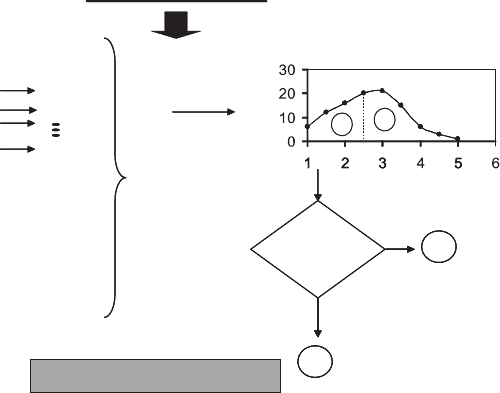
The SMAS decision making routine at a specified control point of the chill chain is
based on the microbial growth that has potentially occurred within the period between
production and arrival of the product at the control point. The growth is estimated based
on the product’s characteristics and the time–temperature history of the product using
the appropriate predictive model. The above elements form the programme core of an
integrated software that allows the calculation of growth in individual product units (e.g.
small pallets, 5–10 kg boxes or single packs) at strategic control points of the chill chain.
Based on the relative growth, it is possible to make decisions for optimal handling, shipping
destination and stock rotation, aiming to obtain a narrow distribution of quality at the point
of consumption. At a certain point of the chill chain, e.g. at a distribution centre, product
from the same initial shipment is split in half and forwarded to two different retail markets,
one close and a distant one that requires long transportation. The split could be random
according to conventional, currently used FIFO practice or it can be based on the actual
microbial growth of the product units and the developed decision system. For all units,
the time–temperature history of the product, monitored by TTI, is input. This information
directly fed into a portable unit with the SMAS software, is translated to microbial status,
N
t
, based on the growth models of the pathogen of concern. Having calculated N
t
for all
the n product units, a microbial load distribution for the products at the decision point is
constructed. Based on the load of each product unit relative to this distribution, decisions
about its further handling are made (Figure 4.7).
A
B
med
B
A
N (i)
?
(2)
N (n)
N (n – 1)
N (n)
N
t
distribution
N
t
(1)
N
B
A
t
< N
med
?
TRUE
FALSE
SMAS based split
N
t
(1)
N
t
´
´
´
´
´
´
´
t
N
t
(3)
t
N
t
(1)<..<N
t
(i)<…<N
t
(n)
÷÷ 2
t
N
t
(2)
N
t
(n − 1)
N
t
(3)
´´ ´
Figure 4.7 Classification of products based on their microbial load and rationale of SMAS
based split at the decision point (where A and B are the two possible destinations, the distant
and the local market).
OTE/SPH OTE/SPH
JWBK126-04 JWBK126-Kerry March 3, 2008 12:54 Char Count= 0
70 Smart Packaging Technologies for Fast Moving Consumer Goods
In order to simulate the results of the application of the developed SMAS system and
quantitatively prove its effectiveness the Monte Carlo method can be applied (Koutsoumanis
et al., 2005). By taking into account the status of the product after production and various
temperature distributions at different steps and alternative storage conditions, the distribu-
tion of the quality of the studied set of products at the final stage of consumption can be
estimated.
To confirm the SMAS effectiveness appropriate experiments were also designed and
conducted. One such experiment is described below to demonstrate the SMAS approach
and the kind of information required for its application.
Modified-atmosphere-packed fresh pork cuts, were used in the experimental chill chain
simulation. Two sets of experiments were conducted. The first was used to model the
growth of the natural spoilage microflora of the products and the second for the ‘field
test’ experiment. Fifty 600-g MA packaged pork cuts (60 % CO
2
, 40 % air) were stored
under controlled isothermal conditions (0, 5 and 10
◦
C) in high-precision (±0.2
◦
C) low-
temperature incubators. Samples were taken at appropriate time intervals to allow for
efficient kinetic analysis of microbial growth. Total plate count and lactic acid bacteria, the
dominant spoilage flora at these conditions were measured. Sensory evaluation was also
conducted at each sampling time.
Lactic acid bacteria were the dominant organisms at all temperatures in MAP samples.
The growth data of spoilage bacteria of pork cuts stored at different isothermal conditions
(0, 5, 10
◦
C) were modelled as a function of time using the Baranyi model, and the kinetic
parameters (exponential growth rate constant k, lag phase) were estimated. The temper-
ature dependence of the kinetic parameters was modelled using the Arrhenius equation
The Arrhenius model sufficiently described the temperature dependence of the growth of
spoilage lactic acid bacteria. At all temperatures, growth of lactic acid bacteria, which is
a well established spoilage index for MAP chilled meat, followed closely the decrease of
sensory quality. End of shelf-life coincided with an average level of log 7.2 of lactic acid
bacteria within the studied range of temperatures.
For the field test the same major meat packer supplied 72 MAP units of packed pork
cuts. The transportation of the products from production site in the island of Crete to
Athens (NTUA) took 18 hours. They were distributed in different trucks and at different
locations within the trucks. Electronic data loggers recorded the temperature for all 72
products during the transportation. On half of the products, TTIs were attached to be han-
dled with the SMAS approach, the rest were handled according to the FIFO approach. Two
different enzymatic TTI tags were used for each package at time of production; M4-10
and L5-8 (CheckPoint
r
TTI). The M4-10 was designed to expire within 10 days at 4
◦
C,
thus serving as a shelf life indicator at the end of the storage (E
A
= 88 kJ/mol). L5-8
having a higher activation energy (E
A
= 200 kJ/mol), and being more temperature sen-
sitive, expire within 2 days at 10
◦
C, serving as indicator at the time of split (decision
point).
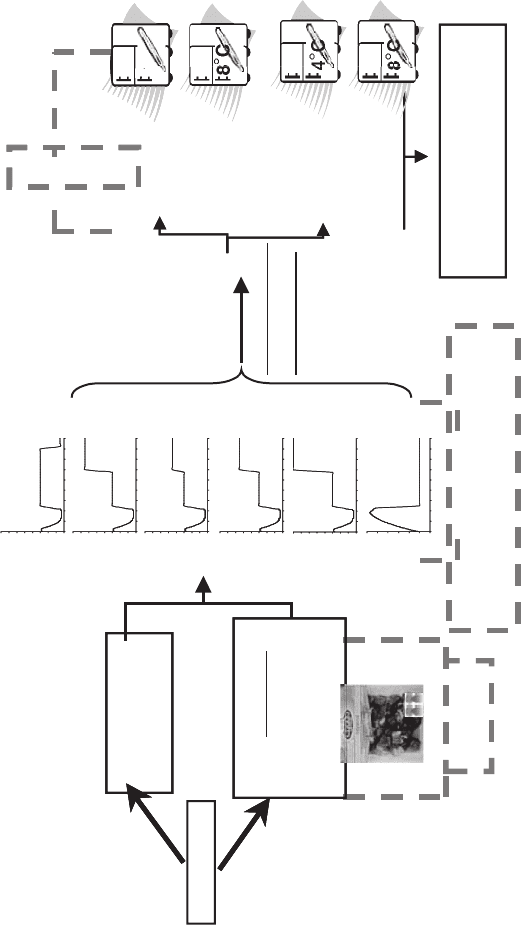
Simulated testing of distribution and storage of MAP packed pork cuts was conducted.
All products were stored in programmable cabinets simulating the conditions of the real
chill chain to the point of consumption. The simulated chill chain conditions consisted of
six different time–temperature scenarios (including the 18 hours’ storage during the transfer
from the meat producer and packer to the laboratory) that were conducted in programmable
controlled temperature cabinets (Figure 4.8).
OTE/SPH OTE/SPH
JWBK126-04 JWBK126-Kerry March 3, 2008 12:54 Char Count= 0
3
rd
step
o
C
10
15
20
25
30
16 32 48 64
time (h)
-1
1
3
5
7
9
11
13
15
16 32 48 64
–1
2
nd
step
72 h at various T tconditions
SMAS
based split
Decision point
T
TIs reading
Microbiological analysis
4
th
step
1
st
step
72 packages
36 Packages
2 TTI tags
attached on
each package
36 packages
without TTIs
L5-8M4-5
Local
market
o
C
24, 48, 72h
Export
market
90, 114, 138h
0
5
10
15
20
25
30
0 8 24 40 56 72
-1
1
3
5
7
9
11
13
15
0 8 24 40 56 72
times (h)
Temperature (°C)Temperature (°C)
Temperature (°C)
Temperature (°C) Temperature (°C)
–1
1
3
5
7
9
11
13
15
0 8 16 24 32 40 48 56 64 72
time (h)
–1
1
3
5
7
9
11
13
15
0 8 16 24 32 40 48 56 64 72
time (h)
Temperature (°C)
1
3
5
7
9
11
13
15
0 8 16 24 32 40 48 56 64 72
time (h)
–1
1
3
5
7
9
11
13
15
0 8 16 24 32 40 48 56 64 72
time (h)
8
°
C
8
°
C
4
°
C
4
°
C
Figure 4.8 Design of the field test for pork cuts products.
OTE/SPH OTE/SPH
JWBK126-04 JWBK126-Kerry March 3, 2008 12:54 Char Count= 0
72 Smart Packaging Technologies for Fast Moving Consumer Goods
Colour change readings of the attached TTIs were taken throughout the field test at
appropriate times corresponding to critical stages of the actual transportation process at
a designated decision time simulated to be the distribution centre, 72 hours after meat
production and packaging TTI visual reading was conducted with an eight-stage TTI colour
reference scale (Figure 4.1).
According to TTI colour scores and using the SMAS Decision Maker Software all SMAS
products (36) were sorted according to their actual temperature history as obtained by the
TTIs. After sorting, the products were split into two groups, products for ‘local’ market and
products for ‘distant’ market, for further handling. The 36 samples that had no TTI attached
were split randomly. After split at the decision point, samples were split and stored at 4
◦
C
and 8
◦
C.
Microbiological analyses of the meat products were conducted at six different stages.
Products that belonged to the local market group were microbiologically analysed at three
stages; 24, 48 and 72 hours after the split. Products coded as products for the distant market
were microbiologically analysed 90, 114 and 138 hours after the split.
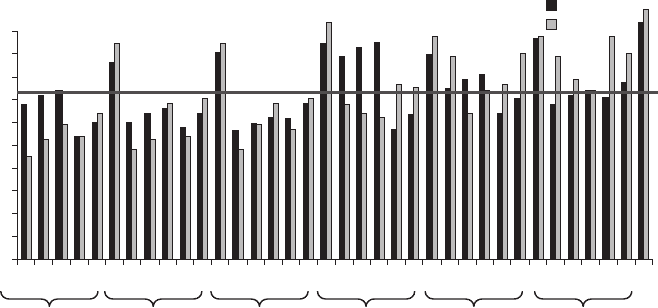
For the field test microbiological results after storage (at 4 and 8
◦
C) at different times
following the split are shown in Figure 4.9.
According to the field test results as illustrated in Figure 4.8, 33 % of samples reach the
spoilage level of log7.2 with the FIFO approach and 16 % when the SMAS split is applied.
Similar results are obtained by Monte Carlo calculations using the above microbial growth
model.
The overall results from this and other field tests with a variety of meat products and
the Monte Carlo simulation showed that the SMAS sorting at a decision point worked
satisfactorily thus demonstrating the usefulness of TTI monitoring and the applicability of
SMAS.
In summary, SMAS uses the information from the TTI, at appropriate points of the cold
chain (e.g at a central distribution centre), to make decisions for the further management
of products based on their temperature history and hence quality and safety status. The
0
1
2
3
4
5
6
7
8
9
10
1
3
5
7
9
11
13
15
17
19
21
23
25
27
29
31
33
35
Lactic acid bacteria log counts
SMAS
FIFO
24*h 48*h 72*h 90*h 114*h 138*h
Figure 4.9 Measured lactic acid bacteria log counts for each date of microbiological analysis
for all 72 samples (
∗
hours after the split).
OTE/SPH OTE/SPH
JWBK126-04 JWBK126-Kerry March 3, 2008 12:54 Char Count= 0
Application of Time–Temperature Integrators 73
0
5
10
15
20
25
30
–40 40 80 120 160
SPOILED
PRODUCTS
0
5
10
15
20
25
30
2
00
Remaining shelf life at 5
°
C (hours)
% Products
SMAS handled products
FIFO handled products
S
P
O
IL
E
D
P
R
O
D
UCT
S
SPOILED
PRODUCTS
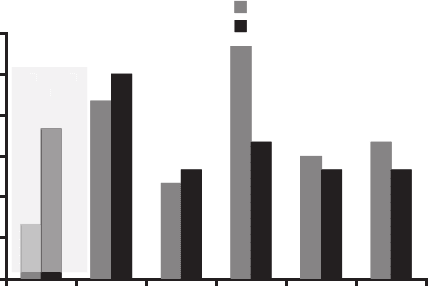
Figure 4.10 Distribution of the remaining shelf-life of meat products at the time of ‘consump-
tion’ with FIFO and SMAS approach.
conducted work established the applicability of the TTI based SMAS approach in improving
the meat chill chain. The overall work showed that the SMAS based sorting at a decision
point resulted in substantially reducing the spoiled products at the time of consumption in
comparison with the conventional FIFO approach (Figure 4.10). Similarly the risk factor (i.e
the probability that the pathogen might exceed a specified level) was significantly reduced
(Koutsoumanis et al., 2005).
Cold chain optimization and effective management will be a central issue in striving
for food and other perishable consumer products of higher quality, in the coming years,
both in research, industrial practice and regulatory efforts. Integrated systems, like the pro-
posed SMAS based on the availability of quality data and temperature history of individual
product units will be applied and validated in practice. TTIs will be combined with RFID
technology and all will supplement and benefit from the traceability requirements that are
being currently put in place by regulation and by industry initiative.
Acknowledgements
Part of the information contained in this chapter stems from research supported from the
Commission of the European Communities, FP5 Quality of life RTD Project SMAS, QLK1-
CT-2002-02545 (http://smas.chemeng.ntua.gr) and the FP6 Collective Research Project
FRESHLABEL COLL-CT-2005-012371.
References
Giannakourou M.C., Koutsoumanis K., Nychas G.J.E., Taoukis P.S. (2001). Development and as-
sessment of an intelligent shelf life decision system for quality optimisation of the food chill chain.
J. Food Prot., 64, 1051–1057.
OTE/SPH OTE/SPH
JWBK126-04 JWBK126-Kerry March 3, 2008 12:54 Char Count= 0
74 Smart Packaging Technologies for Fast Moving Consumer Goods
Giannakourou M.C., Taoukis P.S. (2002). Systematic application of time temperature integrators as
tools for control of frozen vegetable quality. J. Food Sci., 67, 2221–2228.
Giannakourou M.C., Taoukis, P.S. (2003). Application of a TTI-based distribution management
system for quality optimisation of frozen vegetables at the consumer end. J. Food Sci., 68, 201–
209.
Giannakourou M.C., Koutsoumanis K., Nychas G.J.E., Taoukis P.S. (2005). Field evaluation of the
application of time temperature integrators for monitoring fish quality in the chill chain, Int. J. Food
Micro., 102, 323–326.
Koutsoumanis K., Taoukis P.S., Nychas G.J.E. (2005). Development of a safety monitoring and
assurance system (SMAS) for chilled food products. Int. J. Food Micro., 100, 253–260.
Mendoza T.E., Welt B.A., Otwell, S., Texeira, A.A., Kristonsson H., Balaban, M.O. (2004). Kinetic
pameter estimation of time-temperature integrators intended for use with packaged fresh sea food.
J. Food Sci., 69, 90–96.
Taoukis, P.S. (2001). Modelling the use of time–temperature indicators in distribution and stock
rotation. In: Food Process Modelling, L. Tijskens, M. Hertog and B. Nicoloi (Eds). Woodhead
Publishing Limited, Cambridge, UK, pp. 402–428.
Taoukis P.S., Labuza T.P. (1989). Applicability of time temperature indicators as shelf life monitors
of food products. J. Food Sci., 54, 783–788.
Taoukis P.S., Labuza T.P. (2003). Time-temperature indicators (TTI). In: Novel Food Packaging
Techniques. R. Ahvenainen (ed.) Woodhead Publishing Limited, Cambridge, UK and CRC Press
LLC, Boca Raton FL, USA, pp. 103–126.
Taoukis P.S., Bili M., Giannakourou M. (1998). Application of shelf life modeling of chilled salad
products to a TTI based distribution and stock rotation system. In: Proceedings of the International
Symposium on Applications of Modelling as an Innovative Technology in the Agri-food Chain.
Tijkens LMM, Hertog MLATM (eds). Acta Horticulturae, 476, 131–140.
Taoukis P.S., Koutsoumanis K., Nychas G-J.E. (1999). Use of time temperature integrators and
predictive modeling for shelf life control of chilled fish under dynamic storage conditions. Int. J.
Food Microbiol., 53, 21–31.
Taoukis, P., Labuza, T. P., Saguy, I. (1997). Kinetics of food deterioration and shelf-life prediction. In:
The Handbook Of Food Engineering Practice. K.J. Valentas, E. Rotstein, R.P. Singh (eds), CRC
Press, Boca Raton FL, USA, pp. 361–403.