
Kerry J., Butler P. Smart Packaging Technologies for Fast Moving Consumer Goods
Подождите немного. Документ загружается.


OTE/SPH OTE/SPH
JWBK126-10 JWBK126-Kerry March 3, 2008 13:16 Char Count= 0
10
The Influence of Product
and Packaging Characteristics
on Passive RFID Readability
Robb Clarke
10.1 Introduction
Many people assume that once you purchase and set up an RFID system, all you have to do
is turn it on to get information that will help you save money. Of course, nothing is further
from the truth, not only because an RFID reader system is somewhat more complex that
simply plug-and-play, but also because the articles you are trying to read may actually be
interfering with data collection. More often than not, they are, and if you are not aware of
this, you are doomed to wasted time, energy and resources in pursuit of useable information.
To get something of use from this chapter, you must realize why the focus on packaging
andmaterials is important. First of all, everything that ismade and/or transported is packaged
in some manner. All industries and companies use packaging, so there is no one that can
skip the lessons to be learned herein.
Various product or package materials can hinder reads, though in some instances, they
might be of help. What is important is being able to capture the reads you want so that
you can act upon the results generated. It must also be recognized that RFID reads are
a condition of the product composition as well as the packaging and handling materials
being used. You must not fall into the trap of being conditioned to believe axioms such as
‘RFID will not work around metals or water’, though in many cases this is true. Still, there
are many instances where this is really not a concern, depending on how the read system
is configured. Further, flatly stating that RFID can easily read through certain materials,
Smart Packaging Technologies for Fast Moving Consumer Goods Edited by Joseph Kerry and Paul Butler
© 2008 John Wiley & Sons, Ltd. ISBN: 978-0-470-02802-5
OTE/SPH OTE/SPH
JWBK126-10 JWBK126-Kerry March 3, 2008 13:16 Char Count= 0
168 Smart Packaging Technologies for Fast Moving Consumer Goods
like paper, is equally incorrect in many cases. Hence, knowing how materials play a role
in RFID readability will help you get the information to determine accurately the benefits
or detriments of a given product/package system.
10.2 What is Packaging?
Packaging is a unique field in that hardly anyone considers a package system unless it
doesn’t perform its intended job. Every day, billions of packages are handled, used, re-
sealed, stored and recycled with nary a consideration. However, let that one package
leak or not open properly and people curse aloud while impugning the heritage of those
that designed it. While some of us declare, with tongue-in-cheek, that packaging is the
center of the universe, consider the difficulty in advancing beyond basic hunting and
gathering without proper means of handling food or storing goods to last a drought or
winter.
Packaging has been defined as the enclosure for products, items, or other packages, such
as a wrap, pouch, bag, box, cup, tray, can, tube, bottle, or other container form, to perform
one or more of the following major functions [1]:
r
containment,
r
protection and/or preservation,
r
communication and/or identification,
r
utility.
Containment, the original function of packaging, refers to handling, transportation and
use. This basic requirement enables product movement. Imagine the handling and trans-
portation of drinking water or free flowing powders and grains without a container and you
can see how this requirement serves a critical function.
Protection is an interesting function in that it is a two-way consideration. Most people,
rightfully so, consider the need to protect the product from damage due to outside influences,
such as drops and shock, harsh vibration, excessive moisture, gases, light, et cetera, and
a slew of other conditions. However, protective packaging must also be considered in the
movement, handling and storage of hazardous materials such as nuclear waste, oils, certain
biologics and the like, where exposure of the product can cause damage to the environment.
These protections must be viable for the expected life span of the product, regardless of the
external environment.
Communication and identification commonly refer to package contents, directions for
use, product manufacturer, labeling or decoration, or other means by which people can tell
which product the package contains. An international example of this visual communication
is the classic package shape of a bottle of Coca-Cola. People worldwide recognize and
identify the contents through the shape of the package. Of course, this entire book relates
to one of the newer technologies for communication and identification, RFID.
Utility refers to the function of a package that facilitates dispensing and use of products,
such as ease of opening and resealing, apportionment, application and dispensing features,
safety and stability, secondary or post-use packaging applications, etc.
When a deviceor container performs one or more of these major functions, it is considered
to be a package [1].
OTE/SPH OTE/SPH
JWBK126-10 JWBK126-Kerry March 3, 2008 13:16 Char Count= 0
Passive RFID Readability 169
The field of packaging can further be examined from several perspectives. For example,
packaging can look at the differing requirements for industrial, consumer or military pack-
aging. Each, obviously, needs different components to do their respective jobs, whether
that is crating and labeling, eye-catching decoration, or protection from heat and cold over
a 20-year period. Similarly, different requirements are expected from packaging that has
specific functions. Consider the packaging that contains and stores a sensitive product.
Regardless of whether that product is sensitive to light, oxygen, moisture, etc., the first, or
primary level of packaging has requirements that are different than the package that holds
multiple units of the primary package (in essence, a secondary package).
10.3 Discussion of Specific Packaging Materials
There are five main categories of packaging materials. These are wood, paper, plastic, glass
and metal. There are similarities to be found between wood and paper, and this should
come as no surprise. There are also similarities between plastic and glass, though this is
less commonly understood. Metal is generally considered to be a bad material for use
with RFID systems though this, too, needs to be understood so a rational decision can be
made for many package systems. Composite materials can also be utilized for packaging,
though the individual layers making up the composite, i.e., the aluminum and polyethylene
layers of metalized plastic will act according to the dictates of each respective individual
material.
The following discussion is meant as a basic background for these five categories. Note,
however, that the field of packaging is much too expansive to give a full discourse in this
limited space, so you would be advised to peruse the reference section as a starting point
to a more thorough packaging education.
10.3.1 Wood
Wood [2] is a solid material derived from woody plants, notably trees but also shrubs. Wood
is a heterogeneous, hygroscopic, cellular and anisotropic material. Wood is composed of
fibers of cellulose (40 %–50 %) and hemi-cellulose (15 %–25 %) held together by lignin
(15 %–30 %). [3]
Although wood has been used as fuel for the life of mankind, it is also used as for
furniture, weapons, tools, as a construction material, and, of course, boxes, crating and
pallets.
There is a strong relationship between the properties of wood and the properties of the
particular tree that yielded it. For every tree species there is a range of density for the wood it
yields. There is a rough correlation between density of a wood and its strength (mechanical
properties) [2].
Wood is commonly classified as either softwood or hardwood. The wood from conifers
(e.g. pine) is called softwood, and the wood from broad-leaved trees (e.g. oak) is called
hardwood. These names are a bit misleading, as hardwoods are not necessarily hard, and
softwoods are not necessarily soft. The well-known balsa (a hardwood) is actually softer
than any commercial softwood. Conversely, some softwoods (e.g. yew) are harder than
most hardwoods [2].
OTE/SPH OTE/SPH
JWBK126-10 JWBK126-Kerry March 3, 2008 13:16 Char Count= 0
170 Smart Packaging Technologies for Fast Moving Consumer Goods
Water Content. Water occurs in living wood in three conditions, namely: (i) in the cell
walls, (ii) in the protoplasmic contents of the cells, and (iii) as free water in the cell cavities
and spaces. In heartwood it occurs only in the first and last forms. Wood that is thoroughly
air dried retains from 8–16 % of water in the cell walls, and none, or practically none, in
the other forms. Even oven-dried wood retains a small percentage of moisture, but for all
except chemical purposes, may be considered absolutely dry [2].
Wood packages include baskets (dating back over 12 000 years), barrels (casks), wooden
boxes, crates, pallets, and more [4]. In the United States, wooden boxes had a relatively
short life cycle, running from the mid 1800s to the 1920s, when they were displaced by the
newly invented corrugated and solid fiberboard shipping containers [4].
Wood unsuitable for construction in its native form may be broken down mechanically
(into fibers or chips) or chemically (into cellulose) and used as a raw material for other
building materials such as chipboard, engineered wood, hardboard, medium-density fiber-
board (MDF), oriented strand board (OSB). Such wood derivatives are widely used: wood
fibers are an important component of most paper, and cellulose is used as a component of
some synthetic materials, for example vinyl windows [2].
10.3.2 Paper
Paper represents the largest proportion of materials used in packaging; representing 34 %
by volume and 37 % by weight [5].
The ‘modern’ process of making paper was developed by the Chinese over 2 000 years
ago. Prior to that, the Egyptians sandwiched plant material together to form papyrus, a
crude but useable form of paper [5].
Paper was hand made until the early 1800s when the Fourdrinier brothers built the first
papermaking machine. The fourdrinier machine allows paper to be made in a continuous
process, and allows most modern conversion processes to take place, especially those that
are web-fed, like printing, bag-making, and corrugating [4]. While an exhaustive discourse
on paper making is germane to RFID due to the interest in embedding chips and/or inlays
in the paper and box making process, I will leave it to the reader to peruse Twede and Selke
if there is sufficient interest.
What is of interest in paper making is the process of paper coating and surface treatments.
Pigmented coatings are ‘... used to provide a glossy, white, smooth surface for printing,
and are usually applied in line with the papermaking machine.’ Functional coatings ‘...
provide a barrier of lacquer, varnish, or plastic and are usually applied in a separate process
from papermaking [4]’. These are important issues in that coating and treatments can affect
RFID readability and may have to be taken into account during package design or testing.
10.3.3 Plastic
The generic term ‘plastic’ is one of those great descriptors in that it can define almost any
material thing to anyone in any situation. There is no single item that immediately defines
plastic, and few items that immediately raise the concept of plastic packaging without
adding that term into the description. Plastic bag, plastic can, plastic box, etc. As to the
role of plastics in packaging, one description notes that ‘the term plastics is used instead
of polymer to indicate a specific category of high molecular weight materials that can be
OTE/SPH OTE/SPH
JWBK126-10 JWBK126-Kerry March 3, 2008 13:16 Char Count= 0
Passive RFID Readability 171
shaped using a combination of heat, pressure, and time. All plastics are polymers, but not
all polymers are plastics [6]’.
The use of plastics in packaging began in earnest around the 1950s. Early uses were
plastic bags to replace waxedpaper,and plastic used as an adhesive for sealing of paperboard
packages [6]. The major benefit of plastics is that its final composition can be uniquely
defined dependent on the intended application. Thus, a plastic can be specifically tailored
to assist with the functions of packaging. This is generally considered to be a good thing,
but bear in mind that this also brings the use of multiple materials into play and can affect
RF wave propagation if care is not taken in the material selection.
Because of their adaptability, plastics can readily be used with other non-plastic materials
to create combination material laminates. Flexible pouches made of paper, metal and plastic
are examples of this. Also, note the adhesive layer that binds metal foils to paper is typically
a plastic coating because of its ability to bond to multiple materials where there is no natural
affinity to do so.
It is the ability to create specific material combinations that can cause difficulties with
RFID. As materials are added to create a package material, the likelihood grows that one
of the materials will not be radiolucent. Radiolucency is the property of a material to allow
RF wave transmission through the material without deterioration. The more radiolucent a
material is, the less impact it will have on a radio signal.
10.3.4 Glass
Soroka defines glass as ‘An inorganic compound fused at high temperatures and cooled
quickly so that it solidifies to a vitreous or noncrystalline condition. While glass can be
made from many inorganic elements, the majority of container glass used for packaging is
soda-lime glass, made by fusing silica sand (silicon oxide), limestone (calcium carbonate),
and soda ash (sodium carbonate), along with a number of other minerals that help in pro-
cessing, improve clarity, and provide color [7]’. A typical bottle grade of glass may include
calcium oxide (10–12 %), sodium oxide (12–15 %), magnesium oxide (0.5–3.0 %), alumina
(1.5–2.0 %), and trace amounts of iron oxide and sulfur trioxide [5].
In designing glass containers, the following benefits are noted: It is rigid, inert, imper-
meable, and odorless, can be transparent, and come in a variety of shapes, sizes and colors
to provide utility and customer appeal [8].
Of import is the use of additional materials and minerals that are added to get the physical
and chemical properties desired for the container. Similarly to putting additives in plastics,
glass can be radiolucent, or completely block RF energy. Hence, one cannot make the claim
that glass, like plastic, is RF friendly, even though this is true for much of the glass market.
Users of these materials are advised to define the level of additives when discussing RFID
applicability.
10.3.5 Metal
Metal is used in packaging for cans, bottles, closures, trays, pails, drums, bulk contain-
ers, racking, strapping, and lamination with papers and films. The most commonly used
packaging metals are steel, tin and aluminum. Metal containers have the benefit of being
OTE/SPH OTE/SPH
JWBK126-10 JWBK126-Kerry March 3, 2008 13:16 Char Count= 0
172 Smart Packaging Technologies for Fast Moving Consumer Goods
reasonably inexpensive, thermally stable, rigid, easy to process on high-speed packaging
lines, and readily recyclable. Like glass, metal offers a 100 % gas barrier, but unlike most
glass, it also offers a complete light barrier [7].
Like glass, metal packaging has come under assault from developments in the plastics
industry, though its continued use will be assured due to its having the highest absolute
performance in heat tolerance, physical strength and durability, barrier, absence of flavor
or odor, stiffness and deadfold [5]. Their use in bulk transport without breakage, and the
ability to be completely recycled support their use for many package systems.
10.3.6 Summary of Materials
Each of the discussed materials can have an effect on the tag readability in RFID systems.
While each material can be read with RFID, this does not mean that all materials can or
will be read successfully. For example, dry paper packaging will easily let RF energy waves
pass through, though the same material, being hygroscopic (readily absorbs moisture), will
increase its barrier properties in a humid atmosphere. Metal packaging easily reflects RF
waves, but can be successfully read provided a small offset from the material surface is
designed into a tag (3–5 mm), or the frequency of use is altered (moved from 915 MHz to
2.45 GHz).
There is a number of factors that come into play, and the following section will discuss
these more fully.
10.4 The Influence of Product and Packaging Materials on RFID
10.4.1 Introduction
Product materials and package materials both play a major role in whether or not RFID
can be read. The readability or lack thereof, is the result of complex situations including
physics, frequency, localized environment, and product and package material interactions.
Physics plays the key role, since interactions are largely a result of physical properties and
laws. This section will explain some of these in depth and relate them to how they impact
successful RF reads.
10.4.2 How Materials Impact RFID
There are several issues with respect to materials that will affect RFID readability. Chief
among these are the following:
r
translucency,
r
reflection,
r
absorption,
r
interference, and
r
detuning [9].
Translucency refers to the ability of RF waves to pass easily through a material. The
easier they pass through a material, the more translucent the material is. Low moisture
OTE/SPH OTE/SPH
JWBK126-10 JWBK126-Kerry March 3, 2008 13:16 Char Count= 0
Passive RFID Readability 173
materials like paper or plastic having no interfering properties or additives are the most
translucent, while these same materials can drastically cut down on wave transmission
through increased moisture content (paper) or metalized lamination (plastic).
Reflection of RF waves is akin to shining a laser light onto a mirror. The mirror
‘reflects’ the energy beam away, thereby keeping said energy from reaching and activating
the intended transponder. If reflection does take place, the reflected energy could pick up
extraneous transponders resulting in phantom tag reads. This phenomenon is well known
to users in tag-intensive environments, making shielding, and verification of the intended
tag read, a critical requirement or accurate data management.
Absorption of RF signals occurs when the signal strength is weakened through contact
with a material or medium. Water is the best known example of this, though other materials
also absorb signals, notably graphite or salty foods [9]. The weakening of a transmitted RF
signal means that either there is not enough energy to activate the transponder (especially
a passive tag), or the transponder response signal is too weak for the receiver to process
it. The greater the absorption of RF signals (due to a material), the less translucent that
material will be.
Interference is caused by disruption of the RF signal transmissions due to regularly oc-
curring or transient electromagnetic (EM) emanations. Such interfering emanations come
from nearby electronic sources, examples of which are high energy electrical wiring or
electronic motors. In some cases, the term ‘nearby’ may mean a fair distance away, depen-
dent on the source of the EM. Power stations and large satellite dishes have been known to
impact RFID systems, even when not readily visible from a ‘nearby’ supply chain ware-
house. The seemingly sporadic nature of the interference can greatly complicate trial pilots
or successful RFID implementation. This is the reason that facilities need a full energy audit
before an RFID system can be installed and used. Here, a word to the wise is in order: the
audit should not be a snapshot, but rather, a lengthened analysis that will note and record
transient energy interference.
Detuning most often occurs when multiple transponders are placed in densely packed ar-
rangements. The capacitive coupling from one transponder to another detunes the transpon-
der antennae and renders the tags useless.
10.4.3 Classification of Materials
Packaging materials (and all substrates) should be considered as a resistive medium rather
than a translucent energy gate. The material resistance should be recognized as a source
of power loss and ‘noise’ generation [10]. In this manner, the impact of materials is more
easily understood and compensated for.
The permittivity of a medium is an intensive physical quantity that describes how an
electric field affects and is affected by the medium. In electromagnetism one can define
an electric displacement field D, which represents how an applied electric field E will
influence the organization of electrical charges in the medium, including charge migration
and electric dipole reorientation.
Materials can be classified according to their permittivity and conductivity. Materials
with a large amount of loss inhibit the propagation of electromagnetic waves. In this case,
the material would be considered to be a good conductor. Materials with a permittivity that

OTE/SPH OTE/SPH
JWBK126-10 JWBK126-Kerry March 3, 2008 13:16 Char Count= 0
174 Smart Packaging Technologies for Fast Moving Consumer Goods
has a negative real part are considered to be metals, in which no propagating electromagnetic
waves exist. Those with a positive real part are dielectrics [11]. Dielectrics are associated
with lossless or low-loss materials. A perfect dielectric is a material that has no conductivity,
thus exhibiting only a displacement current. Therefore it stores and returns electrical energy
as if it were an ideal capacitor [12].
The dielectric constant is defined to reflect the amount of reduction of effective electric
field [13]. There are three variables that must be equated in order to characterize the effective
field: σ , which is the charge per unit area, dielectric constant ε, which is the permittivity
of space, and k the increase of capacitance. These variables are related in an equation
such as:
E
effective
= E − E
polarization
=
σ
kε
0
(1)
The effectof the dielectric constant reduces the force produced between twoelectric charges.
The velocity of the wave is reduced as it travels through a dielectric, and behaves as if it
were a shorter wavelength. Electrically the dielectric constant is a measure of the extent
to which a substance concentrates the electrostatic lines of flux. More specifically, it is the
ratio of the amount of electrical energy stored in an insulator, when an electrical field is
imposed across it, relative to a vacuum [14].
The constant k is used to designate specific materials, each of which has its own constant
assigned to it much like that of metals in a periodic table (Table 10.1).
Though robust RFID systems work very well in various environments and conditions,
the low-power and short-range RFID signals are easily interfered with, absorbed, and/or
reflected by surrounding electronic devices, dielectric materials, large amounts of metallic
content, and even by the human body. Thereafter, system performance and stability may
be impacted. In a real environment, the RFID interrogator (reader) through an antenna
transmits RFID signals that penetrate multiple media, such as wood (pallet), paperboard
(box), and various kinds of packaging material and product content. Further, the RFID
transponder (tag) backscatters the modulated RF signal to the interrogator along the same
path.
Table 10.1 Dielectric constants for common materials
Packaging material Dielectric constant
Corning glass 6.3–6.7
Pyrex glass 4–6
PE 3
PET (Mylar) 2.5
PP 2.6
Nylon 2.4
Paper 3–4
Teflon 2.1
Wood 1.2–5
Vacuum 1 (by definition)
Air 1.0005

OTE/SPH OTE/SPH
JWBK126-10 JWBK126-Kerry March 3, 2008 13:16 Char Count= 0
Passive RFID Readability 175
With water content from 0 % to 100 % and water ingredients such as salt, the different
materials show variable dielectric properties when electromagnetic fields are applied. To
differentiate the influence of the amount of water content in any product, tests should be
conducted. By measuring the RFID power dissipation and dispersion in the path of the RF
signal along with the water concentration, the influence of water in the product with respect
to RFID performance and stability may be learned. The influence of dielectric properties on
RFID performance and stability may be also profiled through measurement of the dielectric
properties of the same samples [15].
10.4.4 RFID Principles that Affect Reads
RFID systems generally operate in several frequency ranges from low frequency (125 kHz)
to super high frequency (5.8 GHz). Different frequencies have various advantages and
disadvantages for RFID operation. High frequencies have longer read range while low fre-
quencies have less interference from water content and the human body, shorter read ranges
and slower data transfer rates. The radio frequency allocations are regulated by the govern-
ment of a given country and managed by some international organizations, such as Federal
Communications Commission (FCC) and International Frequency Registration Board of
International Telecommunication Union (IFRB/ITU), respectively. The specific frequency
within a range such as UHF may run at different frequencies for different regions, due to
frequency availability and regulation. RFID systems operating in UHF (860∼960 MHz)
are more popular and preferable due to the read range they exhibit (see Table 10.2). The
general RFID frequency allocation within each field is as follows:
r
LF 125∼134 kHz
r
HF 13.56 MHz
r
UHF 400∼960 MHz
r
UHF 2.45 GHz (S band)
r
SHF 5.8 GHz (C band)
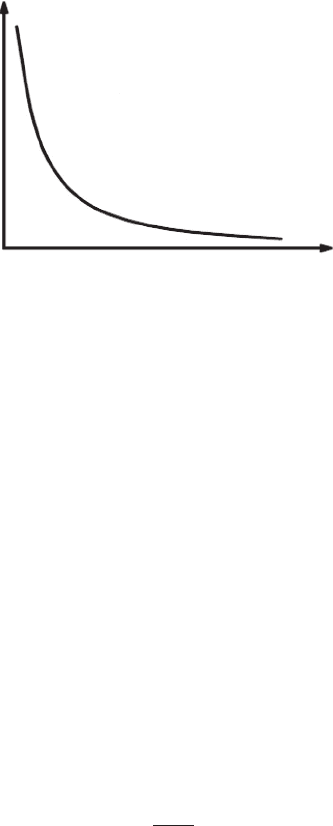
Near Field and Far Field. In LF and HF, the RFID system is mainly based on mutual
inductance coupling in which the magnetic field produced by the loop antenna coils rapidly
drops off with distance (1/r
3
) in free space (see Figure 10.1). R is the distance for the path
of the signal. The attenuation of a magnetic field limits the read range for all passive RFID
devices [16].
Table 10.2 Near field and far field regions
Frequency Near field Far field
Name range region region
LF 30 K–300 K <120 m >12 km
HF 3 M–30 M <1m >110 m
UHF 300 M–3 G <1.65 cm >1.65 m
SHF 3 G–30 G <0.25 cm >0.25 cm
OTE/SPH OTE/SPH
JWBK126-10 JWBK126-Kerry March 3, 2008 13:16 Char Count= 0
176 Smart Packaging Technologies for Fast Moving Consumer Goods
Magnetic Strength (B)
Distance (r)
Figure 10.1 Attenuation of magnetic strength versus distance in near-field region.
At UHF, the RFID transponder and interrogator communicate in both the near field and
far field, which allows broader read ranges and a faster data transfer rate [17]. Near field
refers to a region generally in close proximity to the radiation source where the electric
and magnetic fields do not indicate a completely plane wave characteristic, but alternate
considerably from point to point [18]. The near field is further split into the reactive near-
field region, which is the nearest to the radiation source and accommodates most or nearly
all of the stored energy, and the radiating near-field region where the radiation predominates
over the reactive field but lacks substantial plane-wave character [18]. In the near field, both
the electric field (E) and the magnetic field (H) are relatively static, without propagation.
Maxwell had proved that beyond the quasistatic near field, both the electric field and the
magnetic field, at a certain distance, detached themselves from the conductor and propagated
into free space as a combined wave at light speed with a constant ratio of E/H = 120 π =
377 [18].
The critical point at which separation happens is called the far field. This field has a
predominantly plane-wave characteristic. Electric field strength and magnetic field strength
are represented in transverse planes normal relative to the path of propagation and are
separated distributions. In far field, the transmission power of the propagation RF signal
attenuates as the inverse square of distance,
S =
P
t
4πr
2
(2)
where S is signal strength at a distance r from the source and P
t
is transmission power. The
farther the RFID transponder is from the interrogator, the less RF power can be received
from the interrogator. If the distance is less than 1/20th of a wavelength, it is in the near field;
if the distance is longer than 5 wavelengths, it is generally in the far field (see Table 10.2).
Therefore, at UHF, transponders operate both the far field and transition field (between the
far field and near field) [17, 19].
Read Range and Power Assumption. Read range is the maximum distance at which the
RFID interrogator and transponder can communicate with each other. Read range is an
important specification and characteristic of an RFID system. Active RFID transponders