
Kerry J., Butler P. Smart Packaging Technologies for Fast Moving Consumer Goods
Подождите немного. Документ загружается.


OTE/SPH OTE/SPH
JWBK126-10 JWBK126-Kerry March 3, 2008 13:16 Char Count= 0
Passive RFID Readability 177
have longer read ranges compared with those of passive RFID transponders that are com-
pletely powered by the received RF energy. The actual read range depends on the frequency,
antenna designs and the effective isotropically radiated power (EIRP) [16, 20].
Within this read range, the RFID transponders receive enough RF energy and power
up the integrated circuit to backscatter the modulated signal to the reader [21]. LF and HF
RFID systems are based on inductive coupling, such as the TI-RFID running at 13.56 MHz.
The read range of this kind of RFID system is no more than a few inches. Read ranges
of ultra-high frequency RFID systems, for instance 915 MHz, are more than several feet,
which is based on electromagnetic backscatter coupling. This system is also called a long
range system versus the forward short range system [17].
There are two ways to increase the read range. One is to increase the transmission
power and the other is to decrease the minimal threshold operating power required by
the transponder or increasing the power conversion efficiency [21]. Read range can be
calculated using the Friis free-space formula (notice it is assumed that the read range is in
free space):
r
max
=
λ
4π
P
t
G
t
G
r
(1 −
|
S
|
2
)
P
th
(3)
where λ is the wavelength, P
t
is the power transmitted by reader, G
t
is the transmitting
antenna gain, G
r
is the tag antenna gain, P
th
is the minimum threshold power to power up
the tag, and
|
s
|
2
is the power reflection coefficient at the tag resonant frequency. P
t
G
t
is the
EIRP [22]. Power or current gain can be expressed as a decibel (dB) value. The dB value is
calculated by taking the log of the ratio of the measured power with respect to a reference
power multiplied by 10.
dB = 10 log
10
P
out
P
in
, dBm = 10 log
P
out
1mW
. (4)
In passive RFID systems, power reflected from the tags is negligible in comparison with
the power radiated from the reader. Consequently, the reader might not be able to pick
up the coupled response from the tags. A low frequency subcarrier modulated within the
RFID system can avoid this occurring. For an RFID system with a carrier frequency of
13.56 MHz, the subcarrier frequency could adopt 847 KHz (1/16), 424 KHz (1/32) or 212
KHz (1/64). This depends on the data transfer rate required in the application, and standards
for the system [17].
Electromagnetic Properties
Dielectric Permittivity. Permittivity (ε) of a dielectric substance describes quantitative
characteristics of any electric field affected by the dielectric substance, which presents the
polarized ability of the substance to an applied electric field. In comparison with electrical
conductivity (σ ), it relates to charge in isolation rather than current. When a voltage is
applied to dielectric substance, if there are no free charge carriers, such as electrons and
ions, the substance tends to pass current; the voltage source provides the energy to move
charge. The charge displaced is restricted by the polarity of molecules in the substance.
OTE/SPH OTE/SPH
JWBK126-10 JWBK126-Kerry March 3, 2008 13:16 Char Count= 0
178 Smart Packaging Technologies for Fast Moving Consumer Goods
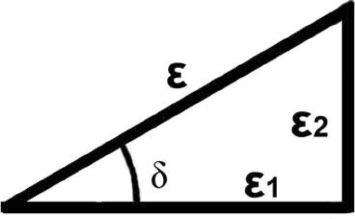
Figure 10.2 Complex permittivity and loss tangent (tan δ = ε
2
/ε
1
).
Permittivity is a complex, frequency-dependant quantity with the real part and imaginary
part, expressed as
ε = ε
1
± jε
2
(5)
the real part, Re(ε) presents the propagation characteristics of the energy. The imaginary
part, Im(ε) referred to as loss factor represents energy loss in the substance due to polar-
ization of molecules [18]. The sign of the imaginary part is dependant on the numeric sign
conversion. The dielectric permittivity of free space ε
0
is 8.85 × 10
−12
F/m. Permittivity is
usually given as the ratio of that of free space, known as relative permittivity or dielectric
constant (ε
r
), which is frequency dependent in parts of frequency range, and dimensionless
(Figure 10.2). Relative permittivity of free space is defined as 1, relative permittivity of air
is about 1.0005 and relative permittivity of water is approximately 80. Higher permittiv-
ity of substances stores greater charges with the same applied electric field. As a result,
the substance has higher capacitance. For most materials, dielectric constant depends on
temperature, frequency, atomic structure, and salinity of the material [23].
Dielectric Absorption. Dielectric absorption indicates the conversion of electromagnetic
energy into heat energy. Dielectric absorption has a few mechanisms: relaxation effects
associated with permanent and induced molecular dipoles, and resonance effects occurring
in the rotations or vibrations of atoms, ions, or electrons [24]. Dielectric relaxation occurs in
insulating materials with negligible or low electrical conductivity. Polarization relaxation
occurs in high dielectric constant substances. Absorption of the field’s energy leads to
energy dissipation. The mechanism of dipoles relaxing is called dielectric relaxation and,
for ideal dipoles without damping, is described by the classic Debye relaxation [24]. Polarity
of a molecular structure and ionized molecules solicits energy dissipation to change the
moments of polar molecules in applied electromagnetic fields. The traits of RF absorption in
a dielectric substance represent the electromagnetic properties. Dielectric permittivity and
loss factor generally represent a material’s electromagnetic properties. Radio frequency
waves propagate in a straight line in free space. They may be reflected, transmitted or
absorbed by dielectric substances in the path. Products, such as foods or drugs with water
content, absorb RF energy and transform it into heat. A typical example that describes this
process is a microwave oven in the kitchen.
OTE/SPH OTE/SPH
JWBK126-10 JWBK126-Kerry March 3, 2008 13:16 Char Count= 0
Passive RFID Readability 179
Water Content in Foods
Water Activity. Foodstuffs and medication materials contain water. As a polar molecule,
water can be partly aligned by an applied electric field; however, there are forces in water
preventing its molecules from moving freely. Thus, the energy counteracting this resistance
is transferred to the ions and then to neighboring atoms or molecules. Food products or any
material containing such charged ions are able to interact with any electric fields. Water
absorbs radio frequency energy and turns it into heat [25].
Water content is a very important factor in determining food quality, shelf stability
and textural properties. Natural moisture content in produce offers freshness and quality.
The crisp, fragile biscuit or one in a limp state is determined by the water content and its
distribution within the biscuit. To maintain the special textures and flavors in a food product,
the food ingredients strictly limit the water content and distribution within the food product.
Controlling the water activity and reactivity with unbound water content in food product
will really help to attain food stability. In spite of the microstructure, local viscosity and
associated molecular mobility are very important to food stability. Nevertheless, moisture
content is one of the key factors in determining these parameters of a food matrix [26]. To
extend the shelf life, adjusting the water content is a common approach. Sublimation or
evaporation is often used to remove liquid water to enhance the product stability [27].
Water Forms. The water molecules in foods appear in different forms depending on
surrounding molecular environments, generally in forms that have different physiochemical
properties as follows:
(i) Free water. Water in this form is enveloped by other water molecules only. The physic-
ochemical properties are the same as these of pure water.
(ii) Capillary water or trapped water. Water in this form is enveloped by a physical barrier
or retained by tiny channels. The physicochemical properties are the same as those of
free water due to normal water–water bonding in this form.
(iii) Bound water. Water in this form is partly enclosed by other food components in
molecular contact, which leads to a significant difference in physiochemical properties
as compared with free water.
Due to different bonding existing in foods, they are considered as heterogeneous mixtures
from the standpoint of chemistry, though the macrostructure of the food material may be
homogeneous [28, 29].
Dielectric Properties. Thestate of waterin a food substance lies in the degree of interaction
between water molecules and the glassy solid pertaining to hydrogen bonding. Lechuga-
Ballesteros et al., [30] found that the proportion of high mobility water molecules at 1 GHz
increased for hydration levels above the hydration limit [31]. Thus, more water molecules
are relatively free to respond to applied electric fields and show a dipole moment near to
gaseous water molecules due to hydration-induced conformational changes. The dielectric
parameter increase is proportional to the increasing of water concentration in the foods [31].
The amount of water content in a material greatly affects its electromagnetic properties
[32]. Water has a high dielectric constant at room temperature (see Table 10.3). Dry ma-
terials have low dielectric constants often less than 10. Therefore the percentage of water

OTE/SPH OTE/SPH
JWBK126-10 JWBK126-Kerry March 3, 2008 13:16 Char Count= 0
180 Smart Packaging Technologies for Fast Moving Consumer Goods
Table 10.3 Dielectric properties of foodstuffs and other packaging
materials at 2.45 GHz and 68
◦
F (Source: Sacharow and Schiffman:
Microwave Packaging [31])
Dielectric
Substance constant Loss factor Loss tangent
Water 80 12.5 0.16
Mashed potato 65 22.1 0.34
Cooked ham 45 25.2 0.56
Peas 63 15.8 0.25
Most plastics 2∼4.5 0.002∼0.09 0.001∼0.02
Woods 1.2∼5 0.01∼0.5 0.01∼0.1
Papers 3∼4 0.15∼0.4 0.05∼0.1
content in the substance is indicative of the dielectric properties. A high water percent-
age usually shows proportional increases of the loss factor of the substance and a high
dielectric constant. The dielectric constant of a mixed substance commonly is based on
its components and stands between the medial of its components. Dielectric loss has a
complicated transaction mechanism. For example, it may increase 20∼30 % with raising
the water content percentage of the substance, and then decrease rapidly [32].
Material Combinations. Typically, combinations of materials depict the worst scenario.
While the material structure may represent the best possible physical structure for a given
product/package system, it offers the worst RFID-friendly aspect of each individual mate-
rial/layer within the structure.
10.5 The Influence of Packaging System Characteristics on RFID
10.5.1 RF Interference Issues
It is critical to consider radio frequency interference issues when implementing RFID sys-
tems, and to recognize that interference can be caused by a number of packaging materials.
The maximum concern comes from the properties of waves, which seem to undergo very
strong alterations when exposed to metals. When using RFID technology, the metal of cer-
tain packages significantly impacts the readability rate of the antenna from the transponder.
A corrugated tray that holds aluminum cans, for example, can have little to no readability
when it is passed through a portal of antennas. Granted, frequency, tag antenna design and
careful site selection can greatly improve readability (from zero), but this is not common
with low cost, Gen 2, tags.
Wave interference is the phenomenon that occurs when two waves meet while traveling
along the same medium. The interference of waves causes the medium to take on a shape
that results from the net effect of the two individual waves upon the particles of the medium
[33, 34].
Wave interference can occur in two forms: constructive interference and destructive
interference (Figure 10.3). Constructive interference takes place when two waves meet in
the same medium, and end up overlapping and taking the same form. This type of response

OTE/SPH OTE/SPH
JWBK126-10 JWBK126-Kerry March 3, 2008 13:16 Char Count= 0
Passive RFID Readability 181
Destructive Interference Constructive Interference
Figure 10.3 Constructive and destructive interference charts [32].
produces a complementary system of transmitting frequency in a clear and readable form.
Destructive interference is a type of interference that occurs at any location along the
medium where the two interfering waves have a displacement in the opposite direction
[35]. When a frequency is traveling from the antenna to the transponder, the response is
cancelled or changed in a manner to produce little to no readability. Metal creates destructive
interference by doing just that, canceling or changing frequency via the material makeup
of the metal. The antenna, in the case of RF, after not receiving the frequency in which it
has transmitted, searches for another method to verify the drastically changed waveform
to another bandwidth, but fails, thus resulting in no reads.
It is widely accepted that metal and water have a detrimental affect on the operation and
use of radio waves. Metal reflects radio waves while water absorbs radio waves, making
these two materials very difficult to use around and with RFID systems [35]. Many products
falling under RFID mandates contain metal and water, and solutions to make RFID systems
work in their presence are not commercially available at an economic price. Products with
high water content included in this category are shampoo, soft drinks, juices, fruits and
vegetables to name a few. Products containing high metal content or metal within their
packages may cause problems with RFID systems. Products and packages in this category
include: steel and aluminum cans, some powdered detergents, foil laminated bags and
pouches, metal bins and totes [36].
RFID testing that has been conducted on these types of product includes testing conducted
by Hewlett-Packard, Gillette and BP Castrol. Hewlett-Packard has been able to overcome
the problems associated with water and metal in their ink cartridges by changing the
orientation in which they were packed [37]. Gillette has run RFID pilots, at the case
and item level, with their razorblades for the Metro Group with mixed success [38]. RFID
testing has been done by BP Castrol on its GTX 5-quart container of motor oil with results
depending on location of the tags relation to the lubricant in the bottles [39]. A graduate
student at Michigan State University’s School of Packaging conducted research on the
RFID transponders ability to read through refrigerated and frozen beef loin muscle. The
research found that the tags performed successfully when reading through frozen beef and
were unsuccessful when reading through refrigerated beef, thus showing liquid water is a
problem area [40].
There are many other factors that can cause interference and are not addressed by known
research. The effect of packaging and packaging materials on RFID systems is not widely
known or publicized. Everything from packaging materials to packaging additives may
have an effect on the readability of RFID tags. However, since the discipline of packaging
enjoys limited understanding, little research has been done specifically on it. RFID tracking
of reusable plastic containers, totes and pallets is being conducted by CHEP; Trenstar is
tracking kegs of beer and AIS is tracking metal carts for flowers all using RFID [41]. The
OTE/SPH OTE/SPH
JWBK126-10 JWBK126-Kerry March 3, 2008 13:16 Char Count= 0
182 Smart Packaging Technologies for Fast Moving Consumer Goods
technology is being used with a variety of packaging materials; however, little information
is available about the efficiency of the RFID systems being used. Rick Fox, president
and CEO of Fox IV Technologies, notes the following: ‘The functionality of the RFID
tag will change based on the position of the tag on the container, the type of product in
the container, the pallet packaging configuration and the power of the tag reader’ [42].
Until further researched, the effect these variables have on RFID systems will remain the
proprietary knowledge of the leading companies implementing RFID, which will not help
the technology, on the whole, to grow and succeed [36].
Interference with RFID systems goes beyond packaging materials and product properties.
Operating systems and other wireless communication devices in a facility can create RF
noise and interrupt the ability of RFID tags and readers to communicate properly. These
systems may include wireless communication on handheld scanners, cell phones, robots
and/or computers. Operating equipment such as conveyors, fork trucks, filling and sealing
equipment can also have negative effects on the operation of an RFID system. In hospitals,
different electromagnetic interference becomes a major issue, with the inability for certain
systems to work coherently alongside each other.
The effect of static discharge on tags is not widely known and could lead to an inability
of tags to read. RFID tags are also affected by the speed at which they pass through the read
field, though successive generations of tags mitigate this issue to some degree. The faster
a tag travels through the field the less likely it is going to be read. Multiple RFID readers,
antennae and tags in an area can have an adverse affect on the systems operating correctly;
this phenomenon is known as collision and proper shielding becomes a primary concern.
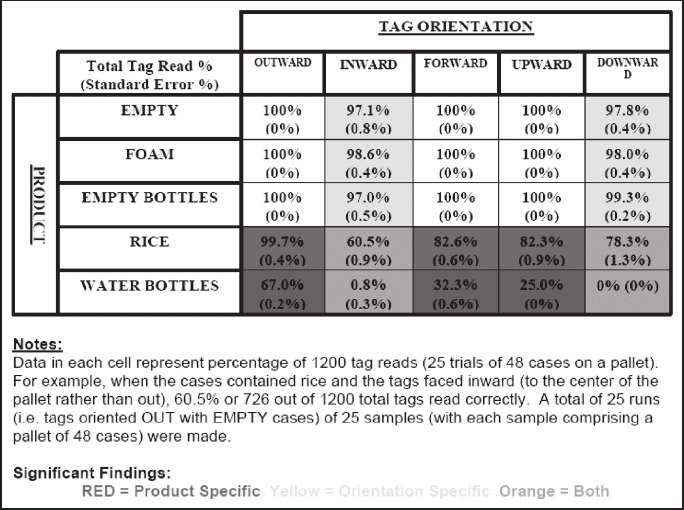
The results of one early experiment shows that tag orientation and package content have
a considerable effect on the readability of RFID transponders when viewed as a pallet load
of product (Figure 10.4). The physical characteristics of the product in the package coupled
with the orientation of the tag lead to a significant amount of no-reads in certain instances.
On the other hand, 100 % of the tags were read in the nine experiments using empty cases,
foam-in-place filled cases, and empty bottle filled cases coupled with outward, forward and
upward tag orientations [36].
The following few sections will help in understanding Figure 10.4 and how it can be of
use in evaluating product/package systems with respect to RFID readability. With respect to
Figure 10.4, note that the red rows demonstrate statistically significant variation as a result
of product content, the yellow columns demonstrate statistically significant variation as a
result of tag orientation, and the combination (orange) cells represent the worst condition
from both effects.
While technological change has progressed since this research was completed, this should
not diminish the findings that product content, tag orientation and case location all contribute
to the difficulties in RFID reading.
Product Contents. The effect of package content on the RFID tag’s ability to read was not
evident for certain products. Empty cases, cases filled with foam-in-place and cases filled
with empty polyethylene terephthalate (PET) bottles showed no major statistical difference
between total read rates for any orientation. However, rice and filled water bottle cases
show major statistical differences between each other and the three products discussed
above when evaluated, based on total reads. In this work, it was found that filled water
bottle cases and rice filled cases have the greatest effect on the readability of RFID tags.
Note that dry rice does not have any noticeable water content and would not normally come
OTE/SPH OTE/SPH
JWBK126-10 JWBK126-Kerry March 3, 2008 13:16 Char Count= 0
Passive RFID Readability 183
Figure 10.4 Results of Tazelaar experiment on product/package influence on RFID
readability.
to mind as far as causing interference. Its interference, like that of dry dish washing powder,
is more a result of the product metal content (iron) than it is of water content.
Tag Orientation. When evaluating the data from rice and filled water bottle cases, tag
orientation on readability became evident. Rice and water were the only products tested
that showed significant statistical differences between total tag reads for the designated tag
orientations. A major difference due to tag orientation was noticed in the number of trials
having 100 % reads, although orientation did not have an effect on the overall number of
reads for empty cases, foam-in-place filled cases or empty-bottle filled cases. Because tag
orientation had no effect on the overall number of reads for these three products, they will not
be used in evaluating the effect tag orientation has on the readability of RFID transponders.
Water plays a significant role in the readability of RFID tags; therefore, the orientation of
the tag on a case of liquid product also has consequences in the readability of the tags. Water
absorbs ultra-high frequency (UHF) radio frequency waves and, therefore, any cases with
tags not in the direct line-of-sight for the RFID system antennae have extreme difficulty in
reading, causing the system to be ineffective. This phenomenon is also found in reading
pallet loads of aluminum and steel beverage cans in corrugated trays, fiberboard cartons,
and corrugated cases, respectively.
When looking at the total number of reads, tags facing inward and downward had the
greatest effect on the readability of RFID tags. Tags facing outward were impacted the
least by products. Tags facing forward, upward and outward read 100 % of the time for
OTE/SPH OTE/SPH
JWBK126-10 JWBK126-Kerry March 3, 2008 13:16 Char Count= 0
184 Smart Packaging Technologies for Fast Moving Consumer Goods
empty, foam and empty-bottle filled cases. However, tag and reader advances mean that
these specific orientations cannot be cited as a given result for any product/package system.
Rather, it is specific to this experiment and, as such, individual results should be established
for any and all systems.
Orientation played a large role in the readability of tags when evaluating the number of
trials with 100 % case reads. This is not evident for water-bottle filled and rice-filled cases,
in that they had no 100 % reads in any single trial except for the rice filled cases with tags
facing outward, which had four. For empty, foam-in-place and empty-bottle filled cases,
tags facing inward and tags facing downward had the greatest effect on the readability of
RFID tags; tags facing forward, upward and outward read 100 % of the time.
Case Location in Pallet Stack. The location of the case on the pallet played a role in the
ability of the RFID tag to read consistently. Cases were grouped based on the tier where
they were located, the row where they were located, and in what column they were located.
No statistical analysis was done on the data obtained from the evaluation of this informa-
tion. However, it should be noted that case location appears to play a role in the readability
of RFID transponders. The following analyses and breakdown are general observations and
should be viewed accordingly.
With this antennae set-up (portal arrangement) the tier, or layer, of the cases on the pallet
plays a role in the readability of the tags. The lower the layer, the less likely the RFID tags
are to read.
The row in which a case was located also played a significant role in the readability of
the tags, with certain product types. The middle rows had a greater number of no-reads than
did the outer rows. Because the middle row tags were not in the direct line-of-sight of the
system antennae, the radio waves had to penetrate more material to reach the transponder,
and thus it is likely that more interference due to the product and/or package materials was
experienced. This occurrence was not consistent across all product types and was generally
observed when the product being tested was not radiolucent.
The effect of orientation on the readability of RFID tags is closely associated with the
product being tagged. When the product being tagged is radiolucent (RF signals can easily
penetrate their materials) orientation plays a smaller role than when RF signals cannot pass
through the product. The ability to read tags on non-radiolucent products is due to tags
being in the direct line-of-sight of the system antennae and not having to penetrate the
product, making those orientations with a greater number of tags in the direct line-of-sight
of the system antennae more effective.
The column in which the cases were located also had an effect on the readability of
the transponders. The closer the RFID tags are to the pallet jack or forklift, the less likely
they are to be read. This is likely due to the close proximity of these cases to the elec-
tronic pallet jack and the resultant interferences from metals or the power source of this
machine.
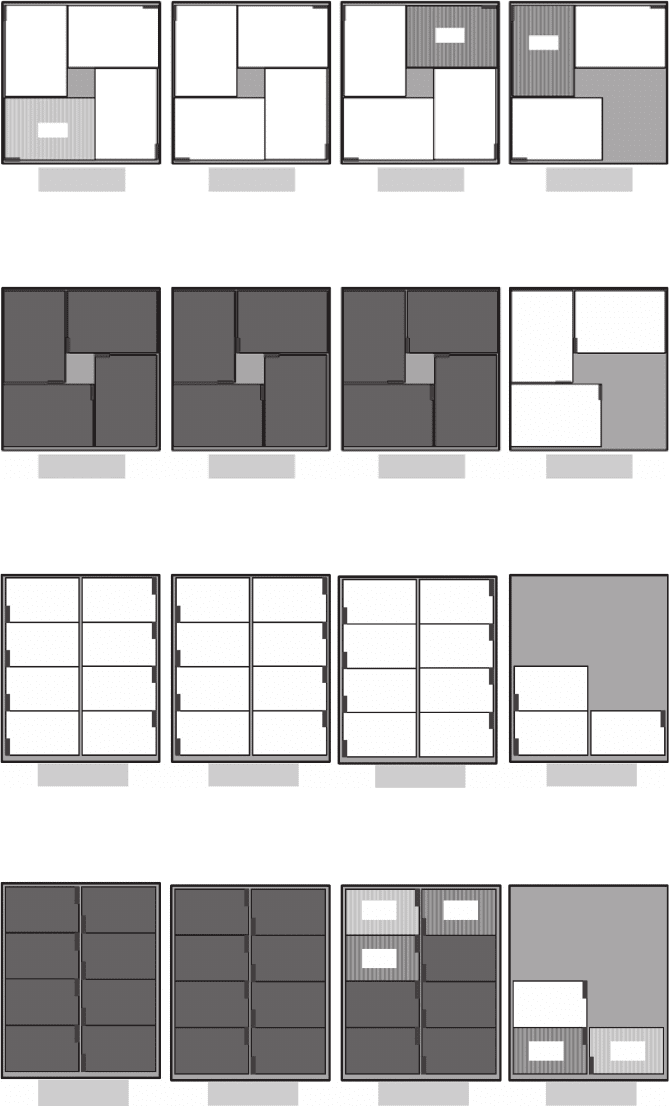
In other instances, the readability of the tags could be increased based on the column
position. For instance, when reading cases filled with water bottles having the tag orientation
facing forward, column four, the front most column, experienced 100 % reads. All other
columns had 0 % reads. This observation is also found in evaluation of trays of produce.
Experiments on pallets of cased lettuce, peaches and strawberries found similar results.
(Figures 10.5, 10.6, 10.7 and 10.8). In these figures, white represents 100% reads, and solid
red represents 0 % reads in 25 replications. Shades of pink are denoted by the percentage
OTE/SPH OTE/SPH
JWBK126-10 JWBK126-Kerry March 3, 2008 13:16 Char Count= 0
1st tier (bottom)
4%
Pallet jack Pallet jack Pallet jack Pallet jack
32%
16%
2nd tier
3rd tier 4th tier (top)
Figure 10.5 Lettuce cases tagged on long side, externally.
1st tier (bottom)
Pallet jack Pallet jack Pallet jack Pallet jack
2nd tier 3rd tier 4th tier (top)
Figure 10.6 Lettuce cases tagged on short side, internally.
1st tier (bottom)
Pallet jack Pallet jack Pallet jack Pallet jack
2nd tier 3rd tier 4th tier (top)
Figure 10.7 Strawberry cases tagged on short side, externally.
1st tier (bottom)
Pallet jack Pallet jack Pallet jack Pallet jack
2nd tier
4%
48%
56% 8%
48%
3rd tier 4th tier (top)
Figure 10.8 Strawberry cases tagged on short side, internally.
OTE/SPH OTE/SPH
JWBK126-10 JWBK126-Kerry March 3, 2008 13:16 Char Count= 0
186 Smart Packaging Technologies for Fast Moving Consumer Goods
of successful reads. The top tier of the internal tags allowed signal access, thereby allowing
successful reads for those cases.
From the information and evaluation of the case location data, a general conclusion can
be made. For certain pallet patterns, strategic tag orientation and/or locations can overcome
or minimize limitation problems based on physics. Taking this a step further, it becomes
imperative that each and every product/package combination be tested to insure that the
pallet pattern, and tag location and orientation are operational throughout the respective
supply chain.
10.5.2 Conveyor Speed, Tag Location, Package Materials, and Package Shape
as They Influence Readability
Since the first mandates put forth by Tesco, Metro, Marks & Spencer, Wal-Mart, and the
US Department of Defense, the use of UHF radio frequency identification (RFID) has been
implemented into supply chains with mixed results. When working optimally, RFID can
provide valuable information regarding inventory data and shipment locations. However,
tag readability issues exist due to a variety of reasons: product and package interference,
RFID equipment set-up locations, and even frequency allocations, depending on the country
of use.
It is almost inevitable that a package will travel on a conveyor at some point during the
manufacturing and distribution process. Since tracking product movement is one of the key
aspects of RFID, it is important to determine if RFID antennae are able to track tagged
packages on conveyors.
There is no one specific method for using RFID technology, nor is there one spe-
cific solution to be applied across industries. For RFID to work most advantageously
within an organization’s supply chain, the implementer must think of each product on
an individual level. An RFID tagged product, Product A will not function equally to
a tagged Product B if there are differences in the product composition and the pack-
age system. Additionally, optimal tag type, tag location and orientation, antenna loca-
tion and orientation, reader location and broadcast strength, and even the cord length
between the reader and the antennae, are among the variables that implementers of the
technology need to consider when trying to optimize the readability of an RFID tagged
product.
In the event that a retailer has implemented RFID mandates to suppliers, both shipper
and receiver must work collectively to optimize performance and usefulness in the supply
chain. Specifically, the read location (where the tag is to be detected) can have a significant
impact on successful RFID utilization. Suppliers will have to ensure that they have tested
their product at each read point in the supply chain process in order to avoid failing to meet
mandates that could lead to financial losses. Traditional read locations for RFID tags are
warehouse dock doors, stretch wrappers and fork trucks, or conveyors.
RFID Read Locations. It is evident that retailers, suppliers, and organizations are working
with RFID systems across the globe. However, the point in the supply chain where imple-
menters determine to set up an RFID system to gather data, known as read point or location,
varies. In retail applications, an obvious point to set up an RFID system and collect data
is by a dock door. The purpose of a dock door is to provide a medium where all products