
Krantz W.B. Scaling Analysis in Modeling Transport and Reaction Processes: A Systematic Approach to Model Building and the Art of Approximation
Подождите немного. Документ загружается.


SMALL PECLET NUMBER APPROXIMATION 163
This equation can be integrated to give the following solution for the temperature
of the sphere as a function of time:
T
∗
= 1 − e
−3Bi
t
·t
∗
(4.4-22)
For very small Biot numbers, equation (4.4-22) simplifies to
T
∗
∼
=
3Bi
t
· t
∗
(4.4-23)
The error in the solution given by equation (4.4-23) will be in the range 10 to
100% if Bi
t
=
◦
(0.1) and 1 to 10% if Bi
t
=
◦
(0.01).
Scaling this problem has illustrated an important simplification: the small Biot
number approximation that can be made when considering convective heat transfer
to or from a solid object having finite dimensions.
8
The Biot number is a measure
of the resistance to heat conduction in the solid object relative to the resistance to
convective heat transfer in the surrounding fluid. For sufficiently small Biot num-
bers the heat transfer will be controlled totally by convection into the surrounding
fluid. Under these conditions there will be a uniform temperature in the solid object,
which permits a straightforward analytical solution. Note that most heat-transfer
textbooks do not provide any rigorous justification for the equations appropriate to
the small Biot number approximation.
4.5 SMALL PECLET NUMBER APPROXIMATION
The problem considered in Section 4.4 involved convective heat transfer in the
fluid phase adjacent to a solid sphere. However, a lumped-parameter approach was
used to account for this convection. In the present example problem we consider
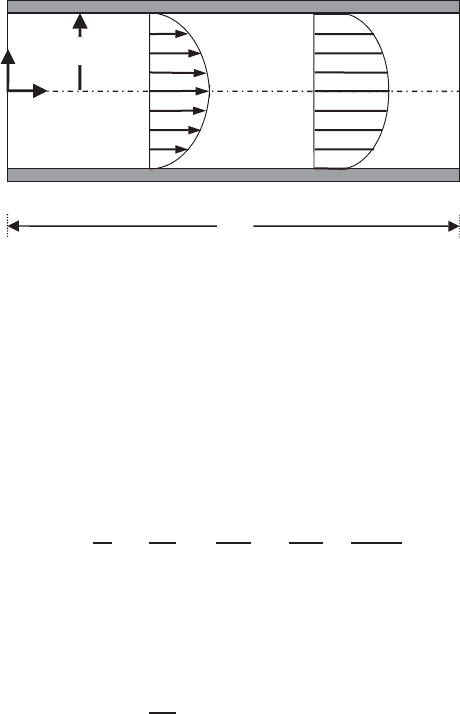
the convective heat transfer explicitly. Consider the steady-state fully developed
laminar flow of a viscous Newtonian fluid with constant physical properties between
two infinitely wide parallel plates separated by a distance 2H and of length L,as
shown in Figure 4.5-1. The upstream (entering) temperature of the fluid is T
0
.The
temperature of the upper and lower plates is also maintained at T
0
. Since the flow
is assumed to be laminar and fully developed, the velocity profile is given by
u
x
= U
m
1 −
y
H
2
(4.5-1)
where U
m
is the maximum velocity. As a result of this shear flow, there will be
heat generation via viscous dissipation. The latter will cause both radial and axial
conduction as well as axial convection of heat.
8
Note that the small Biot number approximation is sometimes referred to as the lumped capacitance
approximation.
164 APPLICATIONS IN HEAT TRANSFER
T
0
T
0
T
0
y
x
H
L
Figure 4.5-1 Steady-state fully developed laminar flow of a viscous Newtonian fluid with
constant physical properties between two infinitely wide parallel plates separated by a dis-
tance 2H and of length L; the temperature of the entering fluid as well as that of the upper
and lower plates is T
0
; the shear flow causes viscous heat generation; the fully developed
velocity profile is shown as well as a representative developing temperature profile.
The thermal energy equation given by equation (F.1-2) in the Appendices, appro-
priately simplified using equation (4.5-1) and for the conditions defined in the
problem statement and the associated boundary conditions are given by (step 1)
ρC
p
U
m
1 −
y
H
2
∂T
∂x
= k
∂
2
T
∂x
2
+ k
∂
2
T
∂y
2
+
4μU
2
m
H
4
y
2
(4.5-2)
T = T
0
at x = 0 (4.5-3)
T = f(y) at x = L (4.5-4)
T = T
0
at y =±H (4.5-5)
∂T
∂y
= 0aty = 0 (4.5-6)
where f(y) is some function of y, which might be unknown. This is a nontrivial
problem to solve, due to the elliptic nature of the describing equations. The presence
of the second-order axial derivative requires that a downstream boundary condition
be specified. In many problems such as this, these downstream conditions are not
known, which precludes solving the describing equations numerically. Clearly, one
would like to know when and how these describing equations might be simplified
to permit a tractable solution. In particular, one would like to know when the
axial conduction and convection terms might be neglected. We use
◦
(1) scaling to
determine the criteria for neglecting these terms.

SMALL PECLET NUMBER APPROXIMATION 165
Define the following dimensionless variables involving unspecified scale factors
(steps 2, 3, and 4):
T
∗
≡
T − T
r
T
s
; x
∗
≡
x
x
s
; y
∗
≡
y
y
s
(4.5-7)
We have introduced a reference factor for the temperature since it is not natu-
rally referenced to zero. Introduce these dimensionless variables into the describing
equations and divide through by the coefficient of one term in each equation that
should be retained (steps 5 and 6):
ρC
p
U
m
y
2
s
kx
s
1 −
y
s
H
y
∗
2
∂T
∗
∂x
∗
=
y
2
s
x
2
s
∂
2
T
∗
∂x
∗2
+
∂
2
T
∗
∂y
∗2
+
4μU
2
m
y
4
s
kH
4
T
s
y
∗2
(4.5-8)
T
∗
=
T
0
− T
r
T
s
at x
∗
= 0 (4.5-9)
T
∗
= f(y
∗
) at x
∗
=
L
x
s
(4.5-10)
T
∗
=
T
0
− T
r
T
s
at y
∗
=±
H
y
s
(4.5-11)
∂T
∗
∂y
∗
= 0aty
∗
= 0 (4.5-12)
Step 7 involves bounding the independent and dependent dimensionless variables
to be
◦
(1). This can be done for the dimensionless spatial coordinates by setting
the dimensionless groups containing x
s
and y
s
in equations (4.5-10) and (4.5-11)
equalto1;thatis,
L
x
s
= 1 ⇒ x
s
= L;
H
y
s
= 1 ⇒ y
s
= H (4.5-13)
To determine the reference and scale factors for the temperature, we need to con-
sider the conditions for which we are scaling. We are seeking to determine when
axial conduction and convection can be ignored relative to heat generation by vis-
cous dissipation and transverse conduction. If the former are negligible, the heat
generation by viscous dissipation must be balanced by the transverse heat conduc-
tion. Hence, we can bound our dimensionless temperature to be
◦
(1) by setting the
dimensionless group in equation (4.5-9) or (4.5-10) equal to zero, thereby determin-
ing the reference temperature, and by setting the dimensionless group multiplying
the heat generation term in equation (4.4-8) equal to 1, to determine the temperature
scale; that is,
T
0
− T
r
T
s
= 0 ⇒ T
r
= T
0
;
μU
2
m
kT
s
= 1 ⇒ T
s
=
μU
2
m
k
(4.5-14)

166 APPLICATIONS IN HEAT TRANSFER
Substitution of the scale and reference factors defined by equations (4.5-13) and
(4.5-14) into the dimensionless describing equations given by equations (4.5-8)
through (4.5-12) yields
ρC
p
U
m
H
2
kL
(1 − y
∗2
)
∂T
∗
∂x
∗
=
H
2
L
2
∂
2
T
∗
∂x
∗2
+
∂
2
T
∗
∂y
∗2
+ 4y
∗2
(4.5-15)
T
∗
= 0atx
∗
= 0 (4.5-16)
T
∗
= f(y
∗
) at x
∗
= 1 (4.5-17)
T
∗
= 0aty
∗
=±1 (4.5-18)
∂T
∗
∂y
∗
= 0aty
∗
= 0 (4.5-19)
Now let us explore possible simplifications of the describing equations (step 8).
The criterion for ignoring axial conduction is
H
2
L
2
1 ⇒ axial conduction can be ignored (4.5-20)
that is, the aspect ratio cannot be too large. Note, however, that the length L was
arbitrary in that L could denote any value of the axial coordinate in the principal
direction of flow. This is the principle of local scaling whereby we scale the
problem for some fixed but arbitrary value of some coordinate, usually that in the
principal direction of flow.
To ignore axial convection of heat, the dimensionless group multiplying the first
term in equation (4.5-15) must be very small; that is,
ρC
p
U
m
H
2
kL
=
U
m
H
α
H
L
=
U
m
H
ν
ν
α
H
L
= Re ·Pr
H
L
= Pe
t
H
L
1 (4.5-21)
where α ≡ k/ρC
p
is the thermal diffusivity, ν ≡ μ/ρ is the kinematic viscosity,
Re ≡ ρU
m
H/μ is the Reynolds number, Pr ≡ ν/α is the Prandtl number, and
Pe
t
≡ U
m
H/α is the Peclet number for heat transfer. The Reynolds number is a
measure of the ratio of the convective to viscous transport of momentum. The
Prandtl number is a measure of the ratio of the viscous transport of momentum
to heat conduction. Hence, the Peclet number is a measure of the ratio of heat
convection to heat conduction. We see that the criterion for ignoring axial heat
convection is that the product of the Peclet number and the aspect ratio must
be very small. The Peclet number in heat transfer has a role analogous to that
of the Reynolds number in fluid dynamics; that is, when it is small, it justifies
ignoring axial convective transport. We will see in the next example problem that
when it is large, it justifies a boundary-layer approximation. Note that ignoring
convective transport in the energy equation in this example is analogous to ignoring

BOUNDARY-LAYER OR LARGE PECLET NUMBER APPROXIMATION 167
convective transport in the equations of motion, which is the basis for the creeping-
flow approximation.
9
If the conditions in equations (4.5-20) and (4.5-21) are satisfied, equations (4.5-
15) through (4.5-19) reduce to
0 =
d
2
T
∗
dy
∗2
+ 4y
∗2
(4.5-22)
T
∗
= 0aty
∗
=±1 (4.5-23)
∂T
∗
∂y
∗
= 0aty
∗
= 0 (4.5-24)
The solution to this simplified set of describing equations is straightforward and
given by
T
∗
=
1
3
(1 − y
∗4
) (4.5-25)
We see from this solution that our dimensionless temperature is bounded of
◦
(1),
which confirms that our scaling analysis is correct.
4.6 BOUNDARY-LAYER OR LARGE PECLET NUMBER
APPROXIMATION
In the preceding example we saw that a low Peclet number justified ignoring the
convective transport of thermal energy, which is analogous to a low Reynolds
number justifying neglecting convective transport of momentum in the creeping-
flow approximation considered in Chapter 3. In this example we consider the other
end of the Peclet number spectrum by exploring the implications of a high Peclet
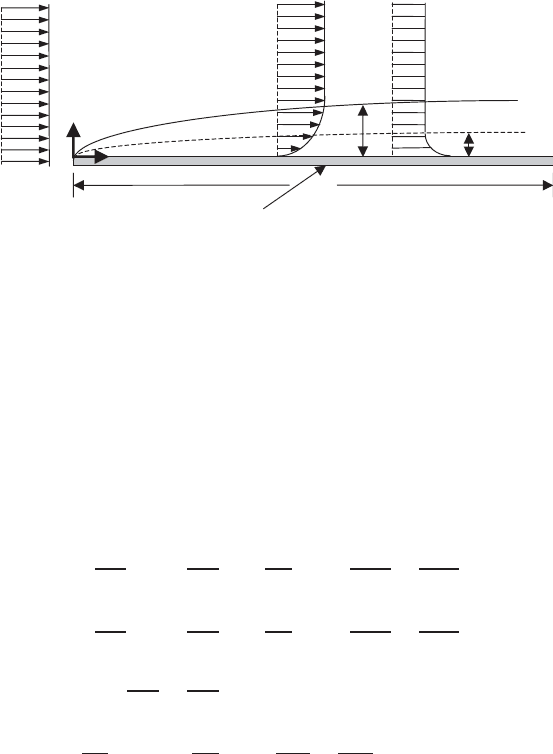
number on heat transfer. Consider the steady-state laminar uniform (plug) flow of a
Newtonian fluid with constant physical properties and temperature T
∞
intercepting
a stationary, semi-infinitely long infinitely wide horizontal flat plate maintained at a
constant temperature T
0
such that T
0
>T
∞
, as shown in Figure 4.6-1. Gravitational
and viscous heating effects can be assumed to be negligible. To fully understand
this example, it would be helpful to review Section 3.4, in which the boundary-
layer approximation in fluid dynamics was considered. As stated in Section 3.4,
boundary-layer flows are examples of region-of-influence scaling,forwhichwe
determine the thickness of a region wherein some effect is confined, in this case
the influence of the heated flat plate that is propagated by conduction. This example
also illustrates the principle of local scaling, in which we carry out the scaling at
some arbitrary but fixed value of the axial coordinate.
9
The creeping-flow approximation was considered in Section 3.3 and Example Problem 3.E.2.
168 APPLICATIONS IN HEAT TRANSFER
U
∞
,T
∞
y
x
d
m
d
t
L
T = T
0
U
∞
T
∞
Figure 4.6-1 Steady-state laminar uniform flow of a Newtonian fluid with constant phys-
ical properties and temperature T
∞
intercepting a stationary, semi-infinitely long infinitely
wide horizontal flat plate maintained at a constant temperature T
0
such that T
0
>T
∞
;the
solid line shows the hypothetical momentum boundary-layer thickness δ
m
, whereas the dash-
dotted line shows the hypothetical thermal boundary-layer thickness δ
t
for Pr > 1, where Pr
is the Prandtl number.
The continuity equation given by equation (C.1-1), equations of motion given
by equations (D.1-10) and (D.1-11), and thermal energy equation given by equa-
tion (F.1-2) in the Appendices simplify to the following for the assumed flow
conditions (step 1):
ρu
x
∂u
x
∂x
+ ρu
y
∂u
x
∂y
=−
∂P
∂x
+ μ
∂
2
u
x
∂x
2
+
∂
2
u
x
∂y
2
(4.6-1)
ρu
x
∂u
y
∂x
+ ρu
y
∂u
y
∂y
=−
∂P
∂y
+ μ
∂
2
u
y
∂x
2
+
∂
2
u
y
∂y
2
(4.6-2)
∂u
x
∂x
+
∂u
y
∂y
= 0 (4.6-3)
ρC
p
u
x
∂T
∂x
+ ρC
p
u
y
∂T
∂y
= k
∂
2
T
∂x
2
+
∂
2
T
∂y
2
(4.6-4)
The corresponding boundary conditions for this flow are given by
u
x
= U
∞
,u
y
= 0,T= T
∞
at x = 0 (4.6-5)
u
x
= f
1
(y), u
y
= f
2
(y), T = f
3
(y) at x = L (4.6-6)
u
x
= 0,u
y
= 0,T= T
0
at y = 0 (4.6-7)
u
x
= U
∞
,u
y
= 0,T= T
∞
at y =∞ (4.6-8)
where f
1
(y), f
2
(y),andf
3
(y) are unspecified functions. The boundary conditions
for the equations of motion were discussed in Section 3.4. The boundary conditions

BOUNDARY-LAYER OR LARGE PECLET NUMBER APPROXIMATION 169
on the energy equation given by equations (4.6-5) and (4.6-7) are the prescribed
temperature of the entering fluid and at the plate, respectively. Equation (4.6-6)
merely states that to solve this elliptic energy equation, a downstream bound-
ary condition must be specified; this condition might not be known in practice.
Equation (4.6-8) states that the temperature becomes equal to that of the entering
fluid infinitely far above the flat plate.
Define the following dimensionless dependent and independent variables (steps
2, 3, and 4):
u
∗
x
≡
u
x
u
xs
; u
∗
y
≡
u
y
u
ys
; P
∗
≡
P
P
s
;
T
∗
≡
T − T
r
T
s
; x
∗
≡
x
x
s
; y
∗
m
≡
y
y
ms
; y
∗
t
≡
y
y
ts
(4.6-9)
Note that we have allowed for different y-length scales for the energy equation
and equations of motion; that is, the temperature might experience a characteristic
change of
◦
(1) over a different length scale than the velocities. Introduce these
dimensionless variables into the describing equations and divide each equation
through by the dimensional coefficient of one term that should be retained to
maintain physical significance (steps 5 and 6):
u
∗
x
∂u
∗
x
∂x
∗
+
u
ys
x
s
u
xs
y
ms
u
∗
y
∂u
∗
x
∂y
∗
m
=−
P
s
ρu
2
xs
∂P
∗
∂x
∗
+
μ
ρu
xs
x
s
∂
2
u
∗
x
∂x
∗2
+
μx
s
ρu
xs
y
2
ms
∂
2
u
∗
x
∂y
∗2
m
(4.6-10)
u
∗
x
∂u
∗
y
∂x
∗
+
u
ys
x
s
u
xs
y
ms
u
∗
y
∂u
∗
y
∂y
∗
m
=−
P
s
x
s
ρu
xs
u
ys
y
ms
∂P
∗
∂y
∗
m
+
μ
ρu
xs
x
s
∂
2
u
∗
y
∂x
∗2
+
μx
s
ρu
xs
y
2
ms
∂
2
u
∗
y
∂y
∗2
m
(4.6-11)
∂u
∗
x
∂x
∗
+
u
ys
x
s
u
xs
y
ms
∂u
∗
y
∂y
∗
m
= 0 (4.6-12)
u
xs
y
ts
u
ys
x
s
u
∗
x
∂T
∗
∂x
∗
+ u
∗
y
∂T
∗
∂y
∗
t
=
ky
ts
ρC
p
u
ys
x
2
s
∂
2
T
∗
∂x
∗2
+
k
ρC
p
u
ys
y
ts
∂
2
T
∗
∂y
∗2
t
(4.6-13)
u
∗
x
=
U
∞
u
xs
,u
∗
y
= 0,T
∗
=
T
∞
− T
r
T
s
at x
∗
= 0
(4.6-14)
u
∗
x
= f
∗
1
(y
∗
m
), u
∗
y
=f
∗
2
(y
∗
m
), T
∗
=f
3
(y
∗
t
) at x
∗
=
L
x
s
(4.6-15)

170 APPLICATIONS IN HEAT TRANSFER
u
∗
x
= 0,u
∗
y
= 0,T
∗
=
T
0
− T
r
T
s
at y
∗
m
= y
∗
t
= 0 (4.6-16)
u
∗
x
=
U
∞
u
xs
,u
∗
y
= 0,T
∗
=
T
∞
− T
r
T
s
at y
∗
m
= y
∗
t
=∞ (4.6-17)
Note that we have divided equations (4.6-10) and (4.6-11) by the dimensional
coefficient of the axial convection term since we are considering a high Reynolds
number flow and high Peclet number heat transfer for which the convection terms
must be retained. However, we have divided equation (4.6-13) by the dimensional
coefficient of the transverse convection term. The reason for doing this is not
obvious at this point. However, we will see that this is the principal convective
term in the energy equation for Pr > 1.
For a high Reynolds number flow for which the action of viscosity is confined
to the vicinity of the boundaries, the y-length scale for the velocities will be the
thickness of the momentum boundary layer or region of influence δ
m
;thatis,we
say that y
ms
= δ
m
. The scale factors for the velocity components, pressure, and
axial coordinate are determined in exactly the same manner as was described in
detail in Section 3.4 and are given by (step 7)
u
xs
= U
∞
; x
s
= L; u
ys
=
δ
m
L
U
∞
; P
s
= ρU
2
∞
δ
2
m
L
2
(4.6-18)
In view of the fact that the principal viscous term in equation (4.6-10) has to be
important at least within some small region in the vicinity of the flat plate, we set
the dimensionless group in front of this term equal to 1 to ensure that this term
is of the same size as the convection terms that are being retained. This yields
the following equation for the thickness of the region of influence or momentum
boundary layer:
δ
2
m
=
μL
ρU
∞
=
L
2
Re
⇒ δ
m
=
L
√
Re
(4.6-19)
where Re is the local Reynolds number based on using L as the characteristic
length. Note that L is arbitrary in that it can be any fixed value of the axial length
coordinate; that is, our scaling was done for an arbitrary length L of a semi-infinitely
long flat plate; this is what is meant by the concept of local scaling. The reference
and scale factors for the temperature are determined by setting the appropriate group
in equations (4.6-14) or (4.6-17) equal to zero and in equation (4.6-16) equal to 1
to obtain
T
r
= T
∞
; T
s
= T
0
− T
∞
(4.6-20)
In view of the fact that the principal conduction term in equation (4.6-13) has to
be important at least within some small region in the vicinity of the flat plate, we
set the dimensionless group in front of this term equal to 1 to ensure that this term
is of the same size as the convection terms that are being retained. This yields the

BOUNDARY-LAYER OR LARGE PECLET NUMBER APPROXIMATION 171
following equation for the thickness of the region of influence or thermal boundary
layer:
δ
t
=
kL
ρC
p
δ
m
U
∞
=
1
√
Pr
L
√
Pe
t
=
1
Pr
L
√
Re
=
δ
m
Pr
(4.6-21)
where Pe
t
≡ U
∞
L/α is the local Peclet number for heat transfer based on using L
as the characteristic length. A comparison of equations (4.6-19) and (4.6-21) again
indicates that in heat transfer the Peclet number plays a role analogous to that of
the Reynolds number in fluid dynamics. Note that for liquids Pr > 1; hence, the
thermal boundary-layer thickness will be less than the momentum boundary-layer
thickness. For gases Pr
∼
=
1; hence, the thermal and momentum boundary layers
have nearly the same thickness. However, for liquid metals, Pr < 1; hence, the
thermal boundary-layer thickness will be greater than the momentum boundary-
layer thickness. The general behavior of δ
t
(x) and δ
m
(x) for the case when Pr > 1
is shown in Figure 4.6-1.
If we now rewrite our dimensionless describing equations in terms of the scales
defined by equations (4.6-18) through (4.6-21), we obtain
u
∗
x
∂u
∗
x
∂x
∗
+ u
∗
y
∂u
∗
x
∂y
∗
m
=−
1
Re
∂P
∗
∂x
∗
+
1
Re
∂
2
u
∗
x
∂x
∗2
+
∂
2
u
∗
x
∂y
∗2
m
(4.6-22)
u
∗
x
∂u
∗
y
∂x
∗
+ u
∗
y
∂u
∗
y
∂y
∗
m
=−
∂P
∗
∂y
∗
+
1
Re
∂
2
u
∗
y
∂x
∗2
+
∂
2
u
∗
y
∂y
∗2
m
(4.6-23)
∂u
∗
x
∂x
∗
+
∂u
∗
y
∂y
∗
m
= 0 (4.6-24)
1
Pr
u
∗
x
∂T
∗
∂x
∗
+ u
∗
y
∂T
∗
∂y
∗
t
=
1
Pr ·Pe
t
∂
2
T
∗
∂x
∗2
+
∂
2
T
∗
∂y
∗2
t
(4.6-25)
u
∗
x
= 1,u
∗
y
= 0,T
∗
= 0atx
∗
= 0 (4.6-26)
u
∗
x
= f
∗
1
(y
∗
m
), u
∗
y
= f
∗
2
(y
∗
m
), T
∗
= f
3
(y
∗
t
) at x
∗
= 1 (4.6-27)
u
∗
x
= 0,u
∗
y
= 0,T
∗
= 1aty
∗
m
= y
∗
t
= 0 (4.6-28)
u
∗
x
= 1,u
∗
y
= 0,T
∗
= 0aty
∗
m
= y
∗
t
=∞ (4.6-29)
The system of equations above is difficult to solve for several reasons. First, elliptic
differential equations are involved that require specifying some downstream bound-
ary conditions that in practice are generally not known. Second, as discussed in
Section 3.4, equations (4.6-22) and (4.6-23) are coupled due to the pressure. Third,
the energy equation is coupled to the solution for the equations of motion through
the two velocity components. However, if the fluid properties are not temperature-
dependent, this coupling is unidirectional in that the equations of motion can be
172 APPLICATIONS IN HEAT TRANSFER
solved independent of the energy equation. In view of these complications, we seek
to explore the conditions required to eliminate these two complications.
Note that in the limit of Re 1andPe
t
1, the system of equations above
reduces to (step 8)
u
∗
x
∂u
∗
x
∂x
∗
+ u
∗
y
∂u
∗
x
∂y
∗
m
=
∂
2
u
∗
x
∂y
∗2
m
(4.6-30)
∂u
∗
x
∂x
∗
+
∂u
∗
y
∂y
∗
m
= 0 (4.6-31)
1
Pr
u
∗
x
∂T
∗
∂x
∗
+ u
∗
y
∂T
∗
∂y
∗
t
=
∂
2
T
∗
∂y
∗2
t
(4.6-32)
u
∗
x
= 1,u
∗
y
= 0,T
∗
= 0atx
∗
= 0 (4.6-33)
u
∗
x
= 0,u
∗
y
= 0,T
∗
= 1aty
∗
m
= y
∗
t
= 0 (4.6-34)
u
∗
x
= 1,T
∗
= 0aty
∗
m
= y
∗
t
=∞ (4.6-35)
Equations (4.6-30) through (4.6-35) are the classical boundary-layer equations for
flow over a heated flat plate. Note that by showing that the pressure term in
equation (4.6-22) is negligible in the limit of high Reynolds number, we have
eliminated the coupling between x-andy-components of the equations of motion.
Moreover, we have shown that the axial viscous term in equation (4.6-22) and
the axial heat-conduction term in equation (4.6-25) are negligible in the limit of
very high Reynolds and Peclet numbers, respectively, and thereby have converted
the elliptic into parabolic differential equations that do not require a downstream
boundary condition. Note that the dimensionless y-coordinate in the equations of
motion is defined differently from that in the energy equation. If these equations
are recast in terms of dimensional variables and a stream function and similarity
variable are introduced, they can be transformed into a set of nonlinear ordinary dif-
ferential equations solved that can be solved via approximate analytical techniques
or numerically.
10
Note that the criterion for the applicability of the hydrodynamic boundary-layer
approximation is
Re ≡
ρU
∞
L
μ
=
U
∞
L
ν
1 ⇒ hydrodynamic boundary layer (4.6-36)
whereas the criterion for the applicability of the thermal boundary-layer approxi-
mation is
Pe
t
=
ρC
p
U
∞
L
k
=
U
∞
L
α
1 ⇒ thermal boundary layer (4.6-37)
10
See, for example, Bird et al., Transport Phenomena, 2nd ed., pp. 388–390.