
Krantz W.B. Scaling Analysis in Modeling Transport and Reaction Processes: A Systematic Approach to Model Building and the Art of Approximation
Подождите немного. Документ загружается.

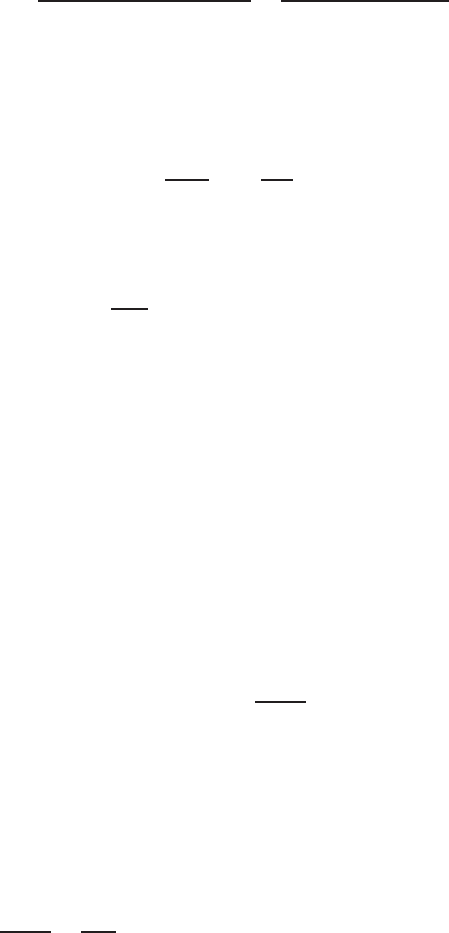
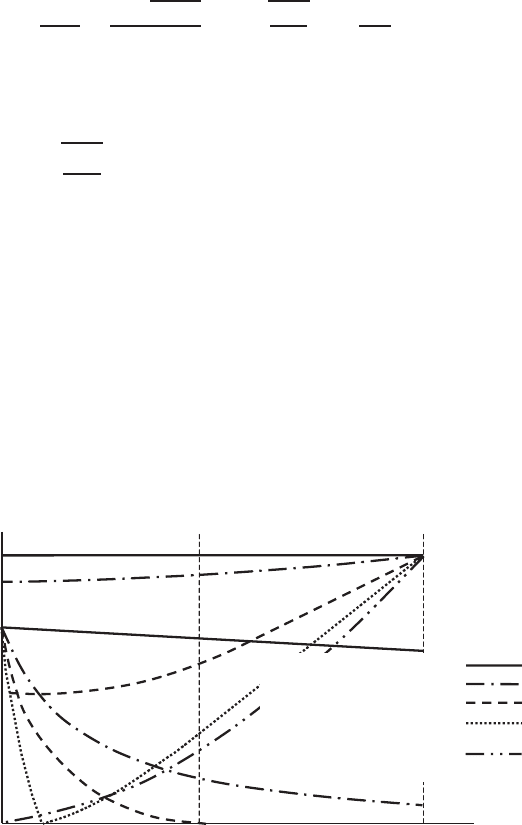
CONCEPT OF THE MICROSCALE ELEMENT 363
Gas in Liquid out
Gas out
Microscale element
Macroscale element
Δz
Liquid
Gas bubble
c
˚
A
d
m
c
A
, c
B
ˆˆ
z
y
ΔS
Infinitesimal
convected
element
Liquid in
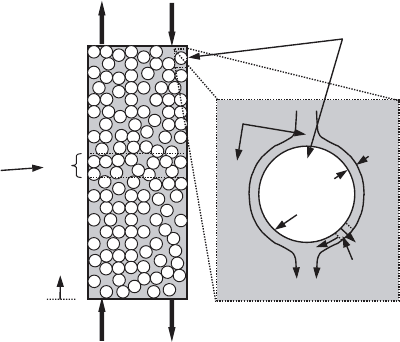
Figure 6.2-1 Bubble column for countercurrent gas absorption; the gas diffuses into the
liquid, where it is chemisorbed; the microscale element is a gas bubble; the flux of the soluble
solute is controlled on the microscale by a thin region of influence within the surrounding
liquid having thickness δ
m
, as shown in the enlarged view; the macroscale element is an
incremental slice z of the entire absorption column.
The microscale element concept can be grasped most easily by means of an
example. Consider chemisorption
4
in a bubble column that involves the absorption of
a component from gas bubbles moving upward through a downward-flowing liquid,
as shown in Figure 6.2-1. Chemisorption is used to increase both the amount that
can be transferred and the mass-transfer rates, thereby allowing the use of a smaller
and less costly column to accomplish the same absorption. The microscale element
in this case is a gas bubble. The mass transfer of the soluble component from this
bubble occurs on the microscale within a thin region of influence or boundary layer in
the liquid whose thickness is δ
m
. This thickness is controlled by the hydrodynamics;
that is, the influence of the gas–liquid interface on the flow will create a relatively
stagnant region near the gas bubble wherein the mass transfer on the microscale
will be confined. The concentration gradients of the diffusing components will occur
over the entire thickness δ
m
for sufficiently long contact times and slow reaction
rates. However, for short contact times or sufficiently fast reaction rates, they will
occur over shorter length scales, identified in Section 6.3 using scaling analysis.
An upper bound on δ
m
is provided by the mass-transfer coefficient k
•
L0
for purely
macroscale equations. However, both conventions for defining the microscale element lead to the same
final results for describing the various mass-transfer regimes.
4
Chemisorption refers to a component going into solution by a chemical potential driving force
accompanied by chemical reaction. In contrast, physical absorption involves only a chemical potential
driving force that leads to a thermodynamic equilibrium concentration of the transferring component
for a sufficiently long contact time.
364 APPLICATIONS IN MASS TRANSFER WITH CHEMICAL REACTION
diffusive mass transfer in the absence of chemical reaction as shown in Section 6.3.
The contact time between the gas and liquid that is available for mass transfer on
the microscale can be estimated from the size of a bubble and the relative velocity
between the gas and liquid. Depending on the contact time, a simple model can be
developed to describe the mass-transfer flux from the gas to the liquid. Whether this
simple model needs to include the effects of chemical reaction on the consumption
of the reactants and steepening of the concentration profiles depends on the reaction
time scale relative to the characteristic diffusion time. In any event, the mass-transfer
flux occurring on the microscale of a bubble is considered to occur at a point on the
macroscale of the gas-absorption column; that is, one converts the mass-transfer flux
per unit area of the microscale element into a species-generation rate per unit volume
of contacting device in the species-balance equations for the absorbing component
by multiplying the former by the packing area per unit volume of column. One then
integrates the species-balance equation for the liquid phase over the length of the
absorption column to determine its overall performance.
6.3 SCALING THE MICROSCALE ELEMENT
As an example of scaling the describing equations for mass transfer from a micro-
scale element, we consider the chemisorption of component A from a gas that is
bubbled upward through a liquid consisting initially of a nonreacting nonvolatile
solvent S and a reacting nonvolatile solute B that is flowing downward in a vertical
column as shown in Figure 6.2-1. Although a chemisorption process is considered
here, the methodology outlined for the scaling analysis is general and can be applied
to other microscale elements involving mass transfer with chemical reaction as well
as to other systems, such as phase-transition phenomena that can be described by
microscale–macroscale modeling.
In this example we assume irreversible kinetics involving reactants A and B but
will not specify the form of the reaction-rate equation, in order to keep the results
as general as possible. Irreversible kinetics means that the reaction can proceed
in only one direction; that is, the products formed by the reaction of A and B
cannot decompose to reform A and B. We will assume that component A is the
limiting reactant; that is, its concentration limits the amount of reaction that can
occur. For chemisorption the component being absorbed is usually the limiting
reactant; that is, the concentration of component B is maintained at a sufficiently
high level to permit the maximum possible absorption of component A in the bulk
liquid. However, for an instantaneous reaction it is possible that component B will
become the limiting reactant at least within some region on the microscale. This
is explored further in Section 6.7.
Solute transfer from the microscale element consisting of the gas bubble will be
controlled by mass transfer through a region of influence having thickness δ
m
.The
system considered for developing the describing equations will be an infinitesimal
element of liquid having area S being convected through the region of influence
as shown by the dotted lines in the enlarged view in Figure 6.2-1. We describe the

SCALING THE MICROSCALE ELEMENT 365
mass transfer within this system in a coordinate system convected at the local rela-
tive velocity between the liquid and the gas bubble. We ignore both transverse and
streamwise convective mass transfer within the convected infinitesimal element;
recall from Chapter 5 that these approximations are justified for dilute solutions of
the diffusing species and for small solutal Peclet numbers; the latter will be small,
owing to the small characteristic length for the thickness of the region of influ-
ence. We also ignore both streamwise diffusion and curvature effects on the mass
transfer; we saw in Chapter 5 that these approximations are justified if δ
m
/L 1,
in which L is the characteristic streamwise length, which is the diameter of the
gas bubble in this example. These assumptions are not limiting in practice since
these neglected effects are accounted for, at least in part, by using mass-transfer
coefficient correlations for this contacting device in order to determine the thick-
ness of the region of influence. The dilute solution assumption implies that in the
absence of chemical reaction on the microscale, there will be diffusion only of
component A since B will not have a concentration gradient. We also assume that
the mass transfer is liquid-phase controlled; that is, any resistance to mass trans-
fer due to the diffusion of component A in the gas phase is negligible. However,
in Section 6.7 we consider instantaneous reaction conditions for which the mass
transfer can become gas-phase controlled.
Mass transfer from the microscale element to the convected infinitesimal element
can occur only during this characteristic time that they are in contact. Hence, the
appropriate contact time for the unsteady-state mass transfer from the microscale
element to the liquid is the time required for the convected infinitesimal element
to pass around a gas bubble. Once this convected infinitesimal element passes over
the gas bubble, it is assumed to mix intimately with the bulk liquid. The microscale
model will provide the continuous mass-transfer flux of solute from the gas to the
liquid phase, which then will be converted into a homogeneous source term in the
species balance on the macroscale. This mass-transfer flux can influence the local
concentration of both reactants on the macroscale of the absorption column, for
which both reactants can continue to undergo convective diffusion and reaction.
In view of the considerations above, the resulting describing equations in general
will involve unsteady-state one-dimensional diffusion and homogeneous chemical
reaction. Hence, equation (G.1-5) in the Appendices simplifies to the following for
the two transferring components (step 1):
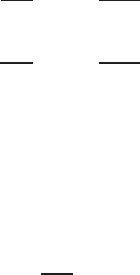
∂c
A
∂t
+ u
x
∂c
A
∂x
= D
AS
∂
2
c
A
∂y
2
+ R
A
(6.3-1)
∂c
B
∂t
+ u
x
∂c
B
∂x
= D
BS
∂
2
c
B
∂y
2
+ κR
A
(6.3-2)
where c
A
and c
B
denote the molar concentrations of components A and B in
the liquid within the microscale element, u
x
is the liquid mass-average velocity
relative to a coordinate system located on the gas bubble, y is a coordinate nor-
mal to the surface of the gas bubble as shown in Figure 6.2-1, D
AS
and D
BS
are
the effective binary diffusion coefficients of components A and B in the liquid S
366 APPLICATIONS IN MASS TRANSFER WITH CHEMICAL REACTION
that are assumed constant for the dilute solutions being considered here, κ is a
stoichiometric coefficient that relates how many moles of component B are con-
sumed per mole of A,andR
A
is the rate of production (moles/volume ·time) of
component A by the homogeneous chemical reaction; note that for chemisorption,
R
A
< 0. Note that each term in equation (G.1-5) has been divided by the molec-
ular weight of component A or B in arriving at equations (6.3-1) and (6.3-2). It
is convenient to transform to a coordinate system that is convected at the liquid
velocity relative to the gas bubble, which will be assumed to be constant; that is,
equations (6.3-1) and (6.3-2) are transformed to a moving coordinate system for
which ˜x ≡ x − u
x
t,inwhichu
x
is assumed to be the average x-component of the
velocity in the region of influence around the gas bubble. Equations (6.3-1) and
(6.3-2) assume the following form in this convected coordinate system:
∂c
A
∂t
= D
AS
∂
2
c
A
∂y
2
+ R
A
(6.3-3)
∂c
B
∂t
= D
BS
∂
2
c
B
∂y
2
+ κR
A
(6.3-4)
in which the time derivatives are now evaluated at a constant value of ˜x rather
than at a constant value of x.
The initial and boundary conditions for equations (6.3-3) and (6.3-4) are
given by
c
A
=ˆc
A
,c
B
=ˆc
B
at t = 0 (6.3-5)
c
A
= c
◦
A
,
∂c
B
∂y
= 0aty = 0 (6.3-6)
c
A
=ˆc
A
,c
B
=ˆc
B
at y = δ
m
(6.3-7)
where ˆc
A
and ˆc
B
are the molar concentrations of components A and B in the
bulk liquid on the macroscale and c
◦
A
is the equilibrium molar concentration of
component A in the liquid at the interface of the gas bubble. Equation (6.3-5)
states that the initial concentrations at the upstream leading edge of the microscale
element are those of the local bulk liquid, as shown in Figure 6.2-1; this translates
to an initial condition for the convected infinitesimal element being considered
here. Although the liquid entering the absorption column is assumed to consist
of only the nonreacting solvent S and reacting solute B, ˆc
A
can be nonzero and
ˆc
B
can be less than its inlet concentration, due to the transfer of component A
to the bulk liquid and depletion of component B by chemical reaction that occur
due to upstream microscale elements; that is, these are local bulk concentrations
that can change with axial position on the macroscale of the absorption column.
Equation (6.3-6) states that thermodynamic equilibrium prevails at the gas–liquid
interface for component A and that component B is insoluble in the gas phase; that
is, it has no mass flux into the gas phase. Equation (6.3-7) states that the undisturbed
bulk liquid concentrations prevail at the edge of the region of influence as shown
in Figure 6.2-1.
SCALING THE MICROSCALE ELEMENT 367
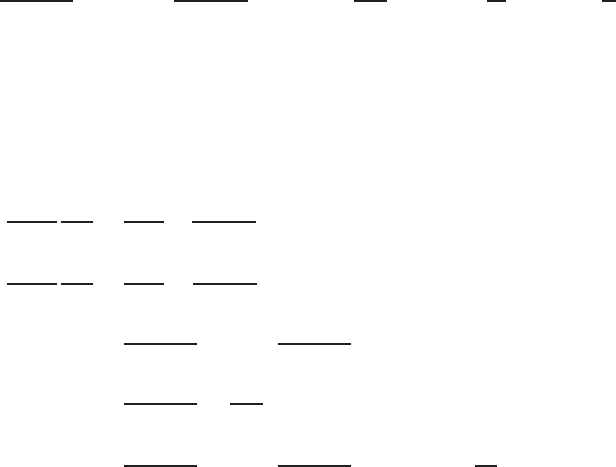
Introduce the following dimensionless variables containing unspecified scale and
reference factors (steps 2, 3, and 4):
c
∗
A
≡
c
A
− c
Ar
c
As
; c
∗
B
≡
c
B
− c
Br
c
Bs
; R
∗
A
≡
R
A
R
As
; y
∗
≡
y
y
s
; t
∗
≡
t
t
s
(6.3-8)
We have introduced reference factors for the concentrations of both components
since neither is naturally referenced to zero. Substitute these dimensionless variables
into the describing equations and divide through by the dimensional coefficient of
one term in each equation (steps 5 and 6):
y
2
s
D
AS
t
s
∂c
∗
A
∂t
∗
=
∂
2
c
∗
A
∂y
∗2
+
R
As
y
2
s
D
AS
c
As
R
∗
A
(6.3-9)
y
2
s
D
BS
t
s
∂c
∗
B
∂t
∗
=
∂
2
c
∗
B
∂y
∗2
+
κR
As
y
2
s
D
BS
c
Bs
R
∗
A
(6.3-10)
c
∗
A
=
ˆc
A
− c
Ar
c
As
,c
∗
B
=
ˆc
B
− c
Br
c
Bs
at t
∗
= 0 (6.3-11)
c
∗
A
=
c
◦
A
− c
Ar
c
As
,
∂c
∗
B
∂y
∗
B
= 0aty
∗
= 0 (6.3-12)
c
∗
A
=
ˆc
A
− c
Ar
c
As
,c
∗
B
=
ˆc
B
− c
Br
c
Bs
at y
∗
=
δ
m
y
s
(6.3-13)
We divided through by the coefficient of the diffusion term in equations
(6.3-9) and (6.3-10) because it provides the only means by which mass can get
into the convected infinitesimal element to react or accumulate and hence must be
retained.
We now set appropriate dimensionless groups equal to zero or 1 to deter-
mine the reference and scale factors, respectively (step 7). If we assume that the
reaction and diffusion of both components occur over the entire thickness of the
liquid layer on the microscale, the appropriate length scale is obtained by setting
δ
m
/y
s
= 1 to obtain y
s
= δ
m
. The scale factor for the reaction rate is chosen to be
some characteristic maximum value R
m
A
. If the form of the reaction-rate equation
were specified, R
m
A
would be determined from the reaction-rate constant and rel-
evant concentrations. We can reference c
∗
A
to zero by setting ( ˆc
A
− c
Ar
)/c
As
= 0
to obtain c
Ar
=ˆc
A
since ˆc
A
is its smallest possible value. We can bound c
∗
A
to
be
◦
(1) by setting (c
◦
A
− c
Ar
)/c
As
= (c
◦
A
−ˆc
A
)/c
As
= 1toobtainc
As
= c
◦
A
−ˆc
A
,
which is the driving force for the diffusion of component A. We can bound c
∗
B
to be
◦
(1) by setting ( ˆc
B
− c
Br
)/c
Bs
= 1toobtainc
Bs
=ˆc
B
− c
Br
. The reference
factor c
Br
is obtained by recognizing that component B will have a concentra-
tion gradient only if there is significant chemical reaction on the microscale. This
implies that the reaction term in equation (6.3-10) must be of the same order as
the diffusion term; hence, we set κR
As
y
2
s
/D
BS
c
Bs
= κR
m
A
δ
2
m
/D
BS
( ˆc
B
− c
Br
) = 1
368 APPLICATIONS IN MASS TRANSFER WITH CHEMICAL REACTION
to obtain c
Br
=ˆc
B
− κR
m
A
δ
2
m
/D
BS
, which provides us with an estimate of the min-
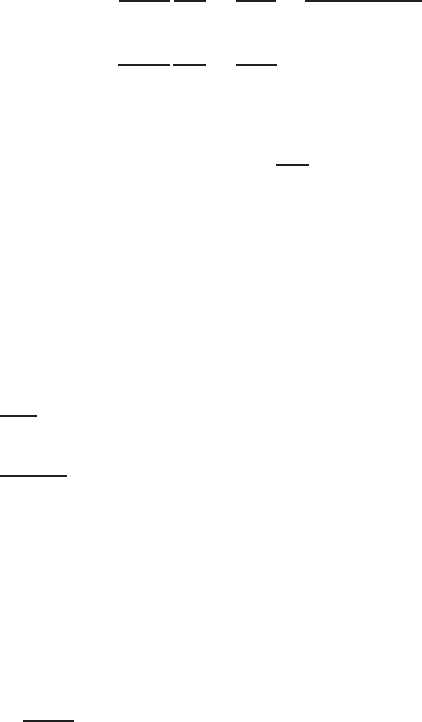
imum concentration of component B. When these scale and reference factors are
substituted into the describing equations, we obtain
δ
2
m
D
AS
t
o
∂c
∗
A
∂t
∗
=
∂
2
c
∗
A
∂y
∗2
+
R
m
A
δ
2
m
D
AS
(c
◦
A
−ˆc
A
)
R
∗
A
(6.3-14)
δ
2
m
D
BS
t
o
∂c
∗
B
∂t
∗
=
∂
2
c
∗
B
∂y
∗2
B
+ R
∗
A
(6.3-15)
c
∗
A
= 0,c
∗
B
= 1att
∗
= 0 (6.3-16)
c
∗
A
= 1,
∂c
∗
B
∂y
∗
B
= 0aty
∗
= 0 (6.3-17)
c
∗
A
= 0,c
∗
B
= 1aty
∗
= 1 (6.3-18)
Let us now use the results of our scaling analysis to explore possible simplifi-
cations in the describing equations (step 8). Equation (6.3-14) indicates that there
are three characteristic times for the microscale mass-transfer process:
t
o
contact time between the liquid and gas on the microscale (6.3-19)
δ
2
m
D
AS
characteristic time for diffusion of A on the microscale (6.3-20)
c
◦
A
−ˆc
A
R
m
A
characteristic time for reaction on the microscale (6.3-21)
Let us first consider the implications of the contact time relative to the charac-
teristic time for diffusion. Note that the characteristic time for diffusion must be at
least of the same order as the contact time if any mass transfer is to occur, since
diffusion is the only transport mechanism available to transfer component A from
the gas to the liquid phase. Steady-state mass transfer will apply on the microscale
if the following criterion is satisfied:
δ
2
m
D
AS
t
o
1 ⇒ steady-state mass transfer on the microscale (6.3-22)
Equation (6.3-22) implies that the characteristic time for diffusion is much shorter
than the contact time. When this criterion is satisfied, the diffusion can penetrate
the entire thickness of the liquid region δ
m
within the time that the liquid flows
over the gas bubble. Hence, the mass transfer on the microscale can be described
by a film theory model, for the reasons discussed in Section 5.2.
Let us use the results of our scaling analysis for steady-state mass transfer
to establish a general relationship between k
•
L0
, the mass-transfer coefficient for
purely physical absorption, and δ
m
, the effective thickness of the fluid layer for
SCALING THE MICROSCALE ELEMENT 369
the microscale element. Let us scale the equation that defines the mass-transfer
coefficient, which is given by
k
•
L
≡
[N
A
− x
A
(N
A
+ N
B
)]|
y=0
c
◦
A
−ˆc
A
∼
=
−D
AS
(∂c
A
/∂y)
|
y=0
c
◦
A
−ˆc
A
(6.3-23)
This equation for the mass-transfer coefficient has been simplified consistent with
the dilute solution assumption, for which the molar density is approximately con-
stant. Introduce the scale factors obtained from our scaling analysis for steady-state
mass transfer on the microscale into equation (6.3-23):
k
•
L
δ
m
D
AS
=−
∂c
∗
A
∂y
∗
y
∗
=0
(6.3-24)
Since ∂c
∗
A
/∂y
∗
A
|
y
∗
=0
=(1), it follows that for steady-state purely physical absorp-
tion,
k
•
L0
=
D
AS
δ
m
steady-state physical absorption (6.3-25)
where k
•
L0
denotes the value of k
•
L
for purely physical absorption. It is determined
solely by the hydrodynamics for purely physical absorption in the absence of any
chemical reaction. Equation (6.3-25) then establishes that the mass-transfer coeffi-
cient for purely physical absorption can be used to estimate the maximum diffusive
penetration distance δ
m
, which was stated without proof in Section 6.2.
Consider now the case when the contact time is very short. This causes a contra-
diction in equation (6.3-14) since the diffusion term must balance the unsteady-state
term; that is, component A can accumulate in the liquid solution only by diffus-
ing into it from the gas phase. The forgiving nature of scaling indicates that δ
m
is not the proper characteristic length scale for short contact times; that is, there
is a region of influence or solutal boundary layer δ
s
within which component A
experiences a characteristic change in concentration. The thickness of this solutal
boundary layer is determined by setting the dimensionless group multiplying the
unsteady-state term in equation (6.3-9) equal to 1, thereby obtaining
δ
s
=
D
AS
t
o
(6.3-26)
Choosing this characteristic length ensures that both the diffusion and unsteady-
state terms are retained in equation (6.3-9). If δ
s
δ
m
, the boundary condition on
component A given in equation (6.3-13) can be applied at infinity and a penetration
theory model can be developed to describe the mass transfer with chemical reac-
tion on the microscale, for the reasons discussed in Section 5.3. This penetration
boundary-layer approximation can be made when the following criterion is satisfied:
1
δ
2
m
D
AS
t
o
=
1
Fo
m
⇒ unsteady-state penetration theory applies (6.3-27)
where Fo
m
≡ D
AS
t
o
/δ
2
s
is the solutal Fourier number.
370 APPLICATIONS IN MASS TRANSFER WITH CHEMICAL REACTION
Let us use the results of our scaling analysis for unsteady-state mass transfer
to establish the relationship between k
•
L0
, the mass-transfer coefficient for purely
physical absorption, and t
o
, the contact time between the liquid and the gas for the
microscale element. Introduce the scale factors obtained from our scaling analysis
for unsteady-state mass transfer in the microscale element into equation (6.3-23):
k
•
L
δ
s
D
AS
=
k
•
L
√
D
AS
t
o
D
AS
= k
•
L
t
o
D
AS
=−
∂c
∗
A
∂y
∗
y
∗
=0
(6.3-28)
Since ∂c
∗
A
/∂y
∗
A
|
y
∗
=0
=(1), it follows that for unsteady-state purely physical
absorption
k
•
L0
=
D
AS
t
o
unsteady-state physical absorption (6.3-29)
where k
•
L0
again denotes the value of k
•
L
for purely physical absorption, which is
determined solely by the hydrodynamics.
In the following sections we consider the implications of the reaction time
scale relative to that for diffusion. The mass transfer from the microscale to the
macroscale can be markedly different depending on the relative magnitude of these
two time scales. Figure 6.3-1 shows the concentration profiles of components A
and B for the assumed irreversible chemical reaction for five characteristic reac-
tion regimes that can occur in the microscale element, depending on the magnitude
of the reaction time scale relative to that for diffusion for component A. Scaling
analysis will now be used to determine the conditions for these various reaction
regimes.
slow reaction regime
d
r
d
m
c
˚
A
c
Br
c
Br
L
y
c
A
or c
B
0
0
intermediate reaction regime
fast reaction regime
inner domain of the
instantaneous reaction regime
surface domain of the
instantaneous reaction regime
c
A
ˆ
c
A
ˆ
c
B
ˆ
Figure 6.3-1 Representative concentration profiles for components A and B as a function
of distance within the liquid layer of the microscale element for chemisorption with an
irreversible reaction.

INTERMEDIATE REACTION REGIME 371
6.4 SLOW REACTION REGIME
The characteristic time for reaction can be much longer than that for diffusion, in
which case no chemical reaction will occur on the microscale, thereby justifying
ignoring the reaction term in equation (6.3-14). This is referred to as the slow
reaction regime approximation. Equation (6.3-14) indicates that this approximation
is applicable when the following criterion is satisfied:
R
m
A
δ
2
m
D
AS
(c
◦
A
−ˆc
A
)
1 ⇒ slow reaction regime (6.4-1)
The criterion above involves the characteristic diffusion time for component A
rather than B because A must diffuse from the gas to the liquid phase for any
reaction to occur, irrespective of how rapidly B can diffuse from the bulk liquid to
the microscale element. Note that the slow reaction regime implies that c
Br
=ˆc
B
−
κR
m
A
δ
2
m
/D
BS
∼
=
ˆc
B
; that is, it implies that there is no change in the concentration
of component B on the microscale. Figure 6.3-1 shows that for the slow reaction
regime the concentration gradient of component A occurs over the entire thickness
δ
m
, whereas there is no concentration gradient for component B, owing to the
absence of any chemical reaction; the linear concentration profile for component
A for the slow reaction regime shown in Figure 6.3-1 is for the special case of
steady-state diffusion corresponding to a long contact time. For short contact times,
the concentration profile of component A would be nonlinear and extend over a
thickness δ
s
<δ
m
. Note that in the slow reaction regime, the bulk concentration of
component A can range from 0 ≤ˆc
A
≤ c
◦
A
for an irreversible reaction, depending
on how fast the reaction is on the macroscale relative to mass transfer from the
microscale element. The slow reaction regime implies that correlations for purely
physical absorption in the absence of chemical reaction can be used to describe the
mass transfer of component A from the microscale to the macroscale. Note that
the slow reaction regime approximation implies only that chemical reaction does
not influence the mass transfer on the microscale; it could influence the transport
on the macroscale, as we will see in Section 6.8.
6.5 INTERMEDIATE REACTION REGIME
If the characteristic time for reaction is of the same order as that for diffusion,
the reaction term must be retained in equation (6.3-14). This will accelerate the
absorption of component A from that for purely physical absorption. Moreover, it
will cause some depletion and thereby diffusion of component B. We refer to this
as the intermediate reaction regime approximation
5
; it applies when the following
criterion is satisfied:
R
m
A
δ
2
m
D
AS
(c
◦
A
−ˆc
A
)
=
◦
(1) ⇒ intermediate reaction regime (6.5-1)
5
The intermediate reaction regime defined here is sometimes referred to as the transition between the
slow to fast reaction regimes.

372 APPLICATIONS IN MASS TRANSFER WITH CHEMICAL REACTION
The minimum concentration of component B due to the chemical reaction can be
estimated from the reference factor that we determined for this component from
our scaling analysis; that is,
c
Br
=ˆc
B
−
κR
m
A
δ
2
m
D
BS
(6.5-2)
Figure 6.3-1 shows that in the intermediate reaction regime, components A and B
both undergo a characteristic change in concentration over the length δ
m
. However,
the reaction is not fast enough to reduce the concentration of either component to
zero within the microscale element. In the intermediate reaction regime, the bulk
concentration of component A can range from 0 ≤ˆc
A
<c
◦
A
for an irreversible
reaction, depending on the time scale for reaction on the macroscale relative to the
time scale for mass transfer from the microscale element. The mass-transfer flux in
the intermediate reaction regime is larger than that for the slow reaction regime, as
shown by the increase in the slope of the concentration profile for component A at
y = 0. It would appear from equation (6.5-2) that the concentration of component
B could be reduced to zero for sufficiently fast reaction rates. However, this is not
possible in the intermediate reaction regime since the concentration of component
A would have to be reduced to zero first because it is the limiting reactant. The
latter can occur within the microscale element only in the fast or instantaneous
reaction regimes.
6.6 FAST REACTION REGIME
Consider now conditions for which the characteristic time for reaction is much
shorter than the characteristic time for diffusion. This is referred to as the fast
reaction regime, which applies when the following criterion is satisfied:
R
m
A
δ
2
m
D
AS
(c
◦
A
−ˆc
A
)
1 ⇒ fast reaction regime (6.6-1)
For these conditions the forgiving nature of scaling indicates a contradiction in
equation (6.3-14); that is, the reaction term no longer balances the diffusion term
that must be retained in order to satisfy the boundary conditions. This implies that
the length scale y
s
= δ
m
is not appropriate for this reaction regime and suggests
that there is a region of influence or reaction boundary layer δ
r
within which the
irreversible reaction of component A goes to completion at which ˆc
A
= 0. The
thickness of this reaction boundary layer is obtained by setting the dimensionless
group that multiplies the reaction term in equation (6.3-14) equal to 1 to obtain
δ
r
=
D
AS
c
◦
A
R
m
A
1/2
(6.6-2)
Figure 6.3-1 shows that in the fast reaction regime the concentration of compo-
nent A is reduced to zero within the distance δ
r
. However, since component A is