
Krantz W.B. Scaling Analysis in Modeling Transport and Reaction Processes: A Systematic Approach to Model Building and the Art of Approximation
Подождите немного. Документ загружается.

SCALING ALTERNATIVE FOR DIMENSIONAL ANALYSIS 13
2.4 SCALING ALTERNATIVE FOR DIMENSIONAL ANALYSIS
In
◦
(1) scaling analysis we arrive at a unique minimum parametric representation
that permits assessing the relative magnitudes of the various terms in the describing
equations. However, in some cases we seek to obtain a minimum parametric repre-
sentation of the describing equations that is optimal for correlating experimental or
numerical data, extrapolating known empirical equations, or scaling-up or scaling-
down some transport or reaction process; the latter procedure is usually referred to
as dimensional analysis. The conventional procedure for dimensional analysis is to
use the Pi theorem, which involves the following steps:
1. List all quantities on which the phenomenon depends.
2. Write the dimensional formula for each quantity.
3. Demand that these quantities be combined into a functional relation that
remains true independent of the size of the units.
In step 3, one invokes the Pi theorem, which states that n − m dimensionless
groups are formed from n quantities expressed in terms of m units. A proof of
the Pi theorem and discussion of the special case n = m is given in Bridgman.
3
Unfortunately, using the Pi theorem approach is not always straightforward. For
example, how do we select the quantities? When do we include dimensional con-
stants such as g
c
(the Newton’s law constant) or R (the gas constant)? How are
dimensionless quantities such as angles involved? How many units must be con-
sidered? For example, force can be considered to be a primary quantity expressed
in units of its own kind (e.g., Newtons) or a secondary quantity expressed in terms
of mass, length, and time (e.g., kg·m/s
2
). This problem also arises with quanti-
ties involving energy or temperature units since both can be considered as either
primary or secondary quantities. The Pi theorem also does not identify quantities
that always appear in combination; for example, a problem might involve the kine-
matic viscosity ν, but the Pi theorem approach would introduce the shear viscosity
μ and the mass density ρ (i.e., ν = μ/ρ) as separate quantities, thereby generating
an additional dimensionless group that in fact is not needed. The aforementioned
difficulties in using the Pi theorem approach can preclude obtaining the minimum
parametric representation, as illustrated in Chapter 3.
Scaling analysis can be used to circumvent the difficulties encountered in using
the Pi theorem for dimensional analysis. The
◦
(1) scaling analysis procedure out-
lined in Section 2.3 leads to the minimum parametric representation for a set of
describing equations; that is, to identifying the minimum number of dimensionless
groups required for dimensional analysis. However, carrying out an
◦
(1) scaling
analysis can be somewhat complicated and time consuming. Moreover, the dimen-
sionless groups obtained from an
◦
(1) scaling analysis often are not optimal for
correlating experimental or numerical data, for extrapolating empirical correla-
tions, or for scale-up or scale-down analyses. The scaling analysis approach to
3
P. W. Bridgman, Dimensional Analysis, Yale University Press, New Haven, CT, 1922.
14 SYSTEMATIC METHOD FOR SCALING ANALYSIS
dimensional analysis illustrated in this section is much easier and quicker to imple-
ment. However, it does not provide as much information as
◦
(1) scaling analysis
for achieving the minimum parametric representation. In particular, it does not lead
to groups whose magnitude can be used to assess the relative importance of partic-
ular terms in the describing equations. It also does not identify regions of influence
or boundary layers, whose identification in some cases can reduce the number of
dimensionless groups. In this section we outline the stepwise procedure for using
scaling analysis for dimensional analysis, which includes systematic methods for
reducing the number of dimensionless groups and for casting them into alternative
forms that are optimal for correlating data.
The stepwise procedure in implementing scaling analysis for dimensional anal-
ysis consists of the following 11 steps:
1. Write the dimensional describing equations and their initial, boundary, and
auxiliary conditions appropriate to the transport or reaction process being
considered.
2. Define unspecified scale factors for each dependent variable and its deriva-
tives and each independent variable appearing explicitly in the describing
equations and their initial, boundary, and auxiliary conditions.
3. Define unspecified reference factors for each dependent and independent
variable that is not referenced to zero in the initial, boundary, and auxiliary
conditions.
4. Form dimensionless variables by introducing the unspecified scale factors
and relevant reference factors for each dependent variable and its derivatives
and each independent variable.
5. Introduce these dimensionless variables into the describing equations and
their initial, boundary, and auxiliary conditions.
6. Divide through by the dimensional coefficient of one term in each of the
describing equations and their initial, boundary, and auxiliary conditions.
7. Determine the scale and reference factors by setting dimensionless groups
equal to 1 (for scale factors) or zero (for reference factors); this yields the
minimum parametric representation in the form
f(
1
,
2
,...,
k
) = 0 (2.4-1)
where
i
denotes a dimensionless group. These
i
’s include dimensionless
groups formed from combinations of the physical and geometric quantities
and any dimensionless independent variables.
8. The dimensionless groups in step 7 are not unique; it might be advantageous
to isolate two or more dimensional quantities into one group (if possible) to
determine their interdependence; this is done by forming a new group from
the k dimensionless groups via the operation
p
= φ ·
a
1
,
b
2
,...,
j
k
(2.4-2)

SCALING ALTERNATIVE FOR DIMENSIONAL ANALYSIS 15
where φ is a dimensionless constant and a,b,...,j are constants chosen
to isolate the desired quantities into the new dimensionless group
p
; one
can then use this new group along with any k − 1 of the original groups;
however, this operation cannot result in eliminating a dimensional quantity
from the analysis.
9. The number of groups can be reduced further when a
i
is either very large
or very small by expanding equation 2.4-1 in a Taylor series in the small
(or reciprocal of a large)
i
:
f(
1
,
2
,...,
k
) = f
i
=0
+
∂f
∂
i
i
=0
i
+
◦
(
2
i
) (2.4-3)
If equation 2.4-3 can be truncated at the first term, the minimum parametric
representation will involve k −1
i
’s.
10. Any dimensionless group that contains the sum or difference of two dimen-
sional quantities γ and δ, either of which appears individually in any other
dimensionless group, can be redefined to exclude this particular quantity;
that is,
if
p
≡ α
a
β
b
(γ − δ)
c
, it can be replaced by
p
≡ α
a
β
b
γ
c
when δ is contained in another of the dimensionless groups
(2.4-4)
11. Any dimensionless group that contains one or more of the dimensionless
groups that appear in the dimensional analysis can be redefined to exclude
these redundant dimensionless groups; that is,
If
p
= f(
1
,
2
,...,
k
) and
j
contains one or more of
the other
i
’s, it can be redefined to exclude the redundant
i
’s.
(2.4-5)
Step 1 in the scaling analysis procedure for dimensional analysis is the same as
that used for
◦
(1) scaling. In dimensional analysis it is essential to begin by writing
the appropriate equation for the quantity that one seeks to correlate. For example,
one might be seeking to correlate the drag force on a particle immersed in a fluid;
one must then write the appropriate integral equation for the total drag; the latter
will, in turn, require the solution to the appropriate form of the equations of motion,
which then must also enter into the dimensional analysis. It is important to empha-
size in implementing step 1 that one must write all the algebraic and differential
equations along with the appropriate initial, boundary, and auxiliary conditions
needed to solve the problem. One must also use all the available information to
simplify these describing equations appropriately; for example, one eliminates the
inertia terms if it is a creeping flow. However, it is sufficient to write the appro-
priately simplified equations of motion, energy-conservation equation, or species
balances in generalized vector–tensor notation; that is, it is not necessary to expand
any of these equations in a particular coordinate system.
16 SYSTEMATIC METHOD FOR SCALING ANALYSIS
Steps 2 through 6 are similar to those used in
◦
(1) scaling analysis with one
exception. In step 2, one scales only the dependent and independent variables; one
does not scale any of the derivatives. The reason for this is that we are merely
seeking to achieve a minimum parametric representation. We are not trying to scale
to ensure that all the dimensionless variables and their derivatives are
◦
(1).
The
i
’s obtained in step 7 constitute dimensionless groups formed from the
physical properties, geometric and process parameters, and dimensionless depen-
dent and independent variables. Note that some of the dimensionless dependent
and/or independent variables will not appear in the
i
’s if they are integrated out
or evaluated at fixed spatial or temporal conditions. For example, one might seek a
correlation for the total drag force at the surface of a sphere falling at its terminal
velocity. The total drag force involves integrating the local shear stress and pres-
sure over the surface of the sphere. Hence, although the dimensionless local shear
stress and pressure depend on the dimensionless spatial coordinates, the total drag
force on the sphere does not depend on these quantities, due to integration over
the surface. This will become clearer when representative problems are considered
in subsequent chapters.
Step 8 is the procedure whereby one obtains the dimensionless groups that are
optimal for the desired correlation. This step states merely that one can form a new
set of dimensionless groups by multiplying two or more of the groups obtained
in step 7 raised to arbitrary powers and multiplied by arbitrary constants. One
does this to isolate certain quantities into just one dimensionless group. The only
precaution to be observed here is that the resulting dimensionless groups must be
independent and equal in number to the original set of groups. In addition, this
procedure cannot result in eliminating any quantity from the dimensional analysis.
For example, one might want to correlate the average velocity for fully developed
laminar flow in a smooth cylindrical tube as a function of the relevant parameters.
Steps 1 through 7 will result in two dimensionless groups. One possible set of
dimensionless groups is the conventional friction factor and the Reynolds number.
However, both of these groups contain the average velocity. This implies that a
correlation for the friction factor as a function of Reynolds number would require
a trial-and-error solution to obtain the average velocity. However, step 8 indicates
that one can multiply the friction factor by the square of the Reynolds number to
obtain a new dimensionless group that is independent of the average velocity. One
can then plot the Reynolds number as a function of this new dimensionless group
to obtain a correlation that is optimal for determining the average velocity.
Step 9 provides the formalism necessary to reduce the number of dimensionless
groups when one or more of the
i
’s is either very small or very large. If one can
assume that the dimensionless correlation has continuous derivatives with respect
to the particular small
i
(or reciprocal large
i
), the correlation can be expanded
in a Taylor series in the small
i
(or reciprocal large
i
). For a sufficiently small
i
this Taylor series can be truncated at the first term, thereby formally eliminating
this small dimensionless group from the correlation. For example, the friction fac-
tor (dimensionless drag force) for flow over a sphere is a function of the Reynolds
SCALING ALTERNATIVE FOR DIMENSIONAL ANALYSIS 17
number. However, at very small reciprocal Reynolds numbers the friction
factor becomes independent of the Reynolds number and approaches a constant
value.
Step 10 is a consequence of the fact that the set of dimensionless groups involved
in a minimum parametric representation of the describing equations is not unique.
If two quantities appear in the describing equations only as a sum or difference,
the number of dimensionless groups can be reduced by using the sum or difference
as a single dimensional quantity. However, if either of the quantities appearing in
a sum or difference appears individually in any other dimensionless group, there is
no advantage to considering the sum or difference as a separate dimensional quan-
tity. Step 10 is particularly useful when one is trying to isolate particular quantities
into just one dimensionless group in order to correlate experimental or numerical
data. For example, a dimensional analysis correlation for the heat-transfer coef-
ficient might involve the temperature difference T
w
− T
∞
,whereT
w
and T
∞
are
the wall and bulk-fluid temperatures, respectively. However, if a heterogeneous
chemical reaction is occurring at the wall, T
w
might enter the dimensional analysis
separately, due to the dependence of the reaction rate constant on temperature. In
this case the quantity T
w
− T
∞
can be replaced by T
w
and T
∞
as separate quanti-
ties. Doing this might be advantageous if one is trying to isolate T
w
into just one
dimensionless group to study its effect on the performance. Sums or differences of
dimensional quantities are often encountered when one obtains the minimum para-
metric representation of a set of describing equations by invoking
◦
(1) scaling; for
example, the characteristic temperature scale might be T
w
− T
∞
. This temperature
difference is appropriate for the scaling analysis to assess what approximations
might be justified. However, it might be inconvenient for a dimensional analy-
sis correlation if one is seeking to isolate T
w
or T
∞
into a single dimensionless
group.
Step 11 also follows from that fact that the set of dimensionless groups involved
in a minimum parametric representation of the describing equations is not unique.
If a particular dimensionless group contains one or more of the other of the dimen-
sionless groups in the dimensional analysis, this group can be redefined to exclude
these redundant dimensionless groups. For example, in convective heat-transfer
problems the Reynolds number, Peclet number, and Prandtl number can arise.
However, the Peclet number is the product of the Reynolds and Prandtl numbers.
If the Reynolds and Prandtl numbers appear independently in the dimensional anal-
ysis, one can eliminate the Peclet number. Dimensionless groups containing other
dimensionless groups are more often encountered when one obtains the minimum
parametric representation of a set of describing equations by invoking
◦
(1) scaling.
For example, describing equations for mass transfer with chemical reaction might
involve a dimensionless group containing the characteristic reaction-rate parame-
ter, which in turn is a function of a characteristic temperature ratio that appears
as an independent dimensionless group. Incorporating the temperature ratio into
the definition of the characteristic reaction-rate parameter is critical to carrying out
accurate scaling analysis. However, it will be very inconvenient for a dimensional
18 SYSTEMATIC METHOD FOR SCALING ANALYSIS
analysis correlation if one is seeking to isolate either of the temperatures in this
ratio into just one dimensionless group.
2.5 SUMMARY
An eight-step procedure was outlined whereby all the dependent and independent
variables and their derivatives are bounded to be
◦
(1). This procedure results in
the minimum parametric representation of the describing equations; that is, the
dimensionless describing equations involve the minimum number of dimensionless
groups. The
◦
(1) scaling procedure permits assessing the relative importance of
each term in the describing equations, which then suggests possible approximations
that can be made. Scaling analysis is forgiving in that it indicates if variables and/or
their derivatives have been scaled incorrectly. This is usually indicated by one or
more terms that are not bounded of
◦
(1).
Although
◦
(1) scaling analysis always leads to the minimum parametric repre-
sentation of the describing equations, implementing this procedure can be tedious
and time consuming. When one just seeks to do dimensional analysis without
assessing the relative importance of the various terms in the describing equations,
one can implement the scaling approach to dimensional analysis in the absence
of any effort to bound the variables and their derivatives to be
◦
(1). The lat-
ter procedure is straightforward and quick to implement. However, the resulting
dimensionless groups do not provide nearly as much information on the physics
and chemistry of the transport and reaction processes as would be obtained from
an
◦
(1) scaling analysis. An 11-step procedure was outlined for implementing
the scaling approach to dimensional analysis. However, only the first seven steps
are essential in implementing this procedure. The remaining four steps involve
manipulations that permit recasting the dimensionless groups into a form that is
optimal for correlating data or process scale-up. Using either
◦
(1) scaling analysis
or the alternative simpler scaling analysis approach to dimensional analysis offers
many advantages relative to using the Pi theorem. In particular, natural groupings
of the variables are identified, and complications related to choosing the proper
dimensions and the need to introduce dimensional constants are avoided.

3 Applications in Fluid Dynamics
To simplify the Navier–Stokes equations within the boundary layer,
we can then utilize the fact that the thickness of this layer is
very small compared to its length along the body.
1
3.1 INTRODUCTION
In this chapter we consider the application of scaling analysis to fluid dynamics.
This will serve not only to illustrate how scaling analysis is implemented but will
also provide a systematic means for introducing somewhat abstract concepts in fluid
dynamics, such as creeping, lubrication, boundary-layer, quasi-steady-state, quasi-
parallel, incompressible, and other flows. The material in this chapter thus provides
a useful supplement to a foundation course in fluid dynamics. No attempt is made in
this chapter or elsewhere in the book to provide a detailed derivation of the describ-
ing equations that are used in scaling analysis. However, the reader is referred to
the appendices, which summarize the continuity equations and equations of motion
along with the corresponding forms of Newton’s constitutive equation in gener-
alized vector–tensor notation as well as in rectangular, cylindrical, and spherical
coordinates. These equations serve as the starting point for each example problem.
In this chapter we use the two ordering symbols introduced in Chapter 2:
◦
(1) and
◦
(1). The symbol
◦
(1) implies that the magnitude of the quantity can
range between 0 and more-or-less 1. The symbol
◦
(1) implies that the magnitude
of the quantity is more-or-less 1; that is, it is never much less than 1. In the prob-
lems in Sections 3.2 through 3.10 on
◦
(1) scaling and dimensional analysis, the
steps involved in each of these scaling procedures are discussed in detail. In the
subsequent example problems, less detail is given; however, the steps involved are
noted parenthetically.
We begin by considering the use of
◦
(1) scaling to simplify laminar flow prob-
lems. We then use
◦
(1) scaling to justify classical approximations made in fluid
1
V. G. Levich, Physicochemical Hydrodynamics, Prentice-Hall, Englewood Cliffs, NJ 1962, p. 14.
Scaling Analysis in Modeling Transport and Reaction Processes: A Systematic Approach
to Model Building and the Art of Approximation, By William B. Krantz
Copyright © 2007 John Wiley & Sons, Inc.
19
20 APPLICATIONS IN FLUID DYNAMICS
dynamics, specifically creeping, lubrication, boundary-layer, and quasi-steady-state
flows. We then apply
◦
(1) scaling to show how it can be used to justify ignoring
end and sidewall effects. We also consider the application of
◦
(1) scaling in simpli-
fying more complex flows, such as those involving free surfaces, porous media, and
compressible fluids. In Section 3.10 we consider the use of scaling in dimensional
analysis. The methodology used in this chapter is to illustrate the use of scaling by
considering detailed examples. Additional worked example problems followed by
several unworked practice problems are included at the end of the chapter.
3.2 FULLY DEVELOPED LAMINAR FLOW
Our first example of scaling analysis will consider a straightforward flow problem
for which an exact analytical solution is available. Of course, one would not need to
scale a problem that can be solved exactly analytically. However, this will permit us
to assess the error made when particular assumptions are invoked based on scaling
analysis. This example illustrate, use of the
◦
(1) scaling analysis procedure. It also
illustrates region of influence scaling, whereby we seek to determine the thickness
of a region in which some important effect is concentrated. Region of influence
scaling is particularly important since it forms the basis of hydrodynamic boundary-
layer theory, considered in Section 3.4, and penetration theory in heat and mass
transfer, considered in Chapters 4 and 5, respectively. Finally, this problem is used
to illustrate the forgiving nature of scaling analysis. By this we mean that if an
incorrect assumption is made concerning scaling, proper analysis will indicate the
contradiction when values of the physical and geometric properties are substituted
into the relevant dimensionless groups that emanate from the scaling.
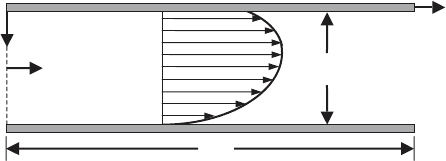
Consider the steady-state fully developed laminar flow of a viscous Newtonian
fluid having constant physical properties between two infinitely wide parallel plates
as shown in Figure 3.2-1. The lower plate is stationary and the upper plate moves
at a constant velocity U
0
. This flow is also subject to a constant axial pressure driv-
ing force P ≡ P
0
− P
L
> 0 applied over the length L. Note that the conditions
required to ensure that any of the aforementioned assumptions are reasonable could
be assessed using scaling analysis; we merely invoke these assumptions so that we
x
y
L
H
P
0
U
0
P
L
Figure 3.2-1 Steady-state fully developed laminar flow of a viscous Newtonian fluid that
has constant physical properties between two infinitely wide parallel flat plates due to a
pressure driving force P ≡ P
0
−P
L
applied over length L; the lower plate is stationary
and the upper plate moves at constant velocity U
0
.
FULLY DEVELOPED LAMINAR FLOW 21
can focus on assessing the applicability of just one assumption: when the effect of
the upper plate velocity U
0
can be neglected. We invoke the stepwise
◦
(1) scaling
analysis procedure outlined in Chapter 2. In this first example of
◦
(1) scaling anal-
ysis, we show all the steps in detail and provide a discussion of the rationale for
each step.
Step 1 involves writing the describing equations, in this case the equations
of motion and their boundary conditions simplified appropriately for this prob-
lem statement. Equations (D.1-10) and (D.1-11) in Appendix D simplify to the
following for the flow conditions specified:
0 =−
∂P
∂x
+ μ
d
2
u
x
dy
2
(3.2-1)
0 =−
∂P
∂y
+ ρg (3.2-2)
u
x
= U
0
at y = 0 (3.2-3)
u
x
= 0aty = H (3.2-4)
Equation (3.2-2) can be integrated and combined with equation (3.2-1) to obtain
0 =
P
L
+ μ
d
2
u
x
dy
2
(3.2-5)
Step 2 involves introducing arbitrary scale factors for each dependent and inde-
pendent variable. Step 3 is unnecessary in this problem since both the velocity and
spatial coordinate are naturally referenced to zero. Step 4 involves defining the
following dimensionless variables:
u
∗
x
≡
u
x
u
xs
and y
∗
≡
y
y
s
(3.2-6)
One might reasonably ask why a separate scale factor is not introduced for the
second derivative in equation (3.2-5). Indeed, one could introduce a scale fac-
tor for the second derivative. If this were done, one would find that there was
no dimensionless group to determine the appropriate scale factor for the veloc-
ity. However, the latter could be obtained by integrating the scale for the second
derivative of the velocity, in which case one would obtain the same scale for the
velocity that will be obtained here by introducing its scale factor directly. Alter-
natively, one could introduce a scale factor for the first derivative of the velocity.
Integrating the resulting scale factor again gives the same scale factor for the
velocity within a multiplicative factor of
◦
(1). This is explored further in Practice
Problem 3.P.1.

22 APPLICATIONS IN FLUID DYNAMICS
In step 5 these dimensionless variables are substituted into the describing
equations (3.2-3), (3.2-4), and (3.2-5):
0 =
P
L
+
μu
xs
y
2
s
d
2
u
∗
x
dy
∗2
(3.2-7)
u
xs
u
∗
x
= U
0
at y
∗
= 0 (3.2-8)
u
xs
u
∗
x
= 0aty
s
y
∗
= H (3.2-9)
Step 6 involves dividing through by the dimensional coefficient of the viscous
term in equation (3.2-7) since this term must be retained in order to satisfy the two
no-slip conditions at the solid boundaries. Similarly, in the two boundary conditions
we divide through by the dimensional coefficient of the dimensionless dependent
variable, which yields
0 =
y
2
s
P
μu
xs
L
+
d
2
u
∗
x
dy
∗2
(3.2-10)
u
∗
x
=
U
0
u
xs
at y
∗
= 0 (3.2-11)
u
∗
x
= 0aty
∗
=
H
y
s
(3.2-12)
Step 7 involves determining the scale factors to ensure that the dimensionless
term causing the flow (i.e., the pressure term) balances the term resisting the flow
(i.e., the viscous term) and ensuring that the relevant dimensionless dependent and
independent variables are
◦
(1) for the region of the flow that is of interest, in this
case all the fluid between the two flat plates. When considering any problem in
fluid dynamics, it is important to ask the question “What causes the flow?” since in
scaling, the term or terms causing the flow must balance the term or terms resisting
the flow. The former might constitute a pressure gradient, a moving boundary, or
body forces such as a gravitational, centrifugal, electric, or magnetic field; the latter
might constitute viscous forces, inertia effects, pressure effects, or body forces (note
that pressure and body forces can resist as well as cause flow). Balancing what
causes the flow with the principal term(s) that resist flow generally determines
one or more of the scales. Since we are scaling this problem for conditions such
that the flow is caused principally by the pressure gradient, we ensure that the
dimensionless viscous force and pressure terms balance by demanding that the
dimensionless group in equation (3.2-10) be equal to 1; that is,
y
2
s
P
μu
xs
L
= 1 (3.2-13)
Since our region of interest spans the entire fluid between the two flat plates,
an appropriate scale for the spatial coordinate is obtained by demanding that the