
Krantz W.B. Scaling Analysis in Modeling Transport and Reaction Processes: A Systematic Approach to Model Building and the Art of Approximation
Подождите немного. Документ загружается.


FULLY DEVELOPED LAMINAR FLOW 23
dimensionless group in equation (3.2-12) be equal to 1; that is,
H
y
s
= 1 ⇒y
s
= H (3.2-14)
Hence by combining equations (3.2-13) and (3.2-14), we obtain our velocity scale,
which is given by
u
xs
=
H
2
P
μL
(3.2-15)
Note that this velocity scale is directly proportional to the maximum velocity for
flow between two flat plates driven only by a pressure gradient. This scaling,
ensures that the dimensionless velocity goes through a change of order one over a
dimensionless distance of order one. Note that a change of order one implies that the
dimensionless variable goes from its minimum value of zero to its maximum value,
which has magnitude of order one. Note that in this case our dimensionless velocity
will always be less than 1 since equation (3.2-15) overestimates the maximum
velocity (by a factor of 8 when the motion of the upper plate can be neglected). In
this case we know the exact value of the scale required to bound the dimensionless
velocity between 0 and 1 since we can solve this particular problem analytically.
However, in general we would not know any of the scales beforehand; indeed,
determining these scales is one of the goals of the systematic scaling method. The
dimensionless groups emanating from the scaling analysis that contain this velocity
scale (
1
for the problem being considered here) could be eight times smaller (for
this problem) or larger (if the reciprocal of
1
were used as the dimensionless
group in this problem) than that obtained when the relevant dimensional physical
and geometric properties are substituted to evaluate them. Hence, we see that the
criteria expressed in terms of dimensionless groups that emanate from scaling
analysis are generally within an order of magnitude. For this reason it is good
practice to demand that the dimensionless groups emanating from a particular
scaling analysis be at least two orders of magnitude less than 1, denoted by
◦
(0.01),
to justify the particular assumption being considered.
Our dimensionless equations now become
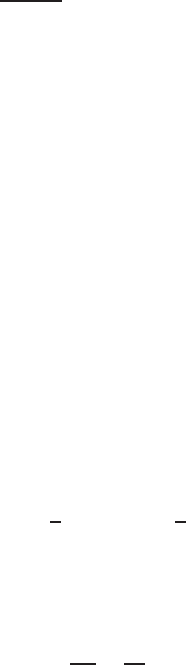
0 = 1 +
d
2
u
∗
x
dy
∗2
(3.2-16)
u
∗
x
=
U
0
μL
H
2
P
at y
∗
= 0 (3.2-17)
u
∗
x
= 0aty
∗
= 1 (3.2-18)
Step 8 then involves using our scaled dimensionless describing equations to assess
the criterion for which we can ignore the effect of the motion of the upper plate.
24 APPLICATIONS IN FLUID DYNAMICS
Equation (3.2-17) indicates that the motion of the upper plate will have an insignif-
icant influence on the fluid flow if the following condition holds:
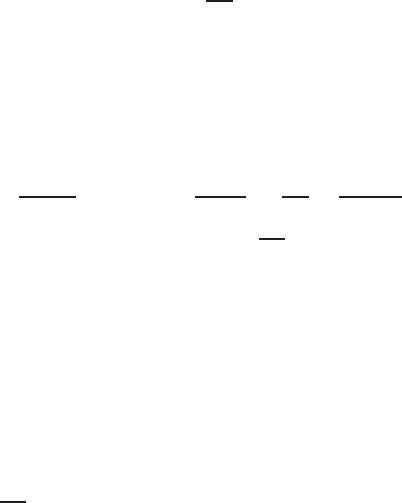
U
0
μL
H
2
P
≡
1
1 (3.2-19)
Note that the criterion that has emerged from our scaling analysis for ignoring
the effect of the moving upper plate on the flow is in terms of a dimension-
less group
1
. The physical significance of this dimensionless group is that it is
the ratio of the magnitude of the velocity of the upper plate to the magnitude
of the characteristic velocity due to the applied pressure gradient. The dimen-
sionless groups that emerge from scaling analysis will always have a physical
significance that can be determined by examining how a particular group was
formed: in this case, by dividing the velocity of the upper plate by the charac-
teristic velocity determined by balancing the pressure and viscous forces in the
equations of motion.
The question arises as to how small
1
has to be for the assumption of ignoring
the upper plate motion to be reasonable. The answer to this question depends
of course, on the error that one can tolerate in their answer. Since
◦
(1) scaling
involves order-of-magnitude analysis, one can project that if the dimensionless
group in equation (3.2-17) is
◦
(0.1), the error will be approximately 10 to 100%;
if this group is
◦
(0.01), the error will be approximately 1 to 10%. For example, the
dimensionless velocity profile obtained from solving equations (3.2-16), (3.2-17),
and (3.2-18) while retaining the effect of the moving upper plate is given by
u
∗
x
=
1
+
1
2
−
1
y
∗
−
1
2
y
∗2
(3.2-20)
The corresponding value of the dimensionless average velocity is given by inte-
grating the foregoing velocity profile across the flow to obtain
u
∗
x
=
1
2
+
1
12
(3.2-21)
One now can access the error in determining the dimensionless average velocity
when the motion of the upper plate is ignored (i.e., when
1
1). For example,
when
1
= 0.1, the error in determining the average velocity when the upper plate
velocity is ignored is 38%. However, when
1
= 0.01, the error is reduced to 5.7%.
This demonstrates clearly that proper scaling analysis provides results within an
order of magnitude. If one wants to be certain that some assumption can be invoked
with confidence, two orders of magnitude should be demanded for any “much less
than” or “much greater than” condition.
Note, however, that the error encountered in making an approximation, such
as assuming that
1
1, depends not only on the magnitude of
1
but also on
the quantity that is being determined from the solution. The average velocity is
an integral quantity whose value is not particularly sensitive to small errors in the
FULLY DEVELOPED LAMINAR FLOW 25
velocity profile near the upper plate. However, if one is interested in determining
the point or local velocity anywhere in the flowing fluid, the error is 100% at the
upper moving plate irrespective of the value of
1
! One might reasonably suspect
that this large error in the point or local velocity is encountered only very near
the upper moving plate. But the question arises: How near the upper plate is a
significant error encountered in determining the point velocity? Scaling analysis
can also address this question by considering region-of-influence scaling used to
determine the thickness of a region within which some effect is important: in
this case, the thickness of the region near the wall where the moving plate has a
significant effect on determining the point velocity.
To carry out region of influence scaling, the unspecified length scale factor
in fact becomes the thickness of the region of influence, which we denote by
the symbol δ
m
to emphasize its particular physical significance. By this we mean
that the relevant dependent variable, in this case the velocity, is
◦
(1) within this
region. Let us rescale this problem to determine the magnitude of δ
m
.Sincewe
are considering the region near the upper wall, equations (3.2-10) through (3.2-12)
remain the same. However, our velocity scale is no longer given by equation (3.2-
15), which characterizes the velocity across the entire flow. Rather, in the region
near the upper wall, the velocity scale is determined by the dimensionless group
in the boundary condition at the upper wall:
u
∗
x
=
U
0
u
xs
= 1 ⇒ u
xs
= U
0
(3.2-22)
However, since the pressure force must still balance the viscous term near the upper
wall, the dimensionless group in equation (3.2-13) must again be set equal to 1.
When equation (3.2-22) is substituted into this dimensionless group, one obtains a
measure of δ
m
, the thickness of the region of influence within which one cannot
ignore the influence of the moving plate on the point velocity:
δ
2
m
P
μU
0
L
= 1 ⇒ δ
2
m
=
μU
0
L
P
⇒
δ
2
m
H
2
=
μU
0
L
H
2
P
=
1
(3.2-23)
One sees from equation (3.2-23) that
√
1
is a measure of the fractional distance
between the two plates, within which the effect of the moving plate on the point
velocity is significant. Hence, if
1
=
◦
(0.01), the moving plate has a significant
effect on the local velocity across 10% of the distance between the two plates. This
will seriously affect determining the point velocity through a significant portion of
the flow but will have a relatively minor effect on integral quantities such as the
average velocity.
One can conclude from this scaling analysis that the solution obtained for
equations (3.2-1) through (3.2-4) when one assumes that U
0
∼
=
0 will be reason-
ably accurate for determining integral quantities such as the average velocity when
1
=
◦
(0.01) and that it will provide an accurate estimate for the local velocity
when
√
1
<y
∗
1, where y
∗
≡ y/H.
Before leaving this example it is instructive to see the forgiving nature of scaling
analysis. For the purpose of illustration, let us assume that we set the dimensionless

26 APPLICATIONS IN FLUID DYNAMICS
group in equation (3.2-22) incorrectly as our velocity scale; that is, we used the
velocity of the upper plate as our velocity scale. Note that this is a gross under-
estimate of the proper scale for the dimensionless velocity when the effect of the
motion of the upper plate has a negligible effect on the overall flow. However, if
we had chosen U
0
as our velocity scale, equation (3.2-10) would have assumed the
following dimensionless form:
0 =
H
2
P
μU
0
L
+
d
2
u
∗
x
dy
∗2
=
1
1
+
d
2
u
∗
x
dy
∗2
(3.2-24)
Note that if we have scaled the dimensionless velocity and spatial coordinate prop-
erly, the dimensionless second-order derivative in equation (3.2-24) should be
◦
(1).
We see from the above that if
1
1, as would be the case if the motion of the
upper plate were negligible compared to the flow caused by the pressure gradient,
equation (3.2-24) would be a statement that the sum of a very large term and a
term of
◦
(1) is equal to zero; this is clearly impossible. As a result of our incorrect
scaling of the dimensionless velocity, we have encountered a contradiction. This
indicates that we need to consider another scaling; this is, of course, the scaling
wherein the velocity scale factor is given by equation (3.2-15). Hence, we see that
scaling analysis is indeed forgiving in that improper scaling leads to a contradic-
tion, which indicates that scaling needs to be repeated. When the proper scaling is
found for the known physical and geometric properties of the problem, all terms
will be bounded of
◦
(1).
In carrying out this
◦
(1) scaling analysis, we were seeking to determine the cri-
terion for neglecting the motion of the upper plate on the fluid flow. We saw that the
conditions required to assure minimal error in neglecting this term depended on
the quantity that one sought to determine from the describing equations. In general,
the criterion is less demanding for integral quantities such as the average velocity,
volumetric flow rate, total drag force, and the like, than for quantities such as the
velocity or shear stress at some point in the continuum. We could also have carried
out
◦
(1) scaling to determine when the pressure force could be neglected relative
to the fluid motion caused by the moving boundary. This is left as an exercise in
Practice Problem 3.P.2.
3.3 CREEPING- AND LUBRICATION-FLOW APPROXIMATIONS
Now that the procedure for
◦
(1) scaling analysis has been illustrated in detail,
we use this method to explore the various approximations made in classical fluid
dynamics. We begin by using
◦
(1) scaling analysis to explore the creeping-and
lubrication-flow approximations. The latter is particularly important for flows invol-
ving very narrow gaps, such as journal bearings and fluid couplings. The problem
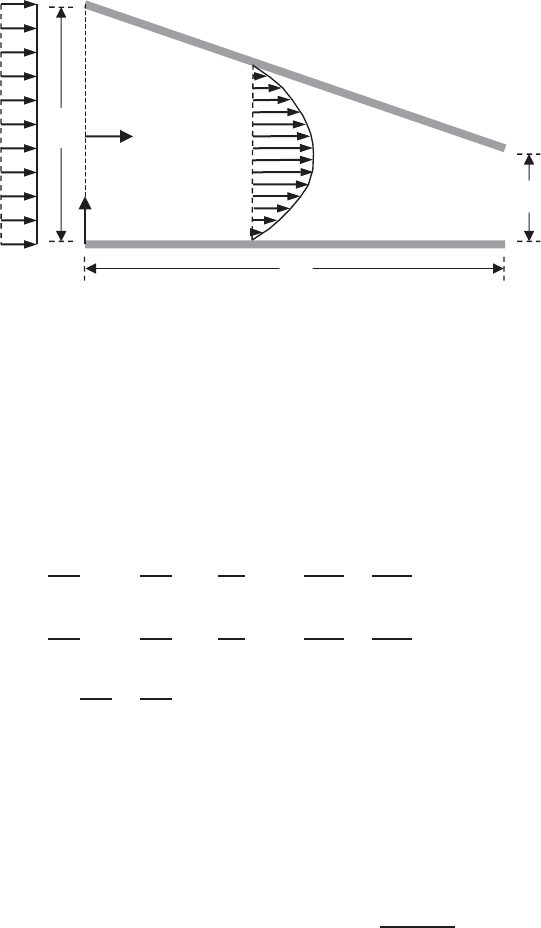
that we consider is steady-state one-dimensional uniform or plug flow of a vis-
cous Newtonian fluid having constant physical properties and constant velocity U
0
impinging on two nonparallel infinitely wide flat plates, as shown in Figure 3.3-1.
This creates a developing flow with nonzero x-andy-velocity components.
CREEPING- AND LUBRICATION-FLOW APPROXIMATIONS 27
L
U
0
H
0
H
L
y
x
Figure 3.3-1 Steady-state developing laminar flow of a viscous Newtonian fluid that has
constant physical properties between two infinitely wide nonparallel flat plates; only the
local axial velocity profile is shown.
To appreciate the utility of scaling analysis, it is instructive to write the describ-
ing equations before we consider the approximations that we might use to simplify
these equations. Indeed, one utility of scaling analysis is that it allows exploring the
approximations that might be made to obtain a tractable solution to a problem. The
continuity equation and equations of motion given by equations (C.1-1), (D.1-10),
and (D.1-11) simplify to the following for the assumed flow conditions (step 1):
ρu
x
∂u
x
∂x
+ ρu
y
∂u
x
∂y
=−
∂P
∂x
+ μ
∂
2
u
x
∂x
2
+
∂
2
u
x
∂y
2
(3.3-1)
ρu
x
∂u
y
∂x
+ ρu
y
∂u
y
∂y
=−
∂P
∂y
+ μ
∂
2
u
y
∂x
2
+
∂
2
u
y
∂y
2
− ρg (3.3-2)
∂u
x
∂x
+
∂u
y
∂y
= 0 (3.3-3)
The appropriate boundary conditions for this flow are given by
u
x
= U
0
,u
y
= 0atx = 0 (3.3-4)
u
x
= f
1
(y), u
y
= f
2
(y) at x = L (3.3-5)
u
x
= 0,u
y
= 0aty = 0 (3.3-6)
u
x
= 0,u
y
= 0aty = H
0
−
H
0
− H
L
L
x (3.3-7)
Equation (3.3-5) prescribes the downstream boundary conditions in terms of two
functions, f
1
(y) and f
2
(y), which might be unknown. The tangential and normal
velocity components to the sloped plate must be zero, due to the no-slip and
impermeable wall boundary conditions. Equation (3.3-7) for the x-andy-velocity
components follows directly from the aforementioned conditions. Note that we
28 APPLICATIONS IN FLUID DYNAMICS
do not need to put any boundary conditions on the pressure since the average
velocity U
0
is known, which permits determining the pressure driving force over
the length L.
Note that this is a nontrivial problem to solve. As a result of the developing
flow, there is strong bidirectional coupling between equations (3.3-1), (3.3-2), and
(3.3-3) through the velocity components and pressure. Moreover, the presence of
the inertia terms in equations (3.3-1) and (3.3-2) make both equations nonlinear. A
further complexity is introduced by the elliptic nature of the describing equations.
The presence of the second-order axial derivatives requires that downstream bound-
ary conditions be specified. In many problems such as this, these downstream
conditions are not known, which precludes solving the describing equations either
analytically or numerically. Clearly, one would like to know how and when these
describing equations might be simplified to permit a tractable solution. In particu-
lar, one would like to know when the inertia terms and axial viscous terms might
be neglected. We use
◦
(1) scaling to determine these conditions.
We begin by defining dimensionless variables involving unspecified scale factors
(steps 2, 3, and 4):
u
∗
x
≡
u
x
u
xs
; u
∗
y
≡
u
y
u
ys
; P
∗
≡
P
P
s
; x
∗
≡
x
x
s
; y
∗
≡
y
y
s
(3.3-8)
Note that we do not need to introduce any reference factors since all the dependent
and independent variables are naturally referenced to zero.
We then introduce these dimensionless variables into the describing equations
and divide through by the coefficient of one term in each of these equations that
we believe should be retained (steps 5 and 6):
ρu
xs
y
2
s
μx
s
u
∗
x
∂u
∗
x
∂x
∗
+
ρu
ys
y
s
μ
u
∗
y
∂u
∗
x
∂y
∗
=−
P
s
y
2
s
μu
xs
x
s
∂P
∗
∂x
∗
+
y
2
s
x
2
s
∂
2
u
∗
x
∂x
∗2
+
∂
2
u
∗
x
∂y
∗2
(3.3-9)
ρu
xs
u
ys
y
s
P
s
x
s
u
∗
x
∂u
∗
y
∂x
∗
+
ρu
2
ys
P
s
u
∗
y
∂u
∗
y
∂y
∗
=−
∂P
∗
∂y
∗
+
μu
ys
y
s
P
s
x
2
s
∂
2
u
∗
y
∂x
∗2
+
μu
ys
P
s
y
s
∂
2
u
∗
y
∂y
∗2
−
ρgy
s
P
s
(3.3-10)
∂u
∗
x
∂x
∗
+
u
ys
x
s
u
xs
y
s
∂u
∗
y
∂y
∗
= 0 (3.3-11)
u
∗
x
=
U
0
u
xs
,u
∗
y
= 0atx
∗
= 0 (3.3-12)
u
∗
x
= f
∗
1
(y
∗
), u
∗
y
= f
∗
2
(y
∗
) at x
∗
=
L
x
s
(3.3-13)
u
∗
x
= 0,u
∗
y
= 0aty
∗
= 0 (3.3-14)
u
∗
x
= 0,u
∗
y
= 0aty
∗
=
H
0
y
s
−
(H
0
− H
L
)x
s
Ly
s
x
∗
(3.3-15)
CREEPING- AND LUBRICATION-FLOW APPROXIMATIONS 29
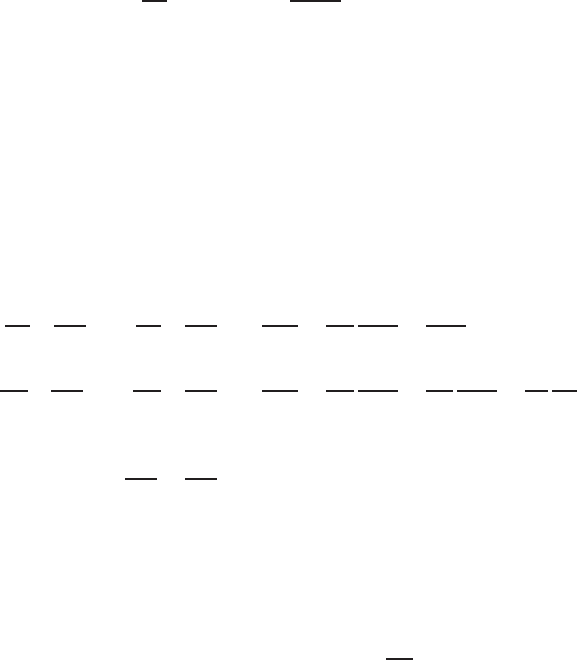
Note that in implementing step 6 for equation (3.3-9), we have elected to divide
through by the dimensional coefficient of the principal viscous term since it must
be retained to satisfy the no-slip boundary conditions at the two flat plates. In
equation (3.3-10) we have elected to divide through by the dimensional coefficient
of the pressure term since it causes the flow in the y-direction.
Now let us proceed to determine the scale factors (step 7). The axial velocity
scale is obtained from the dimensionless group in equation (3.3-12). We choose
the dimensionless group in equation (3.3-15) that gives the larger scale for y
s
since
we want to bound y
∗
to always be less than or equal to 1. The dimensionless
group in equation (3.3-13) provides the axial length scale. Since pressure causes
flow in the axial direction, we set the coefficient of the dimensionless pressure
term in equation (3.3-9) equal to 1 to determine the pressure scale. Finally, we set
the dimensionless group in equation (3.3-11) equal to 1 since the two terms in the
continuity equation have to balance for a developing flow. Hence, we obtain the
following scale factors:
u
xs
= U
0
; u
ys
=
H
0
L
U
0
; P
s
=
μU
0
L
H
2
0
; x
s
= L; y
s
= H
0
(3.3-16)
Note that the scale for the y-component of velocity is dependent on the aspect ratio;
for long closely spaced plates, the scale factor for u
y
will be considerably smaller
than that for u
x
. This is perfectly reasonable since u
y
arises from a need for the
velocity profile to be rearranged to accommodate the change in spacing between
the two plates. Less rearrangement is required for relatively closely spaced long
plates. Note also that the scale factor for the pressure is a measure of the viscous
drag stress multiplied by an aspect ratio. This also is reasonable since we have
balanced the pressure force with the principal viscous stress, which indeed is τ
yx
.
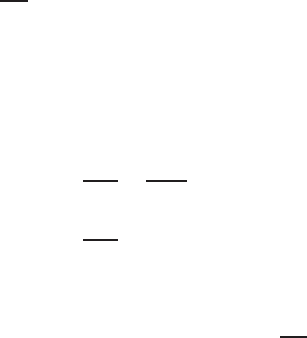
Substitution of the scale factors defined in equation (3.3-16) into equations
(3.3-9) through (3.3-15) yields
Re
H
0
L
u
∗
x
∂u
∗
x
∂x
∗
+ Re
H
0
L
u
∗
y
∂u
∗
x
∂y
∗
=−
∂P
∗
∂x
∗
+
H
2
0
L
2
∂
2
u
∗
x
∂x
∗2
+
∂
2
u
∗
x
∂y
∗2
(3.3-17)
Re
H
3
0
L
3
u
∗
x
∂u
∗
y
∂x
∗
+ Re
H
3
0
L
3
u
∗
y
∂u
∗
y
∂y
∗
=−
∂P
∗
∂y
∗
+
H
3
0
L
3
∂
2
u
∗
y
∂x
∗2
+
H
2
0
L
2
∂
2
u
∗
y
∂y
∗2
−
Re
Fr
H
0
L
(3.3-18)
∂u
∗
x
∂x
∗
+
∂u
∗
y
∂y
∗
= 0 (3.3-19)
u
∗
x
= 1,u
∗
y
= 0atx
∗
= 0 (3.3-20)
u
∗
x
= f
∗
1
(y
∗
), u
∗
y
= f
∗
2
(y
∗
) at x
∗
= 1 (3.3-21)
u
∗
x
= 0,u
∗
y
= 0aty
∗
= 0 (3.3-22)
u
∗
x
= 0,u
∗
y
= 0aty
∗
= 1 −
1 −
H
L
H
0
x
∗
(3.3-23)
30 APPLICATIONS IN FLUID DYNAMICS
where Re ≡ ρU
0
H
0
/μ is the Reynolds number, a measure of the ratio of the kinetic
energy per unit volume of the flow to the principal viscous stress, and Fr ≡ U
2
0
/gH
0
is the Froude number, a measure of the ratio of the kinetic energy to the gravita-
tional potential energy of the flow.
Now let us consider how we might be able to simplify the set of dimensionless
equations above to obtain a tractable solution (step 8). If Re 1, say Re =
◦
(0.01),
we see that we can safely neglect the nonlinear inertia terms in equations (3.3-17)
and (3.3-18) provided that H
0
/L =
◦
(1). This simplification is referred to as the
creeping-flow or Stokes’ flow approximation or simply the low Reynolds number
approximation. The creeping-flow approximation is very important for flow through
porous media, microporous membranes, and packed beds, and for the flow of small
particles such as dusts and mists. If, in addition, we can assume that the aspect
ratio H
2
0
/L
2
1, say H
2
0
/L
2
=
◦
(0.01), we can neglect the second-order axial
derivative in equation (3.3-17) as well as both viscous terms in equation (3.3-
18). When both Re 1andH
2
0
/L
2
1, it is referred to as the lubrication-flow
approximation; that is, all lubrication flows are also creeping flows, but not all
creeping flows are lubrication flows. Lubrication flows are very important in the
design of journal bearings and fluid couplings as well as in the drainage of viscous
films. Hence, in summary, the conditions for the applicability of the creeping-or
Stokes’ flow and lubrication-flow approximations are
Re 1 ⇒ creeping- or Stokes’ flow approximation (3.3-24)
Re 1and
H
2
0
L
2
1 ⇒ lubrication-flow approximation (3.3-25)
Note in the criteria for the lubrication-flow approximation that H
0
denotes a trans-
verse length scale and L denotes a length scale in the principal direction of flow.
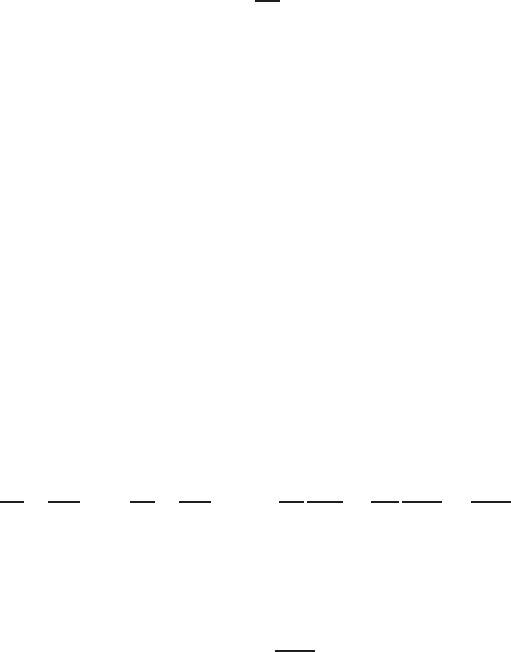
If we make the lubrication-flow approximation, our dimensionless describing
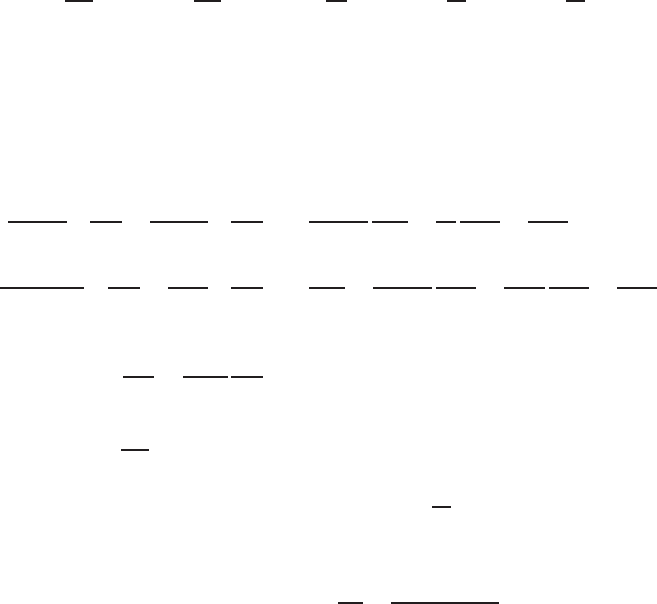
equations for the flow shown in Figure 3.3-1 become
0 =−
∂P
∗
∂x
∗
+
∂
2
u
∗
x
∂y
∗2
(3.3-26)
0 =−
∂P
∗
∂y
∗
(3.3-27)
u
∗
x
= 1atx
∗
= 0 (3.3-28)
u
∗
x
= 0aty
∗
= 1 −
1 −
H
L
H
0
x
∗
(3.3-29)
Equation (3.3-27) implies that there is a negligible pressure drop in the y-direction.
Note that we ensured that the axial pressure gradient was
◦
(1) because we
bounded the pressure and axial distance scales to be
◦
(1). However, we did
not do anything in our scaling to ensure that the y-derivative of the pressure
was
◦
(1); indeed, equation (3.3-18) indicates that the transverse pressure gradi-
ent is
◦
(H
2
0
/L
2
), which is considerably less than 1 for this lubrication flow. The
CREEPING- AND LUBRICATION-FLOW APPROXIMATIONS 31
lubrication-flow approximation has permitted us to eliminate the strong coupling
between the equations of motion and to convert our complex system of elliptic
differential equations into a set of differential equations that obviates the need
to satisfy the boundary conditions given by equation (3.3-21). Indeed, equations
(3.3-26) through (3.3-29) can be solved analytically in closed form. That is,
equation (3.3-27) implies that the axial pressure gradient is a function of only
the axial coordinate x. This in turn implies that equation (3.3-26) can be integrated
directly. Note that the dependence of u
x
on x enters indirectly through the boundary
condition given by equation (3.3-29). The axial pressure profile can be obtained
from the axial velocity profile and the known average velocity U
0
.
Before leaving this example it is important to realize the limitations implied
by the creeping-and lubrication-flow approximations. Our
◦
(1) scaling analysis
indicated that the creeping-flow assumption is reasonable when Re 1. However,
inspection of equation (3.3-17) indicates that an additional condition required to
ignore the inertia terms is that
Re
H
0
L
1 (3.3-30)
That is, it is not sufficient in this case that just the Reynolds number be very
small; in addition, the aspect ratio cannot be too large. Note, however, that the
length L wasarbitraryinthatL could denote any value of the axial coordi-
nate in the principal direction of flow. This is the principle of local scaling,
whereby we scale the problem for a fixed but arbitrary value of some coordi-
nate, usually that in the principal direction of flow. Note that both the creeping-
and lubrication-flow approximations break down near the leading edge of the
two plates. The creeping-flow approximation breaks down when equation
(3.3-30) is not satisfied. The lubrication-flow approximation breaks down when
either equation (3.3-30) or (3.3-25) is not satisfied. This is explored in Practice
Problem 3.P.5.
It is again instructional to illustrate the forgiving nature of scaling for this
example. Let us assume that we incorrectly balanced the pressure term with the
inertial terms in equation (3.3-9), which leads to P
s
= ρu
2
xs
as our (incorrect) pres-
sure scale; note that this pressure scale is a measure of the kinetic energy per unit
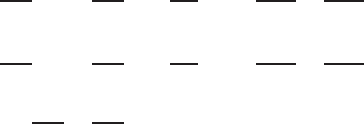
volume. If we use this pressure scale in equation (3.4-9), we obtain the following
dimensionless x-component of the equations of motion:
Re
H
0
L
u
∗
x
∂u
∗
x
∂x
∗
+ Re
H
0
L
u
∗
y
∂u
∗
x
∂y
∗
=−Re
H
0
L
∂P
∗
∂x
∗
+
H
2
0
L
2
∂
2
u
∗
x
∂x
∗2
+
∂
2
u
∗
x
∂y
∗2
(3.3-31)
If we now consider the lubrication-flow approximation, (i.e., Re 1andH
2
0
/L
2
1), equation (3.3-31) simplifies to
0 =
∂
2
u
∗
x
∂y
∗2
(3.3-32)
32 APPLICATIONS IN FLUID DYNAMICS
However, equation (3.3-32) is not a physically realistic result since there is no
mechanism to cause the flow; that is, equation (3.3-32) states that there is no
force to counteract the principal viscous stress. This indicates that the scaling was
improper and that new scales need to be determined to achieve a proper balance
between the relevant terms in the describing equations. Of course, we know that this
error was due to using an improper pressure scale; the pressure force must balance
the principal viscous term, not the inertia terms that drop out in the creeping-or
lubrication-flow limit.
3.4 BOUNDARY-LAYER-FLOW APPROXIMATION
The next example is the complement of the creeping-flow approximation consid-
ered in Section 3.3: the boundary-layer-flow approximation, which is applicable
in the limit of large Reynolds numbers. In this introductory example we con-
sider the classical problem of a uniform plug flow of a viscous Newtonian liquid
having constant physical properties intercepting a stationary semi-infinitely long
infinitely wide horizontal flat plate, as shown in Figure 3.4-1. Boundary-layer
flows are also examples of region of influence scaling, for which we use scal-
ing to determine the thickness of a region wherein some effect is confined, in
this case the effect of the flat plate that is propagated into the fluid by the action
of viscosity. This example also illustrates the principle of local scaling,inwhich
we carry out the scaling at some arbitrary but fixed value of one of the spa-
tial coordinates.
The traditional approach to introducing hydrodynamic boundary-layer theory
is to begin by assuming the existence of the boundary layer. This can be very
confusing, especially for students, since the boundary layer is an abstract concept.
Here we arrive at the need to define some region of influence (e.g., the boundary
layer) by being faced with a paradox due to incorrect scaling. That is, we are
going to scale this problem initially without assuming the existence of a boundary
layer. This will lead to a contradiction since the scaling analysis was improper.
However, by virtue of the forgiving nature of scaling analysis, we naturally arrive
at the concept of a hydrodynamic boundary layer without the need to introduce the
boundary layer initially.
In view of the preceding discussion, the continuity equation and equations of
motion given by equations (C.1-1), (D.1-10), and (D.1-11) simplify to the following
for the assumed flow conditions (step 1):
ρu
x
∂u
x
∂x
+ ρu
y
∂u
x
∂y
=−
∂P
∂x
+ μ
∂
2
u
x
∂x
2
+
∂
2
u
x
∂y
2
(3.4-1)
ρu
x
∂u
y
∂x
+ ρu
y
∂u
y
∂y
=−
∂P
∂y
+ μ
∂
2
u
y
∂x
2
+
∂
2
u
y
∂y
2
− ρg (3.4-2)
∂u
x
∂x
+
∂u
y
∂y
= 0 (3.4-3)