
Krantz W.B. Scaling Analysis in Modeling Transport and Reaction Processes: A Systematic Approach to Model Building and the Art of Approximation
Подождите немного. Документ загружается.

POROUS MEDIA FLOW 53
solid. The local Reynolds number that characterizes flow through the pores is
well into the creeping-flow regime, due to the small pore size; hence, one can
safely ignore the inertia terms in the equations of motion. Moreover, the resistance
to flow offered by the pore walls within the porous medium is generally much
greater than that of the solid walls that bound the entire porous medium (the
wall of the cylindrical tube in the present problem); the former can be described
by Darcy’s law, whereas the latter is usually neglected. However, the effect of
the boundaries of the porous medium cannot be ignored within some region of
influence adjacent to the boundaries. We seek to use scaling analysis to determine
the criterion for when the effect of the lateral boundaries on the flow through the
porous medium can be neglected and to determine the thickness of the region of
influence within which the effect of drag on the lateral boundaries on the flow must
be considered.
The appropriately simplified form of equations (E.2-1) and (E.2-3) in the Appen-
dices for steady-state creeping flow through a porous medium are given by (step 1)
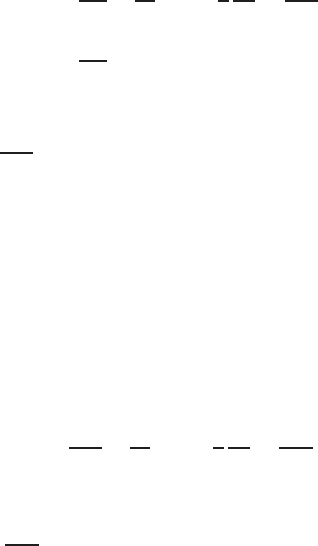
0 =−
∂P
∂z
−
μ
k
p
u
z
+ μ
1
r
d
dr
r
du
z
dr
(3.8-1)
0 =−
∂P
∂r
(3.8-2)
u
z
= 0atr = R (3.8-3)
du
z
dr
= 0atr = 0 (3.8-4)
P = P
0
at z = 0 (3.8-5)
where u
z
is the superficial flow velocity through the porous medium (i.e., the
flow velocity averaged over a differential cross-sectional area of the heterogeneous
medium in contrast to the flow velocity through a pore) and k
p
is the Darcy
permeability of the microporous solid. Note that we have ignored any effect of
hydrostatic pressure in equation (3.8-2). Equations (3.8-1) and (3.8-2) imply that
the axial pressure gradient is a constant. Hence, our describing equations sim-
plify to
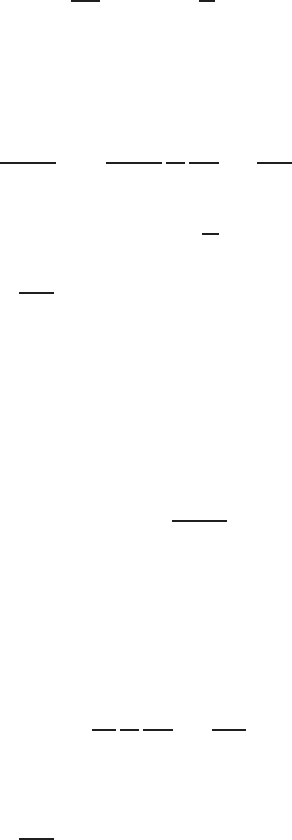
0 =
P
L
−
μ
k
p
u
z
+ μ
1
r
d
dr
r
du
z
dr
(3.8-6)
u
z
= 0atr = R (3.8-7)
du
z
dr
= 0atr = 0 (3.8-8)
where P ≡ P
0
− P
L
,inwhichP
0
and P
L
are the pressures at z = 0andz = L,
respectively. The equations above differ from the conventional equations of motion
by the inclusion of the Darcy term, which accounts for the resistance to flow offered
by the porous medium.
54 APPLICATIONS IN FLUID DYNAMICS
Introduce the following scale factors and dimensionless variables (steps 2, 3,
and 4):
u
∗
z
≡
u
z
u
zs
; r
∗
≡
r
r
s
(3.8-9)
Substitute these variables into the describing equations and divide through by the
dimensional coefficient of a term that must be retained to obtain the following set
of dimensionless describing equations (steps 5 and 6):
0 = 1 −
μLu
zs
k
p
P
u
∗
z
+
μLu
zs
P r
s
1
r
∗
d
dr
∗
r
∗
du
∗
z
dr
∗
(3.8-10)
u
∗
z
= 0atr
∗
=
R
r
s
(3.8-11)
du
∗
z
dr
∗
= 0atr
∗
= 0 (3.8-12)
The radial length scale r
s
is determined by setting the dimensionless group in
equation (3.8-11) equal to 1. Since pressure causes the flow and the porous medium
is assumed to offer the primary resistance to flow, the velocity scale u
zs
is deter-
mined by setting the dimensionless group in the Darcy term in equation (3.8-10)
equal to 1. These considerations then determine the following scale and reference
factors (step 7):
r
s
= R;u
zs
=
k
p
P
μL
(3.8-13)
Note that the velocity scale in equation (3.8-13) is the axial velocity that would
be predicted if just the pressure and Darcy flow terms were retained in equation
(3.8-10).
When the scales defined by equation (3.8-13) are substituted into equations
(3.8-10) through (3.8-12), we obtain
0 = 1 −u
∗
z
+
k
p
R
2
1
r
∗
d
dr
∗
r
∗
du
∗
z
dr
∗
(3.8-14)
u
∗
z
= 0atr
∗
= 1 (3.8-15)
du
∗
z
dr
∗
= 0atr
∗
= 0 (3.8-16)
Hence, we see that the effects of viscous drag at the inner wall of the cylindrical
tube can be neglected if the following condition is satisfied (step 8):
POROUS MEDIA FLOW 55
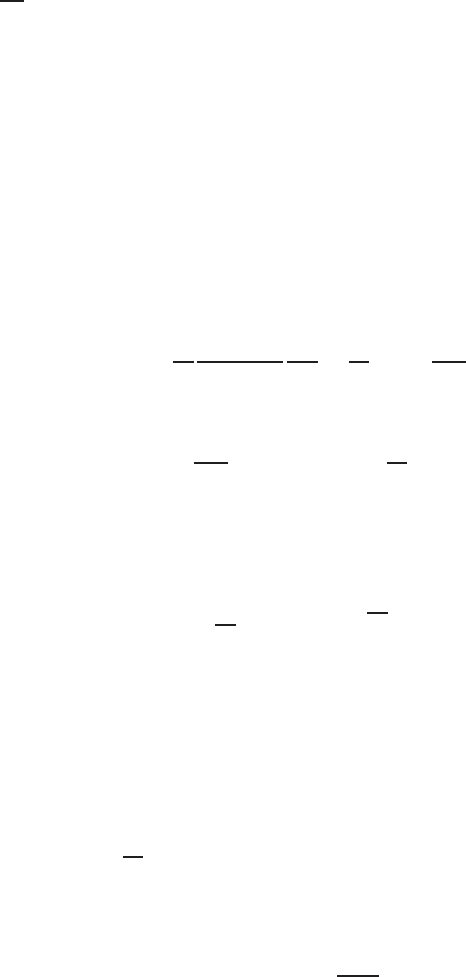
k
p
R
2
1 ⇒ viscous drag at boundary of porous medium can be neglected
(3.8-17)
The velocity obtained by solving equation (3.8-14) while dropping the last
term will be accurate provided that the condition indicated in equation (3.8-17)
is satisfied; that is, if k
p
/R
2
=
◦
(0.01) and provided that one is not interested
in predicting the velocity very close to the tube wall or the viscous drag at the
wall. It is of interest to determine the region of influence δ
p
, wherein the effect
of the tube wall cannot be ignored. To do this it is necessary to translate the
coordinate system to the tube wall via the transformation ˜r ≡ R − r.Sincewe
are considering a region of influence, ˜r
s
= δ
p
; the velocity scale still is given by
equation (3.8-13). The resulting transformed dimensionless describing equations
are given by
0 = 1 −u
∗
z
+
k
p
δ
2
p
1
R/δ
p
−˜r
∗
d
dr
∗
R
δ
p
−˜r
∗
du
∗
z
d ˜r
∗
(3.8-18)
u
∗
z
= 0at˜r
∗
= 0 (3.8-19)
du
∗
z
dr
∗
= 0at˜r
∗
=
R
δ
p
(3.8-20)
Within the region of influence the last term in equation (3.8-18) cannot be ignored;
hence, we set the dimensionless group multiplying this term equal to 1 to determine
the thickness of the region of influence:
k
p
δ
2
p
= 1 ⇒ δ
p
=
k
p
(3.8-21)
For typical Darcy permeabilities, δ
p
is on the order of 10 to 100 pore diame-
ters. Hence, in most cases one can ignore the effect of the system boundaries
on the relationship between the average superficial velocity through the porous
medium and the pressure gradient used. The curvature effects can be ignored
within the region of influence near the wall if the following criterion is satis-
fied:
R
δ
p
1 ⇒ curvature effects can be ignored (3.8-22)
in which case the describing equations simplify to
0 = 1 −u
∗
z
+
d
2
u
∗
z
dr
∗2
(3.8-23)
56 APPLICATIONS IN FLUID DYNAMICS
u
∗
z
= 0at˜r
∗
= 0 (3.8-24)
du
∗
z
dr
∗
= 0as˜r
∗
→∞ (3.8-25)
3.9 COMPRESSIBLE FLUID FLOW
In the examples we have considered thus far, we have assumed that the flowing fluid
was incompressible. This is certainly a tenuous assumption for gas flows and can
be questioned even for complex liquid flows.
10
In this example we use systematic
scaling analysis to assess when a flow can be considered to be incompressible.
This example will again involve introducing separate scale factors for a spatial
derivative rather than assuming that it scales with the ratio of the characteristic
value for the dependent variable divided by the characteristic length.
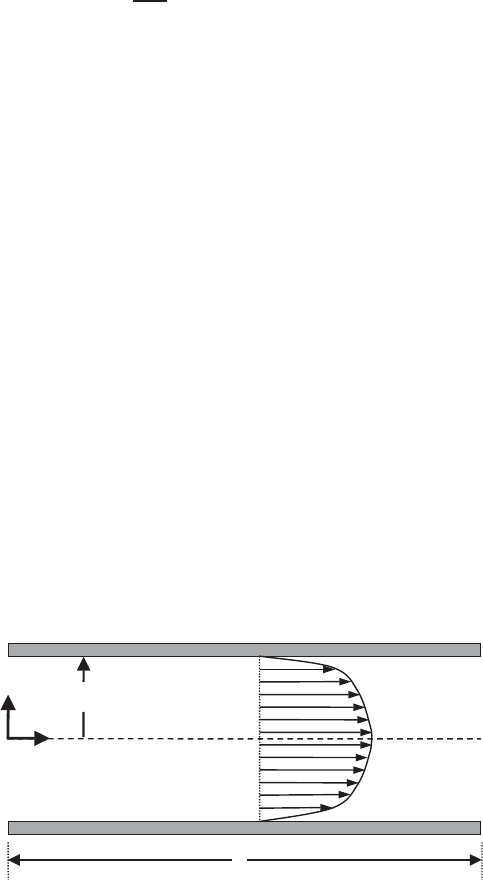
Consider the steady-state pressure-driven flow in a cylindrical tube of a com-
pressible gas whose other physical properties will be assumed to be constant as
shown in Figure 3.9-1. Due to the compressibility, the density of the gas will
decrease due to the pressure drop in the axial direction; it also changes in the
radial direction, however, this effect is usually quite small (although it will be
included in this scaling analysis). Correspondingly, there will be an increase in the
axial velocity, thereby implying that this is a developing flow with both nonzero
axial and radial velocity components. Hence, we must use the appropriate form of
the steady-state equations of motion that allow for a compressible flow. We use
scaling analysis to determine the conditions for which this flow can be considered
to be incompressible and fully developed. Although we allow only for a variable
density in this problem, the manner in which we use scaling to assess when this
r
z
R
L
P
H
P
L
Figure 3.9-1 Steady-state pressure-driven flow in a cylindrical tube of radius R and length
L of a compressible gas for which the other physical properties are assumed to be constant.
10
Examples of complex fluids include the flow of microemulsions, proteins, micellar solutions, and
suspensions, as well as other nonhomogeneous liquids.
COMPRESSIBLE FLUID FLOW 57
property can be assumed to be constant can be used to handle other variable
properties, such as the viscosity.
The describing equations in terms of the components of the viscous stress tensor
are obtained by appropriately simplifying the continuity equations and equations
of motion given by equations (C.2-1), (D.2-1), and (D.2-3) in the Appendices:
ρu
r
∂u
z
∂r
+ ρu
z
∂u
z
∂z
=−
∂P
∂z
−
1
r
∂
∂r
(rτ
rz
) −
∂τ
zz
∂z
(3.9-1)
ρu
r
∂u
r
∂r
+ ρu
z
∂u
r
∂z
=−
∂P
∂r
−
1
r
∂
∂r
(rτ
rr
) −
τ
θθ
r
−
∂τ
rz
∂z
(3.9-2)
1
r
∂
∂r
(ρru
r
) +
∂
∂z
(ρu
z
) = 0 (3.9-3)
where τ
ij
is the viscous shear stress associated with the transfer of j -momentum in
the i-direction. These equations have been given in terms of the components of the
viscous stress tensor to emphasize that the term τ
θθ
is not zero even though this is
an axisymmetric flow. To complete the specification of the describing equations,
we need to provide an equation of state that relates the density to the pressure (the
temperature is assumed to be constant) and need to specify appropriate boundary
conditions; this will be done after we have rearranged the equations above into a
more convenient form.
When the appropriate components of the viscous stress tensor given by equations
(D.2-4) through (D.2-9) in the Appendices are substituted into equations (3.9-1) and
(3.9-2) and the resulting equations simplified using the continuity equation given
by equation (3.9-3), we obtain
ρu
r
∂u
z
∂r
+ ρu
z
∂u
z
∂z
=−
∂P
∂z
+
μ
r
∂
∂r
r
∂u
z
∂r
−
μ
3
∂
∂z
u
r
ρ
∂ρ
∂r
+
u
z
ρ
∂ρ
∂z
+ μ
∂
2
u
z
∂z
2
(3.9-4)
ρu
r
∂u
r
∂r
+ρu
z
∂u
r
∂z
=−
∂P
∂r
+μ
∂
∂r
1
r
∂
∂r
(ru
r
)
−
μ
3
∂
∂r
u
r
ρ
∂ρ
∂r
+
u
z
ρ
∂ρ
∂z
+μ
∂
2
u
r
∂z
2
(3.9-5)
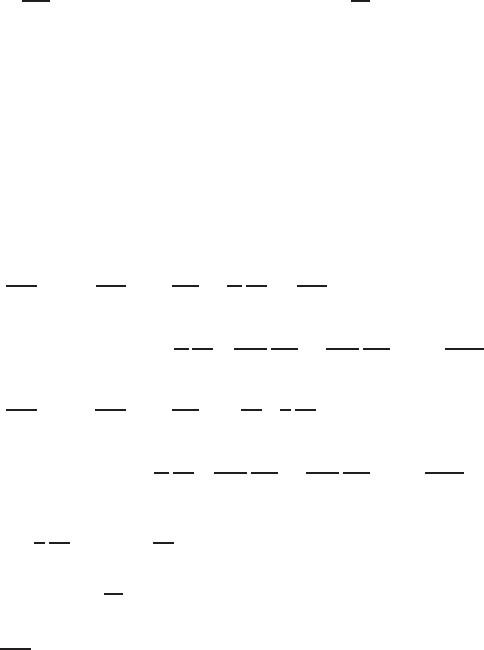
The derivatives of the density can be expressed in terms of derivatives of the
pressure as follows:
∂ρ
∂r
=
∂ρ
∂P
T
∂P
∂r
=
γ
c
2
∂P
∂r
;
∂ρ
∂z
=
∂ρ
∂P
T
∂P
∂z
=
γ
c
2
∂P
∂z
(3.9-6)
in which c is the speed of sound in the gas and γ is the ratio of the heat capacity at
constant pressure to that at constant volume. To assess the effect of pressure on the
density, we represent the density in terms of a Taylor series expansion about some
58 APPLICATIONS IN FLUID DYNAMICS
reference density ρ
0
, which is chosen to be at the downstream low pressure P
L
:
ρ = ρ
0
+
∂ρ
∂P
T
(P − P
L
) +
◦
(P − P
L
)
2
= ρ
0
+
γ
c
2
(P − P
L
) +
◦
(P − P
L
)
2
(3.9-7)
Note that it is sufficient to represent the density as a Taylor series truncated at
the second term since we need consider only small variations in the density. That
is, because we seek to determine the conditions for which incompressible flow
can be assumed, we need explore only small variations in the density since large
variations in the density most certainly will be associated with compressible flow.
Hence, our describing equations and associated boundary conditions are given by
(step 1)
ρu
r
∂u
z
∂r
+ ρu
z
∂u
z
∂z
=−
∂P
∂z
+
μ
r
∂
∂r
r
∂u
z
∂r
−
μ
3
∂
∂z
γu
r
ρc
2
∂P
∂r
+
γu
z
ρc
2
∂P
∂z
+ μ
∂
2
u
z
∂z
2
(3.9-8)
ρu
r
∂u
r
∂r
+ ρu
z
∂u
r
∂z
=−
∂P
∂r
+ μ
∂
∂r
1
r
∂
∂r
(ru
r
)
−
μ
3
∂
∂r
γu
r
ρc
2
∂P
∂r
+
γu
z
ρc
2
∂P
∂z
+ μ
∂
2
u
r
∂z
2
(3.9-9)
1
r
∂
∂r
(ρru
r
) +
∂
∂z
(ρu
z
) = 0 (3.9-10)
ρ = ρ
0
+
γ
c
2
(P − P
L
) (3.9-11)
∂u
z
∂r
= 0,u
r
= 0,P= p(z) at r = 0 (3.9-12)
u
z
= 0,u
r
= 0atr = R (3.9-13)
u
z
= f
1
(r), u
r
= f
2
(r), P = P
H
at z = 0 (3.9-14)
u
z
= g
1
(r), u
r
= g
2
(r) at z = L (3.9-15)
in which p(z), f
1
(r), g
1
(r), f
2
(r),andg
2
(r) are unspecified functions that in prin-
ciple would need to be known in order to integrate the full set of describing
equations. If the conditions that we seek to determine for assuming fully devel-
oped incompressible flow are satisfied, it will not be necessary to know these
unspecified functions.

COMPRESSIBLE FLUID FLOW 59
Introduce the following scale factors, reference factors, and dimensionless vari-
ables (steps 2, 3, and 4):
u
∗
z
≡
u
z
u
zs
; u
∗
r
≡
u
r
u
rs
; P
∗
≡
P − P
r
P
s
;
∂P
∂r
∗
≡
1
P
rs
∂P
∂r
;
ρ
∗
≡
ρ
ρ
s
; r
∗
≡
r
r
s
; z
∗
≡
z
z
s
(3.9-16)
We again allow for a reference pressure P
r
in our definition of the dimensionless
pressure since the latter is not naturally referenced to zero. Note that we must also
scale the density in this problem since it is one of the dependent variables. How-
ever, we do not need to introduce a reference factor for the density even though it
is not referenced to zero. The reason for this is that we are considering only small
variations in density; that is, the density does not vary significantly in either coordi-
nate direction. We have introduced a scale for the radial derivative of the pressure
denoted by P
rs
since we do not anticipate that this will scale in the same way as
the axial pressure gradient. The question might arise as to how one knows whether
to scale a derivative as the ratio of some dependent variable scale divided by some
independent variable scale or to introduce a separate scale for the entire derivative.
The answer is contained simply in the forgiving nature of scaling. That is, if we
were to assume that the radial pressure derivative scales as the pressure scale P
s
divided by the radial length scale r
s
, we would find that the dimensionless group in
front of the dimensionless radial pressure derivative was much larger than that of
any other term in the r-component of the equations of motion. This clearly would
indicate that we scaled incorrectly. Hence, determining whether a derivative needs
its own scale is often a matter of trial and error. If any term is scaled incorrectly,
the forgiving nature of scaling will indicate a contradiction in the dimensionless
equations. One then rescales until a self-consistent set of dimensionless equations
is obtained; that is, a system of equations for which balancing terms are of
◦
(1)
and all other terms, including those multiplied by dimensionless groups, are of
◦
(1). The consequence of not introducing a separate scale for the radial pressure
derivative is explored in Practice Problem 3.P.31.
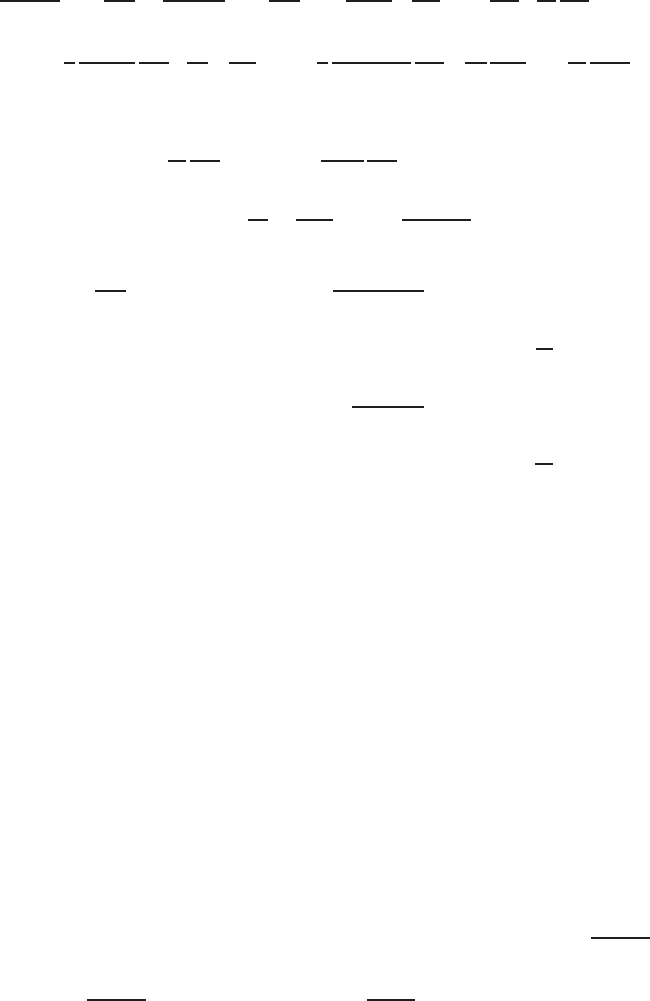
Substitute the variables defined in equation (3.9-16) into the describing equations
and divide through by the dimensional coefficient of a term that must be retained
to obtain the following set of dimensionless describing equations (steps 5 and 6):
ρ
s
u
rs
r
s
μ
ρ
∗
u
∗
r
∂u
∗
z
∂r
∗
+
ρ
s
u
zs
r
2
s
μz
s
ρ
∗
u
∗
z
∂u
∗
z
∂z
∗
=−
P
s
r
2
s
μu
zs
z
s
∂P
∗
∂z
∗
+
1
r
∗
∂
∂r
∗
r
∗
∂u
∗
z
∂r
∗
−
1
3
γu
rs
P
rs
r
2
s
ρ
s
c
2
u
zs
z
s
∂
∂z
∗
u
∗
r
ρ
∗
∂P
∂r
∗
−
1
3
γP
s
r
2
s
ρ
s
c
2
z
2
s
∂
∂z
∗
u
∗
z
ρ
∗
∂P
∗
∂z
∗
+
r
2
s
z
2
s
∂
2
u
∗
z
∂z
∗2
(3.9-17)
60 APPLICATIONS IN FLUID DYNAMICS
ρ
s
u
rs
r
s
μ
ρ
∗
u
∗
r
∂u
∗
r
∂r
∗
+
ρ
s
u
zs
r
2
s
μz
s
ρ
∗
u
∗
z
∂u
∗
r
∂z
∗
=−
P
rs
r
2
s
μu
rs
∂P
∂r
∗
+
∂
∂r
∗
1
r
∗
∂
∂r
∗
(r
∗
u
∗
r
)
−
1
3
γP
rs
r
s
ρ
o
c
2
∂
∂r
∗
u
∗
r
ρ
∗
∂P
∂r
∗
−
1
3
γu
zs
P
s
r
s
ρ
o
c
2
u
rs
z
s
∂
∂r
∗
u
∗
z
ρ
∗
∂P
∗
∂z
∗
+
r
2
s
z
2
s
∂
2
u
∗
r
∂z
∗2
(3.9-18)
1
r
∗
∂
∂r
∗
(ρ
∗
r
∗
u
∗
r
) +
u
zs
r
s
u
rs
z
s
∂
∂z
∗
(ρ
∗
u
∗
z
) = 0 (3.9-19)
ρ
∗
=
ρ
0
ρ
s
+
γP
s
c
2
ρ
s
P
∗
+
P
r
− P
L
P
s
(3.9-20)
∂u
∗
z
∂r
∗
= 0,u
∗
r
= 0,P
∗
=
p(z
∗
) − P
r
P
s
at r
∗
= 0 (3.9-21)
u
∗
z
= 0,u
∗
r
= 0atr
∗
=
R
r
s
(3.9-22)
u
∗
z
= f
∗
1
(r
∗
), u
∗
r
= f
∗
2
(r
∗
), P
∗
=
P
H
− P
r
P
s
at z
∗
= 0 (3.9-23)
u
∗
z
= g
∗
1
(r
∗
), u
∗
r
= g
∗
2
(r
∗
) at z
∗
=
L
z
s
(3.9-24)
The radial and axial length scales, r
s
and z
s
, can be bounded between zero and 1
by setting the dimensionless groups in equations (3.9-22) and (3.9-24) equal to 1.
The dimensionless pressure can be bounded between zero and 1 by setting the
dimensionless group containing the reference pressure in equation (3.9-20) equal
to zero and the dimensionless group containing the pressure scale in equation (3.9-
23) equal to 1. Since pressure causes the axial flow and the principal viscous term
(i.e., involving the second-order radial derivative) must be retained, the velocity
scale u
zs
is determined by setting the dimensionless group multiplying the pressure
term in equation (3.9-17) equal to 1. Since compressibility implies a developing
flow, the dimensionless group in the continuity equation given by (3.9-19) must be
equal to 1. The density scale is obtained by setting the dimensionless group in the
principal term in equation (3.9-20) equal to 1. Since the radial pressure gradient
causes the flow in the radial direction, the radial pressure gradient scale P
rs
is
determined by setting the dimensionless group multiplying the pressure term in
equation (3.9-18) equal to 1. These considerations then determine the following
scale and reference factors (step 7):
r
s
= R; z
s
= L; P
r
= P
L
; P
s
= P
H
− P
L
≡ P ; u
zs
=
R
2
P
μL
;
u
rs
=
R
3
P
μL
2
; ρ
s
= ρ
0
; P
rs
=
RP
L
2
(3.9-25)

COMPRESSIBLE FLUID FLOW 61
Note that the axial velocity scale u
zs
is within a multiplicative constant of
◦
(1)
of the value for the maximum velocity in fully developed incompressible flow in
a cylindrical tube.
When the scales defined by equation (3.9-25) are substituted into equations
(3.9-17) through (3.9-24), we obtain
Re
R
L
u
∗
r
∂u
∗
z
∂r
∗
+ Re
R
L
u
∗
z
∂u
∗
z
∂z
∗
=−
∂P
∗
∂z
∗
+
1
r
∗
∂
∂r
∗
r
∗
∂u
∗
z
∂r
∗
−
1
3
γ
Ma
2
Re
R
3
L
3
∂
∂z
∗
u
∗
r
ρ
∗
∂P
∂r
∗
−
1
3
γ
Ma
2
Re
R
L
∂
∂z
∗
u
∗
z
ρ
∗
∂P
∗
∂z
∗
+
R
2
L
2
∂
2
u
∗
z
∂z
∗2
(3.9-26)
Re
R
L
u
∗
r
∂u
∗
r
∂r
∗
+ Re
R
L
u
∗
z
∂u
∗
r
∂z
∗
=−
∂P
∂r
∗
+
∂
∂r
∗
1
r
∗
∂
∂r
∗
(r
∗
u
∗
r
)
−
1
3
γ
Ma
2
Re
R
L
∂
∂r
∗
u
∗
r
ρ
∗
∂P
∂r
∗
−
1
3
γ
Ma
2
Re
L
R
∂
∂r
∗
u
∗
z
ρ
∗
∂P
∗
∂z
∗
+
R
2
L
2
∂
2
u
∗
r
∂z
∗
(3.9-27)
1
r
∗
∂
∂r
∗
(ρ
∗
r
∗
u
∗
r
) +
∂
∂z
∗
(ρ
∗
u
∗
z
) = 0 (3.9-28)
ρ
∗
= 1 + γ
Ma
2
Re
L
R
P
∗
(3.9-29)
∂u
∗
z
∂r
∗
= 0,u
∗
r
= 0,P
∗
=
p
∗
(z
∗
) − P
L
P
at r
∗
= 0 (3.9-30)
u
∗
z
= 0,u
∗
r
= 0atr
∗
= 1 (3.9-31)
u
∗
z
= f
∗
1
(r
∗
), u
∗
r
= f
∗
2
(r), P
∗
= 1atz
∗
= 0 (3.9-32)
u
∗
z
= g
∗
1
(r
∗
), u
∗
r
= g
∗
2
(r
∗
) at z
∗
= 1 (3.9-33)
where Re ≡ Rρ
s
v
zs
/μ is the Reynolds number and Ma ≡ u
zs
/c is the Mach num-
ber; the latter is the ratio of the characteristic velocity of the fluid divided by
the speed of sound in the medium. We see that equations (3.9-26), (3.9-27), and
(3.9-29) can be simplified significantly if we can make the incompressible flow
approximation, which requires that the Mach number be very small; that is, Ma
1. Note that the size of the Mach number required to ensure incompressible flow
depends on both the Reynolds number and the aspect ratio. These equations can
be further simplified if we can assume fully developed flow, which requires that
Re(R/L) 1; this condition is ensured if Re(R/L) =
◦
(0.01). In summary, the

62 APPLICATIONS IN FLUID DYNAMICS
following conditions justify simplifying the describing equations for this flow:
Ma =
u
zs
c
=
R
2
P
μLc
1 ⇒ incompressible flow approximation (3.9-34)
Re
R
L
1 ⇒ L = 100
ρu
zs
R
2
μ
⇒ fully developed flow approximation (3.9-35)
If the conditions in equations (3.9-34) and (3.9-35) apply, equations (3.9-26)
through (3.9-33) simplify to (step 8)
0 = 1 +
1
r
∗
d
dr
∗
r
∗
du
∗
z
dr
∗
(3.9-36)
du
∗
z
dr
∗
= 0atr
∗
= 0 (3.9-37)
u
∗
z
= 0atr
∗
= 1 (3.9-38)
Of course, these are just the describing equations for fully developed flow of a
Newtonian fluid with constant physical properties in a cylindrical tube.
3.10 DIMENSIONAL ANALYSIS CORRELATION FOR THE
TERMINAL VELOCITY
In dimensional analysis we seek to determine the dimensionless groups required
to correlate data or to scale a process up or down. These dimensionless groups
can always be determined by means of
◦
(1) scaling analysis since this procedure
leads to the minimum parametric representation for a set of describing equations.
However, in the preceding sections we indicated that carrying out an
◦
(1) scaling
analysis can be somewhat complicated and time consuming. In contrast, the scal-
ing analysis approach to dimensional analysis illustrated in this section is much
easier and quicker to implement. Note, however, that it does not provide as much
information as does
◦
(1) scaling analysis for achieving the minimum parametric
representation. In particular, it does not lead to groups whose magnitude can be used
to assess the relative importance of particular terms in the describing equations. It
also does not identify regions of influence or boundary layers, whose identification
in some cases can reduce the number of dimensionless groups. This first example
of the use of scaling for dimensional analysis in fluid-dynamics applications will
provide more details on the steps involved. We also compare the results of scaling
analysis to those obtained from using the Pi theorem, underscore the advantages
of using the former to achieve the minimum parametric representation. The steps
referred to here are those outlined in Section 2.4 for the scaling approach to dimen-
sional analysis; these differ from those used in Sections 3.2 through 3.9 since no
attempt is made to achieve
◦
(1) scaling.