
Krantz W.B. Scaling Analysis in Modeling Transport and Reaction Processes: A Systematic Approach to Model Building and the Art of Approximation
Подождите немного. Документ загружается.

BOUNDARY-LAYER-FLOW APPROXIMATION 33
L
x
y
U
∞
d
m
(x)
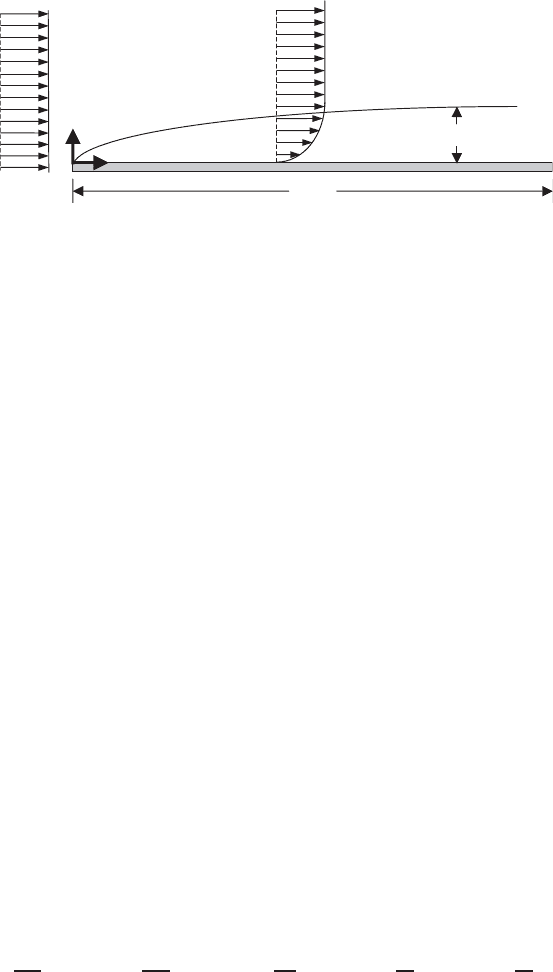
Figure 3.4-1 Uniform plug flow of velocity U
∞
for a viscous Newtonian fluid that has
constant physical properties, intercepting a stationary semi-infinitely long infinitely wide
horizontal flat plate.
The corresponding boundary conditions for this flow are given by
u
x
= U
∞
,u
y
= 0atx = 0 (3.4-4)
u
x
= f
1
(
y
)
,u
y
= f
2
(
y
)
at x = L (3.4-5)
u
x
= 0,u
y
= 0aty = 0 (3.4-6)
u
x
= U
∞
,u
y
= 0aty =∞ (3.4-7)
where f
1
(y) and f
2
(y) are unspecified functions. Equations (3.4-1) through (3.4-3),
as well as the boundary conditions given by equations (3.4-4), (3.4-5), and (3.4-6),
are identical to equations (3.3-1) through (3.3-3) for the lubrication-flow problem
considered in Section 3.3. This is, of course, because both the present example
and that considered in Section 3.3 are developing flows. However, the similarity
ends here because here we are going to consider the limit of a very large Reynolds
number; we thus consider the limit at the other end of the Reynolds number spec-
trum. Note also that the remaining boundary conditions differ in the two problems.
Equation (3.4-7) states that the axial velocity becomes equal to the initial plug-
flow velocity and that the transverse velocity becomes zero infinitely far above the
flat plate.
Keep in mind that at least initially, we are going to scale this problem incorrectly
to prove the point that scaling analysis can be used to arrive at the boundary-layer
approximation systematically. We begin by defining dimensionless dependent and
independent variables (steps 2, 3, and 4):
u
∗
x
≡
u
x
u
xs
; u
∗
y
≡
u
y
u
ys
; P
∗
≡
P
P
s
; x
∗
≡
x
x
s
; y
∗
≡
y
y
s
(3.4-8)
Introduce these dimensionless variables into the describing equations and divide
through by the dimensional coefficient of one term in each equation that should be
34 APPLICATIONS IN FLUID DYNAMICS
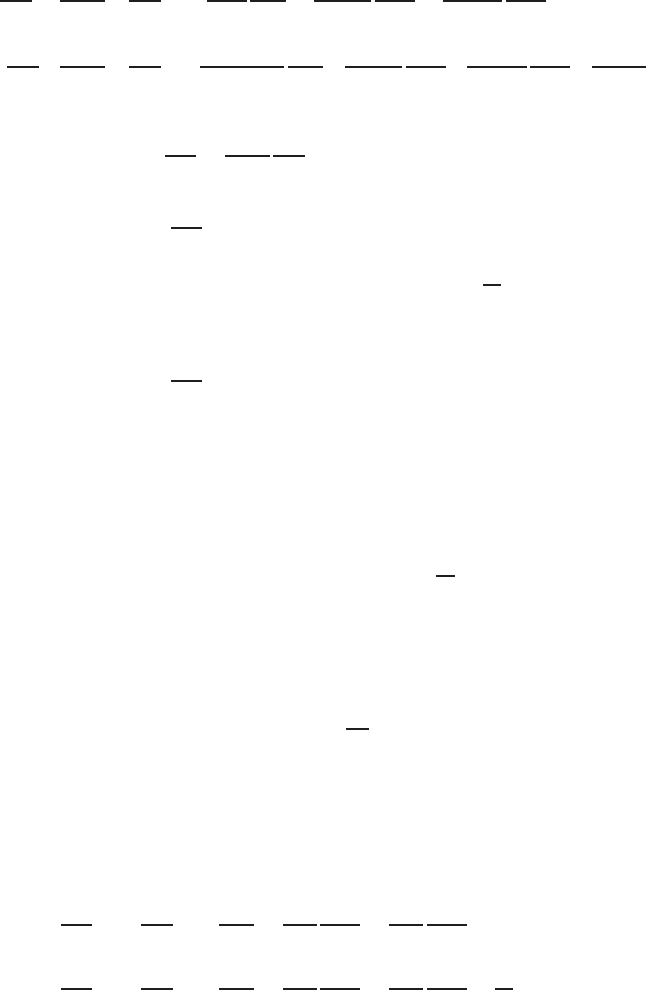
retained to maintain physical significance (steps 5 and 6):
u
∗
x
∂u
∗
x
∂x
∗
+
u
ys
x
s
u
xs
y
s
u
∗
y
∂u
∗
x
∂y
∗
=−
P
s
ρu
2
xs
∂P
∗
∂x
∗
+
μ
ρu
xs
x
s
∂
2
u
∗
x
∂x
∗2
+
μx
s
ρu
xs
y
2
s
∂
2
u
∗
x
∂y
∗2
(3.4-9)
u
∗
x
∂u
∗
y
∂x
∗
+
u
ys
x
s
u
xs
y
s
u
∗
y
∂u
∗
y
∂y
∗
=−
P
s
x
s
ρu
xs
u
ys
y
s
∂P
∗
∂y
∗
+
μ
ρu
xs
x
s
∂
2
u
∗
y
∂x
∗2
+
μx
s
ρu
xs
y
2
s
∂
2
u
∗
y
∂y
∗2
−
gx
s
u
xs
u
ys
(3.4-10)
∂u
∗
x
∂x
∗
+
u
ys
x
s
u
xs
y
s
∂u
∗
y
∂y
∗
= 0 (3.4-11)
u
∗
x
=
U
∞
u
xs
,u
∗
y
= 0atx
∗
= 0 (3.4-12)
u
∗
x
= f
∗
1
(y
∗
), u
∗
y
= f
∗
2
(y
∗
) at x
∗
=
L
x
s
(3.4-13)
u
∗
x
= 0,u
∗
y
= 0aty
∗
= 0 (3.4-14)
u
∗
x
=
U
∞
u
xs
,u
∗
y
= 0aty
∗
=∞ (3.4-15)
Note that we have divided equations (3.4-9) and (3.4-10) through by the dimen-
sional coefficient of the axial inertia term since we are considering a large Reynolds
number flow for which the inertia terms must be retained.
The dimensionless groups in equations (3.4-11), (3.4-12) or (3.4-15), and (3.4-
13) are set equal to 1 to determine the following scales (step 7):
u
xs
= U
∞
; x
s
= L; u
ys
=
y
s
L
U
∞
(3.4-16)
Moreover, since pressure causes the flow in the y-direction, we set the dimension-
less coefficient of the pressure term in equation (3.4-10) equal to 1 to determine
the pressure scale:
P
s
= ρU
2
∞
y
2
s
L
2
(3.4-17)
The immediate problem we see is that there is no dimensionless group to determine
y
s
. In view of this, let us set the transverse length scale equal to the axial length
scale; that is, y
s
= x
s
= L.
Now let us substitute these scales into equations (3.4-9) through (3.4-15) to
obtain
u
∗
x
∂u
∗
x
∂x
∗
+ u
∗
y
∂u
∗
x
∂y
∗
=−
∂P
∗
∂x
∗
+
1
Re
L
∂
2
u
∗
x
∂x
∗2
+
1
Re
L
∂
2
u
∗
x
∂y
∗2
(3.4-18)
u
∗
x
∂u
∗
y
∂x
∗
+ u
∗
y
∂u
∗
y
∂y
∗
=−
∂P
∗
∂y
∗
+
1
Re
L
∂
2
u
∗
y
∂x
∗2
+
1
Re
L
∂
2
u
∗
y
∂y
∗2
−
1
Fr
(3.4-19)

BOUNDARY-LAYER-FLOW APPROXIMATION 35
∂u
∗
x
∂x
∗
+
∂u
∗
y
∂y
∗
= 0 (3.4-20)
u
∗
x
= 1,u
∗
y
= 0atx
∗
= 0 (3.4-21)
u
∗
x
= f
∗
1
(y
∗
), u
∗
y
= f
∗
2
(y
∗
) at x
∗
= 1 (3.4-22)
u
∗
x
= 0,u
∗
y
= 0aty
∗
= 0 (3.4-23)
u
∗
x
= 1,u
∗
y
= 0aty
∗
=∞ (3.4-24)
where Re
L
≡ U
∞
ρL/μ is the Reynolds number based on the local axial distance
as the characteristic length and Fr ≡ U
2
∞
/gL is the Froude number.
Now consider the limit of very large Re
L
(Reynolds number) (step 8). One sees
that the principal viscous term (i.e., the second-order derivative with respect to y)
drops out in both equations (3.4-18) and (3.4-19); this means that it is not possible
to satisfy both boundary conditions given by equations (3.4-23) and (3.4-24). This,
indeed, is a contradiction since if equation (3.4-24) is not satisfied, there is no
mechanism to cause the flow; that is, in this case it is the free stream velocity that
“pulls” along the fluid whose motion is being impeded by the presence of the flat
plate. However, if equation (3.4-23) is not satisfied, the no-slip condition will be
violated at the surface of the flat plate. What we have arrived at is d’Alembert’s
paradox
2
; that is, in the limit of large Reynolds numbers, the equations of motion
appear unable to admit any restraining drag force since in this limit the inertia
terms overwhelm the viscous terms. The conclusion we must come to here is that
there must be some region of influence near the flat plate within which the effects
of viscosity are important regardless of how large the Reynolds number is. We
seek to use
◦
(1) scaling to determine the thickness of this region and to arrive at
a minimum parametric representation of the describing equations that circumvents
d’Alembert’s paradox.
The contradiction that we encountered in the above incorrect scaling arose
because we arbitrarily chose y
s
= L. This scale implies that the velocity goes from
a minimum value of 0 to a maximum value of U
∞
over a length that goes from
a minimum value of 0 to a maximum value of L. However, since L can be quite
large, this scaling implies that the second derivative of u
x
with respect to y could be
grossly underestimated. For a large Reynolds number flow for which the action of
viscosity is confined to the vicinity of the boundaries, the transverse length scale in
general should be considerably smaller than L. Let us refer to this region of influ-
ence for the effect of the viscosity by the symbol δ
m
;thatis,wesaythaty
s
= δ
m
.
Now let us rescale equations (3.4-1) through (3.4-7) and again introduce the
dimensionless variables defined by equation (3.4-8) with the proviso that we replace
2
Jean Le Rond d’Alembert (1717–1783) studied experimentally the drag force on a sphere in a flow-
ing fluid. He expected that the force would approach zero as the viscosity of the fluid approached
zero. However, the drag force observed converged on a nonzero value as the viscosity became very
small. The disappearance of the viscous drag force for very high Reynolds number flows is known as
d’Alembert’s paradox.
36 APPLICATIONS IN FLUID DYNAMICS
y
s
by δ
m
. We again obtain the scale factors given in equations (3.4-16) and (3.4-17),
where we have replaced y
s
everywhere by δ
m
. However, in view of the fact that
the principal viscous term in equation (3.4-9) has to be important at least within
some small region in the vicinity of the flat plate, we set the dimensionless group
in front of this term equal to 1 to ensure that this term is of the same size as the
inertia terms that are being retained. This yields the following equation for the
thickness of the region of influence or hydrodynamic boundary layer:
δ
2
m
=
μL
ρU
∞
⇒ δ
m
=
L
√
Re
L
(3.4-25)
where Re
L
≡ Lρ U
∞
/μ is the Reynolds number based on the arbitrary downstream
length along the plate. We see that the boundary layer becomes thinner for larger
Reynolds numbers, but also becomes thicker with increasing distance L along the
flat plate. Note that L is arbitrary in that it can be any fixed value of the axial length
coordinate; that is, our scaling was done for an arbitrary length L of a semi-infinite
flat plate, which is what is meant by the concept of local scaling. The general
behavior of δ
m
(x) is shown in Figure 3.4-1. It should not be surprising that the
above estimate of boundary-layer thickness is within a multiplicative constant of
◦
(1) of the value obtained via analytical solutions to the boundary-layer equations.
3
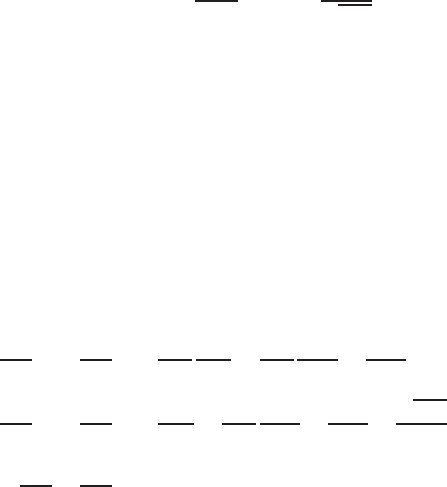
If we now rewrite our dimensionless describing equations in terms of the scales
defined by equations (3.4-16), (3.4-17), and (3.4-25), we obtain
u
∗
x
∂u
∗
x
∂x
∗
+ u
∗
y
∂u
∗
x
∂y
∗
=−
1
Re
L
∂P
∗
∂x
∗
+
1
Re
L
∂
2
u
∗
x
∂x
∗2
+
∂
2
u
∗
x
∂y
∗2
(3.4-26)
u
∗
x
∂u
∗
y
∂x
∗
+ u
∗
y
∂u
∗
y
∂y
∗
=−
∂P
∗
∂y
∗
+
1
Re
L
∂
2
u
∗
y
∂x
∗2
+
∂
2
u
∗
y
∂y
∗2
−
√
Re
L
Fr
(3.4-27)
∂u
∗
x
∂x
∗
+
∂u
∗
y
∂y
∗
= 0 (3.4-28)
u
∗
x
= 1,u
∗
y
= 0atx
∗
= 0 (3.4-29)
u
∗
x
= f
∗
1
y
∗
,u
∗
y
= f
∗
2
y
∗
at x
∗
= 1 (3.4-30)
u
∗
x
= 0,u
∗
y
= 0aty
∗
= 0 (3.4-31)
u
∗
x
= 1,u
∗
y
= 0aty
∗
=∞ (3.4-32)
The system of equations above is difficult to solve, for two reasons. First, these are
elliptic differential equations that require specifying some downstream boundary
conditions that in practice are generally not known. Second, equations (3.4-26) and
(3.4-27) are coupled, owing to the pressure appearing in both equations; note that
coupling through the velocity components does not cause any problems since the
3
R. B. Bird, W. E. Stewart, and E. N. Lightfoot, Transport Phenomena, 2nd ed., Wiley, Hoboken, NJ,
2002, p. 137.
BOUNDARY-LAYER-FLOW APPROXIMATION 37
continuity equation given by equation (3.4-28) permits defining a new dependent
variable, the stream function, that can be used to eliminate the two velocity com-
ponents. Hence, we seek to explore the conditions required to eliminate these two
complications.
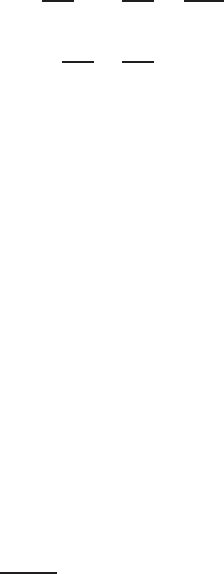
Note that in the limit of a very large Reynolds number, the system of equations
above reduces to
u
∗
x
∂u
∗
x
∂x
∗
+ u
∗
y
∂u
∗
x
∂y
∗
=
∂
2
u
∗
x
∂y
∗2
(3.4-33)
∂u
∗
x
∂x
∗
+
∂u
∗
y
∂y
∗
= 0 (3.4-34)
u
∗
x
= 1atx
∗
= 0 (3.4-35)
u
∗
x
= 0,u
∗
y
= 0aty
∗
= 0 (3.4-36)
u
∗
x
= 1aty
∗
=∞ (3.4-37)
Equations (3.4-33) through (3.4-37) are the classical boundary-layer equations for
flow over a flat plate. Note that by showing that the pressure term in equation
(3.4-26) is negligible in the limit of a large Reynolds number, we have elim-
inated the coupling between this equation and equation (3.4-27). Moreover, we
have shown that the axial viscous term in equation (3.4-26) is negligible in the
limit of a large Reynolds number and thereby have converted the system of ellip-
tic differential equations into a parabolic differential equation that requires only
an upstream boundary condition. By introducing a stream function and similarity
variable, equations (3.4-33) and (3.4-34) can be transformed into a nonlinear ordi-
nary differential equation that can be solved via approximate techniques such as
the Blasius series solution or numerically.
4
Note that the criterion for applicability of the hydrodynamic boundary-layer
approximation is
Re
L
≡
U
∞
ρL
μ
1 hydrodynamic boundary-layer flow (3.4-38)
Since L is merely some fixed value of the axial coordinate x, the criterion above
always breaks down in the vicinity of the leading edge of the flat plate. Hence,
if one is seeking to determine an integral quantity such as the total drag on the
flat plate, the error will not be significant if equation (3.4-38) is satisfied over
most of the plate. However, the error incurred by invoking the boundary-layer
approximation can be quite large in the vicinity of the leading edge of the plate
for point quantities such as the local velocity components or local shear stress.
Note that for 90% of the flat plate to satisfy the condition that Re
L
◦
(100), the
Reynolds number at the end of the plate must be 1000. Our scaling analysis results
for assessing the error incurred in making the boundary-layer approximation are
4
H. Schlichting, Boundary Layer Theory, McGraw-Hill, New York, 1960, pp. 116–124.
38 APPLICATIONS IN FLUID DYNAMICS
consistent with the results obtained from numerical solutions. For example, Janssen
found that the error in the drag coefficient was 40% at Re
L
= 100 and negligible
at Re
L
= 1000.
5
3.5 QUASI-STEADY-STATE-FLOW APPROXIMATION
Thus far, the three examples that we have considered have involved steady-state
flows. Here we consider how to use
◦
(1) scaling to analyze unsteady-state prob-
lems, in particular how to determine when the quasi-steady-state approximation is
applicable. The latter implies that the unsteady-state term does not appear explic-
itly in the describing equations; however, the time dependence enters through the
boundary conditions. In this example we see that there are several possible time
scales. Choosing the proper time scale depends on the conditions being considered.
In particular, we will see that for studying transient phenomena, the proper time
scale is the instantaneous observation time.
Consider the unsteady-state two-dimensional flow of a viscous Newtonian fluid
with constant physical properties between two infinitely wide parallel flat plates.
The upper plate is stationary, whereas the lower plate is initially at rest and then set
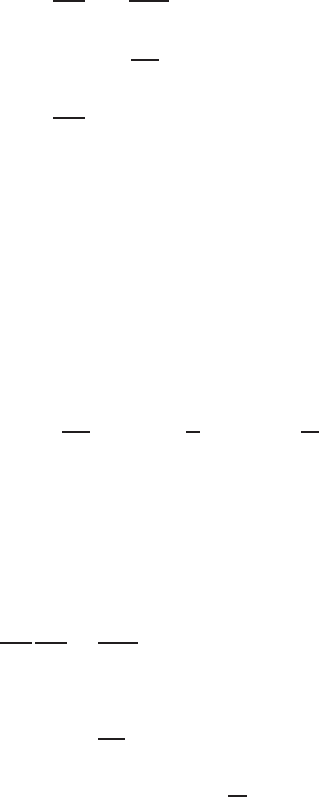
into oscillatory motion as shown in Figure 3.5-1. We use
◦
(1) scaling to address
three different approximations that we might make in modeling this flow: (1) when
we can ignore the transient startup effect on the flow, (2) when we can assume
Oscillating plate with velocity u
x
= U
0
cos wt
Stationary plate
x
y
H
Figure 3.5-1 Unsteady-state two-dimensional flow of a viscous Newtonian fluid that has
constant physical properties between two infinitely wide parallel flat plates; the upper plate
is stationary, whereas the lower plate is initially at rest and then set into oscillatory motion
with a velocity given by u
x
= U
0
cos ωt,whereU
0
is the amplitude and ω is the angular
frequency; the velocity profiles shown by the solid and dashed lines correspond to two
different times during the oscillatory motion.
5
F. Janssen, J. Fluid Mech., 3, 329 (1958).
QUASI-STEADY-STATE-FLOW APPROXIMATION 39
that this flow is quasi-steady-state, and (3) when we can consider the effect of the
oscillating plate to be confined to a region of influence.
The describing equations are obtained by appropriately simplifying equations
(C.1-1), (D.1-10), and (D.1-11) in the Appendices (step 1):
ρ
∂u
x
∂t
= μ
∂
2
u
x
∂y
2
(3.5-1)
0 =−
dP
dy
− ρg (3.5-2)
∂u
x
∂x
= 0 (3.5-3)
u
x
= 0att = 0 (3.5-4)
u
x
= U
0
cos ωt at y = 0 (3.5-5)
u
x
= 0aty = H (3.5-6)
Equation (3.5-4) states that the fluid is initially stationary. Equations (3.5-5) and
(3.5-6) are the no-slip conditions applied at the oscillated lower and stationary
upper boundaries, respectively.
Introduce the following scale factors and dimensionless variables (steps 2, 3,
and 4):
u
∗
x
≡
u
x
u
xs
; t
∗
≡
t
t
s
; y
∗
≡
y
y
s
(3.5-7)
Note that we do not have to scale the pressure since equation (3.5-2) indicates
that it is purely hydrostatic and not coupled with equation (3.5-1). Introduce these
dimensionless variables into the describing equations and divide each equation
through by the dimensional coefficient of a term that must be retained to ensure
that the problem has physical significance (steps 5 and 6):
ρy
2
s
μt
s
∂u
∗
x
∂t
∗
=
∂
2
u
∗
x
∂y
∗2
(3.5-8)
u
∗
x
= 0att
∗
= 0 (3.5-9)
u
∗
x
=
U
0
u
xs
cos ωt
s
t
∗
at y
∗
= 0 (3.5-10)
u
∗
x
= 0aty
∗
=
H
y
s
(3.5-11)
Now let us set appropriate dimensionless groups in equations (3.5-8) through
(3.5-11) equal to 1 to ensure that our dimensionless variables are
◦
(1) (step 7).

40 APPLICATIONS IN FLUID DYNAMICS
The dimensionless groups in equations (3.5-10) and (3.5-11) determine the follow-
ing scale factors:
u
xs
= U
0
; y
s
= H (3.5-12)
One might be tempted to set the dimensionless group in equation (3.5-8) equal to 1
to determine the time scale. However, this choice implies that our time scale is equal
to the time required for the motion of the lower oscillating plate to be felt at the
upper stationary plate by the action of viscosity since this implies that t
s
= H
2
/ν,
where ν ≡ μ/ρ is the kinematic viscosity; if this is the appropriate time scale,
quasi-steady-state can never be achieved for this flow. Alternatively, one could
obtain the time scale from the dimensionless group in equation (3.5-10). However,
this time scale, t
s
= 2π/ω, would characterize the oscillatory motion, which again
might not be proper for the conditions being considered.
6
The latter would certainly
not be the correct time scale to characterize the transient period during which the
fluid is accelerated from rest. The latter time scale is the instantaneous time at
which we “observe” the flow; we call this the observation time, t
o
. Hence, we have
three possible time scales:
t
st
= t
o
time scale corresponding to the observation time
t
sv
=
H
2
ν
time scale characterizing the viscous penetration (3.5-13)
t
sp
=
2π
ω
time scale characterizing the periodic motion
Clearly, 0 t
st
< ∞, since this scale is the actual time beginning at the inception
of unsteady-state flow. In contrast, the time scales t
sv
and t
sp
have fixed values
that depend on the values of the parameters in equation (3.5-13). If t
sv
<t
sp
,the
effect of the oscillatory plate motion will penetrate across the entire fluid to the
upper stationary plate. If t
sv
>t
sp
, the effect of the plate motion will be con-
fined to a region of influence whose thickness is less than H . We can determine
the thickness of this region of influence using
◦
(1) scaling analysis, as will be
shown.
The time scales defined in equation (3.5-13) permit us to determine the crite-
rion for assuming that the transients associated with fluid motion induced during
startup of the oscillatory motion have died out. This criterion is merely that t
st
must be much greater than the characteristic time for the oscillatory motion;
that is,
t
st
= t
o
2π
ω
⇒
ωt
o
2π
1 condition to ignore transient flow effects (3.5-14)
6
Note that we choose t
s
= 2π/ω rather than 1/ω since the oscillatory motion is characterized by the
time it takes to complete one cycle.

QUASI-STEADY-STATE-FLOW APPROXIMATION 41
Now let us assume that the transient effects have died out [i.e., that the con-
dition defined in equation (3.5-14) is satisfied]. We now seek to determine when
quasi-steady-state can be assumed, that is, when the unsteady-state term in
equation (3.5-8) can be neglected. When the velocity and length scales defined by
equation (3.5-12) and the time scale t
sp
defined in equation (3.5-13) are substituted
into equations (3.5-8) through (3.5-11), we obtain
ωρ H
2
2πμ
∂u
∗
x
∂t
∗
=
∂
2
u
∗
x
∂y
∗2
(3.5-15)
u
∗
x
= 0att
∗
= 0 (3.5-16)
u
∗
x
= cos 2πt
∗
at y
∗
= 0 (3.5-17)
u
∗
x
= 0aty
∗
= 1 (3.5-18)
We can now assess when the set of describing equations above can be simpli-
fied (step 8). In particular, we see from equation (3.5-15) that this flow can be
considered to be quasi-steady-state when the following condition holds:
ωρ H
2
2πμ
=
H
2
/ν
2π/ω
=
t
sv
t
sp
1 ⇒ quasi-steady-state (3.5-19)
For quasi-steady-state, the system of equations above can be solved quite simply
analytically to obtain the following solution:
u
∗
x
= (1 − y
∗
) cos 2πt
∗
(3.5-20)
The physical implication of the above is that the viscous time scale must be suf-
ficiently short so that the motion of the lower plate can penetrate across the entire
fluid to the upper stationary plate within a time that is much shorter than that char-
acterizing the periodic motion of the plate. Another way to state this is that if the
motion of the lower plate is sufficiently slow, its effect can penetrate all the way
to the upper plate. Under such conditions, the acceleration of the fluid is relatively
insignificant.
In the scaling analysis that led to the criterion for assuming quasi-steady-state
given by equation (3.5-19), we have assumed that the effect of the lower oscillating
plate penetrates the entire cross-section; that is, we have assumed that the velocity
goes from its minimum to maximum value over a length scale on the order of the
spacing between the two plates. This may not necessarily be true; that is, there
may be a region of influence whose thickness we again denote by y
s
= δ
m
.Using
this length scale then recasts equation (3.5-15) into the form
ωρ δ
2
m
2πμ
∂u
∗
x
∂t
∗
=
∂
2
u
∗
x
∂y
∗2
(3.5-21)
42 APPLICATIONS IN FLUID DYNAMICS
Since there is insufficient time for the effect of the oscillating plate to penetrate
through the entire fluid layer, this is inherently an unsteady-state flow. Hence, the
two terms in equation (3.5-21) must balance; this implies the following:
ωρ δ
2
m
2πμ
= 1 ⇒ δ
2
m
=
2πμ
ωρ
⇒
δ
m
H
=
2π/ω
H
2
/ν
=
t
sp
t
sv
(3.5-22)
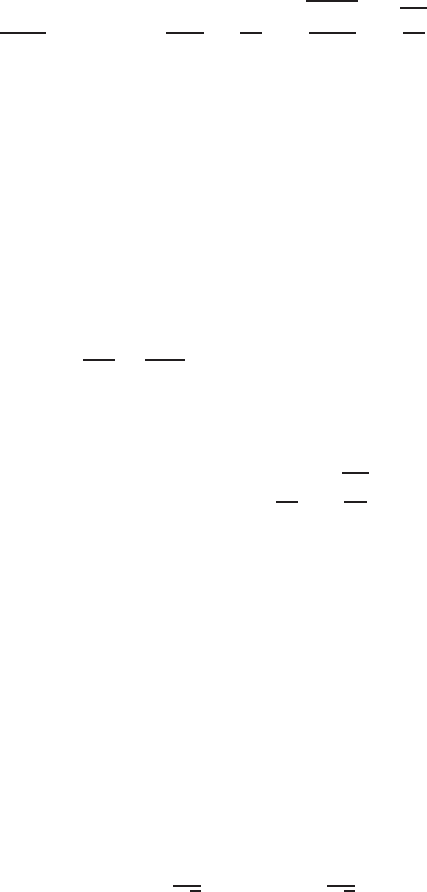
We see that the thickness of the region of influence relative to the spacing between
the two plates is proportional to the square root of the ratio of the characteristic
time for the periodic plate motion to that for viscous penetration. Smaller values
of t
sp
correspond to higher-frequency oscillations and hence to a thinner region
of influence or boundary-layer thickness. Note that when t
sp
= t
sv
, the region of
influence penetrates across the entire fluid layer. For values of t
sp
>t
sv
,thisis
no longer a region of influence or boundary-layer problem but an unsteady-state-
state flow for which the oscillating plate affects the entire fluid layer. For values of
t
sp
t
sv
, we achieve the quasi-steady-state condition defined by equation (3.5-19).
Note that when t
sp
t
sv
, the describing equations simplify to
∂u
∗
x
∂t
∗
=
∂
2
u
∗
x
∂y
∗2
(3.5-23)
u
∗
x
t
∗
= u
∗
x
t
∗
+1
for t
∗
> 0 (3.5-24)
u
∗
x
= cos 2πt
∗
at y
∗
= 0 (3.5-25)
u
∗
x
= 0aty
∗
=
H
δ
m
=
t
sv
t
sp
∼
=
∞ (3.5-26)
Note also that for this region of influence scaling, for which we are assuming
that the transients have died out (ωt
o
1), we have replaced the initial condition
with the periodic flow condition given by equation (3.5-24). The solution to this
simplified set of describing equations is straightforward. We know that u
∗
x
must
be periodic at all values of y
∗
; however, u
∗
x
will lag u
∗
x
at the lower plate by an
increasing amount as y
∗
increases. We also note that u
∗
x
must damp out as y
∗
→∞.
Hence, we assume a solution of the form
u
∗
x
= e
−αy
∗
cos[2πt
∗
− g(y
∗
)] (3.5-27)
where α and g(y
∗
) are an undetermined constant and function, respectively. Sub-
stituting equation (3.5-27) into equations (3.5-23) through (3.5-26) then gives the
following values for these unknown quantities:
α =
1
√
2
,g(y
∗
) =
y
∗
√
2
(3.5-28)
In summary, we see that the scaling of unsteady-state problems can be compli-
cated by several time scales. It is important that the implications of each time scale
be considered carefully when using scaling analysis to simplify such problems.