
Krantz W.B. Scaling Analysis in Modeling Transport and Reaction Processes: A Systematic Approach to Model Building and the Art of Approximation
Подождите немного. Документ загружается.

FLOWS WITH END AND SIDEWALL EFFECTS 43
3.6 FLOWS WITH END AND SIDEWALL EFFECTS
The examples considered in Sections 3.2 through 3.5 involved flows that were
assumed to be infinitely wide in the lateral direction. In this example we use
◦
(1) scaling to determine a criterion for ignoring sidewall effects; that is, to permit
one to assume that the flow is infinitely wide in the lateral direction. The same type
of scaling arguments used to justify ignoring sidewall effects can also be used to
justify ignoring end effects. We also seek to determine the thickness of the region
of influence within which one cannot ignore the effect of the sidewalls on point or
local quantities such as the velocity profile or drag at the sidewalls.
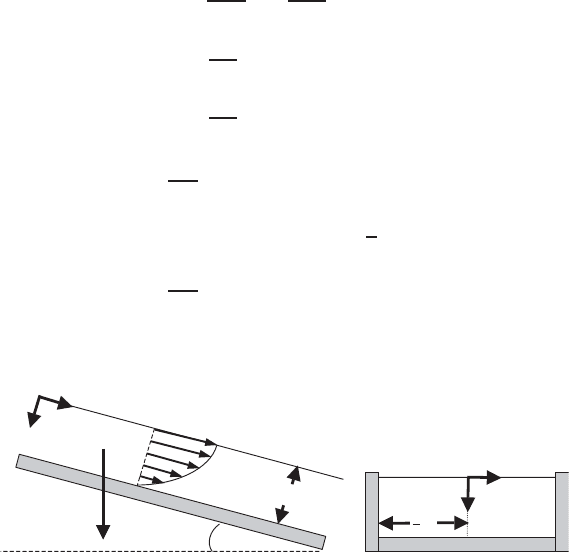
Consider the steady-state fully developed gravity-driven flow of a Newtonian
liquid film having thickness H and constant physical properties down a channel
inclined at an angle θ to the horizontal and having width W as shown in Figure
3.6-1. The describing equations are obtained by appropriately simplifying equations
(C.1-1), (D.1-10), (D.1-11), (D.1-12) in the Appendices for a flow that is caused
by a gravitational body force (step 1):
0 = μ
∂
2
u
z
∂x
2
+ μ
∂
2
u
z
∂y
2
+ ρg sin θ (3.6-1)
0 =−
∂P
∂y
+ ρg cos θ (3.6-2)
0 =−
∂P
∂z
(3.6-3)
∂u
z
∂z
= 0 (3.6-4)
u
z
= 0atx =±
1
2
W (3.6-5)
∂u
z
∂y
= 0aty = 0 (3.6-6)
u
z
= 0aty = H (3.6-7)
z
y
Gas
Liquid
H
x
y
1
2
W
g
q
Figure 3.6-1 Steady-state fully developed gravity-driven flow of a Newtonian liquid film
of thickness H and constant physical properties flowing down a flat plate inclined at an
angle θ to the horizontal; this flow is bounded laterally by two parallel flat plates spaced a
distance W apart.
44 APPLICATIONS IN FLUID DYNAMICS
Equations (3.6-5) and (3.6-7) are no-slip conditions at the solid boundaries.
Equation (3.6-6) is the implication of assuming negligible drag by the gas on the
liquid–gas interface. Equations (3.6-2) and (3.6-3) imply that the pressure is purely
hydrostatic and need not be considered further in the scaling analysis.
Introduce the following scale factors and dimensionless variables (steps 2, 3,
and 4):
u
∗
z
≡
u
z
u
zs
; x
∗
≡
x
x
s
; y
∗
≡
y
y
s
(3.6-8)
Substitute these variables into the describing equations and divide through by the
dimensional coefficient of a term that must be retained to obtain the following set
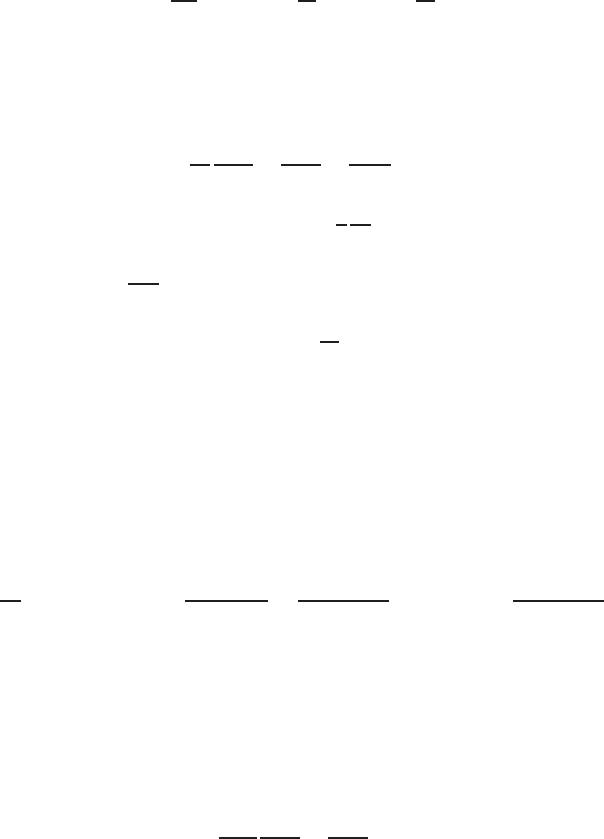
of dimensionless describing equations (steps 5 and 6):
0 =
y
2
s
x
2
s
∂
2
u
∗
z
∂x
∗2
+
∂
2
u
∗
z
∂y
∗2
+
ρgy
2
s
μu
zs
sin θ (3.6-9)
u
∗
z
= 0atx
∗
=±
1
2
W
x
s
(3.6-10)
∂u
∗
z
∂y
∗
= 0aty
∗
= 0 (3.6-11)
u
∗
z
= 0aty
∗
=
H
y
s
(3.6-12)
To bound our dimensionless variables to be
◦
(1), we set the dimensionless group
in equation (3.6-9) that is a measure of the ratio of the gravitational body force to
the principal viscous drag force equal to 1 since gravity causes the flow. The lateral
and vertical length scales over which the velocity goes from its minimum to its
maximum value are obtained by setting the dimensionless groups in equations (3.6-
10) and (3.6-12) equal to 1. This yields the following values for the length and
velocity scales (step 7):
x
s
=
W
2
,y
s
= H,
ρgy
2
s
sin θ
μu
zs
=
ρgH
2
sin θ
μu
zs
= 1 ⇒ u
zs
=
ρgH
2
sin θ
μ
(3.6-13)
Note that the velocity scale in equation (3.6-13) is within a multiplicative constant
of
◦
(1) of the surface velocity for fully developed laminar film flow down an
inclined plate.
When the velocity and length scales defined by equation (3.6-13) are substituted
into equations (3.6-9) through (3.6-12), we obtain
0 =
4H
2
W
2
∂
2
u
∗
z
∂x
∗2
+
∂
2
u
∗
z
∂y
∗2
+ 1 (3.6-14)
u
∗
z
= 0atx
∗
=±1 (3.6-15)

FREE SURFACE FLOW 45
∂u
∗
z
∂y
∗
= 0aty
∗
= 0 (3.6-16)
u
∗
z
= 0aty
∗
= 1 (3.6-17)
Note in the set of describing equations above that the dimensionless dependent and
independent variables are bounded of
◦
(1). We see from the above that we can
ignore the term in equation (3.6-14) that accounts for the effect of the sidewalls if
the following dimensionless group is very small; that is (step 8),
4H
2
W
2
1 ⇒ sidewall effects can be neglected (3.6-18)
The condition in equation (3.6-18) will be satisfied if 4H
2
/W
2
=
◦
(0.01). If this
condition is satisfied, the solution to the appropriately simplified form of equation
(3.6-14) and the boundary conditions given by equations (3.6-16) and (3.6-17) can
be obtained quite simply analytically. This solution will be accurate for predicting
any quantities for which H and W are the appropriate length scales; that is, integral
quantities that depend on the velocity profile across the entire cross section of the
flow, such as the average velocity, volumetric flow rate, and overall drag force.
If one seeks to determine the drag force or velocity in the vicinity of the side-
walls, the simplified form of equation (3.6-14) cannot be used. Clearly, there is a
region of influence within which the effect of the sidewalls on the flow cannot be
ignored. Within this region of influence, the viscous stress term in equation (3.6-14)
arising from the drag at the sidewalls is just as important as the principal viscous
term;thatis,τ
zx
is approximately the same magnitude as τ
yz
. This means that
the dimensionless group multiplying the term arising from τ
zx
in equation (3.6-14)
must be set equal to 1. This provides a measure of the thickness of the region of
influence within which one cannot ignore the effect of the sidewalls; that is,
4H
2
x
2
s
=
4H
2
δ
2
m
= 1 ⇒ δ
m
= 2H (3.6-19)
In summary, the effect of the sidewalls on the flow can be ignored if the flow
channel is much wider than the depth of the liquid film. Ignoring the sidewall
effects is a reasonable approximation under such conditions provided that one is
not interested in predicting some quantity in the immediate vicinity of the sidewalls.
Scaling analysis provides both the criterion for ignoring the sidewall effects as well
as an estimate of the region in which these effects will be important.
3.7 FREE SURFACE FLOW
The flow considered in Section 3.6 involved a free surface, the liquid–gas interface.
However, the complications introduced were minimal in that example because this
free surface was planar. In this example we consider a nonplanar two-dimensional
free surface flow involving the unsteady-state draining of a viscous Newtonian
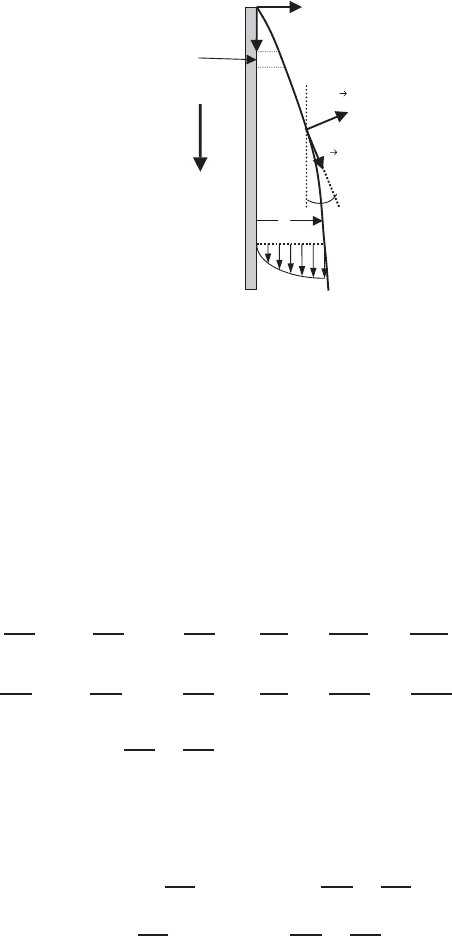
46 APPLICATIONS IN FLUID DYNAMICS
g
z
x
GasLiquid
Δz
t
n
q
h
Figure 3.7-1 Draining of a two-dimensional viscous Newtonian liquid film that has constant
physical properties due to a gravitational body force; the liquid film has a free surface at
which the effects of both viscous drag and surface-tension forces are assumed to be negligible.
liquid film having constant physical properties due to a gravitational body force,
as shown in Figure 3.7-1; we assume that the effects of viscous drag and surface-
tension forces at the free surface can be neglected. We use
◦
(1) scaling to determine
when the describing equations can be simplified; in particular, when the effects of
surface curvature can be ignored.
The describing equations are obtained by appropriately simplifying equations
(C.1-1), (D.1-10), and (D.1-12) in the Appendices for a flow that is caused by a
gravitational body force (step 1):
ρ
∂u
z
∂t
+ ρu
z
∂u
z
∂z
+ ρu
x
∂u
z
∂x
=−
∂P
∂z
+ μ
∂
2
u
z
∂z
2
+ μ
∂
2
u
z
∂x
2
+ ρg (3.7-1)
ρ
∂u
x
∂t
+ ρu
z
∂u
x
∂z
+ ρu
x
∂u
x
∂x
=−
∂P
∂x
+ μ
∂
2
u
x
∂z
2
+ μ
∂
2
u
x
∂x
2
(3.7-2)
∂u
z
∂z
+
∂u
x
∂x
= 0 (3.7-3)
u
z
= 0,u
x
= 0,η=∞ at t = 0 (3.7-4)
u
z
= 0,u
x
= 0atx = 0 (3.7-5)
4
∂u
z
∂z
sin θ cos θ −
∂u
x
∂z
+
∂u
z
∂x
cos 2θ = 0
−P
atm
+ P +2μ
∂u
z
∂z
cos 2θ −2μ
∂u
x
∂z
+
∂u
z
∂x
sin θ cos θ = 0
⎫
⎪
⎪
⎬
⎪
⎪
⎭
at x = η(z, t) (3.7-6)
u
z
= 0,u
x
= 0,η= 0atz = 0 (3.7-7)
u
z
= f
1
(x, t), u
x
= f
2
(x, t) at z = L (3.7-8)
FREE SURFACE FLOW 47
Note that pressure terms are included in both equations (3.7-1) and (3.7-2) even
though we are ignoring surface-tension effects. These pressure terms must be
included because this is a developing flow; that is, flow in the x-direction is caused
by an induced pressure force. The first of equations (3.7-6) is a statement that the
adjacent gas phase does not exert any viscous drag force on the liquid interface;
that is,
t ·nσ
= 0atx = η(z, t),wheren and
t are the local normal and tangential
unit vectors at the free surface, respectively, and σ
= Pδ +τ is the total stress ten-
sor in which δ
is the identity tensor and τ is the viscous stress tensor defined for a
Newtonian fluid by equations (D.1-4) through (D.1-9) in the Appendices. For the
coordinate system shown in Figure 3.7-1, the normal and tangential unit vectors are
expressed in terms of the unit vectors in the x-andz-coordinate directions,
δ
x
and
δ
z
, respectively, as follows: n =
δ
x
cos θ −
δ
z
sin θ and
t =
δ
x
sin θ +
δ
z
cos θ.The
functions f
1
(x, t) and f
2
(x, t) in equation (3.7-8) merely indicate that to solve this
system of differential equations we would need to specify some downstream bound-
ary conditions; often, these are unknown, which precludes solving these equations.
This downstream boundary condition is applied at z = L,whereL can be any
specified value of z; hence, this is another example of local scaling.
Equations (3.7-1) through (3.7-8) constitute three differential equations and their
associated initial and boundary conditions to determine four unknown dependent
variables: u
z
,u
x
,P,and η. Hence, an auxiliary equation is needed to determine the
location of the interface η. This is obtained via an integral mass balance over a differ-
ential length of the film z having local thickness η(z, t), as shown in Figure 3.7-1.
The following development of this auxiliary condition employs Leibnitz’s rule for
differentiating an integral given by equation (H.1-2) in the Appendices:
η
0
ρu
z
dx
z
−
η
0
ρu
z
dx
z+z
=
d
dt
η
0
ρdxz⇒−
d
dz
η
0
u
z
dx=
∂η
∂t
⇒−
η
0
∂u
z
∂z
dx − u
z
∂η
∂z
=
η
0
∂u
x
∂x
dx − u
z
∂η
∂z
= u
x
− u
z
∂η
∂z
=
∂η
∂t
at x = η(z, t) (3.7-9)
Equation (3.7-9) is referred to as the kinematic surface condition. Note that the
solution of the kinematic surface condition requires both an initial and a boundary
condition for η; these are included in equations (3.7-4) and (3.7-7). The former
states that the film is infinitely thick prior to the inception of draining; the latter
states that the film thins to zero thickness at its leading edge as soon as draining
begins.
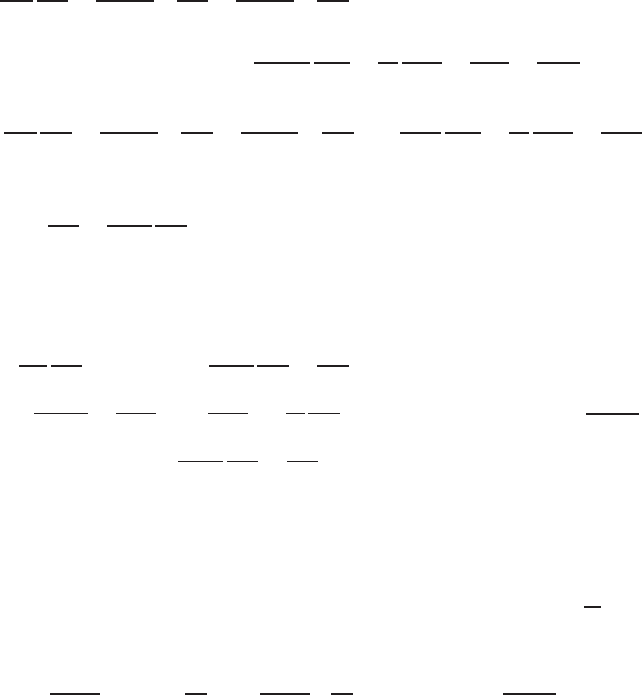
Introduce the following scale factors and dimensionless variables (steps 2, 3,
and 4):
u
∗
z
≡
u
z
u
zs
; u
∗
x
≡
u
x
u
xs
; P
∗
≡
P − P
r
P
s
;
∂η
∂t
∗
≡
1
η
ts
∂η
∂t
;
∂η
∂z
∗
≡
1
η
zs
∂η
∂z
; η
∗
≡
η
η
s
; z
∗
≡
z
z
s
; x
∗
≡
x
x
s
; t
∗
≡
t
t
s
(3.7-10)
48 APPLICATIONS IN FLUID DYNAMICS
Note that we allow for a reference pressure P
r
in our definition of the dimensionless
pressure since the dimensional pressure is not naturally referenced to zero. In
addition, we have introduced separate scale factors denoted by η
ts
and η
zs
for
the temporal and spatial derivatives, respectively, of the film thickness η since
these do not necessarily scale with x
s
/t
s
and x
s
/z
s
. Substitute these variables into
the describing equations and divide through by the dimensional coefficient of a
term that must be retained to obtain the following set of dimensionless describing
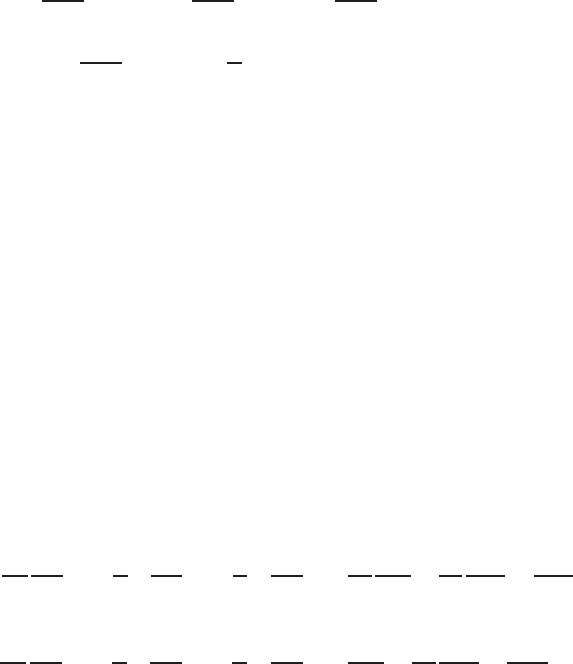
equations (steps 5 and 6):
ρx
2
s
μt
s
∂u
∗
z
∂t
∗
+
ρu
zs
x
2
s
μz
s
u
∗
z
∂u
∗
z
∂z
∗
+
ρu
xs
x
s
μ
u
∗
x
∂u
∗
z
∂x
∗
=−
P
s
x
2
s
μu
zs
z
s
∂P
∗
∂z
∗
+
x
2
s
z
2
s
∂
2
u
∗
z
∂z
∗2
+
∂
2
u
∗
z
∂x
∗2
+
ρgx
2
s
μu
zs
(3.7-11)
ρx
2
s
μt
s
∂u
∗
x
∂t
∗
+
ρu
zs
x
2
s
μz
s
u
∗
z
∂u
∗
x
∂z
∗
+
ρu
xs
x
s
μ
u
∗
x
∂u
∗
x
∂x
∗
=−
P
s
x
s
μu
xs
∂P
∗
∂x
∗
+
x
2
s
z
2
s
∂
2
u
∗
x
∂z
∗2
+
∂
2
u
∗
x
∂x
∗2
(3.7-12)
∂u
∗
z
∂z
∗
+
u
xs
z
s
u
zs
x
s
∂u
∗
x
∂x
∗
= 0 (3.7-13)
u
∗
z
= 0,u
∗
x
= 0,η
∗
=∞ at t
∗
= 0 (3.7-14)
u
∗
z
= 0,u
∗
x
= 0atx
∗
= 0 (3.7-15)
4x
s
z
s
∂u
∗
z
∂z
∗
sin θ cos θ −
u
xs
x
s
u
zs
z
s
∂u
∗
x
∂z
∗
+
∂u
∗
z
∂x
∗
cos 2θ = 0
−
P
atm
x
s
μu
zs
+
P
s
x
s
μu
zs
P
∗
+
P
r
x
s
μu
zs
+ 2
x
s
z
s
∂u
∗
z
∂z
∗
cos 2θ
− 2
u
xs
x
s
u
zs
z
s
∂u
∗
x
∂z
∗
+
∂u
∗
z
∂x
∗
sin θ cos θ = 0
⎫
⎪
⎪
⎪
⎪
⎪
⎪
⎬
⎪
⎪
⎪
⎪
⎪
⎪
⎭
at x
∗
=
η(z, t)
x
s
(3.7-16)
u
∗
z
= 0,u
∗
x
= 0,η
∗
= 0atz
∗
= 0
(3.7-17)
u
∗
z
= f
∗
1
(x
∗
,t
∗
), u
∗
x
= f
∗
2
(x
∗
,t
∗
) at z
∗
=
L
z
s
(3.7-18)
u
xs
u
zs
η
zs
u
∗
x
− u
∗
z
∂η
∂z
∗
=
η
ts
u
zs
η
zs
∂η
∂t
∗
at x
∗
=
η(z, t)
x
s
(3.7-19)
Since the gravitational body force causes the flow, we balance the latter term
with the principal viscous term by setting the dimensionless group that constitutes
the last term in equation (3.7-11) equal to 1; this determines the axial velocity scale
u
zs
. The axial and transverse length scales, z
s
and x
s
, are determined by setting
the appropriate dimensionless groups in equations (3.7-16) and (3.7-18) equal to 1.
FREE SURFACE FLOW 49
Since this is a developing flow, the transverse velocity scale u
xs
is determined by
setting the dimensionless group in equation (3.7-13) equal to 1. Since pressure
causes the flow in the transverse direction, the pressure scale P
s
is determined
by setting the dimensionless group multiplying the pressure term in equation (3.7-
12) equal to 1. The first and third terms in the surface normal stress boundary
condition given by equation (3.7-16) indicate that the dimensionless pressure can
be referenced to zero if we set P
r
= P
atm
. Since this is inherently an unsteady-state
flow, the time scale t
s
is equal to the observation time t
o
, that is, the arbitrary time
at which the flow is “observed”; setting the time scale to be the observation time is
the time-scaling analog of local scaling for spatial variables. Finally, since all three
terms in equation (3.7-19) should be of equal magnitude, we set the dimensionless
groups multiplying the first and third terms equal to 1 in order to determine the
η
zs
and η
ts
scales, respectively. These considerations then determine the following
scale and reference factors (step 7):
u
zs
=
ρgη
2
μ
; u
xs
=
ρgη
3
μL
; P
s
=
ρgη
2
L
; P
r
= P
atm
;
η
ts
=
ρgη
3
μL
; η
zs
=
η
L
; z
s
= L; x
s
= η; t
s
= t
o
(3.7-20)
Note that the z-velocity scale in equation (3.7-20) is within a multiplicative constant
of
◦
(1) of the surface velocity for fully developed laminar film flow down a vertical
plate. Note also that we found that ∂η/∂z scales with η/L, which is the ratio of
the transverse and longitudinal length scales. That is, although we introduced η
zs
as the scale for ∂η/∂z to allow for the possibility that the latter might not scale
with the ratio of the length scales, scaling analysis justified what might appear
to be an obvious choice for this scale. However, scaling analysis also indicated
that the proper scale for ∂η/∂t is ρgη
3
/μL rather than η/t
o
, which would be the
intuitive choice. In fact, one could introduce separate scales for all the derivatives
in the describing equations and then use the systematic scaling method to determine
these. However, this is cumbersome in practice for the more complex describing
equations encountered in scientific research and engineering practice. Hence, if a
more limited set of scales confined to the dependent and independent variables but
not their derivatives is chosen, one can rely on the forgiving nature of scaling to
discern that separate scales might need to be introduced on one or more derivatives
in order to achieve
◦
(1) scaling.
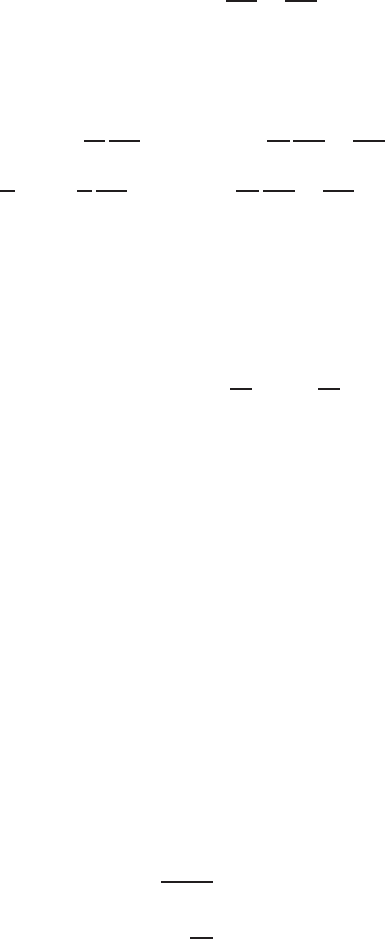
When the scales defined by equation (3.7-20) are substituted into equations (3.7-
11) through 3.7-19), we obtain
η
2
νt
o
∂u
∗
z
∂t
∗
+ Re
η
L
u
∗
z
∂u
∗
z
∂z
∗
+ Re
η
L
u
∗
x
∂u
∗
z
∂x
∗
=−
η
2
L
2
∂P
∗
∂z
∗
+
η
2
L
2
∂
2
u
∗
z
∂z
∗2
+
∂
2
u
∗
z
∂x
∗2
+ 1
(3.7-21)
η
2
νt
o
∂u
∗
x
∂t
∗
+ Re
η
L
u
∗
z
∂u
∗
x
∂z
∗
+ Re
η
L
u
∗
x
∂u
∗
x
∂x
∗
=−
∂P
∗
∂x
∗
+
η
2
L
2
∂
2
u
∗
x
∂z
∗2
+
∂
2
u
∗
x
∂x
∗2
(3.7-22)
50 APPLICATIONS IN FLUID DYNAMICS
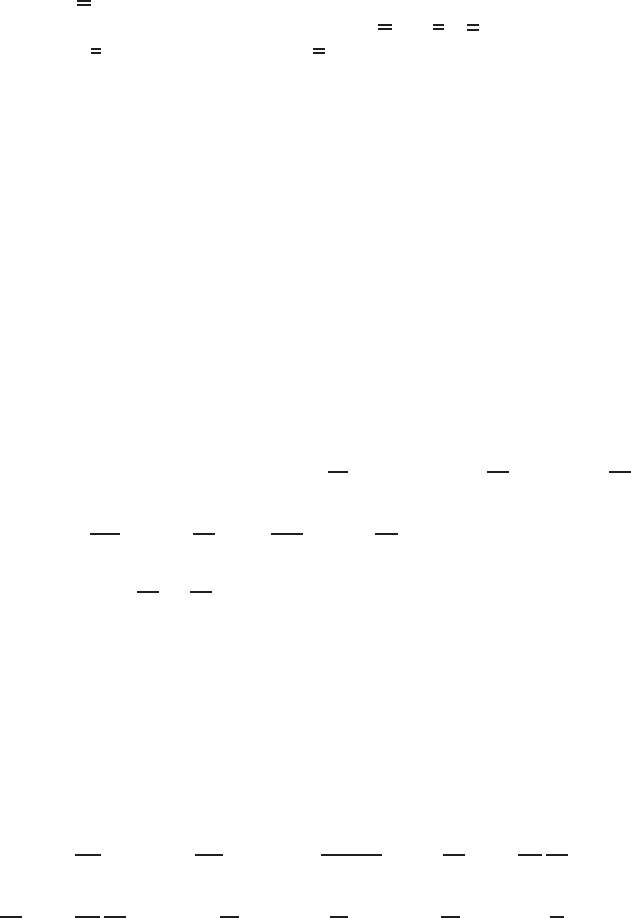
∂u
∗
z
∂z
∗
+
∂u
∗
x
∂x
∗
= 0 (3.7-23)
u
∗
z
= 0,u
∗
x
= 0,η
∗
=∞ at t
∗
= 0 (3.7-24)
u
∗
z
= 0,u
∗
x
= 0atx
∗
= 0 (3.7-25)
4η
L
∂u
∗
z
∂z
∗
sin θ cos θ −
η
2
L
2
∂u
∗
x
∂z
∗
+
∂u
∗
z
∂x
∗
cos 2θ = 0
η
L
P
∗
+ 2
η
L
∂u
∗
z
∂z
∗
cos 2θ −2
η
2
L
2
∂u
∗
x
∂z
∗
+
∂u
∗
z
∂x
∗
sin θ cos θ = 0
⎫
⎪
⎪
⎬
⎪
⎪
⎭
at x
∗
= 1
(3.7-26)
u
∗
z
= 0,u
∗
x
= 0,η
∗
= 0atx
∗
= 0
(3.7-27)
u
∗
z
= f
∗
1
(x
∗
,t
∗
), u
∗
x
= f
∗
2
(x
∗
,t
∗
) at z
∗
= 1 (3.7-28)
u
∗
x
− u
∗
z
∂η
∂z
∗
=
∂η
∂t
∗
at x
∗
= 1 (3.7-29)
where ν ≡ μ/ρ is the kinematic viscosity and Re ≡ ρu
zs
η/μ = ρ
2
gη
3
/μ
2
is the
Reynolds number. The dimensionless group η
2
/νt
o
is a measure of the ratio of
the characteristic time for the diffusion of vorticity
7
to the observation time. We
see from the above that our describing equations can be simplified significantly
if we can make the creeping-flow approximation; that is, if Re =
◦
(0.01), we
can ignore the nonlinear inertia terms in equations (3.7-21) and (3.7-22). These
equations can be further simplified if we can make the lubrication-flow approxima-
tion; that is, if η
2
/L
2
=
◦
(0.01) as well as Re =
◦
(0.01), we can ignore the axial
diffusion of vorticity terms in equations (3.7-21) and (3.7-22). If η
2
/L
2
=
◦
(0.01),
the tangential and normal stress boundary conditions given by equation (3.7-26)
also simplify somewhat. If the aspect ratio satisfies the condition η/L =
◦
(0.01)
(a more demanding condition than that required for lubrication flow), the quasi-
parallel-flow approximation can be made; that is, the effect of surface curvature
on the flow can be ignored. Finally, if η
2
/νt
o
=
◦
(0.01), which implies that the
observation time is long in comparison to the characteristic time for the diffu-
sion of vorticity, the quasi-steady-state assumption can be made. In summary, the
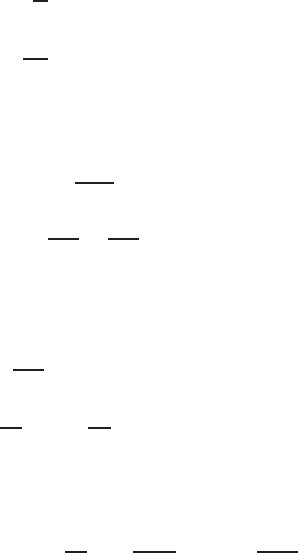
following conditions justify simplifying the describing equations for this flow:
Re =
ρ
2
gη
3
μ
2
1 ⇒ creeping-flow approximation (3.7-30)
Re 1and
η
2
L
2
1 ⇒ lubrication-flow approximation (3.7-31)
7
The vorticity is defined to be the curl of the velocity field, ∇×u; if the curl of the equations of motion is
taken, the vorticity appears as a diffused quantity, the transport coefficient being the kinematic viscosity;
for this reason we refer to the diffused quantity in the equations of motion as the vorticity.
FREE SURFACE FLOW 51
η
L
1 ⇒ quasi-parallel-flow approximation (3.7-32)
η
2
νt
o
1 ⇒ quasi-steady-state approximation (3.7-33)
If the conditions in equations (3.7-30) through (3.7-33) apply, equations (3.7-21)
through (3.7-29) simplify to (step 8)
0 =
∂
2
u
∗
z
∂x
∗2
+ 1 (3.7-34)
∂u
∗
z
∂z
∗
+
∂u
∗
x
∂x
∗
= 0 (3.7-35)
η
∗
=∞ at t
∗
= 0 (3.7-36)
u
∗
z
= 0,u
∗
x
= 0atx
∗
= 0 (3.7-37)
∂u
∗
z
∂x
∗
= 0atx
∗
= 1 (3.7-38)
u
∗
x
− u
∗
z
∂η
∂z
∗
=
∂η
∂t
∗
at x
∗
= 1 (3.7-39)
An estimate of the instantaneous local film thickness η can be obtained from η
ts
,
thescalefor∂η/∂t;thatis,
η
ts
∼
=
∂η
∂t
∼
=
−
ρgη
3
μL
⇒ η
2
∼
=
μL
2ρgt
(3.7-40)
Note that the negative sign was inserted in equation (3.7-40) because η decreases
with increasing t; that is, only magnitudes are involved in scaled variables. This
estimate for η can be used in evaluating the criteria described by equations (3.7-30)
through (3.7-33) to assess the applicability of the various assumptions that can be
invoked to simplify the describing equations for this flow. Note that the estimate
for η given by equation (3.7-40) is within a multiplicative constant of
◦
(1) of that
obtained by actually solving the describing equations. This is a particular advantage
of scaling analysis; that is, it can provide an estimate of the answer we seek by
solving the describing equations.
Let us assume that the approximations indicated by equations (3.7-30) through
(3.7-33) are justified, at least over a reasonable range of t
o
and L.Thesolu-
tion to the resulting simplified describing equations given by equations (3.7-34)
through (3.7-39) is straightforward. One can integrate equation (3.7-34) analyti-
cally subject to the boundary conditions given by equations (3.7-37) and (3.7-38).
The resulting solution for axial velocity u
∗
z
is the same as that for fully developed
film flow down a vertical plate, but with the local film thickness η(z
∗
,t
∗
) replac-
ing the constant film thickness; hence, the t
∗
− and z
∗
− dependence of u
∗
z
enters
implicitly through the boundary conditions. The transverse velocity u
∗
x
can then be
obtained by substituting this solution for u
∗
z
into the continuity equation given by
equation (3.7-35) and integrating across the flow. The solutions for u
∗
z
and u
∗
x
then
52 APPLICATIONS IN FLUID DYNAMICS
can be substituted into the kinematic surface condition given by equation (3.7-39)
to obtain a partial differential equation in terms of only one dependent variable,
η(z
∗
,t
∗
). This can be solved for the instantaneous local film thickness η(z
∗
,t
∗
)
either by the method of separation of variables or via the method of combination
of variables (i.e., a similarity solution).
An ad hoc solution to this flow problem was developed by van Rossum
8
and
isgivenbyBirdetal.
9
Van Rossum assumes quasi-parallel flow and hence uses
the axial velocity profile for fully developed film flow down a vertical plate. He
then carries out an integral mass balance on a control volume that consists of a
differential axial length and the entire cross-section of the film in which he uses the
average axial velocity. The solution he obtains for η(z, t) is within a multiplicative
constant of
◦
(1) of that obtained via scaling analysis given by equation (3.7-40).
The scaling analysis developed here provides a systematic method for justifying
the assumptions used in the ad hoc solution of van Rossum. Moreover, scaling
analysis leads to an improved solution since the exact form of the kinematic surface
condition (integral mass balance) is solved that incorporates contributions from both
the axial and transverse velocity components.
3.8 POROUS MEDIA FLOW
Thus far, all the flows that we have considered have involved homogeneous media,
that is, media consisting of a single phase. Here we consider steady-state fully
developed pressure-driven flow of a Newtonian fluid with constant physical prop-
erties through a heterogeneous medium consisting of a microporous solid contained
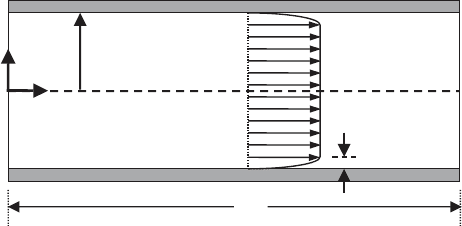
within a cylindrical tube of radius R, as shown in Figure 3.8-1.
Flow through a porous medium is described by a modified form of the equations
of motion in order to accommodate the heterogeneity introduced by the microporous
r
z
R
porous medium
L
P
0
P
L
d
p
Figure 3.8-1 Steady-state fully developed pressure-driven flow of a viscous Newtonian
fluid with constant physical properties through a heterogeneous medium consisting of a
microporous solid contained within a cylindrical tube of radius R; the axial profile is shown
that satisfies the no-slip condition at the tube wall, whose region of influence is δ
p
.
8
J. J. van Rossum, Appl. Sci. Res., A7, 121–144 (1958).
9
Bird et al., Transport Phenomena, 2nd ed., Wiley, Hoboken, NJ, 2002, Problem 2D.2, pp. 73–74.