
Lehner G. Electromagnetic Field Theory for Engineers and Physicists
Подождите немного. Документ загружается.

4 Maxwell’s Equations
then we can write Coulomb’s law, combining all those statements, in the following
way:
(1.5)
where is the force that exerts on . Conversely, the force that exerts
on is:
(1.6)
It follows from these relations that
(1.7)
Here, is just an arbitrary proportionality constant. It is arbitrary because we
still have to select the units for force, charge, and length. We will later make a
selection, which in turn uniquely defines the physical constant , the so-called
permittivity or dielectric constant in free space. Currently we have created a fairly
simple world, which consists only of charges in an otherwise empty space
(vacuum).
1.3 Electric Field Strength E and Displacement Field D
A single charge in the otherwise empty space causes that space to change. A
second charge brought into this space experiences a force at every point of that
space. This force is expressed by Coulomb’s law and varies from point to point. At
this stage it will be beneficial to introduce the concept of the electric field. It is the
quintessence of all possible effects by such forces at the different locations of this
space, which become obvious only after we place a charge at a particular point.
The term field, more generally, refers to a quantity of any kind that is a
function of space (and possibly of time). This book will also deal with various
kinds of fields.
The electric field strength is described by a vector quantity represented by the
symbol E. It is defined as the force in the field per unit charge.
(1.8)
This definition makes sense because the force, according to Coulomb’s law, is
proportional to Q and thus E is independent on the (test) charge.
Furthermore, Coulomb’s law states that a charge at location , at an
arbitrary field point produces the following electric field:
(1.9)
F
12
Q
1
Q
2
4πε
0
--------------
r
2
r
1
–
r
2
r
1
–
3
----------------------
=
F
12
Q
1
Q
2
Q
2
Q
1
F
21
Q
1
Q
2
4πε
0
--------------
r
1
r
2
–
r
1
r
2
–
3
----------------------
=
F
12
F
21
+0=
4πε
0
ε
0
E
F
Q
----
=
Q
1
r
1
r
Er()
Q
1
4πε
0
------------
rr
1
–
rr
1
–
3
-------------------
=
1.4 Electric Flux 5
For reasons which we will be able to understand only later, we will now define
only for vacuum, the vector quantity of the electric displacement Field in the
following way:
(1.10)
1.4 Electric Flux
By means of and Fig. 1.1 we define the electric flux:
(1.11)
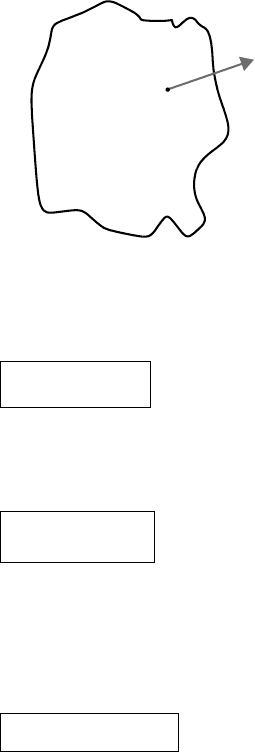
is the component of that is perpendicular (normal) to the surface element
. The dot indicates a scalar or dot product of two vectors. The vector is
always perpendicular to the surface element and its magnitude equals the
value of its surface area. That is:
(1.12)
The term electric flux is based on the analogy to a moving fluid, where the velocity
is:
If the fluid is incompressible, then the amount of fluid that moves through a surface
A per unit of time can be expressed as
This is called flux through the surface. This analogy is frequently used for the
definition of all kinds of fluxes. We now want to ponder about the question, how
much electric flux passes through an arbitrary closed surface if there are charges
somewhere, that is to say, charges can be inside or outside the space enclosed by
our surface.
The answer to this question is rather easy if we limit ourselves to the area of a
sphere (radius r
0
), with a charge Q
1
is at its center. (For a closed surface let be
always oriented outwardly, see Fig. 1.2.)
D
D ε
0
E =
D
A
dA
D
Fig. 1.1 Electric flux
Ω DAd•
A
∫
D
n
A d
A
∫
==
D
n
D
Ad Ad
Ad
AdAd=
vrt,()
vAd•
A
∫
Ad
6 Maxwell’s Equations
(1.13)
Use was made of the fact that for symmetry reasons . So, in this
case, one finds that the flux is the charge itself. How would this result change if we
changed the spherical surface into an arbitrary one? To formally solve the integral
of the flux (1.11) could become very difficult. A trick, however, allows to reduce
the new problem into the already solved one. We surround the charge
simultaneously by an arbitrarily large surface of a sphere A
1
, centered at the
location of the charge Q
1
, and an arbitrary surface A
2
(see Fig. 1.3). As a result, for
every small cone we find the following relation:
This is a consequence of:
,
(1.14)
where dA
t
is the component of parallel to and the fact that although D
decreases with on one hand, on the other, dA
t
, increases with , given that r
dA
Q
1
Fig. 1.2 Charge at the center of sphere
Ω D
n
Ad
A
∫
°
Q
1
4πr
0
2
------------
Ad
A
∫
°
Q
1
4πr
0
2
------------== =4πr
0
2
Q
1
=
D
n
D D==
dA
2
A
1
(sphere)
A2
Q
1
dA
1
D
1
D
2
Fig. 1.3 Electric flux through closed surface
D
1
A
1
d• D
2
A
2
d•=
D dA• DA
t
d=
Ad D
1 r
2
⁄ r
2
1.4 Electric Flux 7
is the distance from the charge. This means, that independently of the shape of A
2
,
the same flux passes through it as passes through the surface of the sphere A
1
.
Let us next study the flux through a closed surface where the charge is outside of it.
The same arguments as before shall serve to analyze the situation in Fig. 1.4, and to
show that the flux through this closed surface will vanish entirely. Every flux
entering the surface will exit it as well. In summary one writes:
(1.15)
What happens if there are multiple charges in our space? We start with the
statement that in order to determine the total force caused by all charges
simultaneously, it is permissible to add the forces exerted by those charges. As
forces are vectors, this addition is a vectorial addition. Addition is also permitted
for the electric field. This only seemingly trivial fact has received its own term:
Superposition principle, which applies to the electric field
We have made use of this principle before, when we introduced charge. We must
emphasize: The superposition principle does not state that it is allowed to add
forces as vectors. This fact is a basic principle of mechanics and is the reason for
the usefulness of vectors altogether. The crucial point is that the force between
charges is independent of the existence of other charges in its vicinity, i.e., is not
changed by those other charges. This, however, is highly nontrivial and perhaps not
even true under all circumstances (it may not apply, for instance, when we deal
with very strong fields).
The superposition principle allows us to write an expression for n charges Q
i
at the locations
.
(1.16)
The flux through any arbitrary closed surface is thus
dA
out
A
Q
1
dA
in
D
in
D
out
Fig. 1.4 Electric flux through closed surface
Ω
Q
1
0
if Q
1
is
inside
outside
of the closed surface =
r
i
Er() E
i
i 1=
n
∑
Q
i
4πε
0
------------
rr
i
–
rr
i
–
3
------------------
i 1=
n
∑
==
Ω
8 Maxwell’s Equations
finally
.
(1.17)
equals the sum of all charges inside this closed surface. Instead of point charges,
we are able to study continuously distributed charges in some space. This requires
the definition of the volume charge density . It is defined as the differential
quotient
,
(1.18)
with dQ being the charge contained in the volume element . The total charge in
a volume V is thus
.
(1.19)
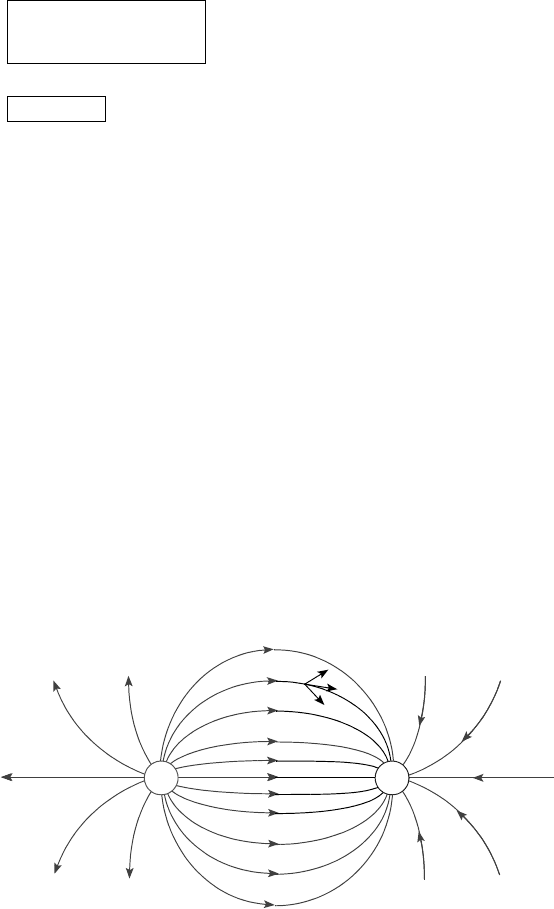
This, on the other hand, equals the electric flux that passes through the surface of
this volume, and enables us to write for any volume (see Fig. 1.5)
.
(1.20)
With this, we found a fundamental relation. It is the integral form of one of the (in
total four) Maxwell’s equations. Before discussing it in more detail, we will need to
introduce several other terms and concepts.
1.5 Divergence of a Vector Field and Gauss’ Integral Theorem
Equation (1.20) is applicable for any volume, in particular for an infinitesimally
small one. This allows one to rewrite
or
Ω DAd•
∫
°
D
i
Ad•
∑∫
°
== D
i
Ad•
∫
°
∑
Q
i
enclosed
∑
==
Ω Q
i
enclosed
∑
=
Ω
ρ r t,()
ρ
dQ
dτ
-------
dτ 0→
lim =
dτ
Q ρdτ
V
∫
=
ρ
A
D
V
Fig. 1.5 Electric flux for arbitrary volume
DAd•
A
∫
°
ρdτ
V
∫
=
ρ
V
∫
dτρV DAd•
A
∫
°
==
1.5 Divergence of a Vector Field and Gauss’ Integral Theorem 9
(1.21)
This is a very important relation in vector analysis. The divergence or
for an arbitrary vector field is defined as the limit:
.
(1.22)
Comparison of (1.21) with (1.22) reveals
.
(1.23)
This is the equivalent of (1.20), the differential form of Maxwell’s equation. We
will verify that it is in fact a differential equation.
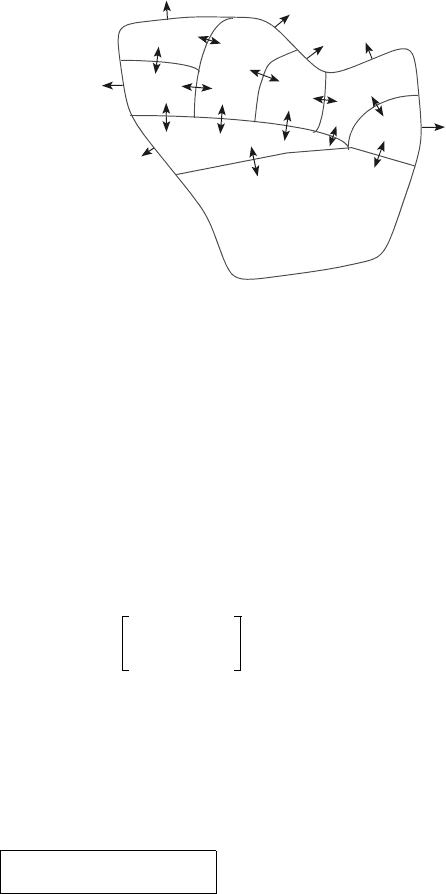
The way we derived this equation also illustrates its significance. We use our
previous example of the incompressible fluid where . Therefore,
can only be non-zero, if fluid flows out of the volume element (source), or flows
into it (sink). To apply this to our field lines E or D, we can say that they can only
originate at locations where electric charges are (Fig. 1.6).
Electric charges are sources or sinks of the electric field
Divergence is a mathematical term suited for this fact and is a measure of the
strength of the source or sink.
At this point one should be alerted to what our conclusions are based on. They
are a consequence of Coulomb’s law, or more precisely of the dependency in
it. Would this dependency be any different, the relation between D, A, and Q would
not hold: and . In view of the streaming fluid and the
dependency, however, we find our results to be rather trivial. A water fountain
idealized as a point source pours water evenly in all directions and produces a
purely radial flux field, with . The flux which does not
enclose a source has to be zero. On the other hand, we have to note that any, even
the slightest deviation from Coulomb’s law, would be significant and would result
ρ
DAd•
A
∫
°
V
-----------------------
V 0→
lim=
div aa∇•
ar()
a∇•
aAd•
A
∫
°
V
---------------------
V 0→
lim =
D∇• ρ =
vAd•
A
∫
°
v∇•
Fig. 1.6 Field of two point charges
-
+
1 r
2
⁄
DAd• Q≠
∫
°
D∇• ρ≠ 1 r
2
⁄
v
r
1 r
2
⁄()∝ v dA⋅
A
∫
°
10 Maxwell’s Equations
in a quantitatively different electrodynamics. For that reason, it was interesting and
necessary to verify by measurements, whether any deviation could be found. Up to
now, not even the most precise measurements have found any deviation. It cannot
be excluded, however, that such deviations might be found in the future when even
more precise measurements become available. In such a case, this will require that
this theory be modified at least in parts. These are areas of concern, which reach far
into the domain of Quantum Mechanics and Relativity. They are related to the
question whether the rest mass of photons is actually zero or not. Appendix A.1
will deal with this topic in more detail.
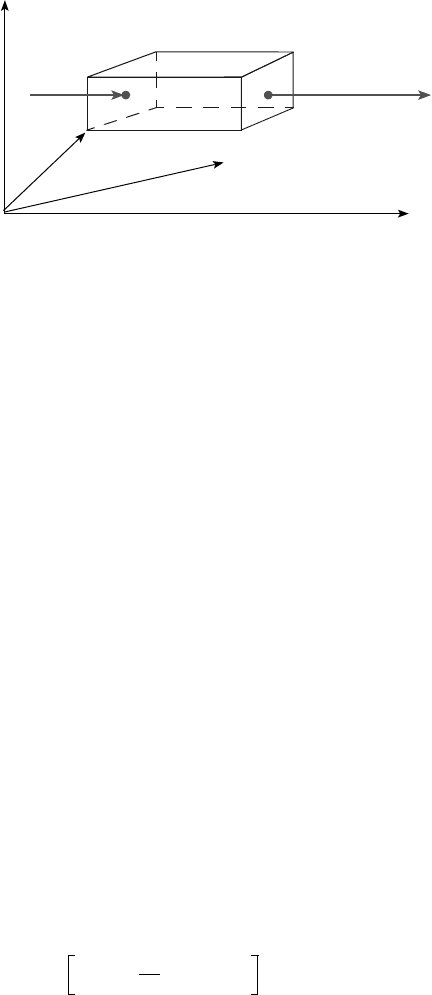
The above definition of the divergence leads to a for us very important
theorem. We want to integrate , the divergence of a vector field over the
volume shown in Fig. 1.7. We use the following fact:
This means to separate the macroscopic volume into many microscopic volume
elements and then calculate the divergence for each such micro element by taking
the limit of V approaching zero. In this case, all the surface integrals inside cancel
because each surface occurs twice, each time with a different sign, as the normal
vector for each of those two surface elements has the opposite direction. What
remains is the surface integral over the outer surface of the macroscopic volume,
i.e.:
(1.24)
This is Gauss’ Integral Theorem.
This equation formally establishes the relation between (1.20) and (1.23).
Using (1.24) in (1.20) gives:
.
a∇• a
a∇• τd
V
∫
a dA•
∫
°
V
i
-------------------
V
i
0→
lim V
i
i
∑
=
Fig. 1.7 Divergence theorem illustrated (i)
∇ a•τd
V
∫
a dA •
A
∫
°
=
D dA•
A
∫
°
ρτd
V
∫
∇ D•τd
V
∫
==
1.5 Divergence of a Vector Field and Gauss’ Integral Theorem 11
Because this has to be true for an arbitrary volume, the integrands have to be equal
to each other, i.e.
.
This means that (1.23) follows from (1.20). Conversely, from (1.23) follows
and hence (1.20). In conclusion, we realize that Gauss’ integral theorem provides
the rigorous formal proof to our previous plausibility arguments
The definition of the divergence in (1.22) is didactically advantageous, but
impractical for actual computations. Therefore, we will calculate in the
Cartesian components of :
(1.25)
We write the related surface integral and take the limit of its volume as it goes to
zero (see Fig. 1.8),
∇ D•ρ=
∇ D•τd
V
∫
ρτd
V
∫
D dA•
A
∫
°
==
∇ a•
a
a a
x
xyz,,()a
y
xyz,,()a
z
xyz,,(),,〈〉=
x
y
z
a
x
(x+dx)
a
x
(x)
(x,y,z)
Fig. 1.8 Divergence theorem illustrated (ii)
∇ a•
a dA•
∫
°
V
-------------------
V 0→
lim=
=
1
dxdydz
------------------
dx dy dz,, 0→
lim a
x
xdx+()a
x
x()–[]dydz a
y
ydy+()a
y
y()–[]dxdz+
+ a
z
zdz+()a–
z
z()[]dxdy
a
x
x()
x∂
∂a
x
dx a
x
x()–+ dydz ………–+[]dxdz …–[]dxdy++
dxdydz
-------------------------------------------------------------------------------------------------------------------------------------------------------------
dx dy dz,, 0→
lim=
12 Maxwell’s Equations
that is
(1.26)
The divergence is a scalar quantity, formally expressed as the scalar product (dot
product) of the vector operator (Nabla or “del”), for Cartesian coordinates with
the vector , and using the Cartesian unity vectors as
.
(1.27)
1.6 Work and the Electric Field
A charge Q within the reach of an electric field experiences the force and
moves, if not held fixed in place. The field performs work on the charge.
Conversely, to move the charge against the field requires one to do work.
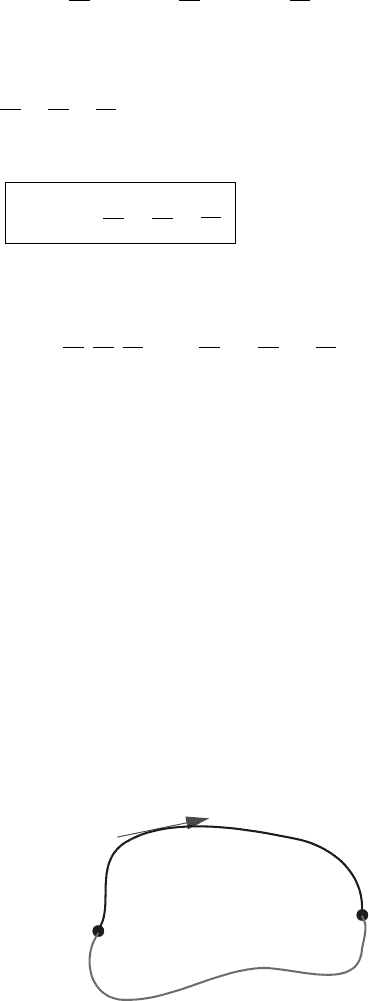
If we move the charge from the starting point P
A
along the contour C
1
to an
endpoint P
E
(Fig. 1.9), then the total work we have to do is given by
.
(1.28)
This is because for the path element is
.
(1.29)
We could have moved the charge along path C
2
with the result:
.
(1.30)
x∂
∂a
x
dxdydz
y∂
∂a
y
dxdydz
z∂
∂a
z
dxdydz++
dxdydz
---------------------------------------------------------------------------------------------
dx dy dz,, 0→
lim=
x∂
∂a
x
y∂
∂a
y
z∂
∂a
z
++=
∇ a•
x∂
∂a
x
y∂
∂a
y
z∂
∂a
z
++=
∇
ae
x
e
y
e
z
,,
∇
x∂
∂
y∂
∂
z∂
∂
,,〈〉e
x
x∂
∂
e
y
y∂
∂
e
z
z∂
∂
++==
QE
Fig. 1.9 LIne integral
P
E
ds
C
1
P
A
C
2
W
1
Fsd•
C
1
∫
– Q E
s
d•
C
1
∫
–==
dW sd
dW
1
Fsd•–=
W
2
Fsd•
C
2
∫
– Q E
s
d•
C
2
∫
–==
1.6 Work and the Electric Field 13
Initially, we will only deal with time-independent fields. Suppose the results W
1
and W
2
would be different. We then could take advantage of this to build a
perpetuum mobile (1st kind). Suppose, for instance, W
2
> W
1
, then it would be
possible to move the charge from P
A
to P
B
via path C
1
and then back to P
A
via path
C
2
. We would need to invest the work W
1
, but gain work W
2
on the way back.
Overall, the work of the closed loop would be . Repeating this process
would manifest itself as a perpetuum mobile. Of course, we have reasons to assume
that this is impossible. The theorem of conservation of energy requires to state that:
.
(1.31)
or
.
(1.32)
Consequently, the work over any closed contour is
.
(1.33)
This important relation was derived without using the knowledge about electric
fields we have gained so far. We need to verify that the electric fields, in fact, meet
this requirement. Again, we are currently studying time-independent fields only.
Time dependency will come in later, and we will find that (1.33) is not applicable
in such a case. Nevertheless, if (1.33) applies to a single point charge, it also
applies to an arbitrary distribution of charges at rest. The reason for this is the
superposition principle. It is therefore sufficient to prove (1.33) for a point charge.
Before starting our proof, we will investigate some simple properties of line
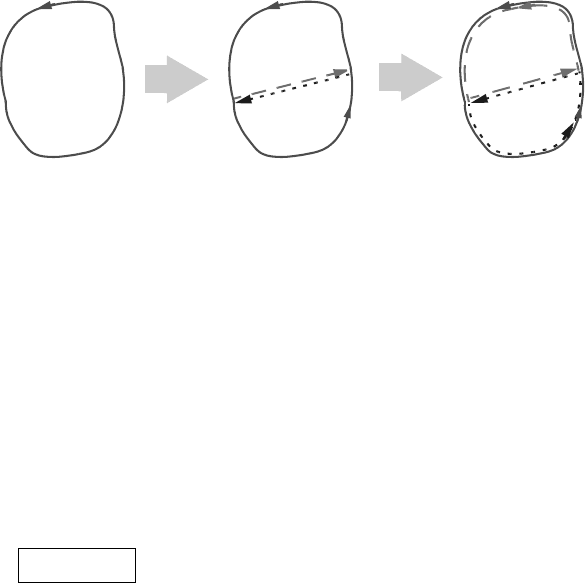
integrals over closed curves. Fig. 1.10 shows a closed curve C, which is separated
into two closed curves C
1
and C
2
by inserting a line. We get:
.
Notice that the two newly added path elements identically cancel. This kind of
subdivision can be repeated by individually subdividing C
1
and C
2
, respectively,
and so on. If we now study the field of a point charge, we can start with any closed
contour. We can reduce the integral to integrals over the kind shown in
Fig. 1.11. For this case we write :
W
2
W
1
–0>
W
1
W
2
=
Esd•
C
1
∫
Esd•
C
2
∫
–0=
Esd•
∫
°
0 =
Fig. 1.10 Line integral along closed path
C
C
C
C
C
2
C
1
C
C
asd•
C
∫
°
asd•
C
1
∫
asd•
C
2
∫
+=
Esd•
∫
°