
Lehner G. Electromagnetic Field Theory for Engineers and Physicists
Подождите немного. Документ загружается.


44 Basics of Electrostatics
,
(2.28)
with an associated potential
,
(2.29)
and the electric field
.
(2.30)
In principle, these formulas allow for the calculation of the potential and electric
field for an arbitrary distribution of point charge, line-, surface-, and volume charge
densities, as well as any combination thereof. However, carrying out the integrals is
not always easy for real-world problems, and the mathematical difficulties may be
appreciable. Nevertheless, it is frequently possible to simplify the task by taking
advantage of symmetries. This is illustrated in the next section via some specific
examples.
2.3 Specific Charge Distributions
2.3.1 One-dimensional, Planar Charge Distributions
In this case, is a function of only one Cartesian coordinate (e.g. x):
.
Here, it is better not to use the general integrals of the previous section, but start
with considering the symmetry. and have to depend on x only and can only
have an x-component. For the same reasons, the potential can only have an
x-dependency. This enables us to start with the relations
(2.31)
and
,
(2.32)
which allows one to calculate and by integrating once and twice,
respectively. Thus
(2.33)
It is left as an exercise for the reader to determine how the constant of integration
needs to be chosen, in order to arrive at the result.
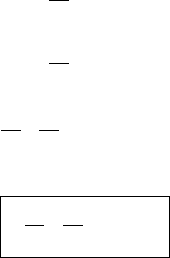
q
dQ
dl
-------=
ϕ r()
1
4πε
0
------------
q r'()
rr'–
---------------
l'd
∫
=
Er()
1
4πε
0
------------
q r'()rr'–()
rr'–
3
-----------------------------
l'd
∫
=
ρ
ρρx()=
ED
D∇•
x∂
∂D
x
ρ x()==
∇
2
ϕ
∂
2
∂x
2
--------
ϕ
ρ x()
ε
0
-----------–==
D
x
ϕ
D
x
x() D
x
a() ρx'()x'd
a
x
∫
+
1
2
---
ρ x'()x'd
∞–
x
∫
1
2
---
ρ x'()x'd
x
∞
∫
–==
D
x
a()
2.3 Specific Charge Distributions 45
2.3.2 Spherically Symmetric Distributions
If the charge distribution depends solely on the distance r to a center
,
(2.34)
then it is spherically symmetric and
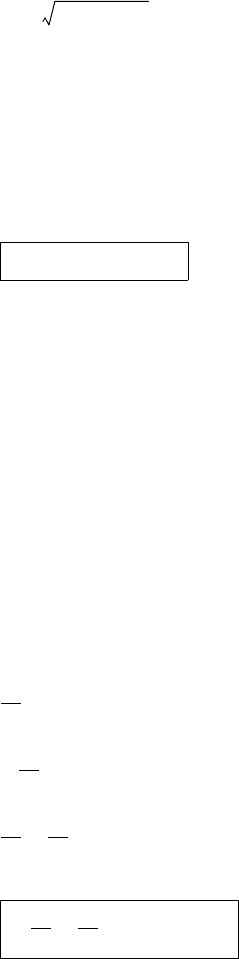
.
It would be very difficult to calculate and by using the general integrals.
Exploiting the symmetry simplifies the problem dramatically, however. One may
assume that and only have components that point towards or away from the
center (radial components and ) , and that these depend on r only. One
surrounds the center of symmetry with a concentric sphere, which allows one to
apply relation (1.20), and immediately solve this problem:
that is
or
(2.35)
and
.
(2.36)
Finally, if we also choose for the limit of , then
.
(2.37)
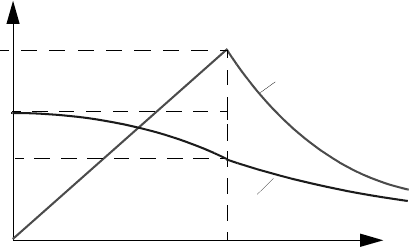
On the other hand we have
and thus
.
(2.38)
rx
2
y
2
z
2
++=
ρρr()=
ϕ E
ED
E
r
D
r
DAd•
A
∫
°
ρdτ
V
∫
=
D
r
r()Ad
A
∫
°
D
r
4πr
2
ρ r'()4πr'
2
dr'
0
r
∫
==
D
r
r()
1
r
2
-----
ρ r'()r'
2
dr'
0
r
∫
=
E
r
r()
1
ε
0
r
2
----------
ρ r'()r'
2
dr'
0
r
∫
=
ϕ 0= r ∞→
ϕ r()
1
ε
0
r'
2
-----------
∞
r
∫
ρ r''()r''
2
dr''
0
r'
∫
dr'–=
r∂
∂
ϕ r()
1
ε
0
r
2
----------
ρ r''()r''
2
dr''
0
r
∫
–=
r
2
r∂
∂
ϕ r()
1
ε
0
-----
ρ r''()r''
2
dr''
0
r
∫
–=
r∂
∂
r
2
r∂
∂
ϕ r()
1
ε
0
-----
ρ r()r
2
–=
1
r
2
-----
r∂
∂
r
2
r∂
∂
ϕ r()
ρ r()
ε
0
----------
–=
46 Basics of Electrostatics
This is nothing other than Poisson’s differential equation for the specific case of
spherical symmetry. In a later section, we will find that
is nothing else than the radial part of Laplace’s operator .
To illustrate this, we use a simple example. Suppose a sphere with radius
is filled with the uniform volume charge density . There shall be no other
charges. The electric field then results in
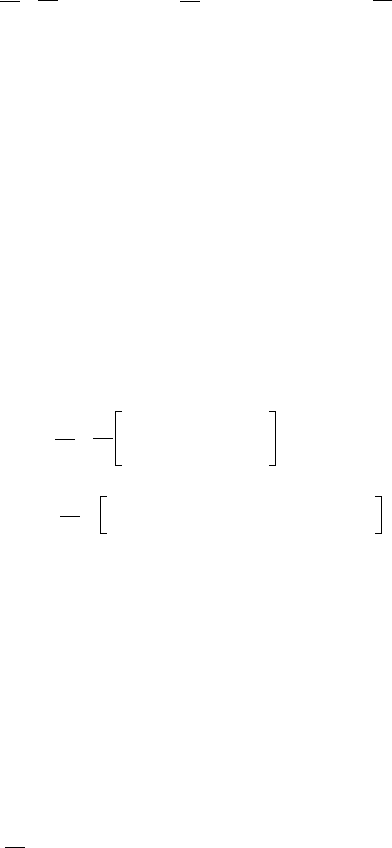
For the potential one finds
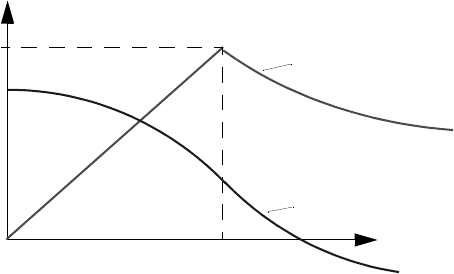
A plot of these relations is given in Fig. 2.2.
Conversely, it is also possible to find the charge density for a given potential.
One might ask, what charge density gives the spherically symmetric potential
( )? If one wants to proceed formally, then one may use eq. (2.38) to
calculate .
1 r
2
⁄()∂∂r⁄()r
2
()∂∂r⁄()
∇
2
r
0
ρ
0
for rr
0
:≤ E
r
r()
1
ε
0
r
2
----------
ρ
0
r'
2
dr'
0
r
∫
1
ε
0
r
2
----------
ρ
0
r
3
3
-----
ρ
0
3ε
0
--------
r===
for rr
0
:≥ E
r
r()
1
ε
0
r
2
----------
ρ
0
r'
2
dr'
0
r
0
∫
1
ε
0
r
2
----------
ρ
0
r
0
3
3
-----
ρ
0
r
0
3
3ε
0
-----------
1
r
2
-----
===
for rr
0
:≤ϕr() E
r
r'()dr'
∞
r
∫
–
ρ
0
r
0
3
3ε
0
-----------
1
r'
2
------
dr'
∞
r
0
∫
–
ρ
0
3ε
0
--------
r'dr'
r
0
r
∫
–==
ρ
0
r
0
3
3ε
0
-----------
1
r
0
----
ρ
0
3ε
0
--------
r
2
r
0
2
–()
2
---------------------
–
ρ
0
3ε
0
--------
3r
0
2
r
2
–
2
-------------------
–==
for rr
0
:≥ϕr()
ρ
0
r
0
3
3ε
0
-----------
1
r
---
=
Fig. 2.2 Electric field and potential of a uniformly charged sphere
r
0
r
ρ
0
r
0
2
3ε
0
----------
ϕ
E
3
2
---
ρ
0
r
0
2
3ε
0
----------
⋅
ρ
0
r
0
3ε
0
----------
E(r)
0
ϕ r()
Q
0
4πε
0
r⁄
ρ r()
2.3 Specific Charge Distributions 47
.
The result is thus that . This not entirely correct. In order to differentiate,
one needs to exclude the origin. However, this is where the charge is
located, and it is precisely this charge that creates the given potential. This example
illustrates that one needs to be mathematically very careful when dealing with
point charges. To remedy this, we will introduce the Dirac function in a later
section. It enables one to formally treat point charges in the same way as other
distributions. The point charge could also be somewhat hidden and thus less
obvious than in this trivial example. Take, for instance, the potential
.
This is the so-called shielded Coulomb potential (in contrast to the ordinary
Coulomb potential ( )). It is relevant for the theory of electrolytes and
plasmas, which will not be covered here. The volume charge density for this
potential is:
.
This allows one to calculate for example, the charge within a sphere of radius r.
One finds the electric field intensity
.
From this we obtain the charge inside a sphere of radius r:
.
Q
0
4πε
0
r
2
-----------------
r∂
∂
r
2
r∂
∂ 1
r
---
Q
0
4πε
0
------------
1
r
2
-----
r∂
∂
r
2
1
r
2
-----–
Q
0
4πε
0
------------
1
r
2
-----
r∂
∂
1–0===
ρ 0=
QQ
0
=
δ
ϕ
Q
0
4πε
0
r
--------------
r
r
D
------
–
exp=
Q
0
4πε
0
r⁄
ρ r() ε
0
1
r
2
-----
r∂
∂
r
2
r∂
∂
Q
0
4πε
0
r
--------------
r
r
D
------
–
exp–=
Q
0
4π
------
1
r
2
-----
r∂
∂
r
2
1
r
2
-----
r
r
D
------
–
exp–
1
rr
D
--------
r
r
D
------
–
exp––=
Q
0
4π
------
1
rr
D
2
---------
r
r
D
------
–
exp–=
ρ
0
r'()4πr'
2
dr'
0
r
∫
Q
0
4π
------
1
r'r
D
2
----------
r'
r
D
------
–
exp–4πr'
2
dr'
0
r
∫
–=
Q
0
1
r
r
D
------
+
r
r
D
------
–
exp Q
0
–=
E
r
r∂
∂
ϕ r()–
Q
0
4πε
0
------------
1
r
2
-----
1
rr
D
--------
+
r
r
D
------
–
exp==
4πε
0
r
2
E
r
Q
0
1
r
r
D
------
+
r
r
D
------
–
exp=
48 Basics of Electrostatics
There appears to be a contradiction. The integration over the charge density led to a
charge that is smaller by . The puzzle is resolved if one looks closely at for a
very small radius:
.
This is the field generated by a point charge located the origin (or the potential
of a point charge at the origin) for very small radii. This point charge is
not included in our expression for and in the integral over it. This clears up the
apparent contradiction. Again, it appears that is necessary to be very careful. The
total charge outside of the origin is just , the overall charge is then zero. The
charge outside cancels the point charge, and shields it, which is why we refer to this
as a shielded Coulomb potential.
2.3.3 Cylindrically Symmetric Distributions
If the charge density depends solely on the distance r from an axis, then this
distribution is deemed to be cylindrically symmetric (Fig. 2.3)
(2.39)
with
.
(2.40)
If we replace the concentric sphere of Section 2.3.2 by a coaxial cylinder, then we
may proceed in much the same way as before. Starting from
,
now, on a per unit length basis, we obtain:
Q
0
E
r
E
r
Q
0
1
r
r
D
------
+
r
r
D
------
–
exp
4πε
0
r
2
----------------------------------------------------------
Q
0
4πε
0
r
2
-----------------
⇒=
Q
0
4πε
0
r⁄
ρ
Q
0
–
Fig. 2.3
z
x
y
r
ρρr()=
rx
2
y
2
+=
DAd•
A
∫
°
ρdτ
V
∫
=
2.3 Specific Charge Distributions 49
or
,
(2.41)
where represents the component of which points away radially from the
axis. This is the only component of , which results from the symmetry of the
problem. From this we get
,
(2.42)
and
,
(2.43)
if the potential for . Then
that is
.
(2.44)
This is again Poisson’s equation, now for this specific case of cylindrical
symmetry. As an example, consider a cylinder of radius with uniform charge
density . There shall be no other charges. Then the electric field is
For the potential, under the assumption that , one finds
2πrD
r
ρ r'()2πr'dr'
0
r
∫
=
D
r
1
r
---
ρ r'()r'dr'
0
r
∫
=
D
r
D
D
E
r
1
ε
0
r
-------
ρ r'()r'dr'
0
r
∫
=
ϕ
1
ε
0
-----
1
r'
---
ρ r''()r''dr''
0
r'
∫
r'd
r
B
r
∫
–=
ϕ 0= rr
B
=
r∂
∂ϕ
1
ε
0
r
-------
ρ r''()r''dr''
0
r
∫
–=
r
r∂
∂ϕ 1
ε
0
-----
ρ r''()r''dr''
0
r
∫
–=
r∂
∂
r
r∂
∂ϕ
ρ r()r
ε
0
-------------–=
1
r
---
r∂
∂
r
r∂
∂ϕ
ρ
ε
0
-----
–=
r
0
ρ
0
for rr
0
:≤ E
r
r()
1
ε
0
r
-------
ρ
0
r'dr'
0
r
∫
ρ
0
2ε
0
--------
r==
for rr
0
:≥ E
r
r()
1
ε
0
r
-------
ρ
0
r'dr'
0
r
0
∫
ρ
0
r
0
2
2ε
0
-----------
1
r
---
⋅==
r
B
r
0
>
for rr
0
:≤ϕE
r
r'()dr'
r
B
r
∫
– E
r
r'()dr'
r
B
r
0
∫
– E
r
r'()dr'
r
0
r
∫
–==
ρ
0
r
0
2
2ε
0
-----------
r
0
r
B
-----ln–
ρ
0
2ε
0
--------
r
2
r
0
2
–
2
----------------
–=
50 Basics of Electrostatics
.
These relations are shown in Fig. 2.4.
An interesting limit is obtained in the case of a line charge at the axis. In this
case, approaches zero, but it does this in a way that the product
remains finite. The , therefore, needs to become infinite. In this case the field
becomes
,
(2.45)
and
,
(2.46)
where is the radius where vanishes. Here, is called the
logarithmic potential, and is typical of the straight and uniform line charge. The
potential shown in Fig. 2.4 is not a true logarithmic potential because it is not
logarithmic for every radius r.
ϕ
ρ
0
r
0
2
2ε
0
-----------
r
0
r
B
-----ln
r
2
r
0
2
-----1–
2
--------------+
–=
for rr
0
:≥ϕE
r
r'()dr'
r
B
r
∫
–
ρ
0
r
0
2
2ε
0
-----------
r
r
B
-----ln–==
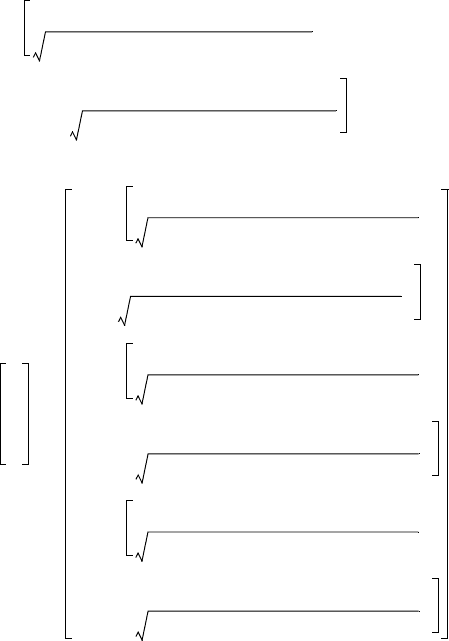
Fig. 2.4 Electric field and potential of a cylindrical charge distribution
r
0
r
ϕ E
E(r)
0
ϕ r()
r
B
r
0
ρ
0
r
0
2
π q=
ρ
0
E
r
q
2πε
0
r
--------------=
ϕ
q
2πε
0
------------
r
r
B
-----ln–=
r
B
0 r
B
∞<<() ϕ ϕ
2.4 The Field Generated by two Point Charges 51
2.4 The Field Generated by two Point Charges
The field generated by two point charges as a special case from the potential of
eq. (2.19)
(2.47)
Taking the gradient gives in column vector notation:
(2.48)
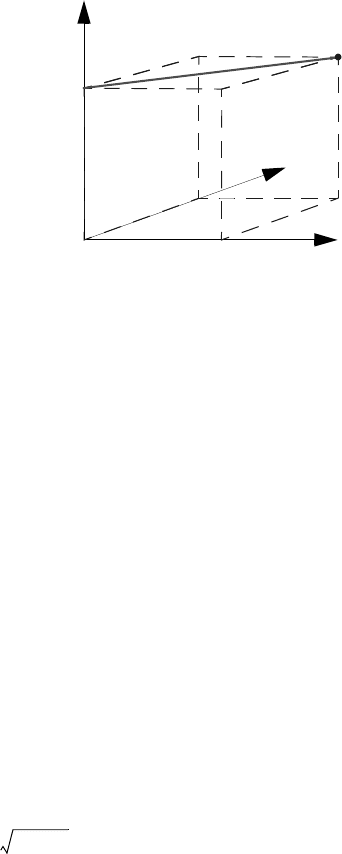
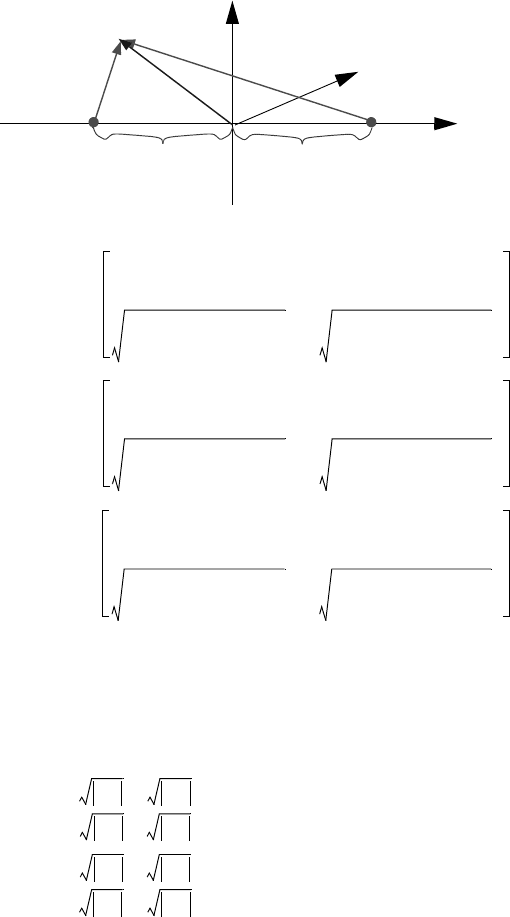
We will use a coordinate system according to Fig. 2.5 and then simplify above
expression somewhat.
We have
(2.49)
and
ϕ
1
4πε
0
------------
Q
1
xx
1
–()
2
yy
1
–()
2
zz
1
–()
2
++
------------------------------------------------------------------------------------
=
Q
2
xx
2
–()
2
yy
2
–()
2
zz
2
–()
2
++
--------------------------------------------------------------------------------+ .
E ∇ϕ–
E
x
E
y
E
z
1
4πε
0
------------
Q
1
xx
1
–()
xx
1
–()
2
yy
1
–()
2
zz
1
–()
2
++
3
----------------------------------------------------------------------------------------
Q
2
xx
2
–()
xx
2
–()
2
yy
2
–()
2
zz
2
–()
2
++
3
----------------------------------------------------------------------------------------
+
1
4πε
0
------------
Q
1
yy
1
–()
xx
1
–()
2
yy
1
–()
2
zz
1
–()
2
++
3
----------------------------------------------------------------------------------------
Q
2
yy
2
–()
xx
2
–()
2
yy
2
–()
2
zz
2
–()
2
++
3
----------------------------------------------------------------------------------------+
1
4πε
0
------------
Q
1
zz
1
–()
xx
1
–()
2
yy
1
–()
2
zz
1
–()
2
++
3
----------------------------------------------------------------------------------------
Q
2
zz
2
–()
xx
2
–()
2
yy
2
–()
2
zz
2
–()
2
++
3
----------------------------------------------------------------------------------------+
===
r
1
d
2
---–00,,〈〉=
r
2
+
d
2
---
00,,〈〉=
52 Basics of Electrostatics
(2.50)
A remarkable fact is that there exists a point where the field vanishes. This is
a special point and, because of the frequently mentioned analogy to flux problems,
is called the stagnation point. To calculate its coordinates , one sets all
three components of in eq. (2.50) equal to zero and then solves this equation for
, . We skip this simple calculation and just give the result:
(2.51)
,
.
Fig. 2.5
rr
1
–
x
y
z
Q
1
rr
2
–
Q
2
r
d
2
---
d
2
---
E
x
1
4πε
0
------------
Q
1
x
d
2
---+
x
d
2
---+
2
y
2
z
2
++
3
-------------------------------------------------------
Q
2
x
d
2
---–
x
d
2
---–
2
y
2
z
2
++
3
-------------------------------------------------------+=
E
y
1
4πε
0
------------
Q
1
y
x
d
2
---+
2
y
2
z
2
++
3
-------------------------------------------------------
Q
2
y
x
d
2
---–
2
y
2
z
2
++
3
-------------------------------------------------------+=
E
z
1
4πε
0
------------
Q
1
z
x
d
2
---+
2
y
2
z
2
++
3
-------------------------------------------------------
Q
2
z
x
d
2
---–
2
y
2
z
2
++
3
-------------------------------------------------------+=
x
s
y
s
z
s
,,
E
xx
s
= y, y
s
= zz
s
=
x
s
d
2
---
Q
1
Q
2
+
Q
1
Q
2
–
----------------------------------
for charges of opposite signs
d
2
---
Q
1
Q
2
–
Q
1
Q
2
+
----------------------------------
for charges of same sign
=
y
s
0=
z
s
0=
2.4 The Field Generated by two Point Charges 53
The stagnation point always lies on the straight line connecting the two charges.
For charges of the same sign, it lies between the two charges and closer to the one
with the smaller magnitude. For charges of opposite signs, it lies outside closer to
the charge with the smaller magnitude.
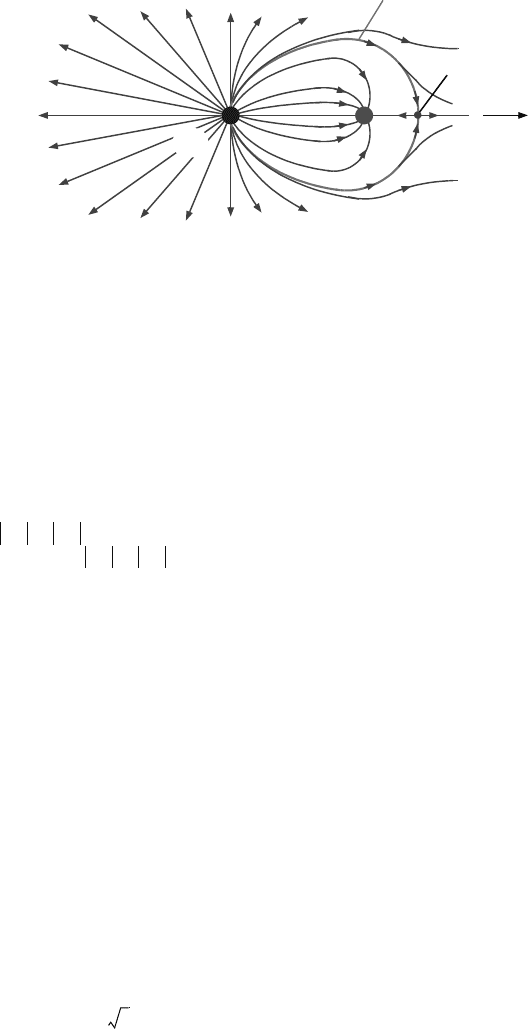
The stagnation point exhibits a strange property, namely that force lines cut
one another here, which is possible only because the field vanishes at this specific
point.
Knowledge of the location of the stagnation point is rather useful in being
able to generate a qualitative picture of the field. Let us investigate the case of
opposite charges as shown in Fig. 2.6, where for example, , ,
. Some of the force lines which originate at end at . Since it was
given that , not all can end at . Those which can not end at the other
charge, extend to infinity. This is plausible, as from a great distance the
configuration has to appear as that of a point charge of value . There are,
therefore, two kinds of force lines: those that end at , and those extending to
infinity. They can be found in the different regions of Fig. 2.6, which would
provide the full 3D picture if rotated around the x-axis. The border of the two
regions is made up of force lines that run through the stagnation point and from that
point on, they can no longer be uniquely traced. Those lines of force are sometimes
referred to as separatrices, i.e. as lines that separate different regions. Another
interesting task is to analyze the equipotential surfaces (see Fig. 2.7).
Again, the equipotential surface which passes through the stagnation point plays a
prominent role. It is also called separatrix. It separates the space in three different
regions. The first region encloses just one charge, the second just the other, and the
third region encloses both charges.
For charges of the same sign, we show the electric force lines and the
equipotential surfaces in Fig. 2.8 and Fig. 2.9. The separatrices are highlighted
It is possible to show that the angle between those equipotential surfaces
which pass through the stagnation point and the x-axis is the same in both cases
and for all charges. One finds
.
Q
1
0> Q
2
0<
Q
1
Q
2
> Q
1
Q
2
Q
1
Q
2
> Q
2
Q
1
Q
2
+
Q
2
Fig. 2.6
separatrix
Q
2
Q
2
Q
1
------
1
10
------–=
x
S
Q
1
αtan 2= ,α55°=