
Lehner G. Electromagnetic Field Theory for Engineers and Physicists
Подождите немного. Документ загружается.


24 Maxwell’s Equations
In this case one has
where
because of , and
because of
and
.
C is a constant, which we will leave undetermined for now. The conclusion is that
for a path that does not enclose any current one has:
.
Fig. 1.19 Magnetic field of a straight current carrying wire
I
Fig. 1.20 Integration path not enclosing the wire (a)
r
1
ϕ
1
r
2
2
3
4
l
H ds•
∫
°
2
3
∫
3
4
∫
4
1
∫
+++
1
2
∫
H ds•=
H ds•
1
2
∫
H ds•
3
4
∫
0==
H⊥ds
H ds•
2
3
∫
H ds•
4
1
∫
–=
H ds•
2
3
∫
C
r
2
----
r
2
ϕ– Cϕ–==
H ds•
4
1
∫
+
C
r
1
----
r
1
ϕ Cϕ==
H ds•
∫
°
0=
1.9 The Electric Current and Ampere’s Law 25
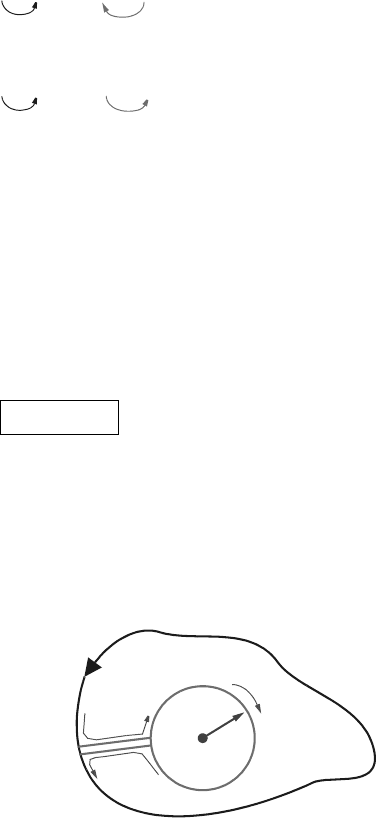
Next we study a path C that encloses the wire. If we add a circle that also encloses
the wire, which we connect to the given path, in the way specified by Fig. 1.21,
then we obtain an overall path that does not include the wire and consequently the
integral vanishes. Because of the fact that the two integrals over the link
between the circle and the initial path identically cancel, one finds that the overall
path including the original path C and the line integral over the circle, which is
oriented in the negative sense (clockwise), also vanish.
.
or
.
All such line integrals give or result in the same, non-zero value. Furthermore, one
can experimentally confirm that all forces, and thus also the fields are proportional
to the current. The introduced constant C is therefore also proportional to the
current. If there are several currents, one only needs to add those to obtain the
overall current, where only this sum is relevant. We summarize that for an arbitrary
path the integral is
,
where I is the sum of all currents that are enclosed by a particular path. One can
choose the proportionality constant as one wishes, as long as one realizes that this
impacts the units for current I and field and length , which are not yet
defined. So, one may simply choose
,
(1.55)
This is known as Ampere’s Law. It is more general, and its validity goes beyond the
example of a straight wire, i.e. it applies to any distribution of currents, which can
easily be verified by experiment. It contains everything relevant for the relation
between time-independent currents and magnetic fields. We will need to make
modifications for the time-dependent case. One can rewrite the previous equations
a little:
H ds•
∫
°
Fig. 1.21 Integration path not enclosing the wire (b)
r
0
C
K
H ds•
C
∫
°
H ds•
K
∫
°
+0=
H ds•
C
∫
°
H ds•
K
∫
°
C
r
0
----
2πr
0
2πC===
H ds•
∫
°
I∼
H ds
H ds•
∫
°
I =
26 Maxwell’s Equations
.
This is true for any surface. Therefore the integrands of the two surface integrals
have to be equal and it must hold that
.
(1.56)
Equations (1.55) and (1.56) are equivalent. One follows from the other. Both state
that currents are the cause of magnetic fields. Their significance is similar to
equations (1.20) and (1.23), which described the relation between the electric field
and charges. There is, however, a big difference: charges cause sources of the
electric field; currents cause a circulation of the magnetic field. Electrostatic fields
are always free of circulation, while we will find that magnetic fields are always
free of sources (to be more specific, that the magnetic induction or field, which
we will need to introduce, never has sources).
If we look at the results (1.55) and (1.56) more closely, one finds that there
are some difficulties and even contradictions, which indicate that their current form
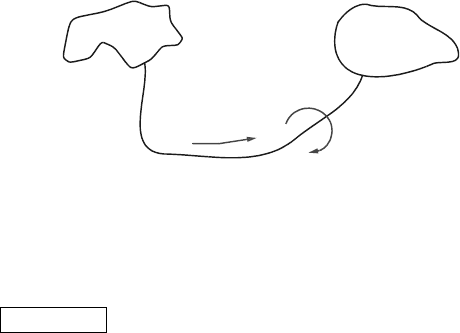
can not be correct for time-dependent systems. Imaging two charged bodies with
charges +Q and -Q, respectively, as shown in Fig. 1.22. Those bodies exert a force
on each other. If we connect the two bodies by means of a conducting wire, then
the charges have a path to follow the electric field. The result is an electric current,
originating at the positively charged body, leading towards the negatively charged
one. If we attempt to use, for instance,. eq. (1.55) in this situation, we experience
some difficulties. Since the wire is neither closed nor extends towards infinity, we
have trouble deciding if a particular path encloses the wire or not. This difficulty is
even more apparent if we use (1.56). It gives
,
(1.57)
This implies that the current density is source free. Obviously this is not so, as the
current density originates at the charged body. During this process the charge
changes as some of it is transported by the current to the other body. To enable us to
discuss this in more detail, we will study the principle of conservation of charge in
section 1.10.
H ds•
∫
°
H dA•∇×
A
∫
I g dA•
A
∫
===
H∇× g =
B
Fig. 1.22 Current between two bodies
- Q
+Q
I
H
H∇×()∇• g∇• 0==
1.10 The Principle of Charge Conservation and Maxwell’s First Equation 27
1.10 The Principle of Charge Conservation and Maxwell’s First
Equation
Consider an arbitrary volume. Charges contained in it may flow in, or out of it.
This is the only way for the overall charge in the volume to change. The only other
possibility would be that charges spontaneously appear or disappear. Our
experience teaches us that this is not the case. This is the Principle of Conservation
of Electric Charge.
Expressed in a more general way, we find that the overall charge in the
universe is constant (probably zero). Although there exist processes where new
charges are created, this does not change the overall charge balance, because
always the same number of positive as negative charges are created. Our
experience up to now is that naturally occurring charges always come in multiples
of an elementary charge. For instance, in the negative charge of an electron or in
the positive charge of its counterpart, the proton. It is possible that a photon creates
a pair of particles with opposite charges (for example a particle, antiparticle pair;
electron, positron or proton, antiproton). We need to mention particles with charges
that are one third or two thirds of the elementary charge (quarks) which, however,
do not change the principle of charge conservation.
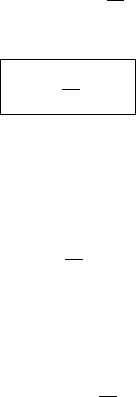
This principle is mathematically formulated as follows:
.
Consequently
.
(1.58)
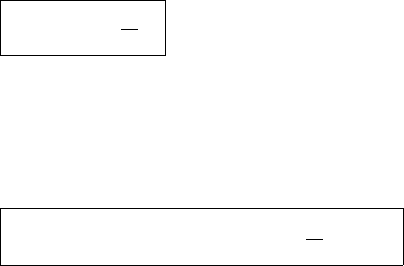
This is the continuity equation. It is an expression of charge conservation. On the
other hand
and therefore
.
(1.59)
This means that the vector sum is source free. Therefore, it is possible
to express it as the curl of a suitable vector field, as according to (1.40) the
divergence of any curl vanishes:
.
(1.60)
At this point it is plausible to identify the vector with the magnetic field intensity
. In the time-independent case this would correctly lead to Ampere’s law (1.55).
It was Maxwell who recognized that this is incorrect in the general case. One
obtains Maxwell’s first equation as the correct generalization of Ampere’s law for
time-dependent processes.
g dA•
∫
°
t∂
∂
ρ dτ⋅
∫
– g∇• dτ⋅
∫
==
g∇•
t∂
∂ρ
+0 =
ρ D∇•=
g
t∂
∂D
+
∇• 0=
g ∂D ∂t⁄+
a∇× g
t∂
∂D
+=
a
H
28 Maxwell’s Equations
.
(1.61)
The term is the total current density. It consists of two parts the free
current density ( ) and the displacement current density
Maxwell’s first equation fixes the inconsistencies we experienced at the end of the
previous section. There exists a field between the charged bodies. The electric field
changes as the current flows and causes the displacement current which closes the
circuit For every closed path we have
.
(1.62)
The result of the integration becomes unique. That is, for a given path, it does not
depend of the chosen surface area. If this were not the case, there would be no
Stokes integral theorem. Let it be also noted that this can also be shown using
Gauss’ law and the relation .
To derive eq. (1.59), we have used the relation and thereby made a
generalization, which is not quite natural and should not be made without
qualifications. We have derived the equation from Coulomb’s law for
charges at rest. Notice that the reverse conclusion may not be made. It is not
necessarily possible to derive Coulomb’s law from . Field lines
originating at a charge could be organized in an unsymmetrical way, for which
Coulomb’s law does not apply anymore, still leaving the total flux equivalent to the
charge. We do not need to assume this kind of field for charges at rest, since due to
symmetry considerations no particular direction is favored. That is the reason why
Coulomb’s law applies to charges at rest. In order to find it, one needs to apply the
symmetry argument to . For moving charges the situation is more
complicated. The symmetry consideration is not valid anymore because the field of
a moving charge is actually not spherically symmetric and Coulomb’s law is not
valid in this case. Still, is applicable or , respectively.
Although our starting point was Coulomb’s law as some basic fact, one now finds
that the relation is more basic and more generally applicable. It could
even be seen as the real definition of charge, because for every charge, moving or
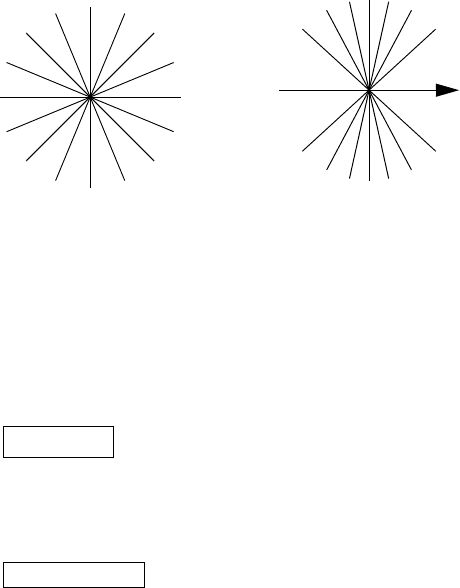
at rest, belongs a corresponding flux and there is no flux without charge. Fig. 1.23
gives a qualitative picture of a charge at rest and one that moves with a uniform
velocity. The field of the uniformly moving charge can be derived from that of the
charge at rest by facilitating the Lorentz contraction. The distortion of the field can
only be understood in the context of the Theory of Relativity. Nevertheless, this
distortion is correctly described in Classical Electrodynamics. The magnetic forces
caused by moving charges are exactly the consequences of the distortion of the
electric field. The magnetic forces are thus also of electrical nature. They are based
on the changes of the electric field due to motion. The distortion of the field of a
moving charge is a relativistic effect, that is, it is noticeable at very high speeds, i.e.
close to the speed of light and it would disappear if the speed of light were not
finite. In this case there would be no magnetism. Because Classical
H∇× g
t∂
∂D
+=
g ∂D ∂t⁄+
g
f
g
D
∂D ∂t⁄=
H ds•
∫
°
HAd•∇×
A
∫
g
t∂
∂D
+
A d•
A
∫
==
A∇×()∇• 0=
D∇• ρ=
D∇• ρ=
D∇• ρ=
D∇• ρ=
D∇• ρ= D dA•
∫
°
Q=
D∇• ρ=
1.10 The Principle of Charge Conservation and Maxwell’s First Equation 29
Electrodynamics already contains magnetism, which is actually a relativistic effect.
It could survive the changes brought into physics by the Theory of Relativity
without changing it. Let us also note here that the field of a moving charge is not
irrotational. (A very worth reading discussion of those issues can be found in [1]).
Besides the vector , we introduce the vector , the magnetic flux density
or magnetic induction. For vacuum one has
.
(1.63)
The forces exerted by magnetic fields are actually based on . It would be most
appropriate to call the magnetic field strength, what some authors actually do.
is the permeability of free space. Key to comprehension of the so far described
magnetic forces is the recognition that they only apply to moving charges.
.
(1.64)
This is the Lorentz force. Is there also an electric field, then one gets the overall
.
(1.65)
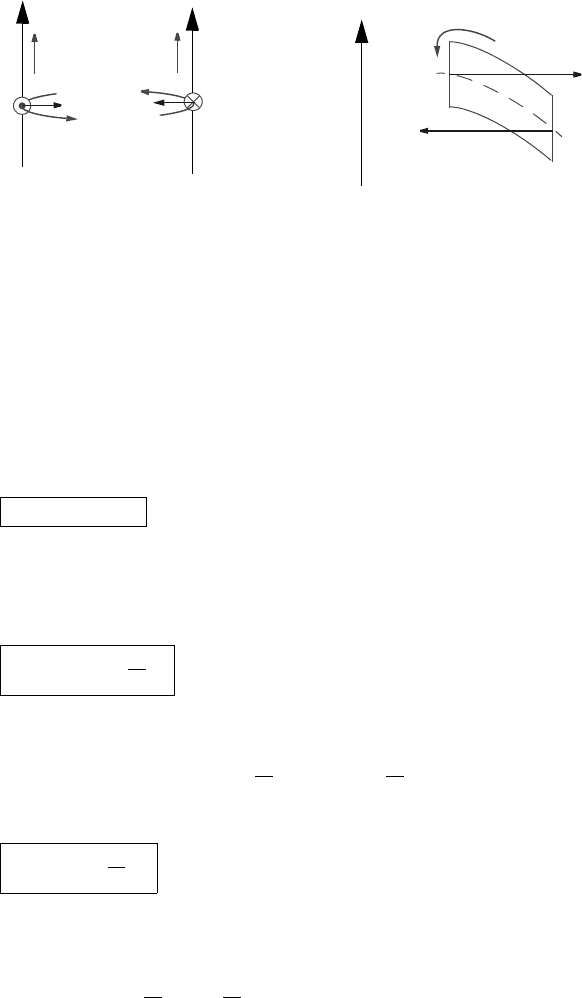
The Lorentz force is perpendicular to and . This results in strange effects. For
instance parallel currents attract each other (Fig. 1.24). The current I
2
(I
1
) causes a
field ( ) at the location of the current I
2
(I
1
) and this field induces the Lorentz
force ( ). It is interesting to study the force of a current carrying wire loop
that is placed in the field of another current (Fig. 1.25). The current I causes the
field at the location of the loop S that carries the current I
s.
The Lorentz force
acts only on currents that are perpendicular to , and causes a torque, in much the
same way as we have described for the compass needle. As far as we know today,
all magnetic materials are characterized by currents that circulate within them
(Ampere’s molecular currents). This is apart from phenomenons related to the
spin–a basic property of elementary particles. The spin of those particles causes
them to act as if they carried circulating currents. We conclude that there are no
magnetic charges and all magnetic forces are ultimately Lorentz forces
(disregarding again the effects of the spin of the elementary particles).
Fig. 1.23 Field of charge at rest and uniformly moving charge
charge at rest uniformly moving charge
v
(high speed)
HB
B µ
0
H =
B
B
µ
0
F QvB ×=
F Q EvB×+()=
vB
B
1
B
2
F
12
F
21
B
B
30 Maxwell’s Equations
1.11 Faraday’s Law of Induction
In addition to the above described experience, there is one more basic property.
Faraday’s law of induction, usually referred to as the Law of Induction, formulates
this phenomenon in the following way:
If a magnetic flux through the surface of a closed loop changes over time,
then there will be an induced voltage in that loop, which is proportional to the
change of the magnetic flux.
By magnetic flux we mean the flux of the magnetic induction
(1.66)
The voltage that we find in a closed loop is the electromotive force (EMF) and is
given by the integral
,
which vanishes in the electrostatic case. Here, this is not the case and one has now
,
(1.67)
where we have already decided that a possible proportionality constant is
dimensionless and equal to 1. One may write as well
.
Since this is true for every surface A, one may also write
.
(1.68)
The two equivalent relations (1.67) and (1.68) represent Maxwell’s 2
nd
equation, in
integral and differential from, respectively.
One takes the divergence of both sides in eq. (1.68) to find
.
Fig. 1.25 Lorentz force on
wire loop
I
B
I
s
S
F
F
Fig. 1.24 Lorentz force on parallel
wires
I
1
v
v
I
2
B
2
B
1
F
21
F
12
φ BAd•
∫
=
Esd•
∫
°
Esd•
∫
°
t∂
∂
φ –=
Esd•
∫
°
E∇×()Ad•
A
∫
t∂
∂
BAd•
A
∫
–
t∂
∂
BAd•
A
∫
–===
E∇×
t∂
∂
B –=
E∇×()∇•
t∂
∂
B∇•–
t∂
∂
B∇•–0===
1.12 Maxwell’s Equations 31
Note that and commute. Consequently, the divergence of may only
be a time-independent spatial function:
.
(1.69)
From our experience, we conclude that
,
(1.70)
and therefore
.
(1.71)
The field lines of B are thus free of sources and sinks. As previously determined,
this means that there are no magnetic charges at which field lines could begin or
end. A frequent conclusion is that this means magnetic field lines have to either
close on themselves, or extend into infinity. This conclusion is, however, incorrect.
There are examples for fields whose lines do neither (a more detailed discussion on
this is found in Chapter 5, Section 5.11.2, which deals with magnetostatics).
1.12 Maxwell’s Equations
In the previous Sections we have introduced all of Maxwell’s equations. There is a
differential and an integral form for each of the those four equations. We
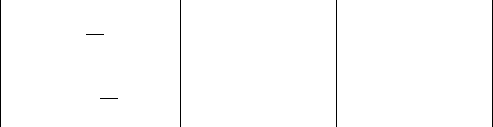
summarize them here, side by side.
These are two vector and two scalar equations for five vector quantities (E, D, H,
B, g) and one scalar quantity ( ). Obviously, since every vector equation is
equivalent to three scalar ones, there are more unknowns (5 times 3 + 1 = 16) than
equations (2 times 3 + 2 = 8). If we consider, as we have seen in the previous
Section, that the relation follows from Maxwell’s second equation, or
more precisely, serves as an initial condition within the system of
Maxwell’s equations, then the discrepancy grows even larger. Now we have 7
differential form
integral form
(1.72)
∇• ∂ ∂t⁄ B
B∇• f r()=
f r() 0≡
B∇• 0 =
H∇× g
t∂
∂D
+=
H ds•
C
∫
°
g
t∂
∂D
+
Ad•
A
∫
=
E∇×
t∂
∂B
–=
E ds•
C
∫
°
t∂
∂
B dA•
A
∫
–=
B∇• 0=
B dA•
A
∫
°
0=
D∇• ρ=
D dA•
A
∫
°
ρ td
V
∫
=
ρ
B∇• 0=
B∇• 0=
32 Maxwell’s Equations
equations for 16 unknowns. That means, to supplement Maxwell’s equations we
need 9 more. At least for vacuum, we have met some of those equations already:
.
(1.73)
If we deal with matter in general, then we need to describe D in some form as a
function of E and B as a function of H (which we will discuss later in more detail).
These relations are called the constitutive relations:
.
(1.74)
We gain another equation from the fact that electric currents in conductors are
caused by electric fields and thus somehow depend on the electric field
.
(1.75)
In the simplest case, and usually the most important one finds that the volume
current density is proportional to E (this is Ohm’s law)
.
(1.76)
The coefficient is the specific electric conductivity. Summarizing, one can say
that (1.74) and (1.75), supplement Maxwell’s equations (1.72), making it a
complete system of equations.
Maxwell’s equations are linear. This is a consequence of the superposition
principle for both the electric and the magnetic fields (for the magnetic field, it is
contained in the reflections that led to (1.55)). Linearity is the formal expression
for the superposition principle. Linearity is also important for practical
applications, that is, to solve specific problems. Linear equations are much easier to
solve than non-linear ones. Linearity is lost when the supplementing “material
equations” (1.74) and (1.75) become non-linear, which is a possible scenario.
Maxwell’s equations exhibit a high degree of symmetry, which gives them kind of
an aesthetic charm. This symmetry is particularly obvious in the case of vacuum
with no charges or currents present. Here we get
We will see that this symmetry results in important consequences. A changing
electric field ( ) causes a magnetic circulation ( ), which is also varying
in time and causes an electric circulation ( ), etc. This describes the
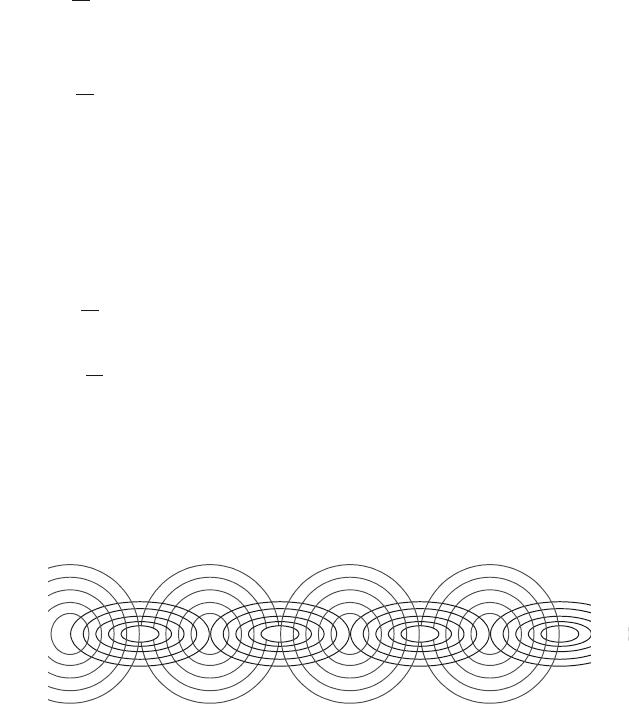
mechanism of generation and propagation of electromagnetic waves (Fig. 1.26), to
which radio waves, light, heat radiation, etc. owe their existence.
(1.77)
D ε
0
E=
B µ
0
H=
DDE()=
BBH()=
ggE()=
g
g κE=
κ
H∇×
t∂
∂D
=
B∇• 0=
B µ
0
H=
E∇×
t∂
∂B
–=
D∇• ρ=
D ε
0
E=
∂D ∂t⁄ H∇×
E∇×
1.12 Maxwell’s Equations 33
This symmetry is somewhat lost when we introduce charges and currents.
This result is somewhat unsatisfactorily. At least as far as we know today, this
asymmetry is based on the fact that there are no magnetic charges which would
serve as sources of the magnetic field. There are a number of scientists who do not
believe that this is the last word on that matter. In fact, it is conceivable that such
magnetic charges, though not yet discovered, do exist. Thus the search for such
charges continues. If they exist, this would require one to make modifications to
Maxwell’s equations. It is a useful exercise to determine how this would need to be
done. Besides the spatial density of electric charges ( ) there would be magnetic
charges ( ). Both could cause currents ( ). In addition to the principle of
conservation of electric charges
,
(1.78)
we would require the conservation of magnetic charges
.
(1.79)
Then
(1.80)
and
.
(1.81)
This gives us
.
.
Those equations can be satisfied with the Ansatz
Fig. 1.26
E
BBBB
EEE
ρ
e
ρ
m
g
e
g
m
,
g
e
∇•
t∂
∂ρ
e
+0=
g
m
∇•
t∂
∂ρ
m
+0=
D∇• ρ
e
=
B∇• ρ
m
=
g
e
t∂
∂D
+
∇• 0=
g
m
t∂
∂B
+
∇• 0=