
Lehner G. Electromagnetic Field Theory for Engineers and Physicists
Подождите немного. Документ загружается.


34 Maxwell’s Equations
,
.
We know that b represents H. In a similar way, to arrive correctly at Maxwell’s 2
nd
equation from , we identify a as representing -E. The overall result would
then be:
Should magnetic charges be discovered some day, Maxwell’s equations were to
modify in the indicated way. Some further remarks on magnetic charges are treated
in Appendix A.2.
We now return to Maxwell’s equations without magnetic charges. They
describe a vast abundance of phenomena, with which we will involve ourselves in
the following. This is usually done step by step and we will proceed in the same
manner. That is to say, we will not attempt to solve the full system of Maxwell’s
equations right way, but start with fields that do not exhibit any time dependency.
Then we get
.
Two of those equations depend solely on electrostatic quantities and we already
know these equations
.
They define the electrostatics, which will be our first area of study. Of course do
we need to include the relation . The other two equations
define the magnetostatic case, if we add the constitutive relation between and
. This topic will occupy the second principle part of this book. Only in the last,
the third principle part will we deal with the complete set of Maxwell’s equations
where we cover topics like skin effect, wave propagation, radiation, antennas, etc.
.
(1.82)
a∇× g
m
t∂
∂B
+=
b∇× g
e
t∂
∂D
+=
g
m
0=
H∇×
t∂
∂D
g
e
+=
B∇• ρ
m
=
E∇×
t∂
∂B
– g
m
–=
D∇• ρ
e
=
H∇× g=
E∇× 0=
B∇• 0=
D∇• ρ=
E∇× 0=
D∇• ρ=
DDE()=
H∇× g=
B∇• 0=
B
H

1.13 System of Units 35
We base all this on our current state of knowledge, which is not necessarily
final. It is always possible that new discoveries some day will mandate us to
modify our understanding and our theories. We already came across several
questions, for which there are currently no final answers, such as whether or not
Coulomb’s law is exact, or whether magnetic charges actually do exist, etc. This
lies within the nature of science. Of course even though our current answers may
only be preliminary, they are nevertheless interesting and important enough to
study.
1.13 System of Units
Initially, we left open the practical question of which units one should employ for
the various quantities That is, which system of units one should introduce. We will
now remedy this situation.
There are quite a number of different systems of units in use and there are
many discussions on which one would be best for whatever reason. Those
discussions are not profitable and we will refrain from doing it here. This book will
use a single system consistently, namely the MKSA system, which is used
internationally, and which in some countries is mandated by law.
Every system of units is based on basic units from which other quantities are
derived. The MKSA system got its name form the fact that meter, kilogram,
second, and Ampere were chosen as its basis. Naturally, every basic unit needs a
firm definition, i.e. it has to be defined through a reference or a “normal”. The term
needs a clear definition and experimentally, the quantity needs to be readily
reproducible. The normal could be of a physical prototype or a natural
phenomenon. For the MKSA system the four basic units are defined in the
following way:
1. 1 Meter
(m): Since 1983, one meter is defined by the propagation time
of light. Specifically, the distance that light in vacuum travels during
.
Previously (1889 - 1960) the definition of the meter was in terms of a
prototype bar that was kept in Paris (France), which consisted of 90%
platinum and 10 % iridium. This prototype of the meter was supposed to
be exactly one ten-millionth part of the distance from an Earth pole to
the equator (but it was not accurate). Between 1963 and 1983 the defini-
tion was based on spectroscopy, i.e. the measure of the spectral line of a
particular wave length of Krypton-86.
2. 1 Second
(s): Recently, the definition of time is also based on spectros-
copy, namely the time span of
9192631770 periods
of a particular radiation of caesium. Before that, 1 second was defined as
the 86400th fraction of a mean solar day of the year 1900.
1
299792458
---------------------------
s

36 Maxwell’s Equations
3. 1 Kilo
gram (kg): It was, and still is defined as the mass equivalent to
that of a prototype consisting of platinum and iridium which is kept in
Paris (France).
4. 1 Ampere
(A): The definition used to be that of a current, exactly con-
stant in time, which in one second deposits 1.118 mg = 1.118 • 10
-6
kg of
silver from an aqueous solution of silver-nitrate. The unit defined in this
way is now called the international Ampere and differs slightly from the
so-called absolute Ampere, which is the one that is used today as the
basic unit for current. To understand this definition, we need to remem-
ber the attracting force between two parallel, current carrying, conduct-
ing wires, described in Section 1.10 (see also Fig. 1.24). If we take two
parallel wires of infinite length at a distance r from each other that carry
the currents I
1
and I
2
then the magnetic field B
1
that I
1
produces at the
location of the current I
2
is
.
(1.83)
This results from the definition of by (1.63) and from equations (1.55) or
(1.56), exploding the symmetry of the problem. If we choose for instance
(1.55) we get
,
that is
.
The force exerted on the second wire follows from (1.83), together with
(1.64). The current in a wire consists of moving charges. The force on a single
charge in the second wire that moves with velocity v is
,
and the overall force on the whole wire is
,
(1.84)
where the sum extends over all charges in wire 2. This is an infinite sum as the
wire is infinitely long and thus contains an infinite number of charges. How-
ever, the force per unit length remains constant.
.
(1.85)
The expression is nothing more than the current I
2
.
B
1
µ
0
H
1
µ
0
I
1
2πr
---------
==
B
H ds•
∫
°
2πrH
1
I
1
==
H
1
I
1
2πr
---------=
FQv
µ
0
I
1
2πr
-----------
=
F
t
Q
i
v
i
µ
0
I
1
2πr
-----------
i
∑
=
F
t
L
-----
µ
0
I
1
2πr
-----------
Q
i
v
i
i
∑
L
-----------------
=
Q
i
v
i
i
∑
()L⁄

1.13 System of Units 37
.
(1.86)
Because of the definition of the current as the charge per unit of time that
crosses a particular cross section we find the overall relation
.
(1.87)
Next, we consider two infinitely long, infinitesimally narrow, straight wires at
a distance of 1m apart. We also require the wires to be parallel and carry the
same current . If each one exerts the force of Newton
per meter of its length, then the related current amounts to
(Ampere). Here, Newton is the unit of force in the MKS-system.
This results in
.
With this definition of the basic unit Ampere, we have also defined :
.
(1.88)
We have now introduced those four basic units. We will derive the other units from
these. There are the purely mechanical units. The unit for force was already used:
1 Newton = ,
the unit for energy
1 Joule = ,
and the unit for power
1 Watt = .
This leads us to the electrical units. From the definition of current,
we can derive the unit for charge
1 Coulomb = .
Note the interesting fact that the charge is just a deduced quantity, although it is of
fundamental importance and was the actual starting point of our discussion.
Charges occur in nature only in multiples of the so-called elementary charge
Q
i
v
i
i
∑
L
----------------- I
2
=
F
L
---
µ
0
I
1
I
2
2πr
----------------
=
II
1
I
2
== 210
7–
⋅
II
1
I
2
1A===
1N 1 Newton 1
mkg
s
2
----------
==
210
7–
⋅
N
m
----
µ
0
A
2
2πm
------------=
µ
0
µ
0
4π 10
7–
⋅
N
A
2
------
=
1N 1
mkg
s
2
----------
=
1J 1Nm 1
m
2
kg
s
2
-------------
==
1W 1
Nm
s
--------
1
J
s
--
1
m
2
kg
s
3
-------------
===
I
dQ
dt
-------=
1C 1As=

38 Maxwell’s Equations
(disregarding quarks). This charge is very small, and just a tiny fraction of one
Coulomb, namely
.
(1.89)
By defining e in this way, we set the charge of an electron to -e and that of a proton
or positron to +e. Because of
,
The unit of the electric field is 1N/C, and thus the unit of the potential becomes
1 Nm/C ( ). It is called Volt:
.
Therefore
.
From Coulomb’s law
,
one derives the dimension for
,
The numerical value can be obtained by measurement. It depends on the chosen
system of units. In our system of units
.
(1.90)
The previously mentioned unit for the electric field (1 N/C) may also be expressed
as 1 V/m. This settles the units for the electric displacement (D) to
,
which is obvious from the relation
.
This definition allows us to write in a different form
,
and finally
.
(1.91)
When comparing the definitions in (1.90) and (1.91) it strikes us that the product of
and has a purely mechanical dimension.
e 1.6 10
19–
⋅ C ≈
F QE=
E ∇ϕ–=
1 Volt 1V 1
Nm
C
--------
1
J
C
----
1
W
A
-----
== ==
1V 1A⋅ 1W=
1V 1C⋅ 1J=
F
Q
1
Q
2
4πε
0
r
2
-----------------=
ε
0
ε
0
[],
ε
0
[]
C
2
Nm
2
-----------
C
2
Jm
-------
C
2
CVm
------------
As
Vm
--------=== =
ε
0
8.855 10
12–
⋅
As
Vm
--------
=
1
As
Vm
--------
V
m
----
1
As
m
2
-------
1
C
m
2
-------
==
D dA•
∫
°
Q=
µ
0
µ
0
[]
N
A
2
------
VC
mA
2
-----------
VAs
A
2
m
-----------
Vs
Am
--------====
µ
0
1.2566 10
6–
⋅
Vs
Am
--------
=
µ
0
ε
0

1.13 System of Units 39
,
The numerical value for this gives
,
(1.92)
that is the square of the speed of light. This is no coincidence. Historically, this was
the first indication that light is of an electromagnetic nature, which will occupy us
in later sections.
The unit for current density is 1A/m
2
. The unit for the magnetic field intensity
H results from Maxwell’s first equation (1.61) to 1A/m. Because of the relation
, this determines the units for B to 1Vs/Am • 1A/m.= 1Vs/m
2
. This unit is
called Tesla
1 Tesla = .
The unit for the magnetic flux is expressed in Weber and results to
.
Another derived unit is that for Resistance
1 Ohm = ,
for Capacitance
1 Farad = ,
and for Inductance
1 Henry = .
Those quantities have not been introduced yet and we will need to make up for this
later. The definitions for 1 Henry and 1 Farad are also used to express µ
0
in Henry
per meter (H/m) and ε
0
in Farad per meter (F/m).
Every physical unit has to be understood as the product of a numerical value
and a unit:
quantity = numerical value • unit
Examples for this are found in equations (1.88), (1.89), (1.90), and (1.92) of this
section. The usual rules for calculations apply for such products, which should be
clear from the way we derived the relations.
Finally, to conclude this section, we will state some useful conversion factors
towards other frequently used units of measurement.
1 Tesla = 1 T = 10
4
Gauss
1 Maxwell = 1M = 10
-8
Weber
1 electronvolt = 1 eV = 1.6 10
-19
Joule .
µ
0
ε
0
[]
Vs
Am
--------
As
Vm
--------
s
m
----
2
==
1
µ
0
ε
0
-----------
910
16
⋅
m
s
----
2
c
2
==
B µ
0
H=
1T 1
Vs
m
2
-------
=
1
Vs
m
2
-------
1m
2
1Vs 1 Weber 1Wb== =
1Ω 1
V
A
---
=
1F 1
C
V
----
1
As
V
------
1
s
Ω
----
== =
1H 1
Vs
A
------
1Ωs==

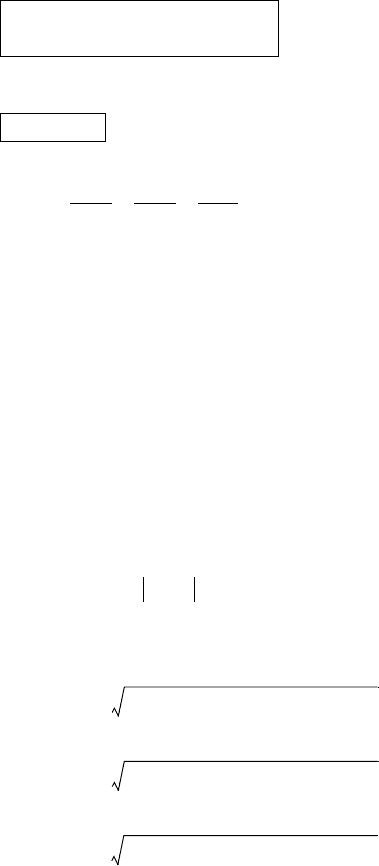
2 Basics of Electrostatics
2.1 Fundamental Relations
The fundamental relations of electrostatics were introduced in Chapter 1. Before
discussing electrostatics in more detail, we summarize the basic results.
The force between two charges Q
1
and Q
2
is given by Coulomb’s law:
.
(2.1)
This, in turn, determines the electric field that a charge Q
1
at location produces
at location in free space
,
(2.2)
while the electric displacement is defined to be
.
(2.3)
For an arbitrary charge distribution it follows that
.
(2.4)
or
.
(2.5)
For charges at rest (this is what is discussed in this chapter) one has
(2.6)
or
.
(2.7)
This is the basis for defining a potential function
.
(2.8)
Conversely, the electric field is given by
.
(2.9)
Because of (2.5), it is also true that
.
(2.10)
Using (2.9) one obtains
F
12
Q
1
Q
2
4πε
0
--------------
r
2
r
1
–
r
2
r
1
–()
3
---------------------------
⋅=
r
1
r
Er()
Q
1
4πε
0
------------
rr
1
–
rr
1
–()
3
------------------------
⋅=
Dr() ε
0
E
Q
1
4π
------
rr
1
–
rr
1
–()
3
------------------------
⋅==
DAd•
∫
°
Q ρτd
V
∫
==
D∇• ρ=
Esd•
∫
°
0=
E∇× 0=
ϕ r() ϕ
0
Esd•
r
0
r
∫
–=
E ϕ∇–=
E∇•
ρ
ε
0
-----=
ϕ∇–()∇•
ρ
ε
0
-----=
G. Lehner, Electromagnetic Field Theory for Engineers and Physicists,
DOI 10.1007/978-3-540-76306-2_2, © Springer-Verlag Berlin Heidelberg 2010
2.2 Field Intensity and Potential for a given Charge Distribution 41
or
.
(2.11)
This is Poisson’s equation, which is going to play a central role . For the specific
case of , one obtains Laplace’s equation
.
(2.12)
Expressed in Cartesian coordinates
,
that is
.
(2.13)
The symbols or represent the Laplace operator also referred to as
Laplacian.
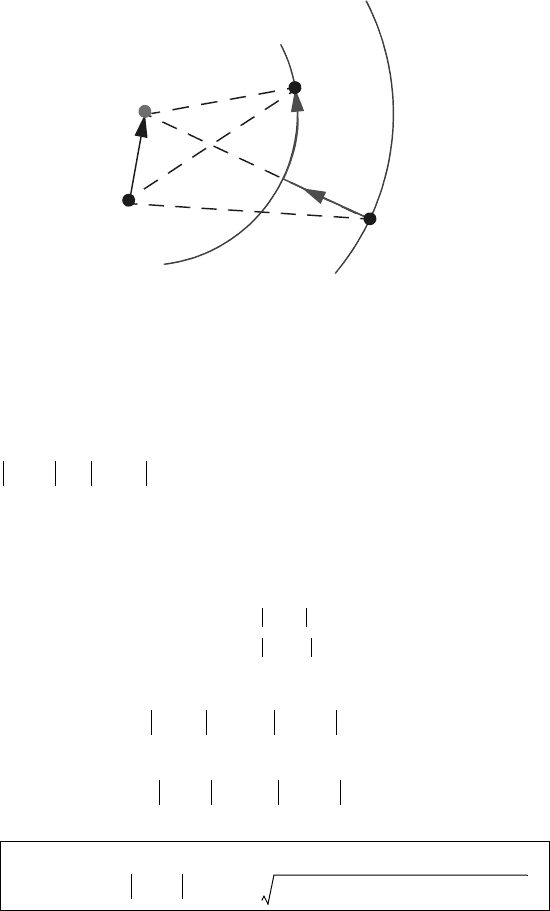
2.2 Field Intensity and Potential for a given Charge
Distribution
If one places a point charge at location , one finds the electric field intensity
to be
(2.14)
or written in terms of its components:
.
(2.15)
To calculate the potential we will start from the general definition:
,
(2.16)
where is an arbitrarily chosen reference potential evaluated at point
(reference point). To calculate , one needs to evaluate the line integral along
some path from to . Since the integral is independent of the chosen path, one
ϕ∇()∇• ∇
2
ϕ∆ϕ
ρ
ε
0
-----
–===
ρ 0=
∇
2
ϕ 0 =
∇
2
ϕ
x∂
∂
x∂
∂ϕ
y∂
∂
y∂
∂ϕ
z∂
∂
z∂
∂ϕ
++
∂
2
∂x
2
--------
ϕ
∂
2
∂y
2
--------
ϕ
∂
2
∂z
2
--------
ϕ++==
∇
2
∂
2
∂x
2
--------
∂
2
∂y
2
--------
∂
2
∂z
2
--------++=
∇
2
∆
Q
1
r
1
Er()
Q
1
4πε
0
------------
rr
1
–
rr
1
–
3
-------------------
⋅=
E
x
Q
1
4πε
0
------------
xx
1
–
xx
1
–()
2
yy
1
–()
2
zz
1
–()
2
++
3
-----------------------------------------------------------------------------------
⋅=
E
y
Q
1
4πε
0
------------
yy
1
–
xx
1
–()
2
yy
1
–()
2
zz
1
–()
2
++
3
-----------------------------------------------------------------------------------
⋅=
E
z
Q
1
4πε
0
------------
zz
1
–
xx
1
–()
2
yy
1
–()
2
zz
1
–()
2
++
3
-----------------------------------------------------------------------------------
⋅=
ϕϕ
B
Esd•
r
B
r
∫
–=
ϕ
B
r
B
ϕ
r
B
r
42 Basics of Electrostatics
has the freedom to choose any convenient path as proven in the previous chapter
(Section 1.6 - 1.8).
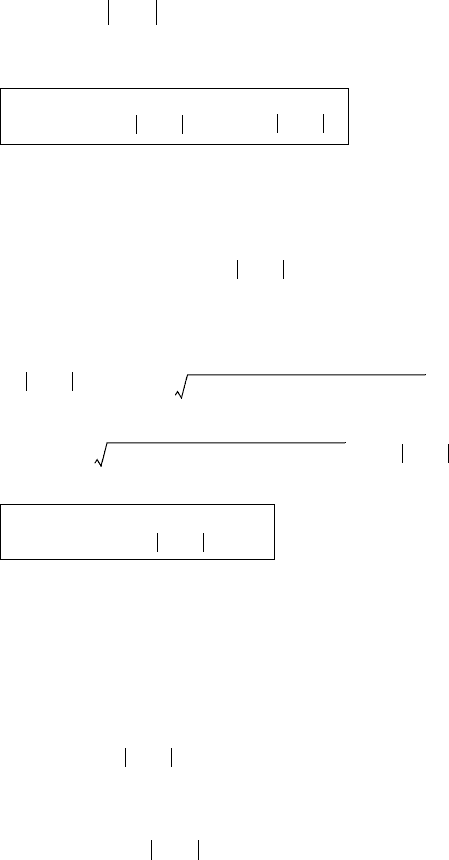
We will take advantage of this freedom and simplify an otherwise difficult
task. We choose the path indicated in Fig. 2.1. Starting at our reference point ,
we head towards the charge at until we reach the concentric sphere around
on which our field point lies. This is at point , where
.
Then we continue on the sphere, centered at the location of , towards the field
point until we reach it. We write the integral
,
.
(2.17)
If we decide to pick for a reference point at infinity, then
.
(2.18)
We use this to calculate the electric field
,
and find the field components according to (2.15).
Fig. 2.1 Integration path to determine the potential
r
B
r
Q
1
r
1
rr
1
–
r'
r
B
r
1
Q
1
rr'
rr
1
– r' r
1
–=
Q
1
r
ϕ r() ϕ
B
Esd•
r
B
r
'
∫
Esd•
r'
r
∫
––=
ϕ
B
Esd•
r
B
r'
∫
– ϕ
B
Q
1
4πε
0
x
2
------------------
dx⋅
r
B
r
1
–
r' r
1
–
∫
–==
ϕ
B
Q
1
4πε
0
r' r
1
–
------------------------------
Q
1
4πε
0
r
B
r
1
–
--------------------------------–+=
ϕ r() ϕ
B
Q
1
4πε
0
rr
1
–
-----------------------------
Q
1
4πε
0
r
B
r
1
–
--------------------------------–+=
ϕ
B
0=
ϕ r()
Q
1
4πε
0
rr
1
–
-----------------------------
Q
1
4πε
0
xx
1
–()
2
yy
1
–()
2
zz
1
–()
2
++
---------------------------------------------------------------------------------------------
==
E ϕ∇–=
2.2 Field Intensity and Potential for a given Charge Distribution 43
If one has many point charges at the locations
, then, because of the superposition principle (which applies not
only to the field, but also to the potential), one uses
.
(2.19)
In general, the charge distribution may be continuous. When the charge density is
given as a function of the location , then
,
(2.20)
where is the volume element in the space of the vector , i.e.
.
(2.21)
The corresponding electric field is
.
(2.22)
Notice that the gradient operator operates on only and not on . To highlight
this, the del operator is marked with the index . Now
,
(2.23)
and finally
.
(2.24)
Sometimes one deals with situations where there are charges distributed on
surfaces or line elements (surface charge, line charge). One then defines the
surface charge density as the charge per unit area,
.
(2.25)
The associated potential is then given by
,
(2.26)
and the electric field
.
(2.27)
Similarly, the line charge density or linear density q is defined as the charge per
unit length,
Q
1
Q
2
… Q
i
…,,,,
r
1
r
2
… r
i
…,, ,,
ϕ
Q
i
4πε
0
rr
i
–
----------------------------
i
∑
=
r
ϕ r()
1
4πε
0
------------
Q'd
rr'–
---------------
∫
1
4πε
0
------------
ρ r'()τ'd
rr'–
-------------------
∫
==
τ'd r'
τ'ddx'dy'dz'=
E ϕ r()∇–
1
4πε
0
------------
∇
r
ρ r'()τ'd
rr'–
-------------------
∫
–==
rr'
r
∇
r
1
rr'–
---------------
∇
xyz,,()
1
xx'–()
2
yy'–()
2
zz'–()
2
++
----------------------------------------------------------------------------
=
2 rr'–()
2 xx'–()
2
yy'–()
2
zz'–()
2
++
3
----------------------------------------------------------------------------------–
rr'–
rr'–
3
------------------–==
Er()
1
4πε
0
------------
ρ r'()rr'–()
rr'–
3
-----------------------------
τ' d
∫
=
σ
σ
dQ
dA
-------=
ϕ r()
1
4πε
0
------------
σ r'()
rr'–
---------------
A'd
∫
=
Er()
1
4πε
0
------------
σ r'()rr'–()
rr'–
3
------------------------------
A'd
∫
=