
Lehner G. Electromagnetic Field Theory for Engineers and Physicists
Подождите немного. Документ загружается.

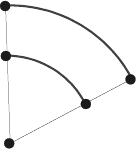
14 Maxwell’s Equations
.
On the paths (arcs) from P
2
to P
3
and P
4
to P
1
, is perpendicular to
.
On the other two paths from P
1
to P
2
and P
3
to P
4
, on the other hand, and are
parallel and anti-parallel, respectively. This means that
.
This finalizes the proof. Unfortunately the perpetuum mobile is not a feasible
option. Relation (1.33) will prove to be far-reaching. First, we need to introduce
some terms, which will be done in the next section.
1.7 The Rotation of a Vector Field and Stoke’s Integral
Theorem
Consider an arbitrary vector field . For any closed curve, we can write the line
integral . We may also look at arbitrarily small area elements, and the line
integrals corresponding to their boundary. Reducing the size of the area elements
more and more will make the line integrals smaller and smaller, such that they will
vanish in that limit. However, the ratio of the line integral over its related area
element will converge towards a limit. We define a new vector field which we call
the circulation or curl of ( or ) as follows:
We choose three perpendicular, but otherwise arbitrary area elements
, which share a common center in space. Together they form a right
handed system. With this we write the limit.
(1.34)
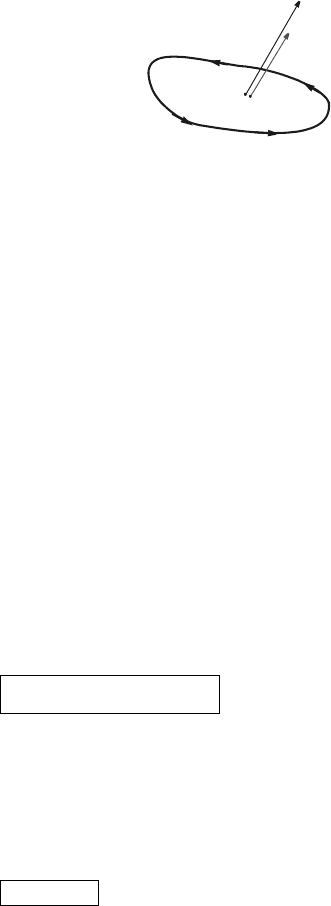
Note that the line integral in the numerator is an infinitesimal loop extending over
the boundary of the area element and the orientation is such that the line integral
forms a right handed system with the vector (Fig. 1.12).
Fig. 1.11 Line integral segments
r
2
r
1
P
3
P
2
P
1
P
4
0
Esd•
∫
°
P
1
P
2
∫
P
2
P
3
∫
P
3
P
4
∫
P
4
P
1
∫
+++
Esd• 0==
E ds
Esd•
P
2
P
3
∫
Esd•
P
4
P
1
∫
+0=
E ds
Esd•
P
1
P
2
∫
E sd
P
1
P
2
∫
E sd
P
3
P
4
∫
– Esd•–
P
3
P
4
∫
== =
ar()
asd•
∫
°
a curl a() a∇×
dA
1
dA
2
dA
3
,,
asd•
∫
°
dA
i
----------------
dA
i
0→
lim r
i
= i 123,,=()
dA
1
1.7 The Rotation of a Vector Field and Stoke’s Integral Theorem 15
The limits r
i
are the components of the vector that represents , the circulation
of the vector field in the coordinate system defined by the three area elements. If
represents the unit vector perpendicular to the area element , then
or
It is not trivial that one can regard the components r
i
as those of a vector. We still
need to prove that those components transform like a vector when transforming the
coordinate system (of course into another orthogonal one). We will not carry out
this proof here, but leave it to Vector Analysis. Using the definition of curl
provides Stoke’s Integral Theorem almost immediately. One looks at an arbitrary
area and calculate the related curl. One separates this area into many arbitrarily
small sub-areas and then apply the definition of curl onto those. The result is a sum
of line integrals where all internal parts cancel, and only one line integral over the
outer boundary remains – as was shown in section 1.6 (using Fig. 1.10)
.
(1.35)
As before, orientation of the surface area and direction of the contour integral have
to form a right handed system. Applying eq. (1.35) to the electric field and using
(1.33) we get
.
This has to be true for an arbitrary curve or its surface area which it surrounds.
Consequently it must be true that
.
(1.36)
Conversely, eq. (1.33) follows from (1.35) and (1.36). This is because of
Fig. 1.12 The area vector
dA
i
n
i
dA
i
∇ a×
a
n
i
dA
i
A
i
---------= where n
i
n
k
•δ
ik
1
0
for
for
ik=
ik≠
==
dA
i
a∇× r
1
n
1
r
2
n
2
r
3
n
3
++ r
1
r
2
r
3
,,〈〉==
n
i
a∇×()• r
i
a∇×()
i
==
a∇× Ad•
A
∫
as d•
C
∫
°
=
Esd•
∫
°
E∇× Ad•
∫
0==
E∇× 0 =
Esd•
∫
°
E∇× Ad•
∫
0==
16 Maxwell’s Equations
This means that eqs. (1.33) and (1.36) are equivalent. Each follows form the other.
This pair of relations were derived for the electrostatic case, i.e. charges at rest. We
will need to modify one of the relations later, when we study time-dependent
systems. We will then explain why or its respective integral formulation
can be applied without change, while the other ( ) requires modification.
It turns out that above definition is rather impractical, should one actually try
to calculate the curl of a vector field. Therefore, we will write the curl of a given
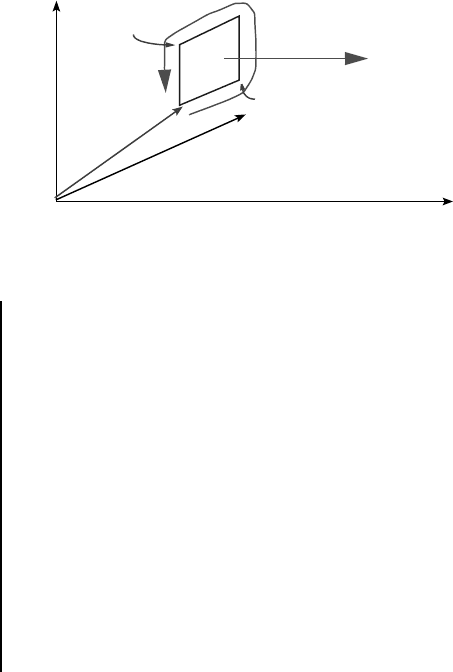
field in its Cartesian components (Fig. 1.13).
It is sufficient to just calculate the x component and then generalize this result,
which can be done rather easily. Based on definition (1.34) and the additional
constraint that the orientation of the path forms a right-handed system with ,
we write:
It is time to summarize our previous results. We found two important
integral relations, namely (1.20) and (1.33);
These have two equivalent differential relations, (1.23) and (1.36)
The relation between them is established via the integral theorems
(1.24) and (1.35)
(Gauss) (Stokes)
DAd•
A
∫
°
ρdτ
V
∫
=
Esd•
∫
°
0=
D∇• ρ= E∇× 0=
a∇• τd
V
∫
aAd•
A
∫
°
= aAd•∇×
A
∫
asd•
C
∫
°
=
D∇• ρ=
E∇× 0=
a
x
y
z
〈x,y,z〉
Fig. 1.13 Curl of a vector field
〈x,y+dy,z〉
〈x,y,z+dz〉
a∇×
a∇×()
x
a
y
z()dy a
z
ydy+()dz a
y
zdz+()dy– a
z
y()dz–+
dydz
-----------------------------------------------------------------------------------------------------------------------
dy dz, 0→
lim=
1.7 The Rotation of a Vector Field and Stoke’s Integral Theorem 17
.
Therefore formally expressed as the vector product of the Nabla operator with the
vector a:
.
(1.37)
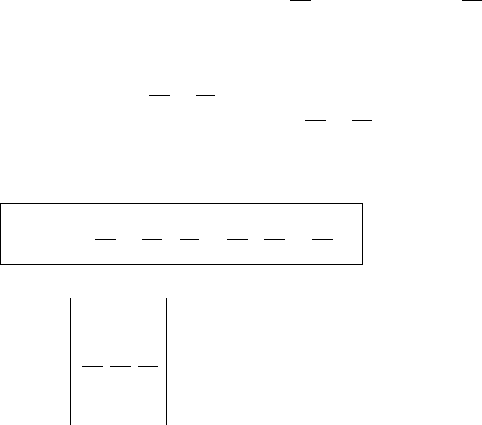
Or written in the form of a determinant:
(1.38)
The determinant is the usual form used in Vector Calculus to express the vector
product. The vectors are the unit vectors in x-, y-, and z-direction,
respectively
(1.39)
It is appropriate to deal with the curl in more detail, but we will abstain from this
here and leave it to Vector Calculus to fill in the intricate details. Nevertheless, it
shall be noted that the reader should not conclude from the notation
that is perpendicular to or to . In contrast to a real
vector, it is not possible to assign a direction to the del ( ) operator. The vector
resulting from can point in any direction relative to . can be
perpendicular to , it can also be parallel to it. The reader should convince himself
of this by studying a few examples.
Because of Gauss’s theorem, for an arbitrary closed surface one has
And because of Stoke’s theorem
a
y
z()dy a
z
y()dz
y∂
∂a
z
dydz a
y
z()dy
z∂
∂a
y
dydz–– a
z
y()dz–++
dydz
----------------------------------------------------------------------------------------------------------------------------------------------------
dy dz, 0→
lim=
y∂
∂a
z
z∂
∂a
y
–
dydz
dydz
----------------------------------------
dy dz, 0→
lim
y∂
∂a
z
z∂
∂a
y
–==
a∇×
y∂
∂a
z
z∂
∂a
y
–
z∂
∂a
x
x∂
∂a
z
–
x∂
∂a
y
y∂
∂a
x
–,,〈〉 =
a∇×
e
x
e
y
e
z
x∂
∂
y∂
∂
z∂
∂
a
x
a
y
a
z
=
e
x
e
y
e
z
,,
e
x
100,,〈〉=
e
y
010,,〈〉=
e
z
001,,〈〉=
curl aa∇×= curl a ∇ a
∇
a∇× aa∇×
a
a∇×()dA•
A
∫
°
a∇×()∇• dτ
V
∫
=
a∇×()dA•
A
∫
°
0=
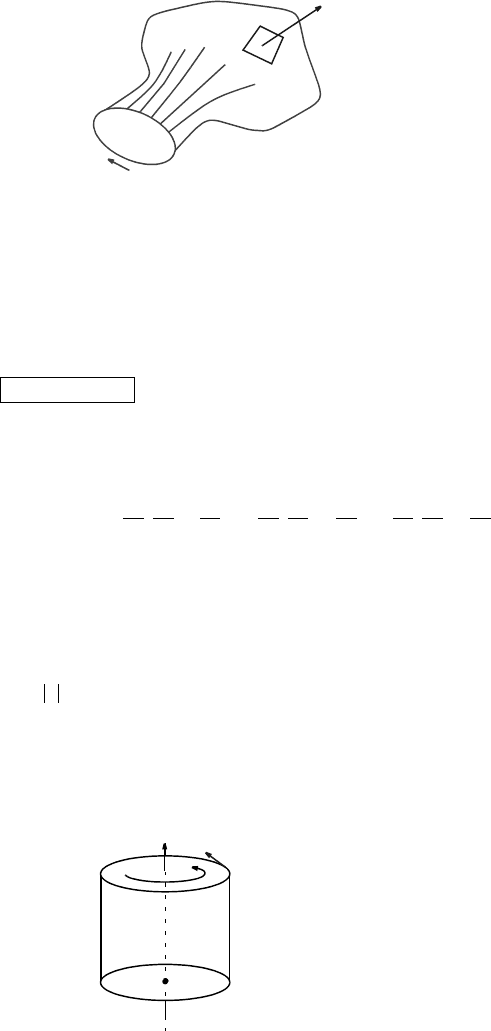
18 Maxwell’s Equations
The right side is zero because the line integral that is initially there, decreases and
finally vanishes when transitioning from an open surface to a closed one
(Fig. 1.14). Therefore, for an arbitrary volume
and because this is true for any volume, the integrand has to vanish
(1.40)
Eq. (1.40) is an important relation. It says that the curl of an arbitrary vector field
has no sources. Proof of this relation can also be shown by directly applying
equations (1.26) and (1.37):
The divergence of a vector field depends rather plausibly on the sources and sinks
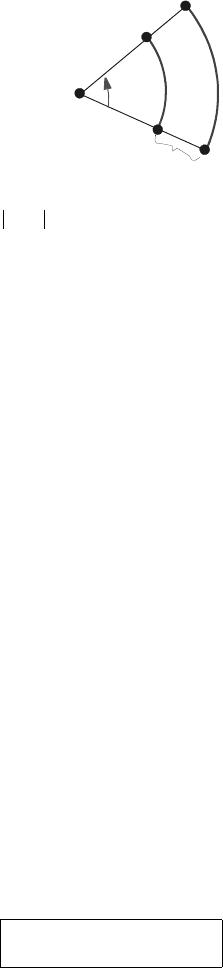
of that field. The curl also has a plausible meaning. Let us, for instance, analyze a
rotating rigid body (Fig. 1.15). Its angular velocity is ω. Thus, a point at distance r
from the center axis has the velocity
.
The angular velocity is oftentimes regarded as a vector whose magnitude is ω and
its direction points along the rotational axis of a right handed system. The curl of
also has the direction of the axis, thus proportional to ω.
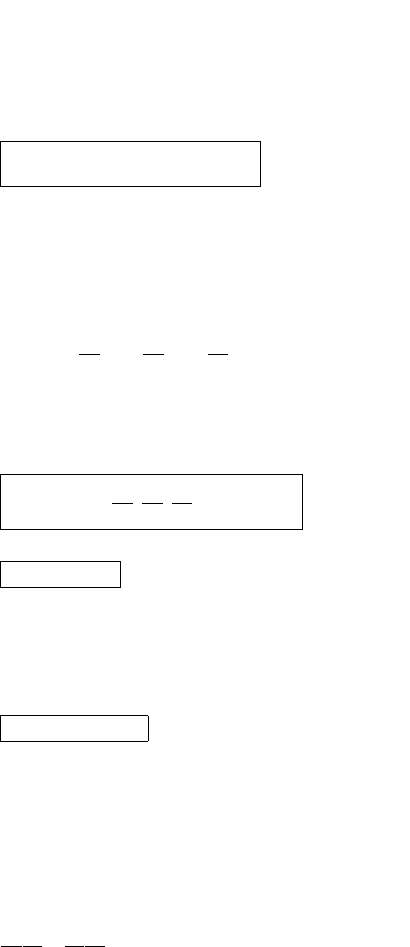
One finds that (see also Fig. 1.16)
Fig. 1.14 Stokes’ theorem
dA
ds
a∇×()∇• dτ
A
∫
°
0=
a∇×()∇• 0 =
a∇×()∇•
x∂
∂
y∂
∂a
z
z∂
∂a
y
–
y∂
∂
z∂
∂a
x
x∂
∂a
z
–
z∂
∂
x∂
∂a
y
y∂
∂a
x
–
++=
0=
Fig. 1.15 Rotating rigid body
v
v v ωr==
v
1.8 Potential and Voltage 19
.
that is
(1.41)
In the area of hydrodynamics, flows whose rotation does not vanish are referred to
as eddies. This refers to the circulation or rotation. Generalizing, we call those
fields curl free or irrotational whose circulation vanishes, while those whose
circulation is non-zero are termed rotational. Consequently, for electrostatics, one
has time-independent fields which have sources, but no circulation.
1.8 Potential and Voltage
An electrostatic field may be described by different, but equivalent terms:
• It is irrotational
• The integral vanishes
• The integral solely depends on the points P
A
and P
E
but not on the particular path taken from P
A
to P
E
.
This allows to express the field in a unique way by a scalar function, which is
closely related to the previously outlined line integral describing the work. In
section 1.6 we found:
.
This is true for any path C
1
or C
2
between the points P
A
to P
E
. (see Fig. 1.9).
Therefore, the potential function (or simply potential) can be defined by
.
(1.42)
The choice of the starting point , for which the potential may assume the value
is arbitrary. This is rather insignificant as just the potential difference (Voltage)
Fig. 1.16 Integration path for curl
r
dr
dϕ
r dϕ
(r+dr) dϕ
v∇×
ω rdr+()rdr+()dϕωrrdϕ–
rdϕdr
-------------------------------------------------------------------------
dϕ dr, 0→
lim=
2ωrdϕdr ωdr
2
dϕ–
rdϕdr
-------------------------------------------------
dϕ dr, 0→
lim 2ω==
v∇× 2w=
E ds•
∫
°
E ds•
P
A
P
E
∫
E ds•
C
1
∫
E ds•
C
2
∫
=
ϕ r() ϕ
0
E ds •
r
0
r
∫
–=
r
0
ϕ
0
20 Maxwell’s Equations
is the important property. Accordingly, the voltage between two points and
is given by
(1.43)
or more compactly
.
(1.44)
V
21
is the work which can be gained per unit of charge when it is moved from P
2
to
P
1
. Consequently, the dimension for V
21
is given as energy over charge. For two
closely spaced neighboring points, the infinitesimal potential difference is
(1.45)
This is the gradient which, in general, is obtained from a function f in the following
way:
(1.46)
From eq. (1.45) follows
.
(1.47)
The scalar function describes the field completely because the gradient provides
all the components of the field. The function is the favored way to describe the
field, as this requires one to deal with a simple function instead of three functions
(one for each coordinate component).
Of course we have also
.
(1.48)
This is true for any function . The fact that the curl of the field vanishes, is the
prerequisite that allows for the definition of a unique potential function. There
exists a vector field for every potential, while the converse does not hold. Namely
there is no unique potential for every vector field (nevertheless, in rotational fields,
it is possible, and is sometimes done, to define not unique potentials). In general, it
is possible to prove the generality of (1.48) by using (1.46) and (1.37). For
instance, the relation for the x component is:
P
1
r
1
()
P
2
r
2
()
V
21
ϕ
2
ϕ
1
– ϕ
0
E ds•
r
0
r
2
∫
– ϕ
0
E ds•
r
0
r
1
∫
+–==
Esd⋅
r
2
r
1
∫
=
V
21
ϕ
2
ϕ
1
– E ds •
2
1
∫
==
dϕ = E ds•– E
x
dx E
y
dy E
z
dz++()–=
=
x∂
∂ϕ
dx
y∂
∂ϕ
dy
z∂
∂ϕ
dz++
=∇ϕ()sd•
∇f r()
x∂
∂f
y∂
∂f
z∂
∂f
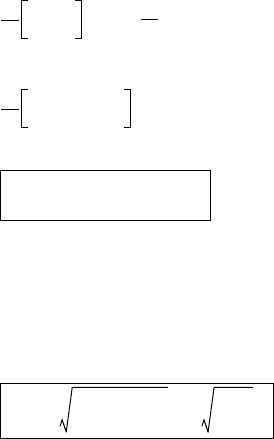
,,〈〉grad f ==
E ∇ϕ –=
ϕ
ϕ
∇ϕ()∇× 0 =
ϕ
y∂
∂
z∂
∂ϕ
z∂
∂
y∂
∂ϕ
–0=
1.8 Potential and Voltage 21
The potential expresses the ability to do work, work of a particle at a particular
spatial location within the field. Is there a charged particle at point , then the
equation of motion applies
(1.49)
If we multiply this equation with
we get
or
and
.
(1.50)
This is the law on conservation of energy. It states that the sum of the kinetic and
potential energy of a particle is constant. If one lets, for instance, a particle start at
location with velocity , where the potential is , one finds
or
.
(1.51)
Here, V is the voltage through which the particle has “fallen”. This relation
between velocity and potential difference has many applications (for instance X-
rays, electronic optics, etc.)
The locations of a potential field at which is constant is defined as an
equipotential surface. For a displacement along such an equipotential surface
one has
.
(1.52)
Consequently is perpendicular to , i.e. is perpendicular to the equipotential
surface. Equipotential surfaces and field lines are important to illustrate fields
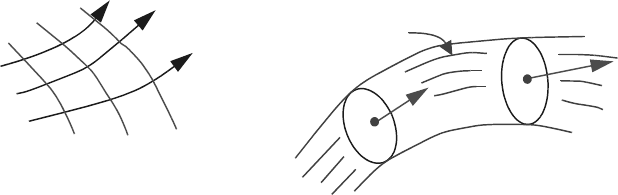
(Fig. 1.17). Oftentimes many field lines are combined to form flux pipes
(Fig. 1.18). There are no sources in the charge-free space.
or
.
r
mr
··
QE=
r
·
mr
··
r
·
• QEr
·
•=
td
d
1
2
---
mr
·
2
Q
td
dϕ
–=
td
d
1
2
---
mr
·
2
Qϕ+0=
1
2
---
mr
·
2
Qϕ+ const =
r
0
r
·
v 0== ϕ
0
1
2
---
mv
2
Qϕ+ Qϕ
0
=
v
2Q
m
-------
ϕ
0
ϕ–()
2Q
m
-------
V ==
ϕ
ds
dϕ E ds•–0==
Esd E
D∇• 0=
D dA•
∫
°
0=
22 Maxwell’s Equations
If one applies this onto a piece of the flux pipe, one obtains:
.
For the outer surface (skin) the relation is
.
One finds thus
.
This means for an infinitesimally small cross-section, if the surface elements are
perpendicular to the fields, that:
.
or
.
If the field components depend on the location
then the equations for the field lines can be obtained from the differential equations
.
1.9 The Electric Current and Ampere’s Law
The discovery of electric forces between electrically charged bodies has led to the
previously discussed electrostatic concepts. Besides those, another type of force
Fig. 1.18 Flux pipe
D
2
D
1
A
2
A
1
outer surface
Fig. 1.17 Equipotential
surface
ϕ=ϕ
1
ϕ=ϕ
2
ϕ=ϕ
3
E
E
E
D dA•
∫
°
D dA•
A
1
∫
°
D dA•
outer
surface
∫
°
D dA•
A
2
∫
°
++0==
D dA• 0=
D dA•
A
1
∫
°
D dA•
A
2
∫
°
+0=
D
1
dA
1
– D
2
dA
2
+0=
D
1
D
2
------
A
2
A
1
------=
E
x
E
x
xyz,,()=
E
y
E
y
xyz,,()=
E
z
E
z
xyz,,() , =
E
x
:E
y
:E
z
dx:dy:dz=
1.9 The Electric Current and Ampere’s Law 23
has been known for a long time, the so-called magnetic force, whose close
relationship to the electric forces is a rather late discovery.
The earth, for instance, is surrounded or penetrated by a strange field, which
expresses itself by exerting forces on specific materials. This field or those forces,
respectively, have peculiar characteristics. For instance, they exhibit a force on a
magnetic needle by trying to align it into a specific direction, while they exert no or
only a minor net force on the needle as a whole. The primary effect is a torque and
to a lesser degree net forces, which may even vanish entirely.
Historically, these phenomena were explained in terms of “magnetic
charges”, which were thought to be located in the magnetic poles of a magnet. This
linguistic use is more confusing than helpful, and we will not introduce these
concepts here in this way. Magnetic forces are – as much as we know today – of a
different kind, as electrostatic ones which we have dealt with so far. We will refrain
from using this only seemingly apparent analogy that suggests magnetic fields as
the result of magnetic charges. Based on our current knowledge, there are no
magnetic charges. The cause of magnetic fields is rather an electric current, i.e.
moving electric charges. By experiment, one finds that a current carrying wire in
the vicinity of a magnetic needle exhibits a magnetic field that influences the
needle. Before we study this in more detail, we have to define the electric current
and electric current density. Observe an infinitesimal area element that is
perpendicular to the flow of the charge and through which in the time interval
flows the charge . Then the vector of the current density is defined as
(1.53)
The flux of through a surface A is the electric current I.
(1.54)
This means that I is the total charge that flows through the surface per unit of time.
There are materials, within which charges can move freely, the so-called
conductors. This is in distinction to insulators, where this is not possible under
normal conditions (or only to a very limited extend). Thus, a current may flow in a
conductor. It is then surrounded by a magnetic field. The simplest case is for a
straight and infinitely long wire. In this case, one finds that the force on a needle of
a compass is inversely proportional to its distance to the wire (that is, with
increasing distance it decreases by 1/r) and that the magnetic needle orients itself in
a tangential way along concentric circles that surround the wire (Fig. 1.19).
To describe this situation one introduces the so-called magnetic field intensity H.
The accompanying field surrounds the infinitely long, straight wire in the shape of
closed loops. We will calculate the integral for any such closed loop. First
one determines the case when the loop does not enclose the wire, i.e. the current I.
As we found already before, it is possible to reduce those integrals to ones of the
form as shown in Fig. 1.20.
dA
dt
d
2
Q
g
d
2
Q
dtdA
------------
dA
dA
-------
=
g
I g dA⋅
A
∫
d
2
Q
dt
----------
A
∫
d
dt
-----
dQ
A
∫
dQ
dt
-------
====
H ds•
∫
°