
Lehner G. Electromagnetic Field Theory for Engineers and Physicists
Подождите немного. Документ загружается.

554 Numerical Methods
.
(8.190)
One proceeds in a strictly formal fashion, in order to highlight the analogy to the
case of triangular finite elements. For the i-th finite element, let
,
(8.191)
where
.
(8.192)
Therefore
,
(8.193)
and
with
, ,
(8.194)
where obviously
.
(8.195)
These relations are analogous to eqs.(8.180) through (8.188), which we have
discussed for the triangles. The form functions (8.194) represents local coordinates
in the i-th element, just as the triangle coordinates do for the triangular finite
element. Next, one finds an approximation for the Poisson equation
(8.196)
with the boundary conditions
, .
(8.197)
This requires to minimize the integral
.
(8.198)
The part stemming from the i-th finite element is
x
i 1–
xx
i
,≤≤ x
i
x
i 1–
– h=
ϕ abx ,+= x
i 1–
xx
i
≤≤
ϕ
i 1–
abx
i 1–
+=
ϕ
i
abx
i
+=
a
ϕ
i 1–
x
i 1–
ϕ
i
x
i
1 x
i 1–
1 x
i
---------------------------------
x
i
ϕ
i 1–
x
i 1–
ϕ
i
–
h
---------------------------------------==
b
1 ϕ
i 1–
1 ϕ
i
1 x
i 1–
1 x
i
-------------------------
ϕ
i
ϕ
i 1–
–
h
-----------------------==
ϕ f
i1
ϕ
i 1–
f
i2
ϕ
i
+=
f
i1
x
i
x–
h
------------= f
i2
xx
i 1–
–
h
--------------------=
f
i1
x
i 1–
()1 ,= f
i2
x
i 1–
()0 ,= f
i1
f
i2
+1=
f
i1
x
i
() 0 ,= f
i2
x
i
() 1= , f
i1
x
i 1–
f
i2
x
i
+ x=
∇
2
ϕ gx()– ,= x
0
xx
n
≤≤
ϕ x
0
() ϕ
0
= ϕ x
n
() ϕ
n
=
I ϕ' x()[]
2
2ϕ x()gx()–{}xd
a
b
∫
=
8.7 Finite Elements Method 555
(8.199)
where
.
(8.200)
Minimization of this, results in the following parts:
.
(8.201)
The corresponding coefficient matrix is called element matrix. Collecting all
contributions of all finite elements gives the overall matrix of the linear system of
equations which, ultimately will need to be solved.
Now, we choose , and . The exact solution in this
case is
.
(8.202)
For the present case, one has
,
(8.203)
and
, .
(8.204)
Ultimately, one obtains the following equations for :
.
(8.205)
Eq. (8.204) yields
(8.206)
and the equation system (8.205) takes on the form
.
(8.207)
Its solution is
I
ϕ
i 1–
h
------------–
ϕ
i
h
-----+
2
2f
i1
gx()ϕ
i 1–
–2f
i2
gx()ϕ
i
–
xd
x
i 1–
x
i
∫
=
1
h
---
ϕ
i 1–
2
2ϕ
i 1–
ϕ
i
– ϕ
i
2
+()2G
i1
ϕ
i 1–
–2G
i2
ϕ
i
–=
G
i12,
f
i12,
x()gx()xd
x
i 1–
x
i
∫
=
∂I
∂ϕ
i 1–
--------------- 2
ϕ
i 1–
h
------------
ϕ
i
h
-----– G
i1
–
=
∂I
∂ϕ
i
-------- 2
ϕ
i 1–
h
------------–
ϕ
i
h
----- G
i2
–+
=
x
0
0= x
n
1= gx() x=
ϕϕ
0
ϕ
n
ϕ
0
–()x
xx
3
–
6
--------------++=
x
i
i
n
---= h
1
n
---=
G
i1
3i 2–
6n
2
--------------= G
i2
3i 1–
6n
2
--------------=
i 1 … n 1–,,=
∂I
∂ϕ
i
-------- 2
ϕ
i 1–
h
------------–
2ϕ
i
h
--------
ϕ
i 1+
h
------------– G
i 11,+
– G
i2
–+
0==
G
i 11,+
G
i2
+
3i 32–3i 1–++
6n
2
-------------------------------------------
i
n
2
-----==
ϕ
i 1–
–2ϕ
i
ϕ
i 1+
–+
i
n
3
-----=
556 Numerical Methods
.
(8.208)
At the nodal points, this coincides with the exact solution. The form function is
used to interpolate in between the nodes. Comparison with eq. (8.162) shows that
for the present case, the finite difference method would have yielded the same
difference equations (8.207).
Despite its simple nature, this example exhibits the steps for applying finite
elements.
a) Partitioning the region into finite elements.
b) For every finite element, approximate the function as a linear combination of
the form functions, where the values of the functions at the nodal points are
expressed as coefficients.
c) Determine the element matrix by evaluating the occurring integrals (which
may require numerical methods).
d) The overall matrix is compiled from the element matrices. This step is poten-
tially complicated. Sound indexing is paramount, in particular, in case of
multi-dimensional problems and finite elements with many nodes.
e) Finally, the system of equations needs to be solved. The same methods can be
used as already partly addressed in Sect. 8.6, presenting finite differences.
Despite its flexibility, finite elements (and also finite differences) are not suitable
for problems involving infinite regions that include the external Dirichlet or
Neumann boundary value problems. Oftentimes one uses finite regions, which has
the disadvantage of introducing errors that are difficult to estimate because the
boundary conditions on those artificially introduced boundaries are unknown and
can only be estimated. An option is to tackle the problem by introducing so-called
infinite elements. Two different approaches were taken so far in this respect. On
one hand, one uses exponentially decaying form functions whereby a suitable
exponent has to be chosen. On the other hand, one transforms the infinite elements
by a suitable transformation onto finite elements. So far, it remains an open
question whether the use of infinite elements leads to satisfactory results. In any
case, problems involving infinite regions can be solved by means of the boundary
element method, which we will discuss in the next section. For this method, the
distinction between finite or infinite regions is insignificant. For many problems, to
couple both methods is beneficial, where the finite elements are used inside a
region and compatible boundary elements are then used on the outside boundary of
this arbitrary region.
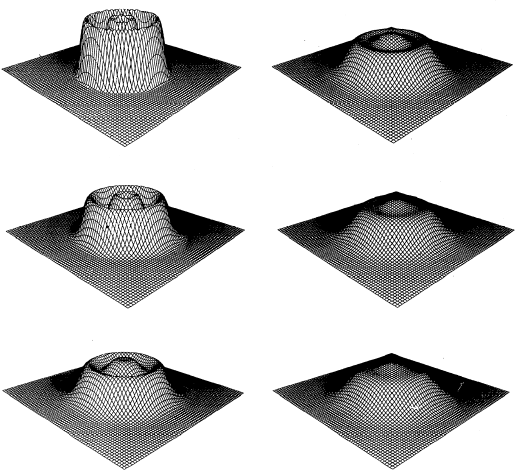
Fig. 8.14 presents the results of a diffusion problem that was solved with
finite elements. It represents a rotationally symmetric magnetic field .
Shown is the initial field and the fields for the dimensionless times ;
; ; . Comparison with the known analytic solution of the problem
shows that the relative error of the presented numerical solution is .
ϕ
i
ϕ
0
ϕ
n
ϕ
0
–()
i
n
---
n
2
ii
3
–
6n
3
------------------++=
B
z
r τ,()
τ 01,=02,
03, 04, 05,
2.38 10
4–
⋅<
8.8 Method of Boundary Elements 557
8.8 Method of Boundary Elements
The Method of Boundary Elements is the most recent of the important numerical
methods; a method, particularly interesting for electromagnetic field theory and
virtually taylor made for many field theoretical problems. The reason is, that it
emerges directly from the integral equations of field theory when discretizing
them. It is valuable in both cases, as an independent method, as well as a
supplement to the finite element method. An in-depth descriptions can be found in
Brebbia or Brebbia, Telles, and Wrobel [28, 29].
Starting with the integral equations presented in Sect. 8.2 (or their
corresponding integral equations for magnetostatic or time dependent problems),
we will initially study only the surfaces (boundaries) of the observed regions.
Solving these integral equations, initially only for the boundaries, yields the
quantities by which the field of the finite or infinite region (this does not make any
difference here) can be calculated, as described in Sect. 8.2. Sometimes a
distinction between direct or indirect methods is made. The direct methods are
based on eqs. (8.1) and (8.2), (8.6), and (8.7) or (in the trivial one-dimensional
case) (8.16) and (8.17), while the indirect methods are based on equations of the
type (8.11) through (8.14).
F
ig. 8.14
τ = 0
τ = 0.1
τ = 0.3
τ = 0.4
τ = 0.5τ = 0.2
558 Numerical Methods
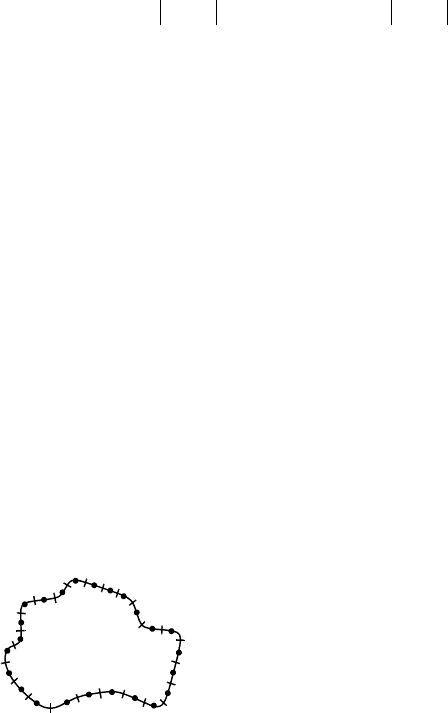
Discretization is achieved by partitioning the boundaries in surface elements
or (in the two dimensional case) into line elements, which may be chosen in many
different ways. The unknowns (that is ϕ or in case of the direct methods,
and surface charge σ or area density τ of the dipole moments in case of the indirect
methods) are expressed on the boundary elements by trial functions with different
form functions. In the simplest case, they are assumed constant on the boundary
element. In the two-dimensional case, for instance, one may proceed as illustrated
in Fig. 8.15 The boundary elements are here line elements on the boundary curve.
The values at the center of each element are assumed to be constant, i.e. there is
only one node per element (the so-called “constant element”).
With , and for example for the Laplace equation (i.e. when ), from
eq. (8.7), the potential on the boundary elements i () yields
.
(8.209)
The result of evaluating these integrals (which each has to be calculated on the
boundary elements referenced by ) is a linear system of equations of the form:
,
(8.210)
or in matrix form
,
(8.211)
where and represent the column vectors of the n values and
, respectively and
, .
(8.212)
The term on the left side of eq. (8.209) is included in . The system of
equations (8.211) is initially homogeneous with respect to the 2n quantities ϕ
k
and
. In any case, half of these quantities are given (for example, in case of
the mixed boundary value problem n
1
of the values ϕ
k
and n
2
of the values
, where ). The remaining n quantities are unknown and
need to be determined by solving this system of equations. Once the unknowns are
determined, the potential may be calculated by means of eq. (8.6) at specific
gridpoints within the entire region.
∂ϕ ∂n⁄
Fig. 8.15
C π= ρ 0=
i 1…n=
πϕ
i
∂ϕ
∂n
------
k
r
i
r
k
–ln s
k
'd
S
k
∫
k 1=
n
∑
– ϕ
k
∂
∂n'
-------
r
i
r
k
–ln s'd
S
k
∫
k 1=
n
∑
+=
S
k
A
ik
∂ϕ
∂n
------
k
k 1=
n
∑
B
ik
ϕ
k
k 1=
n
∑
+0 ,= i 1 … n,,=
A
∂j
∂n
------
Bj+0=
j ∂j ∂n⁄ϕ
k
∂ϕ ∂n⁄()
k
A A
ik
()= B B
ik
()=
πϕ
i
B
ii
∂ϕ ∂n⁄()
k
∂ϕ ∂n⁄()
k
nn
1
n
2
+=
8.8 Method of Boundary Elements 559
Similarly, one might start from eqs. (8.11) and (8.12) and write them in the
following form:
,
(8.213)
where represents the column vector of the n values σ
k
and
, .
(8.214)
Again, n of the 2n quantities ϕ
i
and are given. From the 2n equations,
one selects the corresponding n equations and solves for the values σ
k
. This allows
to calculated ϕ at any point of the entire region.
The boundary element method is similar to the finite element method in the
sense that at the boundary elements, trial functions similar to those used for finite
elements are chosen by suitable form functions. The difference is that the weight
functions are different. Indeed, the Boundary Element Method can be regarded as a
special case of the method of weighted residuals, where the fundamental solution
of the potential theory plays the role of the weight functions. More on this can be
found in Brebbia, Telles, and Wrobel [29]. Thus, the various methods are
somewhat interrelated. One distinguishes hereby the different formulations of the
problem to be solved. For instance, in case of the Laplace equation, the residual
of the unknown function ϕ and the weight function ψ occurs. Integrating by parts
once, by means of Green’s integral theorem, one obtains – except for boundary
integrals – the so-called weak formulation of the problem with the integral
.
and a second integration by parts gives the so-called inverse formulation with the
integral
.
One should not read too much into this terminology. Nevertheless, it is remarkable
and sometimes useful to realize that at each of these steps, the trial function ϕ has
one derivative less and the weight functions requires one derivative more. Besides,
as examples in applying these formulations, one can recognize the method of the
variational integrals in the weak formulation, and in the inverse formulation, that of
the Boundary Value Method. Other weight functions are possible in case of all
three formulations. For instance, if in case of the inverse formulation, the basis and
weight functions are identical, then one obtains the so-called Trefftz method, which
shall not be covered here.
j C
ik
σ
k
k 1=
n
∑
Cs==
∂j
∂n
------ D
ik
σ
k
k 1=
n
∑
Ds==
s
C C
ik
()= D D
ik
()=
∂ϕ ∂n⁄()
i
R ψ∇
2
ϕτd
V
∫
=
∇ψ ∇ϕ•τd
V
∫
ϕ∇
2
ψτd
∫
560 Numerical Methods
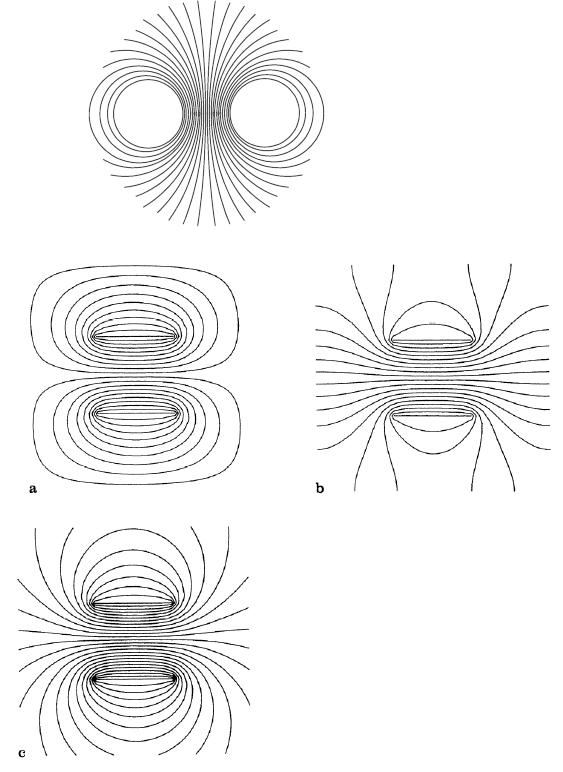
Fig. 8.16 shows the equipotential lines of two parallel conducting cylinders of
potential , calculated with the Direct Boundary Value Method. One obtains
the expected result, namely the circles of Apollonius, which was already calculated
in Sections 2.6.3 and 3.12. This represents a plane problem which was solved by
using eqs. (8.6) and (8.7).
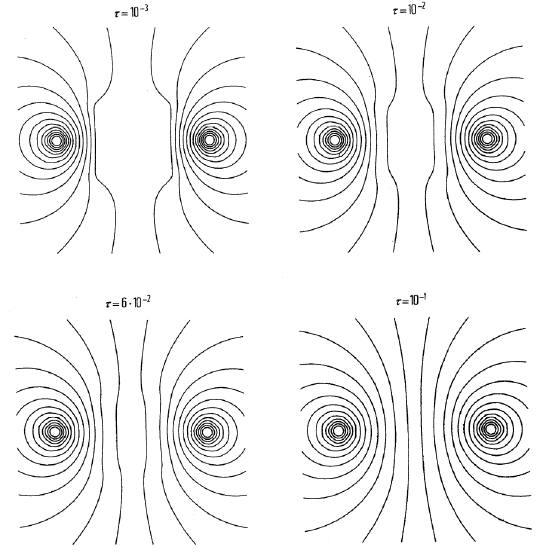
Fig. 8.17 and Fig. 8.18 present fields which were calculated by coupling of
finite elements and boundary elements. Fig. 8.17 demonstrates the advantage of
this approach when applied to problems in finite regions versus the use of solely
using finite elements. If only finite elements are used, then the problem is solved
by approximation in a region that has to be chosen not too small but finite, and on
Fig. 8.16
ϕ
o
±
Fig. 8.17
8.8 Method of Boundary Elements 561
its boundaries one has to, more or less arbitrarily, choose (roughly estimated)
boundary conditions. The equipotential lines in Fig. 8.17a and Fig. 8.17b were
calculated by only applying finite elements. Fig. 8.17a used and Fig. 8.17b
used on the boundary. In contrast, Fig. 8.17c was obtained by
coupling of finite elements and boundary elements, and it obviously delivers the
much better results. The fields of Fig. 8.18 were also calculated by means of the
coupled method. It represents an eddy current problem. There are two infinitely
long wires, carrying a time independent constant current whose magnetic field
penetrates an also infinitely long non-magnetic, conducting cylinder of square
cross section. Fig. 8.18 shows the magnetic field shortly after suddenly turning on
the current, i.e., at the dimensionless time . The remaining illustrations
show the field at , , and . Already for ,
the final state is almost reached. The plots of the fields for times greater than
can hardly be distinguished. The two problems of Fig. 8.17 and
Fig. 8.18 were calculated by use of the so-called direct method while considering
eqs. (8.6) and (8.7). Of course, when coupling, the boundary elements on the
boundary, have to be chosen such that they are always compatible with those sides
of the finite elements which form the boundary and in particular, that they agree at
the nodal points.
ϕ 0=
∂ϕ ∂n⁄ 0=
Fig. 8.18
τ 10
3–
=
τ 10
2–
= τ 610
2–
⋅= τ 10
1–
= τ 10
1–
=
τ 10
1–
=
562 Numerical Methods
8.9 Method of Image Charges
The Method of Image Charges is oftentimes suited to solve field theoretical
problems. This is initially motivated by a number of specific problems, which may
even be solved exactly by use of the image charge method, for example, the
problem of a sphere within the field of a point charge or within a uniform field
(sects. 2.6.1 and 2.6.2), the problem of a conducting cylinder within the field of a
uniform line charge (Sect. 2.6.3), or that of a point charge in a dielectric half-space
(Sect. 2.11.2). Analogous procedures exist as well for the case of stationary electric
current fields (e.g., Sect 4.5), in magnetostatics (e.g. Sect. 5.9), and for time
dependent problems (e.g. Sect. 6.5.3).
For electrostatics, the perhaps most general statement on this subject is
contained in Kirchhoff’s theorem eq. (3.57), which is important in many respects.
It states, among other things, that the fields inside an arbitrarily shaped region,
generated by an arbitrary charge distribution located outside this region, can also
be generated by placing suitable surface charges and dipole layers on the surface of
this region and vice versa. The consequence is that boundary value problems can
be treated as if the fields within the region of interest were generated by
appropriately distributed charges outside of the region. These charges may occur in
arbitrary configurations and form dipoles or more generally multipoles (as for
example, for the case of a conducting sphere inside an electric field where two
image charges occur, which form an ideal dipole). One should not interpret the
term image charges to narrowly. It may represent arbitrary distributions of point
charges, line charges, volume charges, or even an arbitrary distribution of
multipoles.
Usually, one determines the assumed image charges by satisfying the given
boundary conditions at selected points of the surface, i.e., one uses the Collocation
Method, perhaps in its overdetermined form. Therefore, the Method of the
Weighted Residuals is ultimately where the potentials or the fields of the image
charges represent the basis functions. Of course the Collocation Method could be
replaced by other methods, like that of the least squares. However, the Collocation
Method has the big advantage that it avoids potentially tedious integrations. If one
attaches all image charges to the surface in form of surface charges, then the
boundary element method emerges. This shows that the distinction between the
methods is somewhat fuzzy.
The main problem of the various variants of image charge methods is that
there is no clear methodological approach for their application. The user needs
experience and good intuition for the peculiarities of the particular problem in
order to determine the kind, and location of the image charge configuration. Once
this is done, the remaining task is simple, particularly when using the collocation
method. Consider n image charges, then the Ansatz, for example when using
potentials, is
8.10 Monte-Carlo Method 563
.
(8.215)
r
k
is the location where the k-th image charge is located, is the potential
of the unit charge (unit multipole), and M
k
is the charge (multipole moment). If one
has Dirichlet boundary condition
(8.216)
to be fulfilled on the surface A, then one needs to choose (at least) n collocation
points . This results in the system of equations
(8.217)
or with
,
(8.218)
. (8.219)
The values of M
k
have to be calculated from this system of equations. This
approximation may not satisfy the given requirements. There are a number of ways
to improve the solution. For instance, the number of image charges could be
increased. Particularly, repeating the calculation with changed image charge
locations may significantly improve the result. Another option is to not only
consider the coefficients M
k
to be variable, but also the locations r
k
and then
determine them by means of the collocation method. However, the big
disadvantage of this approach is that the system of equations becomes non-linear.
Overall, it is questionable whether the image charge method will be of great
significance in the future. Although there are a number of problems for which it is
suitable, in general however, in particular the boundary element methods are
theoretically better founded and represent a methodologically clearer path for the
solution of such problems.
8.10 Monte-Carlo Method
The Monte-Carlo method is particularly suited for stochastic problems, which we
will not discuss here. But it may as well be used to solve deterministic problems,
for example to calculate definite integrals, for the solution of extrema problems, to
solve linear systems of equations, etc. In the context of electromagnetic field
theory, the Monte-Carlo method can be used to approach boundary value problems
involving the Laplace and Poisson equation, as well as, boundary and initial value
ϕϕ
k
rr
k
,()M
k
k 1=
n
∑
=
ϕ
k
rr
k
,()
ϕ f r
A
()=
r
Ai
, i 1 … n,,=()
ϕ
k
r
Ai
r
k
,()M
k
k 1=
n
∑
f r
Ai
() ,= i 1 … n,,=
ϕ
k
r
Ai
r
k
,()a
ik
,= f r
Ai
() f
i
=
A a
ik
() ,= M
M
1
…
M
n
,= f
f
1
…
f
n
=
AM f=