
Lehner G. Electromagnetic Field Theory for Engineers and Physicists
Подождите немного. Документ загружается.


524 Numerical Methods
(8.81)
and the associated variational integral for homogeneous boundary conditions is
.
(8.82)
This integral is homogeneous in u, i.e. the solution to the variational problem is
specified up to a constant. When dividing eq. (8.82) by (N is constant), one
obtains
.
(8.83)
Here we have the functional F:
,
(8.84)
which was introduced for two-dimensional problems in Sect. 7.11, eq. (7.452). One
can show that minimizing the integral (8.82) leads to the same result as that of the
functional (8.84).
Next, we will analyze the two-dimensional problem of a wave in a rectilinear
wave guide, where, because of its separability, we limit the discussion to one
spatial coordinate.
a) We start with the Dirichlet boundary value problem using the Ansatz
(8.85)
which satisfies the homogeneous boundary conditions
, .
(8.86)
This represents a TM wave. We could use the same Ansatz for the y-depen-
dency. Both functions and exhibit the qualitative characteristics that
can be expected from the eigenfunctions which belong to the two lowest
eigenvalues: no zero or one zero, respectively within the range .
Using the integrals
,
(8.87)
the integral (8.82) becomes
.
(8.88)
∇
2
uNu+0=
I ∇u()
2
Nu
2
–[]τd
V
∫
=
u
2
τd
∫
I
I
u
2
τd
∫
--------------
∇u()
2
τd
∫
u
2
τd
∫
----------------------- N–
u∇
2
u τd
∫
u
2
τd
∫
----------------------– N–== =
F
u∇
2
u τd
∫
u
2
τd
∫
----------------------–=
ux() c
1
ϕ
1
c
2
ϕ
2
+ c
1
x 1 x–()c
2
x
1
2
--- x–
1 x–()+==
u 0() 0= u 1() 0=
ϕ
1
ϕ
2
0 x 1<<
ϕ
1
2
x()xd
0
1
∫
1
30
------
,= ϕ
2
2
x()xd
0
1
∫
1
840
---------=
ϕ'
1
2
x()xd
0
1
∫
1
3
---
,= ϕ'
2
2
x()xd
0
1
∫
1
20
------=
ϕ
1
x()ϕ
2
x()xd
0
1
∫
0 ,= ϕ'
1
x()ϕ'
2
x()xd
0
1
∫
0=
Ic
1
2
1
3
---
N
30
------–
c
2
2
1
20
------
N
840
---------–
+=

8.3 Boundary Value Problems as Variational Problems 525
One obtains
.
(8.89)
These simple equations rest on the fact that and are orthogonal to each
other, as eqs. (8.87) reveal. This allows the eigenvalue equation to be diago-
nalized immediately and, thus, becomes trivial to solve. One obtains two
eigenvalues. Either
or .
(8.90)
The exact eigenfunctions and eigenvalues are known (see Sect. 7.8.1)
with
(8.91)
and
with
(8.92)
The values calculated by approximation are always too large (N
1
by about
1.3% and N
2
by about 6.4%). When choosing c
1
and c
2
such that
then is approximated by
and by . Better approximations yield more accurate (i.e.
smaller) eigenvalues.
b) Now we attempt to improve the lowest eigenvalue. For this purpose, we
choose a more flexible Ansatz
(8.93)
and with
,
(8.94)
one obtains
,
(8.95)
which gives
c
1
∂
∂I
2c
1
1
3
---
N
30
------–
0==
c
2
∂
∂I
2c
2
1
20
------
N
840
---------–
0==
ϕ
1
ϕ
2
NN
1
10== c
1
arbitrary c
2
0=
NN
2
42== c
2
arbitrary c
1
0=
πx()sin N
1
π
2
9.8696…==
2πx()sin N
2
4π
2
39.4784…==
ϕ
1
1
2
---
ϕ
2
1
4
---
1== 2πx()sin
64
3
------
x
1
2
--- x–
1 x–()
πx()sin 4x 1 x–()
ux() c
1
ϕ
1
c
2
ϕ
2
+ c
1
x 1 x–()c
2
x
2
1 x–()
2
+==
ϕ
1
2
x()xd
0
1
∫
1
30
------
ϕ
2
2
x()xd
0
1
∫
1
630
---------=,= , ϕ
1
x()ϕ
2
x()xd
0
1
∫
1
140
---------=
ϕ'
1
2
x()xd
0
1
∫
1
3
---
ϕ'
2
2
x()xd
0
1
∫
2
105
---------=,= , ϕ'
1
x()ϕ'
2
x()xd
0
1
∫
1
15
------=
Ic
1
2
1
3
---
N
30
------–
2c
1
c
2
1
15
------
N
140
---------–
c
2
2
2
105
---------
N
630
---------–
++=
526 Numerical Methods
.
(8.96)
Non-trivial solutions exist only if the determinant of the coefficients vanishes.
This results in a quadratic equation for the eigenvalues N, with the two solu-
tions:
.
We are only interested in the smaller eigenvalue
,
(8.97)
which is a rather close approximation to the exact value .
The ratio of the coefficients becomes
,
(8.98)
which is, when normalized for , the eigenfunction to the lowest
eigenvalue
.
(8.99)
c) Next for the TE wave we, choose a different trial function:
.
(8.100)
This gives
(8.101)
and
c
1
∂
∂I
2c
1
1
3
---
N
30
------–
2c
2
1
15
------
N
140
---------–
+0==
c
2
∂
∂I
2c
1
1
15
------
N
140
---------–
2c
2
2
105
---------
N
630
---------–
+0==
N 56 2128± 56 46.13025038±==
N 9.869749622=
π
2
9.86960…=
c
2
c
1
-----
1
3
---
N
30
------–
1
15
------
N
140
---------–
--------------------- 1 . 1 3 3140==
x 12⁄=
u 3.117000… x 1 x–()1.133140 x
2
1 x–()
2
⋅+[]⋅=
ux() ABxCx
2
Dx
3
++ +=
IB
2
4
3
---
C
2
9
5
---
D
2
2BC 2BD 3CD+++ + +
=
– NA
2
1
3
---
B
2
1
5
---
C
2
1
7
---
D
2
+++
+ AB
2
3
---
AC
1
2
---
AD
1
2
---
BC
2
5
---
BD
1
3
---
CD+++++
8.3 Boundary Value Problems as Variational Problems 527
(8.102)
The eigenvalue equation is of Order 4. However, by inspection, one can see
immediately that is an eigenvalue. Furthermore, one can find that
another eigenvalue is . This leaves a quadratic equation with the
remaining two eigenvalues
.
We are interested in the lower one
.
(8.103)
The eigenfunction corresponding to the eigenvalue is
,
(8.104)
where A is arbitrary. This represents the trivial solution of the Neumann
boundary value problem, an important result for TE
01
or TE
10
waves.
The eigenfunction corresponding to the eigenvalue , when
normalized for is
.
(8.105)
Of course, the eigenfunctions u
0
and u
1
are orthogonal to each other.
In our example, we have not imposed any boundary conditions. Thus, we
obtain solutions which approximately satisfy the homogeneous Neumann
boundary conditions. ( ). This represents a TE wave.
The exact solution for u
1
is .
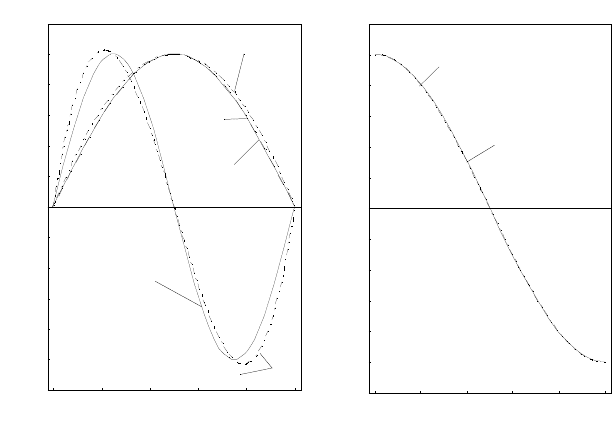
Fig. 8.1 compares the functions
and according to eq. (8.85), as well as
u(x) given in eq. (8.99) with and . Fig. 8.2 compares the
function as of eq. (8.105) with . The difference between
and u(x) as of eq. (8.99) is so small that it is hardly visible in Fig. 8.1. Similarly, the
difference between and by eq. (8.105) is also so small that it is just
recognizable in Fig. 8.2.
A∂
∂I
N 2AB
2
3
---
C
1
2
---
D++ +
–0==
B∂
∂I
2B 2C 2DNA
2
3
---
B
1
2
---
C
2
5
---
D+++
–++ 0==
C∂
∂I
2B
8
3
---
C 3DN
2
3
---
A
1
2
---
B
2
5
---
C
1
3
---
D+++
–++ 0==
D∂
∂I
2B 3C
18
5
------
DN
1
2
---
A
2
5
---
B
1
3
---
C
2
7
---
D+++
–++ 0 .==
N
0
0=
N 60=
N 90 6420±=
N
1
9.87509750…=
N
0
0=
u
0
A=
N
1
9.87509750=
x 0=
u
1
6.45533624 0.15491059 0.02351213 xx
2
2
3
---
x
3
+–⋅+
⋅=
u
1
'0() u
1
'1() 0.157==
πxcos
ϕ
1
4x 1 x–()= ϕ
2
64
3
------
x
1
2
--- x–
1 x–()=
πx()sin 2πx()sin
u
1
x() πx()cos πx()sin
πx()cos u
1
x()
528 Numerical Methods
8.4 Method of Weighted Residuals
The method of weighted residuals is a very general method for exact or
approximate solutions to all kinds of problems. This method is sometimes also
called the momentum method (even though this is also the name for a more
specific method).
Many problems can be stated in the form
.
(8.106)
L is initially an arbitrary linear operator, for example, a differential operator. If u is
an exact solution to eq. (8.106), then the residual is
.
(8.107)
If u is only an approximate solution, then the residual is
.
(8.108)
One might try to approximate u by a set of linear independent functions
.
(8.109)
This gives
.
(8.110)
0 0.2 0.4 0.6 0.8 1
-0.2
-0.4
-0.6
-0.8
-1
0
0.2
0.4
0.6
0.8
1
Fig. 8.2 Approx. vs. exact
u
1
x()
eq. (8.105)
πx()cos
0 0.2 0.4 0.6 0.8 1
-0.2
-0.4
-0.6
-0.8
-1
0
0.2
0.4
0.6
0.8
1
Fig. 8.1 Approx. vs. exact
ϕ
2
64
3
------
x
1
2
--- x–
1 x–()=
2πx()sin
πx()sin
ϕ
1
4x 1 x–()=
ux()
eq. (8.99)
Lu f=
RLuf–0==
RLuf–0≠=
ϕ
i
uc
i
ϕ
i
i 1=
n
∑
=
Rc
i
Lϕ
i
()
i 1=
n
∑
f–=
8.4 Method of Weighted Residuals 529
The approximation is better, the smaller R is. In general, R is a function of space.
The strategy is to analyze appropriately chosen averages of R in order to determine
criteria that allow one to find the best coefficients c
i
, such that the functions ϕ
i
in
eq. (8.109) – the so-called basis functions – yield the desired approximation. The
method of weighted residuals consists of defining at least n so-called weight
functions w
k
, whereby the mean values of the so formed integrals must vanish
when integrating over the entire volume:
.
(8.111)
If the number of basis functions is equal to the number of weight functions, then
one obtains n linearly independent equations which determine the n coefficients c
i
.
If the number of weight functions is larger, then the solution is overdetermined, and
it may be inconsistent and is initially not solvable (if, indeed, the equations are
linearly independent). In this case, as in curve fitting, the method of least squares is
employed to find the best fitting coefficients.
Various variants of this method exist. The basis and weight functions may be
identical, which leads to the Galerkin method. If the weight functions are the
eigenfunctions of the given operator and they form a complete set of basis
functions, then one obtains the usual representation of the solution by expanding
them with respect to these functions (as was presented in detail in Chapter 3). With
the exception of the Monte-Carlo method, all the numerical methods which we will
discuss subsequently can be regarded as special cases of the method of weighted
residuals.
A few specific methods shall now be described briefly.
8.4.1 Collocation Method
The δ-functions can also serve as weight functions. This has the advantage that it
makes the integration trivial, which otherwise can be difficult at times. One obtains
a system of equations, which lets the residual exactly vanish at the so-called
collocation points, however, not at all other points. Usually, the number of δ-
functions and thereby the number of collocation points is the same as the number
of basis functions. If this number is larger, it is called an overdetermined
collocation. An approximation method frequently used in field theory, the so-called
image method or method of virtual charges, is (including various generalizations
and modifications) a typical collocation method.
The procedure shall be demonstrated by means of a simple example.
Consider the one-dimensional Poisson equation
(8.112)
with Dirichlet boundary conditions
.
(8.113)
Its exact solution is easy to find
Rw
k
τd
V
∫
c
i
w
k
Lϕ
i
τd
V
∫
i 1=
n
∑
w
k
f τd
V
∫
–0==
∇
2
ux() x
2
=0x 1≤≤
u 0() u 1() 0==
530 Numerical Methods
.
(8.114)
Now one uses an approximation consisting of two basis functions
.
(8.115)
Both satisfy the boundary conditions. The residual is
.
(8.116)
The parameters c
1
and c
2
are determined by collocation at the two points
and :
that is
therefore
and
.
(8.117)
If one chooses the three collocation points , then
one gets three equations for c
1
and c
2
:
(8.118)
We minimize the sum over the error squares (least error squares),
.
Differentiating this with respect to c
1
and c
2
gives two equations
ux()
x 1 x
3
–()
12
----------------------–=
ux() c
1
x 1 x–()c
2
x
2
1 x–()+=
Rx() ∇
2
ux
2
–2c
2
c
1
–()6c
2
xx
2
––==
x
1
13⁄= x
2
23⁄=
Rx()δx
1
3
---–
xd
0
1
∫
R
1
3
---
2 c
2
c
1
–()2c
2
–
1
9
---–0== =
Rx()δx
2
3
---–
xd
0
1
∫
R
2
3
---
2 c
2
c
1
–()4c
2
–
4
9
---–0== =
2c
1
–0c
2
+
1
9
---=
2c
1
–2c
2
–
4
9
---=
c
1
1
18
------
,–= c
2
1
6
---–=
ux()
x 1 x–()13x+()
18
----------------------------------------–=
x
1
14⁄= x
2
12⁄= x
3
34⁄=,,
2c
1
–
1
2
---
c
2
+
1
16
------=
2c
1
–1c
2
–
1
4
---=
2c
1
–
5
2
---
c
2
–
9
16
------
.=
2c
1
–
1
2
---
c
2
1
16
------
–+
2
2c
1
– c
2
–
1
4
---
–
2
2c
1
–
5
2
---
c
2
–
9
16
------
–
2
++ min=
8.4 Method of Weighted Residuals 531
(8.119)
Eqs. (8.119) can be obtained directly from (8.118) when employing matrix notation
,
(8.120)
and multiply this by the transposed coefficient matrix , i.e.,
.
(8.121)
Equation
is another representation of (8.119), which leads to
,
and
.
(8.122)
The matrix , encountered here is frequently used in curve fitting and is
sometimes called the half-inverse. More on this can be found in [18].
8.4.2 Method of Fractional Regions
With this method, the region is separated in several subregions V
i
, with the mandate
that the integrals over all subregions vanish
.
(8.123)
The weight functions are constant, but each one is non-zero in only one of the
regions. In our example, one chooses two regions, and
which gives
12c
1
6c
2
+
14
8
------–=
6c
1
15
2
------
c
2
+
13
8
------
.–=
A
c
1
c
2
2–12⁄
2–1–
2–52⁄–
c
1
c
2
116⁄
14⁄
916⁄
==
A
A
2–2–2–
12⁄ 1–52⁄–
=
AA
c
1
c
2
A
116⁄
14⁄
916⁄
=
c
1
c
2
AA()
1–
A
116⁄
14⁄
916⁄
536⁄ 19⁄–
19⁄–29⁄
14 8⁄–
13 8⁄–
==
c
1
116⁄–= c
2
16⁄–=
ux()
x 1 x–()38x+()
48
----------------------------------------–=
AA()
1–
A
R τd
V
i
∫
0 ,= i 1 …n,=
0 x 12⁄≤≤ 12⁄ x 1≤≤

532 Numerical Methods
that is
,
and
.
(8.124)
8.4.3 Momentum Method
In case of the momentum method (in the strict sense of the term), the factors
serve as weight functions, i.e., one defines
.
(8.125)
For our current example, with one obtains:
,
,
which results again in
, ,
and according to eq. (8.124).
8.4.4 Method of Least Squares
Another possibility is to apply the method of the least squares directly onto R. This
differs from the overdetermined collocation method. Then, the integral
(8.126)
needs to be minimized. For our example, this gives
and
Rxd
0
12⁄
∫
c
1
–
1
4
---
c
2
1
24
------–+0==
Rxd
12⁄
1
∫
c
1
–
5
4
---
c
2
–
7
24
------–0==
c
1
112⁄–= c
2
16⁄–=
ux()
x 1 x–()12x+()
12
----------------------------------------–=
x
0
x
1
…,,
Rx() x
i
⋅ xd
∫
0 i, 0 … n 1–,,==
n 2=
Rx()xd
0
1
∫
2c
1
– c
2
–
1
3
---–0==
Rx()xxd
0
1
∫
c
1
– c
2
–
1
4
---–0==
c
1
1
12
------
–= c
2
1
6
---–=
ux()
IR
2
τd
∫
=
I 4c
1
2
4c
1
c
2
4c
2
2
4
3
---
c
1
5
3
---
c
2
1
5
---+ ++++=
c
1
∂
∂I
8c
1
4c
2
4
3
---++ 0==

8.4 Method of Weighted Residuals 533
where
,
which again, now for the third time, yields the approximation solution eq. (8.124).
8.4.5 Galerkin Method
Of particular importance is the Galerkin method. Here, the basis and weight
functions are identical. The Galerkin method is equivalent to the Rayleigh-Ritz
method for the case of problems that can also be treated as variational problems;
i.e., see 8.3.1. It leads to the very important method of Finite Elements when
choosing special basis functions (see Sect. 8.7) .
For illustration purposes, we will focus on an already used example. Let
,
,
to obtain
,
that is
.
(8.127)
If one tackles the problem with the Rayleigh-Ritz method, then the integral to be
minimized is
and one obtains the same system of equations as above:
,
.
It should be easy to convince yourself that this is no coincidence, but that the
results always coincide.
As a further example, we will solve the above problem with the generalized
boundary conditions:
c
2
∂
∂I
4c
1
8c
2
5
3
---++ 0==
c
1
1
12
------–= c
2
1
6
---–=,
Rx()x 1 x–()xd
0
1
∫
1
3
---
c
1
–
1
6
---
c
2
–
1
20
------–0==
Rx()x
2
1 x–()xd
0
1
∫
1
6
---
c
1
–
2
15
------
c
2
–
1
30
------–0==
c
1
1
15
------–= c
2
1
6
---–=,
ux()
x 1 x–()25x+()
30
----------------------------------------–=
I
xd
du
2
2ux
2
+ xd
0
1
∫
1
3
---
c
1
2
2
15
------
c
2
2
2
1
6
---
c
1
c
2
1
20
------
c
1
1
30
------
c
2
++
++==
c
1
∂
∂I
2
1
3
---
c
1
1
6
---
c
2
1
20
------++
0==
c
2
∂
∂I
2
1
6
---
c
1
2
15
------
c
2
1
30
------++
0==