
Lehner G. Electromagnetic Field Theory for Engineers and Physicists
Подождите немного. Документ загружается.

564 Numerical Methods
problems of the diffusion equation. Although these problems are of deterministic
nature, they are also problems whose solutions coincide with certain expectation
values of suitable stochastic processes. An overview on Monte-Carlo methods give
the books of Hengartner and Theodorescu or Buslenko and Schreider [30, 31].
Here, we will initially analyze the Dirichlet boundary value problem of the
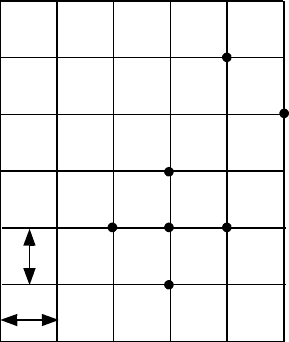
Laplace equation. To simplify, we choose a rectangular area as illustrated in
Fig. 8.19. The area is discretized by introducing little squares where the length of
the sides is h. Internal points are referenced by P and boundary points by Q. Let a
symmetric random walk start at point P
0
, as it was described in Sect. 8.5. For the
first step, each of the neighboring points is reached by the probability 1/4. This
process is repeated until the boundary point Q
i
is reached. This is where the
random walk ends, i.e., the particle is absorbed. Let be the
probability for a random walk that starts at P
j
and ends at Q
i
. Then the relation for
the points P
0
through P
4
drawn in Fig. 8.19 becomes
.
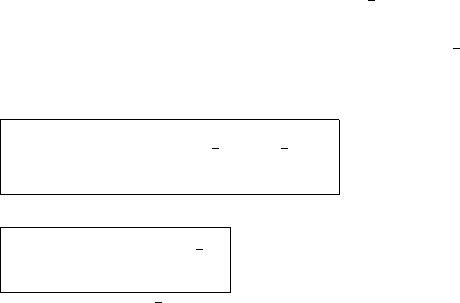
(8.220)
Furthermore, it must of course be:
.
(8.221)
The reason is that a particle is absorbed at a boundary point Q
i
. Now we define the
quantity
,
(8.222)
where s represents the total number of boundary points. Then, it follows from
(8.22) that
Fig. 8.19
P
1
P
4
P
3
P
2
P
0
h
h
P
j
Q
i
WP
j
Q
i
,()W
ji
=
WP
0
Q
i
,()
1
4
---
WP
1
Q
i
,()WP
2
Q
i
,()WP
3
Q
i
,()WP
4
Q
i
,()+++{}=
WQ
i
Q
j
,()δ
ij
,= WQ
i
P
j
,()0=
FP
j
() WP
j
Q
i
,()ϕQ
i
()
i 1=
s
∑
=

8.10 Monte-Carlo Method 565
(8.223)
and
.
(8.224)
These two equations establish the relation between the random walk and the
boundary value problem where F has to be identified with the potential. The result
is identical to the one obtained by applying finite differences. Eq. (8.223)
corresponds to the five-point formula (8.159) while (8.224) represents the
corresponding boundary conditions. On the other hand, one sees that the quantity
F, the potential, can be interpreted in a statistical way, that is, we could say it is a
result of rolling a dice. Let us start many random walks at every internal point, for
example at P
j
. They terminate with different probabilities at the different boundary
points Q
i
. which, in case of the Monte-Carlo method, are determined by a computer
almost experimentally by simulation of the random walk process. By eq. (8.222),
the potential at the point P
j
is nothing else than the average
,
(8.225)
obtained by using these probabilities. We may phrase this in a slightly different
manner. We start many random walks at P
j
and average the potentials of all
boundary points that were thereby reached. The i-th random walk ends at Q
i
with
ϕ
i
. Then
.
(8.226)
The Poison equation
(8.227)
may be treated in a similar manner. Here, we shall only provide the result:
.
(8.228)
r represents the number of all internal points, is the probability that a
particle starting at point P
j
passes through the point P
k
, and
.
(8.229)
The values existing at the points passed, are averaged by the corresponding
probabilities and are responsible for the second sum in eq. (8.228). This sum also
contains the addend . This term is necessary because the particle
may pass through its starting point again. The additional term can be
FP
0
()
1
4
---
FP
1
()FP
2
()FP
3
()FP
4
()+++{}=
FQ
j
() WQ
j
Q
i
,()ϕQ
i
()
i 1=
s
∑
δ
ji
ϕ Q
i
()
i 1=
s
∑
ϕ Q
j
()===
ϕ P
j
() WP
j
Q
i
,()ϕQ
i
()
i 1=
s
∑
=
ϕ P
j
()
1
n
---
ϕ
i
i 1=
n
∑
n ∞→
lim =
∇
2
ϕ g r()–=
ϕ P
j
() WP
j
Q
i
,()ϕQ
i
()
i 1=
s
∑
WP
j
P
k
,()gP
k
()
k 1=
r
∑
gP
j
() ++=
WP
j
P
k
,()
g
h
2
4
-----
g r()=
g
WP
j
P
j
,()gP
j
()
gP
j
()
566 Numerical Methods
interpreted as the product of the probability 1 with . The fact that the particle
originates at point P
j
implies that it certainly passes this point. This should not be
considered again in . One might cancel the term , which would
require to replace by . If the potential vanishes on the
boundary, then
.
(8.230)
In this case, we may write
,
(8.231)
that is, one averages the over all internal points passed during very many random
walks, including the starting point. In contrast to eq. (8.226) where the index i
characterized subsequent random walks, here it addresses all passed internal
points.
The results are related to the integral representations of the corresponding
Green’s functions. Comparison of eq. (8.225) and (3.94) reveals that –
with the exception of constant factors – is the matrix that results from discretization
of . Eq. (8.230) shows that is just the discretized from of
G in eq. (3.93). The Monte-Carlo method serves here, for the most part, in
approximating the Green’s functions by matrixes whose elements can be regarded
as probabilities, and which can be either calculated or determined experimentally,
namely by simulation of the random walk by a computer.
The solution of the diffusion equation is obtained in similar fashion. It shall
not be discussed here. The interested reader is referred to the literature [30].
Two simple examples shall serve as illustration. The Dirichlet boundary
value problem of the Laplace equation for the area given in Fig. 8.6, and the shown
discretization with only three internal points shall be presented first. The potential
at the top boundary shall be given as (dimensionless). For the remainder
of the boundary it shall be . From eq. (8.225) and with the probabilities
(8.155) we obtain
.
One can easily verify that using finite differences yields the same result.
Our second example is the one-dimensional problem shown in Fig. 8.5 where
,
, .
For this one-dimensional case, one writes
gP
j
()
WP
j
P
j
,() gP
j
()
WP
j
P
j
,()WP
j
P
j
,()1+
ϕ P
j
() WP
j
P
k
,()gP
k
()
k 1=
r
∑
gP
j
() +=
ϕ P
j
()
1
n
---
g
i
i 1=
n
∑
n ∞→
lim=
g
WP
j
Q
i
,()
∂G– ∂n⁄ WP
j
Q
k
,()δ
ik
+
ϕ 100=
ϕ 0=
ϕ
1
ϕ
3
15
56
------
4
56
------
1
56
------
++
100
2000
56
------------
250
7
---------== = =
ϕ
2
4
56
------
16
56
------
4
56
------
++
100
2400
56
------------
300
7
---------===
∇
2
ϕ x
2
=0x 1≤≤
ϕ 0() ϕ
0
= ϕ 1() ϕ
4
=
8.10 Monte-Carlo Method 567
. .
Eq.(8.228), together with the probabilities (8.154) give
h
1
4
---= gg
h
2
2
-----
g
32
------
x
2
32
------–===
Fig. 8.20
a
b
568 Numerical Methods
or
.
Here again, the finite differences yield the same result. Of course, when applying
the Monte-Carlo method to an actual problem, then the necessary probabilities are
not calculated but determined by means of random numbers, fed into a computer
simulation. This requires many random walks to determine the necessary
probabilities with sufficient reliability. The Monte-Carlo method is attractive but
the necessary effort is significant because the probabilities need to be determined
for every internal point.
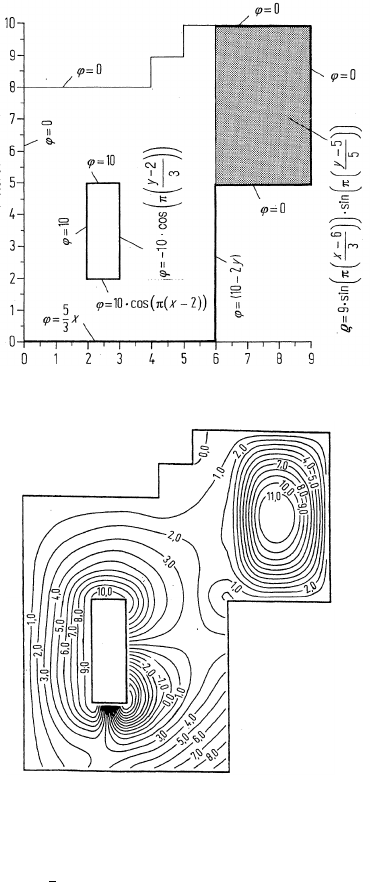
Fig. 8.20 shows a plane Dirichlet boundary value problem that was calculated
by means of the Monte-Carlo method (Fig. 8.20a: problem definition; Fig. 8.20b
equipotential lines).
ϕ
1
3
4
---
ϕ
0
1
4
---
ϕ
4
1
2
---
1
32 16⋅
----------------
⋅ 1
4
32 16⋅
----------------
⋅
1
2
---
9
32 16⋅
----------------
⋅++
–
1
32 16⋅
----------------–+=
ϕ
2
1
2
---
ϕ
0
1
2
---
ϕ
4
1
1
32 16⋅
----------------
⋅ 1
4
32 16⋅
----------------
⋅ 1
9
32 16⋅
----------------
⋅++
–
4
32 16⋅
----------------–+=
ϕ
3
1
4
---
ϕ
0
3
4
---
ϕ
4
1
2
---
1
32 16⋅
----------------
⋅ 1
4
32 16⋅
----------------
⋅
1
2
---
9
32 16⋅
----------------
⋅++
–
9
32 16⋅
----------------–+=
ϕ
1
3
4
---
ϕ
0
1
4
---
ϕ
4
5
4
4
-----–+=
ϕ
2
1
2
---
ϕ
0
1
2
---
ϕ
4
9
4
4
-----–+=
ϕ
3
1
4
---
ϕ
0
3
4
---
ϕ
4
9
4
4
-----–+=
A Appendices
A.1 Electromagnetic Field Theory and Photon Rest Mass
A.1.1 Introduction
Maxwell’s equations constitute a significant foundation for science and technology.
To continuously discuss them and question if, in light of new discoveries, these
equations require modification or if they remain entirely accurate and thus valid, is
rather natural. This leads to a more thorough understanding of the preconditions
and peculiarities of such familiar theories, which often times are taken as too self-
evident. Moreover, these discussions emphasize that electromagnetic Field theory
is not an isolated body of knowledge, but closely intertwined with all of physical
science.
At first sight, it may sound bizarre to relate the question of the exact validity
of Coulomb’s law of electrostatics, to the question on whether the rest mass of light
quanta identically vanishes or not. This Appendix shall be dedicated to this issue,
and its implications for electromagnetic field theory.
We start with the theorem of conservation of energy from classical
mechanics. It states that the total energy W of a particle is constant:
(A.1.1)
is the kinetic, U the potential energy of the particle which
travels in a “conservative” force field, where m is its mass, v its velocity, and p its
momentum. In Quantum Mechanics, physical quantities are replaced by operators.
This transforms the energy theorem into Schrödinger’s equation.
: operator of the total energy
(A.1.2)
: operator of the momentum (A.1.3)
: operator of the kinetic energy (A.1.4)
thus
(A.1.5)
Eq. (A.1.5) constitutes the energy theorem in operator form. Applying it onto a
function gives the Schrödinger equation
.
(A.1.6)
In case of fast (“relativistic”) particles, when the rest mass is , one has:
W
1
2
---
mv
2
U+
p
2
2m
------- U+ const.===
12⁄()mv
2
p
2
2m⁄=
WiÑ
∂
∂t
----
⇒
p iÑ∇–⇒
p
2
2m
-------
Ñ
2
∇
2
2m
-------------–
Ñ
2
2m
-------
∆–=⇒
iÑ
∂
∂t
----
Ñ
2
∇
2
2m
-------------– U+=
ψ
iÑ
∂ψ
∂t
-------
Ñ
2
2m
-------
∇
2
ψ– Uψ+=
m
0
G. Lehner, Electromagnetic Field Theory for Engineers and Physicists,
DOI 10.1007/978-3-540-76306-2, © Springer-Verlag Berlin Heidelberg 2010
570 Appendices
.
(A.1.7)
The associated wave equation, we could call it the relativistic Schrödinger
equation, is the so-called “Klein-Gordon equation”. It is obtained from (A.1.7) in
the same manner as one finds the Schrödinger equation (A.1.6):
or
.
(A.1.8)
For (e.g., for photons when making the usual assumption that their rest
mass vanishes) this becomes
.
(A.1.9)
One thereby obtains the wave equation known from electromagnetic field theory. It
has to be regarded as a special case of the Klein-Gordon equation (A.1.8), which
conversely, is the generalization of the wave equation for particles whose rest mass
does not vanish. There is a restriction one has to mention, namely that this is valid
only for particles with integer number spin (Bosons), but not for those with half
integer spin (Fermions). Another equation, also traceable to the Klein-Gordon
equation applies to Fermions. This is the Dirac equation, which will not be
discussed here.
Using the Compton wave length and introducing the abbreviation:
,
(A.1.10)
lets one write the time-independent Klein-Gordon equation in the following way:
.
(A.1.11)
Its simplest spherically symmetric solution is the so-called Yukawa potential.
(A.1.12)
This can easily be proven by substituting the radial part of the Laplace
operator
.
(A.1.13)
Yukawa introduced this potential, named in his honor, into the theory of nuclear
forces. From their short reach, he predicted the existence of a nuclear field whose
quanta possess a rest mass of ( is the rest mass of electrons). He
W
2
c
2
p
2
m
0
2
c
4
+=
iÑ
∂
∂t
----
2
c
2
iÑ∇()
2
m
0
2
c
4
+=
Ñ
2
∂
2
ψ
∂t
2
----------
– c
2
Ñ
2
∇
2
ψ– m
0
2
c
4
ψ+=
∇
2
ψ
1
c
2
-----
∂
2
ψ
∂t
2
----------
–
m
0
c
Ñ
---------
2
ψ–0 =
m
0
0=
∇
2
ψ
1
c
2
-----
∂
2
ψ
∂t
2
----------
–0=
λ
c
κ
m
0
c
Ñ
---------
2π
λ
c
------==
∇
2
ψκ
2
ψ–0=
ψ
C
r
----
e
κr–
=
∇
2
1
r
2
-----
∂
∂r
-----
r
2
∂
∂r
-----
=
m
0
200m
e
≈ m
e
A.1 Electromagnetic Field Theory and Photon Rest Mass 571
called those particles Mesons, which was a brilliant prediction. The particles he
referred to are now know as π-Mesons (after an initial confusion with the µ-
Mesons).
All this applies in principle to photons as well. Should it turn out that these
have a rest mass that differs from zero (even by an arbitrarily small amount), then
the potential of an electric point charge Q would not be the Coulomb potential
,
(A.1.14)
but the Yukawa potential
.
(A.1.15)
Consequently, Maxwell’s equations would need to change in a significant way.
The Yukawa potential is not related to the formally similar potential, known
in classical field theory as the Debye-Hückel potential:
(A.1.16)
This potential is a result of classical field theory. The exponential decay is not
related to the charge Q itself, but results from volume charges of the opposite sign,
which are distributed in a spherically symmetric manner around Q and thereby
shield the field of Q more and more as the distance to Q increases (hence the term
shielded Coulomb potential, Sect. 2.3.2).
The Coulomb potential yields
.
(A.1.17)
The Yukawa potential for photons with , i.e., for yields
.
(A.1.18)
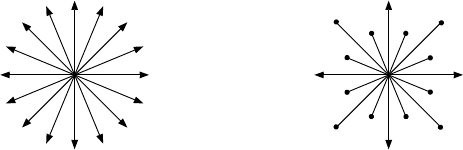
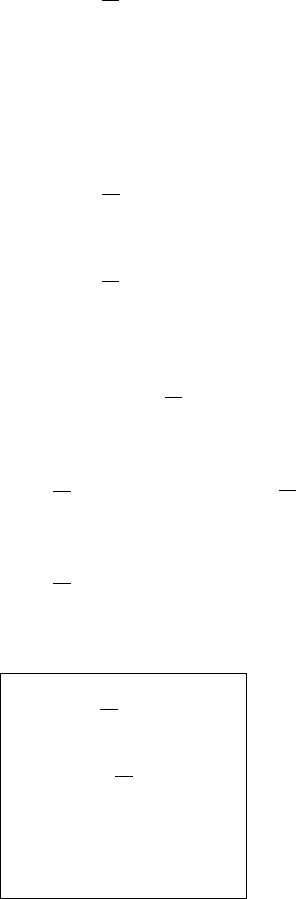
Fig. A.1.1a illustrates the Coulomb field, while Fig. A.1.1b shows the Yukawa
field. All field lines extend to infinity in case of the Coulomb field. In case of the
Yukawa field, the number of field lines diminishes as the distance to the charge
increases, even though there are no charges at those end points (the Debye-Hückel
field would look the same way, but the field lines would end at charges).
If this were so, then Maxwell’s equation
ϕ
Q
4πε
0
r
--------------=
ϕ
Q
4πε
0
r
--------------
e
κr–
=
ϕ
Q
4πε
0
r
--------------
e
rd/–
=
D∇• ρ=
m
0
0≠κ0≠
D∇• ρ ε
0
κ
2
ϕ–=
Fig. A.1.1
a) b)
572 Appendices
(A.1.19)
required modification because otherwise, this would be in conflict with the charge
conservation. We introduce the vector potential A, which by (7.183) allows to
express
,
(A.1.20)
and apply the Lorentz gauge (7.186)
,
(A.1.21)
then, instead of (A.1.19), we now obtain
.
(A.1.22)
One can easily see that this satisfies the charge conservation. Taking the divergence
of (A.1.22) gives
and now applying (A.1.18), together with (A.1.21) gives
,
that is,
.
The other of Maxwell’s equations remain unchanged. We now have the following
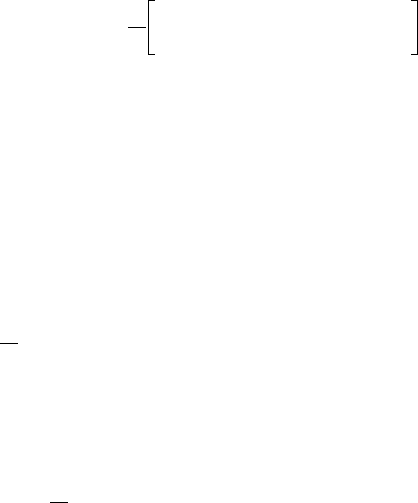
system of equations, which is called the Proca-equations:
Of course, for this results again in Maxwell’s equations.
First, a remarkable fact is that the Proca equations, besides the usual fields E,
D, B, H, the volume charge density ρ, and the current density g, also contain the
potentials A and ϕ. These potentials actually are part of the theory (for finite
photon rest mass) and not auxiliary fields, introduced later to simplify the
(A.1.23)
(A.1.24)
(A.1.25)
(A.1.26)
H∇× g
t∂
∂D
+=
BA∇×=
A∇• µ
0
ε
0
t∂
∂ϕ
+0=
H∇× g
t∂
∂D
κ
2
µ
0
------
A–+=
H∇×()∇• g∇•
t∂
∂
D∇•
κ
2
µ
0
------
A∇•–+0==
g∇•
t∂
∂
ρε
0
κ
2
ϕ–()
κ
2
µ
0
------
µ
0
ε
0
t∂
∂ϕ
–
–+0=
g∇•
t∂
∂ρ
+0=
E∇×
t∂
∂B
–=
H∇× g
t∂
∂D
κ
2
µ
0
------
A–+=
D∇• ρ ε
0
κ
2
ϕ–=
B∇• 0=
κ 0=
A.1 Electromagnetic Field Theory and Photon Rest Mass 573
mathematical calculations. They are real fields that can not be eliminated. On a
side note: Ultimately, they are real also in the context of Maxwell’s theory, as the
experiment of Bohm-Aharonov reveals (see Appendix A.3).
A consequence of eqs. (A.1.23) through (A.1.26) is that the potentials occur
in Poynting’s theorem, which one obtains in its generalized form from these eqs.:
.
(A.1.27)
Using
(A.1.28)
and the energy density
(A.1.29)
gives
.
(A.1.30)
Both, the Poynting vector S, as well as the energy density, contain additional terms
that include the potentials ϕ and A. And again, for , we obtain the classical
results, which we have discussed in Sect. 2.14.
Substituting the relations
(A.1.31)
and
(A.1.32)
into the Proca equations yield the inhomogeneous wave equations in the following
form.
(A.1.33)
(A.1.34)
They differ from the equations of the classical theory by the additional terms
and . Then, for the static case we have for ϕ
,
(A.1.35)
from which for a point charge
EH
κ
2
µ
0
------
ϕA+×
∇•
t∂
∂
B
2
2µ
0
---------
ε
0
E
2
2
----------- κ
2
ε
0
ϕ
2
2
-----------
A
2
2µ
0
---------
+
+++ Eg•–=
SEH
κ
2
µ
0
------
ϕA+×=
w
B
2
2µ
0
---------
ε
0
E
2
2
----------- κ
2
ε
0
ϕ
2
2
-----------
A
2
2µ
0
---------
+
++=
S∇•
t∂
∂
w+ Eg•–=
κ 0=
E ϕ∇–
t∂
∂A
–=
BA∇×=
∇
2
ϕ
1
c
2
-----
∂
2
ϕ
∂t
2
---------
– κ
2
ϕ–
ρ
ε
0
-----–=
∇
2
A
1
c
2
-----
∂
2
A
∂t
2
----------
– κ
2
A– µ
0
g–=
κ
2
ϕ–
κ
2
A–
∇
2
ϕκ
2
ϕ–
ρ
ε
0
-----–=