
Lehner G. Electromagnetic Field Theory for Engineers and Physicists
Подождите немного. Документ загружается.

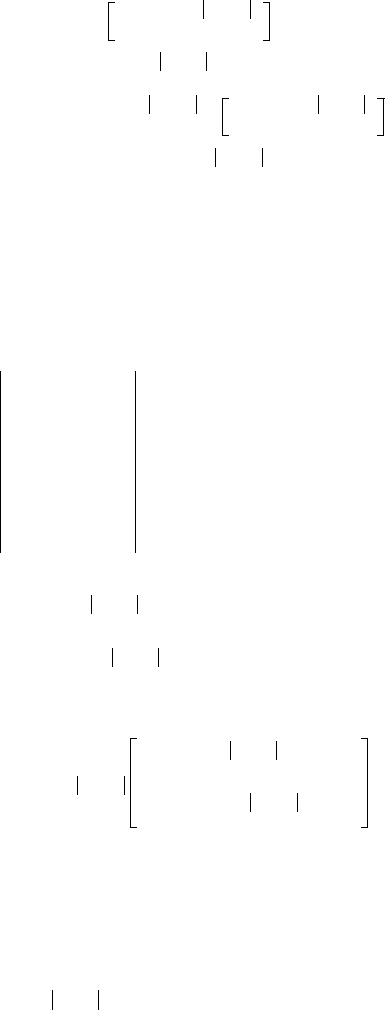
604 Appendices
(A.4.4)
. (A.4.5)
Evaluating these integrals is difficult, despite the delta function in there. Its
argument could be a complicated function of , but has to vanish. In general we
have
,
(A.4.6)
where D is the functional determinant
.
(A.4.7)
For the present case, this determinant is
.
(A.4.8)
Using this, we obtain the so-called Liénard-Wiechert Potentials
(A.4.9)
and
.
(A.4.10)
is defined by the requirement that the argument of the -functions in eqs.
(A.4.4) and (A.4.5) has to vanish, that is, it has to be
,
(A.4.11)
ϕ r t,()
Q
4πε
0
------------
δ r' r
0
t
rr'–
c
---------------–
–
rr'–
----------------------------------------------------
dτ'
∫
=
Art,()
Qµ
0
4π
----------
v
0
t
rr'–
c
---------------–
δ r' r
0
t
rr'–
c
---------------–
–
rr'–
----------------------------------------------------------------------------------------
dτ'
∫
=
r'
F r'()δfr'()[]τ'd
∫
Fx' y' z',,()δf x' y' z',,()[]x'dy'dz'd
∫
=
Fx' y' z',,()δf x' y' z',,()[]
1
D
----
f
x
df
y
df
z
d
∫
=
D
∂f
x
∂x'
-------
∂f
x
∂y'
-------
∂f
x
∂z'
-------
∂f
y
∂x'
-------
∂f
y
∂y'
-------
∂f
y
∂z'
-------
∂f
z
∂x'
-------
∂f
z
∂y'
-------
∂f
z
∂z'
-------
=
D 1
v
0
t
rr'–
c
---------------–
rr'–()•
c rr'–
---------------------------------------------------------–=
ϕ r t,()
Q
4πε
0
rr'–
1
v
0
t
rr'–
c
---------------–
rr'–()•
c rr'–
---------------------------------------------------------–
----------------------------------------------------------------------------------------------------=
Art,() ε
0
µ
0
v
0
ϕ r t,()
v
0
c
2
-----
ϕ r t,()==
r' δ
r' r
0
t
rr'–
c
---------------–
=
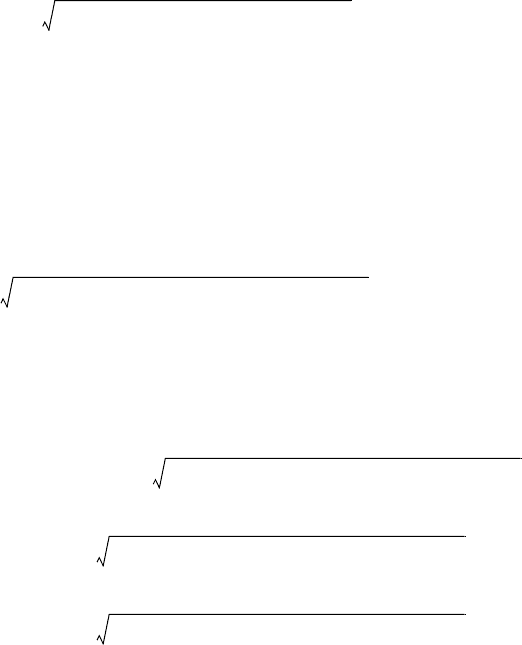
A.4 Liénard-Wiechert Potentials 605
which means that is a function of r and t, and depending on the given trajectory
might be difficult to determine. defines the location where the particle was at the
retarded time.
A relatively simple, special case is that of a particle which moves with
constant speed.
.
(A.4.12)
For this case, after some calculations which we skip, one obtains
,
(A.4.13)
. (A.4.14)
Of course, for the case , the potential has to be
,
(A.4.15)
as it is indeed. Without restricting generality, one may assume that
, which results in
(A.4.16)
(A.4.17)
and for the electric field
(A.4.18)
The ratio is therefore
,
(A.4.19)
that is, the force lines emerge as straight lines from the location , namely
the point where the particle is located at that particular moment. Conversely, the
field is not spherically symmetric. It depends on the angle α, which the force lines
enclose with the x-axis at any particular location of the particle (Fig. A.4.1).
r'
r'
r
0
v
0
t=
ϕ r t,()
Qc
4πε
0
c
2
t v
0
r•–()
2
c
2
v
0
2
–()r
2
c
2
t
2
–()+
----------------------------------------------------------------------------------------------------------=
A
v
0
ϕ
c
2
---------=
v
0
0=
ϕ
Q
4πε
0
r
--------------=
v
0
v
0
00,,〈〉=
ϕ
Qc
4πε
0
c
2
tv
0
x–()
2
c
2
v
0
2
–()x
2
y
2
z
2
c
2
t
2
–++()+
----------------------------------------------------------------------------------------------------------------------------=
A
x
v
0
ϕ
c
2
---------
A
y
0 ,= A
z
0=,=
E
x
∂ϕ
∂x
------–
∂A
x
∂t
---------–
Qc
4πε
0
------------
c
2
v
0
2
–()xv
0
t–()
c
2
tv
0
x–()
2
c
2
v
0
2
–()x
2
y
2
z
2
c
2
t
2
–++()+
3
------------------------------------------------------------------------------------------------------------------
⋅==
E
y
∂ϕ
∂y
------–
Qc
4πε
0
------------
c
2
v
0
2
–()y
c
2
tv
0
x–()
2
c
2
v
0
2
–()x
2
y
2
z
2
c
2
t
2
–++()+
3
------------------------------------------------------------------------------------------------------------------
⋅==
E
z
∂ϕ
∂z
------–
Qc
4πε
0
------------
c
2
v
0
2
–()z
c
2
tv
0
x–()
2
c
2
v
0
2
–()x
2
y
2
z
2
c
2
t
2
–++()+
3
------------------------------------------------------------------------------------------------------------------
⋅==
E
x
:E
y
:E
z
xv
0
t–():y:z=
v
0
t 00,,〈〉
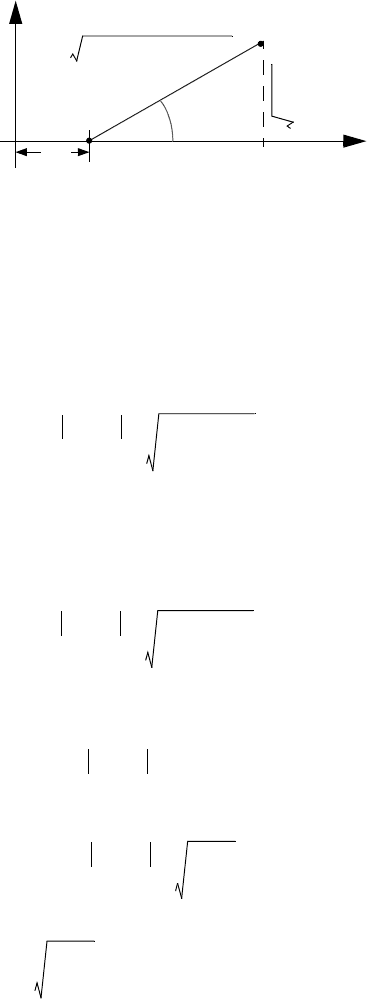
606 Appendices
Using the relation
allows to re-write eq. (A.4.18) in the following way:
.
(A.4.20)
This form makes it obvious that the field lines emerge as straight lines from the
location of the charge. Its magnitude is
,
(A.4.21)
and it clearly reveals the dependency on the angle. The field is minimal for
,
(A.4.22)
and its maximum is for
.
(A.4.23)
Let’s pick a specific value for , e.g.: , then
.
This field, that depends on the angle was already mentioned in Ch. 1 (Sect. 1.10).
Fig. A.4.1
y
2
z
2
+
α
v
0
t
x
xv
0
t–()
2
y
2
z
2
++
xyz,,()
αsin
2
y
2
z
2
+
xv
0
t–()
2
y
2
z
2
++
----------------------------------------------=
E
Q
4πε
0
------------
rv
0
t–()
rv
0
t–
3
---------------------
1
v
0
2
c
2
-----–
1
v
0
2
c
2
-----
αsin
2
–
3
------------------------------------
⋅⋅=
E
Q
4πε
0
------------
1
rv
0
t–
2
---------------------
1
v
0
2
c
2
-----–
1
v
0
2
c
2
-----
αsin
2
–
3
------------------------------------
⋅⋅=
α 0=
E
min
Q
4πε
0
------------
1
rv
0
t–
2
---------------------
1
v
0
2
c
2
-----–
⋅⋅=
απ2⁄=
E
max
Q
4πε
0
------------
1
rv
0
t–
2
---------------------
1
1
v
0
2
c
2
-----–
-------------------
⋅⋅=
v
0
c⁄ v
0
c⁄ 0.6=
E
min
E
max
------------ 1
v
0
2
c
2
-----–
3
0.5≈=
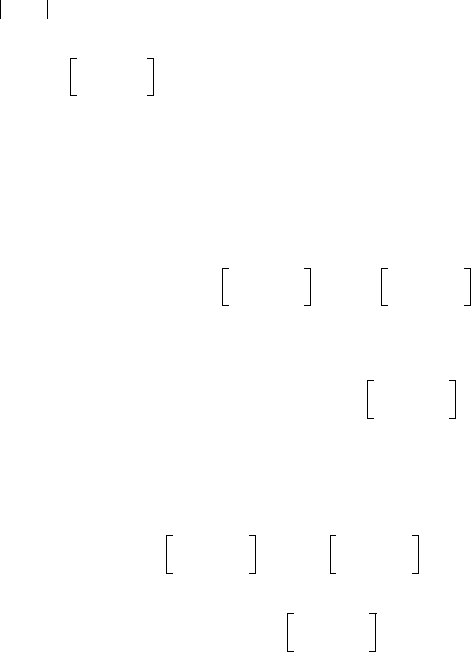
A.4 Liénard-Wiechert Potentials 607
We will discuss another interesting example: A particle which oscillates
harmonically about the origin which is described by
,
(A.4.24)
. (A.4.25)
If we let d be very small, then the first order approximation gives
,
,
and
that is
,
(A.4.26)
. (A.4.27)
Adding a charge at rest at the origin gives the overall potential (using
)
(A.4.28)
. (A.4.29)
These represent the equations for the retarded potentials of the Hertz dipole, eqs.
(7.266) and (7.267), while then the potential was expressed in spherical
coordinates. This result is not surprising. The positive charge, oscillating around a
negative charge at rest represents, in this context, an oscillating dipole. For the
purposes of the radiation, the negative charge at rest is immaterial. The oscillating
particle creates the same radiation as the oscillating dipole does. The difference in
the potential is merely by the potential of the point charge at rest , which
is unrelated to the radiation.
r
0
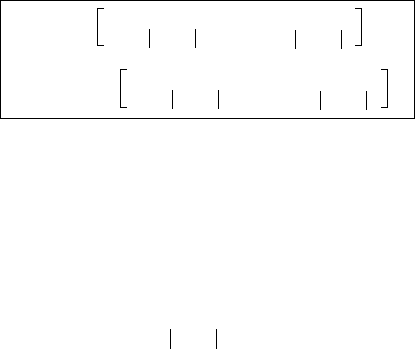
00d ωtsin,,〈〉=
v
0
00ωd ωcos t,,〈〉=
rr'– r 1
zz'
r
2
------
–
≈
z' d ω t
r
c
--–
sin≈
ϕ
Q
4πε
0
r
--------------
1
1
zz'
r
2
------
–
1
zz'
·
cr
------
–
---------------------------------------------
⋅
Q
4πε
0
r
--------------
1
zz'
r
2
------
zz'
·
cr
------+ +
⋅≈≈
ϕ
Q
4πε
0
r
--------------
Qd θcos
4πε
0
--------------------+
ω t
r
c
--
–
sin
r
2
-----------------------------------
ωωt
r
c
--
–
cos
cr
-----------------------------------------+
⋅≈
A
x
A
y
0 A
z
Q
4πε
0
r
--------------
z'
·
c
2
-----
Qdωωt
r
c
--
–
cos
4πε
0
rc
2
-------------------------------------------------
≈⋅≈,==
Q–
Qd p
0
=
ϕ
p
0
θcos
4πε
0
------------------
1
r
2
-----
ω t
r
c
--
–
sin
ω
cr
-----
ω t
r
c
--
–
cos+
⋅≈
A
x
A
y
0 A
z
,
µ
0
p
0
ω
4πr
----------------
ω t
r
c
--
–
cos== =
Q 4πε
0
r⁄
608 Appendices
A.5 The Helmholtz Theorem
A.5.1 Derivation and Interpretation
Helmholtz’s theorem, simplified somewhat, states that an arbitrary vector field can
uniquely be expressed by the totality of its sources and vortices. The easiest way to
conceptualize why this has to be so is by means of a hydrodynamic model.
Consider a finite or infinite volume, within which there is a fluid, initially at rest.
One may add sources, sinks, and generate vortices. These, in conjunction with the
boundary conditions at the surface, will uniquely determine the resulting flux field.
This theorem summarizes many of the properties which we had used in
previous Sections. It also sheds an interesting light on Maxwell’s equations as
such. Their task is to accurately describe two vector fields. In light of Helmholtz’s
theorem, this is best achieved by expressing all of their sources and vortices. This
is exactly what Maxwell’s equations achieve, and they do this in a very simple and
elegant manner. The fields are thereby not independent of each other. They are
correlated by the fact that the time derivative of each one represents the curl of the
other field.
Consider a vector field W in a finite or infinite volume V with the surface a.
Given are its sources and vortices
(A.5.1)
. (A.5.2)
and are arbitrary densities of sources and vortices. In the electrostatic
case it would be , , and the charge density. In the magnetostatic
case it would be , , and the current density. A further assumption
shall be that there are no sources nor vortices at infinity (otherwise, these needed
separate consideration). This allows to express W in the following manner.
(A.5.3)
Introducing the abbreviation and A for the expression in the brackets, we obtain
.
(A.5.4)
This is Helmholtz’s theorem. Its relation to many results in field theory is apparent.
The proof is easy. It starts from eq. (3.53)
,
(A.5.5)
and in conjunction with eq. (3.56)
(A.5.6)
this gives
∇ W•ρr()=
∇ W× gr()=
ρ r() gr()
WD= g 0= ρ
WH= ρ 0= g
W ∇
ρ r '()
4π rr'–
----------------------
τ'd
V
∫
Wr'() da '•
4π rr'–
----------------------------
a
∫
°
––=
∇
gr'()
4π rr'–
----------------------
τ'd
V
∫
Wr'() da '×
4π rr'–
----------------------------
a
∫
°
+ .×+
φ
W ∇φ– ∇ A×+=
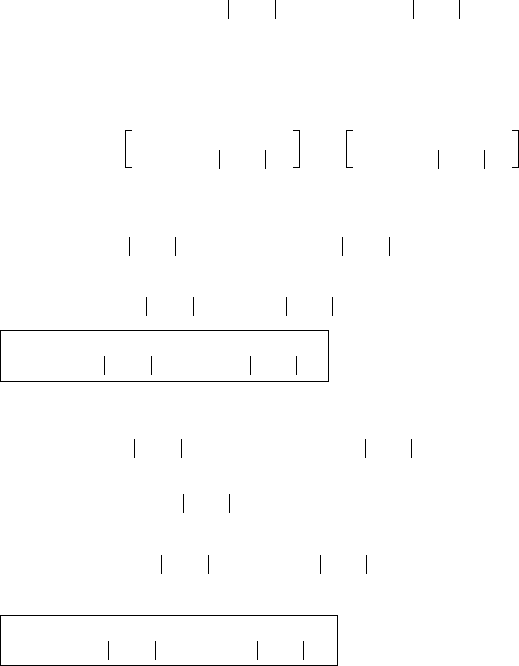
Wr() Wr'()δrr'–()τ'd
V
∫
=
δ rr'–()
1
4π
------
∇
r
2
1
rr'–
---------------
–=
A.5 The Helmholtz Theorem 609
.
(A.5.7)
Applying the vector identity eq. (5.11)
(A.5.8)
gives
.
(A.5.9)
Therefore
(A.5.10)
and
Now applying Gauss’ integral theorem in the form of eq. (5.68) gives
.
(A.5.11)
If we take an infinitely large volume where the location of the sources and
vortices are finite, then all surface integrals vanish. Conversely, for a finite volume,
the surface integrals have to be considered as well. They also have significance
from a plausibility perspective and could have been introduced, even without the
above provided formal prove. We will demonstrate this through an example by
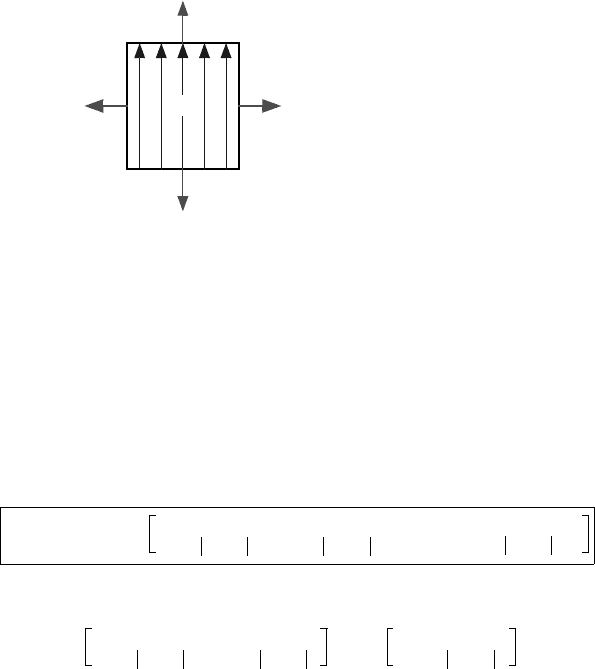
means of the field given in Fig. A.5.1 The field is uniform inside a cylinder and
vanishes outside. Obviously, it must have sources and vortices. Sources and sinks
are generally at locations where the normal component of the field is
discontinuous, and it is rotational at those locations where the tangential field
component is discontinuous. The surface density of the sources is
(A.5.12)
while that of the vortices is
,
(A.5.13)
Wr() Wr'()
1
4π
------
∇
r
2
1
rr'–
---------------
–
τ'd
V
∫
∇
r
2
Wr'()
4π rr'–
----------------------
τ'd
∫
–==
A∇×()∇× A∇•()∇∇
2
A–=
Wr() ∇
r
∇
r
Wr'()
4π rr'–
----------------------
τ'd
V
∫
××∇
r
∇
r
Wr'()
4π rr'–
----------------------
τ'd
V
∫
•–=
φ∇
r
Wr'()
4π rr'–
----------------------
τ'd
V
∫
•
Wr'()
4π
--------------
∇
r
'
1
rr'–
---------------
τ'd
V
∫
–==
∇
r '
Wr'()
4π rr'–
----------------------
•τ'd
V
∫
–
∇
r '
Wr'()
4π rr'–
----------------------
τ'd
V
∫
+=
φ
ρ r'()
4π rr'–
----------------------
τ'd
V
∫
Wr'() a'd•
4π rr'–
---------------------------
a
∫
°
–=
A ∇
r
Wr'()
4π rr'–
----------------------
τ'd
V
∫
×
Wr'()
4π
--------------
∇
r
1
rr'–
---------------
×τ'd
V
∫
–==
+
Wr'()
4π
--------------
∇
r'
1
rr'–
---------------
×τ'd
V
∫
=
∇
r '
Wr'()
4π rr'–
----------------------
×τ'd
V
∫
–
∇
r '
Wr'()×
4π rr'–
----------------------------
τ' .d
V
∫
+=
A
gr'()
4π rr'–
----------------------
τ'd
V
∫
Wr'() da '×
4π rr'–
----------------------------
a
∫
°
+=
σ r() Wn•–=
kr() Wn×=
610 Appendices
where n is the unit vector normal to the surface (pointing outward). This means, the
field in Fig. A.5.1 has sources at the bottom, sinks (negative sources) at the top,
while the vortices are on the sides of the cylinder. If one now considers a volume
that is larger than the cylinder itself, then all those surface sources and surface
vortices are inside this volume and consequently part of the volume integral, where
they appear in the form of δ-functions, which transforms the volume integrals into
surface integrals. We will return to this point in detail in the form of an example.
There is a relationship between the Helmholtz theorem and the previously proven
theorem (3.57). An irrotational field, that is otherwise arbitrary, can be expressed in
the form of a scalar potential. Then with the current notation one writes
.
(A.5.14)
Using Helmholtz’s theorem with gives the same field
.
(A.5.15)
Although the field is uniquely defined by its sources and vortices, still there may be
several ways to express it. The field consists of three parts. The first two are the
same in both representations. The third part can be expressed by a scalar or a vector
potential. We have found in Sect. 3.4.7 that this third part of the scalar potential is
that of a dipole layer. Again, as before in Sect 5.3, one encounters the equivalence
of eddy ring and dipole layer. This means that we can imagine the field to be
created by the surface sources and surface vortices. This equivalence is not as
astonishing as it may seem at first. The vortices are nothing else than the
discontinuity of the tangential components. The boundary conditions (2.117) reveal
that dipole layers, if they are non-uniform, also cause such discontinuities.
Fig. A.5.1
W
n
n
n
n
W ∇φ– ∇
ρ r '()τ'd
4π rr'–
----------------------
V
∫
Wr'() da '•
4π rr'–
----------------------------
a
∫
°
–
φ r '()
4π
------------
∂
∂n'
-------
1
rr'–
---------------
da '⋅
a
∫
°
––==
gr() 0=
W ∇
ρ r '()τ'd
4π rr'–
----------------------
V
∫
Wr'() da '•
4π rr'–
----------------------------
a
∫
°
–– ∇
Wr'() da'×
4π rr'–
----------------------------
a
∫
°
×+=
A.5 The Helmholtz Theorem 611
A.5.2 Examples
A.5.2.1 Uniform Field inside a Sphere
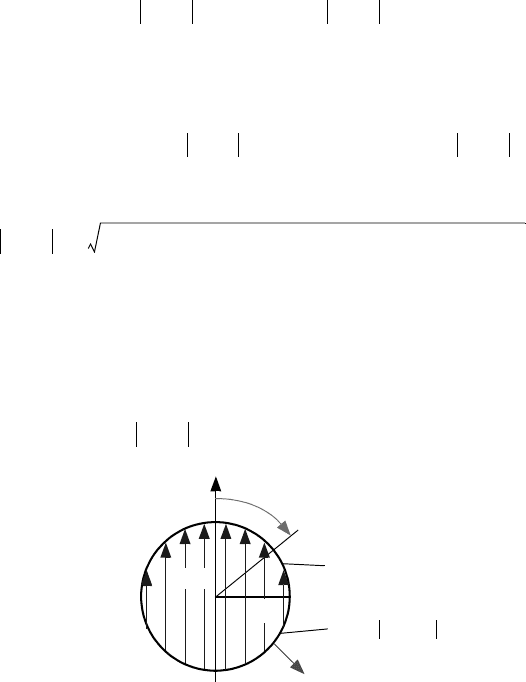
Consider the field W given in Fig. A.5.2, which is uniform inside the sphere and
vanishes everywhere outside. There are no sources nor vortices inside. Therefore,
the field can be calculated solely from the surface integrals. Using
(A.5.16)
and
,
(A.5.17)
together with the Helmholtz theorem gives
(A.5.18)
and
(A.5.19)
where
.
(A.5.20)
Note that, as was mentioned frequently, calculation of should be based on
Cartesian coordinates. This results, as before in eq. (5.44), in the additional factor
in the integrand. Both integrals are not elementary integrals, however,
the series expansion of the inverse distance in spherical coordinates as Legendre
polynomials allows for evaluation in an elegant way. The general integral is
Fig. A.5.2
W
n
z
θ
σ W– n• W θcos–==
k
ϕ
Wn×
ϕ
W θsin==
r
0
σ W θcos–=
k
ϕ
W θsin=
φ r θ,()
W
4π
------
θ
0
cos
rr
0
–
----------------
a
0
d
a
∫
–
W
4π
------
P
1
0
θ
0
cos()
rr
0
–
--------------------------
a
0
d
a
∫
°
–==
A
r
A
θ
0==
A
ϕ
r θ,()
W
4π
------
ϕϕ
0
–()cos θ
0
sin
rr
0
–
-------------------------------------------
a
0
d
a
∫
°
W
4π
------
P
1
1
θ
0
cos()ϕϕ
0
–()cos
rr
0
–
--------------------------------------------------------
a
0
d
a
∫
°
==
rr
0
– r
2
r
0
2
2rr
0
θsin θ
0
sin ϕϕ
0
–()cos θcos θ
0
cos+[]++=
A
ϕ
ϕϕ
0
–()cos
J
P
n'
m'
θ
0
cos()m' ϕϕ
0
–()[]cos
rr
0
–
---------------------------------------------------------------------
da
0
∫
°
=
612 Appendices
.
(A.5.21)
Using the orthogonality relation (3.300) gives
.
(A.5.22)
The potential for the cases ( ) and ( ) becomes
(A.5.23)
and the vector potential is
.
(A.5.24)
The corresponding field inside is
.
It possesses only a z-component.
,
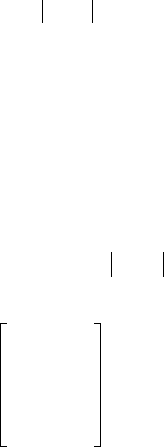
(A.5.25)
which is created by from sources and from vortices. On the outside,
there are only dipole fields which cancel mutually and therefore
.
(A.5.26)
All this should not be surprising. From previous Sections we know, that surface
charge densities proportional to and current densities at the surface in the
azimuthal direction which are proportional to , cause uniform fields inside
J P
n'
m'
θ
0
cos()m' ϕϕ
0
–()[]cos()
2 δ
0m
–()
r
0
-----------------------
r
r
0
----
n
r
0
r
----
n 1+
m 0=
n
∑
n 0=
∞
∑∫
°
=
nm–()!
nm+()!
--------------------
P
n
m
θ
0
cos()P
n
m
θcos()m ϕϕ
0
–()[]da
0
cos⋅
J
4πr
0
2n'1+
----------------
r
r
0
----
n'
r
0
r
----
n'1+
P
n'
m'
θcos()=
rr
0
<φ
i
rr
0
>φ
a
φ
i
W
3
-----
r θcos–
W
3
-----
z –==
φ
a
W
3
-----
r
0
3
r
2
-----
θ cos–=
A
ϕi
+
W
3
-----
r θsin=
A
ϕa
+
W
3
-----
r
0
3
r
2
-----
θ sin=
W
i
∇φ
i
– ∇ A
i
×+=
W
iz
1
3
---
W
2
3
---
W+ W==
13⁄ 23⁄
W
a
0=
θcos
θsin
A.5 The Helmholtz Theorem 613
and dipole fields outside. One corresponds to the electric field of a uniformly
polarized sphere, the other to the magnetic field of a uniformly magnetized sphere.
By (A.5.14), one can also express the entire field W by means of a scalar
potential alone. In this case, the above vector potential has to be replaced by
.
(A.5.27)
In order to be able to calculate this potential, one has to know the potential at the
surface, which does by no means imply that one can arbitrarily fix this potential.
This would lead to over determination of the problem, as we have discussed in
Sect. 3.4. The purely scalar potential inside, that corresponds to the field of
Fig. A.5.2, has to be
.
(A.5.28)
This gives
.
With eq. (A.5.22), one can re-write this
,
i.e.,
.
(A.5.29)
Combining this with the potential eq. (A.5.23) yields
,
(A.5.30)
which was to be proven.
The just presented example gave us a “hands on experience”, illustrating that,
and how, a field, created by surface vortices can, ad libitum, be expressed by either
the corresponding vector potential or by the potential of the equivalent dipole layer.
Vortices, (i.e. discontinuities of the tangential field component) occur only, if the
dipole layer is inhomogeneous or if the potential under the integral eq. (A.5.27) is
not constant. We know from Sect. 3.4 that the surface density of the dipole moment
is
φ
3
1
4π
------
φ r
0
()
∂
∂r
0
-------
1
rr
0
–
----------------
a
0
d
a
∫
°
–=
φ
gi
Wz– Wr θcos–==
φ
3
+
Wr
0
4π
----------
P
1
0
θ
0
cos()
∂
∂r
0
--------
1
rr
0
–
----------------
a
0
d
a
∫
°
=
φ
3
Wr
0
4π
----------
∂
∂r
0
--------
⋅
1
r
0
----
r
r
0
----
1
r
0
r
----
2
4πr
0
2
3
------------
θcos⋅=
φ
3i
2
3
---
Wr θcos–
2
3
---
Wz–==
φ
3a
+
1
3
---
W
r
0
3
r
2
-----
θcos=
φ
gi
Wr θcos– Wz–==
φ
ga
0=