
Lehner G. Electromagnetic Field Theory for Engineers and Physicists
Подождите немного. Документ загружается.

614 Appendices
.
(A.5.31)
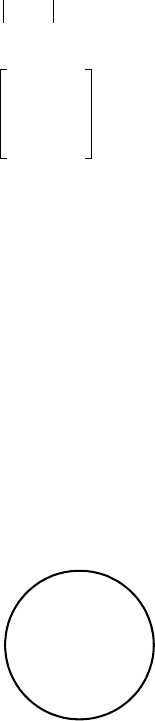
If the boundary coincides with an equipotential surface, then the dipole layer is
uniform and there are no vortices, i.e., the fields must vanish. We will illustrate
this. Consider the very simple field depicted in Fig. A.5.3, which vanishes both,
inside and outside the sphere. The potential shall be constant on the surface of the
sphere:
.
(A.5.32)
This corresponds to the case when in (A.5.14) only the third term is non-vanishing.
Then one gets for the potential
.
Using (A.5.22) and because of , this results in
,
or
.
(A.5.33)
This again, confirms one of our previous results, namely that of Sect. 2.5.3, eqs.
(2.72) and (2.73) in particular. The potentials are constant and the fields vanish,
just like we had assumed. Nevertheless, inside the dipole layer, there exists an
infinitely strong field, which creates exactly the potential difference C.
τε
0
φ r
0
()–=
Fig. A.5.3
W 0=
φ
a
0=
φ
i
C=
φ r
0
() C=
φ
C
4π
------
∂
∂r
0
-------
1
rr
0
–
----------------
da
0
a
∫
°
–=
P
0
0
1=
φ
C
4π
------–
∂
∂r
0
--------
1
r
0
----
1
r
0
r
----
4πr
0
2
P
0
0
⋅⋅=
φ
i
C
τ
ε
0
-----–==
φ
a
0=

A.5 The Helmholtz Theorem 615
A.5.2.2 Point Charge inside a Conducting Hollow Sphere
Here, we will revisit the problem of a sphere which we have repeatedly discussed
and solved, in Sect. 2.6.1 via the method of images, and in Sect. 3.8.2.3 by the
separation of variables. The sphere shall have a radius of . The potential on the
surface shall be and the charge shall be on the z-axis at . Then by
(3.336)
,
(A.5.34)
and the radial field at the sphere’s surface is by (3.340)
.
(A.5.35)
The surface of the sphere constitutes an equipotential surface, that is, there are no
tangential components (vortices).
The Helmholtz theorem under these conditions gives
.
(A.5.36)
The volume integral results with
(A.5.37)
in the first part of the potential obtained in eq. (A.5.34). On the other hand, the
surface integral, together with (A.5.35) provides the other part of that potential,
which can be shown by means of eq. (A.5.22). This second part is nothing else than
the potential of the image charge. However, in the context of this reflection, notice
that this does not constitute a method to solve the problem. After all, we had to use
the initially unknown field at the surface. Rather, the purpose here was to illustrate
the content of the Helmholtz theorem by means of an example.
It shall also be noted that only compatible quantities may be substituted into
Helmholtz theorem. In conjunction with the point charge Q, it would be possible to
consider fields different from the one given in (A.5.35), which would constitute a
different problem. In any case, the field prescribed at the surface has to possess a
flux which fits to the totality of all sources. Consider a field with radial components
at the surface of the following form:
,
(A.5.38)
then the total flux created by this field at the surface is
.
(A.5.39)
r
s
ϕ 0= zr
0
=
φ
Q
4πε
0
------------
1
r
0
----
r
r
0
----
n
r
0
r
----
n 1+
r
0
n
r
n
r
s
2n 1+
---------------– P
n
0
θcos()
n 0=
∞
∑
=
E
r
Q
4πε
0
------------
2n 1+[]
r
0
n
r
s
n 2+
------------
P
n
0
θcos()
n 0=
∞
∑
=
φ
∇ Er'()•τ'd
4π rr'–
------------------------------
V
∫
E
r
r '()da'
4π rr'–
----------------------
a
∫
°
–=
∇ Er'()•
Q
ε
0
-----
δ rr'–()=
E
r
A
n
P
n
0
θcos()
n 0=
∞
∑
=
E
E
r
r'()da'
∫
°
A
0
4πr
s
2
=
616 Appendices
If the total charge inside the volume is Q, then it has to be
,
(A.5.40)
which determines the first term of the series expansion (A.5.38) and agrees with
(A.5.35).
A.6 Maxwell’s Equations and Relativity
A.6.1 Galilean and Lorentz Transformation
Classical physics as coined by Newton, is based on an understanding which
appears self-evident to us, namely that time and space are absolute realities. The
result of this understanding is the supposition that the laws of physics are invariant
under the so-called Galilean Transformation. Consider a physical process in two
different reference frames, we shall call one Σ and the other Σ’, where Σ’ moves
with a constant velocity relative to the rest frame Σ. Both are inertial systems,
i.e., there shall be no inertial forces present. We will not discuss the important
implications that come along with this restriction. The relation between the
location vector r and the time t in system Σ on one hand, and the location vector r’
and the time t’ in system Σ’ is as follows
.
(A.6.1)
The coordinate axes of the two systems shall be parallel to each other and they
shall coincide for . The two equations (A.6.1) constitute the so-called
Galilean Transformation. One of its consequences is the familiar addition of
velocities. If a point particle moves with the velocity in system Σ, then its
velocity in the other system (Σ’) is and thus
.
(A.6.2)
We had assumed, and this is important here, that the velocity is constant. The
acceleration is therefore the same in both reference frames
.
(A.6.3)
Consequently, if there is a force F, then the equation of the motion is the same in
both frames
,
(A.6.4)
having assumed that the mass is the same in both reference frames (which will not
be the case once we consider relativistic effects). Though simplified and
abbreviated, this is precisely what is meant when saying, that the laws of classical
physics are invariant under the Galilean Transformation.
After having theoretically derived the speed of the propagation of electromagnetic
waves in vacuum and identified it as the speed of light in vacuum,
A
0
4πr
s
2
Q
ε
0
-----=
v
r ' rvt–=
t ' t=
t 0=
r
·
r'
·
r
·
v–=
r
·
r'
·
v+=
r'
··
r
··
=
F mr
··
mr'
··
==

A.6 Maxwell’s Equations and Relativity 617
,
(A.6.5)
and then had also proven experimentally that waves really existed (Heinrich Hertz,
1887/88), the question became inevitable, for which reference frame this statement
applied, i.e., in which reference frame does light actually propagate with that
speed. From a classical perspective, there is only one reference frame with this
property. The speed of light according to eq. (A.6.2) is different for all other
reference frames. Initially, it seemed quite natural, yes downright self-evident, to
suppose that this unique reference frame (where the light had the given velocity)
was the surrounding absolute space in which the fixed stars were at rest (not the
earth, however). (From our current knowledge of space, with its vastness and the
incredible dynamic of the behavior of these fixed stars within their spiral nebulas
etc., this was a very naive conception.) In order for waves to propagate in this
absolute space, it was assumed to be filled with a suitable medium, which was
called ether. This ether was to play the same role for light waves as, for example,
gas plays for the propagation of sound waves. Since the earth moves in the ether,
the speed of light as seen from the earth should be different, exactly by its speed
through the ether, which means that eq. (A.6.2) should be applicable. By means of
this equation, it should be possible to determine the speed of the earth within the
ether (and thereby its speed relative to the absolute space). These chains of
reasoning triggered an intensive discussion and hectic experimental activity. Many
experiments were performed with the intention to confirm the just described
understanding (the famous Michelson interference experiment was one of them),
but all failed. The final result shall be presented now without going into further
details of these discussions. The result, which on one hand, is simple, but on the
other, vigorously objects our immediate conception, was first formulated by
Einstein (1905) in this form. It says that the speed of light in vacuum has the same
value in any uniformly moving reference frame (in all inertial systems), regardless
of their speed v, relative to each other. This forms the basis for the theory of special
relativity (not to confuse with the later formulated theory on general relativity,
which is not subject of this discussion). Therefore, Maxwell’s equations are not
Galilei invariant.
The theory of relativity that emerged from this understanding was mandated
by the experimental results and inevitable. It was the compulsory result of the
experimental experience, i.e., it would have emerged, even without Einstein.
Nevertheless, it rightly is connected to his name because he was the first to face the
necessary and inevitable consequences, which required to radically part with our
conception, and he formulated the results of the research of his time, and
furthermore, because he has done this in an ingenious and clear manner.
The theory of relativity has caused discussions, even beyond the realm of
Physics. Many of these discussions were more or less useful, frequently even
bizarre and senseless, sometimes initiated by people who did not even understand
it. Many of the debates, then and now, are distracted by the term relativity, which in
c
1
ε
0
µ
0
---------------=
618 Appendices
a naive way is taken out of context and the theory of relativity is rejected because
of some alleged philosophical reasons by which it is not permissible that
everything is relative. On the other hand, people misuse the theory and claim that
certain statements are relative, i.e., not absolute, even though they are entirely
unrelated to the theory. Feynman has commented on this in an ironic way in his
famous textbook [37, Section 16-1, “Relativity and the Philosophers”]. On the
other hand, let’s note for the record, that Einstein’s theory is ultimately a very clear,
even simple theory, which replaced the theory that preceded it historically (this
preceding theory could be called Galilean theory of relativity). Furthermore, it
shall be noted that Einstein’s theory, by no means contradicts its predecessor but
generalizes it because it includes it as a limit.
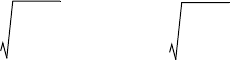
The fundamental statement of the theory of relativity is that the quantity
has the same value in every inertial frame, or that
(A.6.6)
is invariant. The mathematical transformation which ensures this, is the so-called
Lorentz transformation. In contrast to the Galilean Transformation, it also includes
the time. Time is now also dependent on the reference frame. To derive this
transformation is not difficult. It only requires the orthogonal transformation of the
coordinates of an n-dimensional space (here four-dimensional), which is well
known in mathematics.
To illustrate the content of eq. (A.6.6), consider an arbitrary point in the
laboratory frame Σ, from which a spherical wave emerges at time . In the
reference frame Σ’, this wave emerges from the point at the time . By
suitable translation in space and time, it is always possible to achieve a situation
where , , , and . This does not impose a limit on its
generality.
A.6.2 Lorentz Transformation as an Orthogonal Transformation
Consider an n-dimensional Euclidean space where two Cartesian coordinate
systems coexist, but are rotated against each other. A particular location is
represented in one system by and in the other by , where
.
(A.6.7)
This transformation must possess the property
c
2
x
2
y
2
z
2
++
t
2
----------------------------=
x
2
y
2
z
2
c
2
t
2
–++ x
i
2
i 1=
4
∑
=
xyzict,,,〈〉x
1
x
2
x
3
x
4
,,,〈〉x
i
〈〉==
r
0
tt
0
=
r
0
' t' t
0
'=
r
0
0= r
0
'0= t
0
0= t
0
'0=
x
i
〈〉 x
i
'〈〉
x
i
' L
ik
x
k
k 1=
n
∑
= ik, 1 …n,=()

A.6 Maxwell’s Equations and Relativity 619
,
(A.6.8)
that is, the distance must be invariant. This is the case if the matrix operator
(A.6.9)
is orthogonal. Its properties can easily be derived
.
It is therefore
.
(A.6.10)
Of course we have
,
i.e., unity and therefore
.
(A.6.11)
Comparing eqs. (A.6.10) and (A.6.11) yields
.
(A.6.12)
This is exactly what represents the property of the orthogonal transformation
operator, namely that its inverse operator is equal to its transposed operator
(where ). Obviously, one also has
,
.
(A.6.13)
The two eqs. (A.6.10) and (A.6.13) express that both, the column vectors as well as
the row vectors of an orthogonal operator are unit vectors which are orthogonal to
each other.
With this mathematical preparation, we now turn our attention to the Lorentz
transformation. For that purpose, as before in eq. (A.6.6), we will use the four-
dimensional vector
,
(A.6.14)
where now, the four-dimensional distance has to be invariant. Formally, this
is the same problem as that of a four-dimensional Euclidean space. The difference
is merely that one of the coordinates ( ) and its corresponding matrix
x
i
'
2
i 1=
n
∑
x
i
2
i 1=
n
∑
invariant==
LL
ik
()=
x
i
'
2
i 1=
n
∑
L
ik
x
k
k 1=
n
∑
L
il
x
l
l 1=
n
∑
i 1=
n
∑
x
k
2
k 1=
n
∑
δ
kl
x
k
x
l
l 1=
n
∑
k 1=
n
∑
===
L
ik
L
il
i 1=
n
∑
δ
kl
=
L
1–
L 1
ˆ
=
L
ki
1–
L
il
i 1=
n
∑
δ
kl
=
L
ki
1–
L
ik
,= L
1–
L
T
=
L
1–
L
T
L
ki
T
L
ik
=
LL
1–
1
ˆ
=
L
ki
L
il
1–
i 1=
n
∑
L
ki
L
li
i 1=
n
∑
δ
kl
==
xyzict,,,〈〉x
1
x
2
x
3
x
4
,,,〈〉x
i
〈〉==
x
i
2
i 1=
4
∑
x
4
ict=
620 Appendices
elements are now complex valued. This is therefore also called pseudo-Euclidean
four-dimensional space-time, which is also called Minkowski space.
Initially, we shall assume that the relative velocity v has only an
component :
(A.6.15)
This suggests to suppose that and remain unchanged in this case,
while only and will be changed by the transformation. This
assumption is not necessary but simplifies matters in the following discussion. The
transformation may then be written in the following form:
(A.6.16)
When , then the origin of the moving reference frame Σ’ is at ,
which allows one to write
.
Thus
.
(A.6.17)
Because of the orthogonality of L, one has
(A.6.18)
(A.6.19)
. (A.6.20)
Using eqs. (A.6.17) and (A.6.18) gives
.
(A.6.21)
Furthermore, from this and eq. (A.6.20) follows
,
and by (A.6.19) this yields
x
1
v
1
v v
1
00,,〈〉=
yx
2
= zx
3
=
xx
1
= ict x
4
=
x
1
'=L
11
x
1
+L
14
x
4
x
2
'= x
2
x
3
'= x
3
x
4
'=L
41
x
1
+L
44
x
4
x
1
v
1
t= x'0=
x
1
' fv
1
()x
1
v
1
t–()fv
1
()x
1
v
1
fv
1
()
ic
-----------------
ict– fv
1
()x
1
v
1
fv
1
()
ic
-----------------
x
4
–== =
L
14
v
1
ic
-----
L
11
– i
v
1
c
-----
L
11
==
L
11
2
L
14
2
+1=
L
41
2
L
44
2
+1=
L
11
L
41
L
14
L
44
+0=
L
11
1
1
v
1
2
c
2
-----–
-------------------
= L
14
i
v
1
c
-----
1
v
1
2
c
2
-----–
-------------------=,
L
41
L
14
L
11
--------
L
44
–
iv
1
c
-------
L
44
–==
A.6 Maxwell’s Equations and Relativity 621
.
(A.6.22)
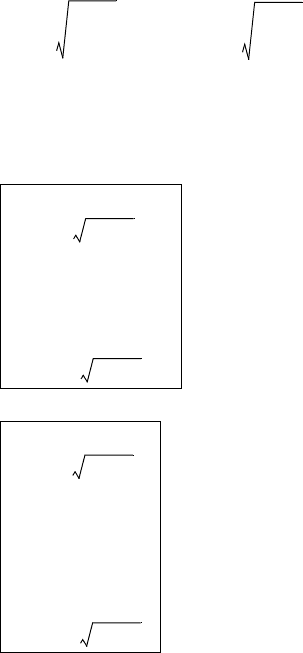
Introducing the frequently used abbreviation
,
(A.6.23)
finally, the Lorentz transformation emerges
(A.6.24)
or expressed with and
(A.6.25)
One can easily verify that all requirements are met and, in particular, eq. (A.6.6) is
invariant.
The case of an arbitrary velocity can be reduced to the just
derived result. For this purpose, decompose into components parallel and
perpendicular to v,
and obtain
L
44
1
1
v
1
2
c
2
-----–
-------------------
= L
41
i
v
1
c
-----
1
v
1
2
c
2
-----–
-------------------–=,
β
v
c
--
v
1
c
----==
x
1
'
x
1
iβx
4
+
1 β
2
–
----------------------
=
x
2
' x
2
=
x
3
' x
3
=
x
4
'
iβx
1
– x
4
+
1 β
2
–
---------------------------=
tt'
x
1
'
x
1
v
1
t–
1 β
2
–
-------------------
=
x
2
' x
2
=
x
3
' x
3
=
t '
v
1
c
2
-----
x
1
– t+
1 β
2
–
-----------------------=
v v
1
v
2
v
3
,,〈〉=
rvt–()
rvt–()
||
rvt–()v•[]
v
v
2
-----
=
rvt–()
⊥
rvt–()rvt–()v•[]
v
v
2
-----
–=
622 Appendices
.
(A.6.26)
Of course, letting gives the result of our previous transformation
(A.6.25). Also easy to verify is that (A.6.26), indeed, is invariant as required, i.e.
.
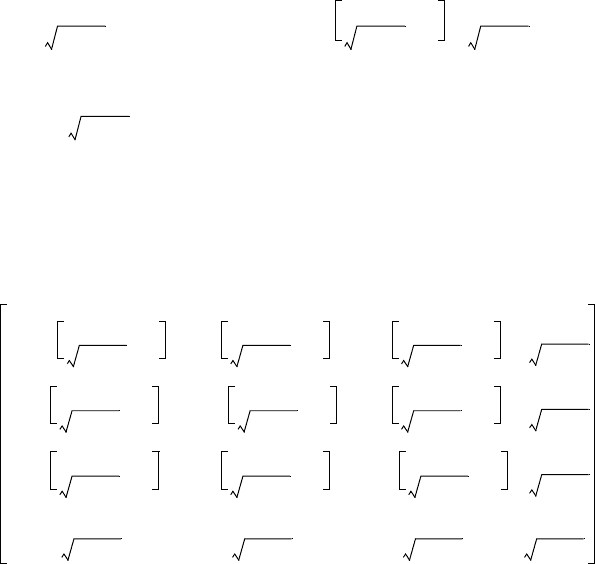
The L operator (when using ) is obtained from (A.6.26) and in the
following form:
.
(A.6.27)
Its inverse transformation is obtained simply by replacing v by -v. It becomes
immediately obvious that the so obtained inverse matrix is . Letting
results in the Galilean Transformation. This means that the theory of
relativity includes classical physics in this limit and thereby generalizes it.
We have, thereby, gained the Lorentz transformation, first in its simple form
of eqs. (A.6.24) or (A.6.25) for and then in its more complicated
form of eq. (A.6.27) for . Next, we want to consider some of its
fundamental consequences. For the most part, we will use the simpler form, which
is sufficient for many purposes.
A.6.3 Some Consequences of the Lorentz Transformation
A.6.3.1 Lorentz Contraction
Consider a rod, oriented parallel to the and the axis, respectively. Its length
in system Σ is . What is its length in system Σ’? The
task requires caution. One has to ensure that the coordinate points of both ends in
r'
rvt–()
||
1 β
2
–
-------------------- rvt–()
⊥
+ r
rv•()v
v
2
-------------------
1
1 β
2
–
-------------------1–
vt
1 β
2
–
-------------------–+==
t'
1
c
2
-----
rv•()– t+
1 β
2
–
----------------------------------=
v v
1
00,,〈〉=
r'
2
c
2
t'
2
– r
2
c
2
t
2
–=
β vc⁄=
L
1
v
1
2
v
2
-----
1
1 β
2
–
------------------ 1–+
v
1
v
2
v
2
----------
1
1 β
2
–
------------------ 1–
v
1
v
3
v
2
----------
1
1 β
2
–
------------------ 1–
iv
1
c 1 β
2
–
---------------------
v
1
v
2
v
2
----------
1
1 β
2
–
------------------ 1–1
v
2
2
v
2
-----
1
1 β
2
–
------------------ 1–+
v
2
v
3
v
2
----------
1
1 β
2
–
------------------ 1–
iv
2
c 1 β
2
–
---------------------
v
1
v
3
v
2
----------
1
1 β
2
–
------------------ 1–
v
2
v
3
v
2
----------
1
1 β
2
–
------------------ 1–1
v
3
2
v
2
-----
1
1 β
2
–
------------------ 1–+
iv
3
c 1 β
2
–
---------------------
iv
1
–
c 1 β
2
–
---------------------
iv
2
–
c 1 β
2
–
---------------------
iv
3
–
c 1 β
2
–
---------------------
1
1 β
2
–
------------------
=
L
1–
L
T
=
β 0→
v v
1
00,,〈〉=
v v
1
v
2
v
3
,,〈〉=
x
1
x
1
'
lx
1e
x
1a
–= l' x
1e
' x
1a
'–=
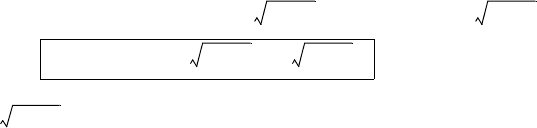
A.6 Maxwell’s Equations and Relativity 623
Σ’ are determined at the same time t’. This needs to be recognized because
simultaneousness in Σ does not imply simultaneousness in Σ’. Therefore, one
requires that , and obtain with (A.6.25)
.
Furthermore
,
.
(A.6.28)
From the moving system Σ’, one “observes” the rod shortened by the factor
. This phenomenon is the so-called Lorentz-contraction. The word
observes in the previous sentence was used in quotation marks because caution is
of order when interpreting this result, in order to avoid misconception – which has
frequently occurred.
The Lorentz-contraction causes, for example, that a sphere in motion for an
observer at rest changes to a flattened ellipsoid. However, it does not mean that a
visually observed sphere is seen by an observer as a flattened ellipsoid, nor that a
photographic picture would show a flattened ellipsoid, as it was frequently stated in
the past. This mistake was cleared only relatively late by Penrose [38] and Terrell
[39]. Since the speed of light is finite, visual or photographic observation of an
object gives a distorted picture, because it shows parts with different distances to
the observer at different times. In case of a large distance to the object (or small
solid angle) the object appears in its natural shape and length, but rotated. If the
object is a sphere, then the observer sees a rotated sphere, but not an ellipsoid. If
the object is a rod, then the observer sees a rod with its natural length but rotated.
The angle is such that the rod’s projection onto the direction of the motion
represents the Lorentz-contraction. We pass on a detailed discussion here. Those
details are found in the mentioned publications [38, 39]. It shall be emphasized that
there is no doubt on the reality of the Lorentz contraction. This is a real and
experimentally verified effect. The described facts simply mean that a visual
observation is not a suitable method to experimentally verify the Lorentz
contraction. The fact that a visually observed object, precisely because of the
Lorentz contraction remains visible in its natural shape is very remarkable. The
reason is that the distortion is compensated for by the different optical paths. In this
sense, the theory of relativity restores the “vividness” of objects in motion, which
were otherwise lost due to the finite speed of light.
t
1e
' t
1a
'=
t
a
v
1
c
2
-----
x
1a
– t
e
v
1
c
2
-----
x
1e
–= t
e
t
a
–
v
1
c
2
-----
x
1e
x
1a
–()=,
l ' x
1e
' x
1a
'–
x
1e
x
1a
– v
1
t
e
t
a
–()–
1 β
2
–
----------------------------------------------------
x
1e
x
1a
–
v
1
2
c
2
-----
x
1e
x
1a
–()–
1 β
2
–
------------------------------------------------------------== =
l ' x
1e
x
1a
–()1 β
2
– l 1 β
2
– ==
1 β
2
–