
Lehner G. Electromagnetic Field Theory for Engineers and Physicists
Подождите немного. Документ загружается.

624 Appendices
A.6.3.2 Time Dilatation
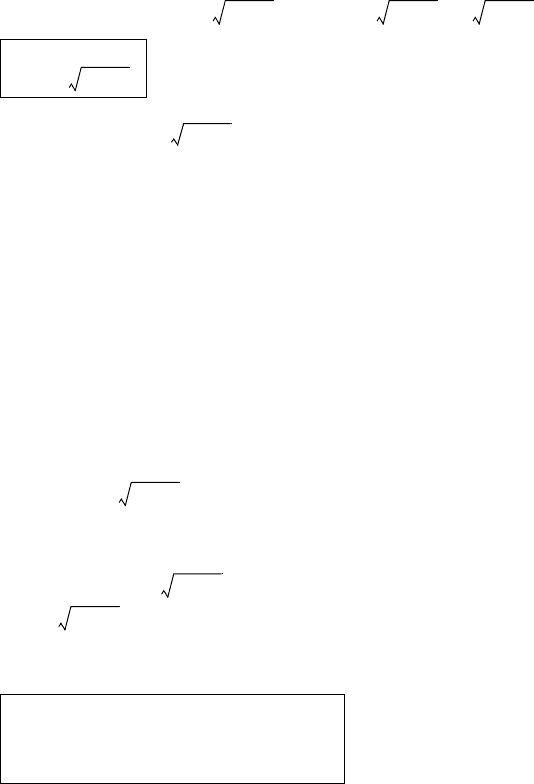
Let an object (e.g. a clock) be located at position , which emits signals at
different times with . Then for system Σ’ one has
.
(A.6.29)
From the perspective of the moving system, the temporal distance appears
expanded by the factor . Therefore, a clock runs slower and slower as it
moves faster and faster. This is the so-called time dilatation. This can be proven
experimentally, e.g., by means of very fast instable particles (radioactive decay),
where its half-life relative to an observer at rest is elongated versus its half-live in
the rest frame. There are so-called µ-mesons contained in high altitude radiation.
They are instable and very clearly show the effect of time dilatation. Time
dilatation is also the root cause of the so-called twin paradox.
A.6.3.3 Relativistic Addition of Velocities
Let a particle in the Σ’ system have the velocity . What is its
velocity in the Σ frame? First, using , gives
and
.
(A.6.30)
Therefore
.
(A.6.31)
Furthermore
,
and with eq. (A.6.30) we obtain
x
1
∆tt
2
t
1
–=
∆t' t
2
' t
1
'–
t
2
v
1
c
2
-----
x
1
–
t
1
v
1
c
2
-----
x
1
–
–
1 β
2
–
------------------------------------------------------------
t
2
t
1
–
1 β
2
–
-------------------
∆t
1 β
2
–
-------------------== = =
∆t'
∆t
1 β
2
–
-------------------
=
11β
2
–⁄
u' u
1
' u
2
' u
3
',,〈〉=
β vc⁄ v
1
c⁄==
u
1
dx
1
dt
--------
dx
1
'
dt'
--------- v
1
+
1 β
2
–
---------------------
dt'
dt
------
⋅==
dt'
dt
------
1
v
1
u
1
c
2
-----------–
1 β
2
–
--------------------
1 β
2
–
1
v
1
u
1
'
c
2
------------+
----------------------==
u
1
u
1
' v
1
+
1
v
1
u
1
'
c
2
------------+
----------------------
, u
1
'
u
1
v
1
–
1
v
1
u
1
'
c
2
------------–
---------------------
==
u
2
dx
2
dt
--------
dx
2
'
dt'
---------
dt'
dt
------
⋅ u
2
'
dt'
dt
------
,== = u
3
u
3
'
dt'
dt
------
=
A.6 Maxwell’s Equations and Relativity 625
.
(A.6.32)
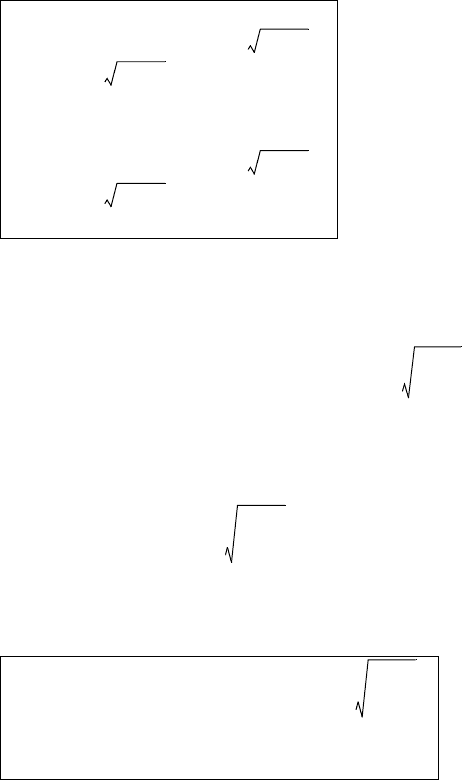
Eqs. (A.6.31) and (A.6.32) represent the relativistic theorem for addition of
velocities, which for small velocities ( ) reduces to the classical vector
addition ( ).
Consider a few special cases: For one has also .
If , then , where
and thus . Next, more general, let
then
,
(A.6.33)
where
.
(A.6.34)
Whereby
and
.
(A.6.35)
This means that an object (for example. light), moving with the speed of light, has
the same speed in every reference frame. This is, of course, necessary and was the
starting point of our reflections (Sect. 6.1). Nevertheless, the direction of the
motion (that is the propagation direction of e.g. light) depends on the reference
frame. This is the so-called aberration (of light), which is described by the
relations (A.6.34).
u
2
u
2
'
1
v
1
u
1
c
2
-----------–
1 β
2
–
--------------------
⋅ u
2
'
1 β
2
–
1
v
1
u
1
'
c
2
------------+
----------------------
⋅==
u
3
u
3
'
1
v
1
u
1
c
2
-----------–
1 β
2
–
--------------------
⋅ u
3
'
1 β
2
–
1
v
1
u
1
'
c
2
------------+
----------------------
⋅==
vc«
u
1
u
1
' v
1
u
2
u
2
' u
3
u
3
'=,=,+=
u' c 00,,〈〉= u c 00,,〈〉=
u'0c 0,,〈〉= u v
1
c 1
v
1
2
c
2
-----–0,,〈〉=
u
2
v
1
2
c
2
1 v
1
2
c
2
⁄–()+ c
2
==uc=
u' c α'cos c α'sin 0,,〈〉=
u
c α'cos v
1
+
1
v
1
α'cos
c
-------------------+
-----------------------------
c α'sin 1
v
1
2
c
2
-----–
1
v
1
α'cos
c
-------------------+
-----------------------------------
0,,〈〉c αcos c αsin 0,,〈〉==
αcos
α'cos
v
1
c
-----+
1
v
1
α'cos
c
-------------------+
-----------------------------= αsin
α'sin 1
v
1
2
c
2
-----–
1
v
1
α'cos
c
-------------------+
--------------------------------
=
αcos
2
αsin
2
+ α'cos
2
α'sin
2
+1==
uu' c==
626 Appendices
For , the velocity is independent of u’. This also is an
immediate and plausible consequence of the invariance of the speed of light.
A.6.3.4 Aberration and Doppler Effect
Consider a moving, point-like light source from which a spherical wave emerges
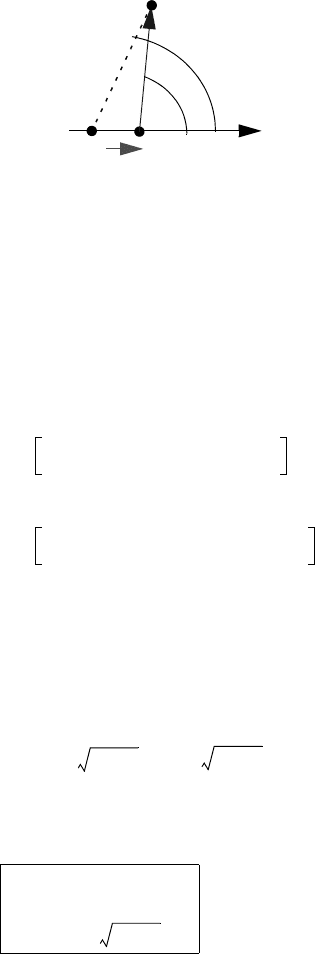
(Fig. A.6.1). At point P, an observer in the rest frame Σ sees it at the angle α, while
an observer moving with the light source (reference frame Σ’) sees the source at the
angle α’. The quantities measured then in Σ have the phase factor
and in Σ’, the phase factor is
.
These have to be compatible with the Lorentz transformation and mutually
transform into each other. This requires that
By comparing coefficients of t we find
(A.6.36)
that is, the angular frequency ω depends on the reference system.
This represents the so-called relativistic Doppler effect. Comparing coefficients of
and , while also considering (A.6.36), results in eq. (A.6.34), i.e. the
aberration of light.
v
1
c= u c 00,,〈〉=
Fig. A.6.1
α
r'
r
α'
x
v
1
P
i ωt
ω
c
----
x
1
αcos–
ω
c
----
x
2
αsin–
exp
i ω't'
ω'
c
-----
x
1
' α'cos–
ω'
c
-----
x
2
' α'sin–
exp
ω't'
ω'
c
-----
x
1
' α'cos–
ω'
c
-----
x
2
' α'sin–
ω' t
v
1
x
1
c
2
----------–
1 β
2
–
-----------------------------
ω' x
1
v
1
t–()
c 1 β
2
–
-----------------------------
α'cos–
ω'
c
-----
x
2
α'sin–=
ωt
ω
c
----
x
1
αcos–
ω
c
----
x
2
α .sin–=
ωω'
1
v
1
c
-----
α'cos+
1 β
2
–
-----------------------------
=
x
1
x
2

A.6 Maxwell’s Equations and Relativity 627
These results amount to the phase being relativistically invariant,
to which we will return in Sect. A.6.5.2.
A.6.4 Lorentz Transformation of Maxwell’s equations
The experiments mentioned in Sect. A.6.1 to determine the speed of the earth
within the absolute space (ether) had to fail, because electromagnetic waves in
vacuum propagate in all inertial systems with the same speed, the vacuum-speed of
light c. Ultimately, the reason for this is that the Maxwell equations are not Galilei
invariant, but Lorentz invariant, which was only revealed by, and understood in
light of Einstein’s theory of relativity. Today, we are able to realize that Maxwell’s
equations were, and still have to be, the starting point for relativity and, even
though it was not apparent when Maxwell stated them, his equations always
contained relativity. This is the reason why it is so important to show that the
Maxwell equations are indeed Lorentz invariant, that is, that these equations apply
unchanged in all inertial reference frames, as long as the field quantities (i.e. the
components of E and B) are transformed in a suitable manner.
To show this, we consider the two reference frames Σ and Σ’. In Σ we have
the coordinates r, t and the fields E(r,t), B(r,t), in Σ’ we have the coordinates r’, t’
and the fields E’(r’,t’), B’(r’,t’). We limit our examination to free space. Later we
will apply a generally applicable formalism which allows in an elegant way to treat
the general Maxwell equations. For the frame Σ, Maxwell’s equations apply in the
following form
.
(A.6.37)
The transformation of r, t by the Lorentz transformation to r’, t’ is not difficult but
tedious and therefore skipped here (this calculation can be found e.g. in Simonyi
[40]) and results again in Maxwell’s equations,
.
(A.6.38)
The transformation of the field components is as follows:
kr•ωt–
B∇×
1
c
2
-----
t∂
∂E
=
1
c
2
----- ε
0
µ
0
=
E∇×
t∂
∂B
–=
B∇• 0=
E∇• 0=
∇' B'×
1
c
2
-----
∂E'
∂t'
--------
=
∇' E'×
∂B'
∂t'
--------–=
∇' B'• 0=
∇' E'• 0=
628 Appendices
.
(A.6.39)
When using , this can be written in a more elegant form
.
(A.6.40)
Only the field components perpendicular to the velocity v change, while the
parallel ones remain unchanged. This is just the reverse from what was found for
the components of the location vector. This is no accident, as we shall see more
clearly. The nabla symbols for curl and divergence have a prime as a
reminder that E’ and B’ are functions of r’, t’, and therefore the derivative in eqs.
(A.6.38) is with respect to . Conversely, eqs. (A.6.40) are
independent of any particular coordinate system and apply for arbitrary velocities
.
The force on a particle in system Σ is f, and f ’ in system Σ’
.
(A.6.41)
This means that the forces on a particle have the same form in every reference
frame, i.e., they are calculated within their respective reference frame from the
electric and magnetic fields in the same way. Nevertheless . The equations
for the transformation of f will be provided in Sect. A.6.5.2, eq. (A.6.72), which
incidentally, can be used to derive the equations for the transformation of the
electromagnetic fields. The charge Q is scalar, i.e., is not transformed, which
means that . Remarkable and easy to verify is also that the two following
quantities are Lorentz invariant:
.
(A.6.42)
The reader shall be reminded of Sect. 6.1.2 and particularly eq. (6.6). Comparison
with A.6.40 reveals that there, if we consider that E is the electric field in the
moving frame, we had applied the non-relativistic approximation, i.e. the
approximation for velocities .
E
x
' E
x
,= E
y
'
E
y
v
1
B
z
–
1 β
2
–
-----------------------
,= E
y
'
E
z
v
1
B
y
+
1 β
2
–
-----------------------=
B
x
' B
x
,= B
y
'
B
y
v
1
c
2
-----
E
z
+
1 β
2
–
------------------------
,= B
y
'
B
z
v
1
c
2
-----
E
z
–
1 β
2
–
-----------------------=
v v
1
00,,〈〉=
E
||
' E
||
,= E
⊥
'
E
⊥
vB×+
1 β
2
–
---------------------------=
B
||
' B
||
,= B
⊥
'
B
⊥
1
c
2
-----
vE×–
1 β
2
–
--------------------------------=
∇' ×∇' •
r' x
1
' x
2
' x
3
',,〈〉=
v v
1
v
2
v
2
,,〈〉=
f Q EuB×+()=
f ' Q E' u' B'×+()=
ff'≠
QQ'=
B'
2
1
c
2
-----
E'
2
– B
2
1
c
2
-----
E
2
,–= E' B'• EB•=
v
1
c 1 β
2
–1→,«
A.6 Maxwell’s Equations and Relativity 629
Furthermore, the reader shall be reminded of Appendix A.4. There, we have
introduced to the Liénard-Wiechert potentials and calculated the problem of a
uniformly moving charge as a specific example. Within the moving frame, the
particle exhibits exclusively an electric Coulomb field and no magnetic field. The
just provided transformation allows one to obtain the electric and the magnetic
field, as experienced by the observer at rest. Carrying out the transformation yields
precisely the field obtained in Appendix A.4, which demonstrates the fact that
Maxwell’s equations automatically provide the relativistically correct result. This
result is limited to the special case of constant velocities because the Lorentz
transformation is valid only for inertial systems, but not for accelerated reference
frames. We will return in Sect. A.6.6.4 to the discussion of a charge of uniform
velocity.
We will carry out the transformation of the fields in a more systematic and
more elegant manner. Thereby, it will be revealed that the field components are
simply components of an anti-symmetric four-dimensional tensor of rank two
(which possesses just six independent components). From this follows immediately
how to transform the field components. Moreover, this tensor allows one to express
Maxwell’s equations in a particularly compact and elegant form, which
furthermore, makes its Lorentz invariance instantly plausible. This requires to
occupy ourselves with the four-dimensional vectors of the Minkowski space (the
so-called 4-vectors) and their corresponding Four-tensors, i.e., the tensor products
of the 4-vectors.
A.6.5 4-Vectors and 4-Tensors
A.6.5.1 Definitions
When changing the reference frame of a 4-vector
,
(A.6.43)
where the fourth component is , then the Lorentz transform
(A.6.44)
is applied and it holds that
.
(A.6.45)
Generally, only vectors that transform in this manner are called 4-vectors
.
(A.6.46)
Quantities which transform like multiple products of the components of 4-vectors
are called tensors of the respective rank. The expressions
r ict,〈〉x
1
x
2
x
3
x
4
,,,〈〉=
x
4
ict=
LL
ik
()=
x
i
' L
ik
x
k
k 1=
4
∑
=
a
i
' L
ik
a
k
k 1=
4
∑
=

630 Appendices
,
(A.6.47)
, (A.6.48)
represent a tensor of rank 2, rank 3, etc. In this sense, a 4-vector is a tensor of rank
1. A scalar quantity is a tensor of rank zero, for which
.
(A.6.49)
The scalar product (corresponding to the summation over a common index, which
is also referred to as rank reduction) reduces the rank of the tensor by one each
time. The scalar product of two 4-vectors represents an invariant scalar
quantity. The scalar product of a 4-vector and a 4-tensor of rank two
yields a 4-vector, etc.
The coefficients of the Lorentz transform for are given by
(A.6.24) and by (A.6.27) for .
A.6.5.2 Some Important 4-Vectors
An important vector in the three-dimensional space is the -vector. In the four-
dimensional space it becomes a 4-vector:
,
(A.6.50)
Now, we explore the continuity equation (1.58) in this context
,
which is nothing else than the four-dimensional divergence of the 4-vector of the
current density or short 4-current density
.
(A.6.51)
It is a very remarkable and consequential result that the three components of the
current density, together with icρ (that is the volume charge density, for the most
part) form a 4-vector. That this is true, can be shown on one hand, but is also a
result of the fact that the divergence of the 4-vector vanishes, i.e. it is invariant.
The Lorentz gauge (eq. (7.186)) represents a four-dimensional divergence
.
(A.6.52)
b
ik
'
L
il
L
km
b
lm
m 1=
4
∑
l 1=
4
∑
=
c
ikl
'
L
im
L
kn
L
lp
c
mnp
p 1=
4
∑
n 1=
4
∑
m 1=
4
∑
=
dd'=
a
i
b
i
i 1=
4
∑
a
i
b
ik
i 1=
4
∑
v v
1
00,,〈〉=
v v
1
v
2
v
2
,,〈〉=
∇
∇
∂
∂x
1
--------
∂
∂x
2
--------
∂
∂x
3
--------
∂
∂x
4
--------
,,,〈〉
∂
∂x
1
--------
∂
∂x
2
--------
∂
∂x
3
--------
1
ic
----
∂
∂t
----
,,,〈〉 ==
∇ g
∂ρ
∂t
------+•
∂
∂x
1
--------
g
x1
∂
∂x
2
--------
g
x2
∂
∂x
3
--------
g
x3
1
ic
----
∂
∂t
----
icρ()+++ 0==
g icρ,〈〉g
x1
g
x2
g
x3
icρ,,,〈〉 =
A∇• µ
0
ε
0
t∂
∂ϕ
+ A∇•
1
c
2
-----
t∂
∂ϕ
+=
∂
∂x
1
--------
A
x1
∂
∂x
2
--------
A
x2
∂
∂x
3
--------
A
x3
1
ic
----
∂
∂t
----
icϕ
c
2
--------
+++ 0==
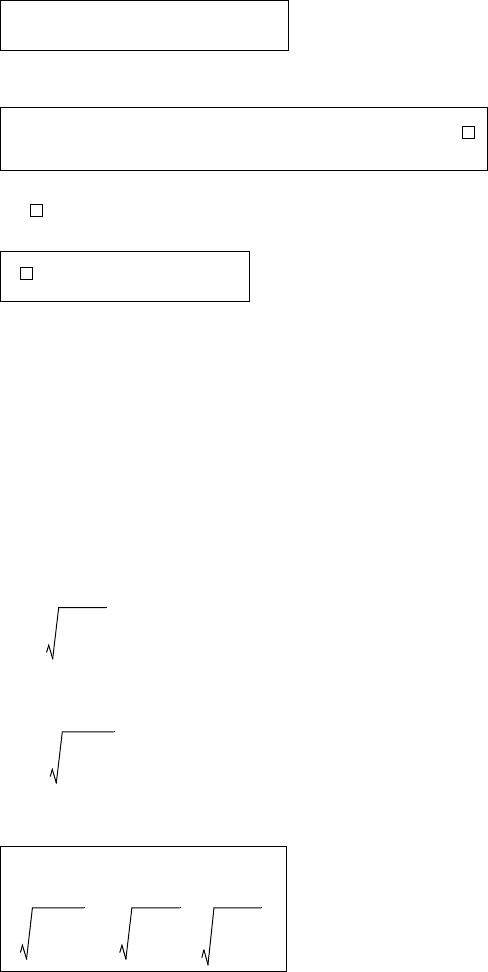
A.6 Maxwell’s Equations and Relativity 631
This brings to light the fact, that the vector potential, together with
as its fourth component forms a 4-potential,
.
(A.6.53)
The scalar product of the four-dimensional -vector with itself yields the four-
dimensional analogue to the Laplacian
.
(A.6.54)
This scalar operator is the d'Alembertian and frequently represented by the square
symbol . This allows to combine the two inhomogeneous wave equations
(7.187) and (7.188) into a single equation:
.
(A.6.55)
This represents the four-dimensional inhomogeneous wave equation for the 4-
potential with the 4-current density as its inhomogeneity. It illustrates in a simple
way that here we have Lorentz-invariant equations.
The Lorentz gauge resulted in a four-dimensional divergence, which means it
is Lorentz invariant. This poses an advantage over other gauges which are not
Lorentz invariant.
Another important 4-vector, particularly for mechanical applications, is the 4-
momentum. Consider a particle in the reference frame Σ with the rest mass and
the velocity . u is used to distinguish the particle velocity from
the relative velocity v of the two reference frames Σ and Σ’. We assign the
momentum vector
(A.6.56)
to the particle in system Σ. For the reference frame Σ’, the vector shall be
.
(A.6.57)
The relation between u and u’ is given by eqs. (A.6.31) and (A.6.32), which allow
to derive the interesting and oftentimes useful relation
.
(A.6.58)
Then reapplying eqs. (A.6.31) and (A.6.32) gives
A
x4
iϕ()c⁄=
A i
ϕ
c
---
,〈〉A
x1
A
x2
A
x3
i
ϕ
c
---
,,,〈〉 =
∇
∇∇•
∂
2
∂x
1
2
--------
∂
2
∂x
2
2
--------
∂
2
∂x
3
2
--------
1
c
2
-----
∂
2
∂t
2
-------
–++ ∇
2
1
c
2
-----
∂
2
∂t
2
-------
–– ===
A
iϕ
c
-----
,〈〉µ
0
g icρ,〈〉 –=
m
0
u u
1
u
2
u
3
,,〈〉=
p
m
0
u
1
u
2
c
2
-----–
-------------------=
p'
m
0
u'
1
u'
2
c
2
------–
--------------------=
1
1
u'
2
c
2
------–
--------------------
1
1
u
2
c
2
-----–
-------------------
1
u
1
v
1
c
2
-----------–
1
v
1
2
c
2
-----–
--------------------
⋅=
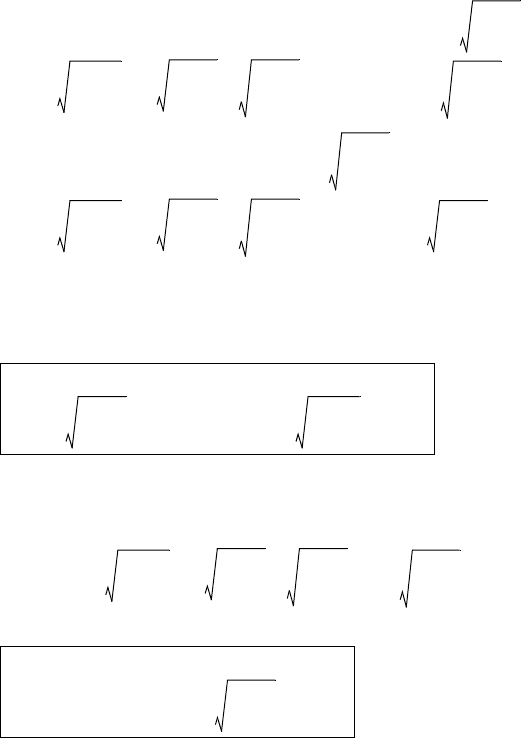
632 Appendices
.
(A.6.59)
We continue by introducing the masses m and m’, as well as the energies W and W’
in the frames Σ and Σ’, respectively.
,
(A.6.60)
with the relation
.
(A.6.61)
Comparison of eqs. (A.6.59) and (A.6.61) with (A.6.24) reveals that the vector
(A.6.62)
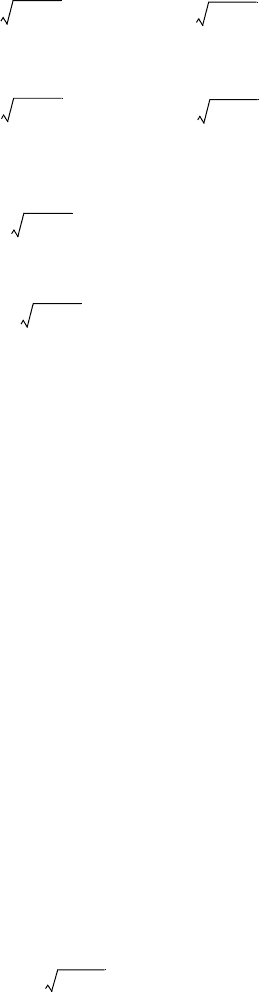
is a 4-vector. We call it the 4-momentum. The quantity m is the velocity dependent
mass, which depends on the reference frame, along with the speed u of the particle.
W is the particle’s energy, which also depends on the reference frame. Eq. (A.6.60)
contains the famous Einstein relation between mass and energy ( ) and
the known relation between and . Now, the background and the reasons for
these relations becomes apparent, which rest in the fact that the vector (A.6.62) is a
4-vector. For very small velocities u, its three spatial components give the classical
momentum , which justifies the name 4-momentum.
The rest mass is invariant, the just defined velocity dependent mass is not,
however. Dividing the 4-momentum by gives another 4-vector, the so-called 4-
velocity
p
1
'
m
0
u
1
'
1
u'
2
c
2
------–
--------------------
m
0
1
u
2
c
2
-----–
-------------------
1
u
1
v
1
c
2
-----------–
1
v
1
2
c
2
-----–
--------------------
u
1
v
1
–
1
u
1
v
1
c
2
-----------–
--------------------
⋅⋅
p
1
m
0
v
1
1
u
2
c
2
-----–
-------------------–
1
v
1
2
c
2
-----–
-------------------------------== =
p
2
'
m
0
u
2
'
1
u'
2
c
2
------–
--------------------
m
0
1
u
2
c
2
-----–
-------------------
1
u
1
v
1
c
2
-----------–
1
v
1
2
c
2
-----–
--------------------
u
2
1
v
1
2
c
2
-----–
1
u
1
v
1
c
2
-----------–
--------------------
⋅
m
0
u
2
1
u
2
c
2
-----–
------------------- p
2
== ==
p
3
' p
3
=
m
m
0
1
u
2
c
2
-----–
-------------------
W
c
2
-----
,== m'
m
0
1
u'
2
c
2
------–
--------------------
W'
c
2
------
==
m'
W'
c
2
------
m
0
1
u'
2
c
2
------–
--------------------
m
0
1
u
2
c
2
-----–
-------------------
1
u
1
v
1
c
2
-----------–
1
v
1
2
c
2
-----–
--------------------
⋅
p
1
v
1
c
2
-----
–
W
c
2
-----+
1
v
1
2
c
2
-----–
----------------------------== = =
p
iW
c
-------
,〈〉m u ic,()
m
0
1
u
2
c
2
-----–
-------------------
u ic,〈〉 ==
Wmc
2
=
mm
0
m
0
u
m
0
m
0
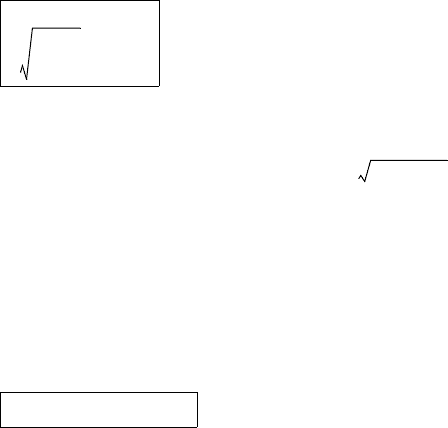
A.6 Maxwell’s Equations and Relativity 633
.
(A.6.63)
Conversely, dividing the 4-momentum by m gives another vector (u,ic), but this is
not a 4-vector. The velocity u can not be regarded as part of a 4-vector. Eqs.
(A.6.31) and (A.6.32) also reveal that u transforms rather differently than the
spatial part of the 4-vector. Only the factor creates a 4-vector.
The absolute value of the 4-momentum is invariant, of course,
.
for and we obtain
.
Rearranging reveals the important relation which we have used before, eq. (A.1.7):
.
(A.6.64)
When specifically considering electromagnetic radiation, one finds that it also
possesses momentum and energy, where both are proportional to each other.
Expressing both for a light quantum (which is not necessary to do), we get
(A.6.65)
and the 4-vector of the momentum becomes
.
(A.6.66)
Consequently,
(A.6.67)
is a 4-vector whose fourth component is, essentially, the angular frequency. We
might call it the 4-vector of the wave number whose scalar product is invariant
with the 4-vector of the location.
.
(A.6.68)
This invariance is nothing else than the phase, whose invariance we have already
noted in A.6.3.4. Furthermore:
.
(A.6.69)
We obtain the dispersion relation, which is of course invariant as well.
Another 4-vector is the 4-force
1
1
u
2
c
2
-----–
-------------------
u ic,〈〉
1/ 1 u
2
c
2
⁄– ()
p
2
W
2
c
2
-------–invariant=
Wm
0
c
2
=
p
0=
p
2
W
2
c
2
-------– m
0
2
c
2
–=
W
2
m
0
2
c
4
p
2
c
2
+=
p Ñk ,= E Ñω=
Ñ k
iω
c
------
,〈〉
k
iω
c
------
,〈〉
k
iω
c
------
,〈〉r ict,()• kr•ωt–invariant==
k
iω
c
------
,〈〉
2
k
2
ω
2
c
2
------– invariant 0== =