
Lehner G. Electromagnetic Field Theory for Engineers and Physicists
Подождите немного. Документ загружается.

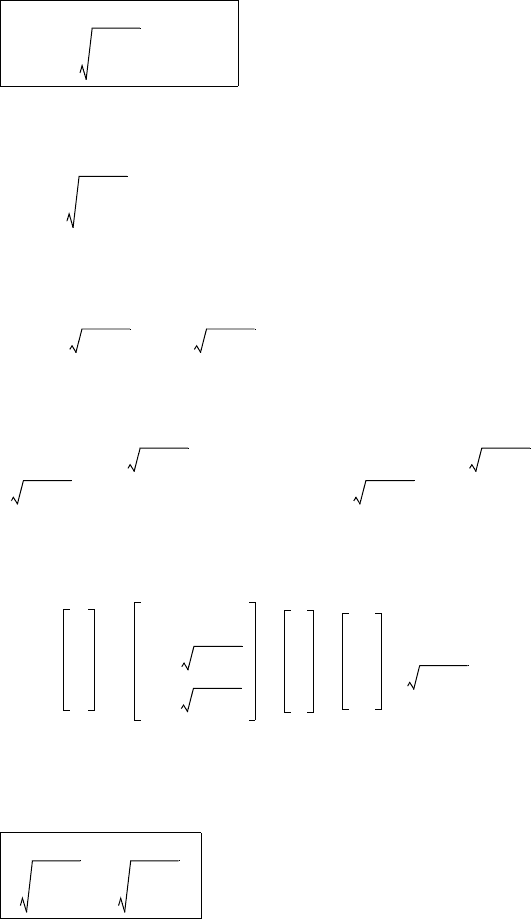
634 Appendices
.
(A.6.70)
W is the particle energy, introduced with eq (A.6.60) and f the 3-force. With this,
we have the relativistic equation of the motion
.
(A.6.71)
Note that f does not represent the spatial part of the 4-force and does not transform
like that. Rather, it results in (see e.g. [45], p 296ff):
(A.6.72)
This transformation allows for a very remarkable rearrangement
. (A.6.73)
Suppose e.g. that , then the transformed force f’ contains the Lorentz
force in the form of the customary vector product . However, any other
arbitrary force results in a force analogous to the Lorentz force.
Finally, the 4-acceleration shall be mentioned as well:
.
(A.6.74)
Here again, the 3-acceleration does not constitute the spatial part of the 4-
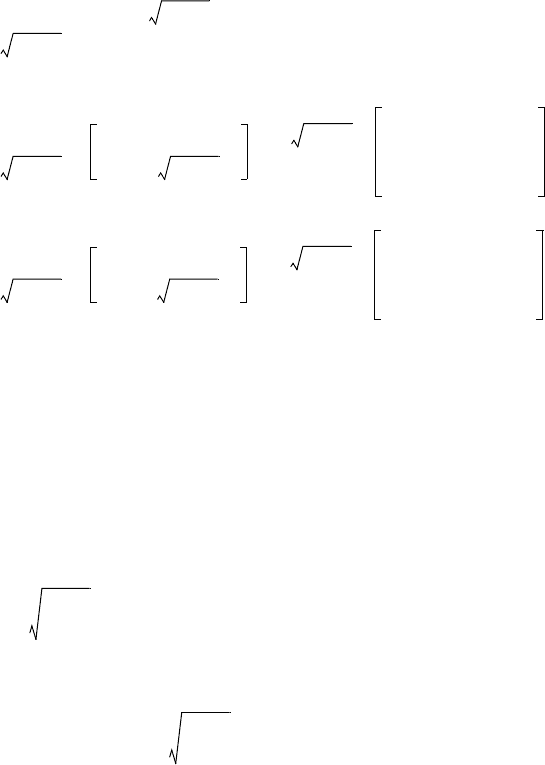
acceleration. The transformation of b yields (see e.g., [45], p 296)
F
1
1
u
2
c
2
-----–
-------------------
f
i
c
--
dW
dt
--------
,〈〉 =
f
d
dt
-----
m
0
u
1
u
2
c
2
-----–
-------------------
=
f
x
' f
x
vu
y
'
c
2
1 β
2
–
------------------------
f
y
–
vu
z
'
c
2
1 β
2
–
------------------------
f
z
– f
x
vu
y
c
2
1
vu
x
c
2
--------–
----------------------------
f
y
–
vu
z
c
2
1
vu
x
c
2
--------–
----------------------------
f
z
–==
f
y
'
1
vu
x
'
c
2
---------+
1 β
2
–
-------------------
f
y
1 β
2
–
1
vu
x
c
2
--------–
-------------------
f
y
; == f
z
'
1
vu
x
'
c
2
---------+
1 β
2
–
-------------------
f
z
1 β
2
–
1
vu
x
c
2
--------–
-------------------
f
z
==
f '
f
x
'
f
y
'
f
z
'
f
x
f
y
1 β
2
–()⁄
f
z
1 β
2
–()⁄
u
x
'
u
y
'
u
z
'
0
f
z
f
y
–
v
c
2
1 β
2
–
------------------------
×+==
f QE=
QuB×
1
1
u
2
c
2
-----–
-------------------
d
dt
-----
u ic,〈〉
1
u
2
c
2
-----–
-------------------
⋅
b
du
dt
------=
A.6 Maxwell’s Equations and Relativity 635
(A.6.75)
These equations for the transformation of b contain a portion that is in the form of
a vector product, similarly to eqs. (A.6.73) for f before.
Clearly, for , it is both, and .
If the force f can be expressed by a potential, i.e., can be expressed by the
potential energy U, then
(A.6.76)
and the equation of the motion takes the following form
.
(A.6.77)
Multiplying by gives
.
We also have
b
x
'
1
vu
x
'
c
2
---------+
1 β
2
–
-------------------
3
b
x
1 β
2
–
1
vu
x
c
2
--------+
-------------------
3
b
x
==
b
y
'
1
vu
x
'
c
2
---------+
1 β
2
–
-------------------
2
b
y
vu
y
'
c
2
1 β
2
–
------------------------
b
x
+
1 β
2
–
1
vu
x
c
2
--------–
-------------------
2
b
y
vu
y
c
2
1
vu
x
c
2
--------–
----------------------------
b
x
+==
b
z
'
1
vu
x
'
c
2
---------+
1 β
2
–
-------------------
2
b
z
vu
z
'
c
2
1 β
2
–
------------------------
b
x
+
1 β
2
–
1
vu
x
c
2
--------–
-------------------
2
b
z
vu
z
c
2
1
vu
x
c
2
--------–
----------------------------
b
x
+==
c ∞→ f ' f= b' b=
∇U– f=
∇U–
d
dt
-----
m
0
u
1
u
2
c
2
-----–
-------------------
=
u
dx
dt
------=
∇U–
dx
dt
------
•
dU
dt
-------– u
d
dt
-----
m
0
u
1
u
2
c
2
-----–
-------------------
•==
636 Appendices
and
,
(A.6.78)
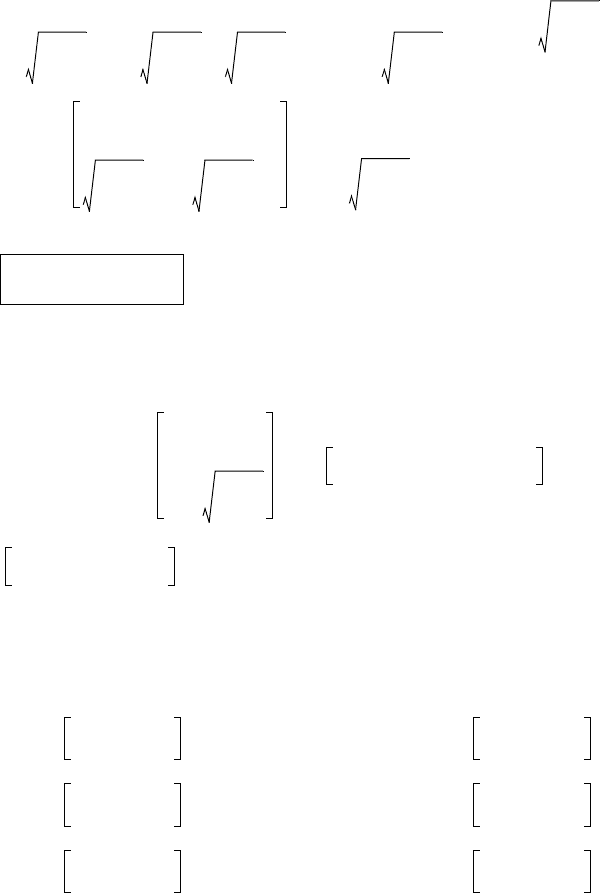
that is, , the sum of potential and kinetic energy, including rest energy of
the particle is a conserved quantity. This represents a relativistic
generalization of the related theorem of classical mechanics, which results when
the velocities approach zero:
.
(A.6.79)
A.6.5.3 Field Tensor F
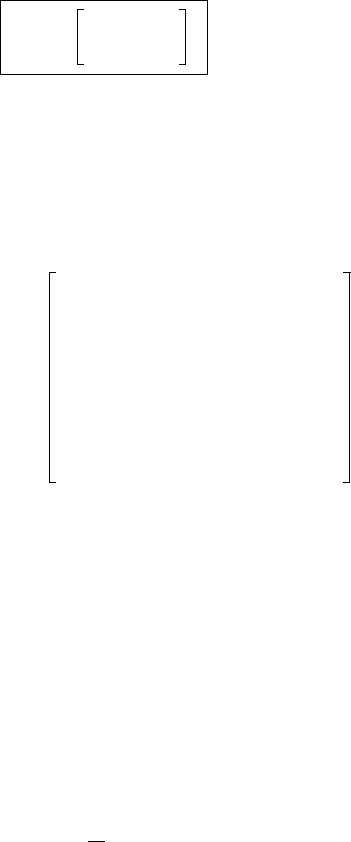
The 4-potential allows to calculate all components of B and E.
(A.6.80)
All these quantities are formally calculated like the components of the curl of a
vector. Naturally, in the three-dimensional space, there are only three components,
which can also be expressed by a three-dimensional vector (simply the curl) even
though curl does not constitute an ordinary vector. For the four-dimensional space,
u
d
dt
-----
m
0
u
1
u
2
c
2
-----–
-------------------
•
d
dt
-----
m
0
u
2
1
u
2
c
2
-----–
-------------------
m
0
u
1
u
2
c
2
-----–
-------------------
du
dt
------
•–
d
dt
-----
m
0
u
2
1
u
2
c
2
-----–
-------------------
d
dt
-----
m
0
c
2
1
u
2
c
2
-----–
+==
d
dt
-----
m
0
u
2
1
u
2
c
2
-----–
-------------------
m
0
c
2
1
u
2
c
2
-----–
1
u
2
c
2
-----–
---------------------------------+
d
dt
-----
m
0
c
2
1
u
2
c
2
-----–
-------------------
==
d
dt
-----
Umc
2
+()0 =
Umc
2
+
m
0
c
2
d
dt
-----
Umc
2
+()
d
dt
-----
U
m
0
c
2
1
u
2
c
2
-----–
-------------------+
d
dt
-----
Um
0
c
2
1
1
2
---
u
2
c
2
-----
…++
+==
d
dt
-----
Um
0
c
2
1
2
---
m
0
u
2
++≈ 0=
B
x1
∂A
x3
∂x
2
------------
∂A
x2
∂x
3
------------–=
B
x2
∂A
x1
∂x
3
------------
∂A
x3
∂x
1
------------–=
B
x3
∂A
x2
∂x
1
------------
∂A
x1
∂x
2
------------–=
;
E
x1
∂ϕ
∂x
1
--------–
∂A
x1
∂t
------------– ic
∂A
x4
∂x
1
------------
∂A
x1
∂x
4
------------–==
E
x2
∂ϕ
∂x
2
--------–
∂A
x2
∂t
------------– ic
∂A
x4
∂x
2
------------
∂A
x2
∂x
4
------------–==
E
x3
∂ϕ
∂x
3
--------–
∂A
x3
∂t
------------– ic
∂A
x4
∂x
3
------------
∂A
x3
∂x
4
------------–==
.
A.6 Maxwell’s Equations and Relativity 637
there are six such components, which sometimes are called a “6-vector”. In a sense,
this represents the curl of a vector in the four-dimensional space. Nevertheless, in
mathematical terms, this is a tensor of rank 2, a so-called field tensor with the
components
.
(A.6.81)
Each of the two terms in this summation, individually embodies a tensor of rank 2
in the sense of (A.6.47), i.e., it constitutes a tensor product of the four-dimensional
-vector and the 4-potential. The field tensor is anti-symmetric and its
components have the following property:
,
(A.6.82)
namely, it has six independent components, which by (A.6.80), essentially, are just
the components of E and B
.
(A.6.83)
It is obvious, even without further calculation, how the field components
transform, namely as of (A.6.47). For the simple case of , we obtain
the same result as eqs. (A.6.39) and (A.6.40), respectively, which can easily be
verified by substitution.
Strictly speaking, the components of the curl of a three-dimensional vector
(as well as the vector product of two vectors) are also the components of an anti-
symmetric tensor of rank 2.
Next we take Maxwell’s equations
(A.6.84)
F
ik
∂A
x
k
∂x
i
-----------
∂A
x
i
∂x
k
----------– =
∇
F
ik
F
ki
,–= F
ii
0=
F
0+B
x3
B
x2
–
i
c
--
E
x1
–
B
x3
–0+B
x1
i
c
--
E
x2
–
+B
x2
B
x1
–0
i
c
--
E
x3
–
i
c
--
E
x1
i
c
--
E
x2
i
c
--
E
x3
0
=
v v
1
00,,〈〉=
B∇× µ
0
g
1
c
2
-----
∂E
∂t
-------
+=
E∇•
ρ
ε
0
-----=
E∇×
t∂
∂B
–=
B∇• 0=

638 Appendices
and reformulate them by means of F. When substituting the respective tensor
components of (A.6.83) into (A.6.84), then from the third and the fourth equation
we obtain
These four equations can be combined into a single equation
(A.6.85)
where represent the number sequences , , , or
, (that is, they are three different numbers out of the range 1 .. 4 in cyclical
arrangement). The first two equations of (A.6.84) yield
.
(A.6.86)
The components of the first equation are obtained for , while for
one gets the components of the second equation. As for eq. (A.6.85), this represents
a tensor of rank 3. Eq. (A.6.86) is a vector equation. The term on the left originates
from the field tensor by taking the divergence (namely, by the scalar product with
the four-dimensional -vector). This constitutes a reduction of the tensor’s rank
by one and thus creates a vector out of the field tensor (rank 2). The vector on the
right side is essentially the 4-current density.
Both, eq. (A.6.85) and (A.6.86) provide a representation of Maxwell’s
equations that is very elegant, and immediately reveals their Lorentz invariance.
However, this form is also very abstract and due to its unfamiliarity, it has lost the
conceptual clarity of the customary form of Maxwell’s equations. Both forms are
entirely equivalent. One is advised to employ both, depending on the type of
problem to be solved.
The purpose of this Appendix is not to generalize and re-write the entire field
theory in a relativistic form. This has been done by various authors which are listed
for further reference [40 - 51]. Here, we will limit ourselves to a few simple
problems with the intent to further clarify the terminology and their
interdependence.
∂F
34
∂x
2
------------
∂F
42
∂x
3
------------
∂F
23
∂x
4
------------++ 0=
∂F
41
∂x
3
------------
∂F
13
∂x
4
------------
∂F
34
∂x
1
------------++ 0=
∂F
12
∂x
4
------------
∂F
24
∂x
1
------------
∂F
41
∂x
2
------------++ 0=
∂F
23
∂x
1
------------
∂F
31
∂x
2
------------
∂F
12
∂x
3
------------++ 0 .=
∂F
kl
∂x
i
-----------
∂F
li
∂x
k
----------
∂F
ik
∂x
l
-----------++ 0 =
ikl,,() 123,,()234,,()341,,()
412,,()
∂
∂x
k
--------
F
ik
k 1=
4
∑
µ
0
g icρ,〈〉 =
i 123,,= i 4=
∇
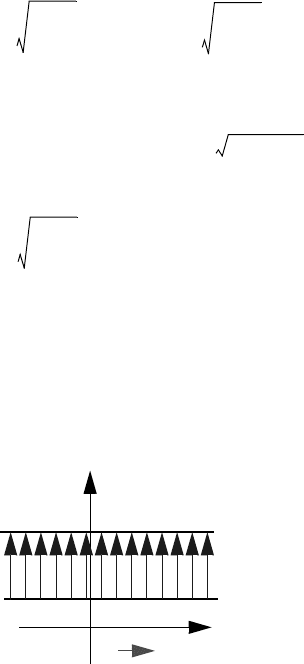
A.6 Maxwell’s Equations and Relativity 639
A.6.6 Examples
A.6.6.1 Surface Charges and their Fields
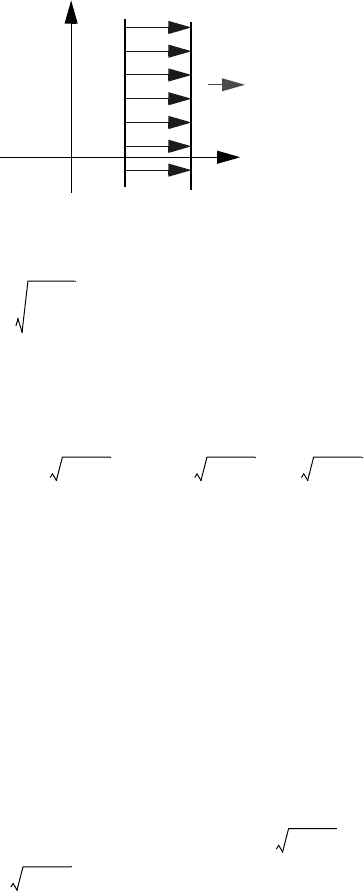
Consider two infinite, parallel planes carrying the uniform surface charge
(Fig. A.6.2). This causes a uniform field between the planes with the magnitude
. Now we observe the situation from within a reference frame Σ’,
which moves with the constant velocity v in the direction parallel to the -axis.
The question is now, what field is observed from within the moving frame?
First, we note that the entire charge inside a volume is relativistically
invariant. This is a well verified, a very important, and a seemingly trivial result.
Nevertheless, charge densities are not invariant, which can also be seen from the
fact that it occurs as the fourth component of a 4-vector. Applying the Lorentz
transformation (A.6.24) to (A.6.51) for gives
.
(A.6.87)
Focusing on the surface elements of the charged plane (Fig. A.6.2), we find that the
charge of such a surface element is invariant. From the moving system’s
perspective, a surface element is shortened in the direction of the motion due to the
Lorentz contraction by a factor . The surface charge density is
therefore increased by the same factor
,
(A.6.88)
which can easily be found by taking the limit of (A.6.87). Both equations, (A.6.87)
and (A.6.88) can therefore be apprehended conceptually as a consequence of the
Lorentz contraction. Naturally, along with increasing goes an increase of
by the same factor
σ±
Fig. A.6.2
+σ
x
2
v
σ–
E
x
2
x
1
E
x
2
σε
0
⁄=
x
1
E
x
'
2
g 0=
ρ'
ρ
1
v
2
c
2
-----–
------------------
,= g
x
1
ρv–
1
v
2
c
2
-----–
------------------=
1 v
2
c
2
⁄–
σ'
σ
1
v
2
c
2
-----–
------------------=
σ' E
x
'
2
640 Appendices
,
(A.6.89)
which conforms with the transformation equations (A.6.39) and (A.6.40), as
. From the perspective of system Σ’, the moving surface charges correspond
to surface current densities. Calculating their magnetic field yields
.
(A.6.90)
which agrees with eqs. (A.6.39) and (A.6.40). Of course, all fields vanish in the
outside space.
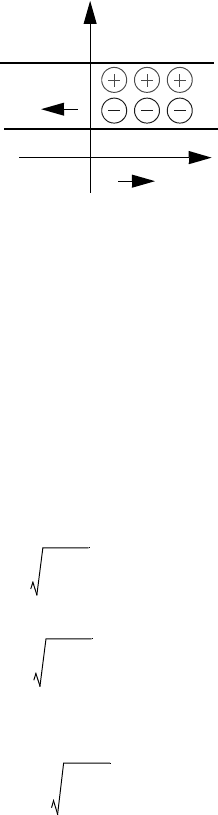
Next, we repeat the analysis for the situation depicted in Fig. A.6.3. Now the
charged surfaces are perpendicular to v, and therefore
(A.6.91)
and
,
(A.6.92)
whereby eq. (A.6.92) also agrees with (A.6.39) and (A.6.40).
Furthermore, (A.6.87) applies as well. Nonetheless, the applicable equation
for is (A.6.91) but not (A.6.88). The reason is that the surface charge is obtained
as the limit of a layer with finite extend.
.
(A.6.93)
The moving charges cause currents in the Σ’ frame, but for symmetry reasons,
these do not cause a magnetic field. Similarly, the equations of the transformation
do not yield a magnetic field because of . Instead of the fields, one might
transform the 4-potential. While in the Σ frame the vector potential is , in
the Σ’ frame we have :
E
x
'
2
E
x
2
1
v
2
c
2
-----–
------------------=
B 0=
B'
B'
x
3
vE
x
2
c
2
1 β
2
–
------------------------–
vσ
ε
0
c
2
1 β
2
–
------------------------------–
µ
0
vσ
1 β
2
–
-------------------–== =
Fig. A.6.3
+σ
x
2
v
σ–
E
x
1
x
1
σ' σ=
E
x
'
1
E
x
1
=
σ'
σρd ρ∞d 0→,→() ;= ρ'
ρ
1 β
2
–
-------------------=
d ' d 1 β
2
– ;= ρ'd ' ρd ,= σ' σ=
E||v
A 0=
A 0≠
A.6 Maxwell’s Equations and Relativity 641
.
(A.6.94)
We have realized already in Sect. (A.6.4) that the component of the location
vector which is parallel to the relative velocity u changes, while the component
perpendicular to it remains unchanged, and that this behavior is reversed for the
field components.
A.6.6.2 Currents and Volume Charges
If the 4-vector of the current density in the rest frame Σ is , then for
the reference frame Σ’ we have
.
(A.6.95)
Even if , it still is , namely
.
(A.6.96)
This might come as a surprise at first, but can be explained quite well on a
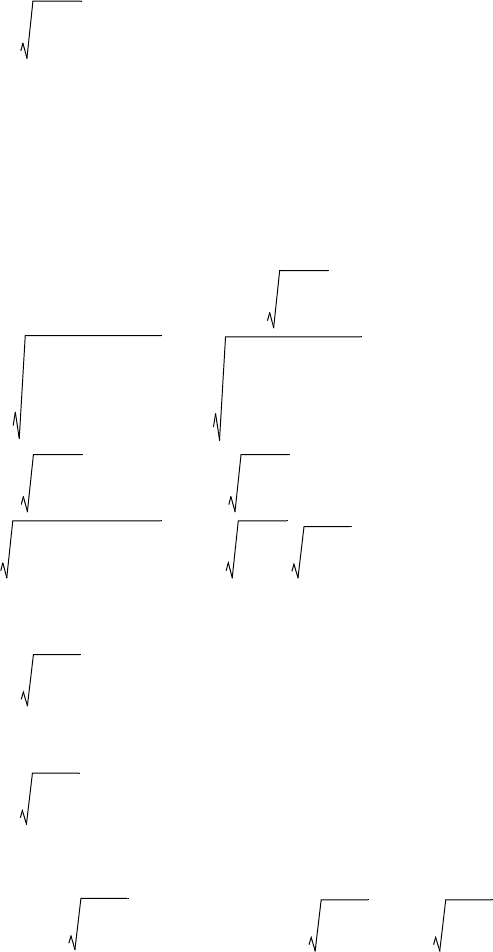
conceptual level. As an example, Fig. A.6.4 depicts a metallic conductor. From the
perspective of the rest frame Σ, it contains ions and electrons with the volume
charge densities and . The electrons travel in negative -direction with
the velocity . The total charge density is . The question is now what
is the perspective of an observer in a reference frame that moves with velocity v in
the positive -direction? First, the volume charge density of the electrons in their
own reference frame (within which they are at rest) is
A' A
x
'
1
x
1
'()00,,〈〉 ;= B' ∇' A'× 0==
g
x
1
00icρ,,,〈〉
g
x
'
1
1
1
v
2
c
2
-----–
------------------
g
x
1
vρ–(),= g
x
'
2
0,= g
x
'
3
0=
icρ'
1
1
v
2
c
2
-----–
------------------
ivg
x
1
c
------------– icρ+
=
ρ 0= ρ'0≠
ρ'
vg
x
1
c
2
1
v
2
c
2
-----–
------------------------–=
Fig. A.6.4
x
2
v
x
1
u
e
+ρ
0
ρ
0
– x
1
u
e
ρ
0
ρ
0
–0=
x
1
642 Appendices
.
The velocity of the observer relative to the rest system of the electrons is given by
eq. (A.6.31) as
.
Therefore, in the reference frame Σ’ of the moving observer we have for the
electrons
.
The volume charge density for the ions is
.
This makes the total charge density in the moving system Σ’
,
which agrees with (A.6.96). For one finds:
ρ
0e
ρ
0
1
u
e
2
c
2
-----––=
vu
e
+
1
vu
e
c
2
--------+
------------------
ρ
e
' ρ
0e
1
1
1
c
2
-----
vu
e
+
1
vu
e
c
2
--------+
------------------
2
–
---------------------------------------------
ρ
0
1
u
e
2
c
2
-----–
1
1
c
2
-----
vu
e
+
1
vu
e
c
2
--------+
------------------
2
–
---------------------------------------------–==
ρ
0
1
u
e
2
c
2
-----–1
vu
e
c
2
--------+
1
v
2
c
2
-----–
u
e
2
c
2
-----–
v
2
u
e
2
c
4
-----------+
-------------------------------------------------–
ρ
0
1
u
e
2
c
2
-----–1
vu
e
c
2
--------+
1
u
e
2
c
2
-----–1
v
2
c
2
-----–
-------------------------------------------------–==
ρ
e
' ρ
0
1
vu
e
c
2
--------+
1
v
2
c
2
-----–
------------------
–=
ρ
i
'+ρ
0
1
1
v
2
c
2
-----–
------------------
=
ρ' ρ
i
' ρ
e
'+
ρ
0
1
v
2
c
2
-----–
------------------
11–
vu
e
c
2
--------–
ρ
0
vu
e
c
2
1
v
2
c
2
-----–
------------------------–
vg
x
1
c
2
1
v
2
c
2
-----–
------------------------–== = =
g
x
1
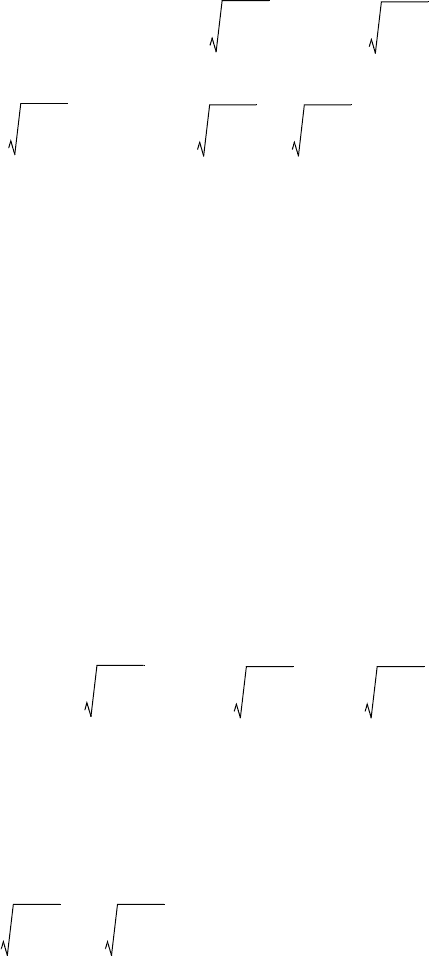
A.6 Maxwell’s Equations and Relativity 643
,
(A.6.97)
which agrees with (A.6.95) for . Of course, the magnitude of the current
density 4-vector is invariant, i.e., for we have
.
(A.6.98)
A.6.6.3 Force of a Current on a moving Charge
If, instead, we replace the observer who moves with velocity v, by a charged
particle, then a force is exerted on this particle. In the system where the conductor
is at rest, this is caused by its magnetic field in the form of the Lorentz force. Now,
there is no electric force because of . Conversely, there exists no Lorentz
force in the reference frame where the charged particle is at rest. Instead, now there
exist an electric field which is created by the volume charges and which exerts a
force on the particle. This electric field is purely radial
.
(A.6.99)
is the radius of the conductor and its cross-sectional area. Using from
eq. (A.6.96) gives
.
(A.6.100)
I represents the current in the rest sytem of the conductor. This results in
,
(A.6.101)
which is nothing else than the azimuthal component of the conductor’s magnetic
field in the rest system. Therefore
(A.6.102)
g
x
'
1
ρ
e
'
vu
e
+
1
vu
e
c
2
--------+
------------------
– ρ
i
'v– ρ
0
1
vu
e
c
2
--------+
1
v
2
c
2
-----–
------------------
vu
e
+
1
vu
e
c
2
--------+
------------------
⋅
ρ
0
v
1
v
2
c
2
-----–
------------------–==
g
x
'
1
ρ
0
1
v
2
c
2
-----–
------------------
vu
e
v–+()
ρ
0
u
e
1
v
2
c
2
-----–
------------------
g
x
1
1
v
2
c
2
-----–
------------------===
ρ 0=
ρ 0=
g
x
1
2
g
x
'
1
2
c
2
ρ'
2
–=
ρ 0=
E
r
'
r
0
2
πρ'
2πε
0
r
--------------=
r
0
r
0
2
πρ'
E
r
'
r–
0
2
π
2πε
0
r
--------------
vg
x
1
c
2
1
v
2
c
2
-----–
------------------------
⋅
vI–
2πε
0
r
ε
0
µ
0
--------------
1
v
2
c
2
-----–
----------------------------------
µ
0
vI–
2πr 1
v
2
c
2
-----–
----------------------------===
µ
0
I
2πr
--------- B
ϕ
=
E
r
'
vB
ϕ
–
1
v
2
c
2
-----–
------------------
vB×()
r'
1
v
2
c
2
-----–
------------------------==