
Lopes H.S., Cruz L.M. (eds.) Computational Biology and Applied Bioinformatics
Подождите немного. Документ загружается.


Computational Methods in Mass Spectrometry-Based Protein 3D Studies
137
Whenever information from crosslinking experiments is integrated within the modelling
procedure, the most common approach recurring in literature is its translation into distance
constraints (i.e. “hard”, fixed distances) or restraints (i.e. variable within an interval and/or
around a fixed distance with a given tolerance) involving atoms, in a full-atomistic
representation, or higher-order units, such as residues, secondary structure (SS) elements, or
domains, in coarse-grained models. A less common approach consists in the explicit
inclusion of the crosslinker atoms in the simulation.
2.2.2.1 Distance restraints
Distance restraints (DRs) are usually implemented by adding a penalty term to the scoring
function used to generate, classify or select the models, whenever the distance between
specified atom pairs exceeds a threshold value. In this way, associated experimental
information can be introduced rather easily and with moderate computational overheads in
all the molecular modelling and simulation approaches based on scoring functions.
However, since crosslinking agents are molecules endowed with well-defined and specific
conformational and interaction properties, both internal and with crosslinked molecules,
accurate theoretical and experimental estimates of distance ranges associated with the
corresponding cross-link agents only qualitatively correspond to experimentally-detected
distances between pairs of cross-linked residues (Green et al., 2001; Leitner et al., 2010).
Steric bumps, specific favourable or unfavourable electrostatic interactions, presence of
functional groups capable of promoting/hampering the crosslinking reaction and changes
in crosslinker conformational population under the effects of macromolecule are all possible
causes for observed discrepancies.
2.2.2.2 Explicit linkers
Explicit inclusion of crosslinkers in the systems, although potentially allowing to overcome
the limits of DRs, presently suffers from several drawbacks that limit its usage to either final
selection/validation stages, or to cases where a limited number of totally independent and
simultaneously holding crosslinks are observed. In fact, when many crosslinks are detected
in a system by MS analysis, they very often correspond to mixtures of different patterns,
because crosslinks can interfere each other either by direct steric hindrance, or by
competition for one of the macromolecule reacting groups, or by inducing deformation in
the linked system, thus preventing further reactions. However, the added information from
explicit crosslinkers may: i) allow disambiguation between alternative predicted binding
modes, ii) provide more realistic and strict estimates of the linker length to be used in
further stages of DR-based calculations, iii) help modelling convergence, iv) substantially
contribute to model validation.
An attempt to reproduce by an implicit approach at least the geometrical constraints
associated with a physical linker has been performed by developing algorithms to identify
minimum-length paths on protein surfaces (Potluri et al., 2004). This approach provides
upper/lower bounds to possible crosslinking distances on static structures but it only
worked on static structures as a post-modelling validation tool, and no further applications
have been reported so far.
3. Available computational approaches in MS3D
MS-based data can be used to obtain structural information on different classes of problems:
a. single conformational states (e.g. the overall fold);

Computational Biology and Applied Bioinformatics
138
b. conformational changes upon mutations/environmental modifications;
c. macromolecular aggregation (multimerization);
d. binding of small ligands to macromolecules.
Sampling efficiency and physical soundness of the scoring functions used during sampling
(stages S1/S2 of Fig. 1) and to select computed structures (stages F1/F2b and FF) generally
represent the main current limitations of 3D structure prediction and simulation methods. In
this view, introduction of experimental data represents a powerful approach to reduce the
geometrical space to be explored during sampling, and also an independent criterion to
evaluate the quality of selected models.
From a computational point of view, structural problems a)-d) translate into system-
dependent proper combinations of:
A. fold identification and characterization;
B. docking;
C. structural refinement and characterization of dynamic properties and of changes under
the effects of local or environmental perturbations.
Since the optimal combination of methods for a given problem depends upon a large
number of system- and data-dependent parameters, and the number of programs developed
for biomolecular simulations is huge, an exhaustive description and compared analysis of
methods for biomolecular structure generation/refinement is practically impossible.
However, we will try to offer a general overview of the main approaches to generate, refine
and select 3D structures in MS3D applications, with a special attention to possible ways of
introducing MS-based data and exploiting their full information content.
3.1 Fold identification and characterization
The last CASP (Critical Assessment of techniques for protein Structure Prediction)
experiment call (CASP9, 2010) classified modelling methods in two main categories:
“Template Based Modelling” (TBM) and “Template Free Modelling” (TFM), depending if
meaningful homology can be identified or not before modelling between the target sequence
and those of proteins/domains whose 3D structures are known (templates).
TFM represents the most challenging task because it requires the exploration of the widest
conformational space and heavily relies on scoring methods inspired by those principles of
physics governing protein folding (de novo or ab initio methods), eventually integrated by
statistical predictions, such as probabilities of interresidue contacts, surface accessibility of
single residues or local patches and SS occurrence. When number and quality of these
information increase, together with the extent of target sequence for which they are
available, “folding recognition” and “threading” techniques can be used, including a broad
range of methods at the interface between TFM and TBM. In these approaches, several
partial 3D structure “seeds” are generated by statistical prediction or distant homology
relationships, and their relative arrangements are subsequently optimized by strategies
deriving from de novo methods.
The most typical TBM approach, “comparative” or “homology” modelling (HM), uses
experimentally elucidated structures of related protein family members as “templates” to
model the structure of the protein under investigation (the “target”). Target sequence can
either be fully covered by one or more templates, exhibiting good homology over most of
the target sequence, or can require a “patchwork” of different templates, each best covering
a different region of the target.

Computational Methods in Mass Spectrometry-Based Protein 3D Studies
139
A further group of approaches, presently under active development and already exhibiting
good performances in CASP and other benchmark and testing experiments, is formed by the
“integrative” or “hybrid” methods. They combine information from a varied set of
computational and experimental sources, often acting as/based on “metaservers”, i.e.
servers that submit a prediction request to several other servers, then averaging their results
to provide a consensus that in many cases is more reliable than the single predictions from
which it originated. Some metaservers use the consensus as input to their own prediction
algorithms to further elaborate the models.
In order to provide some guidelines for structural prediction/refinement tasks in the
presence of MS-based data, a general procedure will be outlined for protein fold/structure
modelling. The starting step in protein modelling is usually represented by a search for
already structurally-characterized similar sequences. Sensitive methods for sequence
homology detection and alignment have been developed, based on iterative profile searches,
e.g. PSI-Blast (Altschul et al., 1997), Hidden Markov Models, e.g. SAM (K. Karplus et al.
1998), HMMER (Eddy, 1998), or profile-profile alignment such as FFAS03 (Jaroszewski et al.,
2005), profile.scan (Marti-Renom et al., 2004), and HHsearch (Soding, 2005).
When homology with known templates is over 40%, HM programs can be used rather
confidently. In this case, especially when alignments to be used in modelling have already
been obtained, local programs represent a more viable alternative to web-based methods
than in TFM processes. If analysis is limited to most popular programs and web services
capable of implementing user MS-based restraints (strategy S1 in Fig. 1), the number of
possible candidates considerably decreases. Among web servers, on the basis of identified
homologies with templates, Robetta is automatically capable of switching from ab initio to
comparative modelling, while I-TASSER requires user-provided alignment or templates to
activate comparative modelling mode. A very powerful, versatile and popular HM
program, available both as a standalone application, and as a web service, and embedded in
many modelling servers, is MODELLER (http://www.salilab.org/modeller/). It include
routines for template search, sequence and structural alignments, determination of
homology-derived restraints, model building, loop modelling, model refinement and
validation. MS-based distance restraints can be added to those produced from target-
template alignments, as well as to other restraints enforcing secondary structures, symmetry
or part of the structure that must not be allowed to change upon modelling. However, some
scripting ability is required to fully exploit MODELLER versatility.
The overall accuracy of HM models calculated from alignments with sequence identities of
40% or higher is almost always good (typical root mean square deviations (RMSDs) from
corresponding experimental structures less than 2Å). The frequency of models deviating by
more than 2Å RMSD from experimental structures rapidly increases when target–template
sequence identity falls significantly below 30–40%, the so-called “twilight zone” of HM (Blake
& Cohen, 2001; Melo & Sali, 2007). In such cases, the quality of resulting modelled structures
significantly increases by combining additional information, both of statistical origin, such as
SS prediction profiles, and from sparse experimental data (low resolution NMR or chemical
crosslinking, limited proteolysis, chemical/isotopical labelling coupled with MS).
If the search does not produce templates with sufficient homology and/or covering of the
target sequence, TFM or mixed TFM/TBM methods must be used. Many programs based on
ab initio, fold recognition and threading methods are presently offered as web services; this
is because very often they use a metaserver approach for some steps, need extensive
Computational Biology and Applied Bioinformatics
140
searches in large databases, require huge computational resources, or to better protect
underlying programs and algorithms, currently under very active development. Although
this may offer some advantages, especially to users less-experienced in biocomputing or
endowed with limited computing facilities, it may also imply strong limitations in the full
exploitation of the features implemented in the different methods, with particularly serious
implications in MS3D. Only few servers either include a NMR structure determination
module (not always suitable for MS-based data), or explicitly allow the optional usage of
user-provided distance restraints in the main input form. Fortunately, two of the most used
and versatile servers, Robetta (http://robetta.bakerlab.org/) and I-TASSER
(http://zhanglab.ccmb.med.umich.edu/I-TASSER/), good performers at the last CASP
rounds (http://predictioncenter.org/), allow input of distance restraints in the modelling
procedure, via a NMR-dedicated service for Robetta (Rosetta-NMR, suitable for working
with sparse restraint) (Bowers et al., 2000), or directly in the main prediction submission
page (I-TASSER). Other servers can still allow the implementation of MS-based information
in the model generation step if they can save intermediate results, such as sequence
alignments, SS or fold predictions. These latter, after addition of MS-based restraints, can be
then included into suitable modelling programs, to be run either locally or on web servers.
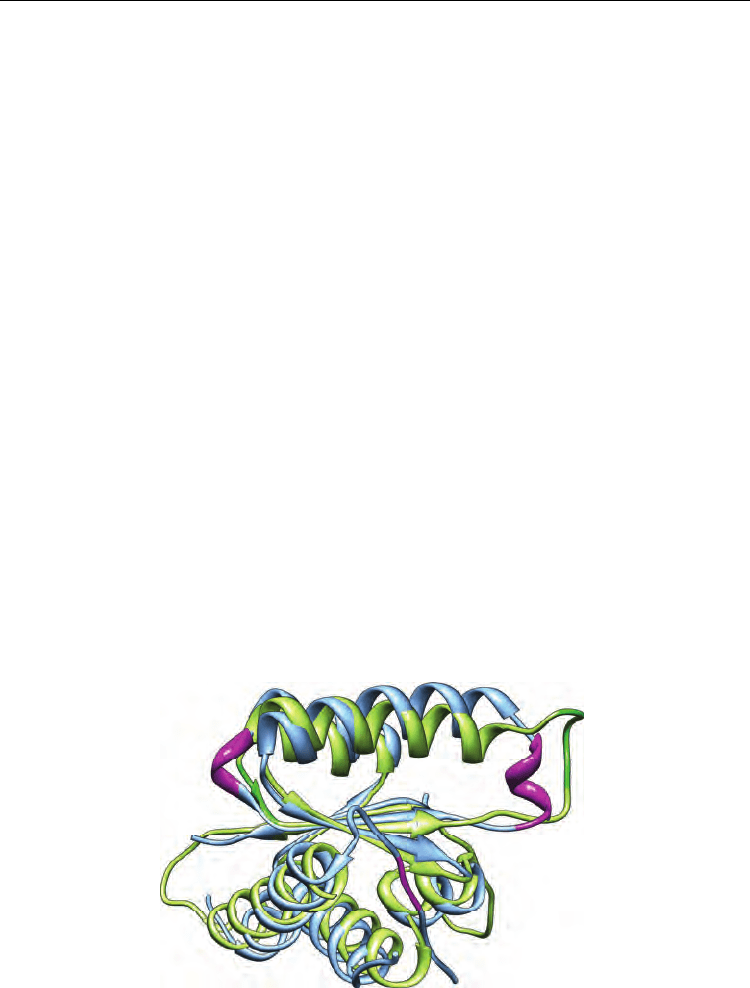
A successful examples of modelling with MS-based information in a low-homology case is
Gadd45β. A model was built, despite the low sequence identity (<20%) with template
identified by fold recognition programs, through the introduction of additional SS restraints,
which were based on SS profiles and experimental data from limited proteolysis and
alkylation reactions combined with MS analysis (Papa et al., 2007). Model robustness was
confirmed by comparison with the homolog Gadd45γ structure solved later (Schrag JD et al.,
2008), where the only divergence in SS profiles was the occurrence of two short 3
10
helices
(three residues each long) and an additional two-residues β-strand in predicted loop regions
(Fig. 2). Furthermore, this latter β-strand is so distorted that only a few SS assignment
programs could identify it, and the corresponding sequence in Gadd45β, predicted
unstructured and outside the template alignment, was not modelled at all.
Fig. 2. Comparison between the MS3D model of Gadd45β (light green) and the
crystallographic structure of its homolog Gadd45γ (light blue). Sequences with different SS
profiles are painted green in Gadd45β and magenta in Gadd45γ.

Computational Methods in Mass Spectrometry-Based Protein 3D Studies
141
3.2 Docking
Usually, methods for protein docking involve a six-dimensional search of the rotational and
translational space of one protein with respect to the other where the molecules are treated
as rigid or semirigid-bodies. However, during protein-protein association, the interface
residues of both molecules may undergo conformational changes that sometimes involve
not only side-chains, but also large backbone rearrangements. To manage at least in part
these conformational changes, protein docking protocols have introduced some degree of
protein flexibility by either use of "soft" scoring functions allowing some steric clash, or
explicit inclusion of domain movement/side chain flexibility. Biological information from
experimental data on regions or residues involved in complexation can guide the search of
complex configurations or filter out wrong solutions. Among the programs most frequently
used for protein-protein docking, recently reviewed by Moreira and colleagues (Moreira et
al., 2010), some of them can manage biological information and will be discussed in this
context.
In the Attract program (http://www.t38.physik.tu-muenchen.de/08475.htm ), proteins are
represented with a reduced model (up to 3 pseudoatoms per amino acid) to allow the
systematic docking minimization of many thousand starting structures. During the docking,
both partner proteins are treated as rigid-body and the protocol is based on energy
minimization in translational and rotational degrees of freedom of one protein with respect
to the other. Flexibility of critical surface side-chains as well as large loop movements are
introduced in the calculation by using a multiple conformational copy approach (Bastard et
al., 2006). Experimental data can be taken into account at various stages of the docking
procedure.
The 3D-Dock algorithm (http://www.sbg.bio.ic.ac.uk/docking/) performs a global scan of
translational and rotational space of the two interacting proteins, with a scoring function
based on shape complementarity and electrostatic interaction. The protein is described at
atomic level, while the side-chain conformations are modelled by multiple copy
representation using a rotamer library. Biological information can be used as distance
restraints to filter final complexes.
HADDOCK (http://www.nmr.chem.uu.nl/haddock/) makes use of biochemical or
biophysical interaction data, introduced as ambiguous intermolecular distance restraints
between all residues potentially involved in the interaction. Docking protocol consists of
four steps: 1) topology and structure generation; 2) randomization of orientations and rigid
body energy minimization; 3) semi-flexible simulated annealing (SA) in torsion angle space;
4) flexible refinement in Cartesian space with explicit solvent (water or DMSO). The final
structures are clustered using interface backbone RMSD and scored by their average
interaction energy and buried interface area. Recently, also explicit inclusion of water
molecules at the interface was incorporated in the protocol.
Molfit (http://www.weizmann.ac.il/Chemical_Services/molfit/) represents each molecule
involved in docking process by a 3-dimensional grid of complex numbers and estimates the
extent of geometric and chemical surface complementarity by correlating the grids using
Fast Fourier Transforms (FFT). During the search, contacts involving specified surface
regions of either one or both molecules are up- or down-weighted, depending on available
structural and biochemical data or sequence analysis (Ben-Zeev et al., 2003). The solutions
are sorted by their complementarity scores and the top ranking solutions are further refined
by small rigid body rotations around the starting position.

Computational Biology and Applied Bioinformatics
142
PatchDock (http://bioinfo3d.cs.tau.ac.il/PatchDock/) is based on shape complementarity.
First, the surfaces of interacting molecules are divided according to the shape in concave,
convex and flat patches; then, complementarity among patches are identified by shape-
matching techniques. The algorithm is a rigid body docking, but some flexibility is
indirectly considered by allowing some steric clashes. The resulting complexes are ranked
on the basis of the shape complementarity score. PatchDock allows integration of external
information by a list of binding site residues, thus restricting the matching stage to their
corresponding patches.
RosettaDock (http://rosettadock.graylab.jhu.edu/) try to mimics the two stages of a
docking process, recognition and binding, as hypothesized in Camacho & Vajda, 2001.
Recognition is simulated by a low resolution phase in which a coarse-grained representation
of proteins, with side chains replaced by single pseudoatoms, undergoes a rigid body Monte
Carlo (MC) search on translations and rotations. Binding is emulated by a high-resolution
refinement phase where explicit sidechains are added by using a backbone-dependent
rotamer packing algorithm. The sampling problem is handled by supercomputing clusters
to ensure a very large number of decoys that are discriminated by scoring functions at the
end of both stages of docking. The docking search problem can be simplified when
biological information is available on the binding region of one or both interacting proteins.
The reduction of conformational space to be sampled could be pursued by: i) opportunely
pre-orienting the partner proteins, or ii) reducing docking sampling to the high-affinity
domain, in the case of multidomain proteins, or iii) using loose distance constraints.
ZDOCK (http://zdock.bu.edu/) is a rigid body docking program based on FFT algorithm
and an energy function that combines shape complementarity, electrostatics and desolvation
terms. RDOCK (http://zdock.bu.edu/) is a refinement program to minimize and rerank the
solutions found by ZDOCK. The complexes are minimized by CHARMm (Brooks et al.,
1983) to remove clashes and improve energies, then electrostatic and desolvation terms are
recalculated in a more accurate fashion with respect to ZDOCK. Biological information can
be used either to avoid undesirable contacts between certain residues during ZDOCK
calculations or to filter solutions after RDOCK.
As in protein folding, also for docking the use of MS-based information allowed the
modelling of several complexes even in the lack of suitable templates with high homology.
The fold of prohibitin proteins PHB1 and PHB2 was predicted (Back et al., 2002) by SS and
fold recognition algorithms, while crosslinking allowed to model the relative spatial
arrangement of the two proteins in their 1:1 complex. Another example of combined use of
SS information, chemical crosslinking, limited proteolysis and MS analysis results with a
low sequence identity (~ 20%) template is the modelling of porcine aminoacylase 1 dimer; in
this case, standard modelling procedures based on automatic alignment had failed to
produce a dimeric model consistent with experimental data (D'Ambrosio et al., 2003).
In the case of protein-small ligand docking, the conformational space to be explored is
reduced by the small size of the ligand, whose full flexibility can usually be allowed, and by
the limited fraction of protein surface to be sampled, corresponding to the binding site, often
already known. Among the programs for ligand-flexible docking that allow protein side-
chains flexibility, Autodock is one of most popular (http://autodock.scripps.edu/).
AutoDock combines a grid-based method with a Lamarckian Genetic Algorithm to allow a
rapid evaluation of the binding energy. A simulated annealing method and a traditional
genetic algorithm are also available in Autodock4.

Computational Methods in Mass Spectrometry-Based Protein 3D Studies
143
In general, MS-based data can be used to limit the protein region to be sampled (Kessl et al.,
2009) or can be explicitly considered in the docking procedure, as in the case of the mapping
of Sso7d ATPase site (Renzone et al., 2007b). In this case, three independent approaches for
molecular docking/MD studies were followed, considering both FSBA-derivatives and the
ATP-Sso7d non-covalent complex: i) unrestrained MD, starting from a full-extended,
external conformation for Y7-FSBA and K39-FSBA residue sidechains, and from several
random orientations for ATP, with an initial distance of 20 Å from Sso7d surface, in regions
not involved in protein binding; ii) restrained MD, by gradually imposing distance restraints
corresponding to a H-bond between adenine NH
2
group and each accessible (i.e., within a
distance lower or equal to the maximum length of the corresponding FSBA-derivative)
donor sidechain; iii) rigid ligand docking, by calculating 2000 ZDOCK models of the non-
covalent complex of Sso7d with an adenosine molecule. The rigid ligand docking
reproduced only in part features from other approaches, as rigid docking correctly predicted
the anchoring point for adenosine ring, but failed to achieve a correct position for the ribose
moiety, due to the required concerted rearrangement of two Sso7d loops involved in the
binding. This latter feature represents one of the main advantages of modelling strategies
involving MD (in particular, in cartesian coordinates) because MD-based simulation
techniques are the best or the only approaches that reproduce medium-to-large scale
concerted rearrangements of non-contiguous regions.
3.3 Model simulation, refinement and validation
Refinement (R stage in Fig.1) and validation of final models (FF stage) represent very
important steps, especially in cases of low homologies with known templates and when fine
details of the models are used to predict or explain functional properties of the investigated
system. In addition, very often the modelled structures are aimed at understanding the
structural effects of point mutations or other local sequence alterations (sequence
deletions/insertions, addition or deletion of disulphide bridges, formation of covalent
constructs between two molecules and post-translational modifications), or of changes in
environmental parameters (temperature, pressure, salt concentration and pH). In these
cases, techniques are required to simulate the static or dynamic behaviour of the
investigated system in its perturbed and unperturbed states.
3.3.1 Computational techniques and programs for model simulation and refinement
Model refinement, when not implemented in the modelling procedure, can be performed by
energy minimization (EM) or, better, by different molecular simulation methods, mostly
based on variants of molecular dynamics (MD) or Monte Carlo (MC) techniques. They are
also commonly used to characterize dynamic properties and structural changes upon local
or environmental perturbations.
Structures deriving from folding or docking procedures need, in general, at least a structural
regularization by EM before final validation steps, to avoid meaningless results from many
methods. Scoring functions of the latter evaluate the probity of parameters, such as dihedral
angle distributions, presence and distribution of steric bumps, voids in the molecular core,
specific nonbonded interactions (H-bonds, hydrophobic clusters). Representing a
mandatory step in most MC/MD protocols, EM programs are included in all the molecular
simulation packages, and they share with MC/MD most input files and part of the setup
parameters. Thus, unless they are be explicitly discussed, all system- and restraint-related
features or issues illustrated for simulation methods also implicitly held for EM.

Computational Biology and Applied Bioinformatics
144
As we are mostly interested in techniques implementing experimentally-derived constraints
or restraints, some of the most popular methods for constraints-based modelling will be
briefly described. These methods have been developed and optimized mainly to identify
and refine 3D structures consistent with spatial constraints from diffraction and resonance
experiments (de Bakker et al., 2006). They have also been extensively applied to both TBM
(Fiser & Sali, 2003) and free modelling prediction and simulation (Bradley et al., 2005;
Schueler-Furman et al., 2005), and are often used to refine/validate models produced in
TFM and TBM approaches described in sections 3.1 and 3.2. There are two main categories
of constraint-based modelling algorithms: i) distance geometry embedding, which uses a
metric matrix of distances from atomic coordinates to their collective centroid, to project
distance space to 3D space (Havel et al. 1983; Aszodi et al. 1995, 1997); ii) minimization,
which incorporates distance constraints in variable energy optimization procedures, such as
molecular dynamics (MD) and Monte Carlo (MC). For both MD and MC, it is possible to
work both in full cartesian coordinates, or in the restricted torsion angle (TA) space, with
covalent structure parameters kept fixed at their reference values, thus originating the
Torsional Angle MD (TAMD) and Torsional Angle MC (TAMC) approaches. They are
currently implemented in several modelling and refinement packages, developed for
structural refinement of X-ray or NMR structures (Rice & Brünger, 1994; Stein et al. 1997;
Güntert et al., 1997), folding prediction (Gray et al., 2003), or more general packages
(Mathiowetz et al., 1994; Vaidehi et al., 1997). Standard MC/MD methods are only useful for
structural refinement, local exploration and to characterize limited global rearrangements.
However, they are also widely used as sampling techniques in folding/docking approaches,
although in those cases enhanced sampling extensions of both methods are employed.
Simulated annealing (SA) (Kirkpatrick et al., 1983) and replica exchange (RE) approaches
(Nymeyer et al., 2004) are the most common examples of these MC/MD enhancements, both
potentially overcoming the large energy barriers required for sampling the wide
conformational and configurational spaces to be explored in folding and docking
applications, respectively.
A non-exhaustive list of the most diffused simulation packages including a more-than-basic
treatment of distance-related restraints and also exhibiting good versatility (i.e.
implementation of different algorithms, approaches, force fields and solvent
representations), may include at least: AMBER (http://ambermd.org/), CHARMM
(http://www.charmm.org/), DESMOND (http://deshawresearch.com/resources.html),
GROMACS (http://www.gromacs.org/) and TINKER (http://dasher.wustl.edu/tinker).
CYANA (http:www.cyana.org) and XPLOR/CNS (http://cns-online.org/v1.3/), although
originally more specialized for structural determination and refinement from NMR and
NMR/X-ray data, respectively, have been recently included in several TFM and TBM
protocols, thanks to their efficient implementations of TAMD and distance or torsional angle
restraints. The choice of a simulation program should ideally keep into account several
criteria, ranging from computational efficiency, to support of sampling or refinement
algorithms, to integration with other tools for TFM or TBM applications.
The main problems associated with simulation methods having relevant potential
implications on MS3D are: i) insufficient sampling; ii) inaccuracy in the potential energy
functionals driving the simulations; iii) influence of the approach used to implement
experimentally-derived information on final structure sets.
Sampling problem can be approached both by increasing the sampling efficiency with
MC/MD variations like SA and RE, and by decreasing the size of the space to be explored.

Computational Methods in Mass Spectrometry-Based Protein 3D Studies
145
This latter result can be reached by reducing the overall number of degrees of freedom to be
explicitly sampled and/or by reducing the number of possible values per variable to a
small, finite number (discretization, like in grid-based methods), and/or by restraining
acceptable variable ranges. Reduction of the total number of degrees of freedom can be
accomplished by switching to coarse-grained representations of the system, where a number
of explicit atoms, ranging from connected triples, to amino acid sidechains, to whole
residues, up to full protein subdomains, are replaced by a single particle. This method is
frequently used in initial stages of ab initio folding modelling, or in the simulation of very
large systems, such as giant structural proteins of huge protein aggregates.
Another possible way to reduce the number of degrees of freedom is the aforementioned TA
approach, requiring for a N atom system only N/3 torsional angles compared with 3N
coordinates in atomic cartesian space (Schwieters & Clore, 2001). Moreover, as the high
frequency motions of bending and stretching are removed, TAMD can use longer time steps
in the numerical integration of equations of motion than that required for a classical
molecular dynamics in cartesian space. Its main limitation may derive from neglecting
covalent geometry variations (in particular, bending centred on protein Cα atoms) that are
known to be associated with conformational variations (Berkholz et al., 2009), for instance
from α-helix to β-strand, and that can be important in concerted transitions or in large
structures with extensive and oriented SS regions. Discretization is mostly employed in the
initial screening of computationally intensive problems, such as ab initio modelling.
Restraining variable value ranges in MS3D is usually associated with either predictive
methods (SS, H-bond pattern, residue exposure), or to homology analysis, or to
experimentally-derived information. Origin, nature and form of these restraints have
already been discussed in previous sections, while some more detail on the implementation
of distance-related information into simulation programs will be given at the end of this
section.
While the implementation of restraints can be very variable in methods where the scoring
function does not intend to mimic or replicate a physical interaction between involved
entities, in methods based on physically-sounding molecular potential functions
(forcefields) have DRs implemented by a more limited number of approaches. At its
simplest, a DR will be represented as a harmonic restraint, for which only the target distance
and the force constant need to be specified in input. This functional form is present in
practically all most common programs, but either requires a precise knowledge of the target
distance, or it will result in a very loose restraint if the force constant is lowered too much to
account for low-precision target values, the usual case in MS-based data. In a more complex
and useful form, implemented with slight variations in several programs (AMBER,
CHARMM, GROMACS, XPLOR/CNS, DESMOND, TINKER), the restraint is a well with a
square bottom with parabolic sides out to a defined distance, and then linear beyond that on
both (AMBER) or just the upper limit side (CHARMM, GROMACS, XPLOR/CNS,
DESMOND). In some programs (CHARMM, AMBER, XPLOR/CNS), it is possible to select
an alternative behaviour when a distance restraint gets very large (Nilges et al,1988b) by
“flattening out” the potential, thus leading to no force for large violations; this allows for
errors in constraint lists, but might tend to ignore constraints that should be included to pull
a bad initial structure towards a more correct one.
Other forms for less-common applications can also be available in the programs or be
implemented by an user. However, the most interesting additional features of versatile DR

Computational Biology and Applied Bioinformatics
146
implementations are the different averages that can be used to describe DRs: i) complex
restraints can involve atom groups rather than single atoms at either or both restraint sides;
ii) time-averaged DRs, where target values are satisfied on average within a given time lapse
rather than instantaneously; iii) ambiguous DRs, averaged on different distance pairs. The
latter two cases are very useful when the overall DRs are not fully consistent each other,
because they are observed in the presence of conformational equilibria and, as such, they are
associated with different microstates of the system. In addition, complex and versatile
protocols can be simply developed in those programs where different parameters can be
smoothly varied during the simulation (AMBER).
3.3.2 Programs for model validation
A validation of the final models, very often included in part in the available automated
modelling protocols, represents a mandatory step, especially for more complex (low-
homology, few experimental data) modelling tasks. A huge number of protein and nucleic
acid structural analysis and validation tools exists, based on many different criteria, and
subjected to continuous development and testing; thus, even a CASP section is dedicated to
structural assessment tools (http://www.predictioncenter.org/), and the “Bioinformatics
Links Directory” site alone currently reports 76 results matching “3-D structural analysis”
(Brazas et al., 2010). Being outside the scope of the present report, information on 3D
structural validation tools can be searched on specialized sites such as
http://bioinformatics.ca/links_directory/ . However, similarly to what stated on prediction
metaservers, a general principle for validation is to possibly use several tools, based on
different criteria, looking for emergent properties and consensus among the results.
Specific parameters associated with MS-based data can be usually analysed with available
tools. Distance restraints and their violations can be analysed both on single structures and
on ensembles (sets of possible solutions of prediction methods, frames from molecular
dynamics trajectories) with several graphic or textual programs, the most specialized
obviously being those tools developed for the analysis of NMR-derived structures.
Surface information can be analysed by programs like:
DSSP (http://swift.cmbi.ru.nl/gv/dssp/),
NACCESS (http://www.bioinf.manchester.ac.uk/naccess/),
GETAREA (http://curie.utmb.edu/getarea.html/),
ASA-VIEW (http://gibk26.bse.kyutech.ac.jp/jouhou/shandar/netasa/asaview/)
that calculate different kinds of molecular surfaces, such as van der Waals, accessible, or
solvent excluded surfaces for overall systems and contact surfaces for complexes are used.
However, differently from distance restraints, available programs usually work on a single
input structure at a time, thus making structure filtering and analysis on the large ensembles
of models potentially produced by conformational prediction, molecular simulation or
docking calculations, a painful or impossible task. In these cases, scripts or programs to
automate the surface calculations and to average or filter the results must be developed.
4. Modelling with sparse experimental restraints
In the previous section many of the computational methods that can concur to produce
structural models in MS3D applications have been outlined, together with different ways to
integrate MS-based experimental information into them. Here we will refocus on the overall